




Abstract
The COVID-19 pandemic transformed the work of sign language interpreters from mostly face-to-face assignments to remote interpreting. The overall aim of this study was to investigate the experiences of interpreters working between spoken Swedish and Swedish Sign Language (STS) during the adjustment to remote interpreting (RI) due to COVID-19. Semi-structured telephone interviews were conducted with 26 sign language interpreters and analysed with qualitative content analysis. The interpreters represented 19 of the 21 regions in Sweden. The results of the analysis revealed five themes: (a) a comparison of interpreting settings; (b) adaptability; (c) social relations and interaction; (d) technical equipment; and (e) sustainability. Within the themes’ multifaceted experiences of both positive and negative aspects from a micro to a macro level were reported. This rather new setting for interpreters is still in transformation; thus, follow-ups are necessary.
1. Introduction
The COVID-19 pandemic impacted and transformed social interaction and several public services. One such service is interpreting between spoken and signed languages for deaf, hard of hearing, and people with deafblindness. 1 The first confirmed case of COVID-19 in Sweden was reported in November 2019, whereas the first lockdown was announced in March 2020. The implications for sign language interpreting were significant; interpreters needed to handle the change from interpreting on site face-to-face with all of the interlocutors present to remote interpreting (RI) via the Internet. To cite De Meulder et al. (2021, p. 12), “[t]he pandemic has forced the profession (and deaf people who work with interpreters) into new working practices.”
Deaf people and people with deafblindness will not “learn to hear” or use a spoken lingua franca due to the language modality. Deaf, hard-of-hearing, and people with deafblindness who have a signed language as their first language use sign language interpreting throughout their lives. This means that there is a requirement for sign language interpreting to be provided, despite the presence of a pandemic.
Sign language is a visual and gestural language that is dependent on vision. Sign language interpreting is therefore dependent on the interlocutors being able to see each other to communicate. As restrictions related to the COVID-19 pandemic required physical separation, interpreting services had to be offered remotely.
Previous studies have identified changes in interaction when using a signed language remotely. It has been shown how such changes influence the signers to alter their communications, for example, by limiting their signing space, changing how signs are produced, reducing their signing speed, and repeating several variants of the same message (Keating & Mirus, 2003). Technology therefore generates new boundaries with regard to virtual space that are crucially different from non-virtual space and that need adjusting to. These changes concern both the manner of signing and the distribution of meaning over manual and nonmanual signs, as technology influences gaze and discourse organisation (Keating et al., 2008).
In Sweden, the public sector has a specific responsibility, as outlined in the Language Act (2009), to safeguard and promote Swedish sign language (STS). The Swedish government has also decided that the country should work to achieve the United Nations 17 Global Sustainable Development Goals, including Goal 10: Reduced inequalities. This goal aims to establish a society that is based on the principle of equal rights and opportunities for everyone. Using signed language is one way for the deaf, hard-of-hearing, and people with deafblindness to achieve equality as it makes it possible to access a range of public services through the use of an interpreter. This is a means through which, at the governmental level, to safeguard individuals’ access to public services (cf. Bronfenbrenner, 2013).
After the initial cases of COVID-19, waves of new outbreaks occurred. To maintain the delivery of a high-quality service and prevent interpreters from leaving the field (e.g., De Meulder et al., 2021), it is necessary to know what it was like to be a part of this transformation and explore the consequences for interpreting practice, especially given that RI has become a permanent part of the regular service provided in Sweden.
The primary goal of the current study is to provide an evidence base for relevant stakeholders to support a (re)organisation of the interpreting services post-COVID. Research-based evidence from interpreters can provide insights into the circumstances in which interpreting services are best provided in person and those in which RI could be an appropriate alternative. New insights also offer an opportunity to enhance interpreter working practices in ways that support equal access for the deaf, hard-of-hearing, and people with deafblindness. The overall aim of the current study is to investigate the experiences of interpreters working between spoken Swedish and STS in remote delivery mode during the COVID-19 pandemic through the following questions:
How do the interpreters perceive and experience their work when interpreting remotely?
What are the key factors that interpreters consider when offering RI services?
1.1 Sign language interpreter services in Sweden
Sweden has a population of approximately 10,500,000 people, of whom approximately 30,000 are deaf and hard-of-hearing and use STS (Region Stockholm, 2023). According to its size (449.964 sq.km), the southern part of the country has a higher density of the population. The deaf population is concentrated in larger towns, such as Örebro, Stockholm, and Malmö, although deaf people live around the country. The exact number of sign language interpreters around Sweden is unknown; it has been estimated that there are approximately 500–600 (Sikh, 2020).
The situation in Sweden differs from many other countries, as all of the employed interpreters have gone through a formal sign language interpreter training programme (cf. World Association of Sign Language Interpreters, 2023). The current formal education in Sweden is either a 4-year programme at a folk high school (currently in Örebro and Leksand) or a bachelor’s degree at Stockholm University.
Sign language interpreting services for liaison interpreting (e.g., hospital and general practitioner [GP] visits and governmental contacts) are regulated by law (SFS, 2017, p. 30) and financed by the government in the 21 county councils present in Sweden. Authorities other than the county councils have special payment responsibilities. Employers who need interpreters have some responsibility for payment, although the county councils handle some of the responsibility of interpreting assignments related to working life. For deaf, hard-of-hearing, and people with deafblindness, interpreting is free of charge. Before the pandemic, only a few county councils had engaged in remote interpreting delivery (Sikh, 2020).
Another procurer of interpreting at a distance is the Post and Telecom Authority (PTS, 2023). However, the PTS is responsible for phone calls (video relay service, VRS for short). Within the VRS, short spontaneous assignments are also procured within the same service; these are assignments where the interlocutors are in the same place, while the interpreter works in an interpreter centre (Warnicke & Broth, 2022). Such calls are a part of the Swedish VRS but known as the video remote service (known as VRI in some other countries, cf. Warnicke & Plejert, 2016). In other countries worldwide, the VRS and the video remote service are separate services with different regulations (Haualand, 2012, 2014). In the Swedish context, it is worth stressing that the Swedish service provided by the PTS is regulated differently and funded through another budget to the one used for assignments via the county council. This study focuses on liaison interpreting assignments that are carried out for the county councils and not VRS or video remote calls.
1.2 Previous research on sign language interpreting at a distance
According to a review conducted in 2020, there is limited extant research on interpreting between a sign language and a spoken language in real time at a distance (Warnicke & Granberg, 2022). Only 17 related studies were identified in the review, six of which focused on RI, while the remaining 11 were concerned with VRS interpreting. Those studies on RI addressed advantages and challenges, with a particular focus on challenges in the health and workplace settings for interpreters (Warnicke & Granberg, 2022).
The rapid and transformative changes that impacted both interpreters and their work have been further investigated. An online survey, which included self-selected interpreters from Anglo-Saxon/Western/US backgrounds, was conducted and resulted in a report (De Meulder et al., 2021), which focused on how the COVID-19 pandemic has impacted sign language interpreters’ working practices and experiences, and how digital disruption has influenced and led to innovations in the profession. Importantly, the surveys were conducted in 2020; therefore, as the authors emphasise, the findings are time-sensitive and specific to that period. For the majority of respondents, 0% of their workload in the last 6 months of 2019 was remote; however, by April 2020 this had changed to 100%, indicating a tremendous shift in practice.
The most common settings for working remotely were educational, business/employment, medical/health, and government/social services. While RI was rated to be more stressful than face-to-face interpreting, the most significant benefits reported were flexibility and the possibility of improving the efficiency and availability of sign language interpreting services. The report highlighted a need for follow-up research. In line with De Meulder et al.’s (2021) finding of RI as more stressful, a study by Roman et al. (2022) found the same patterns in their survey of 120 interpreters from the United States, Canada, and England, March–September 2021, and concluded that more mental health concerns arise in the case of RI.
A more recent study by Roman et al. (2023) covering the period March–August 2021 in the United States compared the pandemic-related work experiences of sign language interpreters and interpreting administrators in relation to the transition from on-site to remote work. Both positive and negative were reported. A concluding remark of the study was that the new insights into RI practices could protect and promote interpreters’ occupational health through (new) recommendations.
Previous insights into the impact of COVID-19 on the sign language interpreting profession in the Republic of Ireland showed a drastic decrease in workload and a forced transition into an online environment (Sheridan & O’Donnell, 2023). Through surveys of and focus groups held with interpreters, the study found, among other things, that a lack of experience with remote interpreting made it more difficult to establish an interpreter–client relationship, with related negative impact on both physical and psychological health. RI entails a higher volume of work and a new client base, offering increased flexibility and a work/life balance related to hybrid working arrangements, but could presumably account for negative health outcomes too. A related study by Mathews et al. (2022) investigated sign language interpreters’ experiences during the COVID-19 crisis in the Republic of Ireland and the United Kingdom by exploring the interpreter’s role in relation to the situation for the deaf or hard-of-hearing community. These authors stressed the need for improved support, for example, by developing existing interpreter-led strategies, the need for preparatory information for interpreters working in crises, such as in the ongoing pandemic.
However, it is not only interpreters and their work that have undergone a shift and been affected by the transformation, but also people who need sign language interpretation (Greco, 2020; Kushalnagar et al., 2019; Rivas Velarde et al., 2022; Trumm et al., 2023; Yabe, 2020). There appear to be three recurring issues related to signers in remote settings: the availability of interpreters, the need for a reliable Internet connection/device, and the need for skilled interpreters.
Almost all of the previously mentioned studies in the field of remote signed language interpreting have stressed the need for follow-up research and the need to evaluate changes that have occurred due to the (partly forced) transformation from face-to-face interpreting to RI. A concluding remark in the study by Sheridan and O’Donnell (2023, p. 1) was that offering RI should “not be exacerbated as we move forward.” A goal with the current study is to provide an evidence base for relevant stakeholders’ for future organisation of RI.
2. Method
This study was approved by the Swedish Ethical Review Authority (Dnr. 2021-02182). During the study process, the explicit and comprehensive reporting checklist of qualitative studies, namely, The Consolidated Criteria for Reporting Qualitative Research (COREQ; Tong et al., 2007), was used to structure the reporting of the research.
The recruitment of interpreters was conducted by an e-mail that was sent to all of the regional interpreting service centres across Sweden. The centres forwarded the e-mail to their interpreters. The interpreters who wanted to participate in the study contacted the authors without obtaining any agreement from their employers. All of the respondents received information and signed a written consent form to provide informed consent. The participants were assured that data would be anonymised.
In all, 26 sign language interpreters expressed interest in participating in the study and were included. The data consist of semi-structured telephone interviews held with interpreters working with Swedish and STS. These interpreters were employed at regional interpretation centres (county council) or a (single) private company that provides service for the public on a regular basis within a region in Sweden (see Table 1). The 26 participants represented 19 of Sweden’s 21 regions and were interviewed between October 2021 and June 2022. The interpreters were aged between 27 and 61 years, and their length of experience as an interpreter varied from 1.5 to 38 years. The interpreters self-rated their experiences in working remotely, with 3–15 RI assignments being defined as a low amount of experience, 16–50 assignments being defined as moderate, and over 50 assignments being defined as a high amount of experience. All the participants except four reported that they had a high amount of experience working remotely. All of the interpreters reported having received a formal interpreter’s education. The characteristics of the participants (Table 1) show the varying nature of their sex, age (rounded to tens due to anonymisation), years in the profession, RI experience, and employment.
Self-Reported Characteristics of the Respondents.
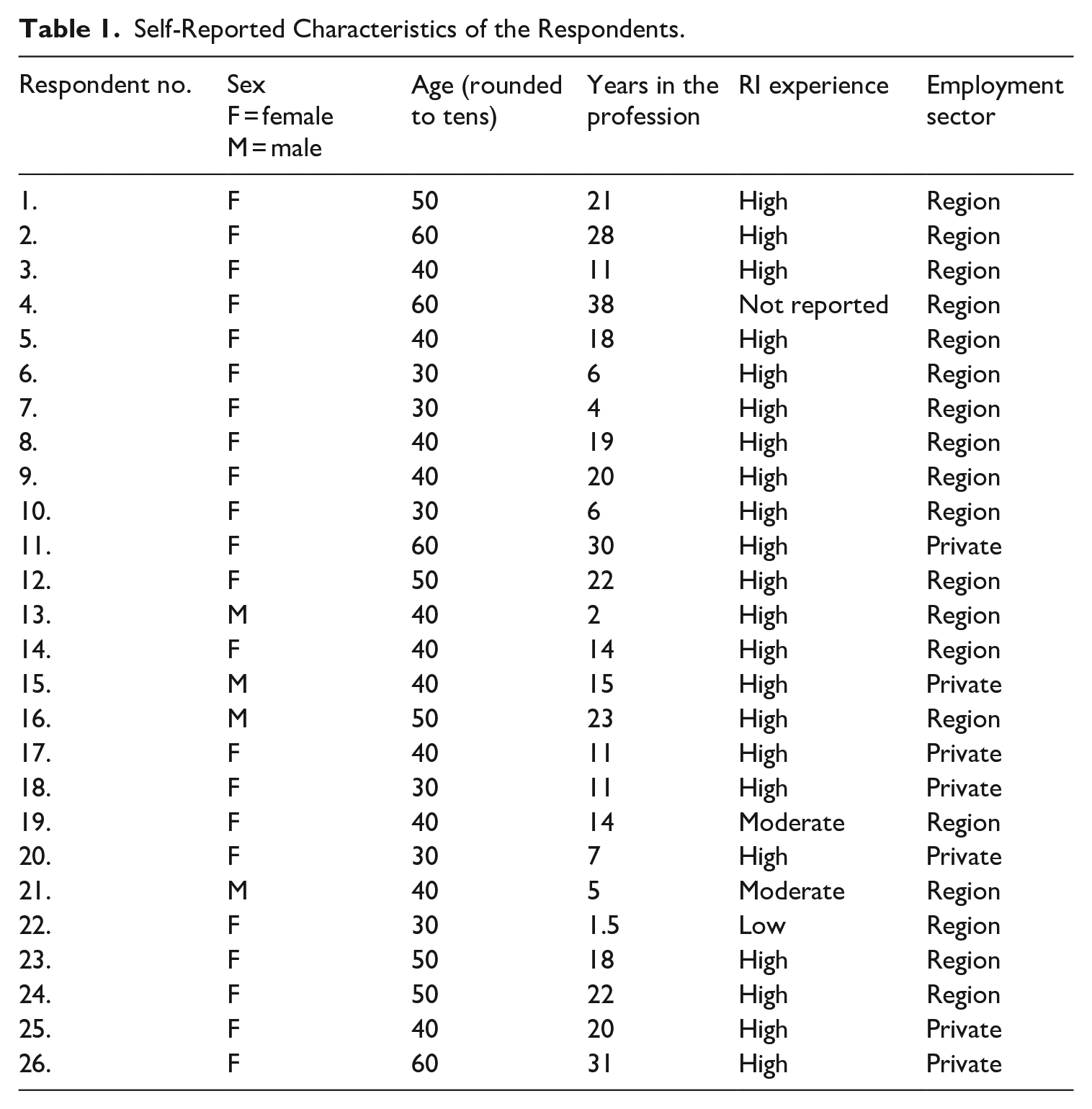
The interviews were conducted in Swedish and recorded via telephone by the first author of the study (C.W.) and lasted for approximately 1–1.5 hr each. The first author (C.W.) is a female associate professor and a certified interpreter between Swedish and STS. She is familiar with both face-to-face interpreting and RI and has extensive experience as an interviewer. The interview guide was piloted in one interview. Small revisions were made before the data collection process started to make some of the questions clearer. The interview guide consisted of three sections, each with a different focus: the experiences of the interpreters, the organisation of RI, and the team interpreting. The current study focuses on the interpreters’ experiences.
The interviews were recorded and transcribed verbatim by a secretary. An inductive approach was chosen to capture the interpreters’ experiences and thoughts. Data were analysed using qualitative content analysis, in accordance with Graneheim and Lundman (2004). Both of the authors read the transcriptions back and forth. Using the data programme NVivo 11 (QSR International, Inc., Cambridge, MA, USA), the first author undertook the first phase of the analysis, i.e., shortening meaning units that fit into the aim of the study while still preserving the condensed meaning and then putting them into codes. The codes were aggregated (Barrosso, 1997) and grouped together under higher-order headings (Burnard, 1991), that is, labelled and sorted into categories. The first author made a tentative attempt at categorisation, which was subsequently reviewed by the second author; then, a discussion about categorisation was held until consensus was reached. In this phase, 19 categories were identified. In the following phase, themes were created from the categories by both of the authors separately. The respective themes were then compared and discussed until consensus was reached. Finally, five themes emerged, which are presented in the “Results” section. Quotations were translated into English by the authors, and illustrate the results.
3. Results
The analysis of the interviews resulted in five themes that consisted of comparison of interpreting settings; adaptability; social relations and interaction; technical equipment; and sustainability (see Table 2). The themes and respective categories are presented and illustrated by quotations gathered from the interviews with the interpreters.
Overview of Themes and Categories.
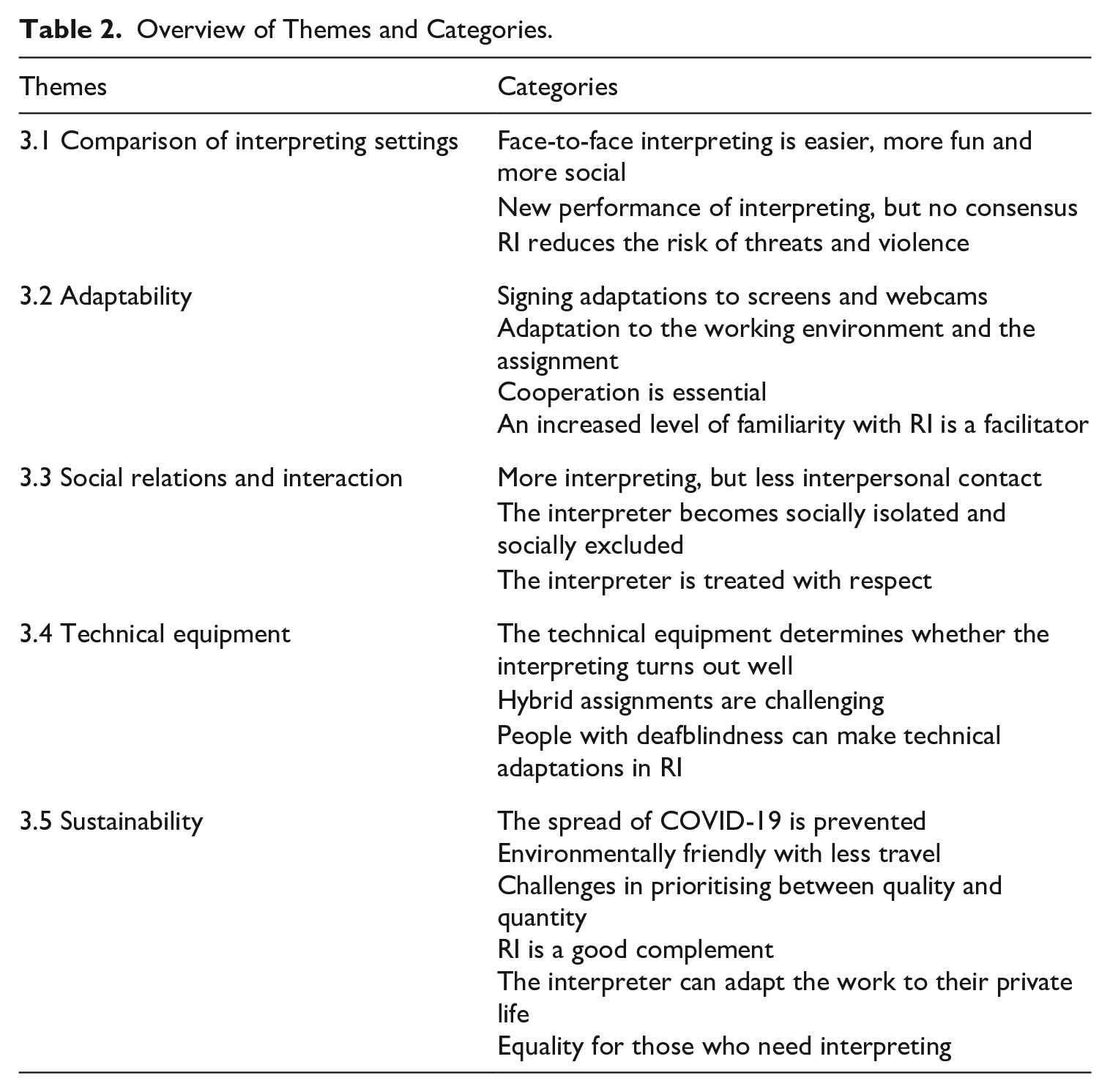
3.1 Comparison of interpreting settings
The interpreters reflected on and compared face-to-face interpreting with RI, which became a theme with three categories, although the current study focuses on RI. The themes elucidate the interpreters’ reflections on the differences, the period of transformation, and the processes involved in face-to-face interpreting compared with RI. A common opinion among interpreters is that face-to-face interpreting is easier, more fun, and more social than RI. Face-to-face interpreting is experienced as something that generates a more natural set of feelings in interaction: it is considered easier for interpreters to create relations and gain control over the situation. The interpreters described that such feelings make it less draining to do an interpreting assignment. According to the interpreters, the energy saved by not travelling from one assignment to another (as when interpreting in person) gives them more space to pause and reflect on previous assignments, which is not the case when working remotely.
The shift from face-to-face interpreting to RI provides new opportunities for cooperation across regional borders. It increases the possibility of working with new colleagues and new persons who need interpreting. The interpreters pointed out that new performance of interpreting, but no consensus according to interaction and changes made in the interpreting setting. The experiences from the respondents highlighted that there was no standardised or formalised consensus on how to interact in RI. The limitation of formalisation involves both technical aspects (a wish for one platform for all assignments) and how to interact in remote interpreting.
The interpreters reported that working remotely is a different working practice, which was described both in positive and negative terms. RI assignments were reported to be more formal and shorter in general. Such assignments start immediately, which differs to face-to-face interpreting assignments, for which there is often a meeting held with the person before the official assignment starts. As a consequence of other organisations being involved in the assignments, the interpreters shared that they had other, unclear responsibilities related to RI, for example:
It is difficult for me then to take the full responsibility for my technology and that is not good for the user . . . who has invited us . . . It is probably easy to think, “Yes, but the interpreter’s Internet was bad and I’m not going to pay for this hour of consultation because the screen shot froze.” It becomes difficult, it can get a bit tricky. Who is responsible for payment and who is not? And who is responsible for the technology and who is not? Yes, and who will compensate when it is not working? I have experienced things like that. (Interpreter 2)
The respondents reported experiencing ambiguities in responsibility ranging from technology to turn organisation, which can be frustrating. They also implied that the interpreter’s role is unclear, which may influence the entire situation. The interpreters were often forced by participants to coordinate meetings, with expectation that they will solve problems that arise; however, the interpreter may not fully believe that doing so is their responsibility. In contrast, interpreters may also assume this role voluntarily, and seek to do everything to make the interpretation possible:
We are driven by doing our job; that is why we are employed, and that is why we exist, to be able to interpret for the deaf. Yes, that is what drives us, to be able to do the job. A little too much, maybe tipping into absurdity sometimes, I think. (Interpreter 1)
The interpreters emphasised that differences in and preferences for RI must be respected by all interlocutors in an assignment. Individual preferences, both concerning interpreters and users, need to be accounted for. Some interpreters reported that it is exciting to try new ways of working, whereas others (foremost older interpreters who are not familiar with technical equipment) reported wanting to be on site, interpreting face to face. A clearly positive consequence, according to one respondent, is that RI reduces the risk of threats and violence:
I’ve only been involved once when a flower pot [was thrown], but threats and violence and all these risks [are present] . . . if you interpret for someone at the Social Welfare Office, someone who is not feeling well. By interpreting remotely, you do not expose yourself to [this type of] risk. (Interpreter 21)
Precarious and emotional situations may therefore occur in face-to-face encounters, putting interpreters at risk. RI may decrease this kind of threats and violence.
3.2 Adaptability
The next theme that emerged from the interpreters’ interviews relates to situational and environmental adaptations for interpreting. This theme included four categories.
Sign language is a three-dimensional (3D) language that is dependent on vision; however, a screen is a two-dimensional (2D) space. As a consequence, the interpreters argued that signing in the virtual environment becomes “flat” and that adapting their signing to screens and webcams is necessary. The interpreters reported only adaptations concerning the signed language and not the spoken language. The signing adaptations made in RI reportedly cause some of the interpreters to become tense throughout their entire body. To adapt to webcams, their signing was reported as being more distinct and consisting of smaller gestures and slower paced, especially when fingerspelling. In some cases, when a sign is assessed as difficult to see by the other party, the interpreters stated that signs are changed to another sign; an adaptation to the 2D setting:
I’m aware that you cannot see certain signs; it is more 2D than 3D, so I kind of re-do some signs. I even have to turn my body . . . or if I am going to fingerspell or something like that, I do it very slowly. (Interpreter 19)
The interpreter needs to have better control of their signing production and try to bring out emotional expressions and indications of turn organisation in their interpretation more clearly. Due to the limitations imposed by the screen, interpreters declared that they cannot show things within the environment by pointing to them or referring to them by pointing, for example, towards a PowerPoint slide.
Several of the respondents stated that both adaptation to the working environment and the assignment were necessary. Some of the interpreters reported having adapted their work environment to enable them to switch between sitting and standing when interpreting from home or at an interpreter centre. The interpreters reported that they make sure they are wearing clothes in a colour that contrasts with the background. Two screens were reported as a way to adapt to the interpreters’ physical environment, as makes it easier to follow the meeting and see the signing part. In addition, parts of the signing environment (such as the background) need to be adapted so that they do not disturb the interpreter.
However, the psychosocial environment appeared to be more difficult to adapt to RI than the physical environment; structured meetings and pauses are essential for everyone in remote assignments, not at least for interpreters. Interpreters stated that meetings that last too long, such as for an entire day, were considered as not being suitable for remote work. A risk with RI is that the active interpreting time increases while recovery times decrease. Interpreter 10 declared that accepting an RI booking request “depends on the type of assignment and the participants and all such things in combination.” Short, structured information meetings are preferred by the respondents more than meetings that are unstructured and contain several attendees who often speak at the same time.
The interpreters stressed that cooperation is essential for all participants in remote assignments. The interpreters stated that all participants strive to be more explicit and distinctive:
In general, I think that everyone from all sides tries to be more distinctive when there are remote assignments, all parties with their respective language in some way. (Interpreter 14)
The intention and will to cooperate determine the extent to which a remotely interpreted meeting works out well, according to the respondents. As an example, signing participants can help the interpreter by telling them what is happening in the environment, so that the remote interpreter understands what is going on at the signer’s place. Cooperation may help to solve technical problems, support environmental adaptations, or interactional cooperation. Team interpreting in remote assignments also seems to be a major issue that is addressed in several different ways.
As time passes, an increased level of familiarity with RI helps everyone. Although some interpreters reported fearing a forced transformation, they stated that they felt more comfortable the more practice and experience they gained, in accordance with the practice of learning by doing:
Because there were a few fires to put out in the beginning with everything, since we rearranged it all pretty much overnight . . ., it [the change to remote interpreting] went very quickly. And it was probably a lot because people were so solution-oriented. (Interpreter 14)
However, some of the experienced interpreters reported that it was an advantage to have worked as an interpreter before the pandemic and having developed enough interpreting skills to feel comfortable with this new way of working. New interpreters may have difficulties adapting to RI. Interpreters need skills, and other professions that work with interpreters need guidance and familiarity with the interpreting process specific to RI work.
3.3 Social relations and interaction
This theme consisted of three categories of aspects of social relations and interactions that are affected by RI.
The respondents emphasised that RI allows for more interpreting, but less interpersonal contact. RI appears denser, with less social chatter between the interpreters and those in need of interpreting. Social interaction before and after an assignment is rare. This implies that interpreters, for example, are not forced to act as psychological support. However, while some interpreters feel that the reduced level of interaction lessens the burden, some miss the close interpersonal contact. One interpreter stressed in negative terms that it is not possible to have physical contact (such as holding a person’s hand if something traumatic happens). However, another interpreter pointed out that physical separation between the interpreter and interlocutors in RI sometimes means that the meeting shuts down during breaks. This entails that these interpreters cannot and are not supposed to work during breaks when the cameras and sound are turned off; as a result, no chit chat or interpreting during the break can proceed. Interpreters can rest in such instances, which is not the case in face-to-face situations.
Some of the interpreters felt that they have become more of a technical tool than a facilitator or an interactional coordinator in the encounter; one of them described feeling as more of a robot in RI. This seems to be a question of how the interpreter defines their work and the attendees in the assignment, that is, as a part of the interaction or the recipient of language transfer. This also reflects a perception reported by some interpreters that such interaction can become “unreal”:
And I can feel . . . that I am almost watching a meeting that is going on on film . . . you truly get that sense of distance that you are not truly there. (Interpreter 8)
Remote situations create a social distance between people, not only between the interpreter and the other parties but also between those who need the interpretation.
However, the interpreters could save energy, as they do not need to serve as someone’s ally and be treated as a representative of the deaf party. Feelings for people and their situations were reported to be reduced as the use of a screen makes these interactions “impersonal.” Relatedly, interpreters reported that it was more difficult to build social relations and trust, which would, in the long run make the interpreting event run more smoothly. Perceived distance causes a reduced sense of control in situ, as the overview of the situation is restricted. An example was reported of the signing party turning off their camera, which means that the interpreter could not know who was watching or listening, or if the interpreting was being recorded. The interpreters reported that the possibility of perceiving emotions and relations becomes difficult, as well as their ability to check whether or how the other party understands the interpreting. The physical separation in space makes the interpreter less psychologically affected in both good and bad ways; i.e., it is easier to avoid being emotionally affected, although it may be harder to process things without physically experiencing an event. A potential risk, however, is that the interpreter may be less engaged and do the job without feeling for the individual, for example, one of the interpreters said:
It is more just completing the mission so that everyone is satisfied and happy in some way. I do not know. It sounds terrible when you say it like that. (Interpreter 25)
As a result of barriers to engagement for the interpreter, some of the interpreters stated that sensitive assignments are not suitable for RI due to the reduced opportunity for the interpreter to extend support to the signing party.
Although an interpreter may be met with respect as a human being, some pointed out that the interpreter becomes socially isolated and socially excluded in remote settings. Often, an interpreter is alone in the studio, with a feeling of loneliness and a lack of opportunity to enjoy collegial support. This drains the interpreter of energy and is challenging because the interpreter has to solve everything themselves without, for example, technical support. Many of the interpreters reported becoming bored and feeling blasé when they work too often alone in a studio. To be exposed to others seems to give them energy. One respondent described the situation as follows: “It can be a bit boring sometimes when you never get to stand on the stage and shine” (Interpreter 16).
Interaction is somehow important for an interpreter to clearly communicate their needs to achieve cooperation with the persons involved in the setting. As a counterpoint to interpreters feeling socially isolated and socially excluded, some interpreters stated that the interpreter is treated with respect as a human being in the remote delivery mode:
[In face-to-face interpreting] I am still very much the interpreter and “Can the interpreter do that?” and “Can the interpreter do this?” but [in RI] as my name is actually written in a completely different and clearer way on the screen compared to wearing a small badge on my chest [in face-to-face], many people say “Maria, are you aware of xxx?” or “Can Maria see xxx?” and that. I strongly advocate that “My name is actually Maria.” And I’m not the interpreter, I am Maria, who also works as an interpreter. So I think it is a clear improvement that I am also a human being. (Interpreter 20)
However, presenting oneself and explaining how interpreting works is more difficult in RI. In some respects, the interpreter becomes more prominent and more dominant as a result.
3.4 Technical equipment
A fourth theme included technical aspects described by the respondents as belonging to three categories.
The technical equipment determines whether the interpreting turns out well or not. A presumption is that all signing parties need to have their own webcam through which to portray their signing. If the equipment works well, then the RI is also likely to work well. Several interpreters stated that they worried about the technical equipment, such as handling the devices and having a stable Wi-Fi connection, which is crucial for their work. To prepare for potential problems is difficult. However, two interpreters reported the possibility of blaming the devices to cover up poor interpretation. The equipment incorporates several technical functions that facilitate interpretation. The interpreters stated that, it is positive that the perception of input (senses) is reduced, as the sound produced via a microphone and related visual impressions are limited to the very near environment. A new option for communication arises in remote delivery in the form of the chat box that an interpreter can make use of (Warnicke & Plejert, 2021). The respondents also described that technology limits their work in RI. One example of this relates to sound: the use of a microphone means that only one person can speak at a time; otherwise, the sound disappears, making it challenging to determine who is saying what. In addition, if a party is signing and using their voice, then the interpreter’s spoken interpretation disappears. From an interpreter’s standpoint, there may be limitations in auditory cues that may cause restrictions and difficulties in interpreting. When sound is restricted and interpreters need to seek clarification, disturbances in sensitive situations may occur, for example:
It is harder to interrupt, it is harder to ask for clarification, which are things that you can do quite quickly if I’m on site for an assignment, if someone says something that can be difficult to hear in an interpretation if they say an abbreviation of which I have never heard. . . . Abbreviations are very difficult to hear, it does not get any easier from a distance. The problem is that it is difficult to interrupt something like that in a witty manner: “Excuse me, what abbreviation did you say?” (Interpreter 8)
From a visual perspective, it is more exhausting to see what is signed, especially when the screen view glitches, as some of the respondents reported. Other limitations associated with the device is to see what is finger spelled. Also, visual nuances may be difficult to perceive. Movement within the environment needs to be restricted, as webcams are not easy to move. A common experience concerns both audio and video latency in remote settings, which makes them tiring.
Remote assignments can be organised in different ways, with some or all parties connected from a distance. When some of the participants and/or the interpreter(s) join remotely, while others do not, the assignment is called a “hybrid.” A common experience is that hybrid assignments are challenging. This affects the signing party more:
What is difficult is if only the interpreter is remote, where everyone sits at their workplace around a table and the interpreter is remote. In that case, I think the deaf are more outside than if we [the interpreters] had been sitting in the room, because there you can control a little more: “Excuse me, now we talk one by one.” Also, you do not see what is going on behind the screen, so you cannot interpret that—now someone is talking about the football yesterday—and has time to sneak it in, because we don’t see it. But I think the advantage is if everyone is remote. If so, I think the deaf gain because it is the same for everyone. (Interpreter 23)
Some interpreters also stated that it is even more difficult when it is only the interpreter who is located at a distance because, for example, pauses are more frequent when everybody participates remotely.
Some of the interpreters reflected that it was impossible for people with deafblindness to engage in RI. However, other interpreters declared that people with deafblindness can make technical adaptations in RI. It could be even better for people with deafblindness to attend an assignment remotely, as they can adjust the equipment to meet their needs and wishes in the moment, that is, by adjusting the screen view and enlarging the screen:
Some deaf-blind people who see so well that [remote delivery] can be an advantage, you can focus on a person if there are the right lighting conditions and background and so on. And then they said, “But this was really good,” because then you don’t have to sit in a room with poor lighting conditions, colourful colours, so it has sometimes been an advantage for some. (Interpreter 2)
Perceptions of sound, vision and energy for people with deafblindness may change from time to time and from situation to situation. Remotely, encounters can be more controlled (e.g., lighting and limited visual interference). Another gain, according to the interpreters, is that people with deafblindness can save energy by not needing to travel to an assignment, booking taxis, finding assistants, and so on.
3.5 Sustainability
The last theme involved six categories and related to the different dimensions of sustainability: environmental, economic, and social.
The respondents emphasised that during the pandemic, RI played a role in preventing the spread of COVID-19, as well as other diseases, which is considered a sustainability aspect. Interpreters ran a lower risk of getting ill. However, one of the respondents highlighted the risk of continuing to work while being ill, particularly when working from home.
The interpreters reflected that RI is environmentally friendly with less travel. In addition, this implies not only saved time but also fewer costs, reduced stress, and more secure work, especially in large regions with long distances between places. As a consequence, resources can be distributed effectively and save frustration and time:
I do not know how many times I have gone to, yes, we go to a city. From here it is 8 [Swedish] miles up to the psychiatry clinic . . . it is very often the case that the deaf party does not appear the day you have your appointment. So I have driven for 1½ hours to go there, they did not come, and then I drove 1½ hours back home again. (Interpreter 16)
In addition, engaging in RI for short assignments saves money and is a gain for society, as the interpreter can undertake more interpreting assignments in less time. Furthermore, an interpreter from the northern part of Sweden pointed out the risks associated with driving in the winter, with heavy snow and challenging road conditions.
RI can thus be economically favourable for society, regions, and the person who needs RI. However, the participants expressed a fear that there would be only RI and no face-to-face interpreting available in the future. The interpreters also stated that it is easier to plan their RI working time, that is, both regular work times and assignments that take place at nights and at weekends for on-call and emergency interpreters. The money saved may afford gains for those who need interpreting, with fewer costs for companies and greater ease for those who need an interpreter to get one.
How to offer RI or face-to-face interpreting becomes an ethical issue, as it is a challenge related to prioritising quality and quantity. Several interests and perspectives compete with each other: interpreters’ desired working conditions; the wishes and needs of those using interpreting services; and societal considerations, such as economy and production versus quality. One interpreter pinpointed the following aspect of balancing: “So that is the question: what is good enough—that balance” (Interpreter 14). It seems to be an issue of ethical balancing between access to an interpreter and quality of the interpretation:
And it [RI] can even get a little worse quality, because it is not the same as . . . in real life, but I think it must be worth it so that more users get an interpreter. (Interpreter 16)
RI was reported to be of worse quality due to the risk of non-reflected mistakes in the situation, the greater risk of incorrect interpretations and misunderstandings, and reduced linguistic and emotional cues that are essential for interpreting, among other things.
Several interpreters pointed out the risk facing signers in sparsely populated areas where they may not have the opportunity to opt for an in-person interpreting encounter. While RI is a good complement, as seen from the interpreters’ perspectives, all of the interpreters stressed that it should be possible to choose face-to-face interpreting with some arguing that it is always the preferred approach:
Because probably something that I have been a little bit wary of or seen a warning flag that I’ve reacted to is precisely that when we start talking about “Yes, but maybe we should only offer some assignments remotely” Yes, but then we truly have to think about it. . . it becomes more of a class question about whether you can get an interpreter or not, if you do not have Internet at home or a computer or tablet. (Interpreter 6)
Although some interpreters argued that in-person is preferred, others reported that interpreting remotely has exceeded expectations. From the interpreters’ perspective signers must have a choice and should not be forced to use RI. A related fear is that those for whom sign interpreting is offered either remotely or not at all, will not dare to complain about poor interpreting.
RI was reported by the interpreters as not being a suitable alternative for vulnerable groups such as refugees, children, and the elderly, as RI may be perceived as a deterioration in service quality, leading these groups to feel unsafe. Short but critical situations may arise in which an interpreter is needed on site, that is, a quick move, transportation from one setting to another (as in the quote below), the need for an explanation of the environment, and so on. The use of a remote interpreter may result in a feeling of being excluded and exposed:
I think that the interpreting service should offer a service so the interpreter users can participate as much as possible like other hearing people in society . . . I’m just thinking about things like moving around on a healthcare visit. There is feeling of security in knowing that the interpreter will hear when they call out my [i.e., the user’s] name at a healthcare facility, that I’m [i.e., the user] going to visit maybe a healthcare provider and then maybe I’m [i.e., the user] going to go have an X-ray and then maybe I [i.e., the user] should go to the lab. And there are a lot of similar things that make remote interpreting not as good. (Interpreter 4)
In addition, the effort needed by individuals to split their attention between both a screen and other things (e.g., children around at home and the device they are using to communicate) could be burdensome for the users, as noted by some of the interpreters.
A reported positive aspect of RI is that the interpreter can adapt the work to their private life. This implies that interpreters do not need to take time to travel to another place; they can work from everywhere, which becomes less stressful and generates a feeling of freedom. One respondent stated that working remotely made it possible to have a dog, which probably would have been too difficult when working long hours away from home. In addition, according to health status, RI provides some with the opportunity to continue working:
I am in week 27 [as a pregnant woman] and I am still working 100%. And it’s very much about the fact that when I shut the camera down, then I can go to my own bed and sleep for 20 minutes; so that makes a big difference. (Interpreter 20)
The freedom of choice related to RI gives interpreters the opportunity to choose whether to interact with colleagues or not. What may determine this preference is the interpreter’s private life situation and family situation, that is, whether they are lonely.
RI can provide equality for those who need interpreting. The signing person is not required to have an extra person (i.e., interpreter) on site in sensitive situations, such as a GP visit. RI becomes more flexible as individuals can obtain an interpreter instantly without booking weeks in advance. In the case of meetings involving several delegates, the signing person (who could be one of hundreds of participants) may not be exposed or associated with the interpreter; instead, they can, like other participants, switch on their webcam and do other things during the meeting. In addition, as remote meetings are more structured in terms of their organisation, signing parties have the same opportunity as others to speak up.
A possible gain from the perspective of those who need interpreting is that according to some interpreters, no one needs to feel that they have to interact with the interpreter before and after an assignment:
[There are] some who might not actually want an interpreter in the room all the time. I think the younger ones think it might be okay to . . . always have an interpreter with them. I [i.e., the signing party] undress and then the doctor goes out and says, “I will be back” and there I sit with an interpreter with whom I have nothing in common. So, if you’re at a distance, it is not the same at all. You’re not as connected with the interpreter. (Interpreter 22)
4. Discussion
This study on the ways in which interpreters of spoken Swedish and STS experienced the shift to RI due to the COVID-19 pandemic has revealed mixed views about the advantages and disadvantages it offers. This was evidenced in various ways across the data set, including the transformation process itself, situational and environmental adaptations, the impact on social relations, the technical equipment, and questions about sustainability. Although the views expressed did not differ significantly among the respondents, the findings show a range of multifaceted and sometimes contradictory experiences.
The interpreters expressed their experiences of enforced RI in relation to interpreting from several angles, or levels (cf. system theory model; Bronfenbrenner, 2013), which helped to establish a holistic perspective; for example:
RI is a service, based on relations between users of the service and interpreting colleagues in situ (micro level);
The relations are shaped, for example, by co-cooperation and adaptation to technical equipment and the patterns of relations between the users (meso level);
Regulations and the organisation of RI operating on a system level (i.e., macro level), both shape the interaction and form a potential basis for sustainability.
One example of reflexivity shown in the data concerns interpreters’ attention to the circumstances of the signing parties and people with deafblindness. Interpreters appear as trustworthy allies (Shaw, 2014) by repeatedly returning to the assumed perspective of the users. The interpreters described how they take the signing users’ perspective into great consideration, in some cases giving it perhaps greater emphasis than their own ability to perform their work. As a consequence, these professionals show that they are choosing to shoulder a significant responsibility to meet the new situational and environmental demands imposed by RI.
The interpreters highlighted the need for signing users to be able to choose between RI and face-to-face interpreting. While a shift to RI was enforced by the pandemic, technical and social advancements provided opportunities for new ways to interact. From the interpreters’ perspective this transformation may be a way for signing people to take part in society on an equal footing to others. Based on the interpreters’ statements, the opportunity to extend the use of RI appears to create tremendous advantage, although it is not a quick fix that is solved by just offering another means to deliver interpreting (cf. Holmström & Bagga-Gupta, 2021). We recognise that users’ perspectives may differ from interpreters’ which are the focus of this study, suggesting that user perspectives merit further investigation, as research is sparse in this field. If the pursuit of equality for signing parties in RI is a genuine goal, then there are several aspects that need to be considered.
According to what has been found with regard to the Republic of Ireland (Sheridan & O’Donnell, 2023), there are potential differences between interpreters and those who need interpreting in larger cities compared with those in more rural areas. Given that Sweden is a long and geographically diverse country, various factors can be relevant, such as climate, the availability of interpreters, and travel time. Interpreters’ (relatively new) opportunity to work from home is something that is considered positive for the individuals; instead of organising life around work, work can now be adapted to suit the interpreters’ needs.
From a societal perspective, interpreters reported that, on one hand, RI saves money due to offering more assignments, is easier to plan, is quicker, and encounters tend to be shorter in length. On the other hand, the opportunity to decide whether an assignment will be remote or face-to-face needs to be available for those who require interpreting and/or the interpreters; it should not be a decision based on purely economic factors. A clear ethical dilemma arises, as the interpreters expressed concerns that RI could be both easier and more difficult, and that RI may lead to poorer quality with more potential misunderstandings and challenges in interaction.
The duality of gains and challenges of RI becomes an ethical issue. Drawbacks need to be weighed against the positive economic, environmental, and infection-control aspects, among other things. One can therefore ask, as some of the interpreters reflected, which type of sustainability should prevail, whether social, economic, or environmental. In addition, it is also relevant to ask whose preferences should be prioritised, namely those of the interpreters, service users, the service procurers, or others. Again, a shift to RI does not automatically solve the issues of inclusion and accessibility; rather, it (also) creates new demands. A complex ethical problem for individuals on a micro level becomes a democratic dilemma on a macro level; quality of interpretation versus quantity (completed assignments), who can afford technical equipment and knowledge, and so on.
It appears that interpreters have a large burden to solve themselves; however, their actual responsibility in RI is something that needs to be defined. The question of the interpreters’ role is somehow not a new question specifically for RI; rather, it forms part of an ongoing discussion stemming from the point at which the interpreting profession emerged (cf. Angelelli, 2004; Roy, 2002). The results of the study imply a need for both formalisation and decision making in relation to every type of encounter. Elaborated guidelines on how responsibility should be distributed would facilitate interpreter work in RI, although situations may occur that need to be solved in relation to, for example, specific assignments, users, interpreters, preferences, economic aspects, and so on. Altogether, the decisions of whether and how to make RI work in ways that maximise well-being and sustainability for the individuals, procurer, and the society, will only be determined in the future.
The interpreters seem to shoulder a great responsibility in RI, although they appear be more or less a piece in a game, dependent on external circumstances. As this is still a relatively new way of working for interpreters, it will take time to standardise interaction and organisation. Even so, interpreters respond in positive terms to this concern: the situation will become better as time passes and people get used to RI, which will provide a deeper and broader understanding of what constitutes effective RI provision.
A report by De Meulder et al. (2021) highlights the need for follow-up research. Over time, as circumstances change and countries diverge in their approaches to interpreting services, examining how RI operates in different regions and nations can provide a more comprehensive understanding of what a sustainable future in this context might entail. In summary, the current study provides valuable and evidential insight into interpreters’ experiences and contributes to a deeper understanding of how interpreters in Sweden perceive changes. However, it is also important for research to gain insights from those who require interpreting services, country-specific considerations, and longitudinal studies of RI. This study offers another crucial piece of the puzzle, thereby enhancing our comprehension of the related experiences during this period of transformation; some of the results could be transferrable to other countries.
In terms of methodological considerations, a strength of the current study is that 19 of Sweden’s 21 regions are represented. The interpreters who chose to participate in the interviews of the current study did so voluntarily and under their own initiative. This could lead to bias in that only interpreters who have clear and strong opinions may have decided to participate. However, this is a qualitative study that aims to capture the experience of individuals without quantifying and generalising in a broader sense.
The first author, who performed the interviews, was able to understand the interpreters’ perspective and add follow-up questions in the interviews. While the aim of this study is to investigate the interpreters’ experiences, the interviewer’s prior experience as an interpreter enabled them to pick up on aspects of the interpreters’ responses that other interviewers without such a background may have not noticed. Remaining impartial and non-biased could also be a challenge. However, the second author (M.M.) is not an interpreter or a signer. As a result, collaboration among the authors during the reading of the interviews and during the analysis enabled us to minimise the risk of bias.
5. Conclusion
The working practices of sign language interpreters and those who need interpreting services have been affected by the COVID-19 pandemic, leading to more assignments being conducted remotely. The interpreters interviewed in this study have witnessed and experienced a transformation with regard to expectations about interpreters’ working practices within interpreting encounters in ways that highlight differences between in-person and remote interpreting.
The interpreters stressed the need to adapt to the changes and contexts according to technical, environmental, and related demands. Social relations and interactions during encounters were reported as having been affected for all participants, with the interpreters’ working practices being a specific focus. Technical equipment was highlighted as being both facilitating and challenging. Hybrid assignments were stressed as creating additional challenges. The interpreters also emphasised democratic aspects, such as sustainability, from environmental, economic, and social perspectives in light of the likelihood that greater use of RI will be made in the future. The interpreters’ interviews reflect a holistic perspective on RI: challenges on a micro level concerning relations in interaction; co-cooperation and adaptation to technical equipment on a meso level; and finally with unclear rules, regulation, and organisation on a macro level.
The interpreters made several recommendations regarding future developments in RI: the possibility of offering both face-to-face interpreting and RI (not just RI); offering interpreting that matches the specific needs in the assignments; and considering interpreters and users’ preferences while also keeping environmental and societal sustainability in mind. Other key factors highlighted included the need for cooperation among all of the participants in the RI setting and reliable technical devices.
The current study was conducted in Sweden during a specific time span. We recommend follow-up studies be conducted, both in Sweden and in other countries, to investigate how the shifts in practice evolve and are established over time.
Footnotes
Declaration of conflicting interests
The authors declared no potential conflicts of interest with respect to the research, authorship, and/or publication of this article.
Funding
The authors disclosed receipt of the following financial support for the research, authorship, and/or publication of this article: This study was financially supported by Region Örebro County, Sweden.