



Abstract
This article examines the impact of the COVID-19 pandemic on the sign language interpreting profession drawing on data from a fourth and final survey conducted in June 2021 as part of a series of online “living surveys” during the pandemic. The survey, featuring 331 respondents, highlights significant changes in the occupational conditions and practices of sign language interpreters due to the sudden shift towards remote video-mediated interpreting. The findings reveal a range of challenges faced by interpreters, including the complexities of audience design, lack of backchanneling from deaf consumers, the need for heightened self-monitoring, nuanced conversation management, and team work. Moreover, the study highlights the physical and mental health concerns that have emerged among interpreters as a result of the shift in working conditions, and a need for interpreters to acquire new skills such as coping with the multimodal nature of online interpreting. While the blend of remote, hybrid, and on-site work has introduced certain advantages, it also poses new challenges encompassing workload management, online etiquette, and occupational health concerns. The survey’s findings underscore the resilience and adaptability of SLIs in navigating the shift to remote interpreting, suggesting a lasting transformation in the profession with implications for future practice, training, and research in the post-pandemic era.
1. Introduction
In March 2020, with the declaration of COVID-19 as a pandemic by the World Health Organisation, the occupational conditions and practices of professional sign language interpreters (SLIs) underwent a substantial and sudden transformation. Meetings and conferences were cancelled across the board, and remote work from home swiftly became the prevalent mode of operation. The pandemic, together with the accompanying digital disruption, expedited the trend towards remote video-mediated interpreting. Although this paradigm shift may have been inevitable regardless of the pandemic, its pace and scope at the global level have surpassed expectations. Despite some SLIs being well-equipped for remote work, most interpreters found themselves learning on the fly and acclimated to this approach without adequate skills, setup, and space.
To gauge how SLIs experienced this sudden shift and how it has been affecting and innovating the sign language interpreting profession during and beyond the pandemic, we administered a series of four online “living surveys” during the pandemic. The first three surveys were conducted between April and July 2020, that is, only a few months after the pandemic hit the world, and included the (sometimes repeated) participation of 2.634 SLIs from 63 different countries. Further details regarding the first three surveys can be found in De Meulder et al. (2021). This article reports on the fourth and last survey, which was conducted in June 2021, almost a year later. By this time, some countries had made significant progress in controlling the spread of the virus (e.g., through mass vaccination campaigns) and had begun to ease restrictions, while others were still grappling with high numbers of cases and deaths. In the fourth survey, 331 respondents participated. Over half (187) also participated in one or more of the previous editions of the surveys.
Going forward, after providing a brief overview regarding video-mediated remote interpreting (before and during the pandemic) and delving into the methodology of the study, the findings will be presented and discussed, followed by some recommendations for future practice.
2. Video-mediated remote interpreting during COVID-19
The COVID-19 pandemic has significantly transformed the landscape of the sign language interpreting profession, with many interpreters being compelled to shift from predominantly on-site work to video-mediated remote interpreting from their homes almost overnight. Although research has explored different facets of the pandemic’s impact on the SLI profession, little attention has been given to the experiences and challenges of interpreters working remotely from their homes. Most research on the pandemic’s effect on the SLI profession has focused on areas such as the heightened visibility of interpreters at public press briefings interpreting for heads of state, majors, and public health officials (McKee & Nilsson, 2022; Robinson & Hou, 2020), working conditions and opportunities for interpreters who are deaf (Gebruers et al., 2022; Gebruers & Haesenne, 2021; Hanquet & le Maire, 2021), and access to information for deaf communities (Napier & Adam, 2022; Rijckaert & Gebruers, 2022). Some research has also focused on the impact on SLI students’ training, with educators having to quickly adapt to online delivery of teaching and assessment and SLI students having to cope with isolation and other stressful circumstances resulting from the pandemic (Webb et al., in press). Other investigations in sign language interpreting studies (mostly published pre-COVID) have centred on interpreting in times of disasters and crises (Leeson, 2020; Matthews et al., 2022; McKee, 2014).
Although a few inquiries have examined the pandemic’s impact on the interpreting profession and how interpreters adapt to new working practices (Crezee & Major, 2020; Napier, 2020), this domain remains relatively underexplored. Most studies in this area have focused on the measurement of stress levels among interpreters, primarily through the use of questionnaires (Ellala et al., 2021; Pollard et al., 2021; Schnack, 2020), and the occupational health of interpreters who worked remotely from home during the pandemic (Roman et al., 2022, 2023).
Specifically for video-mediated remote interpreting, extensive research has been conducted, including studies by Alley (2012), Braun (2015), Haualand (2011), Kushalnagar et al. (2019), and Skinner et al. (2018). However, most of these studies were conducted before the pandemic, focusing on, for example, the experiences, working conditions, and strategies of SLIs working in video relay service (VRS) or video remote interpreting (VRI) call centres, as highlighted by Brunson (2011), Napier et al. (2017), and Tyer (2018). However, the pandemic has significantly transformed the concept of remote work, expanding it to include work from home. Although many VRS and VRI interpreters during the pandemic received permission to work from home, the majority of interpreters were accustomed to 100% on-site work and had to start working remotely from their homes, often combining online work with caring duties. Our first survey indicated that 60% of respondents had never worked remotely before the start of the crisis, whereas 27% did so only occasionally (De Meulder et al., 2021).
In addition, various professional bodies and deaf consumers have issued guidance on best practices for remote work. For example, the International Association of Conference Interpreters (AIIC) reviewed its position on distance interpreting, issuing new guidelines for interpreting during the pandemic. 1 Sign language interpreting associations and research centres in several countries, such as the Dutch Sign Language Interpreting Association 2 and the Deafness Cognition and Language Research Centre (2020), also issued guidelines for remote work. Deaf consumers of sign language interpreting services shared tips for working remotely with interpreters, as shown by, for example, Wooten (2020), and discussed the challenges for deaf academics to attend online meetings when working with SLIs (Kusters et al., 2020).
3. Background and methodology
The methodology used in this study was an online survey, designed in MS Forms. This was the fourth in a series of “living surveys,” which aimed to investigate how the COVID-19 pandemic has affected the working practices of SL interpreters. The Ethical Review Board (ECO-SD) of the University of Applied Sciences Utrecht has given approval for this research.
The first three surveys were conducted between April 2020 and July 2020, and had 1,168, 871, and 595 interpreter participants respectively. For the detailed findings of these surveys, please refer to De Meulder et al. (2021). The fourth survey was conducted between 15 and 17 June 2021, almost a year later than the previous surveys, thus providing a snapshot of that specific moment in time.
The questions were designed based on observations made by the research team in their own networks, field observations, and what was topical for SLIs during the pandemic. The questions in the fourth survey were also informed by those used in the previous surveys, particularly the third one. The survey was developed using Microsoft Forms and featured multiple-choice questions, questions rated on a Likert-type scale, and open-ended questions. Branching was used to allow respondents to skip non-applicable questions. The fourth survey comprised 47 questions and was only available in English, with a medium completion time of approximately 20 min. The survey was promoted via social media and personal and professional networks such as interpreter associations and WhatsApp groups.
3.1 Respondent demographics
In this study, 331 self-selected interpreters participated, comprising of 318 hearing, 7 deaf, and 5 hard of hearing participants, and 1 who preferred not to disclose their hearing status. Among these respondents, 187 had previously participated in the same research project’s earlier surveys and 49 were unsure. The respondents came from 38 different countries, with the highest numbers from the United Kingdom (60), the Netherlands (56), the United States (32), Germany (32), and Canada (22).
Thus, consistent with the previous surveys, the responses were skewed towards Anglo-Saxon/Western/US perspectives. Respondents were more likely to have a Western background, and a degree of fluency in English, which may have affected the study outcomes. However, institutionalised sign language interpreting services are still mainly a Western phenomenon (Napier et al., 2010), mostly established in countries where there is a larger supply of interpreters, interpreter training programmes, greater legal protection for deaf people’s rights, employment opportunities, and access to technologies. In this respect, our data reflect the current state of sign language interpreting services in these countries.
The survey respondents were mostly female, reflecting the female-dominated sign language interpreting profession (Napier et al., 2022). Of the 331 respondents, 117 had 0–10 years of professional (paid) experience, 126 had 10–20 years of experience, and 88 had over 20 years of professional experience. Twenty-seven interpreters indicated that they had never worked online and were not included in this analysis, leaving 304 respondents for this study.
Although some respondents participated in the previous surveys, it was not feasible to compare their responses over time due to varying respondent rates. The data from the fourth survey demonstrated high representative participation of SLIs who were working remotely. Obviously, this was to be expected over one year into the pandemic. It is possible that interpreters who primarily worked on-site in June 2021 were less likely to participate in the survey. Therefore, the results should be interpreted with caution.
3.2 Data analysis
The survey data were analysed using Microsoft Forms, which automatically analysed and visualised the responses to the closed questions. The responses to the open-ended questions were coded and thematically analysed in Microsoft Excel. For analysis of the data, iterative data coding was used through several cycles to identify key themes and subthemes, following the principles of Grounded Theory (Corbin & Strauss, 2008). The findings presented in this article provide a descriptive statistical overview of the survey results, along with qualitative extracts from open-ended questions and comments.
4. Findings based on closed questions
In June 2021, of the 304 respondents, 72 reported working remotely 90% of the time and on-site for 10%, 61 worked remotely 100% of the time, and 32 worked on-site for 90% of their time. The remaining respondents reported various levels of on-site versus remote work. There were no clear changes in the remote versus on-site workload from July 2020 to June 2021. This phenomenon may be a reflection of disparities in national lockdown policies and cross-country variations. However, as the survey did not explore the reasons behind this, we cannot say for sure. Of the respondents, 105 reported doing less remote interpreting, 103 reported doing more, and 89 reported no significant changes. Most respondents always worked from home when interpreting remotely. Other locations where respondents worked remotely included VRS/VRI centres, external offices, and other locations. The responses to the question “approximately how many days (i.e., working 1 hour or more a day) per week do you currently interpret remotely?” varied, with most respondents working remotely 2 days a week and a close second working remotely 3 days a week. The majority of respondents worked 1–3 hr per day remotely, on average.
Out of the 304 respondents in this study, 41 reported that they interpreted remotely alone for 90% of their assignments, while 37 reported that they did so for 100% of their assignments. The remaining respondents reported various levels of remote interpreting alone, with only 31 stating that they never worked remotely alone. However, the wording of the question (“how much of your current remote interpreting do you do alone?”) may not have been clear to all respondents, as the interpretation of “not working alone” can vary from working in team to being physically present with another interpreter, among other possibilities. The majority of respondents reported that the duration of their assignments did not change compared with July 2020. Out of the 304 respondents, 125 reported earning the same income from interpreting work as in July 2020, while 99 were earning more and 60 reported earning less.
Over half of the respondents expressed an interest in accepting more remote work after the pandemic subsides. However, 74 respondents preferred to work remotely only with specific clients. Compared with on-site assignments, 54.3% of the respondents rated their performance for remote interpreting assignments as similar, whereas 33.2% reported performing worse. Regarding working conditions (e.g., payment, amount of time working alone, technical and physical ergonomics, . . .), 35.5% felt that their conditions were worse for remote interpreting, whereas 28.3% thought they were the same and 23.4% felt that they were better. The majority of respondents found the lack of personal contact to be the most problematic issue with remote interpreting, followed closely by limitations in managing conversations, interpreting in a two-dimensional (2D) environment instead of a three-dimensional (3D) one, and teamwork being more challenging. Other problematic issues included screen time duration and technical glitches. Nearly half of the respondents felt confident about the IT skills necessary for remote interpreting. Zoom and MS Teams remained the most commonly used platforms. Although 39.5% of respondents sometimes used two platforms simultaneously (e.g., to see both the deaf signers, the meeting participants and/or their co-worker), 24.3% did so “very often,” whereas 15.5% never used two platforms simultaneously.
When asked if any statements about remote work applied to their current situation compared with July 2020 (given predefined choices and could choose all that applied), the majority of respondents indicated that deaf and hearing clients were now more used to remote work. This was closely followed by the statement “I can cope with technical issues better” and “my remote working environment is more equipped.” Regarding the benefits of remote interpreting (respondents again could choose all that applied), the majority noted that it reduced travel time. Other benefits included increased access for deaf consumers, environmental benefits, better work–life balance, and more choice for deaf consumers regarding which interpreters they work with. Among the domains where respondents were working on-site in June 2021 were the business/employment domain and the medical domain (where general practitioner (GP) appointments were the most commonly reported), see Figure 1.
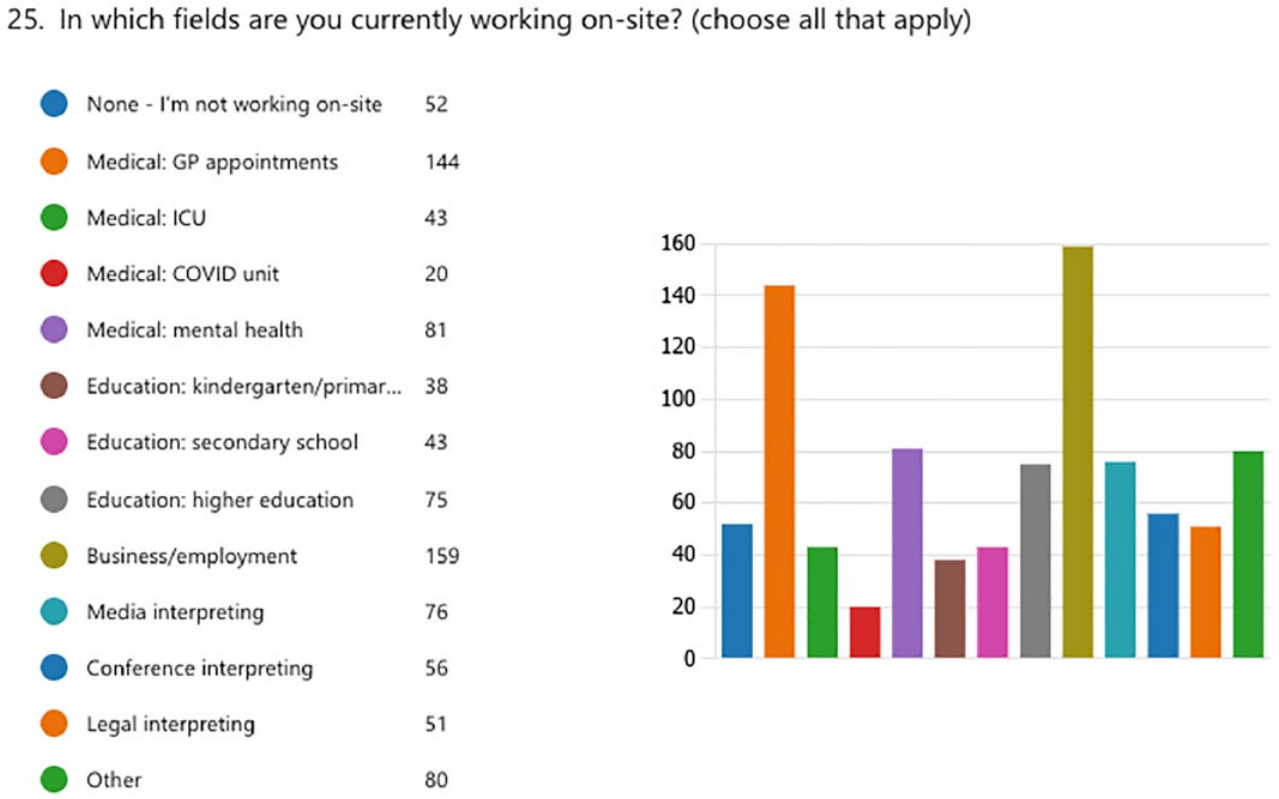
In which fields are you currently working on-site? (choose all that apply).
5. Findings based on open questions and comments
We will now present the results of the responses to the open questions, and the analysis of the comments. This is structured to reflect the following themes: audience design and lack of backchanneling, interpreting techniques, self-monitoring, conversation management, working in team, health issues, and the challenges of coping and adapting.
5.1 Audience design and lack of backchanneling
In general, SLIs appreciate seeing the deaf people for whom they work. They are used to, and require and/or are trained to receive direct real-time feedback, often called backchanneling (see, for example, Mesch, 2016). This backchanneling is supposed to provide an external monitoring mechanism for SLIs to receive confirmation that their interpretation is understood and meets the needs of the deaf audiences. However, the shift to remote video-mediated interpreting has significantly changed this gaze dynamic (De Meulder & Stone, 2023). Online, attendees’ cameras are sometimes or often off. In this case, when working from a spoken language to a signed language, interpreters are working into a void without seeing the deaf customer(s). This significantly affects their working practices, and 46.1% of respondents agree that their interpreting work is different because they cannot see the audience:
“When on-site, I get direct feedback from Deaf clients—smiles, nods, eyebrows, whatever—so I know they understand my interpretation. In remote settings I sometimes don’t even see them.”
Asked who they would like to have their camera on during interpreting assignments (choose all that apply), 35% of respondents chose deaf participants; 27% also chose interpreting colleagues, while 25% would like “everyone” to have their cameras on. Only 6% would like non-signing hearing participants to have their cameras on. However, respondents remarked that the lack of backchanneling is not all doom and gloom, but can also be liberating for deaf consumers (a point also made by De Meulder & Stone, 2023):
Pre-COVID I think interpreters were very hesitant to work online because they felt it might disempower deaf consumers. However, in my work to date, I have found that deaf consumers seem to feel more liberated as they no longer have to stare at an interpreter to make the interpreter feel comfortable.
Several respondents stated that this (the lack of confirmation from deaf customers) is what makes remote work so tiring. To mitigate this, some respondents shifted to a more “generic” style of interpreting, while others tended to use their own register more: “in situations where I am unable to engage with the audience I tend to use my own register as I have nothing to gauge the register of the end user.” For other respondents, the absence of backchanneling led to more “break[ing] down concepts that you may not need to otherwise,” “repeating things more often,” or making involuntary omissions in their interpreting output: “. . . because it is more difficult to interpret without a visible ‘audience’.” One respondent stated that the lack of backchanneling means they have “less energy and (are less) confident because of less confirmation from my clients.”
The sometimes frustrating experience of working into the void with deaf participants having their cameras off is often exacerbated by being pulled into remote assignments at short notice without much preparation or background information and no opportunity for informal interaction with deaf customers either before and/or after assignments. Like one respondent putted it: being “dropped in the deep end,” which is experienced as the more stressful part of remote interpreting:
Less rapport, less time for informal conversation about the context. Working into a void and feeling stressed about not having built a sense of relationship or common understanding with the consumers . . . communication is co-constructed and yet online I feel I am doing all the message and meaning construction and just hoping that it lands right. That is stressful.
However for one respondent, the fact of not seeing the deaf customer(s) and considerations about audience design have made them stronger in their signing:
I do miss not seeing consumers, but I feel that may have been a crutch in the past. Particularly for big conferences where deaf people are in the room as well as at home, I may have provided a decent service for those on-site because I could see them, but I may not have even considered my audience at home enough. Particularly now, I feel stronger in my signing because I’ve been forced to watch myself nearly every day for the last 18 months.
5.2 Interpreting techniques
For question 44 “do you use any of the following techniques?” the respondents were given a predefined set of choices (see Figure 2).
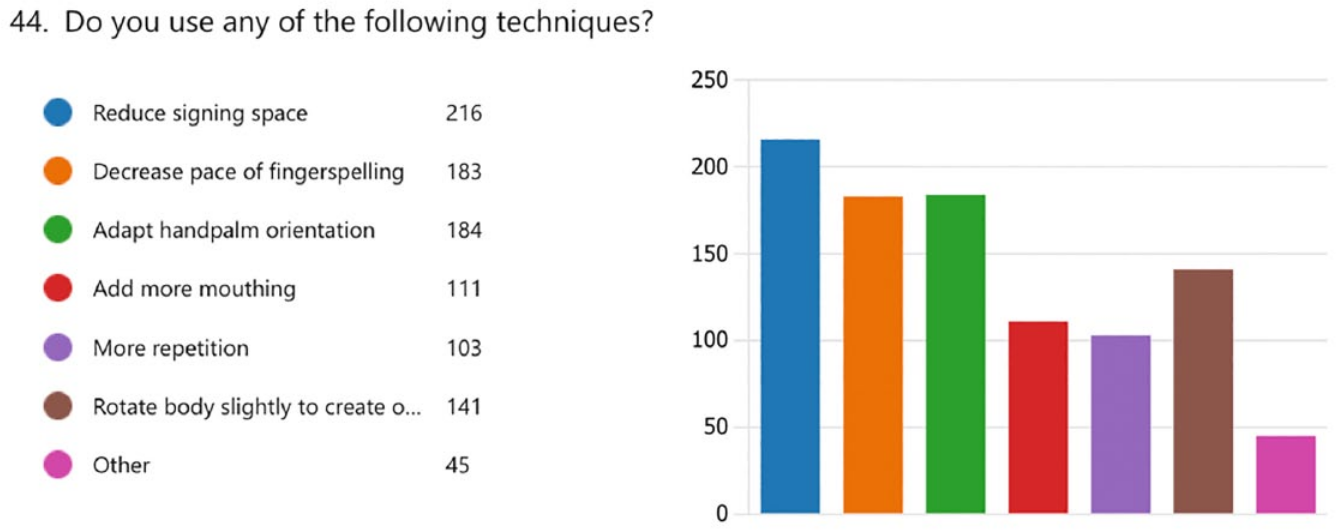
Do you use any of the following techniques?
The majority of respondents chose “reduce signing space.” Based on further analysis however, (respondents could also comment on this question), it seems that this is not only about reducing signing space but also about conscious use of space when working online, influenced by 2D instead of 3D, and the size of the screen. “We are working in miniature,” as one respondent putted it. Techniques or issues to keep in mind when working online included sitting closer to or further from the screen, signing within the screen’s frame, changing the direction of some signs (e.g., using timelines left to right instead of back to front because this is easier to see in 2D), using more body shift to indicate turn taking, rotating the body slightly to create an optical 3D effect, or exaggerating a sign to the front. Sometimes, the smaller signing space of the screen led to “bigger, more exaggerated” signing compared with how one would sign in person:
“. . . rationally I know it’s not necessary but a part of my brain feels I need to throw the movements through all the space between me and the Deaf person.”
A total of 184 respondents adapted their hand palm orientation. Further analysis made clear this also included choice of specific signs or vocabulary synonyms that were easier to see/understand in 2D, for example “when a sign has two or more versions, picking the sign that is clearest on screen (regardless of which Auslan dialect it is from).” Another technique was to change a sign’s location by moving signs within the torso/head signing space, or using signs with a central location instead of being located peripherally or on the lower torso. An example is signing LEGS in the air instead of lower on the body (where it is not visible on screen), or spelling words that would normally be signed on the legs, for example spell K-N-E-E or A-N-K-L-E instead of pointing to the knee or ankle. Some respondents avoided using specific signs that share multiple meanings or can hide mouthing leading to misunderstandings:
For example in FinSL there is a sign ‘shape, version, skets’, which also can block mouthing in 2D/screen. That kind of things I either interpret in a different way or I do a little adding or explaining so that I can be sure that participants understand correctly.
A total of 111 respondents indicated “Adding more mouthing” because mouthing might be hard to see on a small screen, whereas 103 respondents said they also used more repetition. A total of 183 respondents said that they decreased the pace of fingerspelling, most often to cope with bandwidth issues (for example, when the image is not clear). However, the issue of fingerspelling was also discussed in other ways. For once, the task of fingerspelling seemed to be made more demanding because of the absence of backchanneling:
Whereas before the pandemic with fingerspelling specific terms I could stop as soon as the deaf person nods, I now have to spell them completely every time, cause I don’t see my clients, I don’t know whether they already got it.
Other respondents changed how they fingerspell, for example, adapting their fingerspelling location to provide contrast, that is, not signing next to the body but rather in front of the torso/dark clothes or in front of a dark(er) background.
“Before the pandemic, I was not a black turtle neck kind of interpreter. Now I am, helps tremendously when interpreting into a camera.”
Others struggled with the receptive skills of fingerspelling online:
In person, I can process receptive fingerspelling pretty quickly and it is one of my strengths. However, virtually, it has become one of my weakest skills and I struggle with it, even when working with the same people I have worked with for years.
Respondents could also indicate other techniques they used. Several of these had to do with the issue of bandwidth not being good—“video quality has his hiccups almost every assignment”: use of less fingerspelling, slower signing, signing in pace of lag time, altering processing time, using more consecutive approaches and showing the form of a sign before making it, for example, show 8 before signing 18. Related to this was the issue of concise signing/conservation of signing: “trying to pare back on [the] number of signs for each phrase.” This is influenced by the issue of working alone for longer periods without a break, or running jobs back-to-back. This leads to “more chunking/summarizing as one tires quickly.” Other respondents have developed methods to cope with Zoom fatigue:
I am a Designated Interpreter, so my client(s) are the same. I find myself holding more information until they look up than I did before (not sure why). I think I am trying to help the Zoom fatigue in making every sign ‘count’.
Some respondents paused more, “because deaf people are in their homes and have many distractions—holding info until they reappear on screen (unless they ask me to just go ahead).” One respondent said that it very often happens that hearing participants ask other hearing participants for things to be repeated and developed coping methods for this: “to save myself energy and arm pain, I will tell my client that the conversation is being repeated for someone and I’m going to ‘rest’ or take a drink while everyone repeats themselves.”
Pointing to PowerPoints or visuals was another commonly used strategy, as well as the use of chat to supplement signed information, for example, to type abbreviations, names or numbers, and for interaction management with customers and co-workers: “[I] use chat in addition to interpreting to make sure the spelling or other important info is received in English as well as in sign.” Some respondents made optimal use of their workspaces:
It’s not a technique that shows in the actual interpretation, but my main screen is surrounded by notes with all the names of meeting participants, acronyms that might pop up, names of organizations, . . . this is something that was not possible when we were working on-site.
Captions were also used by deaf customers, either to check whether the signed to spoken output is correct (or at least not completely off) or to check the spoken to signed interpretation: “I find my client checks to make sure I’m signing what the speaker says. I’m signing much less ASL and more English.” For one respondent the use of captions and live transcripts made them switch from being a designated interpreter to taking on more freelance work:
I work full-time as a designated interpreter and since Zoom added the Live Transcript option, I am no longer needed to interpret (signing person prefers to read and communicates with speech). This has impacted my skills so I have taken on some freelance work in order to keep my skills up.
Online, signing spaces have become “emboxed” (Hochgesang, 2020) and signing styles change (Keating et al., 2008; Keating & Mirus, 2004): pointing or using eye gaze is harder online—when someone signs “here” or “you” there is no point of reference; turn-taking has changed; there are changes in language use with name signs being used vocatively: “using the person’s namesign directly to them in order to get their attention” and “use of sign names to indicate source attribution or to indicate a comment/question is directed to an individual.” Other strategies mentioned were spelling or initialising the name of the active speaker and explicitly naming speakers by spelling/signing their name whenever they began to interpret for example, M-A-R-K speaking, and using the participant list to see who will be the next speaker or how a name is spelled.
5.3 Self-monitoring
Another issue that is very different in remote work is that interpreters see themselves on screen and thus can see themselves signing. Although spoken language interpreters hear themselves speaking, SLIs generally do not see themselves signing when working on-site. Thirty percent of respondents stated that seeing themselves on screen meant they were more aware of their own signing style, while 26% were more aware of facial expressions, 18% were more aware of mistakes, 14% were more aware of processing time, while 12% said it did not affect the perception of their work. For some respondents, monitoring affected their self-confidence, and they felt this was tiring:
Re the question about being more self-aware due to seeing myself on screen: I have been utilizing the facility to hide my self-view so that I see myself as little as possible. I get the screen set up and then I switch myself off.
However, for most respondents seeing themselves on screen has made them more aware of their own signing either their signing style, location of signs, pace, clarity and understandability of the content.
“Seeing myself on screen next to the deaf person increases the quality of my interpreting: more awareness of what I’m doing.” “Being able to self-monitor my work has helped me to better understand my strengths and weakness and to seek out resources to improve on areas of my work that need to be addressed.”
One respondent remarked that they feel “v[ery] odd as I’ve gotten so used to seeing my signing reflected back at me! I’m reliant on that as a feedback tool now.”
Sometimes, this self-monitoring meant that they repeated something or signed it differently:
I noticed in general that since I see myself signing, I’m more aware of placement of signs and my pace. I can see when—in my own opinion—I’m not signing clearly, which makes me repeat something or sign it a different way for clarification (even if the message came across just fine). I wouldn’t do that in a live situation unless I was prompted by the need for clarification from the deaf consumer(s).
The fact that so much is recorded online (“a blessing and a curse,” said one respondent) can provide self-monitoring after an assignment.
5.4 Conversation management
Conversation management is another area that has been affected by remote work and one that 196 out of 342 respondents marked as problematic when working online. For one thing, this is linked to the previously mentioned issue of signing spaces becoming ‘emboxed’: pointing or using eye gaze is harder, turn-taking has changed, boxes get moved around when someone turns their camera on or off or leaves/joins a meeting. This interrupts the flow and makes it harder to manage conversations. Several respondents commented on the issue of managing being more disruptive and overt online than it would be on-site, commenting on the issue of “asking overtly to meet any communication breakdowns”:
On the one hand it’s nice to think that deaf consumers trust us to portray their signing accurately, but if you’re not with them on another platform (which is only the case if they are presenting at length) it poses challenges if misunderstandings occur. On-site there are subtle ways to clarify with the client, however, on camera it is more intrusive now to clarify as you have to turn your camera on, stop proceedings, request the consumer to go back and then take it from there.
Because of the more overt nature of interrupting or voicing engagement, one respondent commented that this actually reduces deaf consumers’ inclusion because the interpreter is doing less voicing of engagement/backchannelling of deaf consumers:
I am much less able to voice the engagement/backchanneling of the Deaf consumer. Often the Deaf participants are highly engaged but Zoom makes it difficult to voice those moments which convey the clients personality and little things without interrupting the whole session. I’ve found my clients prefer me not to interrupt, and I think it has reduced their inclusion. It feels like hearing people know them less now.
Another issue linked to management is that the character of online meetings if often such that everyone is let into a Zoom or other meeting space at the same time and interpreters struggled with setting up their work space, while at the same time having to start interpreting:
Often I am let into a virtual space at the same time as the participants. I am unable to effectively set up my work space on my computer and monitor. They often immediately start talking and I am unable to even find the Deaf participant(s) or set my screens to see the various windows that might help me follow the assignment. Trying to get this done during a person’s breath between sentences is very stressful and it is the worse part of online work.
One respondent made a similar comment:
Interpreters are treated as part of the tech set-up—very little consideration [is] given to our needs, we are switched on and switched off again, propelled into meetings with no time to prep, still trying to find and pin the deaf client(s) whilst still interpreting.
Other respondents noticed that online meetings were paced faster because more people can attend, and the agenda is busy. This might be at the disadvantage of deaf consumers also: although it has advantages to fade into the background and not be clearly “deaf visible,” respondents stated that an interpreter needs to be more assertive in a meeting with 100 people compared to 10 people, that this might lead to the deaf consumer being “invisible” and no consideration is given to how the interpreter needs to work, meaning they become invisible too.
Often times due to remote interpreting you become even more invisible so that no thought is paid to how you need to work and either have to become far more assertive, say for example in a business meeting when you have over 100 people in the meeting.
Therefore, one respondent commented they feel more like a conduit now:
I find it a lot harder to ‘read the room’ compared to face to face work . . . I think I took for granted how much additional and supplementary information I acquired from being in situ. Remote work has some benefits, but I feel a bit more of a conduit now.
Other respondents said that they are taking matters in their own hands now more, also as a way to reduce the stress of remote work. This is affected by their improved digital literacy, respondents comment they feel more confident about this now compared with at the beginning of the pandemic: they know how to (multi)-pin, spotlight, and so on. On the contrary, this might also constitute additional labour for interpreters, which is not required when working on-site.
I am also taking control of situations when possible. I teach about spotlighting vs. pinning. Sometimes I am co-host and actively spotlight those who need to be spotlighted including the interpreters to ensure the visual are good for Deaf viewing. “In order to reduce stress, I have found myself becoming the tech-expert (researching and experimenting with different platforms before use) and thus having a more directive role on the process.”
5.5 Teamworking
Several respondents commented on the issue of working in team. Some of these comments were positive, whereas others were more critical. A positive aspect of working in team online (also commented on in the previous surveys) was that there are more opportunities to work in a team (although some respondents are still doing most online interpreting work alone). In addition, remote work meant that interpreters have more flexibility to team up with colleagues of their (and the deaf consumer’s) preference, with whom they could not work before because of distance, including deaf interpreters. Another benefit included learning new signing styles and expanding their sign language repertoire, to include, for example, regional signs, other sign languages, and different registers of International Sign (for example, European versus African). This is also influenced, for some respondents, by working with a more diverse pool of consumers than they would do on-site, because of the absence of geographical barriers.
“Increased online (live) interactions with deaf/SLPs during COVID has expanded my exposure to sign languages and interpreters from around the world. This has broadened my signing repertoire.”
Working in a team online is different from working on-site in several ways. For instance, interpreters are able to see each other interpreting directly online, unlike on-site where interpreters often sit next to each other facing the audience, and it can be difficult to see each other unless you turn your head directly. This was seen by some respondents as a learning opportunity. In addition, some respondents mentioned that working with deaf interpreters was another learning opportunity. However, other respondents noted that online, “team work” is no longer a team effort, but instead it becomes interpreters taking turns with no support at all or no real-time support.
“The nature of working online makes real co-working impossible and so any repairs (e.g. non-active co-working supplying a missed word/sign) are glaringly obvious.”
This is influenced by the fact that interpreters are often asked to turn off their cameras to spotlight the main signer/speaker in a meeting.
Tandem most often work with one camera on, one off so we are not able to see the ‘off’ interpreter to get feeds for mistakes/omissions or confirmation support. Sometime this is provided by using the chat function on programs or by sms/text but it’s not as helpful as being able to look at a tandem for confirmation that your signing is clear, or to get fed a missed name or concept etc.
However, this would only be the case for those interpreters not using another platform to support and see their colleague(s), which is generally not seen as best practice (de Wit, 2020; de Wit et al., 2021).
5.6 Health issues
Respondents commented on health issues informed by the increase in remote online work. These included physical, mental health issues, and stress-related issues.
5.6.1 Physical health
Some respondents reported experiencing physical issues such as repetitive strain injury (RSI) and pain at the shoulders, arms, and neck due to the fact that they were being forced to use a smaller signing space and interpreted seated instead of standing or using headsets. Other concerns included weight gain, fear of deteriorating eyesight due to screen time or headaches caused by excessive screen time or poor sound quality. Not getting body and brain breaks because of not travelling between assignments was another issue. The hyperfocus needed for remote interpreting and the fact that some respondents are working alone for longer stretches of time is something some respondents also experience as physically (and mentally) draining. On the contrary, for some respondents, the fact that they do not need to travel (and experience traffic) and often get more sleep because it is not necessary to leave for work early, made them feel more energetic.
5.6.2 Mental health and stress
Several respondents reported that remote interpreting negatively affected their self-confidence, using words such as lethargy, decreased passion for the work, and not feeling excitement or motivation. One primary issue that negatively affected mental health is the absence or significant reduction of real-life interactions with deaf customers, not only during but also outside assignments.
“It often feels harder to get motivated because energy is generated in my body by interacting with real people in real space and time. Lethargy is a more frequent issue than it was previously.” My interactive engagement is with the same people—there is little scope for incidental conversation with people outside my working ‘zone’. I am fortunate in that I engage regularly with about 30–35 different deaf people, but the nature of the interaction is more formal than would be the case if we met in real life as we don’t generally have the opportunity to engage in general chat/catch up.
This also includes a lack of opportunity for pre-briefing and post-assignment briefing with team interpreters, especially in highly complex interpreting settings:
“ [. . .] little to no opportunity for per-briefing and post assignment debriefing with team interpreters. Concerns for interpreters working remotely during highly complex, emotional or intense assignments that may include triggers or vicarious trauma.”
However, it is not all negative: respondents also reported that they enjoy their job more, feel more relaxed, and produce better work. They feel this especially in large groups because they only see the deaf participants and co-workers, which reduces stress. Online settings also mean interpreters can adapt their own volume and sound, can ask a speaker to use a microphone, and so on; whereas at on-site work, they are often entirely dependent on others for technical issues (for example, having trouble hearing someone who is sitting further away).
As challenging as remote interpreting has been, I have learned new skills and have appreciated the opportunity to stay home and stay safe. While there are some in- person assignments I have missed, there are other things that I would like to keep remote (such as IEP meetings or parent/teacher conferences). I am hopeful that my employer will enable us to keep some things remote and give us the option of working from home, as we’ve proven it can be done. Additionally, I feel like I am in a better place mentally than what I was before the pandemic, so returning to ‘normal’ has me a bit nervous.
5.7 Coping and adapting
The pandemic gave some respondents who were working towards a burn-out or other health issues a much-needed break.
“Benefits of Covid: time to reevaluate self. Pressed to work outside comfort zone. Realizing hidden abilities. Lockdown was also a time to reset my schedule as I was working towards burn-out. Glass half full ”
It was also an opportunity for some respondents to recalibrate their views on working as an interpreter and working remotely, considering their work–life balance, especially with the view of post-pandemic working conditions and “returning to normal.” Having a better work–life balance was one thing that clearly stood out as a positive aspect of remote work.
With clients talking about returning to the workplace or face-to-face work generally, I have found myself having quite a strong visceral reaction to some jobs that I now much prefer doing remotely. I have started to re-assess my work/life balance priorities and think about other variables like how long I am prepared to commute for certain jobs. Or, thinking about the toll that the pre-pandemic workload had on my health . . . What have I valued about working from home that I would like to see continue, and how much leverage do I have before I start to lose work. And how that might mesh with how my clients imagine the work continuing.
Interpreters have adapted technically: buying better equipment (e.g., lighting, head phones, or bigger screens), refurbishing their work spaces, and upgrading their technical skills (e.g., multi-pinning, spotlighting).
“Onscreen interpreting is very tiring but when I think back to last March, when my IT knowledge and remote interpreting experience was zero, I’m proud that I have been able to adapt!” “I never would have wanted to work remotely and still don’t think I’ll ever do on- demand VRS but overall I think it’s had some positive impact on my skills and the service I offer.” “One year ago I felt like working remotely was not ‘my thing’. I didn’t feel certain about myself and my ICT skills. Now I feel totally different. Working remotely is something I have gotten used to, and I feel sure about myself and my skills.”
6. Discussion
The pandemic has forced the SLI profession to adapt their working practices, and post-pandemic these working practices (or at least some of them) seem here to stay. One of the critical changes is the impact of remote work on backchanneling and self-monitoring. The lack of visual cues for interpreters and the inability to see the deaf audience can be challenging in online settings. When deaf consumers cannot or do not provide backchanneling, interpreters’ self-monitoring began to serve as backchanneling and some interpreters become reliant on it as a feedback tool (see also Janzen & Shaffer, 2008 for how meaning is co-constructed in interpreted interactions). As a result, interpreters tend to repeat things differently in real-time, based on their own perceptions of clarity. Online recordings have proven both challenging and beneficial in this regard. As such, self-monitoring has emerged as a significant aspect of remote work. Seeing themselves on screen has been a new experience for many interpreters. Self-monitoring can make them more aware of their signing style, facial expressions, mistakes, processing time, and other aspects of their work. Although some interpreters find self-monitoring tiring, most find it helpful and believe that it increases the quality of their work. It is something that could be incorporated into SLI training programmes more. Furthermore, the pandemic has forced many interpreters to work online at short notice with minimal preparation, partly similar to the experiences of VRS interpreters (Brunson, 2011; Tyer, 2018). Although the experiences of those interpreters working for VRS/VRI companies are different in terms of having to deal with on-demand calls and having less control over many variables, including coping with a higher volume of work, it seems the boundaries between VRS work and online remote work from home are becoming increasingly blurred.
Interpreters have developed various techniques for working in online settings. They have reduced signing space and adapted hand palm orientation, location of signs, mouthing, and used repetition to enhance understanding, cope with bandwidth issues and deal with poor video quality. However, issues related to fingerspelling, such as changes in the way of fingerspelling and struggles with receptive skills online, have arisen. However, this would mostly apply to sign languages such as ASL and Auslan, which make more use of fingerspelling (Nicodemus et al., 2017)—and which again reflects the Western lens of this study. Coping methods have been developed to deal with Zoom fatigue and distractions, such as holding information until the client looks up, or pausing more. Working alone for longer periods and running jobs back-to-back have led to more concise signing, conservation of signing, and chunking/summarising. Consecutive approaches, showing the form of a sign before producing it, and choosing the clearest sign have been used to deal with poor video quality and to enhance understanding.
The challenges of conversation management are significant and include issues related to turn-taking, eye gaze, and interruption, as well as the difficulty of managing conversations due to the overt nature of online communication. The impact on deaf consumers and their inclusion is also noted, as interpreters find it harder to voice engagement or backchanneling online. Other challenges include the character of online meetings, pace of meetings, and lack of consideration of interpreters’ needs. Respondents also commented on their efforts to adapt to these challenges and improve their digital literacy to better manage remote interpreting work.
The benefits of team work in remote interpreting include increased opportunities to work in a team, more flexibility to team up with colleagues, and expanding sign language repertoire, because the online environment exposes SLI to sign languages and interpreters from around the world. Furthermore, interpreters have the opportunity to see each other interpreting directly, which creates a learning opportunity for them and might affect on-site work, as interpreters may realise that sitting next to each other might not be the best way to team effectively. However, some respondents, who likely do not use a separate platform for support, also remarked that online team work is no longer a real team effort, but instead it becomes interpreters taking turns with no support at all or no real-time support. The issue of interpreters being asked to turn off their cameras to spotlight the main speaker/signing also makes it challenging for them to receive feedback and confirmation support.
Respondents reported physical and mental health issues due to remote interpreting work (and/or due to working alone for longer periods and running jobs back-to-back, which seem to be a consequence of the shift to remote), including RSI, weight gain, headaches, fear of deteriorating vision, fatigue due to hyperfocus and working alone, decreased passion for the work, lethargy, and mental health issues because of lack of interaction with deaf customers and team interpreters. However, some respondents found benefits in the pandemic, such as time to reevaluate themselves and reset their schedule, as well as recalibrating their work–-life balance. Interpreters also adapted technically by buying better equipment, refurbishing their work spaces and upgrading their technical skills.
One of the other notable changes due to remote work is the multimodal nature of interpreting, which has expanded beyond the traditional face-to-face interpretation to include other modes such as chatboxes and instant messaging, captions, and post-it notes. This trend is expected to continue, and may even become more common in on-site assignments. In addition, the pandemic has eliminated geographical barriers for SLI provision, providing greater flexibility for both interpreters and deaf consumers. Although pre-pandemic, on-site assignments may have been cancelled due to unforeseen circumstances (train strike, car trouble, sick child), both interpreters and deaf consumers seem to have adapted to the new normal of switching online at short notice. However, the combination of remote, hybrid, and face-to-face work has also presented new challenges. These include online tech etiquette, preparing for a meeting, managing workload, and coping with the combination of on-site and remote work, such as making sure to get home on time from an on-site job to work remotely. This is a stress factor that was not that dominant pre-pandemic. Furthermore, remote technology may need to consider issues such as eye strain, hearing health, and occupational health more generally.
For new SLI students, remote work (different from VRS/VRI work) has become a core skill. For VRS/VRI work, at least in the United Kingdom, it is still recommended for call centre companies to set a 3-year post-qualification experience benchmark before interpreters can undertake this work (Ryan & Skinner, 2015). This caution implicitly assumes, seeing it was made pre-pandemic, that this post-qualification experience mostly involves face-to-face experience. There is no such caution for remote work. Newly graduated SLI students can and do start working remotely immediately. SLI students and novice interpreters need to be trained and prepared to undertake online interpreting assignments (different from VRS/VRI work) and work a hybrid career. Anecdotal evidence suggests that students who were trained during the pandemic may struggle with interpreting from the signed to the spoken modality when deaf consumers were not facing them directly (as is often the case in online settings).
An enduring concern that necessitates the active involvement of interpreters, interpreter associations, and deaf stakeholders, is the establishment of critical benchmarks for online work, as well as determining the appropriateness of remote interpreting in various contexts. In addition, a critical area for follow-up research are the motivating and inhibiting factors at play for interpreters arising from the themes identified in this study. What prompted them to engage online when they otherwise said they had not previously worked online? Curiosity? Willingness to “give it a go?” Financial necessity? Equally significant is understanding the incentives that sustain their online work preference, or the inclination to predominantly work online while engaging to a lesser extent on-site. Demand from deaf consumers? Issues related to work–life balance? In tandem with this, are considerations regarding the usefulness of surveys to capture the increasingly complex working arrangements of SLIs. As revealed in this study, how researchers frame their questions or assume how interpreters work is no longer a straightforward matter. We have previously highlighted that the pandemic has significantly transformed the concept of “remote work,” expanding it to include work from home, and the potential blurring of boundaries between remote work and VRS work. Going forward, we might need to be more cautious in defining terms such as “remote,” “online,” “face-to-face,” “on location,” “working in team,” or “working alone.” The semantic shift in these terms has direct implications for survey design and other data collection methods. For example, an interpreter may work in a call centre alongside other interpreters, but predominantly work online, and alone. Is this interpreter part of a team or alone, on-site or remote? An interpreter working at a conference may spend their day in a studio interpreting (within a team) for people online, at different geographical locations. The delineation of whether this interpreter is working on-site or remotely is no longer that clear-cut. Any follow-up surveys to this study must acknowledge and adapt to these shifts in terminology to ensure accuracy and relevance in capturing the evolving landscape of SLIs’ working practices.
Finally, sign language interpreting services exist only by virtue of having deaf people who use them. A critical consideration of deaf perspectives on remote sign language interpreting, both in the post-pandemic context and beyond, is another critical issue for follow-up research. Paradoxically, the transition to remote video-mediated interpreting, although in many aspects advantageous to deaf consumers, has also led to an increase in performative inclusion measures, such as the provision of live online sign language interpretation to signal inclusivity, irrespective of whether deaf people are actually present, so that it becomes a “spectacle of access” (Robinson & Hou, 2020). It will be interesting to see how this will change the interpreting profession and the relationship with deaf consumers, considering the growing familiarity of interpreters with working without a visible audience, and how this phenomenon will shape their future practices.
7. Conclusion
The COVID-19 pandemic has resulted in significant changes to the sign language interpreting profession, forcing interpreters to adapt and innovate to meet the new demands of remote video-mediated work. The shift has presented challenges, including audience design, self-monitoring, and conversation management. In addition, the pandemic has resulted in physical and mental health issues, as well as the need for interpreters to develop new skills for remote work, including coping with the changing multimodal nature of online interpreting. The pandemic has further blurred the boundaries between VRS work and video-mediated remote work from home. The combination of remote, hybrid, and on-site work has become the new normal, leading to new challenges such as managing workloads, online tech etiquette, and occupational health concerns. However, despite these challenges, remote work offers benefits such as increased opportunities for teamwork, expanding sign language repertoires, and greater flexibility for both interpreters and deaf consumers. Moving forward, it will be important to address these challenges and continue to innovate to meet the evolving needs of the sign language interpreting profession.
Footnotes
Acknowledgements
Thanks to Karolien Gebruers, Oliver Pouliot, and the reviewers for their generous feedback on previous drafts of this paper.
Declaration of conflicting interests
The author(s) declared no potential conflicts of interest with respect to the research, authorship, and/or publication of this article.
Funding
The author(s) received no financial support for the research, authorship, and/or publication of this article.
Notes
Biographies
