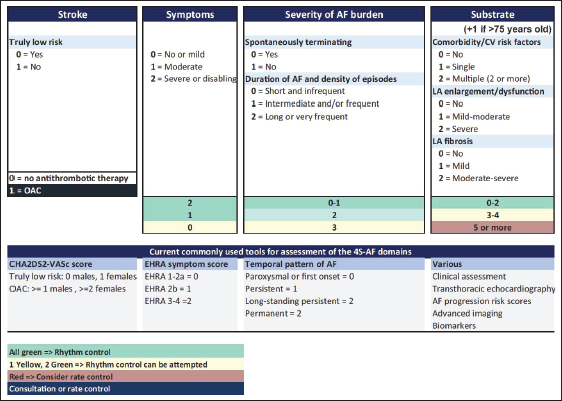
Timing of initiating AF treatment: EAST-AFNET 4 trial and other investigators have put forth a view that in comparison with rate control of AF, initiating early rhythm control, within 1-year of AF onset, decreases the risk of death from cardiovascular (CV) causes, ischemic stroke, heart failure (HF) admission, or acute myocardial infarction.1, 2 Better CV outcomes with rhythm control were due to lower rates of stroke/transient ischemic attack.
3
A contrarian view by the AFFIRM sub study is that rather than the timing, benefits of rhythm control were due to refined therapies.
4
Data from a large Chinese AF registry that recruited >8,000 patients, wherein progression of AF was lesser in patients who received antiarrhythmic drugs (AAD) and/or catheter ablation (CA), supports this notion.
5
In fact, an echocardiographic and hemodynamic reversal of an acute tachycardiomyopathy-induced cardiogenic shock following AF ablation has been documented by 1 small study.
6
In patients with nonvalvular AF, the purported clinical benefit of early rhythm control is apparent only after long-years of patient follow-up
7
and would likely be influenced by the evolving CHA2DS2-VASc score. A nonsignificant trend in favor of rate control was observed by Kim et al,
2
when treatment was initiated late, 2 years after the AF diagnosis.
Symptom status decides: In practice, rate control is chosen twice as frequently for AF symptom management vis-à-vis rhythm control, even in highly symptomatic patients (EHRA III-IV), thereby hinting at the need to improve physician’s skills to prescribe symptom-focused treatment.
8
Younger patients with less comorbidities appear to be more active and may complain of higher burden of symptoms due to paroxysmal AF during daily activities, these patients more often receive rhythm control. Choice of AAD is often dictated by its availability, thus amiodarone is used more frequently, followed by class IC agent (flecainide, propafenone). While one needs to guard against overuse of amiodarone, damning would be to wrongly prescribe class IC drugs in patients with significant structural heart disease (SHD). Less patients with symptomatic paroxysmal AF receive CA due to limited hospitals in our country offering this expertise, direct current cardioversion (DCV) is more often used for persistent symptomatic AF. Rate control, even for symptomatic paroxysmal AF, is often assigned to elderly with comorbidities; but also to patients who are reluctant, fail, or have contraindications to rhythm control AADs. A lenient rate control in a persistent/permanent AF patient (resting HR <110/min) may be enough, unless symptoms demand a stricter rate control (resting HR <80/min, with moderate exertion <110/min). Beta blockers ± digoxin are mostly preferred. Quality of life (QOL) of HF patients with AF may be better with rhythm control, by employing CA or amiodarone, and needs to be individualized over rate control strategy. Finally, it should be understood that clinical outcomes in AF, all-cause death, CV mortality, and thromboembolic phenomenon, are not entirely determined by symptom status.
9
Patient characteristics matter: It seems befitting to prefer rate control in the elderly, as they commonly have persistent or permanent AF with left atrial enlargement, the latter leads to failure of rhythm control AADs to restore sinus rhythm and risks proarrhythmogenicity.
10
In fact, rate control is safe in the elderly with a comparable improvement in QOL as with rhythm control, the latter often associated with a higher rate of hospitalization. AF in elderly can incite decompensatory episodes of pre-existing HF, digoxin is an effective rate control agent in this setting. A proactive Korean experience reported that CA in nonfrail elderly patients lowers the risk of all-cause death and composite outcomes.
11
AF in patients from the lower socioeconomic strata is associated with increased 1-year all-cause and CV mortality; they get offered fewer DCVs, CAs, readmissions, and outpatient visits.
12
Again, women despite a higher risk of stroke, death, and worse QOL, less often receive DCV and CA for rhythm control.
13
HF and AF have a bidirectional pathophysiological relation. In practice, rate control is initiated first and rhythm control thereafter for resistant HF-AF symptoms.
14
Beta-blockers, despite their doubtful mortality benefit, should be the initial monotherapy; digoxin (HFrEF-AF) and dihydropyridine calcium channel blockers (CCBs, HFpEF-AF) are appropriately added to achieve target rate control. Empirically, optimal rate control would be <100 to 110 bpm. Aggressive rate control <70 bpm is associated with poor prognosis and more pacemaker implantations. Inadequate rate control may need addition of amiodarone or subsequently atrioventricular node ablation with permanent pacemaker implantation. In HF-AF, rhythm control is superior to rate control and is better achieved by CA than AADs. Immediate DCV would be indicated for a hemodynamically unstable or life-threatening AF episode, or for a new-onset (<48 h) AF; plan DCV in persistent AF only after adequate anticoagulation. Amiodarone is the “weapon of choice” to maintain sinus rhythm; dofetilide, though indicated in HrEF-AF, requires in-hospital initiation to mitigate the risk of torsades de pointes (TdP). In an AF patient, with HFrEF or HFpEF, CA of AF can substantially reduce AF burden and thereby reduce mortality and HF hospitalizations.
15
Benefits also accrue by improvement in left ventricular ejection fraction (LVEF) and consequently VO2max, 6-minute walk distance, and QOL measures. Due to advanced atrial disease, patients may require multiple or “pulmonary vein isolation plus” (PVI + lines + complex fractionated electrograms) CA strategies. Trick here is to recommend CA to young patients with “arrhythmia-induced cardiomyopathy” and a clinical profile wherein recent AF, nonischemic cardiomyopathy, LVEF ≥35%, no significant left atrial/LV dilatation or fibrosis, and absence of comorbidities are weighed in.
16
Health-care setting dictates: Facility-specific variation in AF management abounds. In the contemporary UK general practice, 70% AF patients are prescribed rate control medications and a far lesser number (5%) receive rhythm control medications, probably due to concerns over AAD efficacy and safety and greater availability of CA.
17
Patients presenting to the emergency department (ED) with a new/recurrent AF episode and rapid heart rate (HR) may complain of palpitations, shortness of breath, or exercise intolerance. Achieving rate control from 150 to 100 bpm reduces symptoms sufficiently to allow discharge home. Restoration of sinus rhythm would resolve symptoms that triggered the ED visit better and can be achieved by DCV or IV ibutilide (1 or 2 mg). In case of ibutilide, pretreatment with MgSO4 and post-ibutilide rhythm monitoring for 4 to 6 h prior to ED discharge is mandated. Hospitalization would be necessitated when fast HR persists.
18
In absence of a protocol for management of AF in the intensive care unit (ICU), termination was often (95%) awaited in hemodynamically stable patients and rhythm control was sought using amiodarone, DCV, beta blockers (not Sotalol), and MgSO4 in that order of preference in hemodynamically unstable patients. Comorbidities kept digoxin and CCBs out of favor in the ICU setting.
19
In present-day practice, clinical significance of smartphone-connectable electrocardiogram (ECG) device detected new AF episode is not convincingly established. However, in patients with recurrent paroxysmal AF, AF burden logged-in by an implantable loop recorder has a greater impact on QOL than the duration and number of AF episodes, and may guide upscaling rhythm control therapy.