




Abstract
Background:
Although training in palliative care (PC) is increasingly frequent in medical schools, some barriers still hamper the design and implementation of effective educational programs. Information Technology-based distance learning (IT-DL) might contribute to the development of appropriate knowledge on PC in students, but it is still not clear how to best develop such curricula and how to deliver methodologically sound learning activities, allowing students to work on the complex skills required in PC.
Objectives:
To describe how internet-based education can be used in undergraduate medical PC education, in terms of realist theorization.
Design:
A realist review was carried out, producing a framework – or, in the terms of a realist review, a theory – focusing on finding out what might work, for whom, and in which circumstances, describing these variables in terms of Contexts, Mechanism, and Outcomes.
Methods:
An international group of experts of PC education assessed the relevance and pertinence of 256 articles resulting from systematic retrieval of literature and expert suggestions.
Results:
The final synthesis, mainly informed by the 43 articles rated as most relevant, is presented in propositions regarding three groups: (1) Educational theory, where (a) Cognitivism (learning as an increase in knowledge); (b) Constructivism (learning as a social, cultural, and negotiated process); and (c) Behaviorism (learning as an observable modification of behaviors) appear to be consistent with the learning outcome of PC. (2) Desired effect of the technology, suggesting the simple use of IT-DL is not an additional value per se, as it should overcome objective limits set for face-to-face activities. (3) Contextualization and duration of the curricular activity, suggesting PC training activities should be included in an organic and legitimate way in the overall curriculum.
Conclusion:
This field is expected to experience huge growth soon, and present and future research could use a realist approach like the one here presented to make sense of all the different variables involved.
Introduction
Palliative care (PC) ‘is fundamental to human dignity and a component of the human right to health’ 1 ; however, the health sector generally faces a shortage of medical doctors trained in PC in European countries.2,3 Responding to this growing need of PC professionals, education and training in PC have become essential components of undergraduate medical education. The European Association for Palliative Care issued a White Paper listing the core competencies of PC education at the undergraduate level 4 and in 2020 the European Palliative Care Curriculum (EDUPALL) was developed based on these recommendations. 5 The lack of teachers with specific expertise in the field of PC still hampers the design and implementation of effective educational programs in medical schools.6,7 The various forms of technology-enhanced learning and, more specifically, synchronous and asynchronous online learning are promising pedagogies to foster effective teaching of the PC core competencies, at least for the chance they give to overcome the constraints of resources required by in-person learning. Despite the availability of systematic reviews and meta-analyses on the overall use of Information Technology in medical education and – more specifically – on the use of online teaching and learning on PC, for a medical educator, it could be challenging to derive clear indications for the design of teaching and learning activities that are theory based, feasible, and fit for the local context. 8
This review aimed to propose a reference framework and specific indications for designing and implementing online teaching and learning activities on PC for undergraduate students.
This review has been the first product of a European project, named ELPIS (E-Learning on Palliative care for International Students), funded under the Erasmus+ KA220 program.
The project derives from the need of educators to find a way to provide successful and sustainable PC education to a large number of students, and therefore we decided to explore the available experiences with this review.
Rationale for review
There is an increasing need for training health professionals in PC for many reasons: (1) the population is aging and the amount of chronic patients is rising 9 ; (2) PC is gradually accepted as a more human standard of care for seriously ill and dying people, even in non-onco-hematologic field 10 ; (3) PC is as a considered part of the simultaneous and supportive care of the patient since the diagnosis. 11
As PC has been developed as a discipline through the years, educators and decision-makers are increasingly engaged in producing PC education for future health professionals. Thanks to this, international and national training curricula and standards have been increasingly developed, and the educational environment has become more accustomed to providing formal training in PC than in the past. 12 Italy and Romania, for example, have included nationwide the recommendation to include in the undergraduate medical schools a formal training in PC. 6
Focusing on the contents, some of the PC educational learning outcomes pertaining to the domain of relationships and attitudes (learning to be) cannot be met with class lectures. What is more, in the teaching of PC, we found an objective practical difficulty, as a consequence of the peculiar characteristics of the PC provision, that makes it often impossible to offer an adequate period of training to all the undergraduate students.
Because of that, online learning might contribute to the development of appropriate knowledge on PC in students and is thought to be a possible way to provide adequate education and training to a large number of students. However, it is not clear how to best develop such teaching curricula and how to deliver methodologically sound learning activities, in a way that permits students to work on complex skills such as those required in PC.
Objectives and focus of the review
Our review aims to describe how internet-based education can be used in undergraduate medical PC education, producing a framework or – in the terms of a realist review – a theory of what works, for whom, and in which circumstances, based on the available evidence.
We therefore conducted our review considering the following research questions to guide us through the process:
What are the elements to be considered in the educational design of online teaching for PC?
Which are the possible educational theories, and which one suits best to which context and for which outcomes? Pros and cons?
Which methods work well for any given learning outcome?
Which is the best way to adapt methods to a given context, considering its features?
Methods section
Changes in the review process
While conducting the review, an initial broader focus on internet-based education on PC for all health professionals was considered. When we chose a realist synthesis approach, the scope of the review was reduced to the literature on undergraduate student studies, to have a more manageable number of articles and to produce a more fitting theory for our goal. The definition of internet-based education was debated by the team, and we agreed on the terms ‘Information Technology-based distance learning’ (IT-DL) as more precise in describing our focus of interest. 13
Rationale for using realist synthesis
IT-DL is a fast-changing landscape and a complex intervention to deliver: resources, trainer and trainee characteristics, cultural aspects, and many more aspects modify its possible impact.14–17 PC education is a complex intervention in itself, as even the first level competencies expected from nonspecialists involve the acquisition of specific attitudes, critical thinking, and a holistic approach, in addition to more familiar clinical knowledge and skills.
Realist theory focuses on finding out what might work, how, and for whom, on a specific intervention, and generally describes these variables in terms of Contexts, Mechanism, and Outcomes (CMOs).17–19
CMO configurations are used to explain why particular interventions succeed or fail, and how they influence outcomes.
Realist synthesis is a type of review often used to collate multiple sources and types of evidence around a complex topic. It usually produces an evidence-informed theoretical reflection, expected to be useful to a specific audience (in this case, e.g. PC undergraduate teachers) interested in replicating or developing similar interventions. It refers to a model of practical approach to research where knowledge is seen as an incremental, never-ending task, and every intervention is seen as a complex system positioned inside another complex system (the social context of the intervention). The effects of a specified intervention are describable, but every repetition is an independent experience where known and unknown variables can contribute to producing different results. For this reason, every intervention is a new chance to produce knowledge in terms of what works for whom and in what circumstances.
The realist review process allows us to consider relevant evidence from adjacent research topics 20 (e.g. relevant articles on the use of internet-based education for all health professionals) if it is logically proven to be consistent.
In this way, the more precise scope of the research is expected to produce a more useful result, while the more flexible methodology reduces the risk of excluding key evidence from the final theorization.
Scoping the literature
The initial phase of scoping the literature was iterative and nonlinear. FC, a doctor with extensive experience in education research, conducted the initial scoping of the literature before discussing it with all the other authors who are specialists in the field and familiar with the literature, in several group meetings.
This first scoping review has been initially explored through the consultation of relevant systematic reviews on topics related to the main research question (e.g. to describe how internet-based education can be used in undergraduate medical PC education) and articles on relevant experiences of teaching PC to undergraduate students.
After that, an Initial Rough Theory (IRT) was developed, consistent with realist synthesis methodology, as a first theoretical draft of general CMOs underpinning the internet-based education of undergraduate medicine students. IRT is ‘the initial sketch of a theory that is used to guide a realist synthesis’, as ‘to support the process of undertaking a review, it is at least useful to construct an initial rough theory of action (What is supposed to happen?) and an initial rough theory of change (Why is that supposed to work?)’. 21
Searching process
After the first scooping review mentioned before, a deeply systematic review was conducted in 2020. The review has been repeated in June 2022. Supplemental File 1 contains the research string.
For the articles’ analysis, a guide on realist synthesis was derived from international guidelines, and a model of appraisal form was provided to all the researchers.14,15 A first meeting was held to further clarify and discuss the appraisal process; after that, every researcher assessed 43–44 articles.
An additional list of relevant articles, suggested by experts in the field and the research group itself, was added. A series of meetings of the research groups served as participatory moments in which the purpose of the review and the available knowledge were discussed, to select possible additional articles according to the experience of the research group. Most of the additional suggested articles came from Drs. JP and CC, two members of the groups and coauthors of these articles, who have great expertise in the field of teaching PC.
Selection and appraisal of documents
The process of document selection included numerous steps, as you can see in Figure 1.

The process of document selection.
The appraisal process was conducted using an appraisal form, which was applied to all the retrieved articles (see Supplemental File 1). The appraisal form required the reviewer to select the relevance of the article for our research question, and report in a box the reason for the relevance and useful data from the article, possibly in the form of CMOs configurations. Since the ELPIS project is an international cooperative project, the appraisal phase was done at each partner’s site, and the forms were uploaded into a shared folder (using the Google Drive® application). Each partner was in charge of assessing a part of the retrieved articles. The discussion in the following analysis and synthesis process was done through online meetings. Then a first, general synthesis of the relevant data retrieved, presented as a short text in the form of an ‘if. . . then’ proposition, was shared by every researcher. After that, the article was classified by the researcher as having high, moderate, or low usefulness and relevance for the study or being excluded. In analogy with other mixed and qualitative review methods, one of the authors (JP), with a great expertise in distance learning in PC, has been involved only at the end of the appraisal process as a second opinion, external to the main review process, to increase the trustworthiness of the appraisal process. He checked all the material produced and provided a second opinion on the labeling of the articles as relevant or nonrelevant for our review. The resulting divergences of assessment among the researchers’ groups have been resolved through distance and in-person group discussion.
Data extraction
One of the researchers made a matrix with all the useful information from the articles reported by the other researchers in the form of CMO configurations. This matrix was shared with all the researchers on a Google Sheet® as a commentable file. This made it easier to compare and navigate the data for all the researchers from each other’s work (see Supplemental File 2, Sheet with all the CMOs summarized).
Analysis and synthesis processes
GM was in charge of the data synthesis, and the review team talked often about the results of the synthesis to make sure they were correct and consistent. This review team focuses on finding common and repeated patterns of contexts and outcomes (demi-regularities) in the data. After finding the patterns, the group focused on the ways they happened (mechanisms).
This new data resulting from the review process were added to the IRT and presented as a shared, commentable Google document® between the authors. The authors were also asked to sketch a visual explanation of the synthesis, and the visual representations were then discussed to facilitate the work of forming a final theoretical framework.
The text resulting from their feedback and its subsequent reworking was then used to write the core part of the results.
For example, we discussed the importance of having a strong, explicit theoretical orientation declared in the educational project to improve its global coherence (e.g. constructivism). In the IRT, this seemed to be a common recommendation, but it was quite rare to meet such statements in real-life experiences, even in the most successful ones. So, the IRT has been modified accordingly, and this possible divergence from previous data has been inserted; many interventions seemed to be effective even in the absence of a strong reference theory.
Document flow diagram
An initial quick review found a selection of seven articles.22–28 These seven articles were used to produce the IRT.
After that, in June 2021 and January 2022, a systematic review was conducted in PubMed, Scopus, and ERIC. So, a total of 855 articles resulted from this research. Finally, 21 extra articles were added as a result of experts’ opinions.
A selection of 256 articles was the final result of the subsequent systematic retrievals.
Supplemental file 1 reports the strings used in the systematic research.
The analyses of these articles were divided into the five collaborative centers, which had the task of classifying them according to their relevance to the final theory as ‘high’, ‘medium’, ‘low’, or ‘excluded’. Finally, 43 articles were considered highly relevant, 46 were moderately relevant, 59 were low, and 108 were excluded or not found. Supplemental File 2 reports the appraisal process.
Document characteristics
Supplemental File 1 presents the strings used in the systematic research. Supplemental File 2 summarizes the appraisal process. Supplemental File 3 is the appraisal form. Supplemental File 4 presents the main CMOs configurations that researchers found in the articles selected as most relevant.
Main findings
The results of the theory-based, systematically researched, evidence-based iterative process that we adopted are presented in three main findings. After a first focus on the very definition of ‘e-learning’, we addressed the research questions. Our final synthesis of the reviewed literature and CMOs retrieved is presented in propositions. We intended to answer research questions B, C, and D, through a list of statements and examples in the three paragraphs regarding (1) educational theory, (2) desired effect of the technology, and (3) contextualization and duration of the curricular activity.
We decided to answer research question A (‘What are the elements to be considered in the educational design of online teaching for PC?’) in a more concise and specific way through a series of questions that are supposed to guide the educator in the planning activity. This list is reported in Table 1.
Key questions for educators.

IT-DL, Information Technology-based distance learning; PC, palliative care.
A first clarification: What is ‘e-learning’?
The term e-learning has been interchangeably used with the terms web-based learning, online learning or education, computer-assisted or -aided instruction, computer-based instruction, internet-based learning, multimedia learning, technology-enhanced learning, and virtual learning. Such nomenclature has led to confusion as to whether e-learning is part of the medium (e.g. computer-assisted instruction) or the delivery mechanism (e.g. online learning). 29 We therefore chose the umbrella term IT-DL, which includes all types of distance learning in which the relationship between the teacher and the learner is mediated by a technological artifact. The educational value is therefore mainly based on the activities, and the role of technology is to enable and/or constrain the activities.
Educational theory
The explicit declaration of the educational theory of reference is commonly reported as a favorable factor, as it helps in building a curriculum where the expected learning outcomes and teaching methods are projected coherently. The Theory-Technology Alignment Framework 22 represents this way of planning training activities. Even if we initially took this assumption for granted, the research group suggests now that we consider, in addition to this, that many positive experiences are present in literature that do not express the theory of reference in an explicit way. The explicit statement of reference theories is relatively infrequent, even in successful experiences. A possible explanation might be that even curricula that don’t state their theoretical orientation might have strong internal coherence, leading to effective curriculum implementation.
We therefore worked to infer the theory of reference most of the time, as it mostly was not available in the articles or additional materials.
Which
reference theories, which methodologies/techniques?
Learning theories (at least their number and variety) can be overwhelming, and we need to be pragmatic in our use of theories, models, and/or frameworks. 22
Since many of the learning outcomes for PC are clinical, consistent reference theories may be cognitivism or social cognitivism. Effective methods must be consistent, such as clinical exercise solving, case-based learning, and virtual case simulation, preferably run in a small synchronous group with tutorial assistance.
Cognitivism: E-learning might work coherently with cognitive constructivism: active learning engages the student in higher-order thinking, promoting the maintenance and practical application of knowledge. This teaching method involves the reconceptualization of learning that makes use of both instructor-led pedagogy and the flexibility of multiparty involvement. 30
Constructivism: Since PC also requires communicative-relational learning outcomes, constructivist theoretical approaches can be considered, and effective methods are those that encourage reflection on lived experiences, even in a vicarious manner (film, narration), and are better if socialized. 31
Examples of the described methodologies are:
Virtual Standardized Patient Contact; e-lectures; patient case vignettes 32 ; reflective study questions with experts’ answers 33 ;
Standardized patients, for verbal and nonverbal communication skills 34 ;
In experiences involving virtual patients, students ‘are able to explore the consequences of their decisions in a more lifelike simulation’. The inclusion of many end-of-life (EOL) psychosocial management issues may also aid students in more confidently managing potentially emotionally charged EOL situations. 35
Flipped classroom, where IT-DL is used to learn theoretical aspects and class time for skill-based learning exercises. 36
Simulation-based learning experiences are usable to teach communication skills (even if based on mainly self-reported outcomes based literature). 37
Teleconferences, as in Project Extension for Community Healthcare Outcomes (ECHO ©), 38 successfully permitted connections across multiple settings and disciplines.
Blended learning pedagogy might be an effective strategy based on an advanced constructivist pedagogical approach 31 ; new pedagogies can help make the skill training participatory and experiential. 39 Even if most of the described experiences seem to be closer to a cognitivist or constructivist approach, other approaches are still considered and reported as successful. In fact, in a clinical and communication skills course, the behaviorism theory would also be appropriate since students are being provided feedback, rewards, and encouragement by teachers. 40
Technology’s expected effect
Our data suggest that the simple use of IT-DL is not an additional value per se, as it should have an ‘enhancement’ effect or overcome objective limits set for face-to-face activities (scarce resources, a limited number of teachers/trainers, etc.).
Two key questions for the decision-maker might be: (1) What is the specific need for implementing instructional technology? (2) Does its use add something that would be impossible without it?
A variety of technologies are available, so the selection depends on understanding their respective strengths and weaknesses, learners’ needs, and access to the appropriate equipment. 41
Advantages of IT-DL include consistency of content delivery, convenience, flexibility, addressing topics for which there is no local expertise, and reviewing content in a ‘just-in-time’ fashion. Learners can skip content that they already know and spend more time on new content, customized to their schedule. E-learning may be especially useful when faculty resources are scarce and may supplement faculty-based curricula when faculty are available. 42
Results are not univocal: Schulz-Quach et al. 33 found that their e-learning course was not able to detect any effects on students’ self-estimation of competence in communication with dying patients and their relatives, or the preparation to provide PC. Anyway, many other interventions suggest a positive impact on self-referred variables (as Shorey et al., 31 with the Communication Skills Attitudes Scale (CSAS), and the communication skills subscale of the Nursing Students Self-Efficacy Scale (C-NSSES), and effective acquisition of learning outcomes was shown in studies with reported learning theories and validated tools. 22
We can find many interesting examples of curricula planned with a clear, specific advantage connected to IT-DL:
It might be applicable with good results to subspecialist contents, such as Children Palliative Care, 43 or communication with minorities, 32 even if only in self-reported outcomes.
Pulsford et al. 44 suggest that it should also be preferred the use of interactive and student-centered methods to simple provision of online material for asynchronous fruition.
Artificial intelligence, as a chatbot, might theoretically contribute to a higher personalization of the training, helping in navigating a multimedia experience. 45
Technology associated with reflective activities could somehow have a vicarious role in learning, as usually students cannot attend hospice in large numbers. 44
Web-based modules might offer a chance to train in an interprofessional (virtual) environment and provide an interprofessional education,32,46–48 and teleconferencing might connect with professionals from multiple disciplines (with a possible impact on knowledge and self-efficacy 38 ).
IT-DL presents some caveats too, emerging from the available experiences:
IT-DL should not be a reason to limit attendance in healthcare environments; even with much pedagogical end media effort, students, while appreciating the experience, might still express the need for more real-life contact with patients. 33
Furthermore, some additional risks are: some students may suffer from a lack of ‘physical’ interaction with the teacher, less importance is given to the nonverbal elements of the explanation; lack of the social aspect of the relationship; lack of the presence of other learners; and the teacher may reduce motivation to learn (if not present in the training). 49
A system that is hard to access (as a closed one, not usable from home) might prevent significant e-learning even in a carefully-structured educational environment. 50
In one of the reviewed experiences, students stated a preference for passive lectures rather than completing constructivist activities; the learning results varied in both groups. 51
Even in a strongly constructivist environment, with peer and faculty discussions, students might fail to develop critical thinking skills in applying relevant evidence to ongoing discussions. 52
Furthermore, in Dietz et al. 53 students did not consider bed-side teaching to be more useful than a film-based unit.
Contextualization and duration of training activities
The design of PC training activities should be included in an organic and legitimate way in the overall curriculum:
The closer the overall curricular context is to the topic of PC, the more effective and successful the module is.54–56
Theory-based design of every teaching/learning activity might give better results. 57
It’s possible that students in first medical years have a preference for a less self-directed, less inferential, more structured learning; this might be considered a reason to prefer more structured contents, or to enhance the value of more constructivist approach to students; the choice made by the decision-makers, anyway, should consider this. 51
Duration of the interventions: Many interventions that had positive outcomes were projected to be reasonably long, with close and not episodic repetitions (as confirmed in Kinghorn 54 and Sullivan et al. 58 ), where successful undergraduate experiences have been provided in 16-week and 6-month time frames, respectively). While initially this seemed to be the most logical assumption to have effective interventions, our synthesis suggests that short modules can be very useful too, as they can fit easily in different contexts and are easily reusable. 59
Speaking of duration, cognitive learning theories, Even if they are not specific to PC training, could provide an evidence-based approach to educational video development: videos should be brief to best maintain residents’ attention and interest. Particularly, it was noticed that for videos shorter than 6 min, engagement was ~100%; for recordings 9–12 min long, engagement was ~50%, and for videos with a duration of 12–40 min, learner engagement was ~20%. 60
Table 1 summarizes some key questions that might help decision-makers and educators while building a curricular activity on PC for undergraduate students, consistent with the goal of the review and the realist methodology.
Visual representation of the CMOs
Figure 2 sums up the CMOs configurations that we theorized in our results.
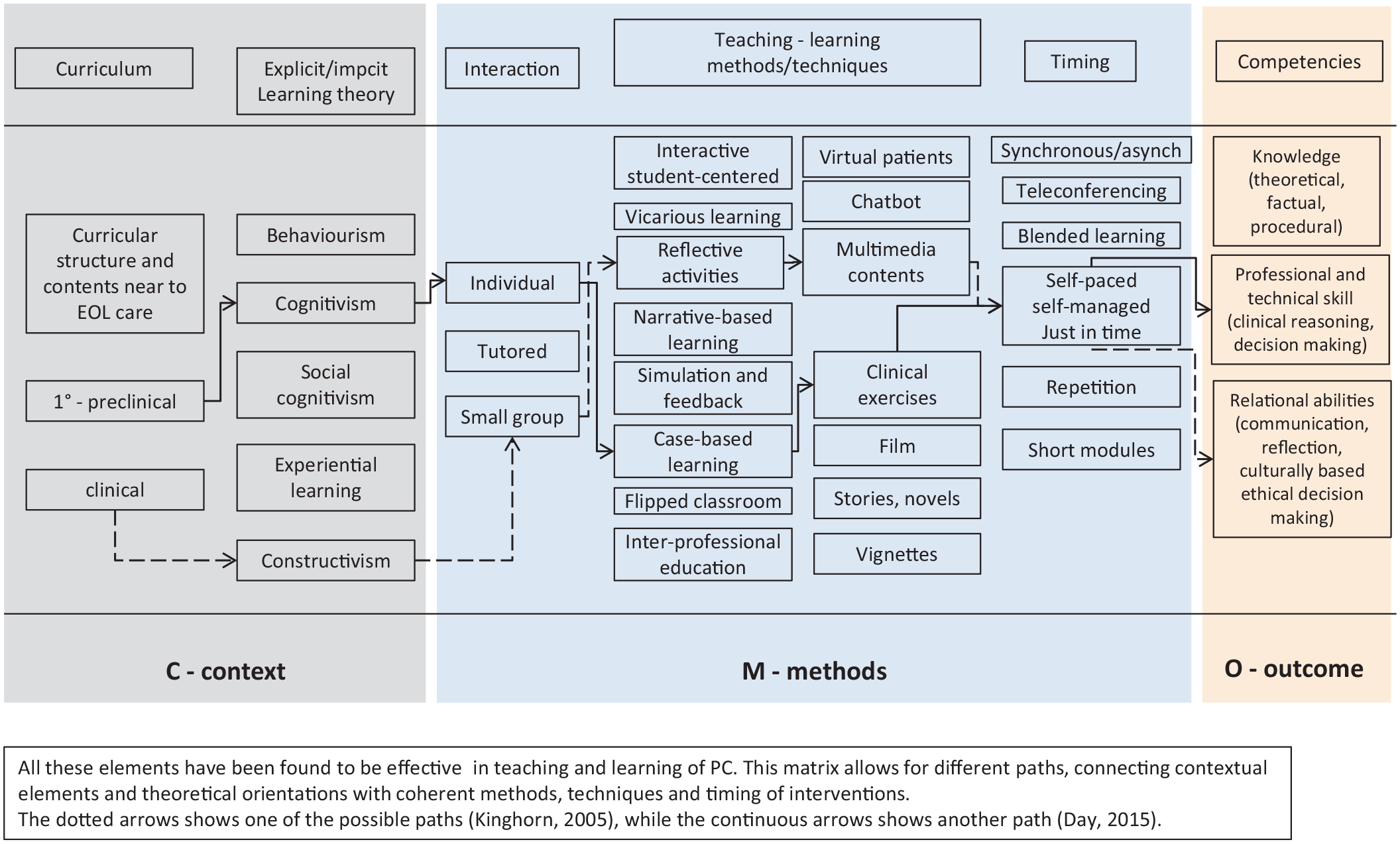
Examples of relevant CMOs found.
Many approaches are possible, and no one-size-fits-all solution seems to emerge from the review of the available literature. From the available experience, we inferred some key elements (column titles in the image), such as the curriculum position in the students’ course of study, the learning theory of reference, the level of interaction, the teaching/learning methods/techniques, the timing, and the expected competences, that can be considered to have higher chances of producing a more coherent educational proposal and therefore a better learning experience.
As we are going to discuss, our results are mainly consistent with what other reviews found, but the theory-based methodology that we adopted adds some insight for decision-makers and managers in the field of PC education.
Discussion
Summary of findings
Our findings suggest that when planning an undergraduate IT-DL curricular activity on PC, it is often suggested to use a Theory-Technology Alignment Framework or similar structures. But we think it might be helpful to consider that many positive experiences are present in literature that do not express the educational theory of reference in an explicit way.
Many experiences seem to have cognitivism as the main implicit theory, and methods consistent with it seem to produce useful experiences, such as clinical exercise solving, case-based learning, and virtual case simulation.
We have similar findings on cognitive constructivism: active learning engages the student in high-order thinking, practical application of knowledge, and multiparty involvement.
We should expect technology to add a specific value that should probably be intentionally considered, stated, and pursued in the curriculum building and application, as IT-DL presents specific disadvantages, and not only possible positive effects.
Contextualization matters, as a consistent consideration of PC in the rest of the curriculum helps. Regarding duration, long forms are preferred in many positively received interventions, but shorter modules have more flexibility.
Strengths, limitations, and future research directions
A good systematic review is only as good as its primary literature. Educational methodology and PC are both fields with specific difficulties in producing methodologically robust evidence.
Furthermore, the research group highlights that some really interesting, yet not present in our review, topics are emerging, such as artificial intelligence and telemedicine opportunities. In fact, the use of artificial intelligence in education still needs to be fully studied and understood. And, because some PC interventions can be delivered online, some training experiences may be performed accordingly, given the rapid growth of telemedicine in recent years.
Comparison with existing literature
Our results are consistent with the already available evidence, but we specify possible design key features that might be helpful in PC undergraduate education.
Theory-Technology Alignment Framework 22 is one example of a possible way of aligning training design, which considers IT in an instrumental way, as a helping device.
The most considered educational theories in the assessed studies were: problem-based learning (16/81, 20%), social learning theory (11/81, 14%), and cognitive theory of multimedia learning (10/81, 12%) 22 : On the other hand, we found it interesting that, as previously stated, in the assessed articles, the learning theory foundation was seldom made explicit, even in successful experiences.
Previous reviews also agree that other factors might be implicated in the delivery of good quality IT-DL: While IT-DL is not inferior to face-to-face teaching for the knowledge and skill outcomes considered,22,25,26,28 factors like adequate provision of exercises and objective outcome assessment 28 have a positive impact, and other meta-analyses23,24 suggest that the use of technology in simulation (but not necessarily in a learning environment) is more effective:
- If interventions are repeated several times
- If feedback is intense
- If the practice is group based.
While several overall theories for distance learning have been proposed, here we recall as a possible comprehensive and sound example, Picciano’s work, 27 which recalls Anderson’s model, where two actors (the student and the teacher) and two resource systems (the asynchronous or synchronous communication channels and the structured contents) interact with each other to produce knowledge.
The learner can act collaboratively and group-paced or independently and self-paced. The teacher can act by encouraging the creation of a research community or by proposing resources and/or structured activities.
Self-pacing and self-management of distance learning proved to be appreciated and effective in large programs; some of the evidence is from programs directed to professionals, though, and this might be a feature preferred by them. 45
Consistently with our work, other authors highlight that the aim is not to find a better method but to determine which method works best for whom 42 : new technologies should facilitate a rethinking of ‘what learning is about. New strategies for how we learn, where we learn, and when we learn should be entertained’.
While the overall principles seem to be mostly applicable to our particular focus of interest, we have been able to condense in this review an ordered sequence of useful experiences that can be considered by decision-makers in PC undergraduate education, to access practical knowledge and instruments for their educational activities. Figure 2 (a visual representation of CMOs) and Table 1 (key questions for educators) might help the decision-makers navigate the available evidence.
Conclusions and recommendations
Our realist review aimed at helping educators use internet-based learning for medical undergraduate students. We presented the main mechanisms we found in the available literature in three groups: the theory of reference, the expected effect, and the contextualization of the educational intervention. We created a list of questions to help educators and decision-makers focus on key aspects of planning their intervention.
We expect this field to experience huge growth in the near future, and present and future research could use a realist approach like the one here presented to make sense of all the different variables involved.
Supplemental Material
sj-docx-1-pcr-10.1177_26323524231218279 – Supplemental material for Online learning in palliative care education of undergraduate medical students: a realist synthesis
Supplemental material, sj-docx-1-pcr-10.1177_26323524231218279 for Online learning in palliative care education of undergraduate medical students: a realist synthesis by Gianfranco Martucci, Jose Pereira, Csilla Busa, Carlos Centeno, Agnes Csikos, Luca Franchini, Frank Elsner, Melania Raccichini, Maria-Mirabela Mihailescu-Marin, Daniela Mosoiu, Sandra Rubio Bernabé, Alexandra Scherg and Fabrizio Consorti in Palliative Care and Social Practice
Supplemental Material
sj-docx-2-pcr-10.1177_26323524231218279 – Supplemental material for Online learning in palliative care education of undergraduate medical students: a realist synthesis
Supplemental material, sj-docx-2-pcr-10.1177_26323524231218279 for Online learning in palliative care education of undergraduate medical students: a realist synthesis by Gianfranco Martucci, Jose Pereira, Csilla Busa, Carlos Centeno, Agnes Csikos, Luca Franchini, Frank Elsner, Melania Raccichini, Maria-Mirabela Mihailescu-Marin, Daniela Mosoiu, Sandra Rubio Bernabé, Alexandra Scherg and Fabrizio Consorti in Palliative Care and Social Practice
Supplemental Material
sj-docx-3-pcr-10.1177_26323524231218279 – Supplemental material for Online learning in palliative care education of undergraduate medical students: a realist synthesis
Supplemental material, sj-docx-3-pcr-10.1177_26323524231218279 for Online learning in palliative care education of undergraduate medical students: a realist synthesis by Gianfranco Martucci, Jose Pereira, Csilla Busa, Carlos Centeno, Agnes Csikos, Luca Franchini, Frank Elsner, Melania Raccichini, Maria-Mirabela Mihailescu-Marin, Daniela Mosoiu, Sandra Rubio Bernabé, Alexandra Scherg and Fabrizio Consorti in Palliative Care and Social Practice
Supplemental Material
sj-pdf-4-pcr-10.1177_26323524231218279 – Supplemental material for Online learning in palliative care education of undergraduate medical students: a realist synthesis
Supplemental material, sj-pdf-4-pcr-10.1177_26323524231218279 for Online learning in palliative care education of undergraduate medical students: a realist synthesis by Gianfranco Martucci, Jose Pereira, Csilla Busa, Carlos Centeno, Agnes Csikos, Luca Franchini, Frank Elsner, Melania Raccichini, Maria-Mirabela Mihailescu-Marin, Daniela Mosoiu, Sandra Rubio Bernabé, Alexandra Scherg and Fabrizio Consorti in Palliative Care and Social Practice
Supplemental Material
sj-xlsx-5-pcr-10.1177_26323524231218279 – Supplemental material for Online learning in palliative care education of undergraduate medical students: a realist synthesis
Supplemental material, sj-xlsx-5-pcr-10.1177_26323524231218279 for Online learning in palliative care education of undergraduate medical students: a realist synthesis by Gianfranco Martucci, Jose Pereira, Csilla Busa, Carlos Centeno, Agnes Csikos, Luca Franchini, Frank Elsner, Melania Raccichini, Maria-Mirabela Mihailescu-Marin, Daniela Mosoiu, Sandra Rubio Bernabé, Alexandra Scherg and Fabrizio Consorti in Palliative Care and Social Practice
Footnotes
Acknowledgements
Many thanks to the ELPIS research group: Guido Biasco, Andrea Giannelli, Silvia Varani (ANT), Laura Iosub, Nicoleta Mitrea (Brasov), Veronika Osztromok-Lukacs, Katalin Takacs, Nora Frank (Pecs), Silvia Lai, and Roberto Caronna (Roma), who provided organizational support and useful insights and feedbacks on the subsequent drafts of the work as partners of the ELPIS projects.
Declarations

Supplemental material
Supplemental material for this article is available online.
References
Supplementary Material
Please find the following supplemental material available below.
For Open Access articles published under a Creative Commons License, all supplemental material carries the same license as the article it is associated with.
For non-Open Access articles published, all supplemental material carries a non-exclusive license, and permission requests for re-use of supplemental material or any part of supplemental material shall be sent directly to the copyright owner as specified in the copyright notice associated with the article.
