






Abstract
Objective
The Thai Medical School Palliative Care Network conducted this study to establish the current state of palliative care education in Thai medical schools.
Methods
A questionnaire survey was given to 2 groups that included final year medical students and instructors in 16 Thai medical schools. The questionnaire covered 4 areas related to palliative care education.
Results
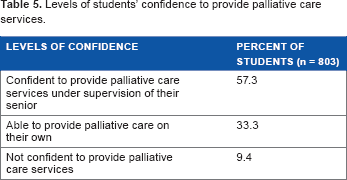
An insufficient proportion of students (defined as fewer than 60%) learned nonpain symptoms control (50.0%), goal setting and care planning (39.0%), teamwork (38.7%), and pain management (32.7%). Both medical students and instructors reflected that palliative care education was important as it helps to improve quality of care and professional competence. The percentage of students confident to provide palliative care services under supervision of their senior, those able to provide services on their own, and those not confident to provide palliative care services were 57.3%, 33.3%, and 9.4%, respectively.
Conclusions
The lack of knowledge in palliative care in students may lower their level of confidence to practice palliative care. In order to prepare students to achieve a basic level of competency in palliative care, each medical school has to carefully put palliative care content into the undergraduate curriculum.
Background
Since there are increasing numbers of aging peoples and medical technologies that keep people alive much longer, it is generally considered that the care of this group of people is the responsibility of general practitioners or family doctors. 1 Only if the patients have suffering of such severity, complexity, or rarity that their doctors cannot be expected to look after them will a specialist be needed. In order to provide palliative care for all patients who may require it, it is essential that doctors obtain the core skills in palliative care during their undergraduate training–a finding identified in the United Kingdom by the General Medical Council in the document Tomorrow's Doctors: Recommendations on Undergraduate Medical Education.1–3 Moreover, the World Medical Association recommended that medical school curricula should include the teaching of palliative care. 4 The World Health Organization also suggested that palliative care services require skills in the following areas: communication, decision-making, management of complications of treatment and the disease, management of pain and symptoms, psychosocial care for the patient and family, spiritual understanding and approaches, care of dying, and bereavement care. 5 Despite increased education and teaching of palliative care, junior doctors still report that this is an area in which they feel most unprepared and that causes them the greatest distress.6,7
Palliative care education is well established in many countries, but it is still at an early stage in Thailand. Although palliative care education at medical schools has increased in Thailand within the last few years, it showsa wide variation among different medical schools, and there is no standardized Thai core curriculum. Before creating a Thai undergraduate core curriculum in palliative care, the Thai Medical School Palliative Care Network conducted this study to establish the current state of palliative care education in Thai medical schools. Moreover, we would like to promote collaboration in the development of palliative care education among all of those schools.
Methods
The research proposal was approved by the Ethics Review Board of the Faculty of Medicine at Prince of Songkla University in Thailand. A questionnaire was developed by an interdisciplinary panel of experts in palliative care coordinated by the Thai Medical School Palliative Care Network. We adopted the first 3 steps of the task-oriented model of program evaluation in the process of questionnaire development. 8 First, we examined the evaluation need. Second, we determined what was to be evaluated. Third, we discussed when, where, and how it should be done and what to analyze. From the results of these 3 steps, we developed a self-administered questionnaire. This questionnaire covered 4 areas related to palliative care education: (1) the perceived definitions of palliative care among Thai medical students, (2) what students have learned in palliative care, (3) the importance of palliative care education on medical professional responsibilities, and (4) confidence to provide palliative care services.
Sixteen medical schools participated in this study. Prior to the questionnaire survey, a research coordinator in each medical school was identified. The exact numbers of final year medical students and instructors were reported by the coordinators. Then the questionnaire survey was given to final year medical students in 12 medical schools (there were no final year medical students in 4 medical schools) and to instructorsin 15 medical schools (there was no formal teaching of palliative care in 1 new medical school).
The perceived definitions of palliative care were explored using an open-end question, and the questionnaire asked them to identify palliative care according to their understanding of it. Coding of the answers was done by 2 doctors. Keywords for coding were taken from Palliative and End of Life Care Glossary of Terms, Palliative Care Australia. 8
Results
The response rate for students was 51.1% (879/1720), and the response rate for instructors was 21.3% (503/2359). The answer to the first research question was answered by 50.1% (862/1720) of the students. After we excluded the incomplete questionnaires, the response rate for students was 46.7% (803/1720), and the response rate for instructors was 21.0% (495/2359).
Keywords relating to palliative care identified by medical students.

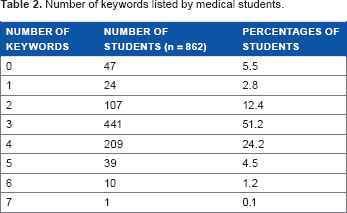
Number of keywords listed by medical students.
Percentage of students who have learned content areas relating to palliative care (n = 803).

Important areas of palliative care education for medical professional responsibilities.

Levels of students’ confidence to provide palliative care services.
Discussion
Thai medical students defined palliative care similar to the World Health Organization (WHO) definition of palliative care. WHO defines palliative care as an approach that improves the quality of life of patients and their families facing problems associated with life-threatening illness, through the prevention and relief of suffering by means of early identification and impeccable assessment and treatment of pain and other problems related to physical, psychosocial, and spiritual matter. 10 However, they focus on the end of life and end-of-life care. Most medical students are still lack learning in some important domains recommended by the European Association of Palliative Care. 1 This association suggests that the content of the curriculum should comprise 7 domains of palliative care in order to achieve a basic level of competency. These 7 domains are (1) palliative care, palliative medicine (definitions), (2) pain, (3) neuropsychological symptoms (agitation, confusion), (4) management of other symptoms (dyspnea, nausea), (5) ethics and law, (6) patient/family/nonclinical caregiver perspectives, and (7) clinical communication skills. Both medical students and instructors perceived that palliative care education influenced the improvement of quality of care and professional competence.
Palliative care education has importance in improving the quality of care and professional competence. The results of our study corresponded to what Catto suggested in his report that “if the medical regulators are to sustain the confidence of the public, the medical profession, and the government, they must ensure that they are competent and fit for purpose, and have the interests of the patient at the heart of everything they do.” 11
The majority of students were confident to provide palliative care services under supervision. Only 33.3% of the students were able to provide services on their own. The result was similar to a study done by Weber and colleagues in 2011. They asked the final year medical students in Germany to self-estimate their confidence in 4 domains that included the overall domain, psychological domain, somatic domain, and spiritual domain. From their study, 32% of the students were confident to provide palliative care services. 12 In 2012 at Prince of Songkla University in Thailand, Srisawat and Phungrassami conducted a questionnaire survey to evaluate the final-year medical students’ perception of their competencies related to palliative care. The results showed that about 80% of them were confident to manage the cases independently or under supervision, 13 whereas the combined total result of this study was 90.6%, which included the percentage of students who were confident to provide services under supervision of their senior (57.3%) and those who able to provide services on their own (33.3%). Even though the students reported that they lacked the education, they still had a sense of confidence. The possible explanation is they may have learned palliative care from their clinical experience without the perception that it was learning.
There were some limitations in this study. There was a low response rate from the instructors despite several efforts to improve recruitment. It may indicate their apparent lower interest in actually teaching palliative care. The response rate was fairly good from medical students. It may indicate an interest by the students in palliative care. Moreover, the voluntary response rates in both groups may have led to a selection bias.
Conclusion
Thai medical students did not learn enough in important areas that are recommended by the European Association of Palliative Care. The majority of students were confident to provide palliative care services under supervision. A lack of knowledge about palliative care in students may lower their level of confidence to practice palliative care. To prepare students to achieve a basic level of competency in palliative care, each medical school has to carefully put palliative care content into the undergraduate curriculum. Moreover, a new upcoming Thai undergraduate core curriculum in palliative care initiated by the Thai Medical School Palliative Care Network will need to cover all important content areas.
Author Contributions
All authors have contributed sufficiently to the project to be included as authors. KS wrote the initial draft of the paper. All authors contributed to the revision of this draft and approved the final manuscript for publication.
Disclosures and Ethics
As a requirement of publication the authors have provided signed confirmation of their compliance with ethical and legal obligations including but not limited to compliance with ICMJE authorship and competing interests guidelines, that the article is neither under consideration for publication nor published elsewhere, of their compliance with legal and ethical guidelines concerning human and animal research participants (if applicable), and that permission has been obtained for reproduction of any copyrighted material. This article was subject to blind, independent, expert peer review. The reviewers reported no competing interests.