




Abstract
Study Design
Technical note
Objective
To introduce a new technique for the purpose inter-maxillary fixation (IMF) that is simple, quick, and minimally invasive.
Method
-IMF with wire has been used for treating fractures pertaining to the maxillomandibular complex for both closed reduction and as an adjunct to open reduction. Here we present a new type of technique using 24 gauge stainless steel wires providing stabilization from lingual side which gives 3-dimensional stability.
Result
This technique is rapid and simple for IMF.
Conclusion
This technique can be effectively used in cases of simple facial fracture, orthognathic surgery, tumor resection, or where prolonged post-operative IMF is not required.
Technique
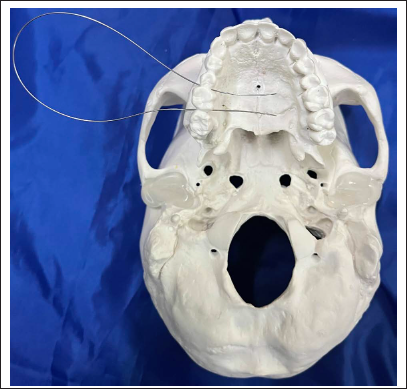
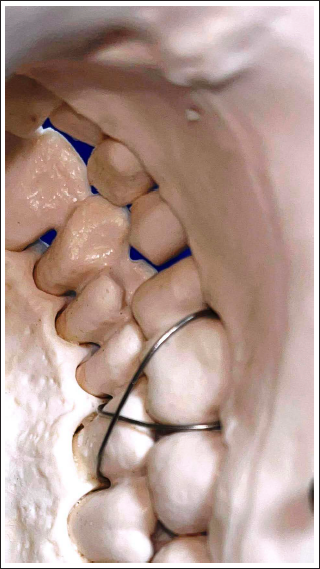
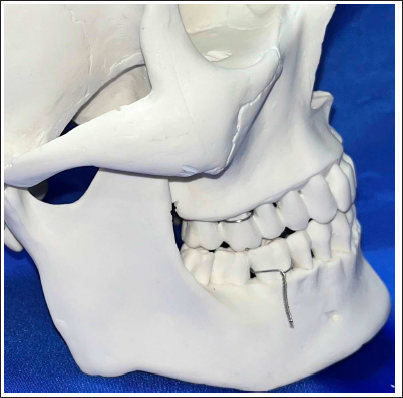
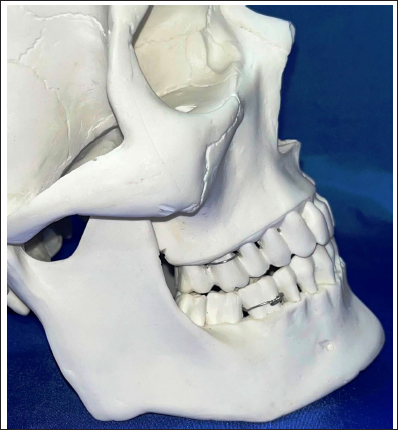
After stretching it 10% from its original length, a wire of 24 gauge is used. The wire measures 8 to 10 inches in length and is preformed in the shape of a “U”. The wire is passed through the distobuccal side of the maxillary first molar on one end and the mesiobuccal side on the other (Figure 1). The mesiobuccal end of the wire is passed on towards the distolingual side of the mandibular first molar, while the distobuccal end is passed through the mesiolingual side of the mandibular first molar (Figure 2). After the desired occlusion is achieved, the ends are brought together and twisted on the buccal aspect of the mandibular teeth (Figure 3). A loop is formed, and the wire is tucked into the interdental cervicogingival level for inter-maxillary fixation (IMF) to avoid impingement on the mucosa (Figure 4). In this way, a single cross brace is formed. 2 The same steps are then followed on the opposite side.
Wire Passed from Mesiobuccal and Distobuccal Side of the Maxillary First Molar Towards Palatal Side.
Cross Brace With Single Wire.
Twisted Wire on the Buccal Aspect of the Mandibular Teeth.
Wire Tucked into the Interdental Space.
Prerequisites for the technique are tight contact in the posterior teeth and periodontally healthy maxillary and mandibular molars.
It can be used intraoperatively to keep the maxillomandibular unit in the desired reduction before plating as well as for immobilizing the jaws postoperatively.
However, this technique is not indicated in patients who are partially or completely edentulous, who do not have proper tight contact in the posterior teeth, or who need long-term IMF.
Advantages
Rapid procedure
Oral hygiene can be easily maintained.
Less technique-sensitive 3
Two-way stability can be achieved
Indications
In patients with simple facial fractures, orthognathic surgery, tumor resection, and pediatric mandibular fractures, where prolonged postoperative IMF is not required.
Contraindications
Partially or completely edentulous patients who do not have tight contact in the posterior teeth
Periodontally compromised maxillary and mandibular molars
Discussion
This technical note aimed to put forth a rapid method for achieving IMF with a good outcome. This technique can be an alternative to conventional techniques like IMF screws and arch bars for selective patients, as it is less time-consuming; moreover, it has been noted that screws may damage tooth roots, whereas an arch bar requires the insertion of numerous wires, which causes discomfort to the patient and makes it difficult for them to maintain oral hygiene.
The complications encountered by these conventional methods are overcome by doing IMF with a single wire.
However, the single-wire technique cannot be used in the management of severely displaced fractures, and the technique’s long-term IMF is questionable. 4
Footnotes
Declaration of Conflicting Interests
The authors declared no potential conflicts of interest with respect to the research, authorship, and/or publication of this article.
Funding
The authors received no financial support for the research, authorship, and/or publication of this article.
Statement of Informed Consent and Ethical Approval
Not applicable.
