



Abstract
In this paper we draw attention to the relevance of informal training in entrepreneurship for advancing sustainable and inclusive rural development. Adopting a perspective inspired by Paulo Freire’s Pedagogy of the Oppressed, we explore how the informal training facilitated by CARE International’s village savings and loan associations (VSLAs) impacts the lives and livelihoods of members of these associations in a rural region of Rwanda. Based on our findings from a qualitative interview study of multiple stakeholders, we show how this informal training is facilitated through CARE’s train-the-trainer methodology and through regular dialogue, peer feedback and reflection at weekly group meetings. Our analysis highlights how such training emancipates and empowers participants, enabling them to act more reflectively and make more informed decisions in their efforts to improve their socioeconomic circumstances through entrepreneurial activities. Whereas prior research has tended to measure the impacts of membership in VSLAs on financial outcomes quantitatively, our qualitative study explores how VSLAs also contribute to the creation not only of economic but socio-cultural value in rural settings.
Keywords
Introduction
Fostering entrepreneurship is ever more widely recognized as a vital means of promoting job creation, economic growth and development (Acs et al., 2018; for a more critical view da Costa & Saraiva, 2012). Based on the hope that expanding entrepreneurship education will directly translate into higher levels of entrepreneurial intention and activity, manifold forms of entrepreneurship education and training have emerged in diverse country contexts over recent decades (Pittaway & Cope, 2007). Training aimed at supporting rural entrepreneurship in particular has gained growing support from politicians and key developmental actors as a way of tackling rural poverty, with scholars likewise now beginning to explore how entrepreneurial ecosystems can be created and developed in rural areas (Liedtke et al., 2021).
Although training in rural entrepreneurship has expanded significantly, empirical evidence and analyses of the effects of such training remain somewhat mixed, however, with increasing consideration given to context-specific factors (Lee et al., 2018). This inconclusiveness may be attributable in part to the multidimensional causes of rural poverty, which vary across regions and within countries (Liu & Li, 2017). Among the complex problems faced by rural populations across the world, Pato and Teixeira (2016) have nonetheless identified the following typical challenges: a rapid decline in employment in the agricultural sector and a lack of alternative employment opportunities; a poor socioeconomic environment with low quality infrastructure in key areas such as transportation; long distances to markets and services; a sparse and ageing population; and limited access to essential public services such as education and healthcare. While many economies worldwide are struggling with rural poverty, the International Fund for Agricultural Development reported in 2020 that the countries of sub-Saharan Africa together account for no less than 76% of global rural poverty (IFAD, 2020).
Previous studies assessing the impacts of entrepreneurship training in sub-Saharan Africa and other developing regions and countries have yielded valuable insights, including Jesselyn Co and Mitchell’s (2006) survey of such training in higher education institutions in South Africa. However, the focus of such studies has primarily been on formal entrepreneurship training, i.e., on training leading to a certificate or degree. With our present study on Rwanda, by contrast, we explore how rural development can be advanced in developing countries through informal entrepreneurship training. This focus is especially salient since research has shown that informal training positively affects self-efficacy as a prerequisite and predictor of entrepreneurial intention, through techniques such as having real entrepreneurs as role models and mentors (Sharafizad, 2017), ‘learning by doing’ (Coetzer et al., 2017), joining professional networks (Dehghanpour Farashah, 2013), and acquiring action principles based on good scientific evidence in intervention settings (Glaub et al., 2014). Another reason for examining informal training is that formal entrepreneurship programs are often not very effective in developing countries. This is partly because the contents and pedagogical tools designed for these programs were often originally aimed at Western contexts and lack applicability in other settings, though also because developing countries often lack teachers sufficiently qualified and experienced in entrepreneurship (e.g., Alese, 2014). Unlike formal programs, a potential advantage of informal training is that it is likely to be much easier to adjust to the needs of specific contexts and target groups in the rural populations of developing countries. At present, however, few opportunities are available for informal training in rural areas, especially for women entrepreneurs (Davis, 2012).
To explore how informal entrepreneurship training can contribute to enhancing rural development, we conducted interviews with a range of actors involved or participating in village savings and loan associations (VSLAs) in Rwanda organized by CARE International, one of the world’s leading NGOs focused on combatting rural poverty with a specific focus on the empowerment of women and girls. Although such associations have been hailed as models for positively influencing socio-economic empowerment, recent years have seen the emergence of more critical assessments. In the case of VSLAs in Rwanda, for example, a recent study by Poole (2021) has problematized the dominant narrative of success and its central claim that such savings groups lead to productive entrepreneurship for perpetuating a neoliberal agenda while failing to address the country’s economic problems. Whereas Poole’s work is focused on assessing the economic outcomes of VSLAs, however, in this study we apply a critical perspective inspired by Paulo Freire’s (1970/1996) Pedagogy of the Oppressed to analyze the impacts of the informal training provided by VSLAs. In this way we aim to develop a deeper understanding and more nuanced account of how these pedagogic activities can contribute to rural development, including by nurturing non-economic value creation.
Rural Entrepreneurship and the Role of VSLAs
VSLAs have emerged as a way to address insufficient access to finance as the single greatest obstacle to entrepreneurial activity among rural populations (e.g., Kaumba et al., 2021). Recent decades have seen a proliferation of microfinance institutions worldwide, positioning microloans as instruments for solving limited access to finance (Bruton et al., 2015), thereby enabling large segments of society to benefit from financial services (Khavul et al., 2012). However, microfinance institutions have tended to be concentrated in urban and semi-urban areas (e.g., Allen & Panetta, 2010). As community-based financial institutions serving economically vulnerable and marginalized groups (Isaac & Remmy, 2017), VSLAs are intended to enhance economic development by overcoming the “last mile problem of microfinance” (Ksoll et al., 2016), i.e., by providing some of the world’s poorest people with access to financial services such as savings, credit and insurance schemes (Burlando & Canidio, 2017; Flora et al., 2015).
Becoming a member of a VSLA enables poorly resourced individuals to establish or develop their own small businesses or otherwise engage in typically small-scale income-generating activities (Cassidy & Fafchamps, 2020; Chineka & Mtetwa, 2021). Beyond these benefits at the level of individuals and households, research has also identified a positive relationship between VSLA activities and accelerated socio-economic development among rural populations (Karlan et al., 2017). For example, Ksoll et al.’s (2016) study of the impact of VSLAs in Northern Malawi found that villages with VSLAs activities tend to have substantially higher savings and more livestock than villages with no such activities, while Burlando and Canidio’s (2017) research on Ugandan savings groups suggests that, depending on certain mechanisms, membership of these groups can improve financial inclusion even for ultra-poor households. Other studies have found evidence that access to financial capital through VSLAs has a positive impact on children’s nutrition, health, housing, and living conditions (Abubakari et al., 2014; Chineka & Mtetwa, 2021; Nnama-Okechukwu et al., 2019). For example, Cameron and Ananga (2015) found that money obtained from VSLA activities helped villagers to pay for their children’s educational expenses, while Ksoll et al.’s (2016) cluster randomized trial calculated that income generated from VSLA activities increased the number of meals consumed per day by its members’ families. As an important additional further benefit of such associations, Karlan et al. (2017) have highlighted how VLSAs empower women, not only increasing their influence over household budgeting and education and healthcare costs but also over business expenses.
Whereas numerous studies have thus assessed the socio-economic impacts of VSLAs in terms of savings generated, loans taken, and subsequent changes in the socio-economic status of group members, our research focus is on the informal training provided by VSLAs as an important but often overlooked aspect of their work. Such training includes instruction in financial literacy, bookkeeping and business development (Cassidy & Fafchamps, 2020), capacity-building to empower women, and awareness-raising aimed at transforming gender norms and improving maternal and child health outcomes (Bapolisi et al., 2020). Of particular relevance here is a recent study by Schoofs (2022) on the financial literacy training provided by VSLAs in rural Rwanda. While Schoofs highlights the need for such training in contexts where individuals risk failing to identify and act on crucial business opportunities due to their inability to make informed decisions about financial resources and investments, her study concludes that a ‘one-size-fits-all’ approach to training with limited personalized feedback reduces the quality of instruction and the engagement of trainers and students, significantly undermining the potential effectiveness of financial literacy training.
In sum, although previous research has highlighted the importance of the informal training available to VSLA members, we still lack a deep understanding of how this informal training makes an impact on VSLA members’ rural entrepreneurship activities. This deficit can be mainly ascribed to the quantitative methods used in prior studies to assess the impacts of informal training. To address this research gap, we focus on informal training sessions held by VSLAs and their effects on group members to shed light on how these associations contribute to enhancing rural entrepreneurship through such training.
Freire’s Theory of a Pedagogy of the Oppressed
Our study is inspired by Paulo Freire’s (1970/1996) Pedagogy of the Oppressed. One of the main aims of Freire’s critical pedagogy is to help oppressed people gain liberation through education in a process consisting of two main stages: a stage of reflection in which learners reflect on their current situation, followed by concrete action to change and improve that situation. In contrast to the traditional ‘banking model’ of education in which teachers ‘deposit’ facts into the minds of their students and then ask them to memorize and reproduce these facts, in Freire’s pedagogy the two stages of reflection and action are facilitated by a “problem-posing model” that rejects and supplants the typical power relationship between teachers and students. In this model, learners are treated as active participants engaged in producing “generative themes” by critically assessing their own worlds and then linking this knowledge to take action – at local level and beyond – to tackle the challenges they identify in their communities and societies. As such, Freire’s theory is highly relevant to our focus on informal entrepreneurship training in Rwanda, since the aim of VSLAs is likewise to empower their members by engaging them in “actionable learning” that can be put directly to practical use. Importantly, applying a Freire-inspired perspective to informal entrepreneurship training must proceed from an understanding that people bring their own knowledge and experiences into interactive dialogue as a crucial element in the learning process.
The Use of Freire’s Work in Prior Research on Entrepreneurship Education.
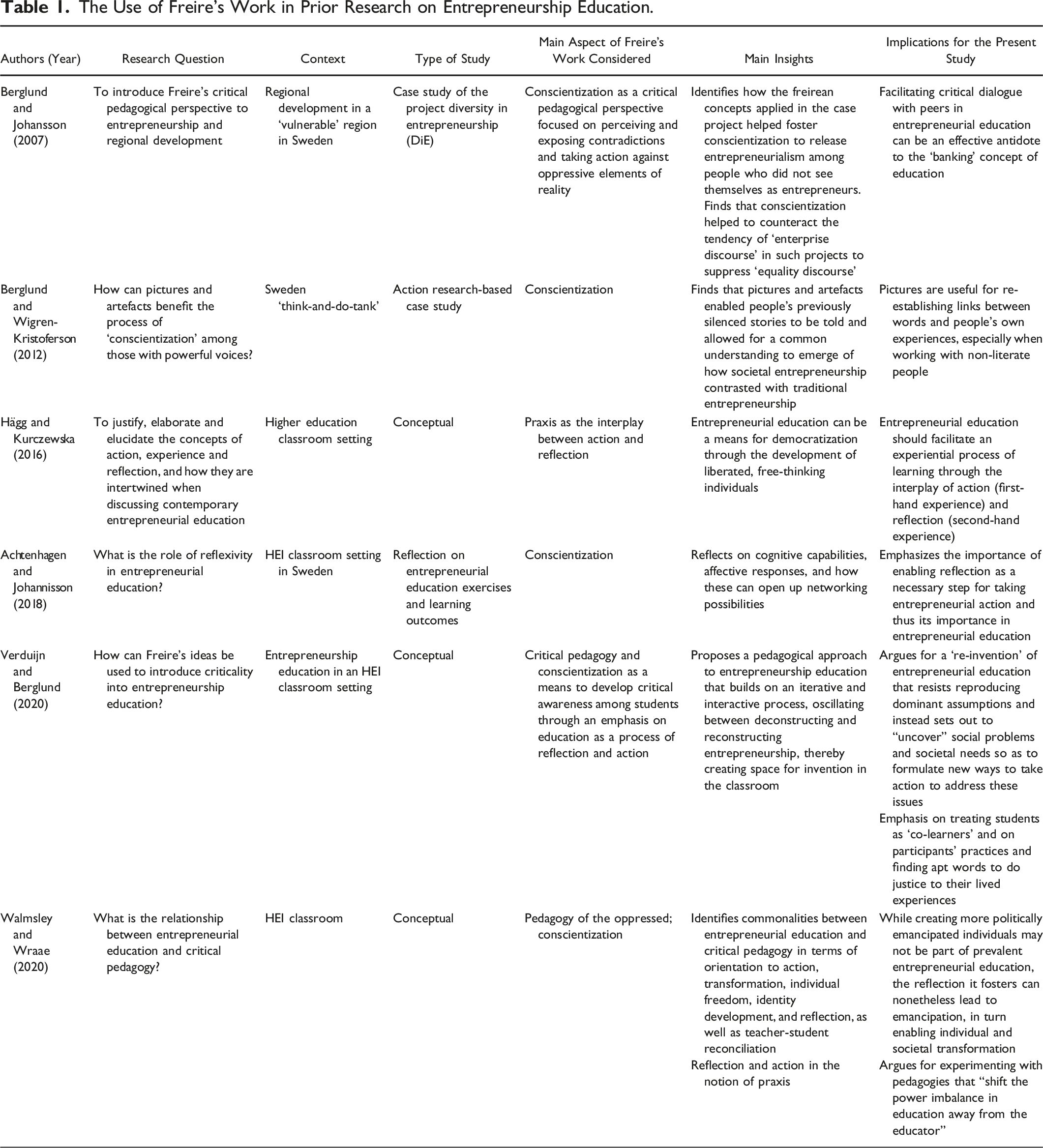
In their study of a regional development project aimed at boosting entrepreneurialism in a vulnerable region of Sweden, Berglund and Johansson (2007) not only applied Freire’s critical pedagogic perspective to entrepreneurship but analyzed the application of Freirean logic and principles by key actors in this project. Consistent with the premise that there is at least latent entrepreneurial potential in every individual, their study sought to identify which kinds of processes catalyze entrepreneurial initiatives among people who do not typically regard themselves as entrepreneurs, highlighting how dominant “enterprise discourses” clashed with the Freirean “equality logic” built into the project.
Building on Freire’s concepts of conscientization, referring to a kind of learning focused on perceiving and exposing contradictions and on taking action against the oppressive elements of reality, and epistemological curiosity, Achtenhagen and Johannisson (2018) have underscored the importance of fostering reflexivity in entrepreneurial education and identified ways of developing the “generalized form of self awareness” and “care for the world” needed for students to position themselves as “learning subjects beyond educational settings” capable of taking ethical entrepreneurial action. Freire’s work and concepts are also touched upon in Hägg and Kurczweska’s (2021) conceptual paper on the philosophical foundations of experience-based entrepreneurship education, and are also mobilized by Verduijn and Berglund’s (2020) in proposing a pedagogical approach to entrepreneurship education which builds on an iterative and interactive process, oscillating between deconstructing and reconstructing entrepreneurship, creating space for invention in the classroom.
In sum, these prior studies have mainly drawn inspiration from Freire’s work to explore formal entrepreneurship education in higher education settings and how such training might be better conceptualized. More empirical exploration is needed to substantiate these initial ideas about the usefulness of applying Freire’s theory in entrepreneurial practice as a means for rural development, however, especially in the kind of disadvantaged contexts Freire had in mind when developing his thoughts. We contribute to addressing this gap with our empirical study, the context and methods of which are described in the following sections.
The Context: Rwanda
Given that the challenges and prerequisites for effective entrepreneurship education vary greatly across contexts, it is important to take account of the salient contextual factors in our research setting of rural Rwanda, including the country’s socio-economic development and prior and ongoing efforts to stimulate rural development through entrepreneurship training and support for women’s empowerment. These factors constitute crucial background information for attaining an understanding of our analysis of the role of informal entrepreneurship training for rural development in Rwanda.
Ever since the terrible Genocide against the Tutsi in 1994 when over a million lives were shed, the Rwandan government has been focused on rebuilding the country’s disrupted society and economy. Various public institutions and agencies have been established to support this reform process, together with a plethora of policies, laws and regulations aimed at building a strong foundation for socio-economic development. Among these measures, a number of initiatives have been undertaken to promote entrepreneurial activities and small-scale businesses, particularly in rural areas, including the establishment of savings and loan groups as microfinance institutions to help poor households access finance. The government’s facilitation of these types of financial services as part of its Economic Development and Poverty Reduction Strategy II (2013–2018) (Government of Rwanda, 2013, p. 48) was widely hailed as a critical measure for increasing financial inclusion as a prerequisite for sustainable economic development. Indeed, the developmental approach taken by Rwanda has generally been very positively received (e.g., Biedermann, 2016). Only recently have more critical evaluations emerged of the country’s approach to microcredit and other related programs, including claims that the measures implemented to date have largely failed to address the economic challenges typically faced by developing countries. For example, Poole (2021) has highlighted the unintended consequences of Rwanda’s “neoliberal” prescription of entrepreneurship and SME development, including the opportunity costs encouraging savings at the sacrifice of consumption.
Trends in Literacy Among the Rwandan Population and in the Enrolment of Students in Secondary Schools and Higher Education Institutions.
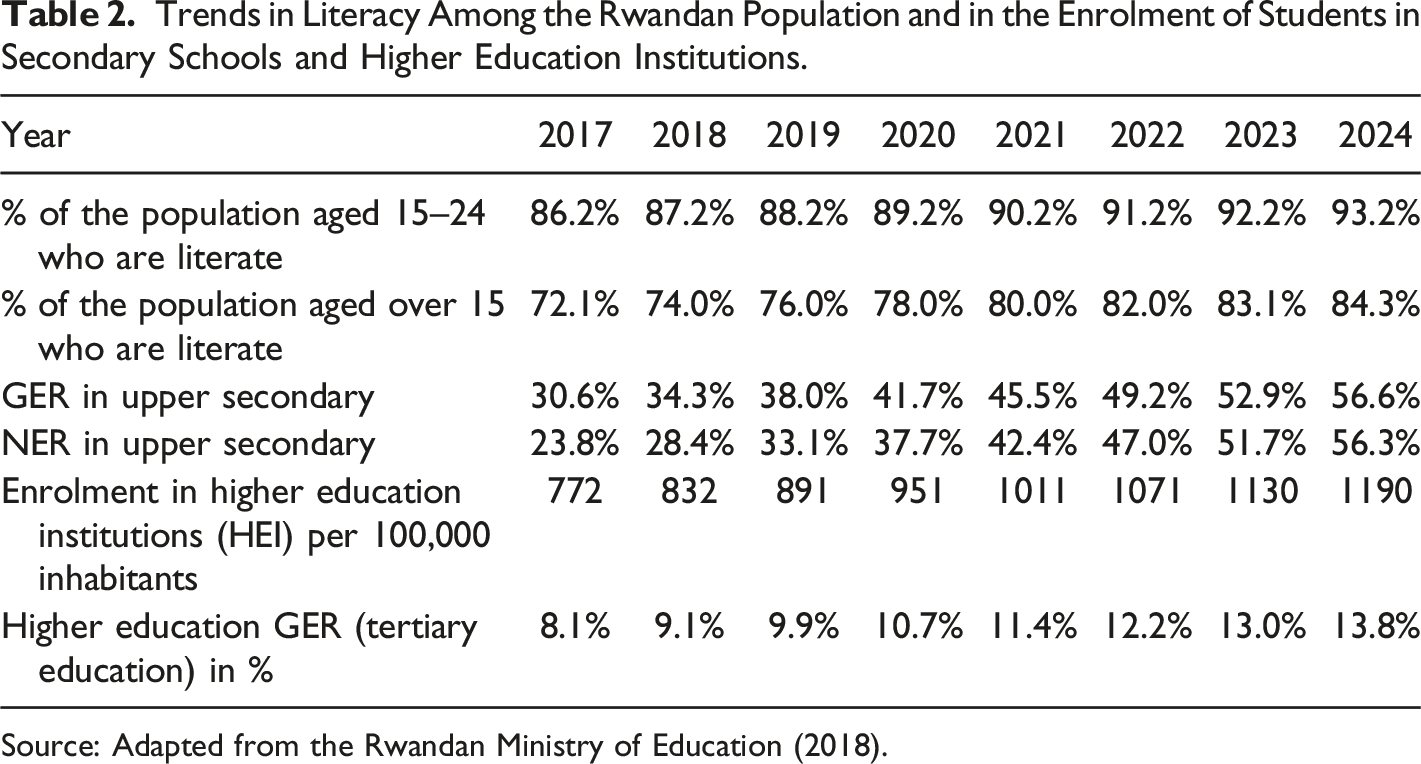
Source: Adapted from the Rwandan Ministry of Education (2018).
In this context, the situation of women and girls in rural areas of Rwanda is of particular relevance to our research focus on the role played by informal entrepreneurship training in empowering vulnerable and poor people. For while females greatly outnumbered males in Rwanda’s population following the Genocide against the Tutsi of 1994, this new gender ratio did not lead to greater gender equality. For example, women continue to face socio-economic exclusion, with far fewer employment opportunities and lower levels of income than men, especially in rural areas, while girls’ education in villages has often been’, as there has recently been a new policy for longer schooling been put in place limited to primary school (Nyataya, 2018). Women who are dependent on agricultural wage labor are also among the most deprived economic subgroups of the population, with extreme poverty affecting many widowed female heads of rural households (East African Community Secretariat, 2009).
Over the years, NGOs - based on government programs and orientations - have undertaken numerous initiatives in Rwanda to assist and empower women and girls in rural poverty, including through projects to help them develop financial and business skills and gain greater access to and control over resources. A common aim of these projects has thus been to increase economic opportunities for women in rural areas by helping them build their capacities to generate sustainable incomes, e.g., through developing and applying their entrepreneurial skills to set up or develop their own small businesses (Kagaba, 2015). Given that most entrepreneurial activities in rural Rwanda are related to agriculture, however, achieving this aim entails overcoming several major obstacles impeding women’s stronger engagement in this sector.
One such impediment to women’s socioeconomic empowerment are intra-family conflicts frequently observed among rural households in Rwanda (Bahati et al., 2022). Fuelled by post-genocide tensions and the effects of wider socio-economic and cultural changes on rural communities, including challenges to traditional gender roles, such intra-family conflict renders women more financially precarious and socially vulnerable due to divorce and disrupted social ties (Ndushabandi et al., 2001). In addition to the traumatic and destabilizing effects of physical and mental domestic abuse, the breakdown of family relations reduces women’s capacities to participate more productively and profitably in the rural economy, with adverse consequences not only for themselves and their children but for the long-term prospects of attaining sustainable rural development, since increased productivity in the agricultural sector drives growth in all other parts of the rural economy (e.g., Ntaganira et al., 2008). Recognizing the need to mitigate and prevent such consequences, the government has led numerous initiatives to overcome intra-family conflicts, including projects implemented by the Rwandan Ministry of Gender and Family Promotion, the Ministry of Justice, and the Ministry of Local Government.
Another persistent obstacle to the greater socio-economic inclusion and engagement of women in rural entrepreneurship is their low rate of participation in agricultural extension services in Rwanda, as highlighted over a decade ago in a gender analysis conducted by the East African Community Secretariat (2009, p. 18). Such agricultural advisory services include state-supported measures to improve the productivity and livelihoods of smallholders through the dissemination of knowledge and agronomic techniques to promote more efficient farming. Efforts to increase women’s access to and participation in these services is one of the priorities of VSLAs.
Overcoming these and other gender-based challenges is a key aim for NGOs involved in the creation and development of the creation and development of various smallholder cooperatives in Rwanda, including the VSLAs set up by CARE International that we examine in this paper. Far from serving solely as micro-financing institutions, these village-level associations also support their members through knowledge exchange about the processing and marketing of agriculture commodities. In doing so, VSLAs further afford abundant opportunities for informal and formal learning. Our empirical study thus focuses on the activities facilitated by VSLAs to explore how informal training advances rural entrepreneurship.
Method
Research Design
To explore the impacts of informal entrepreneurship training from a Freirean perspective beyond merely quantifiable results, we adopted a qualitative approach and research design for this study. In choosing to focus only on the operations and activities of VSLAs set up in Rwanda by the NGO CARE International (hereafter “CARE”) to foster the socio-economic empowerment of the rural poor, we sought to obtain more in-depth insights into the methods and outcomes of informal training for members of these associations. This NGO is especially apt for our research purpose because, although different forms of local saving groups have long existed in several African countries (Maliti, 2017), CARE was the first organization to launch VSLAs as an innovative and more sustainable form of financial access combined with training in rural entrepreneurship (Nnama-Okechukwu et al., 2019). CARE conducts a range of activities in different provinces of Rwanda. Beyond VSLAs, these activities include projects for preventing the spread of HIV/AIDs, supporting water-system rehabilitation and the community management of water systems, health education, agroforestry and sustainable land use, community-assisted shelter projects, and the promotion of women’s participation in agricultural production.
Data Collection
As the sites for our data collection in this study, we selected five VSLAs located in rural areas of the Ruhango district in Rwanda’s Southern Province, one of the districts where CARE first introduced its VSLA methodology in 2006. The five associations we selected were each established at different times between 2006 and 2012 and thus had various levels of experience operating as VSLAs. Such variation in experience enabled us to attain a more nuanced understanding of how VSLAs contribute to enhancing rural entrepreneurship through informal training. In all five VSLAs, agriculture and livestock were the main income-generating activities for group members, with the most common crops being cassava, rice, sweet potatoes, maize, and beans, while the most typical animals raised are cows, goats, pigs, rabbits and hens.
List of Informants.
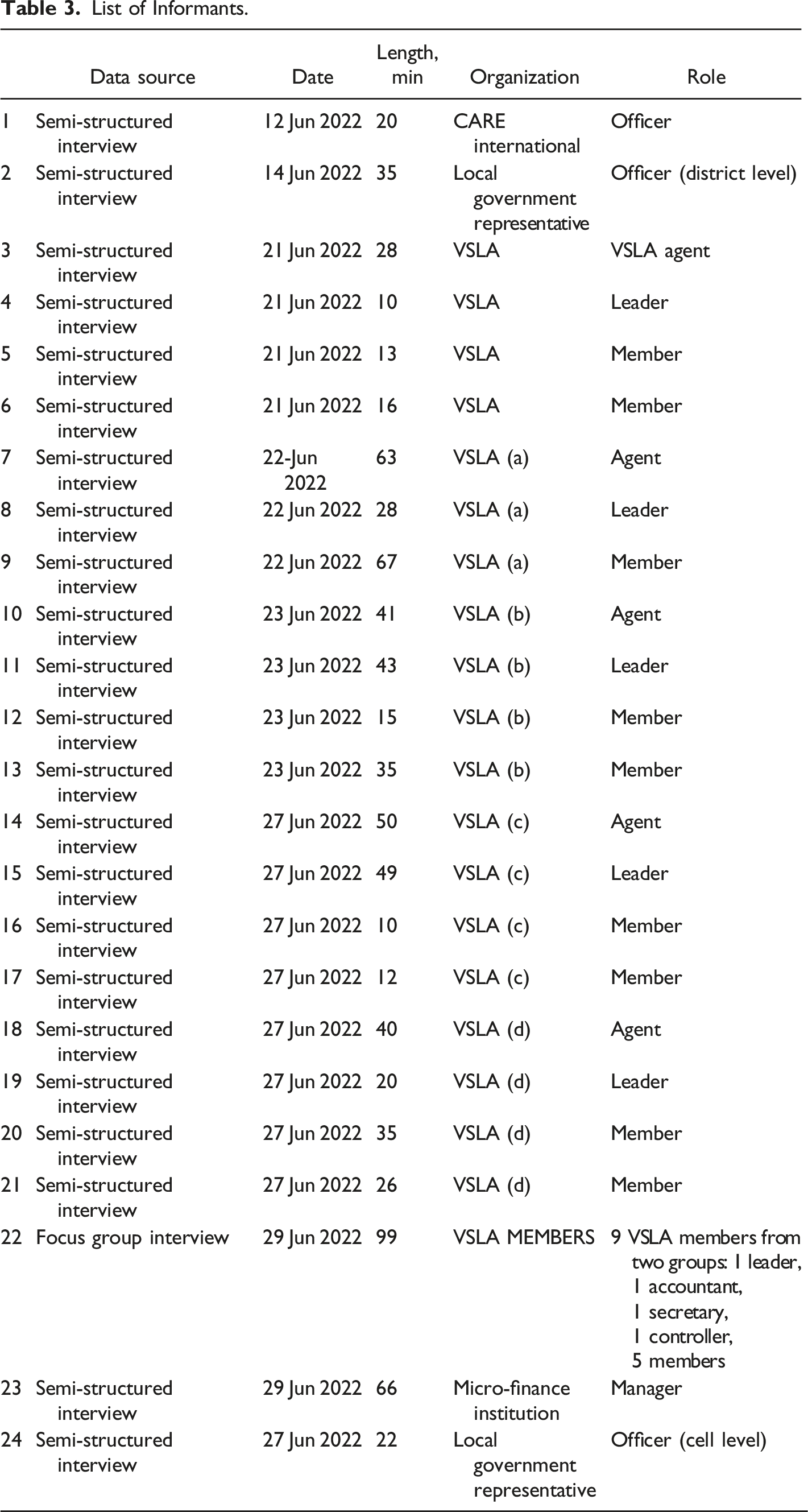
All of the interviews followed flexible guidelines adjusted to the respective positions and organizations of our informants, further ensuring we kept our questions open to encourage more detailed accounts. In our interview with the officer from CARE, therefore, we asked questions aimed at eliciting concrete examples of how VSLAs are initiated and organized, the modes and contents of the training provided, and the officer’s perceptions of the opportunities and challenges for VSLAs. In interviews with actors in VSLAs, meanwhile, we asked for examples of the entrepreneurial activities the members engaged in and their reasons for doing so, the opportunities and challenge they perceived in relation to these associations and activities, as well as their opinions of the training provided and its outcomes. And finally, in our interviews with external stakeholders, including a microcredit institution, we asked about these actors’ reasons for interacting with VSLAs. These interviews enabled us to develop an in-depth understanding of how informal training influences entrepreneurial activities and rural development. In addition to individual interviews, we also conducted a focus group discussion with nine informants from two VSLAs (1 leader/president, 1 accountant, 1 secretary, 1 controller, and 5 members). The purpose of this discussion was to gather multiple views on informal training in relation to the entrepreneurial activities carried out by the VSLA members.
To supplement our interview data, we collected documents such as mission statements and training manuals related to CARE and the VSLAs. As well as providing us with further insights into the operations, activities and training undertaken in relation to the VSLAs, these documents also facilitated our discussions with informants about emergent themes (Corley & Gioia, 2011).
Data Analysis
Our data analysis proceeded alongside our data collection, thereby affording us greater flexibility to probe for relevant themes and events during interviews. We iterated between data and literature in three recursive stages. Thus, our analysis began as we transcribed and translated the interview transcripts and fieldnotes. Next, we compiled a case description based on interview data and documents to derive a detailed understanding of how the five VSLAs were organized and facilitated by CARE. In the final stage, after we had attained a good sense of the case, we began to code empirical descriptions related to the entrepreneurial activities of the VSLA members, the contents and delivery modes of the training provided by associations, and the perceived outcomes of such training. In later rounds, our analysis became more theory-driven as we focused on discovering the main themes underlying our empirical data. In particular, we were intrigued to observe that the informal training provided by VSLAs proved effective in triggering the kind of critical reflection, dialogue, and peer learning advocated in Freire’s pedagogical theory. To ensure the trustworthiness of our analysis, the entire research team met regularly to discuss emerging findings. These meeting provided an opportunity for the other authors to ask for further details and additional clarification from the field researchers (Corley & Gioia, 2011).
CARE International in Rwanda
CARE’s history dates back to the end of the Second World War when an international aid initiative called the ‘Cooperative for American Remittances to Europe’ was set up in the United States to facilitate the sending of millions of food parcels to soldiers and civilians in war-torn Europe. 1 Since then, the NGO has changed its name to the ‘Cooperative for Assistance and Relief Everywhere’ and has evolved to become one of the largest NGOs in the world, operating in approximately 90 countries to fight poverty and advance economic empowerment by helping socioeconomically deprived people to build sustainable livelihoods. CARE has also greatly expanded the scope of its activities beyond its initial focus on disaster relief. Recognizing that no sustainable future is possible so long as women are excluded from full socioeconomic participation and remain among the world’s poorest and most marginalized groups, the NGO began to focus on activities specifically aimed at empowering women. In the early 1980s, it initiated support for income-generating activities like weaving and poultry-raising. Today, CARE is highly active in promoting such small-scale entrepreneurial activity, mainly through its village savings and loan schemes, though these are often combined with other efforts such as projects to improve water sanitation and hygiene, as well as gender-based violence protection and sexual and reproductive health. The NGO is independent of political, commercial, military, ethnic or religious objectives and provides humanitarian assistance on the basis of need irrespective of political and other factors.
CARE first started operating in Rwanda in 1984, initially focusing on reforestation and environment protection activities. In the wake of the genocide against the Tutsi, the NGO focused mostly on emergency relief, rehabilitation and reconstruction programs, with specific initiatives aimed at helping people with HIV/AIDS and orphaned children alongside its growing efforts to promote socio-economic empowerment and women’s rights. In 2017, CARE established a new program strategy for the empowerment of women and girls. This strategy is targeted at those aged 10–59 years who fall within the most vulnerable households (as calculated according to household income in the Ubudehe system of socioeconomic stratification). 2
How VSLAs Operate in Rwanda and how They Provide Informal Training
In this section we first describe how VSLAs operate in Rwanda before presenting our analysis of informal training processes in the five associations we researched and the subsequent entrepreneurship activities of their members. We then integrate our findings to derive a model outlining how elements of informal training contribute to rural development (Figure 1). Our empirical findings offer unique insights into how such informal training contributes to rural entrepreneurship. Exploring the role of informal training in VSLAs for rural entrepreneurship inspired by P. Freire.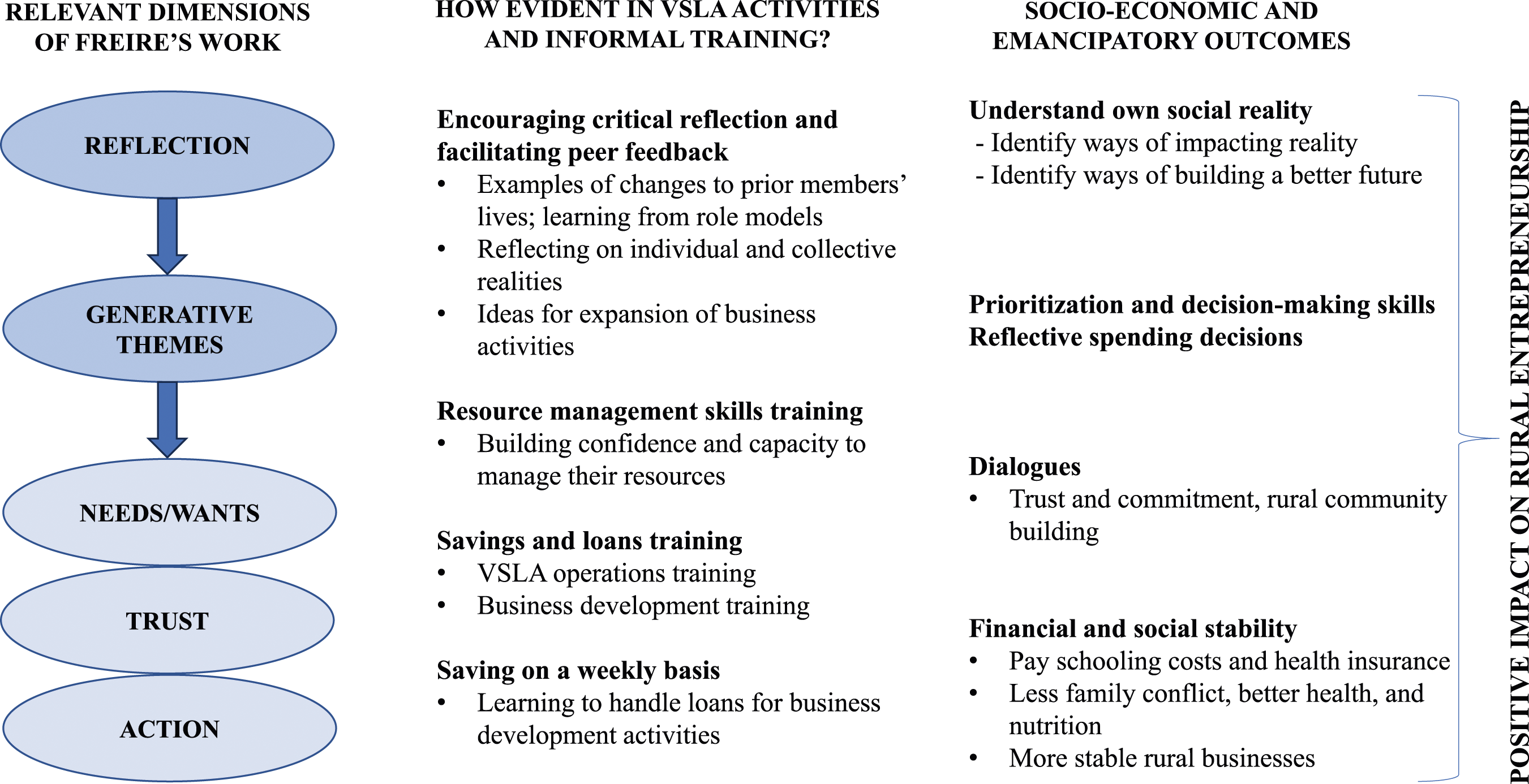
The basic idea behind VSLAs is that vulnerable people can help themselves and each other by teaming up in small groups and continuously saving small amounts of money together in a safe place, thereby enabling members to access short-term loans, typically for the purpose of starting up a business or expanding their existent business activities. An underlying principle of VSLAs is that they should provide members with the informal training in savings, loans and financial literacy they need to build and develop their own businesses. The narrative used to attract members to participate in these schemes is based on the prospect of becoming a successful entrepreneur and generating an income to afford nutritious food and other essentials for their families, including the expenses of sending children to school.
CARE initiates the formation of new VSLAs by first searching locally for suitable individuals to work as agents or “mobilizers”. Once a candidate for this role has been identified, often in the context of larger village gatherings, CARE provides them with training on how to establish a VSLA and recruit members, the procedures for group meetings, and the regulations related to savings and loans. Trained agents play an essential role not only in mobilizing members of their communities to form VSLAs but also in informing new VSLA members about the purpose of these groups, the functioning of savings and loans, as well as basic training in financial literacy and small-scale entrepreneurship. As explained by one member we interviewed: They are the ones who trained us, for instance, on how the VSLA operates, about savings and lending, about small-scale entrepreneurship and businesses, financial literacy, how to best use the credits and more. Everything we know now about VSLAs we got from them.
VSLAs typically consist of 25–30 self-selected individuals from the same area, meaning members tend to know each other and thus have a basis for mutual trust. Consistent with CARE’s prioritization of transparent organization and democratic decision-making, each VSLA is managed by a jointly elected committee of five people, i.e., a president, a secretary, an accountant, and two controllers. The committee is responsible not only for administering savings, loans, and emergency funds but also for ensuring that meetings follow the correct procedures, facilitating group decision-making, and helping to resolve any conflicts or tensions that may arise within the group. One of the VSLA leaders we interviewed described their role as follows, emphasizing the democratic character of these associations: The leadership position does not mean much. What is instead important here is that it is a membership. From that perspective, as members, we have all equal rights in all VSLA operations – savings, loans and emergency funds – including decision-making power. My role as a VSLA leader is essentially a facilitation role, nothing else. When you start to act beyond the responsibility assigned to you, they can dismiss you, because the members are the ones who elected you.
VSLA activities are organized in one-year cycles with meetings held each week. At the beginning of each cycle, the members agree on what the price should be for buying a “share” in the group fund or cash deposit for that year. Thereafter, each member is expected to purchase a minimum of one share or a maximum of four shares per week as their contribution to the fund. In addition, members also jointly put aside a small amount of money as a basic insurance fund for emergencies such as unexpected costs related to accidents or funerals. All savings and interest accumulated over the course of each year are shared out among members according to the total shares each person has acquired in that cycle. The savings distributed in these annual “share-outs” are typically used by members to purchase essentials or to invest in small-scale agriculture. The importance of these savings for poor people in rural areas of Rwanda – and especially for women and their empowerment – was frequently stressed by our interviewees: At the end of the cycle, share-outs are distributed proportionally to shares saved weekly. From the money received, women buy the farming equipment needed for their family. They also pay for medical insurance for their family members or other necessary things for the family. This financial support not only contributes to family development but also strengthens a woman’s voice with regard to family matters.
Although it was initially difficult to recruit members to VSLAs when these associations were first introduced in Rwanda, our data confirm that they have become popular over the years, leading to constant requests from people seeking to join a group. As one VSLA agent explained: Now people are aware about the importance of VSLAs … It’s no longer necessary to mobilize people or sensitize them for the groups. They’ve seen them and they know a lot about VSLAs’ benefits. This is totally different compared to the time when the VSLA approach started.
VSLAs differ from other micro-finance tools in that they take savings rather than loans as their point of departure. Only once sufficient savings have been accumulated by a group can members request and obtain loans. Members applying for a loan at a weekly meeting also need to present a plan to the group to explain how they intend to use the money. These plans typically relate to investments in small-scale business activity such as buying a cow, fertilizer, or a means of transportation, since most VSLA members have at least one income-generating business activity. The presentation and group discussion of such plans provides a crucial opportunity for the mutual exchange of knowledge, experience and best practices. Consistent with Freire’s advocacy of “dialogical processes” for learning, the members of the group give and receive feedback on each other’s investment ideas, often persuading each other to adjust or abandon the plan they first presented. As an example we observed of such dialogue, a member who had presented a business plan for growing peanuts was dissuaded from making this investment by the other members in a group discussion. In this discussion it was pointed out that the business would probably not prove profitable because the growing season for peanuts was not propitious. Rather than rejecting the loan application outright, the group asked the member to present a different business idea in order to be granted a loan. As one interviewee explained: “Members generally accept the advice they receive. … Some participants return later to thank their peers for important advice that enabled them to review or come up with a new productive income-generating activity.” As we elaborate further in the following section, the form of direct peer feedback thus constitutes a valuable type of informal training in rural entrepreneurship, comparable as such to the informal training opportunities provided in more economically advanced settings through on-the-job training or participation in professional networks (Coetzer et al., 2017; Davis, 2012).
Types of Informal Training
Our analysis identified two main types of informal training provided through the VSLA activities: (i) training related to the initial learning input and trainer-training sessions organized by CARE; and (ii) training through the subsequent dissemination of such input among members at group meetings, including through peer discussions of the kind described above in relation to proposed investments and business ideas.
First, all VSLA agents are required to attend CARE’s training sessions before setting up a group. These sessions not only introduce the VSLA methodology and the regulations for administrative matters (e.g., how to run weekly meetings and how to calculate annual share-outs) but also cover a range of business-related topics, including input on the entrepreneurial process (e.g., identifying business opportunities and planning, setting up, managing and expanding a small business), as well as basic financial management skills and the prudent use of loans. The trainer-training sessions further provided informal training through CARE’s learning-by-doing approach and pedagogical methods such as storytelling, field visits and group work. An illustrative example of this approach was provided by one interviewee as follows: After having explained to us about savings and lending activities and how they should be handled during a VSLA meeting, a CARE trainer generally picks some trainees and asks them to consider their fellow trainees as if they were members of their own VSLA. The trainees are asked to show concretely how they will proceed based on what they just learnt about a particular topic. The trainees will then get feedback from the trainers and the other participants in the training session on how to improve.
The second main type of informal training we identified occurs when agents bring back the skills and knowledge they have acquired through CARE’s initial training to their respective VSLA groups. As our interviewees confirmed, village agents typically set aside time to go through any materials they have gathered from their training with the group as a whole, thereby providing a crucial opportunity for members to ask questions and to reflect collectively in dialogue on members’ entrepreneurial activities. Our interviews frequently highlighted the value of this training for developing a better understanding of financial management, with many informants referring back to the initial sessions as the source of improvements in their lives and livelihoods. For example, one interviewee told us they had “learnt how to avoid unplanned expenses in assessing family needs and how to make a priority list,” while another elaborated on how the sessions had empowered them as follows: Through the trainings we received we now know how to request a loan and invest it in small-scale productive activities. We also know how to calculate profits achieved and losses faced. In case of a loss experienced, we are able to assess and understand its causes. … CARE has significantly empowered us. Its training uplifted our confidence and we’re no longer afraid of taking out loans.
The qualitative analysis of such informal training further supplies an important counterargument to Poole’s (2021) criticism of the lack of economic outcomes generated by participation in saving groups. In particular, our findings show how this training enables group members to think beyond solely economic value and to combine their entrepreneurial activities with the creation of non-economic value for the benefit of themselves and their community.
In addition, informal training takes place on a continuous basis through discussions at weekly group meetings. During these meetings, members reflect on their own situations with the intention of finding adequate solutions to various pressing problems. One informant explained: “We are generally quite homogenous groups, and our living conditions are to some extent similar … So during our meetings we normally take time and discuss our shared issues of concern.” Importantly, the matters discussed at these meetings extend well beyond purely business-related topics or operational issues such as loan applications and repayments. As the following interview excerpt illustrates, the continuous informal training facilitated by weekly VSLA meetings also occurs through collective dialogue and reflection on social issues such as domestic violence, good family relationships, sanitation, and hygiene: When there is, for instance, a member who is not paying the school fees for their children or a group member who often gets drunk, disturbing his family and community, these kinds of behavior are raised and discussed in the group. The group then offers the member their advice. … This advice, together with peer pressure, generally bring them to review their behavior and try to change it.
When invited to reflect on how their own learning took place through the informal training opportunities facilitated by VSLA activities, our informants frequently referred to the importance of dialogue, the exchange of ideas and experiences, and the use of concrete illustrative examples that could be directly applied in practice. As such, the train-the-trainer principle underlying CARE’s approach to VSLAs is consistent with the Pedagogy of the Oppressed advocated by Freire and the prioritization of actionable learning. More specifically, such informal training effectively circumvents the risk highlighted in Freire’s (1970/1996) critique of people either only reflecting or only taking action, instead combining both with the aim of bringing about societal change through dialogical action. One of the key ways in which VSLAs facilitate and effectuate actionable learning is through the emergence of role models in groups and the “emulation” of best practices. According to one informant, for example: For us, VSLA is a suitable platform where people learn and acquire important knowledge towards an emulation process. Some participants become role models for others.
Often proposed as an effective tool for informal entrepreneurship training in other settings, the emulation of other entrepreneurs in real life is thus contextually adjusted in this case to local circumstances and the particular mode of operation of CARE’s VSLAs.
All in all, the accounts offered by our informants from five different VSLAs confirm that informal training has significantly improved their lives and livelihoods. The following comment, for example, reflects the typically positive evaluations of VSLAs offered by our informants holding different positions within these associations: VSLA has greatly supported us to improve our living conditions. I can even say that it is like a basic school that helps particularly poor rural people to step forward and improve their lives. In short, a VSLA is a place where people meet, share knowledge, build their confidence, and fight against ignorance and poverty.
Other interviewees emphasized that such training had led them to think in more practical business terms and better equipped to assess the feasibility of their ideas before investing in small-income projects:
Based on knowledge gained from trainings, where we learned that before creating a business an entrepreneur must first assess the area and identify available opportunities, I took the time to assess business opportunities in my area and initiated small-scale entrepreneurial activities that deliver mobile money and airtime services. This was the outcome of the opportunity analysis, which indicated to me that there was a true need for these services in this area.
Our findings further indicate that informal training is effective in building the capacities of group members to run small-scale businesses and generate profit. Again, these profits are by no means used only for paying back loans or entrepreneurial goals such as purchasing or renting agricultural land and buying animals to increase agricultural productivity but for a much wider range of purposes. For example, business profits are frequently used to pay for health insurance (“mutuel de santé”) or to cover family expenses such as costs related to schooling, as well as for building and improving their dwellings (e.g., installing electricity). The account offered in the following excerpt reflects the ways many members make use of the revenue generated as a result of their improved business skills and acumen: Based on the training received, I decided to request a loan and start a micro business. At that time, I started a small business buying sorghum and making “sorghum beer” [a fermented beverage made from sorghum]. This business has slowly grown. And due to the profit gained, I was able to improve our farming activities. Later, I gave up that project and started trading agricultural products in the market instead. This business essentially supports my family. Currently, we have four children in secondary school and the profits we make cover their school expenses and other family needs. We also buy shares every week with this revenue.
Other interviewees specifically stressed the positive impacts of informal training on entrepreneurial outcomes, often also alluding to local cases of business success – as in the following excerpt: There is a VSLA member in our area who operates handcraft activities that she established based on a small loan granted by a VSLA. In the beginning she sourced raw materials locally, but her business has progressively grown and she is now purchasing raw materials from distant areas. She also rents a vehicle for transportation. It is really one of the cases illustrating the positive impacts of VSLA training.
Finally, another significant benefit of training repeatedly stressed by our informants was the usefulness of attaining greater financial literacy, especially in improving their capacities to assess and mitigate risks: Before joining the VSLA, we were very poor. But since we became part of these groups our life has significantly improved, based essentially on the trainings and the possibility to access financial means. We no longer use money as we previously did, for instance spending it on unplanned items. This was wasting resources.
Discussion
Drawing on Paulo Freire’s work to theorize our findings, we can identify three main dimensions of informal training that influence the impact of VSLAs on rural entrepreneurship: reflection, generative themes, and action (see Figure 1).
Reflection plays a crucial role in Freire’s pedagogical theory as the primary means whereby people come to gain a critical understanding of their own social reality. In the case of VSLAs in Rwanda, such reflection is triggered and facilitated from the moment village agents begin mobilizing people in rural areas to form a VSLA group, since this process of recruitment involves raising awareness among potential members of how forming or joining such a group can help them find a practical path out of poverty. New members are also exposed to the improvements achieved by veteran members of the group, which serves as a major stimulus to reflect on how they can improve their own lives, including by expanding their own business activities. In striving to translate reflection into action, members are further supported not only by learning from successful rural entrepreneurs as role models but also by the informal training tools of peer feedback and the sharing of experience and knowledge, including knowledge about agronomic techniques and the entrepreneurial process.
Regarding the dimension of generative themes, Freire emphasized the importance of investigating such themes through dialogue as a way for learners to gain a better understanding of their own oppressed situation and thus to reflect on ways to liberate themselves from such oppression. From our data on the informal training provided through VSLAs, we identified three generative themes in the core topics discussed and explored at weekly group meetings. Given our focus on the impact of such training on rural entrepreneurship, the most salient of these themes relates to resource management, which is also fundamental for the success of CARE’s VSLA methodology.
At its most basic level, learning how to manage resources entails distinguishing realistically between expenditures that are absolutely essential, i.e. needs, and expenditures which are optional and thus constitute “wants”. Although this may seem an elementary distinction at first glance, many of our interviewees testified to the immediate usefulness of acquiring this awareness and skill; indeed, some said it had been an eye-opening experience to learn how much difference it could make to apply this distinction in their daily decision-making, enabling them to budget and save more effectively by identifying and avoiding unnecessary purchases. For the many members of VSLAs seeking to run their small-scale businesses more profitably but who lack experience and knowledge, the most important resource-management skills acquired through informal training are those of basic accounting and bookkeeping. After all, it is only once such basic skills have been mastered that training in somewhat more advanced entrepreneurship training such as business development makes sense.
A second generative theme we identified in our data as having been facilitated by informal training relates to the importance of trust, especially in the context of post-genocide Rwanda. Trust is promoted through learning and practising the underlying principles of CARE’s approach to savings and loans, for example, including through training in the calculation of annual share-outs and the implementation of other key regulations for the operation of VSLAs. The way in which such training is realized in VSLAs—through dialogue among peers—further serves to nurture mutual trust in the group and its processes, fostering greater commitment to participation in its collective activities. This finding of our study is of particular relevance given Rwanda’s long and arduous struggle to re-establish trust through forgiveness and reconciliation since the Genocide against the Tutsi of 1994 (Mukashema & Mullet, 2013).
Action – as a third main dimension we identified in the informal training provided through VSLA activities that corresponds with Freire’s pedagogy – refers here to the actionable learning facilitated by training that enabled members to transform their own socioeconomic reality. Again to take a basic but crucial example, such training led directly to action on the part of group members in the form of saving and thereby stabilizing their own and their families’ financial situation. Through dialogues and knowledge exchange about the management of finances, moreover, informal training also builds the confidence of members to take on prudent loans. This impact of training is evident, for example, in the following account by a VSLA member of how they acquired financial literacy and subsequently translated this into enhanced business activities: I started my first small business buying and selling sorghum. The money I invested was a loan from the VSLA. I began with a capital of 70,000 Rwandan francs. After some months I bought a cow from the profit resulting from that business. The year after, the cow gave birth and I sold that young cow and saved the money into the bank as a deposit with the aim of getting an opportunity to apply for a loan in the future. In short, I began with a small amount which allowed me to become familiar with loans … It also helps people like me, particularly from rural areas, to feel confident and apply for a bigger loan from a financial institution. I am a good example to testify this. I was afraid to use a loan from any financial institution, but after using the small amount I received from VSLA, I felt it was possible to use credit from a bank as well. So I applied for a credit from a bank and I bought a motorcycle for 900,000 Rwandan francs. Now I’ve repaid the loan successfully and the motorcycle is now fully mine. I normally use it for transportation services. I didn’t close down the initial business – it’s still operating and the cow has just given birth again! Although I bought the motorbike through a loan, I attribute it to VSLA because it helped me to start and helped me gain the required confidence that fundamentally enabled me to start using bank credits as well.
As schematized in our model (Figure 1), these three dimensions of the informal training facilitated through CARE’s VSLAs served directly to improve the lives and livelihoods of the group members we interviewed through a combination of mutual learning activities consistent with Freirean principles. The mechanisms we identify whereby these impacts are achieved include the following types of informal training activities: (i) encouraging critical reflection on individual and collective realities through exploring generative themes; (ii) building the confidence and capacities of members to manage their resources, both individually and as a group – from basic savings to loans and business management; (iii) affording exposure to learning from role models; and, last but by no means least, (iv) facilitating peer feedback and group discussion on business ideas at weekly meetings.
In sum, we find evidence that all these processes of informal training facilitate praxis by building the capacities of the participants to take effective actions to improve their lives and livelihoods. Interpreting our findings from a Freirean perspective, our analysis reveals how this impact is achieved first of all by raising participants’ individual and collective awareness of their socioeconomic situation and thus inducing them to take practical joint action to manage their resources in the face of oppressive challenges, i.e., by establishing or joining a VSLA group. The initial training organized by CARE then not only introduces new agents to the NGO’s methodology and regulations for running a VSLA but also provides input on basic skills in resource and business management through a learning-by-doing approach. The train-the-trainer principle applied by CARE in these sessions then further facilitates the translation of learning and reflection into effective action by building the participants’ capacities to organize informal training activities in their respective groups. In this way, knowledge, experience, skills and best practices directly relevant to the local context are rapidly disseminated – above all through regular group discussions. Overall, our findings indicate that such training helped empower members of VSLAs to engage more effectively in entrepreneurial activities appropriate to their circumstances and thus to contribute to rural economic development in this district of Rwanda. Beyond the quantifiable economic value of VSLAs in advancing rural entrepreneurship, our study also highlights the role of these village-level associations in generating non-economic value that is nonetheless relevant to sustainable rural development in Rwanda, including through the building of mutual trust and the empowerment of women and girls to make use of their emancipatory potential. This latter finding is important as prior research on women’s entrepreneurship had shown how their entrepreneurial activities were often constructed around preserving traditions and patriarchal structures (Al-Dajani & Marlow, 2010).
Conclusion
Our study contributes both to scholarship and practice. First, in applying Freire’s critical pedagogical perspective to analyze the role of informal training in rural entrepreneurship provided by VSLAs, we contribute to theory by showcasing how this more holistic perspective can help researchers capture the socio-cultural value generated by such training beyond its quantifiable economic impacts, entailing consideration of context-specific variables such as rates of literacy, family circumstances, women’s empowerment, and current local rural development. And while Freire originally developed his pedagogical approach to help people “liberate” themselves from “oppressors” in the most precarious of circumstances and extremes of poverty, our study demonstrates how this perspective can also yield valuable and actionable insights when applied in non-revolutionary settings.
A Freirean perspective is especially apt for evaluating the impacts of informal training on the lives and livelihoods of the rural poor, we argue, since Freire consistently emphasized the value of non-formal and uncertified education. Thus, although we refrain from making claims as to the potential of VSLAs for liberating members from oppressors, we are confident in concluding from our findings that the informal training facilitated by these associations did help to empower (Karlan et al., 2017) and emancipate people by building their capacities for reflective action and praxis. Our findings suggest that this approach helps to overcome some of the issues identified in prior research regarding how well-intending intermediary organizations might constrain rather than support women entrepreneurs’ emancipatory potential of their entrepreneurial activities (Al-Dajani et al., 2015). We further theorize how this outcome was achieved through dialogical processes among peers that effectively circumvented the reproduction of power relations traditionally prevailing between teachers and students in schools and in formal types of entrepreneurship training.
Our study also contributes to the literature on VSLAs by providing novel and nuanced insights into how VSLAs generate positive socio-economic impacts for rural development. In particular, we make the case that the positive and perhaps most important socio-economic outcomes of VSLAs ensue not from the mere availability of savings and loans but from the informal training opportunities provided through the activities of these associations – above all though the dimensions we identify in our study of reflection, generative themes, and action.
As a practical contribution, our findings underscore the need to consider context-specific factors when designing and implementing entrepreneurship education. For example, our data provide evidence of the usefulness of developing basic financial skills (e.g., Cassidy & Fafchamps, 2020) before moving on to more advanced input on the entrepreneurial process. In this regard it should be noted that higher levels of literacy inevitably make all forms of entrepreneurship education more effective and easier to facilitate, including the informal training provided through VSLAs, since it is self-evidently more difficult for people to learn how to save effectively and make efficient use of loans without basic literacy and numeracy, let alone to develop more advanced skills in financial management. As such, our analysis affirms the importance of the Rwandan government’s longstanding commitment to increasing rates of literacy, since these efforts to promote literacy are demonstrably effective in helping people acquire the skills they need to start up new and sustainable small-scale entrepreneurial activities that are crucial for advancing socioeconomic development at household and community level (e.g., Chineka & Mtetwa, 2021; Habumuremyi et al., 2019; Karlan et al., 2017; Nnama-Okechukwu et al., 2019).
Finally, the contributions and limitations of this study alike open up promising avenues for future research into the role of informal training in advancing rural entrepreneurship. On the one hand, our approach and analysis contribute by taking scholarship a step forward towards a more detailed understanding of how informal training can create both economic and non-economic value supportive of sustainable development. On the other hand, the applicability of our findings to other contexts is far from certain since our theorization is based on the specific case of VSLAs in rural areas in Rwanda, i.e., a research context in which most business activities are related to the agricultural sector, with relatively high levels of unemployment and traditional gender roles that impede the empowerment of women. Future research could thus usefully apply our proposed conceptual framework for evaluating the impacts of informal training through VSLAs in other contexts. Notwithstanding the constraints of our study, however, our findings indicate that facilitating dialogue among peers and fostering individual and collective reflexivity on context-specific socioeconomic challenges can play a crucial role as modes of informal training in advancing rural entrepreneurship. In this regard, an interesting topic for future research could be to investigate how the dimensions identified in our study would play out among entrepreneurs displaced from their countries of origin, for example, by war or natural disasters. Such research could contribute to an emerging conversation held, for example, by Al-Dajani and Marlow (2013) and Harima (2022), who draw attention to empowerment and emancipation among refugee entrepreneurs as well as differences regarding entrepreneurial activities among displaced entrepreneurs.
Footnotes
Declaration of Conflicting Interests
The author(s) declared no potential conflicts of interest with respect to the research, authorship, and/or publication of this article.
Funding
The author(s) disclosed receipt of the following financial support for the research, authorship, and/or publication of this article: This research has been funded by the Swedish International Development Cooperation Agency (Sida) through the UR-Sweden Programme for Research, Higher Education and Institutional Advancement.
