






Abstract
Millions of workers in India who migrated to cities for employment have transited back to seek refuge in their home villages, causing disruptions in both cities and villages. This type of mass flow of migrants in transit represents a humanitarian crisis. Understanding migrant flow patterns and ways to ameliorate the conditions for migrants in transit is critical to managing the humanitarian crisis. In this study, we develop a model that examines the influence of migrant networks, inter‐organizational collaboration, and environmental uncertainty on locational advantage, which, in turn, predicts migrant flow patterns. This study contributes to the humanitarian operations management and migration literatures by uncovering how migrant networks and inter‐organizational collaboration help provide access to humanitarian resources. Additional new findings of this study include uncovering different classes of migrants with their respective flow patterns and the role of collaboration along migration paths. The study also uncovers how travel constraints increase the duration of transit and the importance of point‐to‐point transfers to avoid congregation at transit hubs. Furthermore, findings from this research provide insights on how long‐term humanitarian support to migrants through inter‐organizational collaboration morphs to short‐term aid in the event of a crisis.
INTRODUCTION
Migration is a universal phenomenon. In times of crises, migrant flows often become overwhelming and turn into a humanitarian problem. Therefore, it is critical to predict and potentially manage flows while providing support to the migrants. Mass migrant flows can be thought of as a supply chain problem. Transportation links connect the different upstream nodes, midstream hubs, and downstream nodes. During crisis scenarios, capacity issues tend to arise at the nodes and links, and managing the flows becomes important. Public institutions are not always able to handle the surges in demand across this chain and require collaboration with other supporting partners such as non‐governmental organizations (NGOs). Consequently, inter‐organizational collaboration is essential among public and private entities along the entire supply chain to accommodate migrant travel and ensure a resilient economy (Ivanov & Dolgui, 2020).
A goal of migration management by humanitarian operations is to ensure that any migrant who transits through the system does so safely. However, it is possible that additional barriers and constraints potentially could crop up and slow down the flow. Nagurney (2022) highlights the value of aiding migrants in their transit process while recognizing the role of constraints (e.g., regulations; Nagurney & Daniele, 2021). Other constraints to these flows include restrictions such as pandemic‐related quality processes (e.g., testing, quarantining, and other measures). Humanitarian operations can play a role in alleviating the constraints.
At times the most interesting contributions to literature come about when scholars identify and challenge assumptions underlying existing theories (Alvesson & Sandberg, 2011). As such, we examine assumptions related to the literatures in humanitarian operations management (HOM), migrant, and relief aid. Two assumptions held by many scholars in the HOM field are that people in need of help are stationary (i.e., settled in camps; Abushaikha et al., 2021) and that these settlements provide temporary (i.e., short‐term) shelter to the displaced. However, the Syrian refugee crisis questioned both assumptions. As refugees were moving from Syria toward Europe, it became clear that the existing supply chains, designed to assist people in camps, were unable to sufficiently help people on the move (IFRC, 2016). Consequently, Oloruntoba and Banomyong (2018) called for research on managing these human flows. In this research, we add to the HOM literature by pivoting to flow processes rather than assuming stationarity.
The migrant literature also generally assumes flows moving from villages to cities. Migrants often leave their underdeveloped rural villages to tap locational advantages found in urban areas. However, this flow pattern is not unidirectional. At times of crises, when the pendulum of locational advantages turns to rural areas, a mass flow toward villages occurs. In this study, we generalize migration flow patterns to include transit from cities to villages.
The transit from cities to villages results in a lasting impact on the employment structure, availability of skills, and the overall culture in urban areas (Kaur & Shubham, 2021), causing disruptions in migrants’ home communities and the locations through which they transit (Chia & Poh, 2020), and bringing about widespread negative health and economic consequences (Mukhra et al., 2020). To respond to these negative impacts, NGOs and other humanitarian agents need to quickly adapt their traditional long‐term development support to help migrants transit back to their home villages. Research indicates the value of negotiations between pharmaceutical firms, suppliers, and governments (Anderson et al., 2023); similarly, negotiations and collaboration between NGOs and governments would be of value in delivering services, especially within informal networks (Jónasson et al., 2022).
Prior literature focuses on in situ relief (e.g., after earthquakes) or long‐term relief of people who are refugees but not on people who are in transit. In this study, we generalize humanitarian aid to include short‐term relief along the entire flow path.
The unit of analysis in our study is the flow of a migrant group. Our research question is: What factors facilitate humanitarian benefits for people on the move? In essence, how should humanitarian resources be deployed to support migrants along flow paths? With guidance from the literature, we examine the following sub‐areas: (1) the role of migrant networks and inter‐organizational collaboration in facilitating access to humanitarian benefits and influencing locational advantage, (2) the role of uncertainty on locational advantage, and (3) the role of humanitarian organizations in mitigating constraints for migrants in transit.
In the next section of the paper, we examine the relevant literature. In Section 3, we describe our methodology. In Section 4, we develop a conceptual model built upon propositions derived by crossflow analysis. Finally, in Section 5, we discuss the implications of this research for the implementation of crisis‐mitigation configuration strategies and for its contribution to the body of knowledge in the HOM and refugee flow spheres. In this process, we uncover unique and new future avenues of research.
LITERATURE
In this section, we examine relevant streams of literature that provide guidance in understanding migrant flows and relevant constructs. We identify gaps in the literature and address those gaps by presenting a conceptual model derived from the case study. The model captures the humanitarian benefits and corresponding locational advantage obtained through migrant networks, inter‐organizational collaboration and mitigating for environmental uncertainty, and provides direction on how humanitarian organizations can play a role in helping migrants in transit.
Migrant networks
The pandemic has highlighted the importance of supply chain networks that are well‐integrated and coordinated. According to network theory (Johanson & Mattsson, 1987), firms that are more embedded in developed supply chain networks have access to resources such as shared physical and human capital, technology, and shared data. These resources help reduce operating cost, increase revenue, increase innovation, and mitigate risk (Zeng & Yen, 2017). Similarly, migrants have access to humanitarian resources embedded in their social networks; these can include intangible resources such as support and access to influence and tangible resources such as access to information, jobs, accommodations, materials, and financial resources (Bourdieu, 1986; Burt, 1992; Putnam, 1995) provided by government agencies or NGOs.
Extensive research suggests that migrant networks with ties of kinship and community facilitate the process of migration (e.g., Waldorf, 1998). These networks are particularly useful in poorer communities where network ties can help gain access to humanitarian resources needed for migration; poorer and low‐skilled migrants tend to depend more on migrant networks, compared to individuals with greater wealth and more skills. Migrant networks can facilitate access to humanitarian resources, lower the costs of migration, and increase the expected net return of migration; they can help potential migrants find jobs, accommodations, and other opportunities (Waldorf, 1998). Several characteristics of networks can influence the migration process. One key concept in network theory is the notion of embeddedness (both structural embeddedness and relational embeddedness), which is connected to the strength of ties among entities in a network (Granovetter, 1973). Structural embeddedness refers to the presence or absence of social ties, as well as the number of ties and network configuration (Nahapiet & Ghoshal, 1998). Relational embeddedness refers to the level of trust, tie strength, obligations, and expectations present in the relationship (Granovetter, 1973). Strong ties indicate tight links among individuals, whereas weak ties indicate fewer and more tenuous connections.
Other characteristics of networks include network size or the number of network ties among individuals (Wasserman & Faust, 1994) and network diversity or the similarity or differences among network contacts. Dense, homogeneous network configurations consisting of members with common attitudes, beliefs, and problem‐solving techniques (Burt, 1992) often result in over‐embeddedness, decreased innovation, and inertia (Gargiulo & Benassi, 1999). In contrast, individuals with networks rich in information benefits have contacts in places where useful information is likely to be transmitted; thus, diverse networks with few redundant contacts provide more humanitarian benefits than dense networks (Burt, 1992). Network diversity often is measured through range and density. Range is the number of different social groups and systems represented by contacts and relationships (Burt, 1992), and density is the extent to which people in a network are connected to each other (Brass, 1984). More diverse or heterogeneous networks have high range and low density. Thus, migrant networks with ties to social systems that do not overlap are more diverse than networks with ties to people who all know each other. Network diversity also can be connected to Nahapiet and Ghoshal's (1998) cognitive dimension of social capital; individuals in homogeneous networks may be more likely to share systems of meaning and interpretation, compared to individuals in heterogeneous networks. Network strength, size, and diversity can play an important role in providing access to humanitarian resources for migrant groups.
Inter‐organizational collaboration
Supply chains are more efficient when well‐developed linkages exist in the form of inter‐organizational partnerships (Gabler et al., 2017); such partnerships can help mitigate and manage disruptions in networks (Kleindorfer & Saad, 2005). The amount of collaboration that exists in inter‐organizational partnerships influences the extent to which those partnerships can provide humanitarian support to migrants. According to Moshtari (2016, p. 1544), “inter‐organizational collaboration refers to a partnership process where two or more independent organizations share resources (e.g., information, expertise and infrastructure) or work closely to design and implement their operations.” Generally, NGOs work with government agencies to support long‐term development in cities and villages. However, during the pandemic crisis, many public institutions lacked the capacity to manage the surge in demand for services, and inter‐organizational collaboration became organized in providing short‐term humanitarian aid. Examples of humanitarian services included providing safe transport, managing labor contracts, helping prepare documents for transit, and ensuring proper accommodations.
Research on collaboration is gaining momentum in the humanitarian supply chain literature. Inter‐organizational collaboration includes both cooperation (i.e., collaborative goals and shared resources allocated toward those goals) and coordination (i.e., actions that help achieve collaborative goals; Gulati et al., 2012). Factors that influence inter‐organizational collaboration include the ability and willingness of organizations to engage in collaborative actions. Public and private organizations can collaborate when there exists inter‐organizational collaborative capacity or “the capability of organizations … to enter into, develop and sustain inter‐organizational systems in pursuit of collective outcomes” (Hocevar et al., 2011, p. 1). The resource‐based view (Barney, 1991) emphasizes the importance of an organization's ability to reconfigure existing resources to exploit external opportunities; it focuses on resources that are valuable, rare, imperfectly imitable, and non‐substitutable. Although this perspective looks at intra‐organizational resources and capabilities, we also recognize the importance of inter‐organizational collaborative capacities and resources. Inter‐organizational collaboration is especially important when each partner organization has complementary skills, capabilities, and resources (heterogeneity), and the capabilities and resources are not transferable from one organization to the other (immobility). Collaboration with other organizations can result in the creation of new and novel assets as well as valuable collaborative alliances (Eisenhardt & Martin, 2000); these assets can be in terms of humanitarian aid (short term or long term). Organizations that recognize the benefits of learning, integration, and reconfiguration through inter‐organizational collaboration are more likely to have the ability and willingness to engage in collaborative actions, thus increasing their ability to provide humanitarian support to migrants.
Environmental uncertainty
We look at environmental uncertainty as a subjective construct using Milliken's (1987) definition of uncertainty as a “perceived inability to predict … accurately” (p. 136). Dess and Beard's (1984) three dimensions of the environment (capacity, volatility, and complexity) allow us to examine different levels of perceived uncertainty expected to exist because of the pandemic. We believe that the environmental dimension that is especially applicable to this situation is volatility or the degree of instability in the environment. Volatility identifies the unpredictability of environmental change and lack of pattern in change; it refers to turbulence, frequency of change, and speed of change. When there is a high degree of unpredictable change, it is difficult for individuals and groups to accurately identify the probabilities associated with various alternatives.
Environmental uncertainty can occur in the presence of disasters such as earthquakes, typhoons, and pandemics. The pandemic resulted in varying levels of perceived uncertainty, especially because of its enormous impact on human lives. During the pandemic, environmental uncertainty resulted from varying levels of virus outbreak occurring across different geographies and cities, as well as the ambiguity created by varied shelter in place and quarantine restrictions across regions. The pandemic has had a broad overarching impact across nations, with a perceived inability to accurately predict and control the levels of outbreaks and the potential human and economic impact (Queiroz et al., 2022). Migrant groups experienced varying levels of environmental uncertainty generated by this global pandemic. Migrants’ perceptions of uncertainty may be influenced by the availability of trusted and accurate information that can help in making decisions, along with humanitarian resources to help increase perceived safety and security. This is especially true when the environments are turbulent and susceptible to unpredictable change.
Locational advantage
Migrants examine the comparative advantage (utility) gained when making the decision to travel to their destinations (villages). Long‐term and short‐term humanitarian aid can affect utilities at origin and destination locales. Past research found that locational advantages influence one's decision to migrate (Prasad et al., 2022; Speare, 1971). For example, Speare (1971) described this locational advantage as a cost versus benefit analysis, where migrants consciously make decisions relative to their perceived outcomes about respective locations. De Jong (2000) added that those expectations must conform to migrants’ cultural norms and values. Similar to a production system, Prasad et al. (2022) defined the migrant decision based on push and pull factors. Push factors are negative stress factors driving individuals or families to leave a location; such factors include high unemployment, low wages, violence, and insufficient government services. Conversely, pull factors are positive factors that drive individuals toward a location, such as job opportunities, salaries and working conditions, adequate government services, and other humanitarian benefits. However, economic factors, by themselves, are insufficient to explain migration. Researchers have found that intangible factors play a large role in a migrant's decision‐making process. Kley (2011) developed a model to explain the migration factors individuals use in determining the perceived differential in opportunity among locations, including: (1) the influence of others (i.e., friends or family), (2) life events (i.e., marriage or children), and (3) resources (i.e., financial or property rights). The destination location is likely to be perceived as having a comparative advantage over the origin when it has greater utility, measured by both intangible resources (e.g., being with family and friends) and tangible resources (e.g., job opportunities).
In this research, we examine migrant flows and explore the influence of migrant networks, inter‐organizational collaboration, environmental uncertainty, and constraints in travel on such flows. Furthermore, we discuss access to humanitarian benefits in such a context. Based upon qualitative research, we provide a conceptual model.
METHODOLOGY
Research design
Typically, research on migrant flows has relied upon mathematical models (Nagurney, 2021) or secondary data with fixed assumptions (Rahmati & Tularam, 2017), and evidence‐based research based upon real data on horizontal cooperation is limited (Van Oorschot et al., 2023). However, “it is preferable to use real data” (Gupta et al., 2016, p 1630) to develop a theory. Models built upon secondary data might miss relevant migratory variables or relationships. To overcome such limitations, we use case study methodology to examine the multi‐dimensional phenomena associated with migration (Rahmati & Tularam, 2017), including flows from cities to villages (Dandekar & Ghai, 2020). Given the novel nature of viewing migrant flows through the lens of supply chain management, we rely on case research for theory building (Ketokivi & Choi, 2014). Case study methodology allows us to uncover new and unexpected patterns to challenge assumptions, create innovative models, and identify avenues for future research. Furthermore, the advent of the pandemic gives us “the opportunity to rethink supply chain management (SCM) for research and practice” (Sodhi & Tang, 2021, p. 7), especially in terms of migrant flows.
We took the advice of Besiou and Van Wassenhove (2015) in our study by forging an “understanding of the problem context by teaming up with practitioners and conducting case studies” (p. 1399). As such, we collaborated with practitioners and employed case study methodology to investigate migration from cities to home villages during the pandemic. Case study methodology has been used to build supply chain management theory (McCutcheon & Meredith, 1993; Meredith, 1998, Voss et al., 2002) and more recently in the humanitarian operations context (Comes et al., 2020; this methodology is especially applicable when a limited body of knowledge exists within a sub‐area of study. Because the investigation of pandemic‐related migrant flows is a relatively new sub‐area of study, we utilized Eisenhardt's (1989) process of building theory from case study research.
In this study, we work toward ensuring internal validity, construct validity, external validity, and reliability (Gibbert et al., 2008). Our analysis develops a framework built upon case data. We use within‐case analysis and cross‐case comparisons to develop our model.
Minimizing bias
Our case study sample is of sufficient size and diversity to minimize biases (Lewis, 1998). We selected 16 migrant flows in India (presented in Table 1) to examine. The flows covered migrant supply chain patterns from various geographic regions (North, East, South, and West) of the country and represented a range of origin departure communities (e.g., rag‐pickers in Delhi; skilled workers in Barmer, Rajasthan; seasonal agricultural workers in Rajasthan). This diversity allows for sufficient generalizability in the Indian context. The selection of the 16 migrant flows was also partly based on long‐term relationships we had with the NGOs in the country; these relationships allowed access to data and provided a richer understanding of the context. Multiple flows can provide a degree of external validity and protect against potential biases (Barratt et al., 2011).
Migrant flow patterns studied.
The data were collected in a systematic manner (Barratt et al., 2011). We followed best practices within case study research (Eisenhardt, 1989) and operations management case study literature (Shaheen & Azadegan, 2020; Sodhi & Knuckles, 2021) by utilizing an iterative approach by simultaneously collecting and analyzing our data. Our within‐case analysis enabled us to become intimately familiar with each flow and understand commonalities among the migrant classes. As such, we found four types of multi‐classes (long term, skilled, short term, and seasonal) from our 16 flows.
The various flows were supported by differing types of NGOs. These NGOs historically have provided long‐term developmental needs in cities and villages but pivoted to short‐term aid in the time of a crisis. The NGOs provided valuable aid to the migrants in need, at various stages of the network flow, including providing food and shelter in the cities, and helped them find transit while maintaining pandemic mitigation protocols (medical checkups, quarantining, and documentation). As some groups reached villages, NGOs helped with access to government services and employment. In this study, we included NGOs operating throughout the network flows including cities, transit hubs, and villages. The NGOs varied in the type of services provided and the degree of partnership with government entities. This range of services, partnership, and location along the network flow provides additional generalizability and adds to the usefulness of the model derived.
To ensure construct validity, we provide evidence from the initial research question to the conclusions using multiple different data forms and sources allowing for triangulation.
Context, data collection, coding, and nesting
The coronavirus (COVID‐19) global health crisis is an example of a severe crisis that has affected entire societies (Sodhi & Tang, 2021). Since vulnerable populations can be much more negatively impacted during crises (Sodhi, 2016), the lockdowns and border closures associated with COVID‐19 disproportionally affected migrant workers (Besiou et al., 2021) forcing many of them to find refuge in their hometowns. The scale of the flow has been enormous, with more than 120 million migrants in India transiting back to their home villages (Dandekar & Ghai, 2020). This provides a rich context to study migrant flows. It is within this context that the data for our case study have been obtained.
Data concerning the 16 migrant flows are a result of field interviews, direct interactions with migrants, and access to internal NGO reports. Descriptive statistics of the modality, duration, individuals interviewed (e.g., directors, frontline workers, doctors, etc.), NGO focus and pivot, and why the informant(s) were included are provided in Table 2. We interviewed a diverse set of participants who either were directly affected by the pandemic (i.e., migrants) or helped support groups of migrants including the Chief Executive Officers (CEOs) of NGOs, NGO directors, NGO supervisors, NGO frontline staff, and NGO medical personnel. Interviews providing views from a diversity of perspectives enhance internal and external validities. In many cases, medical officers and frontline health‐care workers were the first responders in helping migrants with health‐care protocols and providing services. Interactions with CEOs and directors of NGOs allowed access to secondary data (reports detailing the service provided). Coupling the primary interviews with the secondary data provided a much richer understanding of the relationships and increased reliability (Barratt et al., 2011). The process of questioning and transcribing was conducted by two authors who were proficient in Hindi and English. In addition, one of the authors was proficient in Telegu. The data were organized independently into tables by the two authors. The two data streams were compared and then reconciled into a single dataset (Supporting Information Tables E6a–E6g), which includes direct quotations. One of the researchers in this project was embedded with an NGO in managing the migrant flows. This study brings an element of action research, whereby the multi‐method triangulation reduces bias and adds to real‐world relevance (Choi et al., 2016).
Non‐governmental organizations (NGOs) interviewed by network flows and saturation process.
Total number of people interviewed: 262 (225 migrants/23 medical workers/six frontline government employees/six NGO employees (CEO and director level)/two private sector individuals); total number of interview hours: 54.7.
Additional hours of observation and direct involvement with the migrants occurred through an action research agenda executed by the chief medical officer.
In this research, we developed the interview questions (see Supporting Information Table E3) with guidance from the literature. Based upon the constructs identified in the literature, interviewers asked questions relating to migrant networks, the role of inter‐organizational collaboration, environmental uncertainty, locational advantage, pandemic‐related quality processes, and migrant flows. For example, network size was identified by asking questions about the number of network ties, network strength in terms of density and connectivity between individuals in a network, and network diversity as the number of different social groups and systems represented by contacts and relationships. Similarly, the types of collaboration among government agencies and NGOs were identified by asking questions about establishing collaborative goals and agreement on the shared resources allocated toward those goals (cooperation) and the activities undertaken in achieving those collaborative goals (coordination). We coded and analyze the interviews to categorize the degree of the constructs. By comparing and contrasting, we saw relationships emerging from the migrant flow patterns. As relationships between the various constructs also were identified, there was space to uncover new variables and relationships. If specific ideas were unclear in the initial round of discussions, the researchers followed up with additional sets of questions for clarification. For example, in describing efforts NGOs took while in transit points, follow‐up questions were asked regarding the types of health‐care services provided. This then led to a discussion about the first aid provided to migrants and the importance of moving citizens away from hub depots to the final destinations.
The categorization grew from the data, and ranges were observed in the interviews. Examples of low, medium, and high categories used are presented in Supporting Information Table E4. To ensure reliability in the categorization process, the two raters coded the interviews independently. If the two categorizations matched, they were included in the database. Initial inter‐rater reliability exceeded 85%. However, if discrepancies arose, the two raters reexamined the data and came to an agreement. Furthermore, constructs and relationships were adjusted as the data were collected. In this pattern‐matching process, patterns emerged. If unexpected patterns cropped up, we reached out to the NGOs for clarification. This clarification would entail a possible revision of the initial relationships or finding entire new streams of research. To capture flows throughout the entire chain, upstream (e.g., A1, A2, B1, C1, C2), midstream (e.g., D1, D2), and downstream (e.g., B2, E1, E2) flows were included. In our dataset, there were multiple “nested” flows involving NGOs (e.g., Sodhana Charitable Trust—F1, F2, & F3, and India Pollution Control Association [IPCA]—G1, G2, & G3), allowing us to account for intra‐organizational and locational context (see Table 1).
Saturation and methodological demonstration of grounded theory
The interviews followed an iterative process. The primary data collection process began on June 24, 2020, and was conducted over a 1‐month period. As part of the saturation process, secondary and tertiary interviews were conducted. The saturation process included approaching the NGOs with a proposed model and revisiting the constructs and relationships to see if there are any significant changes that are necessary. This iterative process was conducted at both intra‐ and inter‐NGO levels until only marginal improvements in learning occurred and the phenomena became consistent (Eisenhardt, 1989). Saturation was reached in January 2022. The intra‐ and inter‐NGO saturation process provides greater external validity to the proposed model (see Table 2).
The research has a demonstrated level of methodological rigor in the context of grounded theory and methodological fit (Barratt et al., 2011), understanding, generalization, and control (see Table E5 in Supporting Information; Denk et al., 2012; Rauer & Kaufmann, 2015). Our research delves into an area of study that needs a further understanding of the practice and available literature. Finally, the model provides specific approaches that NGOs can utilize in managing future migrant flows effectively.
ANALYSIS AND CONCEPTUAL MODEL
This research examined migration during the pandemic using the flow of a group of migrants as the unit of analysis. It viewed migrant flows as complex supply chain configurations with departure, transit, and arrival points (Seifert et al., 2018) and identified the influence of migrant networks, inter‐organizational collaboration, and environmental uncertainty on locational advantage that, in turn, affected the strength of migrant flows. In addition, we examined the moderating influence of constraints on the relationship between locational advantage and migrant flow, as well as the role of humanitarian operations in helping to mitigate those constraints. The theory is established through case analysis. The resulting conceptual model is presented in Figure 1.
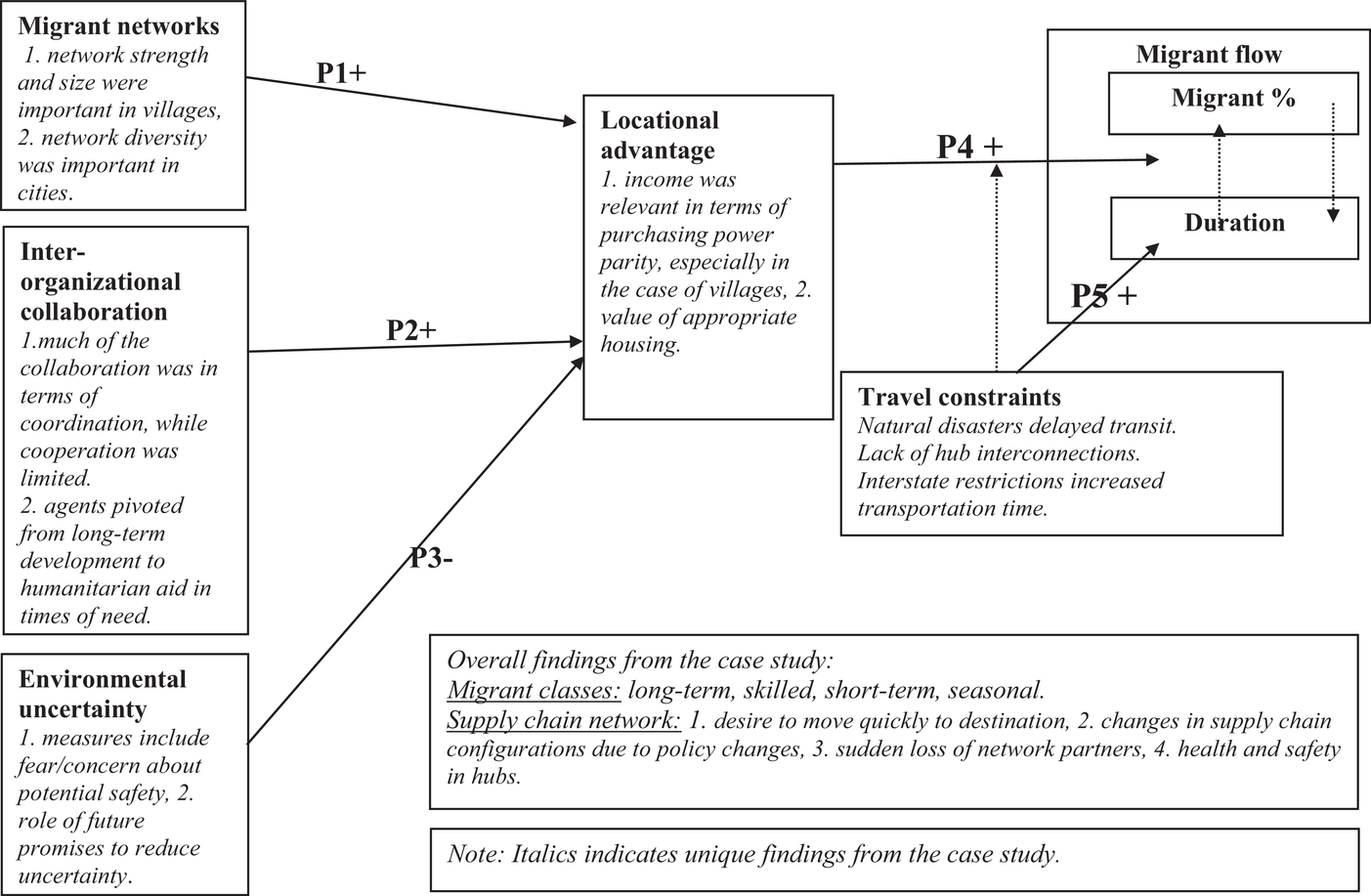
Migrant flow patterns.
Using the information collected from the 16 migrant flows in India, new relationships and additional constructs were refined. We used a process of iterative triangulation to organize and arrange elements of our model (Lewis, 1998), which helped derive propositions. Furthermore, serendipity allowed us to remain open to being surprised by the data (Ketokivi & Choi, 2014). In our analysis, we post hoc found four classes of migrants, each with its own unique supply chain configuration and corresponding pandemic mitigation strategies: (1) seasonal workers operating with a contractor, (2) unorganized short‐term migrants operating in the informal sector, (3) skilled individuals or those owning micro‐businesses in cities, and (4) long‐term migrants. Furthermore, the written analysis in the following sections relies on such a classification. Unexpected findings are noted in the discussion sections (Section 5) and provide new insights for future research.
The influence of migrant networks on locational advantage
By cross‐flow comparison, we found that characteristics of migrant networks, such as size, strength, and diversity, can provide access to humanitarian benefits and were positively linked to locational advantage. Compared to the city, seasonal workers in Andhra Pradesh perceived more utility in the village (Kondadi). For example, seasonal workers in Andhra Pradesh (F2) perceived greater locational advantage in their village (Kondadi) because of large, strong village networks due to commonalities such as shared caste, large numbers of connections, and “frequent interactions through social gatherings such as weddings.” Many of the “migrant families also were part of self‐help groups and being supported by Sodhana Charitable Trust.” At the onset of the pandemic, “migrants could available themselves to the health‐care network run by Sodhana Charitable Trust.” In contrast, their networks in the city, where they worked in brickmaking, were weak and narrow (less diverse) because they remained somewhat isolated within same‐village migrant groups. As one NGO official noted: “A local village coordinator would organize the seasonal work and include payments, transportation, and accommodations,” “the workers would all be clustered together at the work sites,” while “the seasonal workers were unable to tap any benefits locally.”
On the other hand, long‐term migrants in Andhra Pradesh cities had a stronger locational advantage in cities. One NGO worker stated “…over the years, they have developed connections with locals in cities through work or marriage. These diverse interpersonal connections provided support when in need.” Likewise, “long‐term migrant rag‐pickers in Delhi from rural West Bengal had developed networks with buyers/sellers of solid waste” (G2, G3), NGOs, and other entities over the years. This resulted in building diverse networks with a variety of socio‐economic groups within the city. Over time, however, their village networks in rural West Bengal became weaker and smaller; and the rag‐pickers had fewer connections and interactions with the village community that they visited only once or twice a year. As one rag‐picker noted, “we hire a lorry once a year and go to the village for weddings.” Also, as stated by an NGO officer, “the pickers’ partners in the city have become diverse over time.” Because of the diversity of their city networks, these migrants were able to procure humanitarian resources such as food, supplies, and even health care in the city; they perceived less locational advantage in the villages. Similarly, long‐term migrants from Uttar Pradesh and Bihar (E2) had relatively weak and small networks in the village but had diverse urban networks, resulting in less perceived locational advantage for villages. Based on our analysis, we offer the following proposition: Locational advantage (i.e., migrants’ perceptions of the comparative utility of a locality) is positively influenced by migrant networks that provide access to humanitarian benefits.
The influence of inter‐organizational collaboration on locational advantage
Because informal support for migrants can be exhausted easily in crises, migrant networks rely on inter‐organizational collaboration between NGOs, corporations, and the government to obtain critical humanitarian support and resources and to help control the spread of the virus. Collaborative partnerships between organizations have several advantages such as the ability to share limited resources to accomplish collective goals (Min et al., 2005). The ability to tap inter‐organizational collaboration and humanitarian support was critical for vulnerable communities during the pandemic. An NGO officer operating in rural Bihar noted that in the pandemic, “organizations providing long‐term developmental aid pivoted their efforts in providing short‐term humanitarian aid in this crisis.” While the CEO of an NGO based in urban Maharashtra exclaimed, “I was surprised to see how active this collaboration was,” and a United Nations Children's Fund (UNICEF) officer noted, “the organized and quick coordination by the state of Maharashtra was impressive.” However, there was concern about maintaining this collaboration after the crisis expired.
We found that the relative levels of inter‐organizational collaboration in providing humanitarian benefits were positively linked to the relative difference in locational advantage potentially experienced by migrants in the destination (village) versus origin (city). For example, there was a high level of inter‐organizational coordination among NGOs and government agencies in Kondadi, the home village of seasonal migrants (F2), relative to the cities where they worked in brickmaking. As a result, these migrants perceived a greater locational advantage in the villages, compared to the cities. “Migrants returning to Kondadi could obtain employment through the MNREGA 1 government scheme and obtain food rations via the public distribution system.” Sodhana effectively facilitated the delivery of humanitarian services through their own decades‐long developmental relationships with banks, government entities, and private health‐care networks.
There also was a high level of inter‐organizational coordination among NGOs and government agencies in Delhi, Mumbai, and Bengaluru, compared to villages in Uttar Pradesh and Bihar, resulting in greater locational advantage in cities for long‐term migrants from Uttar Pradesh and Bihar (E2). “These migrants had access to banking resources, could tap rations, prepared meals and trained medical practitioners, and could obtain gas cylinders at a discounted price in the cities” (i.e., Delhi, Mumbai, and Bengaluru) (E2). Similarly, rag‐pickers in Delhi (origin) from rural West Bengal (village destination) (G1, G2, G3) had higher levels of support in the city, compared to the villages, resulting in less locational advantage in the villages. For example, operating in urban India, IPCA CEO noted that “many large MNCs were ready to provide humanitarian aid to the rag‐pickers via our network.” Such an offer could be made given the established relationship IPCA had with corporate entities.
Research suggests that inter‐organizational collaboration can result in better allocation of humanitarian resources (Soosay et al., 2008), as well as learning, the establishment of new routines, a faster dissemination of information, and better overall responsiveness (Moshtari, 2016) and have a positive impact on smaller entities with limited resources (Cao & Zhang, 2011). As such, migrant groups were able to maintain their living conditions as well as access to food and health care in the city throughout the lockdown. Inter‐organizational humanitarian aid was most effective when the migrant groups could tap indirectly into the existing long‐term developmental networks between NGOs, corporations, and governmental entities; tapping this secondary network proved to be valuable. Based on our analysis, we propose: Locational advantage (i.e., migrants’ perceptions of the comparative utility of a locality) is positively influenced by inter‐organizational coordination that provides access to humanitarian benefits.
The influence of environmental uncertainty on locational advantage
External factors within the environment can influence the advantage of one location over another. In normal times, cities offer less uncertainty, as village incomes often are tied to the vagaries of the monsoon. In addition, the reliability of infrastructure tends to be higher in cities relative to villages. However, during the pandemic, there was a dramatic increase in environmental uncertainty in the cities. Economic and employment disruptions resulted in a more turbulent and volatile environment (Dess & Beard, 1984) for migrant networks. Migrants in all locations expressed concerns about the duration of the pandemic and the length of time that quarantine restrictions might be in place. Migrants also were concerned with the uncertainty associated with having sufficient resources to survive and the complexity of controlling infections. Infection outbreaks across different areas, the limited availability of humanitarian resources, and the accurate information needed in making decisions about perceived safety and security resulted in varying levels of perceived environmental uncertainty at a location.
We found that the relative levels of village and city environmental uncertainty were negatively linked to the relative difference in locational advantage. At the onset of the pandemic, short‐term unskilled migrants working in urban Madhya Pradesh (D1) and in Mumbai (A1) experienced an increase in economic and employment volatility and an increase in the level of environmental uncertainty. The humanitarian resources available in the cities suddenly dried up, and a director of an NGO stated: “There was a money shortage, and mine sites closed during lockdown…” coupled with “…discrimination by landlords” (B1, B2). In contrast, environmental uncertainty was perceived to be not as high in the destination villages, resulting in greater locational advantage. For example, the village was viewed as a place where resources such as food and housing were available, and one migrant stated: “100 rupees could cover expenses for days” (C1). Similarly, laborers in Barmer (Rajasthan) (C1) experienced extreme hardship due to high levels of uncertainty in the city, compared to their destination villages in Madhya Pradesh, resulting in higher locational advantage for the villages.
In contrast, long‐term migrants, skilled workers in the formal economy, and migrants who owned micro‐enterprises in the cities (e.g., Delhi) experienced less environmental uncertainty in the city than in the village (e.g., rural West Bengal) due to humanitarian support from organizations; they were “promised business opportunity when the lockdown is over.” Skilled workers employed in the formal economy (a local crude oil refinery) felt little uncertainty in the city (C2), given that the “company provided accommodations, food, and salary.” Furthermore, we found that NGOs and other entities could help reduce volatility by assuring migrants “that they could maintain their recycling business.” As stated by the NGO officers at IPCA, “we gave guarantees of future payments when supplies resumed.”
Also, “migrants have adapted to city culture over the years and became part of it. City services continued to operate.” As the city viewed the migrants as formal residents, they were able to tap into the local humanitarian services. Migrant groups’ formal recognition can be thought of as a form of social insurance (Kuhn, 2003) because they can help mitigate the risks and uncertainty. As a result, these migrants found less locational advantage in the villages, compared to cities. In fact, many rag‐pickers (G1, G2, G3) “were able to build up excess food supplies given the generosity” of the urban community and government in cities. Based on our analysis, we offer the following proposition: Locational advantage (i.e., migrants’ perceptions of the comparative utility of a locality) is negatively influenced by the volatility of the environment, which could be partially mitigated by humanitarian organizations.
The influence of locational advantage on migrant flow
Migrant flow refers to the movement of individuals and groups from one location to another. Traditionally, individuals in developing countries migrated from villages to cities because of greater amounts of resources in urban areas. Pellenbarg et al. (2002) found that migration can occur due to resource differences among locations. However, during the pandemic, the locational advantage of cities decreased, while that of villages and rural areas appeared to increase. The inherent value of intangible resources, such as the support of family and community members in home villages, and the psychological comfort associated with being with similar others who share language, values, and norms, all played a part in the locational advantage being perceived as tilting back in favor of the villages, providing motivation for the flow of migrants from cities to villages.
In our analysis, we found that locational advantage had a strong (positive) effect on migrant flow. Generally, when the locational advantage of the destination (village) was high, the flow rate also was high. For example, agricultural workers returning to Madhya Pradesh (C1) had a high locational advantage in the village, and the corresponding flow strength also was high. On the other hand, in the case of crude refinery workers (C2), the locational advantage of the village was low, and the flow strength also was low. Seasonal workers managed by contractors (e.g., C1, F2) were associated with a very large positive locational advantage that resulted in a strong migrant flow back to their home villages. For example, an NGO officer stated: “Food supplies were available through public distribution systems at villages. A nominal amount of money was given by the government. In villages, they have physical resources (housing, land, etc.).” Workers in the unorganized informal sector who migrated to cities on a temporary basis (e.g., B2, D1, F3) also had a positive locational advantage that resulted in a moderately strong migrant flow back to the villages from cities. The skilled workers and micro‐business owners operating in cities (e.g., A1, B1, D2, E1, G1) had a moderately positive locational advantage with a corresponding moderate pullback to the villages. In fact, one NGO officer noted that “although some skilled workers came back to their villages, shortly thereafter they wanted to get back to the cities as soon as possible.” In contrast, long‐term migrants (e.g., E2) had a negative locational advantage, and the migrant flow back to the villages was not significant. Hence, we offer the following proposition: Migrant flow is influenced by locational advantage (i.e., migrants’ perceptions of the comparative utility of a locality).
Constraints on travel
There were several constraints on the flow of migrants that potentially affected the flow rate and duration of travel. Pandemic‐related restrictions were enacted by governments and corporations and supported by NGOs to ensure safe transit as well as the safety of the communities through which the migrants traveled. Through our interviews, we also uncovered other forms of constraints. Specifically, “rag‐pickers from Assam found it difficult to travel back due to the flooding” and “lack of arranged transport.” Other forms of constraints included traversing state boundaries, “as certain states had policies to restrict flows,” and pandemic protocols, as “certain states such as AP required quarantining in government facilities if they came from other states.” Also, “the lack of connections at train depots increased travel time significantly.”
Often, a network of supporting agencies, including NGOs, corporations, and/or government entities, attempted to manage the flow to ensure that the spread of the virus was minimized. For example, “the government had dedicated “special” direct trains that reduced transit times.” Humanitarian organizations helped migrants follow proper protocols to reduce travel times. As an NGO officer in Mumbai noted, “to get e‐pass, migrants have to go to the police station and get a travel date after obtaining medical clearance.” NGOs “helped obtain clearances and medical certificates for travel.” Furthermore, some humanitarian entities organized direct transport to the migrants’ villages. For example, one NGO officer noted, “NGO provided health check‐ups for those moving back, established quarantine units, obtained the required clearance for transit, and provided buses/food for transit. Because the trip was of longer duration, providing food and safety were critical including providing 2‐day provisions such as chips and dried food for the trip.” Hence, we offer the following proposition: The duration of transit is positively influenced by constraints, which could be partially mitigated by humanitarian operations.
Our findings suggest that the restrictions (constraints) did not seem to either accelerate or decelerate the flow of migrants. If the locational advantage was strong enough, migrants were willing to tolerate restrictions such as quarantines, additional processes, and lead times. The duration of the journey did not seem to be a factor in the decision to make the journey; as one migrant said, “live or die, I want to go back to my village.” At a group level, duration did not seem to be affected by the percentage of migrants departing. One possible reason is that migrants might have chosen informal methods of travel (e.g., walking) as formal systems were overwhelmed.
DISCUSSION AND FUTURE RESEARCH
This research uses case study methodology to develop a framework that identifies factors influencing migrant flow patterns from cities to villages. The framework is grounded in the HOM literature. Based on the data collected in our case study, we performed a crossflow analysis similar to Shaheen and Azadegan (2020); this iterative triangulation helped us develop and refine our propositions. We found that the extent to which villages had locational advantage over cities was positively influenced by migrant networks and inter‐organizational coordination among governmental agencies, NGOs, and corporations and negatively influenced by the volatility of the environment. Locational advantage, in turn, affected the strength of migrant flow; travel constraints increased the duration of transit.
One of the important benefits of using case study methodology is the ability to synthesize findings and uncover new and unexpected patterns. Our study demonstrates that the relationships between migrant networks, inter‐organizational collaboration, pandemic‐related quality processes, and migrant flow are complex; it connects migrant flows with short‐term and long‐term humanitarian aid. We identified several unique patterns that we believe have significant theoretical and practical implications. One interesting finding was that the above relationships varied based on the migrant class; for example, locational advantage and flow of long‐term migrants appeared to be influenced by the diversity of migrant networks, whereas the flow of seasonal migrants was influenced by the strength and size of networks. In addition, we found that governmental agencies, NGOs, and corporations were more likely to undertake coordinated aid and less likely to engage in setting joint collaborative humanitarian goals (Gulati et al., 2012). The case study also suggests that large migrant networks often engage in collaborative activities with NGOs and government agencies. Finally, contrary to expectations, pandemic‐related quality processes did not moderate the relationship between locational advantage and migrant flow. We discuss each of these unique patterns below and identify their implications for theory and practice.
We found that the four different migrant classes experienced different levels of locational advantage in villages (destination) versus cities (origin). Seasonal workers managed by contractors (e.g., C1 and F2) were associated with a very large positive locational advantage in the villages. Workers in the unorganized informal sector who migrated to the cities on a temporary basis (e.g., B2, D1, F3) also had a positive locational advantage in the villages versus cities. Skilled workers/micro‐business owners operating in cities (e.g., A1, B1, D2, E1, G1) had a moderately positive locational advantage. Finally, in the case of long‐term migrants (e.g., E2, F1, G3), their city networks had grown, while village networks had diminished. As such, this group had a negative locational advantage in the village, and the pullback to the villages was not significant. Given the differences between the four different migrant classes, it is possible to carefully craft unique humanitarian policies both in terms of long‐term and short‐term aid.
Humanitarian support for migrant groups can be provided through inter‐organizational collaboration. Inter‐organizational collaboration requires organizations to set collaborative goals and agree upon the allocation of shared resources to achieve the goals (cooperation) as well as to engage in actions to achieve collaborative goals (coordination). Our case study found that government agencies, NGOs, and corporations engaged in high levels of coordination activities resulting in humanitarian support but not in cooperation activities. During the pandemic, NGOs quickly reconfigured their activities to create new services, including ensuring complementary humanitarian resources to the programs provided by the government. For example, Avani, an NGO working with picker groups, shifted gears to partner with the government ration shops to distribute food to migrants. This collaboration only was possible if there was a prior relationship among the parties. Furthermore, it became evident that this coordination with government entities was likely to dissipate after the initial crisis passed. Such partnerships are likely to adjust over time as the crisis evolves.
Many governments, even in the developed world, were concerned that pandemic management quality processes (e.g., in airlines) might restrict the flow of migrants and other individuals, thus dampening economic activity. One interesting finding in this research was that the pandemic‐related quality processes such as temperature checking, testing, and quarantining did not slow down the migrant flow rate but might have increased throughput time. These findings suggest that the relationships between pandemic‐related quality processes, locational advantage, and migrant flow are complex.
Much of the HOM literature related to the refugee context focuses on services (e.g., food, water, shelter, and clothing) provided at camps; that is, either temporary waiting points such as transit hubs or settlements where refugees aggregate. In our flows, migrants aggregated at transit hubs (e.g., Bhopal), hoping for transport to their villages. We found that these aggregation points can become problematic, especially during a pandemic.
Our research found that environmental uncertainty can have negative repercussions in terms of locational advantage. For example, a sudden loss of a partner (e.g., the disappearance of a coordinating contractor) at a critical time (harvest time) added to the uncertainty at the origin. However, we also discovered that humanitarian organizations can play a role in reducing uncertainty. For example, future promises (contracts) as offered by IPCA (G1, G2, G3) helped in reducing the volatility migrants faced as they were assured of future income, thus retaining some of the locational advantages at the origin. Humanitarian organizations also played a key role in helping migrants navigate the pandemic protocols by helping them follow proper procedures, coordinating direct point‐to‐point transfers for migrants, and arranging for transportation.
Implications for humanitarian organizations
Multi‐class
Through our study, we were able to find four unique migrant classes. Identifying the class of migrant groups serves a practical purpose. Organizations that collaborate to provide support for migrants are likely to be more successful if they tailor their humanitarian strategies to the migrant class. For long‐term migrants, those working in the formal sector and those operating micro‐enterprises in cities, the optimum pandemic mitigation strategy can be to prevent the migrant flow back to villages. Given the likelihood of eroded village networks and relatively strong city networks of these migrant class types, the humanitarian resources available in villages are likely to be limited, compared to cities. This locational advantage should be fostered via inter‐organizational collaboration to ensure better access to city services and facilitate continued employment. For migrants who have rushed back to their home villages, only to return to the cities, organizations can ensure their safe return using appropriate health and safety procedures. In the case of short‐term migrants working within the informal sector, the pull to return to villages is likely to be strong given the perceived locational advantage in favor of villages. If these types of migrants travel back and forth between cities and villages, organizations can focus on proper health and safety procedures, especially at transit hubs and destination points. Finally, in the case of seasonal workers, the locational advantage is strongly orientated to pull migrants back to their home villages. Governments and NGOs need to collaborate to enable returning migrants to have immediate access to village resources, safe transit back to villages, and proper safety protocols.
Inter‐organizational collaboration
From a practical perspective, NGOs, corporations, and governments could work together on an ongoing basis to develop a strategy of inter‐organizational cooperation (Moshtari, 2016), including information alignment (Dubey et al., 2021), goal setting, negotiation, resource sharing, and even creating temporary channels (Sodhi & Tang, 2021) with various actors along the entire humanitarian supply chain network. India is a technologically sophisticated country, perhaps there is value in creating a migrant support portal designed to facilitate inter‐organizational cooperation.
Our findings suggest that migrant groups might need to be included as an entity when examining inter‐organizational collaboration in the context of migration. In line with this, secondary data of migrant flows (COVID Action Support Team, 2021) indicate that large groups of migrants are able to connect with NGOs. These large migrant groups have informal internal structures and could be considered tertiary entities in inter‐organizational collaboration; they have internal means for coordination (e.g., in the distribution of humanitarian supplies) that could be interwoven with other efforts.
Our study also found that the networks that NGOs and other stakeholders (e.g., government entities) had established prior to a crisis were critical in delivering humanitarian services. As such, the growth of networks between NGOs and government entities could be facilitated via inter‐organizational collaboration on long‐term development projects; these networks could be useful in providing short‐term humanitarian aid in times of need.
Short‐term aid and long‐term development
Humanitarian short‐term aid operations related to migrant flows should reexamine the relative value of point‐to‐point transfer of migrants versus using hub and spoke systems. Although hub and spoke models provide cost efficiencies (Alumur & Kara, 2008), such models are not built to minimize transit times. If migrants start aggregating at hub locations, it is important to facilitate dedicated transfers for onward journeys. Ideally, humanitarian resources should be redeployed using a pull system where migrant flows are managed along the entire supply chain. Another approach is to slow the flow of migrants by improving the locational advantage of the origin. NGOs, corporations, and governments can provide promises of future work contracts, jobs, and humanitarian aid to mitigate environmental volatility.
When the crisis is over, the focus should be on long‐term development at the node ends of the network. For example, in urban areas, diversity of network activities among different migrant class types and local communities could be facilitated, whereas in villages, self‐help groups (SHGs) could be created to build strong network ties. Because livelihood and adequate housing are critical in facilitating the flow back home (Sydney, 2018), SHGs could be organized to help with income generation and housing projects. The number of returnees also depends on the number of years that they are away from home. Thus, the importance of moving quickly to rebuild communities and networks becomes critical.
Another mechanism to encourage long‐term development is to help migrants become part of the formal economy. This could include gaining official identification such as “Aadhaar” cards and access to the formal banking system. Finally, development investments need to be viewed in terms of the purchasing power parity between countries and urban/rural context (e.g., C1). Thus, investments in rural communities in developing countries might yield a high return on investment in motivating migrant flows.
Implications for research
Multi‐class
In this research, we identify four unique classes of migrants; these migrant classes can be utilized for future research. In manufacturing, groups of products interacting with processes allow for the creation of cellular layouts, which provide the ability to blend the benefits of job‐shop product variety with efficiencies of mass production by having dedicated lines. Likewise, we propose a cellular layout of supply chains in the context of migrant flows, where classes of migrants (product lines) are grouped, with specific humanitarian processes identified for each class. The grouping would be based on migrant class, with the objective of reducing inventory (migrants at transit points) and lead times (transit times) while ensuring quality (safety and virus‐free travel). This line of research would add to the theoretical work on migrant flow by drawing connections to concepts of cellular layout and clustering in supply chains (DeWitt et al., 2006).
In examining migrant classes, we found underlying patterns, including the differing influences of network size, strength, and diversity on locational advantage. Long‐term migrants relied to a greater degree on the diversity of the networks in cities to leverage this locational advantage (e.g., G2, G3). In contrast, seasonal workers often were cloistered among their own village groups, even when working in cities or farms outside their state (e.g., F2). As such, seasonal workers relied more on the locational advantage of their home villages due to the prevailing network size and strength they could leverage. This finding suggests an interesting connection between migrant class and network theory; if a primary benefit of networks is the opportunity to broker the flow of information between groups, then a key aspect of networks is a configuration with many structural holes, that is, linkages to groups that are not otherwise connected.
Inter‐organizational collaboration
Our research found that coordination trumped cooperation within the inter‐organizational collaboration space, perhaps because coordination is easier to execute in dynamic situations where different organizations have varied missions and responsibilities. The emphasis on coordination noted in this study suggests that the theoretical work on inter‐organizational collaboration needs to include the dynamic nature of the environment when examining cooperation and coordination. It is possible that in dynamic environments, such as a rapidly evolving pandemic, logistical coordination needs to occur along the lines of “swift trust” (Dubey et al., 2019). This occurs when hastily formed networks (Lundberg et al., 2014) are established, and entities must rely on peripheral routes to trust such as third‐party information, dispositional trust, and the role played by logisticians.
We also found that migrant groups were able to reap humanitarian benefits from the strength of networks of their NGO partners. This study provides new insights on the value of social capital based upon a partner's network. Such concepts can be applied to the general supply chain network literature and social capital theory.
Augmented operations research/mathematical models
The findings from this research can shape future research questions, especially in relation to the HOM literature regarding refugee and internally displaced people (IDP) contexts. There is a natural tendency for migrants and refugees to cluster around transit hubs, with these hubs often turning into temporary camps. Our research indicates that these clusters form because dedicated outbound transportation systems are not synchronized for migrants to utilize. Since the current literature in operations research has not sufficiently explored the role of hubs in migrant flows, reexamining the delivery of humanitarian services to migrants, refugees, and IDP through the lens of network flows rather than services provided at “hub” camps might be a fruitful endeavor. For example, the system‐optimization model for multi‐class human migration (Cappello et al., 2021) could be revisualized to incorporate aggregation hubs.
Our research revealed that multiple forms of constraints are present, including inter‐state control measures interacting with the lack of hub interconnectedness and natural disasters. It would be possible to develop models to examine the influence of such interactions on the duration of transit and to explore the role of informal mechanisms of transportation being relied upon when formal systems are overwhelmed.
An interesting finding was that the pandemic protocols did not seem to moderate the relationship between locational advantage and flow. One reason might be that intangible factors such as the desire to be with extended family in times of crisis can overcome any pandemic quality measure demands. It would be possible to map out utility functions for intangible locational advantage and examine its pull effects on migrant flows.
Capturing dynamic patterns
In our study, we noticed the possibility of dynamic patterns within several variables, including inter‐organization collaboration, environmental uncertainty, and pandemic quality processes. For example, shifting patterns over time are suggested in the inter‐NGO saturation phase (January 2022); many NGOs hoped that the unique form of collaboration that evolved could be maintained and not revert to the pre‐pandemic modus operandi. This study provides a mapping of the relationships as a static function; however, these variables could have a dynamic influence on the flow rate. It may be possible to capture the functions over time, which then may be programmed as a system dynamics model using a series of simulations across time. This may provide unique insights on migrant flow rates over time as the pandemic evolves. In the Indian context, it might be possible to look at geographical differences as the pandemic waves swept through different states at varying rates and across a range of time periods. Furthermore, it would be possible to model the dynamic nature of migration between villages and cities as locational advantage shifts over time.
Research opportunities across countries
This study was conducted within a single country during the COVID‐19 pandemic, and the findings may not be generalizable to the international setting or other forms of disasters. Other types of disasters or shocks both at the village or city level might result in a different dynamic, with the severity and duration of the shock varying from the COVID‐19 pandemic. For example, while other pandemics could be much more severe within a short duration, climate change could evolve at a much slower pace. As such, future studies might want to examine inter‐country flows exposed to other forms of possible disasters and the role of humanitarian operations. In addition, India is a mature democracy with some 75 years of developed governance systems and is accountable to citizens via periodic elections. It would be interesting to explore how younger countries with different government structures collaborate with NGOs. Finally, this study examines the collaboration of NGOs and government entities. Collaborations between corporations and NGOs and between corporations and government entities would be worth examining. It also would be interesting to explore three‐way partnerships between NGOs, corporations, and government entities.
CONCLUSION
Our study is a form of grounded research and, as such, has a high degree of external validity in advancing our understanding of mass migrant flows in the context of humanitarian operations. This research contributes to the stream of supply chain quantitative migration models by introducing new constructs and relationships to consider based on case study evidence. Our study captures city to village flow patterns while bridging the connection between short‐term humanitarian aid and long‐term developmental support.
Fresh insights include the interaction of migrant class with configuration strategies, deficiencies of hub systems, new forms of inter‐organizational collaboration, dynamic network flows reflecting policy changes, loss of partners, and the role of promises. Specific long‐term development and the pivot to short‐time aid for migrants are identified. Finally, this research enables us to question the assumption of stationarity of beneficiaries in the humanitarian aid context.
Our research adds to the debate within the HOM field in terms of logistical issues pertaining to IDPs and refugees. As opposed to providing aid for migrants in a fixed location, our study offers theoretical support to illustrate that aid along the migrant's journey is particularly valuable when travel is constrained and quick transit from origin to destination is prioritized. In this context, we identify how migrant networks, inter‐organizational collaboration, and environmental uncertainty influence migrant flows through the mediating influence of locational advantage. We add to the literature by identifying how migrant networks vary in cities relative to villages, especially in terms of diversity, size, and strength. We also augment the inter‐organizational collaboration body of knowledge by uncovering the role of coordination. Furthermore, we identify how relative uncertainty accelerates migrant flows and the value of formal systems. Finally, we find that constraints arising from quality processes, state regulations, lack of hub interconnectedness with dedicated transport systems, and natural disasters are likely to increase the duration of travel but do not moderate the relationship between locational advantage and migrant flow.
Footnotes

References
Supplementary Material
Please find the following supplemental material available below.
For Open Access articles published under a Creative Commons License, all supplemental material carries the same license as the article it is associated with.
For non-Open Access articles published, all supplemental material carries a non-exclusive license, and permission requests for re-use of supplemental material or any part of supplemental material shall be sent directly to the copyright owner as specified in the copyright notice associated with the article.
