




Abstract
The assay metric Z’ has come to play a critical gatekeeping role in determining whether high-throughput assays can be performed. While Z’ is commonly required to be > 0.5, this expectation is not well supported. Requiring Z’ > 0.5 likely prevents many potentially useful phenotypic and cell-based screens from being conducted, and causes other assays to be conducted under extreme conditions that may prevent activity from being found. We used power analysis and a novel numerical simulation approach to determine how Z’ reflects assay performance under a variety of conditions. Our results show that assays with Z’ > 0.5 perform better than assays with lower Z’, but when an appropriate threshold is selected, assays with Z’ < 0.5 can almost always find useful compounds without generating too many false positives. We provide a method that will allow researchers to estimate how to set an appropriate threshold for their assay. We suggest that instead of always requiring Z’ > 0.5, assays with Z’ < 0.5 should be performed when they can be justified in terms of the importance of the target and the limitations of alternate assay formats.
Introduction
The assay quality metric Z’ was introduced in 1999 by Zhang et al. 1 in a paper that has so far been cited almost 6000 times. Z’ is defined as:

where σ and µ represent the standard deviation and mean, respectively. Z’ defines a separation band between normalized positive (pc) and negative control (nc) populations, and unlike other measures of assay quality such as the signal-to-noise and signal-to-background ratios, it takes into account not only the amplitude of responses but also their variance.
Z’ has come to exert a very prominent role in determining whether assays are considered suitable for high-throughput screening (HTS). Despite the fact that there is no direct relationship between Z’ and the probability of correctly declaring a compound a hit, 2 it is now essentially a universal requirement that for an assay to advance to HTS, Z’ must be > 0.5 (see https://www.europeanleadfactory.eu/how-submit/drug-target-assays/requirements and https://grants.nih.gov/grants/guide/pa-files/par-17-331.html for examples). In the authoritative Assay Guidance Manual, four chapters state that Z’ should be > 0.5 without providing a rationale for the cutoff,3–6 although two of these3,6 point out problems that can arise if unrealistically strong controls are used to achieve Z’ > 0.5. A fifth chapter 7 recommends Z’ > 0.4. This recommendation emerges from two papers; the first defined the ability of an earlier parameter, the signal window (SW), to correctly identify hits, 8 and the second estimated the relationship between SW and Z’. 9
Why care if the requirement for Z’ > 0.5 is not firmly rooted in analysis of assay performance? Is it not best to conduct only “excellent” assays? We see two serious negative consequences of rigidly requiring Z’ > 0.5. First, it likely bars many potentially valuable assays from ever advancing to HTS. Cell-based assays are inherently more variable than biochemical assays 10 and therefore may be more likely to have Z’ between 0 and 0.5, as has been noted by Bray et al. 3 While target-based screens conducted in vitro with purified proteins have dominated HTS in the recent past, there is a growing sense that drug discovery efforts based on this paradigm have been less successful than anticipated. 11 Phenotypic screening, which is an alternative approach, has to be conducted in cells, in organoids, or even in some cases model organisms. It therefore seems likely that requiring Z’ > 0.5 is preventing important and useful phenotypic assays from being done, leaving potentially valuable compounds undiscovered. It is impossible to know how many assays have failed to go forward because of the requirement for Z’ > 0.5, either in assay originators’ labs or during the transition to HTS format in screening centers. We also cannot know how much time has been spent trying to optimize assays unnecessarily to get them to have Z’ > 0.5; our direct experience suggests this might be substantial. Second, and related, the requirement that Z’ be > 0.5 may lead researchers to conduct assays under conditions that maximize Z’ but hinder detection of useful compounds, as has been noted by Glickman 6 and Bray et al. 3 As an example of our experience with this, we recently developed a screen for compounds that act as antagonists of phorbol dibutyrate (PDBU) binding to C1 domains. 12 To achieve Z’ > 0.5, we conducted the screen with a very high concentration (100 nM) of the activator PDBU. Since the Kd for PDBU binding is in the low nM range, 13 however, we speculate that using PDBU in excess may have prevented us from finding competitive antagonists.
Here, we have explored the effects of Z’ on assay performance using power analysis and a novel computational approach we developed, seeking to determine the practical differences in performance between assays with different Z’ and different distributions of σ. While our results show that assays with Z’ > 0.5 do perform better than assays with Z’ < 0.5, they do not support the use of a strict cutoff based on Z’. Instead, they are consistent with the idea that when an appropriate threshold is chosen, assays with Z’ < 0.5 can have significant ability to detect hits while still generating a manageable number of false positives. We propose that researchers should take a more nuanced approach to using Z’ to assess assay quality, matching threshold selection to assay performance in the context of the unmet need for the assay. Those in a position to determine whether assays are conducted should use these arguments when they make decisions rather than relying on a single metric.
Materials and Methods
For all of our simulations, we used the R software, Version 3.4.4. 14 In our simulations we generated 40,000 compounds so that half were set to be inactive (0% inhibition) and half were simulated to be active. Among the active compounds, 19,800 were generated by drawing random values, xi, from a geometric distribution with a probability parameter of 0.05. Since this generates positive integers, we transformed these values to yi = 1−xi/max(xi), so that yi are all between 0 and 1, and they are concentrated very close to 1. The other 200 active compounds were drawn from a standard uniform distribution, to ensure that if we divide the [0,1] segment to 50 bins, there will be a small number of active compounds in every bin. These values were then converted to percent inhibition (% inhibition).
For each Z’ between 0.1 and 0.9 (in increments of 0.1), we calculated the corresponding

With this formulation, when C = 1, we get the constant variance case, because
Results
Estimating Assay Power When the Standard Deviation Is Constant
Z’ is a normalized measure that in the simplest case assumes constant σ regardless of response amplitude. 15 Under the conditions of these assumptions, Z’ depends (linearly) on σ alone. One way to assess the effect of Z’ on assay performance is to estimate power (1 − β, where β is the type II error rate), which is the ability to correctly reject the null hypothesis and detect genuine hits. If one sets α, the type I error rate (which is the probability of incorrectly rejecting the null hypothesis, or accepting a false positive), to a desired value, this can be done for different effect sizes and Z’ using Equation (3):

where

and σ = (1-Z’)/6 is determined from the Z’ value as described above.
Note that for this and all results described below, we have adopted the convention that we are screening for inhibitors. The exact same logic applies, however, for activator screens. We also multiply power by 100 and report it as a percentage to simplify written descriptions. Figure 1 shows plots of power as a function of Z’ and inhibitory effect calculated for α < 0.05, 0.01, and 0.001 for Z’ ranging from 0 to 0.9. An assay with a Z’ of 1, where σ is 0, would be able to detect any level of inhibition with a power of 1 and a false positive rate of α < 0.05. Such an assay is indeed “ideal” in the sense that it likely cannot be achieved in the real world. The calculations show that for α < 0.05, an assay with Z’ = 0.9 will reach 80% power for levels of inhibition greater than ~4%. As Z’ is decreased in steps of 0.1, the level of inhibition needed to achieve 80% power increases linearly, but by only ~4% per step. An assay with Z’ = 0.5 thus reaches 80% power when compounds inhibit by > ~20%. Assays with Z’ < 0.5 behave surprisingly well by this measure. An assay with Z’ = 0.1 reaches 80% power when inhibition is > ~36%.
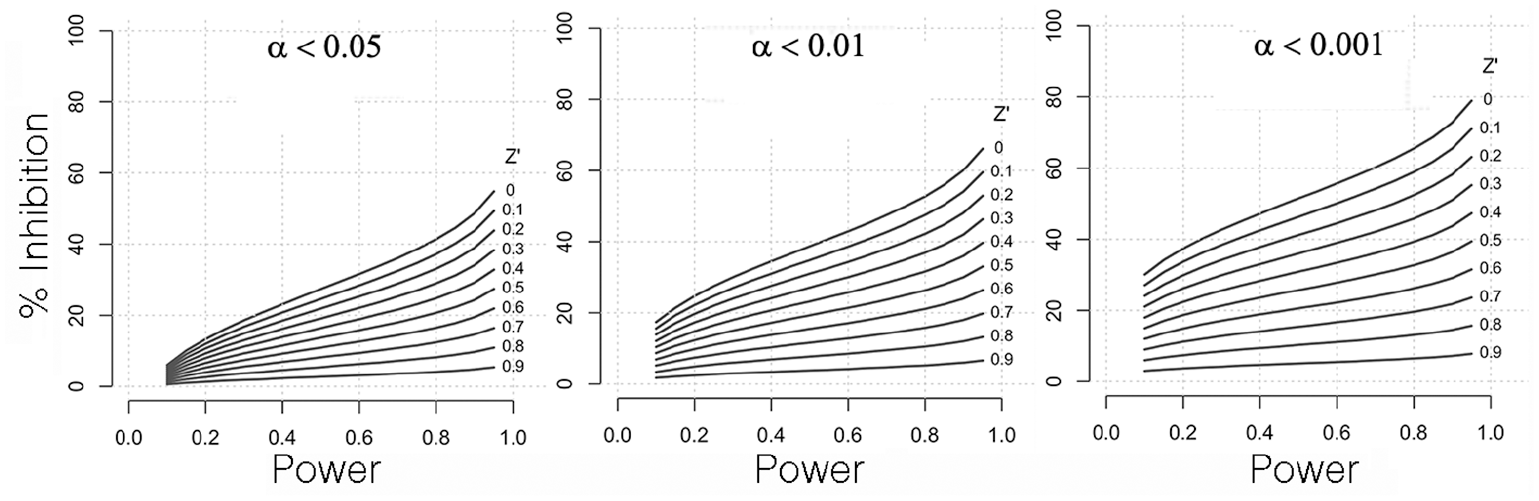
Assays with Z’ < 0.5 have significant statistical power when the standard deviation is constant. Plots of percent inhibition versus power for α < 0.05, 0.01, and 0.001 allow determination of the level of inhibition needed to generate a desired statistical power level.
Because the vast majority of compounds are likely without effect (see below), it is generally accepted that α = 0.05 would result in too many false positives. Higher activity levels are required if either lower α or more power is desired, but assays with Z’ < 0.5 still appear to perform well. For α < 0.001 (which corresponds to the > 3σ assumption that is implicit in the definition of Z’), an assay with Z’ = 0.9 reaches 80% power for compounds that inhibit by > 6.7%. As Z’ decreases in steps of 0.1, the level of inhibition required for 80% power increases, but only in steps of ~6%. Thus, for Z’ = 0.5, inhibition by >32% is required for 80% power, but an assay with Z’ = 0.1 reaches 80% power when inhibition is >58%. To achieve 90% power, these values increase to 35% and 65%, respectively. Assays with higher Z’ clearly perform better by this analysis, but there does not seem to be a compelling rationale for rejecting assays with Z’ below 0.5.
A Novel Approach to Simulating Assay Performance under the Assumption of Constant Standard Deviation
Power analysis is most applicable when trying to distinguish between two normally distributed populations. In terms of screening, those populations would be “active” and “inactive” compounds. In screening, however, compounds can have a range of effects. When analyzing assay performance, what we really would like to know is not just how many active compounds assays with different Z’ will find but also how active those hits are likely to really be, since compounds with low levels of activity may not be any more desirable than completely inactive ones. This is a complex problem depending on both the properties of the assay and the distribution of activities in the compound library being screened, and analytic solutions are impossible. It is possible, however, to solve the problem numerically, provided we try to duplicate what happens in an assay and are willing to make some assumptions about the distribution of activity in the compound library. Taking the assay component first, Z’ is commonly understood as defining a separation band between the positive and negative controls, 1 which it does. The σ we measure when we assess how the sum of all of the errors in the system (liquid handling, compound dispensing, measurement instrumentation, biology, etc.) introduces uncertainty into defined control signals, however, also applies to our estimates of the effects of test compounds throughout the entire signal range of the assay. This means that when we measure the effect of a compound in an assay, we do not obtain the “true” value of its effect (unless our assay has a Z’ of 1 and therefore a σ of 0). Instead, we get a noisy estimate; the “true” effect of a given compound lies probabilistically within a normal distribution (whose width is defined by σ) that includes the measured value. Turning to the compound library, the number of both active compounds found and false positives generated obviously depends on the distribution of compound activities in the collection being screened. There can be no genuine hits in a library with no active compounds, and there will be no false positives if all compounds are active. Unfortunately, we do not know the true distribution of compound activities for any compound library, because this is always measured in the presence of noise introduced by an assay.
We put these two pieces together as follows to mimic an assay in silico. We first modeled a modestly sized “typical” screening collection composed of 40,000 compounds, assuming that compound activity would be distributed in a more-or-less exponential fashion with fewer and fewer compounds demonstrating progressively higher levels of inhibition. We assigned about half the compounds to have absolutely no inhibitory effect at all, another ~18,000 compounds to inhibit by 25% or less, ~1900 compounds to inhibit between 25% and 50%, and only ~100 compounds to inhibit by > 50%. The final distribution of activities in our model compound collection is shown in two forms in Figure 2A . Then, for Z’ ranging from 0 to 0.9, we took the “true” assigned inhibitory effect of each compound and assigned the compound a second “assayed” value obtained probabilistically from a normal distribution (whose width was determined by the σ associated with that Z’) containing the “true” value. This procedure converts each of the defined bins of activity in Figure 2A into a normal distribution with σ determined by Z’. For bins with hundreds or thousands of compounds, the procedure results in a fairly well-defined probability distribution for the “assayed” values. Because, however, we assumed that there are relatively few compounds producing higher levels of inhibition, the resulting “assayed” distributions were sparse. To circumvent this, we repeated the overall procedure 100 times for each Z’ and averaged the results. The effects of this procedure on the apparent distribution of compound activities in the set is shown in Figure 2B . As Z’ decreases, the apparent distribution changes fairly dramatically, coming to look more and more like a normal distribution centered on 0% inhibition.
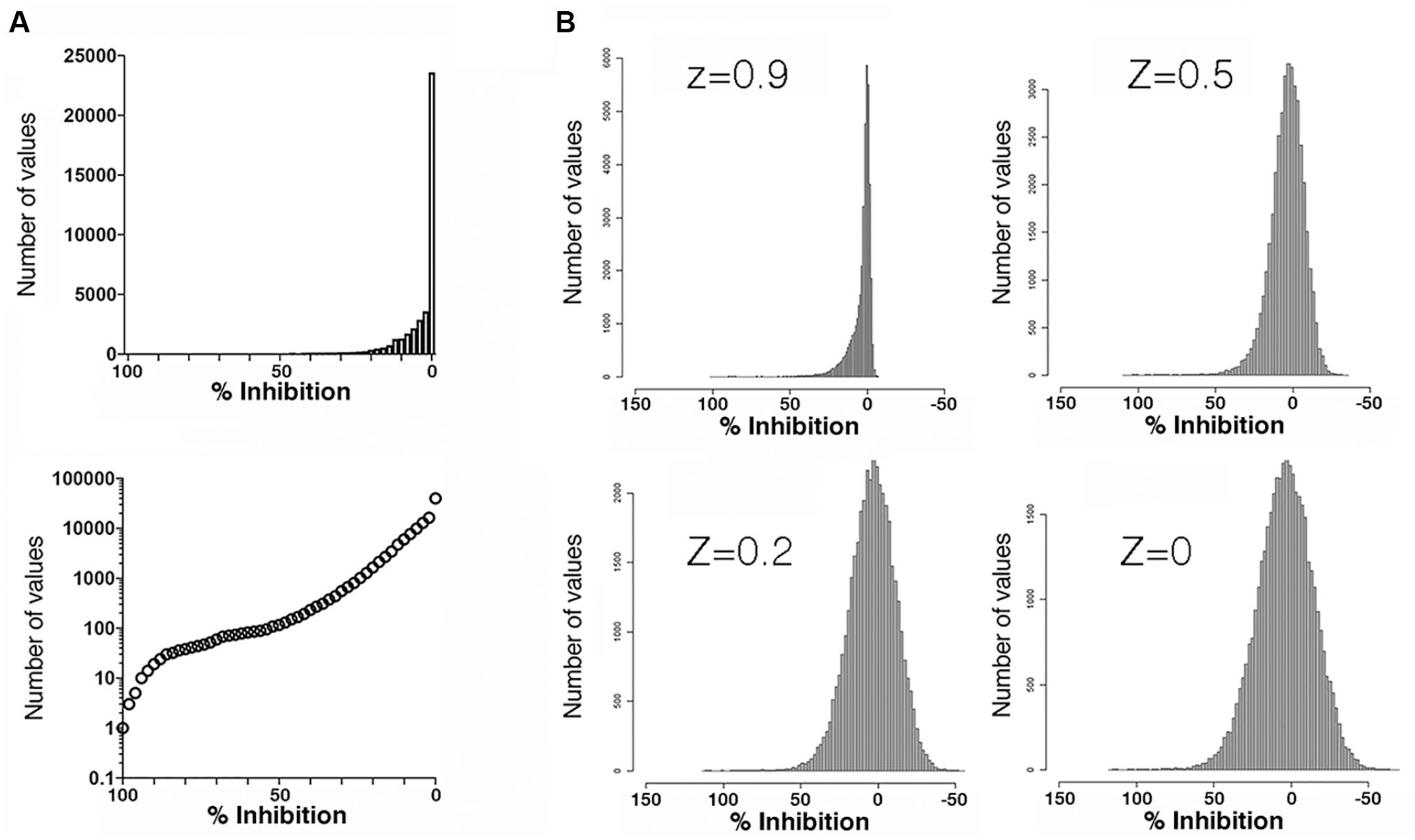
Assay-introduced noise makes a simulated compound collection appear normally distributed. (
In
Figure 3A
, we show plots for several different Z’ for three parameters that we calculated as we decreased the observed apparent “assayed” % inhibition from 100%. The first parameter (displayed as a solid line that goes up) is the cumulative total number of apparently active compounds found. Of course, the “true” activity of these compounds may be different than this apparent value. The second (displayed as a dashed line that goes down) is the cumulative number of the 20,000 completely inactive compounds that are mistakenly identified as active as a result of the noise that was added. The final parameter (displayed as a dotted line that goes up) is the cumulative total number of compounds found whose “true” inhibitory activity (i.e., prior to noise addition) is actually ≥ 50%. We included this parameter because it gives us insight as to how assays behave with respect to finding compounds that, while not completely inactive, may be less active than desired. The choice of 50% apparent inhibition was arbitrary but informed by our experience that in many cases, screens are conducted with the intention of finding compounds that inhibit by 50% or more. The utility of this parameter is most readily appreciated in the plot for Z’ = 0 (
Calculated Performance of Assays with Different Z’.
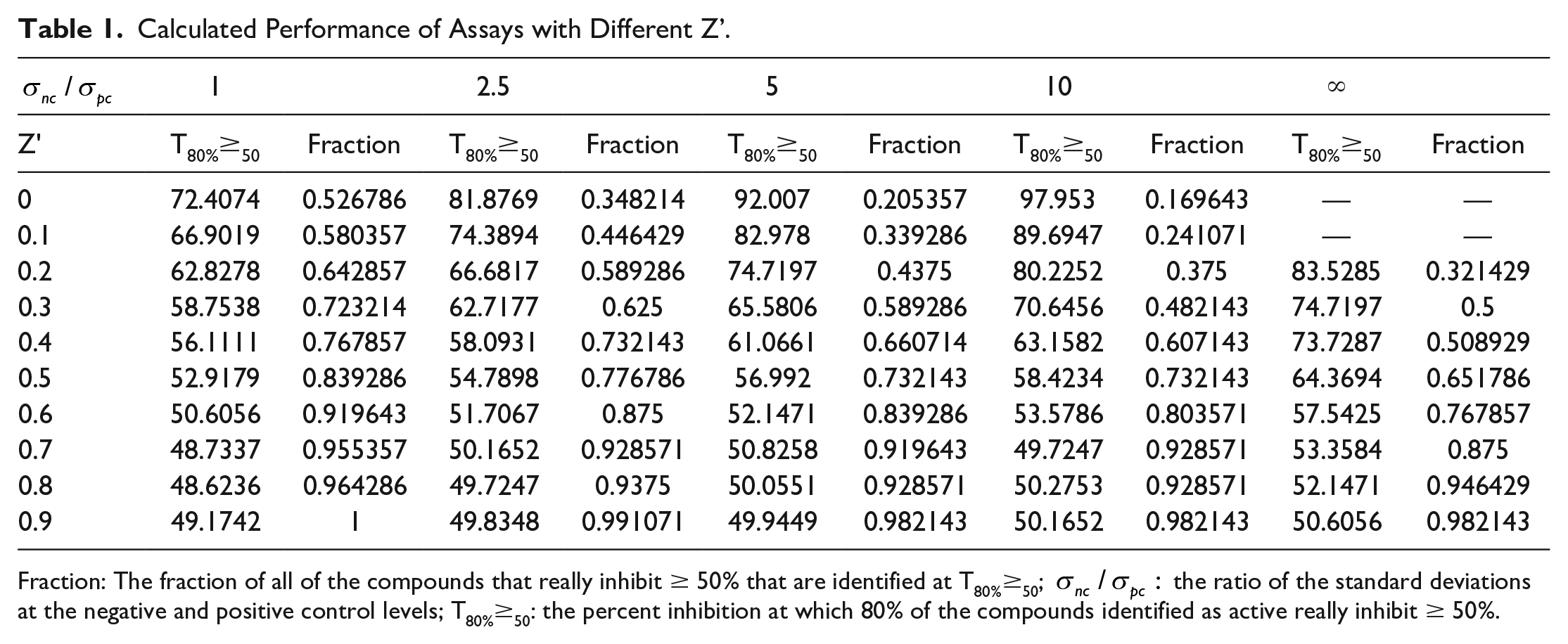
Fraction: The fraction of all of the compounds that really inhibit ≥ 50% that are identified at T80%≥50;
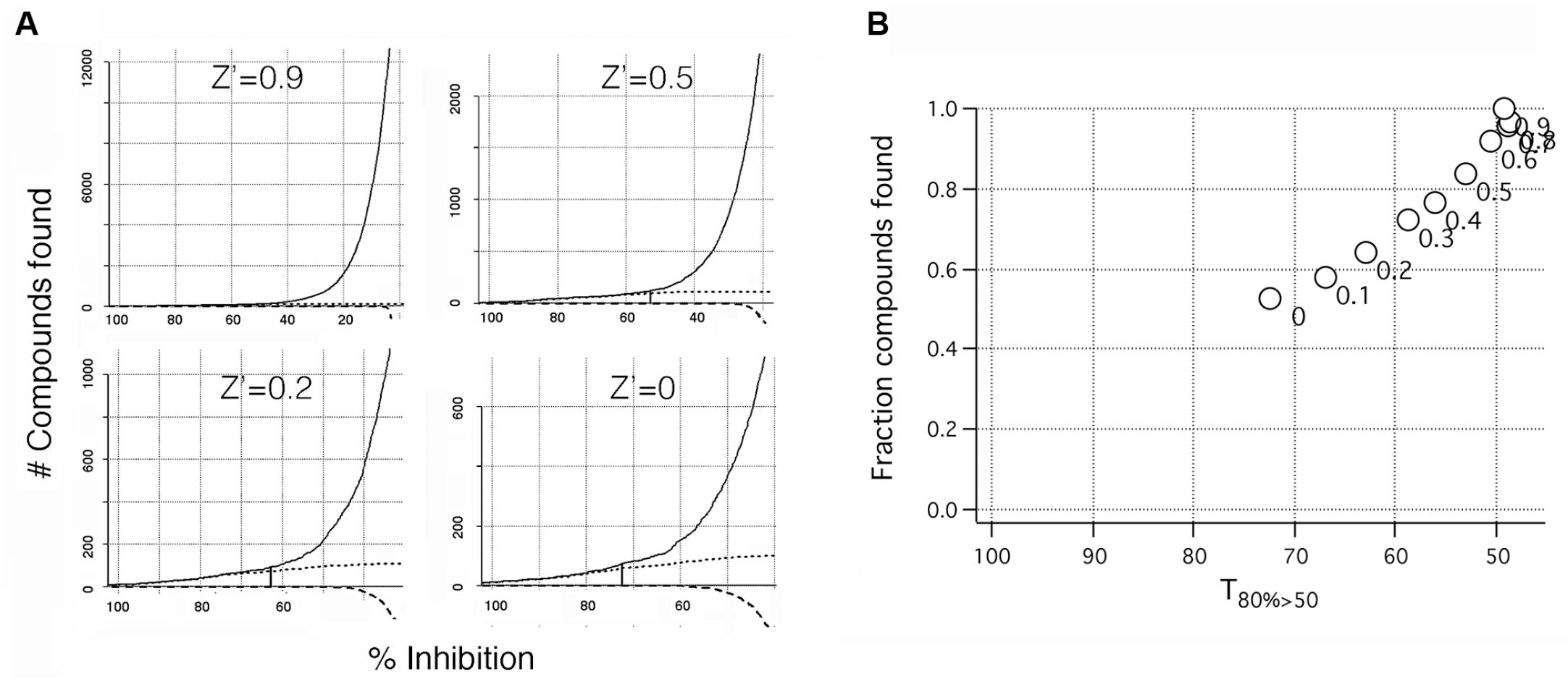
Simulations indicate assays with Z’ < 0.5 have significant ability to find compounds when the standard deviation is constant. (
Assay Performance When the Standard Deviation Is Not Constant
So far, we have considered only assays in which the standard deviation is constant. As Sui and Wu have noted, however, it is often the case that σ varies with signal amplitude, and they demonstrated that this can profoundly affect assay power.
15
To examine how unequal standard deviation affects assay performance, we repeated both our power analysis and our simulations under conditions in which σ increased linearly with signal amplitude from a low value of
Power analysis suggests that unequal σ has relatively small effects when Z’ is > 0.5, but degrades assay performance when Z’ < 0.5 (
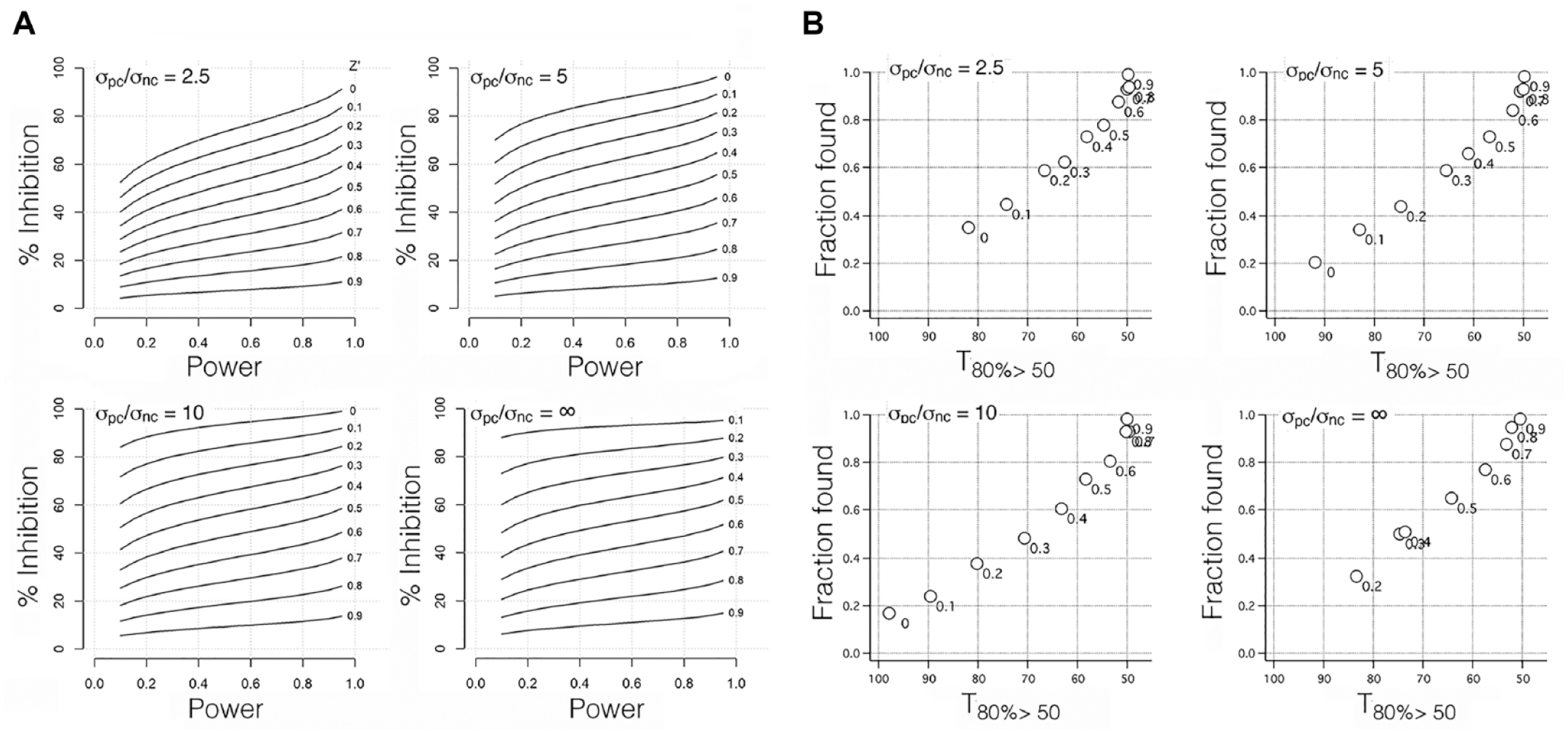
Performance is degraded for assays with Z’ < 0.5 when the standard deviation is not constant, but most assays can still find active compounds. (
Discussion
Our goal in this work was to determine whether assays should be required to have Z’ > 0.5. We find two compelling reasons why they should not. First, whether assessed by analyzing statistical power or by the simulation approach we developed, it is clear that, except in extreme circumstances, assays with Z’ < 0.5 can find useful compounds without also finding too many unwanted, less active compounds, provided an appropriate activity threshold is selected. Second, Z’ does not serve to allow meaningful comparison of assay performance, assessed either by power calculations or by our simulation method, except when assays have the same
We have taken two approaches to assess assay performance: power calculations and simulations. Sui and Wu were the first to perform power analysis on assays with different Z’. 15 Our results are largely in agreement with theirs. They found that assuming constant σ and α < 0.001, assays with Z’ as low as 0 retain significant power to find active compounds; for compounds that inhibit by 50%, we both estimate that power = 50%, and show that power increases for compounds that inhibit more than this. Further support for the idea that Z’ need not be > 0.5 can, as mentioned previously, be found by combining the results of two papers from a group at the Lilly Research Laboratories. The first explored the use of the signal window (SW) as an assay quality metric, finding that assays with a SW of 2 or more had reasonable power to identify active compounds. 8 The second related the SW to Z’, finding that the SW of 2 corresponds to Z’ of ~0.3–0.4. 9 Sui and Wu 15 also applied power calculations at two signal-to-background ratios when assays have a constant coefficient of variation (i.e., σ is a constant fraction of the signal amplitude). They found that assay performance was substantially degraded. We applied power analysis under four conditions in which σ increases linearly with signal amplitude and also found that assay performance suffers. Except in the most extreme cases, however, our results indicate that power of 80% or more can be achieved if a sufficiently stringent activity threshold is applied.
Our approach to simulating assay performance under different conditions is, to the best of our knowledge, novel. One of the main challenges we faced was deciding on the composition of the model compound collection we used. Zhang et al. mention having assumed a normal distribution of compounds in which the majority have no effect, 1 although it is not clear that this played a significant role in their formulation of Z’. We used a pseudo-exponential distribution instead for the following reasons. It seems to us highly unlikely that in a properly designed screen, equal numbers of compounds will demonstrate blocking and enhancing activity (as we stated, we adopted the formalism of a screen for inhibitors). This would seem to argue against a normal distribution of compound effects. If we were to include enhancing compounds in our set, it would have only minimal effects that would be similar to those of adding additional inactive compounds, but with even less effect on a per-compound basis. Also arguing against an underlying normal distribution of compound activity, we note that the effect of increasing σ in our simulation is to cause the distribution of compound activities to appear progressively more normal. This effect tends to “spread” compound activities to more extreme values. For example, some inactive compounds are made to appear active, an effect that can be appreciated by examining the distribution of compounds for Z’= 0.5 in Figure 2B . Although there are no real enhancing compounds in our set, there appear to be compounds that enhance by more than 30%. Importantly, if the distribution of true compound activities started out as normal and there was any significant width to the distribution, this effect would further spread the values at the extreme of the tails. Since this does not seem to be the case, it suggests that if compounds are normally distributed around 0% inhibition, the width of the distribution must be small and is thus not likely to be a significant factor. We suspect that since the true distribution of activity in a compound library can never be observed, the impression that compound effects are normally distributed is created by the noise introduced by assays. Additional simulation would be needed to determine whether the details of the compound distribution affect results, but because we compared assays using the same set, we suspect any such effect would be small. We note that our simulated set contained ~100 out of 40,000 total compounds that inhibit by > 50%. This would correspond to a hit rate of 0.25% in a screen that set a 50% cutoff for activity, which is reasonable.
A number of assay quality metrics have been proposed that could potentially be used in place of Z’. The group at Lilly Research Laboratories initially proposed the SW, 8 although they subsequently concluded that Z’ was a better metric. 9 Zhang 2 has proposed two parameters—strictly standardized mean difference (SSMD) and coefficient of variability in difference (CVD)—that, unlike Z’, can be interpreted readily in terms of probability of finding active compounds and thus might be better choices than Z’. Sui and Wu 15 suggested replacing Z’ with the power at 50% inhibition. The screening community has so far not adopted any of these alternate metrics, however; acceptance and use of Z’ as an assay quality metric remain widespread in the screening community, and we therefore do not favor replacing it. In fact, we are opposed to using any single assay metric as a strict criterion for assay acceptance. Doing so will continue to cause valuable assays not to be performed and other assays to be performed under non-ideal conditions. As long as important biology is being interrogated, it seems better to us to perform an assay that has a chance of finding some active compounds, even if others will be missed, than not to perform the assay at all and find no compounds. It may also be better in some cases to perform an assay under conditions that yield a lower Z’ than under conditions that give a higher Z’ but may prevent compounds from being found. Our results demonstrate clearly that under almost all conditions at almost any positive Z’, assays can find active compounds without generating too many false positives as long as the threshold selected for defining activity is matched to assay performance.
We recommend the following. Assays with Z’> 0.5 can continue to be justified by this parameter, provided extreme conditions were not used to achieve this benchmark. For assays with Z’ < 0.5, we suggest researchers should use the data in
Table 1
to determine the T80%≥50 for their assay’s Z’ and
Supplemental Material
Supplemental_Figure_for_Barr_and_Zweifach – Supplemental material for Z’ Does Not Need to Be > 0.5
Supplemental material, Supplemental_Figure_for_Barr_and_Zweifach for Z’ Does Not Need to Be > 0.5 by Haim Bar and Adam Zweifach in SLAS Discovery
Footnotes
Declaration of Conflicting Interests
The authors declared no potential conflicts of interest with respect to the research, authorship, and/or publication of this article.
Funding
The authors received no financial support for the research, authorship, and/or publication of this article.
References
Supplementary Material
Please find the following supplemental material available below.
For Open Access articles published under a Creative Commons License, all supplemental material carries the same license as the article it is associated with.
For non-Open Access articles published, all supplemental material carries a non-exclusive license, and permission requests for re-use of supplemental material or any part of supplemental material shall be sent directly to the copyright owner as specified in the copyright notice associated with the article.
