



Abstract
Down jackets consume a lot of energy and water, and emit greenhouse gases, wastewater and other pollutants during the life cycle. For example, melt spinning polyester fibre production, spinning, weaving, fabric dyeing and finishing are high-energy consumption processes. Down processing, fabric dyeing and finishing are typical water consumption and wastewater pollutant discharge processes. Carbon and water footprints are practical tools for evaluating the environmental impact of a product in its life cycle. This article quantified and evaluated the carbon and water footprints of the life cycle of 100 down jackets – from raw material production to recycling and disposal without transportation activities. The results showed that the carbon footprint of the 100 down jackets production was 2544.1 kgCO2e with recycling. As for the water footprint, it showed that fabric production had a great impact on water eutrophication and water scarcity. The water scarcity footprint of 100 down jackets production was 27.46 m3H2Ot, respectively. The water eutrophication footprint generated by producing 100 down jackets in new industry was 1.91 kgPO43−eq. The comprehensive assessment of carbon footprint and water footprint with the life cycle assessment polygon method indicated that the raw material production phase of down jackets generated a more significant impact on the environment than the use phase. The impact on the environment during the use phase is primarily the environmental load on water resources.
Introduction
Since the industrial revolution, greenhouse gas (GHG) emissions generated by human society have caused the global average temperature to rise by 1.5°C. 1 The fashion industry is the third largest manufacturing sector in the world. It was predicted that the volume of garment manufacturing would increase by 81% between 2018 and 2030. Although this makes a significant contribution to the global economy, the fashion industry causes serious environmental impacts in terms of climate change, resource depletion, air and water pollution and the use of toxic chemicals. 2 For instance, the clothing life cycle is responsible for significant consumption of energy, chemicals and water, as well as discharge of wastewater and emission of GHGs, which causes problems in climate and aquatic environments. 3 The textile and apparel industry due to its long supply chains and energy-intensive production is one of the most polluting industries in the world. 4 Therefore, reducing the environmental impacts of clothing is increasingly in the spotlight, and it is an important component of working towards United Nations Sustainable Development Goal 12 (Responsible Consumption and Production). 5
Studies6–18 on the environmental impact of the life cycle of apparel products quantified and assessed the ecological impact of GHG emissions, water consumption and wastewater pollutant discharges, evaluated high-emission segments and made decisions on how best to reduce environmental impacts.
Currently, the application of carbon footprint in the field of textile and apparel is a research hotspot. Most studies focus on just one or a few areas of the product life cycle, and/or on a specific type of product. 6 The research object involves a wide range of fibre, yarns, fabrics, apparel and so on. Zhao et al. 7 showed that for every 1 kg of polyester fabric produced, 7.074 kg of CO2 emissions are generated. However, another study illustrates that producing 1 kg of polyester fabric generated 1.36 kg of CO2. 8 The accounting results often have large variability, as they are affected by the accounting boundary, data collection, characterization factors and so on.
For textile and apparel products, Steinberger et al. 9 studied the carbon footprint in the whole life cycle of cotton T-shirts and polyester jackets. It was suggested that establishing a life cycle inventory (LCI) for each country can effectively reduce the carbon footprint of clothing over the entire life cycle. Large apparel companies and consultants, such as Levi Strauss & Co., 10 Jungmichel 11 and Continental Clothing Company Ltd., 12 calculated the carbon footprint of jeans, shirts, jackets and T-shirts throughout the life cycle of the apparel. The results could give guidance for companies to develop sustainable development strategies, reduce the carbon footprint of high-emission links and choose suppliers with lower carbon footprints. Bevilacqua et al. 13 accounted for the carbon footprint of wool sweaters throughout their life cycle based on life cycle assessment (LCA) theory. It was pointed out that strengthening industrial clusters could effectively reduce the carbon footprint of manufacturers because carbon footprint caused in the transportation of textile products (e.g. yarn, fabric) in each chain segment could be eliminated. In addition, the carbon footprint study methodology for the environmental performance of silk products over their life cycle was analysed, 14 which improved the accuracy of the quantification and assessment of the environmental performance of the life cycle of silk products. And the carbon footprint of nylon carpet in the whole life cycle was 4.8 kg CO2. 15
As for the water footprint of textile and apparel products, Zhu et al. 16 accounted for the baseline water eutrophication footprint and baseline water scarcity footprint of 1 kg of viscose filament and 1 kg of viscose staple fibre produced by existing and new enterprises. The accounting results showed that viscose filament production had greater potential for water saving and emission reduction to reduce the water load caused by the production. Zhu et al. 17 also calculated the grey water footprint and water eutrophication footprint of the 1 kg viscose staple fibre production process based on the grey water footprint theory in the water footprint network methodology system and the ISO 14046 standard. It was pointed out that the grey water footprint of black liquor wastewater in the pulping stage and the refining wastewater in the spinning stage was larger, which provided a direction for water conservation and pollution reduction. Qian et al. accounted for the water eutrophication footprint and water scarcity footprint of 1 kg of virgin polyester textile and the apparel product production process according to ISO 14046 standard, and the results were 1.97 kgPO43− eq/t and 26.1 m3H2O eq/t, respectively. The authors pointed out that chemical oxygen demand caused the largest water eutrophication footprint, followed by ammonia nitrogen and 5-day biochemical oxygen demand. 8 Some scholars also accounted for and evaluated the water footprint of alkali reduction, printing and washing processes of polyester printed fabrics based on the water footprint theory, 18 which pointed out that the washing process is a key aspect of water conservation and the alkali reduction process is a key aspect of implementing pollutant reduction and treatment.
Down jackets are practical cold-weather garments. In 2021, China produced 104 million pieces of down jackets with a cumulative increase of 3.51%. 19 The production of down jackets causes increased water consumption and environmental pollution. During the duck and goose breeding process, a lot of feed and freshwater resources are consumed. It was reported that 20,000 breeding geese can produce around 20,000 tonnes of manure per year, 20 which could cause serious water pollution. During feather washing at the down-processing stage, water and chemical product may be consumed substantially, which has an enormous environmental impact. 350–400 tonnes of water are required for 1 tonne of down processed production, 21 and wastewater with lots of ammonia and nitrogen pollutants leads to the eutrophication of water.
Down jackets have high requirements for comfort and warmth, and this generally requires that fabrics are high-count, high-density. 22 The fabrics of down jackets in this article are made from polyester and nylon fibres, while polyester and nylon fibres are produced using petrochemicals. 23 Polyester and nylon fibre manufacturing involves energy, chemicals, water, steam, light diesel, fuel oil, and so on, which produces a lot of exhaust gases (soot, SO2, CO2, argon, nitrogen, etc.) and wastewater (C2H4, waste liquid). In addition, spinning, weaving, dyeing and finishing processes consume a substantial amount of energy 24 and generate solid wastes, while the fabric dyeing phase involves high water intake, chemical intake and wastewater output.
However, there are few studies focusing on quantifying and evaluating the life cycle environmental assessment of down jackets. In order to fill the research gap in the literature, LCA, carbon footprint and water footprint are applied to evaluate the environmental impacts of down jackets. Selecting one down jacket as the research object and synthesizing inventory data across all phases of the life cycle of down jackets, the carbon footprint and water footprint of each process unit in the down jacket life cycle were calculated and evaluated. Subsequently, LCA polygon was used for comprehensive environmental load assessment. Based on the results of research, the down jacket enterprise and policy implications for reducing the environmental impacts of down jackets are proposed and discussed. It is of great significance to promote green production and processing for the textile and apparel industry. The data in this study could give an insight into future research requirements.
Methods and Data
In the current article, the potential environmental impacts of down jackets were investigated, according to the carbon footprint, the water footprint and LCA polygon methodology. According to PAS 2050 standard, the carbon footprint was used to quantify the GHG emissions and the load of the down jacket life cycle on the environment. The water scarcity footprint and water eutrophication footprint according to ISO 14046 standard were used to quantify an environmental load of water resources in the life cycle of down jackets. With the LCA polygon methodology, the ecological limitations of climate and water resources were evaluated based on the accounting results of the carbon footprint, the water scarcity footprint and the water eutrophication footprint.
System Boundary Description
In this study, the environmental impacts are assessed from the moment where duck and goose breeding enters the recycling and disposal facilities, excluding the ecological implications caused by transportation and daily human life. Due to the diversity of products and the complexity of technologies at each stage, the life cycle of down jackets was divided into four stages: raw materials production, processing of down jackets, use, as well as recycling and disposal stages. A typical process flow of the down jacket life cycle stages is shown in Figure 1.
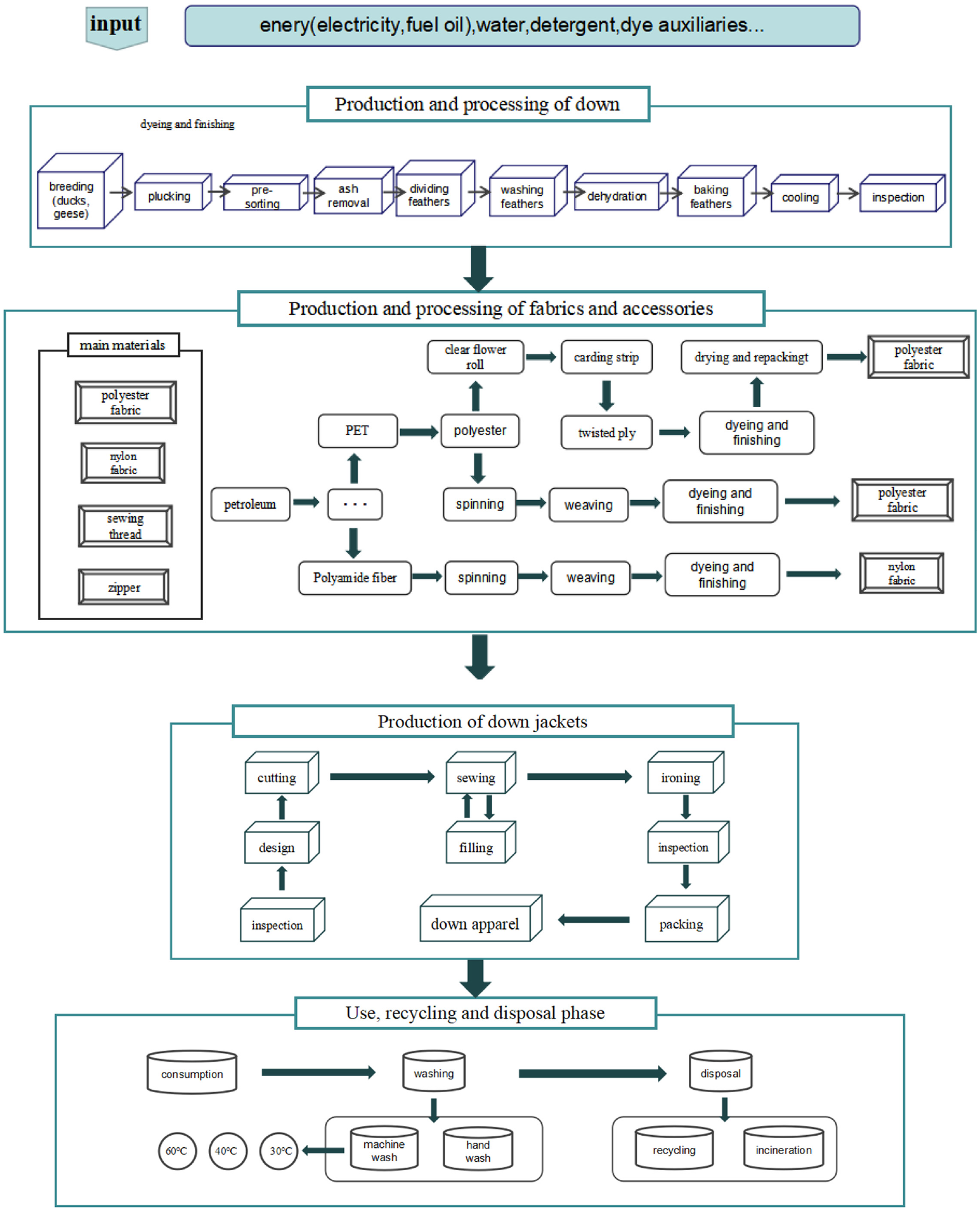
Life cycle system boundary of down jackets.
Carbon Footprint Assessment
The carbon footprint is expressed in terms of carbon dioxide equivalent (CO2eq), that is, other GHGs (CH4, N2O, SF6, etc.) are converted to CO2 by multiplying the emissions of gas by the corresponding GWP value to convert it to CO2-equivalent gas. The carbon footprint can be calculated by the carbon emission factor method using equation (1): 25

where CF is the carbon footprint of the product in kg CO2e; Mi is the amount of energy consumed in kg for category i; fi is the carbon emission factor in CO2e for category i.
Water Footprint Assessment
The water eutrophication footprint (WFeu) could evaluate the water eutrophication impact caused by discharged phosphorus and nitrogen pollutants, which was used to evaluate the water degradation footprint. WFeu is calculated as follows: 26

where WFeu indicates the eutrophication footprint of water body in kg PO43−eq/t; CFeu,j indicates the characteristic factor leading to eutrophication pollutant j of water body in kg PO43−eq/kg; Meu, j indicates the mass of eutrophication pollutant j discharged into water body by process chain section i in kg; and i indicates the product process chain section.
The water scarcity footprint (WFscar) is used to evaluate the impact on water scarcity caused by freshwater consumption. The method used for WFscar calculation is as follows: 26

where WSF is water scarcity footprint in m3H2O eq; WSI is average water stress index (where j denotes region and gl denotes global); Cj is volume of freshwater consumption in m3 per unit time in region j; and i is the product process chain segment.
LCA Polygon Method
The LCA polygon theory is a comprehensive evaluation of environmental loads for two environmental damage categories, climate change and water resources environment, which can eliminate the impact bias of quantitative assessment by a single indicator.
The LCA polygon theory refers to forming an n-directional measurement axis system in a positive n-sided shape, where each measurement axis represents a specific damage category. The scale and unit chosen for each measurement axis are based on the numerical values and the particular damage category. The actual numerical points on the measurement axes can be connected to form a new n-deformation, which is the LCA polygon.
In the same n-directional measurement axis system, the LCA polygon areas of different products and process activities are compared, and the degree of their environmental impact is analysed. 19 The ecological load impact is proportional to the size of the average area of the LCA polygon. In the LCA polygon, the total impact of each product or process could be concluded by comparing the areas of the different polygons. The larger the area, the more serious the impact of the product or process. The calculation formula is as follows:

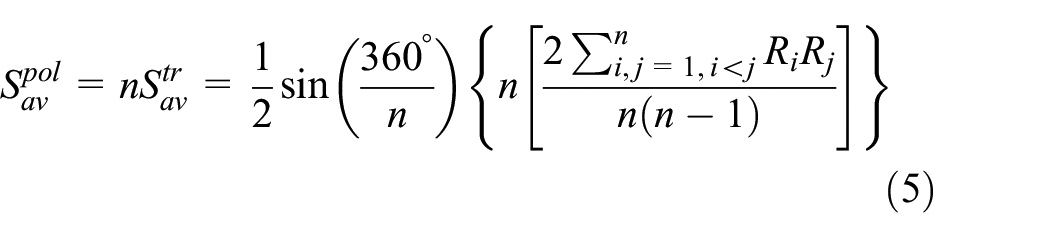
where S is the area of the LCA polygon; Ri is the side of triangle i; and i is the number of triangles formed in the n-sided polygon;
Data Collocate
In this article, the functional unit (FU) was set as 100 pieces of one down jacket. The data on raw material usage, technological process and energy consumption in the production process of the down jackets were collected from enterprises. On the contrary, the data on polluted water discharge, zipper, recycling and disposal were obtained from industry experts and literature.
Life Cycle of Down Jackets
Raw Material Production
The raw materials of down jackets include down-filling material, fabrics and auxiliary materials. For the fabrics of the down jacket, polyester fabric is used for outer fabric and bile cloth, and nylon fabric is used for lining, regardless of rubber belt and other supplementary materials. Accessory materials are sewing thread, zipper and four buttons, labels and rubber bands, and other supplemental materials are not taken into account. According to the different raw materials, this article divided the raw material production into two chains, which were a down-production process chain and a fabric and accessories production process chain. The specific process is shown in Figure 1.
Down-Production Process Chain
This stage is where down is manufactured from feathers. It starts from the feeding of ducks/geese, and feathers are plucked and pre-sorted to form the original down, which must be washed before being used as a filling material. The specific process is shown in Figure 1.
Fabric and Auxiliary Materials Production Process Chain
The production chain starts from petroleum, after cracking, esterification, condensation and other chemical reactions to form PET and polyamide, which can be finished into polyester and polyamide fibres by turning. The threads are made through spinning, dyeing and finishing processes that can be used as down garment fabrics and lining materials. Polyester fabric and nylon fabric that are high-density and anti-drilling are used as a down garment lining material. The main auxiliary materials are polyester sewing thread, metal zipper and four buckles. Sewing thread and zipper backing are made from polyester fibre, while the zipper head and four hooks are made from metal.
Down Jackets Production
This stage is where down jackets are manufactured from fabrics: it includes the inspection of raw materials (down, fabrics and accessories), the style, structure and process design of down jackets, and a series of processing processes such as cutting, sewing, down filling and finishing, and the down jackets were put into the market after the inspection and packaging. This is a highly labour-intensive process, and energy is generally the main input in this life cycle stage. The specific process is shown in Figure 1.
Use, Recycling and Disposal of Down Jackets
In this article, the washing process of down jackets in the use stage adopts two ways, namely hand washing and machine washing at 30°C, 40°C and 60°C. The recycling and disposal process of down jackets was recycle or incineration. In the recycling process, the recycled raw materials can enter the next life cycle.
Inventory Analysis
According to the data collected, the material inventory of the inputs and outputs of each process unit in the life cycle of down jacket was analysed. The inventory analysis results are shown in Table 1.
Life cycle inventory analysis of down jackets.
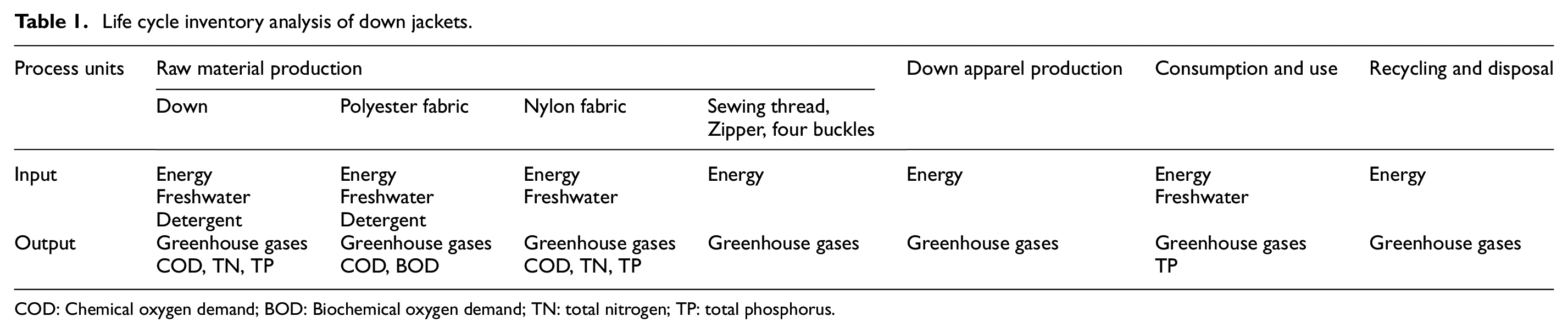
COD: Chemical oxygen demand; BOD: Biochemical oxygen demand; TN: total nitrogen; TP: total phosphorus.
The use phase of down jackets plays an important role in their life cycle. The number of washing cycles operated during the use phase is critical since it affects the durability of down jackets and increases energy consumption. According to literature data, the average service life of down jackets is 6.6 years; for the convenience of calculation, this article uses 7 years of useful service life. The types of washing machines used (or the absence of their use) can make a significant difference to the environmental impacts of this phase. 27 Considering the characteristics of down jackets, washing methods was divided into two categories of hand washing and machine washing, and the drying method is natural air-drying, without ironing. The temperature of machine washing, energy consumption, water usage, washing capacity and other factors should be considered. According to the literature,28,29 the results are shown in Table 2 in the supporting information file.
Results and Discussion
Carbon Footprint Accounting and Assessment
Figure 2 shows the carbon footprints of different process units in the life cycle of down jackets. With different treatment methods in the recycling and disposal stage, carbon footprint values in the whole life cycle of down jackets varied. As shown in Figure 2, it is found that raw material production and use stage are the main contributors to the environmental impact, and the contribution ratio to the total environmental impact is 83.2% and 12.4%, respectively. The reason why the carbon footprint of raw material production is the largest is that the raw material production stage contains a variety of production processes. Oil degradation cracking, chemical condensation, yarn dyeing and finishing, and metal processing all involve a substantial amount of electric energy, water, chemicals and so on.
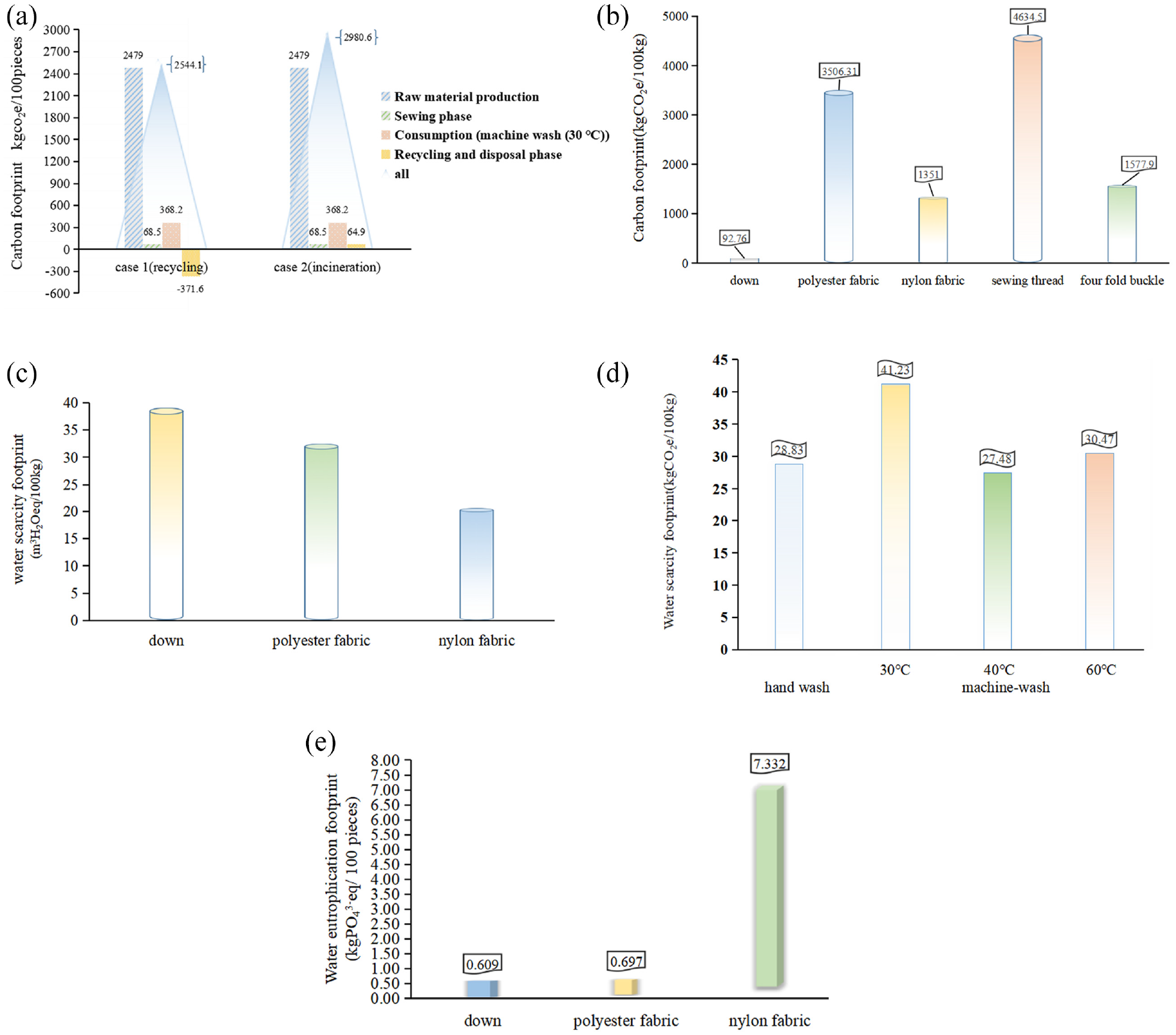
(a) Carbon footprints of different process units in the life cycle of down jackets. (b) Carbon footprint of the production of various raw materials. (c) Water scarcity footprint of raw materials production. (d) Water scarcity footprint of different washing methods. (e) Water eutrophication footprint of raw materials.
The recycling and disposal stage creates significant environmental impacts due to unsustainable disposal methods of down jackets. As shown in Figure 2(a), recycling generated better environmental impacts of down jacket. The carbon footprint of recycling is −371.6 kgCO2eq, and the negative value is due to the fact that the carbon footprint generated by the production process of raw materials is much larger than that of recycling process. Incineration causes a much greater global warming potential than recycling, so recycling is a preferable option.
The carbon footprints of the production of various raw materials are shown in Figure 2(b). This result shows that sewing thread and polyester fabric cause the highest environmental impact (based on GHG emissions), which contribute 36.1% and 31.4% of carbon footprint, respectively. This is because the sewing thread and polyester fabric are mainly made of polyester fibres, polyester fibres are produced using petrochemicals, and polyester fibre manufacturing involves a lot of energy and chemicals that generate a lot of CO2. 23 Although a large amount of water was consumed, down production has the lowest environmental impact among the raw materials, because the CO2 emission factor of water is very small. It is worth noting that the carbon footprint of producing a standard strip zipper is 0.149 kgCO2eq, which cannot be compared with other materials, because the FUs are not uniform.
Water Footprint Accounting and Assessment
Water Scarcity Footprint
According to the collected data of freshwater input, the water scarcity footprint of the raw materials (down, polyester fabric, nylon fabric) production and the life cycle of the down jackets were accounted for, where the national WSI value was 0.602 and the region was selected as Jiangsu, whose WSI value is 0.6680.
The results of the water scarcity footprints generated during the production of raw materials are shown in Figure 2(c). In the raw materials production process, 100 kg down caused a water scarcity footprint of 39.05 m3H2Oeq, which was mainly caused in the down washing stage, while nylon fabric production caused a smaller environmental load on water resources.
According to the material data of down jackets, the total water scarcity footprint of 100 down jackets in the raw material stage was 27.46 m3H2Oeq. Fabric and liner both are polyester fabrics, of which polyester fabrics have the largest water scarcity footprint due to the largest consumption, accounting for 73.7%. The water scarcity footprints of the down and nylon fabrics are 5.55 m3H2Oeq and 1.67 m3H2Oeq, respectively.
In the use phase, washing process of down jackets resulted in a large environmental load on water resources. The types of washing machine used (or the absence of their use) can make a significant difference to the environmental impacts of this phase. As shown in Figure 2(d), the water scarcity footprints of down jackets in the use phase with different washing methods are various. When the water temperature is 40°C, the water scarcity footprint caused by machine washing is the smallest, followed by hand washing. Machine washing produces the largest significant water scarcity footprint at a water temperature of 30°C.
Water Eutrophication Footprint
After collecting the data of new industry (new industry data is more representative), the calculation results of the water eutrophication footprint generated by different raw materials (down, polyester fabric, nylon fabric) in the raw material production stage of the down clothing is shown in Figure 2(e). In producing raw materials, nylon fabric has the most significant eutrophication footprint of 7.332 kgPO43−eq, in which ammonia nitrogen is the main source of pollution. Therefore, optimizing the nylon fabric production process or adopting other materials could effectively reduce water pollution.
In the use phase, the water eutrophication footprint produced during washing 100 pieces of down jackets was 0.79 kg PO43−eq. Combined with the above accounting results and raw material consumption, the water eutrophication footprint of 100 down jackets of the new industry in the life cycle can be calculated as 1.91 kgPO43−eq.
Comprehensive Evaluation of Environmental Load
As there is only carbon footprint data in the down jackets production and recycling and disposal stages of down jackets in the life cycle, this article analysed the load on climate and environment in these two stages only through carbon footprint. The LCA polygons for the raw material production and down jacket use stages of the down jacket life cycle are shown in Figure 3. The result is 321.69 for the LCA triangle area of the raw material production stage and 81.06 for the LCA triangle area of the down jackets use stage (under 30°C machine wash conditions).
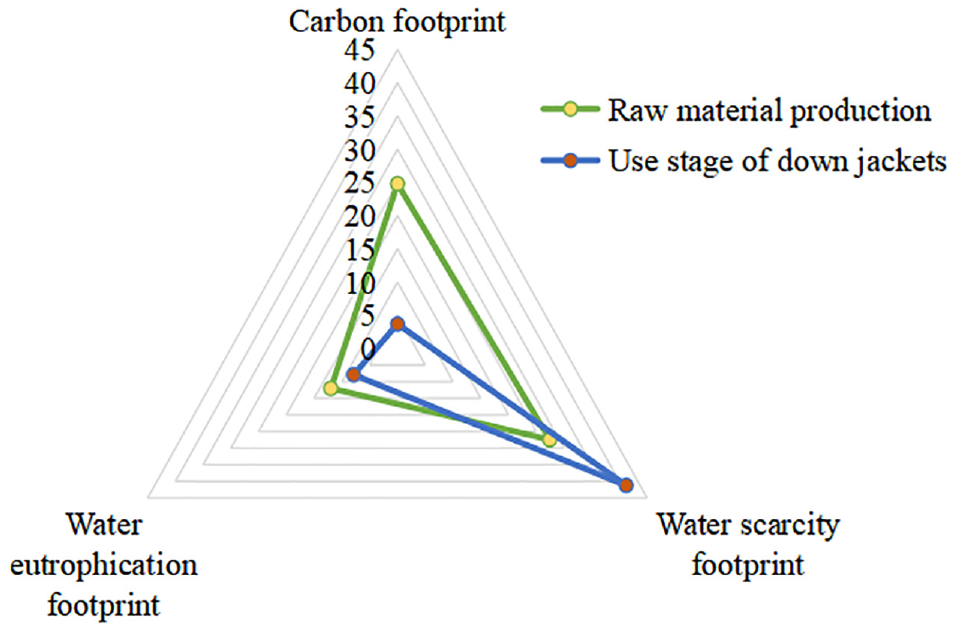
LCA polygon of raw material production and use stage of down jackets (30°C machine wash).
As can be seen from Figure 3, despite the large value of water scarcity footprint in down jacket use stage, the polygon area of raw material production with larger values of carbon footprint and water eutrophication footprint was large. The raw material production stage of down jackets produced a more significant integrated load on the environment than the use stage. The environmental load in the use stage of down jackets is mainly the consumption of water resources.
Discussion
It can be concluded from the investigation that several improvements can be introduced for minimizing the negative impacts of down jacket manufacture and converting it into a more ecofriendly industry. To cope with the global warming situation and reduce environmental pollution in the production of down jackets, the following points can be made.
Considering that the production stage of raw materials contributes the most to the carbon footprint, the production of sewing thread and polyester fabric has the greatest impact on the environment (based on GHG emissions), accounting for 36.1% and 31.4% of the carbon footprint, respectively. Therefore, carbon emissions can be reduced by changing basic raw materials, such as replacing polyester fibre materials that require a lot of energy and chemicals.
The down jacket use stage causes much environmental impact, which arises from water energy use in consumer washing. Changing consumer care behaviour of down jackets can significantly reduce the overall impact from the use stage. Educating consumers to better care for their purchased apparel is one key option for reducing overall impact: for example, less frequent washing, washing with a full machine load and use of more efficient washing machines can be included as better care options.
Improving the recycling technology of textile products and recycling the raw materials of down jackets to replace the traditional disposal methods, such as incineration and landfill, is also a direction to reduce the load of environment. In most cases, benefits from the production of recycled materials compensate for the impacts of garment manufacture. If recycling cannot be performed, incineration seems to be the second preferable scenario for down jackets. 30
This article is not about the impact of waste residue, waste gas, noise and other environmental impacts on the assessment of down jackets in the life cycle. The evaluation angle needs to be more comprehensive to be further improved. In addition, most of the inventory data collected in this article come from secondary data in the literature. There needs to be more data in many stages, especially data related to water footprint accounting. So it is necessary to collect more detailed enterprise actual measurement data and use the Monte Carlo model to conduct quantitative uncertainty analysis on the inventory data to obtain more accurate and reliable life cycle evaluation results.
Uncertainty Analysis of LCI
According to the source and quality of LCI, data are traced, and the uncertainty analysis of the down jackets life cycle list is carried out using the data quality index analysis method.31–33
Subjectively evaluate inventory data quality according to the LCI data quality index matrix, calculate the sum of inventory data quality index scores at each stage of the down jacket life cycle, and convert them into uncertain values to determine the distribution interval. Then, according to the final evaluation results, quantify the contribution value of the inventory data of each stage in the whole life cycle of the down jacket. The quantitative results are shown in Table 3 in the supporting information file.
Among them, the inventory data contribution value of polyester fabric production and use stage of down jackets is more considerable. The inventory data contribution value of polyester fabric is as high as 85.97% in GHG emissions. Its data uncertainty dramatically influences the results of the whole life cycle evaluation of down jackets.
The distribution of inventory data and data uncertainty for each stage is shown in Figure 4. Combining the uncertainty of the data and the contribution value in the life cycle, it can be seen from the figure that most of the inventory data of each stage are distributed in area B, and a small amount is distributed in area A. The data distributed in area A are related to the use stage, water resource consumption and water eutrophication. These two data groups are from the statistical literature data, and there is a certain gap between them and the current research time. Their uncertainty is high, which has a greater impact on the accuracy and reliability of the LCA results.
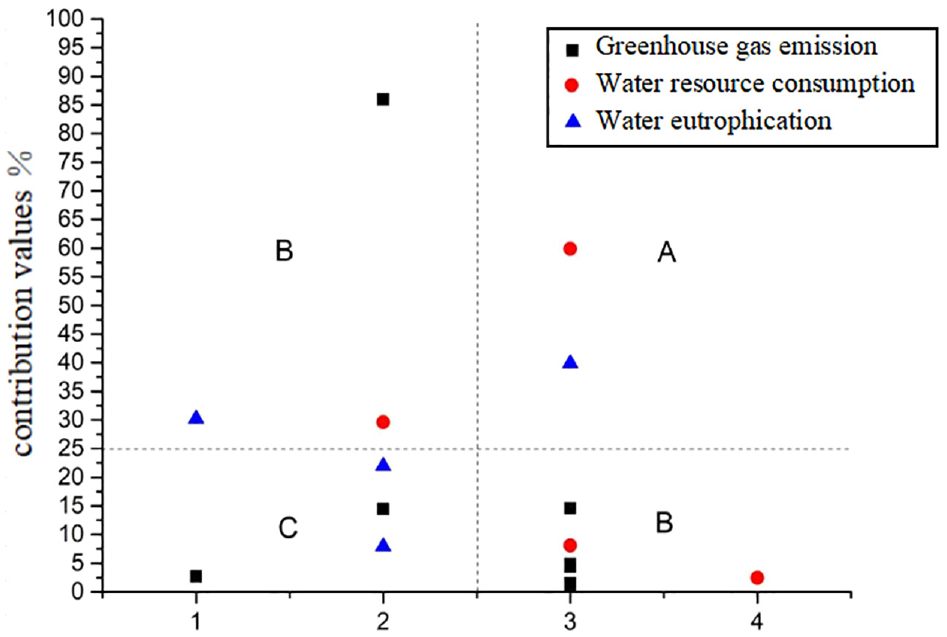
Data uncertainty analysis results distribution chart.
Conclusion
The current study analysed the environmental impacts of 100 down jackets manufactured from one down jackets enterprise. In terms of the carbon footprint, raw material production is one of the highest contributors to the environmental impact due to the high-energy consumption. Down production had the most negligible impact on the environment (followed by nylon fibre). Among the various stages of down jacket production, sewing thread and polyester fabric production place the highest environmental burden in carbon footprint indicators.
In terms of the water footprint, the results have demonstrated that the use stage of down jackets caused great environmental impact in terms of water consumption and water pollution. In the raw material production stage, in contrast, water consumption in processes of down production caused more adverse impact than polyester fabric material production. The total water scarcity footprint generated by the raw material stage in the life cycle of 100 pieces of down jackets was 27.46 m3H2Oeq, among which polyester fabric produced the most significant water scarcity footprint of 20.24 m3H2Oeq.
It was noticed that several improvements can be employed for minimizing the negative impacts of down jacket manufacture to make this industry more ecofriendly. Suggestions were presented in this study for reducing the overall impacts of this industry. One way to reduce the carbon emissions of the down jacket production process is to use clean electricity (e.g. wind power, solar power and water power). And improving the recycling process is also an environmentally friendly measure.
This article only conducted a demonstration study on the LCA of one down jacket. Whether this LCA model applies to other brands and styles of down jackets needs further research and verification. In addition, it is necessary to collect more detailed actual measurement data of enterprises, especially the data related to water footprint accounting in the down jacket production stage and recycling stage, to obtain more accurate and reliable LCA results.
Supplemental Material
sj-docx-1-aat-10.1177_24723444231172216 – Supplemental material for Carbon Footprint and Water Footprint Assessment of Down Jackets
Supplemental material, sj-docx-1-aat-10.1177_24723444231172216 for Carbon Footprint and Water Footprint Assessment of Down Jackets by Yue Zhou, Wei Bao, Fangying Yan, Ying Zhang and Laili Wang in AATCC Journal of Research
Footnotes
Declaration of conflicting interests
The author(s) declared no potential conflicts of interest with respect to the research, authorship and/or publication of this article.
Funding
The author(s) disclosed receipt of the following financial support for the research, authorship and/or publication of this article: The authors are grateful to Soft Science Research Project of Zhejiang Provincial Innovation Center of Advanced Textile Technology (ZX2022002R), the Clothing Engineering Research Center of Zhejiang Province (2021FZKF01), Science and Technology Innovation Activities of University Students in Zhejiang Province (2022R406C077) and Ouhai District Science and Technology Plan (G20210201) for providing funding supports to this research.

Supplemental material
Supplemental material for this article is available online.
References
Supplementary Material
Please find the following supplemental material available below.
For Open Access articles published under a Creative Commons License, all supplemental material carries the same license as the article it is associated with.
For non-Open Access articles published, all supplemental material carries a non-exclusive license, and permission requests for re-use of supplemental material or any part of supplemental material shall be sent directly to the copyright owner as specified in the copyright notice associated with the article.
