



Abstract
Lifestyle changes have altered the consumption behavior of people. As one of the most energy-intensive and energy-consuming activities in the apparel consumption process, laundry and clothes drying have a significant impact on the environment in terms of carbon emissions and water consumption. Undergraduates are a special category of people whose worldviews are in the developmental stage, and it is important to study and develop their beliefs and behaviors regarding environmental consumption. This study investigates and evaluates the relationship between undergraduates’ consumption behaviors and environmental impacts. The 125 undergraduates in Hangzhou, China are classified into three different washing modes: H-mode (hand-washing only), M-mode (machine-washing only), and HM-mode (hand- and machine-washing) on the basis of their washing behavior. The environmental impacts including water footprint and carbon footprint of undergraduates are calculated by the methods of direct consumptive carbon footprint (
Keywords
Introduction
In the current wave of industrialization and urbanization, environmental degradation due to excessive emissions of carbon dioxide (CO2) into the atmosphere and sewage into the natural water bodies has become a common challenge for many developing countries. 1 Scholars have highlighted the prevailing emphasis on the analysis of the environmental impact stemming from products belonged to consumers during use stage. Alsabri and Al-Ghamdi 2 conducted a comparative analysis of data for three types of polymers, namely, polyvinylchloride (PVC), polyethylene (PE) and polypropylene (PP), and suggested that the use of recycled PVC can improve their production scale. Koiwanit and Filimonau 3 reported a carbon footprint (CF) assessment study of homestays in Ranong, Thailand, showing the importance of consumer behavior in generating the CF of homestays. They also suggested that Thailand should consider using more sustainable energy sources. Salo et al. 4 investigated how differences in consumption patterns affect the CF and provided implications for policymaking. Chen et al. 5 explored household energy use and carbon emissions in Beijing between 1996 and 2011 and investigated the most energy/carbon-intensive consumption behaviors. Their results indicated that during that period of time, total household energy consumption increased from 22.7% to 59.2% and total household CO2 emissions increased from 32.2% to 68.8% compared to the city.
Since the late 1980s, the impact of consumer behavior and lifestyle concepts related to energy use has been broadly studied in the research of individual energy consumption. 6 The characteristics of consumer groups with only strong environmental concerns or general consumer group in different ages have been identified in many previous studies. Harris et al. 7 conducted a study of consumers that identified barriers associated with sustainable clothing, ranging from normalizing the design of sustainable clothing and increasing the ease of purchase, to shifting clothes laundry norms and increasing upcycling that are also of great importance. Bin and Dowlatabadi 8 explored the relationship between consumer activities and environmental impacts in the USA. Their estimates revealed that more than 80% of the energy use and CO2 emissions in the country are the consequence of consumer demands and the economic activities that support that demand. The direct impact of consumer activities (household energy use and personal travel) accounts for 4% of U.S. GDP, but 28% and 41% of U.S. energy use and CO2 emissions, respectively. Miilunpalo and Räisänen 9 investigated Finnish consumers’ textile laundering practices and their attitudes toward garment care processes. Flores and Jansson 10 categorized the determinants of consumer green innovation into four groups: Social, Personal, Innovation and contextual, and External level determinants. However, garment is usually targeted to a certain age group, and eliminating the environmental impact on consumers may not be possible if the understanding is limited to describing all age groups. Moreover, it is crucial to guide adult consumers who are currently in the developmental stage of their worldview to develop their beliefs and behaviors regarding environmental consumption. Meanwhile, the quantization of environmental impact of undergraduates’ apparel consumption is of significant influence. As two important factors quantifying environmental pressures, CF and water footprint (WF) will not be limited to the measurement to specific geographical boundaries and contributes to enhanced public awareness of people’s environmental impact. 11 Therefore, we suggest that the consumption and laundering patterns of undergraduates, a major consumer group, and the subsequent CF and WF should be promoted. Currently, there is a paucity of literature addressing the consumption and laundry patterns of undergraduates and their environmental impacts. In this regard, this article investigates undergraduates’ apparel consumption and laundry patterns and estimates their impact on CF and WF.
Considering that laundry and drying clothes are among the most energy-intensive and energy-consuming activities in the consumption process, 12 this study focuses on the apparel consumption behavior of undergraduates and the environmental impact of washing and drying stages. According to a questionnaire survey conducted in 2020, the undergraduates in Hangzhou were divided into three groups based on their washing behavior. The CF and WF of undergraduates were calculated by using carbon emission factor method and Water Footprint Manual. 13 The environmental impact assessment of undergraduates from the perspective of apparel consumption contributes to sustainable policymaking on apparel products. This study also contributes to the development of environmental awareness among undergraduates and provides empirical evidence in the field of apparel consumption.
Materials and Methods
Data Collection
Data collection took place in June and July 2020. We developed our online questionnaire on the official website of “Questionnaire Star,” which is recognized as a professional online questionnaire, evaluation, and voting platform. We sent the questionnaire to the undergraduate students in Hangzhou (A, B, C, …) and told them in detail the purpose, meaning, and announcement of this survey. The questionnaires were then distributed online through students A, B, and C in a combination of point-to-point distribution to other undergraduate students (H, I, J, …). Prior to completing the questionnaire, all participants were informed of the purpose and content of the study. Once consent was given, participants began filling out the set of questionnaires online. We also included our email address and phone number on the first page of the questionnaire so that participants could inquire and interact with us at any time.
The questionnaire contained 21 questions consisting of individual questions or sets of related questions about laundry and drying habits (detailed questionnaire can be found in the Supporting information). The questionnaire in our study can be divided into five parts. The first set of questions (Questions 1–4) aimed at obtaining respondents’ background information, such as occupation, gender, age, and residential city. These questions were necessary to screen the participants who are suitable for our study and also to provide a reference for further study. Question 5 was designed to understand the apparel consumption behavior of undergraduates. This information was crucial to understand the apparel purchase behavior of undergraduates. In order to investigate the apparel washing behavior of undergraduates, the important factors such as apparel washing mode, apparel washing frequency, and the number of clothes washed each time and so on were collected (Questions 6–10). To calculate the electricity consumption during washing and drying of undergraduate clothes, the parameter information of washing machines and dryers was investigated (Questions 11–17), where key factors regarding drying methods and how the laundry occupied the capacity of the washing machine were also collected. These questions were essential to determine the undergraduates’ consumption behaviors on environment. Questions 18–21 were set to investigate the students’ detergent use habits during washing, which also played an important role in assessing the relationship between detergent use behavior and the environment.
The survey results were considered to be representative of Hangzhou undergraduates, showing that the apparel consumption patterns of Hangzhou undergraduates can be categorized into three types (as shown in Supplemental Figure S1): hand-washing only (H-mode), machine-washing only (M-mode), and hand- and machine-washing (HM-mode). H-mode implies that undergraduates wash their clothes by hand only. M-mode means that undergraduates wash their clothes in the washing machine only. And the HM-mode mean that undergraduates sometimes wash clothes by hand and sometimes by washing machine.
In this study, the
The Parameters of Washing Machines and Dryers
According to the investigation, the most common type of washing machine used by Hangzhou undergraduates was the “LG commercial washing machine,” which was a drum washing machine with energy efficiency grade 1 and a rated washing capacity of 13 kg. The most commonly used dryer was the “LG Commercial Clothes Dryer,” which was a drum inline dryer with a rated drying capacity of 13 kg and an energy efficiency rating of A.
Calculation of Electricity Consumption and Water Consumption for Single Time of Washing
The electricity consumption and water consumption per washing of the washing machine were calculated according to the “GB 12021.4-2013 Energy and water efficiency limit values and grades of electric washing machines.” 14 The energy efficiency grades of drum washing machine are shown in Supplemental Table S1 in the supporting material. The energy efficiency grade is divided into five levels, with grade 1 being the best and grade 5 being the worst. When calculating the electricity consumption and water consumption per unit efficacy of a washing machine at full load and half load, the maximum value of the consumption of each energy efficiency class was used. According to Equation (1) from the GB standard, the electricity consumption and water consumption were calculated by working cycle electricity consumption and working cycle water consumption.
The electricity consumption (E) of a washing machine for a single time of washing was calculated by equation (1):

where E1 is the total electricity consumption during the wash performance test at rated capacity (unit: kWh/cycle), E2 is the total electricity consumption during the wash performance test at half load capacity (unit: kWh/cycle).
The water consumption (W) of a washing machine for a single time of washing was calculated by Equation (2):

where W1 is the total water consumption during the wash performance test at rated capacity (unit: L/cycle), W2 is the total water consumption during the wash performance test at half load capacity (unit: L/cycle).
Based on Equations (1) and (2) and Supplemental Table S1, the values of E and W were 1.0725 kWh/cycle and 68.25 L/cycle, respectively. So the electricity consumption and water consumption per wash were 1.0725 kWh and 68.25 L, respectively.
Calculation of Electricity Consumption for Single Time of Drying
The drum inline dryer did not involve the calculation of water consumption because little water was used during this process. The electricity consumption for a single drying cycle of the dryer was calculated according to the “GB/T 23118-2008 Technical Requirement For Household and Similar Tumble Washer-Dryer” 15 The main performance indicators and grading are listed in Supplemental Table S2. According to the electricity consumption per unit efficacy of each grade in the standard for drum inline dryers (A is the highest, D is the lowest), the maximum value (0.59 kWh/kg) was taken to calculate the electricity consumption for a single drying session of the dryer. According to Supplemental Table S2, the electricity consumption per drying was 7.67 kWh.
Calculation of Carbon and Water Footprints
Greenhouse gas emissions during the washing stage are mainly on account of powder and liquid detergent, water, and electricity. While in the drying stage, electricity is the major source of CF. Based on the result of investigation conducted in this article, liquid laundry detergent and powder laundry detergent won the preference of undergraduates in Hangzhou. Therefore, the

where
The consumptive WF (CWF) can be divided into green WF, blue WF and grey WF.
13
The green WF refers to rainwater consumed during the process. The blue WF refers to consumed water that originates from surface water and underground water. The grey WF is defined as the amount of water required to assimilate pollutants in the polluted water given natural background concentrations and existing ambient water quality standards. Regarding
The
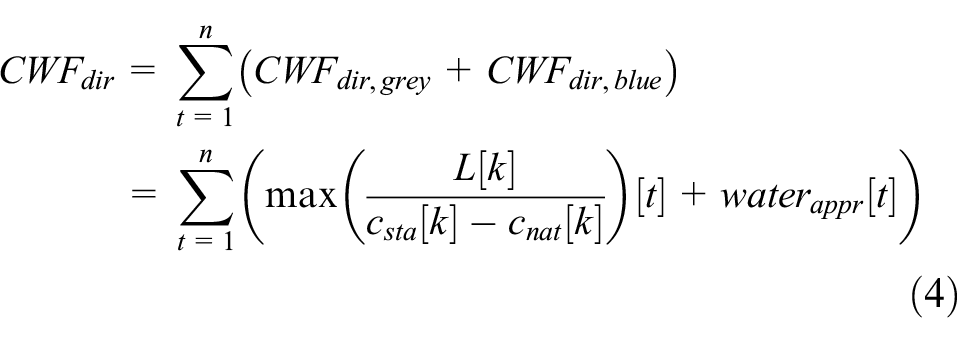
where
Results
Participant Information
The sample size of the survey we recruited online included 137 undergraduates in Hangzhou, of which 12 samples were removed due to inconsistencies in relevant questions. Cases of these inconsistencies are, for example, choosing the “machine washing only” in Question 6 while selecting “Soap” in Question 18. As shown in Supplemental Table S5, study participants included undergraduate students ranging from freshmen to seniors, aged 18–21 years. It should be noted that the ages of different grades are averages from the participants. Typically, students tend to have an age range of 1–2 years at the same study level. And the ages in Supplemental Table S5 were obtained by averaging and rounding the survey results. From Supplemental Table S5, it is clear that the majority of these students were sophomores, accounting for 65.6% of the total number of undergraduates, with juniors coming in second at 20.0%. In terms of the gender, 36% of the participants were males and 64% were females.
Results of Direct Consumptive Water Footprint
From Figure 1, it can be found that
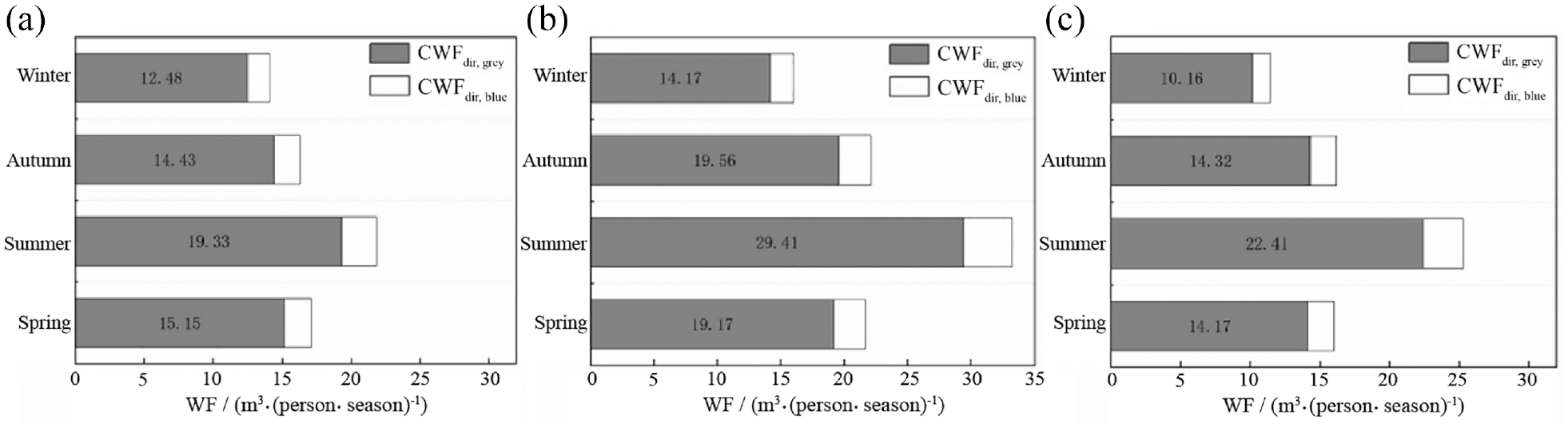
Seasonal
Table 1 indicates that the washing frequency of undergraduates in summer is the highest, followed by spring and autumn, while the washing frequency in winter is the lowest which explains the seasonal variation of undergraduates’
Seasonal washing frequency of undergraduates in Hangzhou.
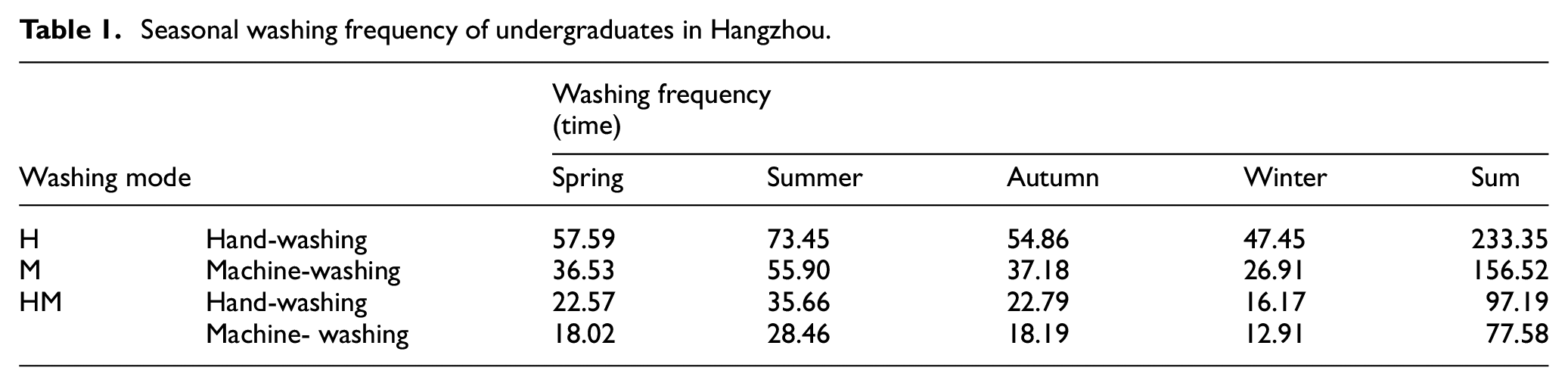
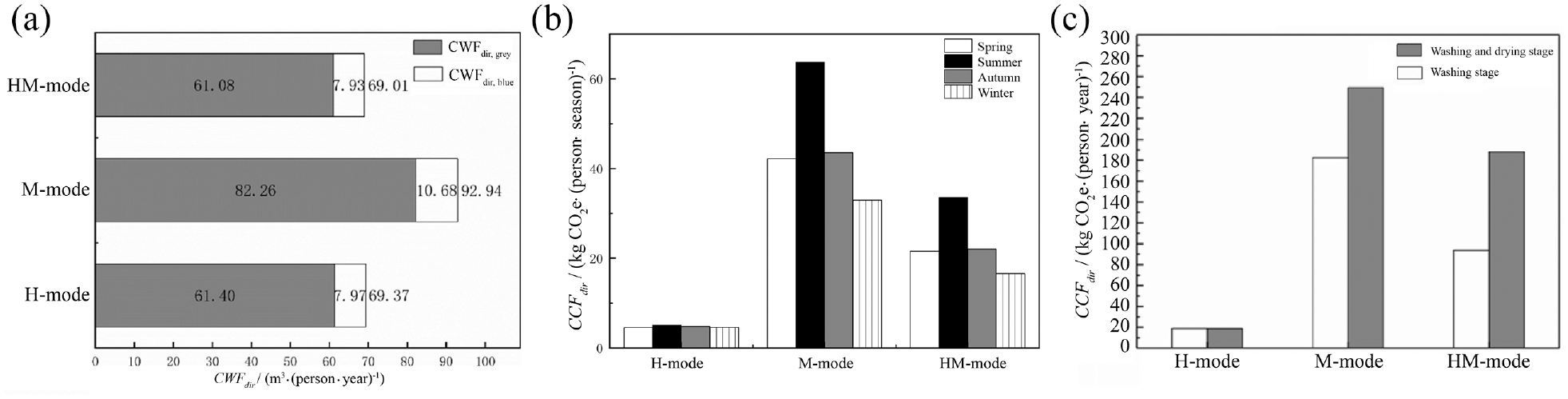
It can be observed from Figure 2(a) that the annual
Results of Direct Consumptive Carbon Footprint
Washing Stage
It can be observed from Figure 2(b) that the average
Washing and Drying Stage
Figure 2(c) indicates the comparison between the annual average
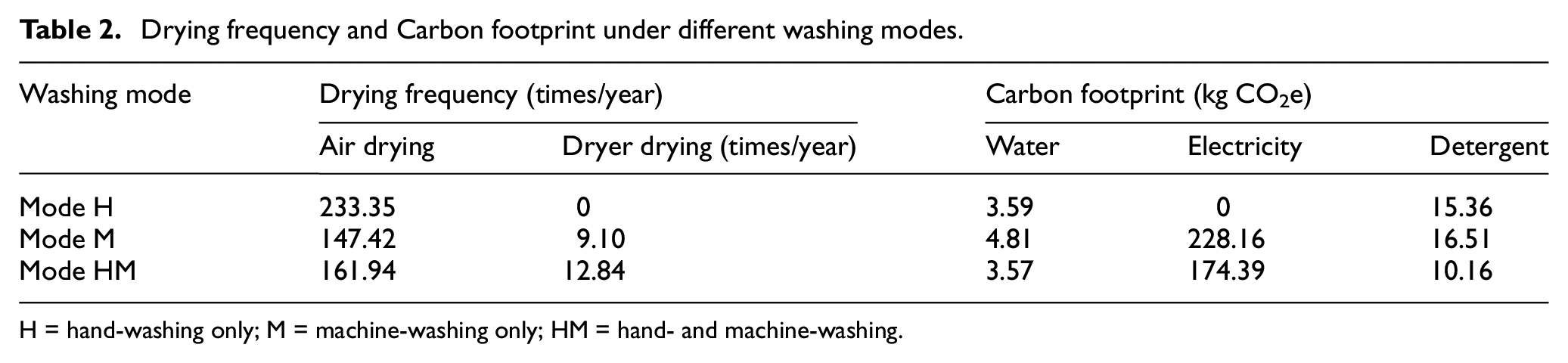
As shown in Table 2, the drying methods of undergraduates in the three modes differ significantly. Instead of using a dryer to dry their clothes, all the H-mode undergraduates dry their apparel by air drying, which accounts for the zero-CF deriving from electricity on drying stage. Although the frequency of dryer drying (which is the main force of CF on drying stage) in the total drying frequency (M-mode 5.81%, 7.34%), the CF of M-mode and HM-mode undergraduates in the drying stage accounts for 26.86% and 50.24% of
Drying frequency and Carbon footprint under different washing modes.
H = hand-washing only; M = machine-washing only; HM = hand- and machine-washing.
Discussion
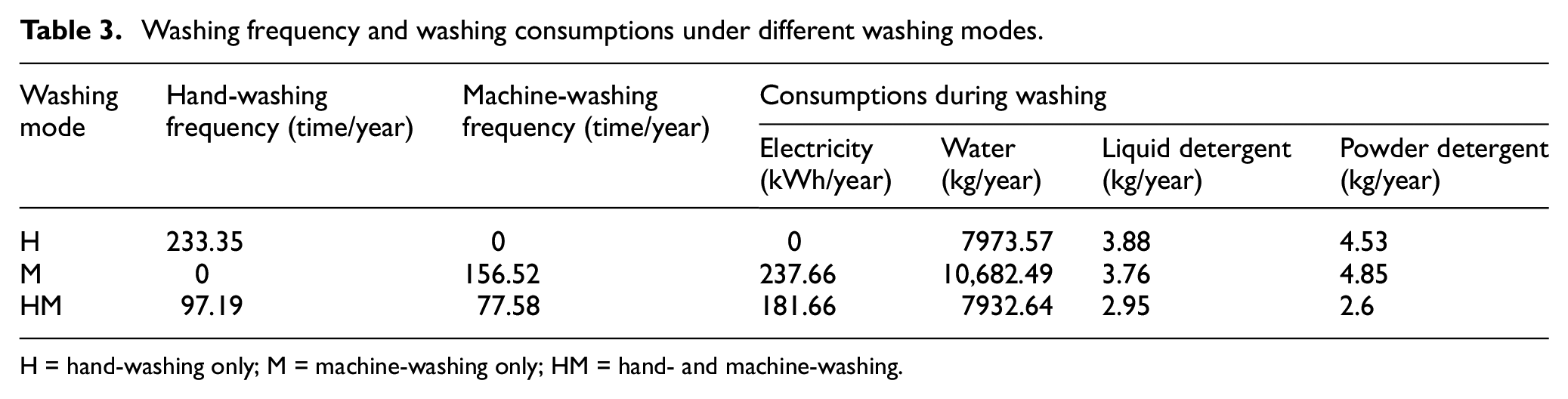
The investigation contributes to the existing study on the environmental impact of consumers’ apparel consumption, for it is one of the very few studies surveying undergraduates’ consumption behavior and emphasizing their environmental impact at the same time. All respondents were classified into three categories: H-Mode, M-Mode, and HM-Mode, accounting for 18.4%, 34.4%, and 47.2% respectively. H-Mode tends to wash clothes more frequently (233.35 times/year), compared to M-Mode and HM-Mode (156.52 times/year, 174.77 times/year). The environmental impact assessment of Hangzhou undergraduates’ apparel consumption was conducted in this study on a per-capita/year basis. The following points can be concluded from this impact assessment.
First, clothing purchases are shown to be a possible contributing factor to both
Washing habits are also identified as an influencing factor for
The aforementioned information has proved that washing frequency is a factor influencing
Washing frequency and washing consumptions under different washing modes.
H = hand-washing only; M = machine-washing only; HM = hand- and machine-washing.
From the point of view of washing method mode, differentiations can be observed from Figure 2(b), where the
Regarding drying habits, according to Table 2, we can obtain that undergraduates prefer air-drying to dryer-drying, and H-mode undergraduates never use dryer-drying. This is the reason why the drying stage has no effect on the
Practical Implications
This study provides insights to the apparel consumption behavior of undergraduates and contributes to the assessment of environmental impact of undergraduates’ apparel consumption. The findings might contribute to the discrimination of
From the perspective of washing habits, washing frequency, consumer knowledge and washing methods appear to be key elements that determine undergraduates’ environmental impact. Lower washing frequency should be encouraged. Actually, for many people who wash their clothes frequently, though their clothes are not actually dirty, or the machines are not fully loaded, 9 their higher washing frequency ultimately resulted in more energy consumption and severe environmental impacts. Also, better apparel care could decrease washing frequency, such as wearing an apron while eating or cooking.
In terms of the washing method, the frequency of machine-washing has a significant impact on the
Consumer knowledge is identified as a factor influencing undergraduates’ consumption behavior, which is in accordance with the previous study.
17
People have the intention to buy environmentally friendly products while only a small number of them actually purchase these products. This discrepancy is called “attitude–behavior gap,”
16
which exists between undergraduates as well. In most cases, undergraduates are often confused by the existing information due to the availability of knowledge concerning apparel care or sustainable consumption behavior. The results of the findings revealed that undergraduates in Mode HM generate the lowest
Overall, it is clear that the findings of this research will help undergraduates to develop a more sustainable apparel consumption habit and encourage government and university to take actions to discriminate the environmental of undergraduates’ apparel consumption.
Conclusions
Based on the questionnaire survey and quantitative analysis, this study investigated the consumption behavior of undergraduates in Hangzhou, assessed the environmental impact of undergraduates’ apparel consumption in Hangzhou, and identified the main factors influencing factors of their environmental impact. The results of this study show that higher washing and drying frequency may result in severe environmental impact due to consumption of water and electricity mainly. Priority of renewable energy source for apparel consumption during washing and drying stage is vital for environmental impact discrimination. The lack of availability to consumer knowledge is also of significant influence. Government and universities are advised to expose undergraduates to more consumer knowledge regarding apparel consumption, which will help them in sustainable decision-making. Proper washing and drying method and clothing purchase quantity are other two factors concerning impact reduction. Despite the convenience of machine-washing, higher hand-washing and air-drying frequency are encouraged when it is necessary. And smaller purchase quantity also makes a difference in impact discrimination.
Although the findings of this research provide some insight for government and universities as well as undergraduate students. This investigation still has some limitations that need to be addressed in the future. First, the respondents of this survey were undergraduates in Hangzhou, China, suggesting that the results of this study would be difficult to apply to other regions, while on the contrary, it is interesting to extend the research to a wilder range of places to confirm whether the findings would have commonality. Second, the frequency of changing clothes was not investigated, so it cannot be directly inferred that purchasing clothes is a major factor affecting the environment. When studying the relationship between clothing purchase and environmental indicators, the issue of frequency of changing clothes needs to be further investigated. Third, the main focus of this study was on the environmental impact of the washing and drying stages. Further research could be conducted in the future to extend this study to additional stages, such as online shopping as well as recycling or disposal stages, and to introduce additional influencing factors, such as gender.
Supplemental Material
sj-docx-1-aat-10.1177_24723444231172218 – Supplemental material for Environmental Impact Assessment of Undergraduate Apparel Consumption Behavior
Supplemental material, sj-docx-1-aat-10.1177_24723444231172218 for Environmental Impact Assessment of Undergraduate Apparel Consumption Behavior by Lisha Zhu, Yunfeng Chen, Qianwen Huang, Ying Zhang and Laili Wang in AATCC Journal of Research
Footnotes
Declaration of conflicting interests
The author(s) declared no potential conflicts of interest with respect to the research, authorship, and/or publication of this article.
Funding
The author(s) disclosed receipt of the following financial support for the research, authorship, and/or publication of this article: The authors are grateful to the General Project of Humanities and Social Sciences Research of the Ministry of Education of China (21YJCZH160), the Science Foundation of Zhejiang Sci-Tech University (ZSTU) under Grant No. 22202009-Y, Soft Science Research Project of Zhejiang Provincial Innovation Center of Advanced Textile Technology (ZX2022002R), Soft Science Research Project of Zhejiang Province (2022C25030) and Ouhai District Science and Technology Plan (G20210201) for providing funding supports to this research.
Data availability statement
The data that support the findings of this study are available from the corresponding author, upon reasonable request.
Supplemental material
Supplemental material for this article is available online.
References
Supplementary Material
Please find the following supplemental material available below.
For Open Access articles published under a Creative Commons License, all supplemental material carries the same license as the article it is associated with.
For non-Open Access articles published, all supplemental material carries a non-exclusive license, and permission requests for re-use of supplemental material or any part of supplemental material shall be sent directly to the copyright owner as specified in the copyright notice associated with the article.
