




Abstract
In this article, we identify institutional contradictions as a central challenge that institutions must address to develop and maintain stakeholder trust. Institutional contradictions occur when institutions present stakeholders with inconsistent or conflicting decisions, statements, ideas, or actions. Drawing on both the organizational literature and the findings presented by articles in the Spotlight section of this issue, we describe the nature and antecedents of institutional contradictions and how they can compromise trust development and foment distrust. In addition, we propose ways for institutions to identify and remediate the processes that lead to institutional contradictions.
Trust in institutions is essential for social cohesion, effective governance, economic stability, and overall societal well-being. Researchers define an institution as an organization, a system, a set of practices, a person, or another entity that becomes imbued with special and widely shared meaning. When something becomes an institution, it has been endowed with meaning and legitimacy that extends well past its physical form or formal structure.1–3 For example, the king or queen of a country is typically seen as more than just a political administrator, the Twin Towers in New York City were more than a corporate office complex, and the national flag is not merely a piece of cloth.
Researchers across disciplines have been particularly interested in examining the dynamics of the erosion of trust in governments, other societal institutions, and organizations because the degeneration of trust in such institutions can undermine acceptance of their basic governing principles and impair the institution’s effectiveness. The unfortunate reality is that in recent years, trust in a wide array of societal institutions around the world has precipitously declined.4–7 This ongoing decline compromises the ability of societies to navigate urgent challenges—including climate change, pandemics, and threats to democracy.
Stakeholders in an institution (that is, the people who are affected by or affect it) will trust that institution only to the extent that they can be confident in its motives, values, and reliability. Trust is key to the effective functioning of institutions because it enhances stakeholders’ sense of order and stability and thus promotes participation, cooperation, innovation, and an overall sense of well-being.8,9 Stakeholders who trust an institution willingly allow themselves to become vulnerable to that institution, because they are confident that the institution’s decisions and actions will be benevolent and competent. 10 In contrast, stakeholders become distrustful when they are skeptical of an institution’s motives, decisions, and activities, 11 and this skepticism makes them unwilling to be vulnerable to or rely on the institution.12,13 In these situations, stakeholders’ willingness to participate in an institution’s activities or to cooperate with the institution and its members can be severely reduced.14,15
The articles in the Spotlight section of this issue explore many factors that influence the development of institutional trust and distrust and propose evidence-based solutions for strengthening and rebuilding trust. We contend that even though institutional contradictions are not the explicit focus of every Spotlight article in this issue, the findings of those articles nonetheless indicate that such contradictions are a critical cause of stakeholder distrust. Institutional contradictions occur when institutions present stakeholders with inconsistent or conflicting decisions, statements, ideas, or actions. In this article, we summarize the findings reported in Spotlight articles, explore the causes of institutional contradictions, and outline some general ways institutions can avoid or repair them. The main ideas we present about institutional contradictions are summarized in Figure 1.
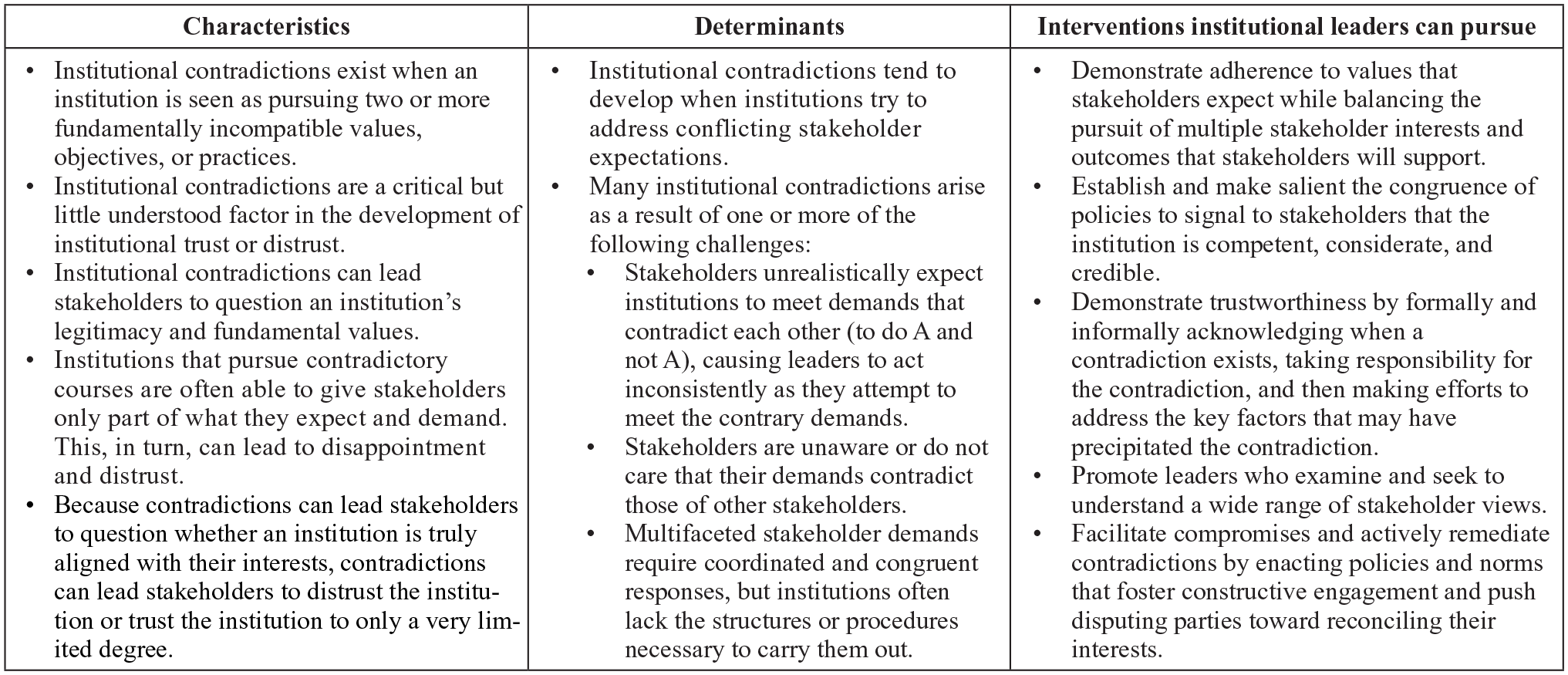
Characteristics & determinants of institutional contradictions & interventions
Findings From the Spotlight Articles
In the first article that follows, Mariana Prats, Emma Phillips, and Sina Smid report on data from the 2021 Organisation for Economic Co operation and Development (OECD) Trust Survey, which measured public perceptions of the reliability, responsiveness, openness, integrity, and fairness of public institutions in OECD countries and examined the relationship between those perceptions and trust in public institutions. 5 The OECD is a collection of democracies that collaborate on policies for sustaining economic growth. The findings reported in the article go beyond the speculation of much past work to demonstrate that several perceptions about governments are critical to establishing trust, including (a) that governments are reliable (in other words, they will consistently meet expectations) and (b) that individual citizens are able to effectively exercise their voice in local and national government decision-making processes. The latter point is critical in showing that even when addressing large-scale national issues, a focus on local impact and local influence is essential.
In the second article, David M. Bersoff explores why populations in many democracies are not merely polarized in their views of key societal issues but are also deeply hostile to people with opposing views—a state known as affective polarization. 4 With his colleagues at the Edelman Trust Institute, Bersoff reanalyzed data from the 2023 Edelman Trust Barometer, which annually charts trust in societal, governmental, and religious institutions. The 2023 barometer, which included data from more than 27,000 people drawn from 25 nonautocratic countries, found that nearly 60% of citizens distrust societal institutions to a high degree and that a substantial fraction of people do not trust their fellow citizens to remain nonviolent in the face of ideological disagreements. The analysis revealed, among other things, that perceiving that one’s country is divided on key issues is not enough to engender distrust and hostility; those feelings arise when people are also pessimistic about whether these divisions are likely to be overcome. This finding suggests that to mitigate polarization, democracies should focus more on changing citizens’ perceived capacities to constructively address disputes and less on altering the polarized perceptions of the disputants.
In the final Spotlight article, Michelle Williams, Paul W. Mulvey, and Roger C. Mayer examine institutional trust at the level of businesses. 6 They argue that employees lose trust in their managers and companies when they perceive that the organization is pursuing multiple and misaligned goals. They suggest that individuals in these environments feel like they are associating with a person who has multiple distinct personalities (technically called dissociative identity disorder). When employees have this perception (whether or not it is accurate), the authors say that the organization is being viewed as suffering from organizational dissociative identity disorder (ODID). They note that the condition can arise when turbulent environments pull managers in conflicting directions, causing them to issue contradictory directives that confuse employees. The authors further observe that ODID may be becoming more common as environmental dynamism makes it harder for organizations to coordinate actions within and across departments. In these situations, organizational trust will be more difficult to attain and organizational distrust will be more prevalent.
Causes of Institutional Contradictions
Collectively, institutions face three challenges that can lead them to generate trust-eroding contradictions.
Stakeholders Expect Institutions to Meet Contradictory Expectations
Multiple stakeholders—individuals, groups, or both—may make contradictory demands on an institution. An institution’s attempts to address multiple, often conflicting, demands from its stakeholders can result in policies that appear incompatible and confused. For example, Prats and her colleagues show that citizens expect their governments to achieve particular objectives efficiently and decisively but also expect those governments to expend the time and other resources required to gather input from diverse sets of stakeholders to ensure that policies are fair and inclusive. 5 As governments encounter challenges in satisfying these contradictory demands, they leave themselves open to severe criticisms that can foment stakeholder distrust.
Stakeholders Are Unaware That Their Demands Contradict Those of Other Stakeholders or Do Not Care About Whether the Expectations of Others Are Met
Because stakeholders primarily evaluate how effectively an institution addresses their own particular needs, they often remain unaware or unconcerned that their demands may directly conflict with those placed on the institution by other stakeholders. For example, members of one stakeholder group may expect an institution to sustain a particular policy, while another group may expect the institution to enact significant policy changes. In a situation like this, when the institution sides with one stakeholder group, it may foster distrust and damage its relationship with the other stakeholder group. Alternatively, it may promulgate a compromise solution that fails to fully satisfy the expectations of either group. When this happens, each group may see the situation solely from its own perspective and fail to value or even acknowledge the other group’s interests. When institutional leaders face such dynamic and complex environments, they will often attempt to live up to two or more fundamentally opposing or incompatible objectives with decisions and actions that appear contradictory. As Williams and her colleagues indicate, institutions can end up addressing these divergent interests by adopting inconsistent values, goals, directives, and behaviors that fail to satisfactorily meet any of their stakeholders’ expectations. 6
An Institution Lacks the Structures Needed to Make Coordinated Responses to Multifaceted Stakeholder Demands
As Williams and her colleagues point out, rigid, overly complex, or siloed institutional decision-making systems can end up leading to contradictory institutional goals and actions. 6 In seeking efficiencies and economies of scale, institutions generally codify their practices, norms, and routines into formalized policies, regulations, and procedures. Although necessary and normal, this formalization processe can lead institutions to embed a multiplicity of routines that create (or at least support) contradictions among their standard operating procedures, 16 strategic decisions, 17 and implementation methods.18,19
These are the types of dynamics that participants in the Edelman Trust Barometer survey are responding to when they report their distrust of their governments and the media, express pessimism over whether economic systems will treat them fairly, or lament that their society has failed to foster a shared identity. 4 In response, Bersoff argues that business settings provide forums through which societies can begin to effectively address persistent polarization problems. 4 He suggests that because of performance demands, business organizations “cannot allow affective polarization, or they will cease to function.” 4 As a result, they have evolved cultures that promote civility and eschew open hostility. Because these organizations actively support constructive conflict engagement, they provide a way for societies to encourage dialogue that can foster shared perspectives, coalesce participants’ agreements around common goals, and promote intergroup collaboration.
Addressing Contradiction-Related Problems to Increase Institutional Trust
Given that stakeholders who perceive institutions are attempting to accommodate conflicting agendas may come to distrust the leadership’s decisions and actions, what can institutional leaders do to maintain trust or repair broken trust?
Institutions can avoid distrust and foster stakeholder trust by actively acknowledging and working to at least partially mitigate known institutional contradictions. 20 Consistent with past research, the findings reported in this issue suggest that institutions should enact and make salient their continued adherence to values that stakeholders expect. 6 In addition, they should work to effectively balance their pursuit of multifaceted values in ways that stakeholders accept as legitimate. 2 The balance they strike must enable them to achieve successful outcomes that their stakeholders value.
In an article in Academy of Management Review, Nicole Gillespie and Graham Dietz defined some ways organizational leaders can explain and repair revealed inconsistencies in institutional communications, decisions, and actions. 21 One approach to repairing trust that they suggest emphasizes the concept of congruence. Through congruence, institutions and organizations ensure that the signals coming from all divisions of an institution are consistent with one another and reinforce perceptions of trustworthiness across time and situations. In their classic book, The Leadership Challenge, James Kouzes and Barry Posner make the idea of congruence more specific and actionable, noting that communication must be credible: Words and actions must convey competence and consideration of the concerns of relevant stakeholder groups. 22
In addition to making efforts to achieve congruence, institutions that are aware of their contradictions need to work to minimize distrust and demonstrate institutional trustworthiness. 21 To regulate distrust, institutions can, for instance, formally and informally acknowledge that contradictions exist, take responsibility for those contradictions, and make explicit efforts to address the key factors that may have precipitated those contradictions. Such actions help to demonstrate that the institution is sincerely concerned about the contradictions stakeholders see and is making efforts to eradicate or address identified problems in ways that allay fears of future inconsistencies. In other words, the institution needs to actively address the distrust that the perceived contradictions engendered to be able to take the next step of rebuilding trust. 23
Acknowledging and accepting responsibility for the contradictions stakeholders are observing is often only a first step in establishing trustworthiness. Institutional leaders then need to demonstrate their trustworthiness by making explicit efforts to promote stakeholder confidence. For example, leaders can enact and make salient policies focused on showing the institution’s willingness to live up to its stated values. Similarly, leaders must make clear how each stakeholder’s perspective and concerns are understood and reflected in the actions the institution takes. These efforts cannot be “paper only” but must generate real change if they are to bolster stakeholders’ beliefs that the institution will consistently pursue and promote positive values going forward. For example, an institution could make a point of celebrating leaders or other key institutional representatives who personify the principles of competence and concern. Providing awards and job promotions to such individuals allows the institution to make explicit that those who exemplify the congruence the institution is trying to highlight are valued in practice.
The authors of the other articles in this Spotlight section offer a range of recommendations for how to repair and rebuild trust. These recommendations are also relevant to ameliorating distrust related to institutional contradictions. For example, Prats and her colleagues implore government institutions to actively demonstrate the five dimensions the authors view as critical to trustworthiness: reliability, responsiveness, openness, integrity, and fairness. 5 It is noteworthy that enacting all of these dimensions together will require an institution to recognize and address fundamental contradictions. Specifically, the authors argue that institutions that communicate with citizens clearly and effectively can enhance public perceptions of institutional effectiveness. At the same time, they also argue that institutions must take steps to visibly incorporate divergent opinions in institutional decision-making mechanisms, a process that takes time. Doing this requires institutions to not only give people a voice in how those decisions are made but also provide them with mechanisms for surfacing and addressing contradictory perspectives. Highlighting the importance of voice, 24 they encourage institutions to “aggregate, synthesize, and distill” their citizens’ viewpoints and respond to them in a “cogent and comprehensible” way that makes those citizens feel that they have been heard.
As we have already noted, Bersoff takes the view that to help overcome deep animosity between groups that hold contradictory beliefs, institutions need to find ways to increase confidence in dispute resolution processes. 4 He also notes that people tend to view their employers as reliable sources of information, and he advocates urging businesses to direct citizens toward shared sets of facts that can facilitate healthy debates around critical issues. The advice he offers to businesses is equally apt for leaders of democratic institutions who want to remediate contradictions: Enact “strong norms against intransigence and in favor of constructive engagement.” Many of these norms may naturally evolve from rules that codify “decorum and zero tolerance for violence.”
Williams and her colleagues suggest various ways to foster trust by addressing contradictions. 6 They urge institutional leaders to think prospectively and examine a wide range of views for insights into how their decisions affect various stakeholder groups. The authors argue that once leaders begin interacting and communicating with stakeholders, they should emphasize interventions that actively support shared interests and reconcile divergent viewpoints.
The articles in the Spotlight also suggest that policymakers interested in developing interventions for institutional contradictions would be wise to consider the level at which the contradictions are occurring. For instance, Prats and her colleagues stress the importance of considering whether dissatisfaction with government is a large-scale problem (say, occurring at the country level) or more of a local issue. 5 Even when dissatisfaction is widespread, policymakers should consider whether it might be best addressed by attending to local concerns and rebuilding trust at that level. Bersoff’s findings suggest, moreover, that it makes sense to consider whether the core problem is that contradictions are grounded in major disagreements or that those disagreements seem intractable. 4 In situations where stakeholders have lost hope for resolution, a solution may lie in the institution adopting or developing effective conflict resolution processes. Finally, policymakers faced with losses of trust in government institutions should consider turning to business organizations to help address eroding trust rather than relying on existing governmental institution frameworks.
Conclusion
The articles in this issue’s Spotlight section explore the complex tapestry within which trust in institutions is forged or lost. We hope they will provide policymakers across multiple disciplines with new ideas for addressing the growing institutional trust crisis. We have highlighted the value of understanding the growth of the institutional trust challenge through the lens of institutional contradictions. This concept points to potentially fruitful avenues for addressing rising institutional distrust and presents directions for further research on the nature and impact of institutional trust.
Footnotes
Declaration of Conflicting Interests
The authors declared no potential conflicts of interest with respect to the research, authorship, and/or publication of this article.
Funding
The authors received no financial support for the research, authorship, or publication of this article.