




Abstract
The inaugural OECD Survey on the Drivers of Trust in Public Institutions asked respondents in 22 OECD countries to evaluate the trustworthiness of national and local governments and other public institutions as well as to report their perceptions and experiences with various public governance–related drivers of trust (factors likely to affect trust) in those institutions. The main drivers include the government’s competence (as indicated by its reliability and responsiveness) and government values, including integrity, openness, and fairness. The article highlights the key findings of the survey and of analyses exploring the impact of various drivers on trust. The results underscore that people are relatively satisfied with delivery of public services and governments’ reliability, but it is crucial to enhance citizens’ perceptions of governments’ responsiveness and their perceived ability to influence public decision-making. The article also addresses the policy implications of the research and describes ways some countries have already used the country-specific findings as a guide to developing policies for reinforcing their citizens’ trust.
Trust in public institutions helps countries govern and make policy choices to tackle different challenges, reduce transaction costs—in governance, society, and the economy—and ensure compliance with public policies. Trust can help foster public investments in challenging reforms and programs that produce better outcomes. In democracies, moderately high levels of trust, along with healthy levels of public scrutiny, can help reinforce important democratic institutions and norms.
Trust is also an important indicator for measuring how people perceive the quality of and how they associate with government institutions in democratic countries. At the same time, high trust in public institutions is, of course, not a necessary outcome of democratic governance. Indeed, low levels of trust measured in democracies are possible because citizens in democratic systems—unlike in autocratic ones—are not only free to report that they do not trust their government but also encouraged to show skeptical trust. The resilience of democratic systems comes from the open public debate they foster, which enables them to improve and meet increasing citizen expectations in the continuous pursuit of trustworthiness.
Evidence shows that trust in governments has declined over the past 50 years,1,2 with the sharpest falls occurring during economic and social crises—precisely when higher levels of trust would be most beneficial for fostering the cooperation needed to weather the upheavals. In the aftermath of the 2008 global financial crisis, public trust dropped to an all-time low in Organisation for Economic Cooperation and Development (OECD) countries. It took nearly 10 years for OECD countries to restore trust to precrisis levels. 3 Countries experienced similar drops in public trust during the COVID-19 pandemic4,5 and during other shocks affecting people’s security and living standards.
In 2017, the OECD Public Governance Directorate developed a unique policy and analytical framework to measure drivers of public trust along competence and values dimensions. In 2021, it launched the OECD Survey on the Drivers of Trust in Public Institutions (also known as the OECD Trust Survey), which asked people in 22 OECD countries about their experience with and expectations of government reliability, responsiveness, capacity to tackle global challenges, openness, integrity, and fairness (see note A for the list of participating countries). Using that data, inputs from an open-ended question, and logistical regression analyses, we have analyzed the main drivers and levers of public trust. In this article, we summarize the key findings of the survey and the regression analyses, discuss the implications for policymakers, and describe actions that various countries are already undertaking on the basis of the overall and country-specific findings (see note B for the OECD publications on which this article is based).
The data show that people’s trust in government varies by country, level of government, and public institutions. The results highlight the particular importance for trust in government of citizens perceiving that public institutions are reliable and that one can have an influence on political decision-making. The OECD Trust Survey is to be conducted every two years, and the results of the 2023 wave are published in the summer of 2024. These results will help governments to identify new challenges and to reinforce trust-building approaches implemented in response to the findings.
The OECD Trust Survey
Following the sharp decline in public trust after the global financial crisis in 2008, at the 2013 OECD Ministerial Council Meeting, OECD countries called for stronger efforts to understand trust in public institutions and trust’s influence on economic performance and people’s well-being. As part of carrying out that mission, the OECD Public Governance Committee developed a unique policy and analytical framework (see Table 1) to measure drivers of public trust and to more effectively connect the policy dialogue on trust with a practical reform agenda. 6
OECD framework on drivers of trust in public institutions, 2021
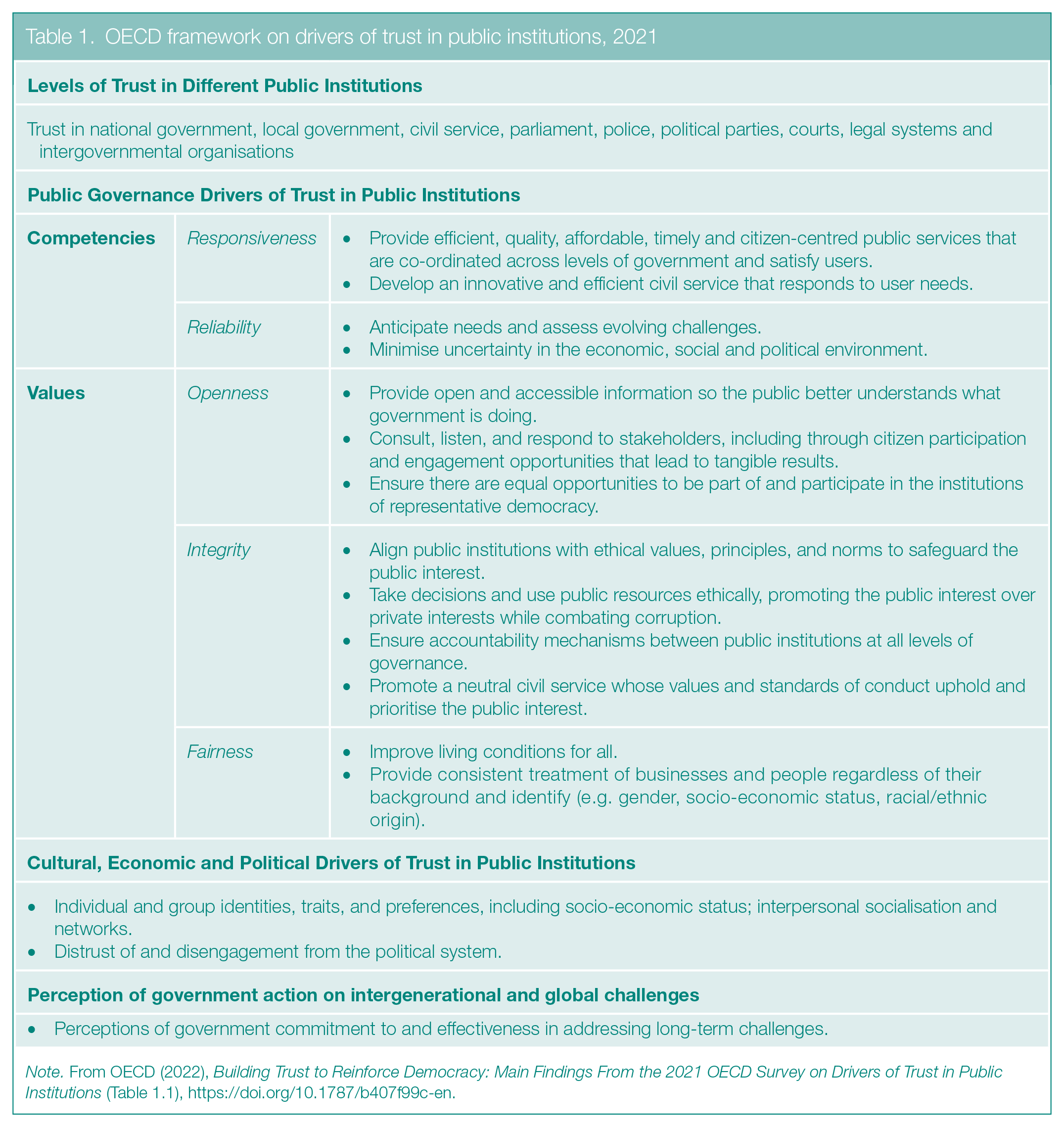
Note. From OECD (2022), Building Trust to Reinforce Democracy: Main Findings From the 2021 OECD Survey on Drivers of Trust in Public Institutions (Table 1.1), https://doi.org/10.1787/b407f99c-en.
The framework evaluates the trustworthiness of institutions, aiming not to merely gauge how much people trust public institutions but also to assess their expectations about future behavior and functioning of institutions. The OECD defines trust as “a person’s belief that another person or institution will act consistently with their expectations of positive behaviour.” 7 Trust in government, therefore, can be understood as a citizen’s expectation that the government will fulfill its mandate competently while acting for the benefit of society.
Based on previous research, the framework identifies five main public governance drivers of trust and divides them into two dimensions.8–11 One dimension is competence, the ability of governments to deliver to citizens the services they need, at the quality level they expect—that is, carrying out their critical functions. This dimension includes two main components: responsiveness and reliability. Citizens must believe that their government has the expertise, technical knowledge, and capacity to make the best judgements and deliver services. The other dimension is values, the principles that inform and guide government action, in the form of openness, integrity, and fairness.
Following an encompassing dialogue with policymakers, academics, and civil society, in 2021, the framework was updated to reflect the effects of the COVID-19 pandemic and other salient challenges. 4 Therefore, the inaugural 2021 OECD Trust Survey and its analyses went beyond those five public governance–related drivers to also examine potential cultural, economic, and political influences on trust in public institutions (such as people’s individual and group identities or their sense of political voice). In addition, the updated framework also considers people’s views of their government’s commitment to and effectiveness at addressing long-term challenges, such as climate change. It is worth noting that the drivers in the framework reinforce each other. For instance, people who feel shut out because of their economic anxiety may also be prone to scoring the government low on fairness or openness. Likewise, low expectations that the government will do a good job of handling a long-term challenge could well feed into poor assessments of responsiveness, reliability, and fairness.
Guided by the framework on public governance drivers of trust, the OECD Trust Survey, an encompassing nationally representative population survey (see the Supplemental Material for more details), was fielded for the first time to about 50,000 respondents from 22 participating countries between November 2021 and April 2022. 12 The 2021 OECD Trust Survey was a nonprobability nationally representative online survey, administered to around 2,000 respondents in each country, with country-specific quotas on the distribution of age, gender, education, and region to ensure national representativeness of the data for these characteristics.
The survey’s questions typically use a 0–10 response scale, which allows for detailed comparisons both within and across countries regarding respondents’ levels of trust and their perceptions of public governance trust drivers.
In addition to questions relating to all of the drivers of trust already described, the survey included an open-ended question soliciting respondents’ thoughts on what influenced their trust in public institutions. This question was meant to provide hints to as-yet-unrecognized drivers that might be explored in future surveys. For the full set of survey questions, see reference 13.
Other surveys capture levels of trust in various countries (among them, the Edelman Trust Barometer, the Latinobarometer, and the Eurobarometer) or examine indicators of trust as well as levels of political participation (such as the European Social Survey). But the OECD Trust Survey stands out for its comprehensiveness and assessment of people’s perceptions of the drivers of trust in public institutions. The results from this survey offer an in-depth cross-national picture of the complex relationship between the functioning of democracies and public trust. In this sense, it represents a significant milestone in providing actionable evidence for policymakers.
Aggregate Survey Results & Their Implications
There Is an Even Split Between Those Who Trust Their National Governments & Those Who Do Not
To directly assess people’s trust in government, the survey asked respondents to indicate, on a scale of 0 (not at all) to 10 (completely), how much they trust each of the following: the national government, the local government, the parliament or congress, political parties, the police, the civil service (nonelected government employees at central or local levels of government), the news media, the courts and legal system, and international organizations. As Figure 1 shows, on average, an equal percentage of respondents who express high or moderately high trust and low or no trust in their national government, with approximately 41.4% of people reporting high and moderately high trust and 41.1% reporting no or low trust. These averages, however, mask significant variation across countries (See note C for a discussion of the implications of neutral scores of 5).
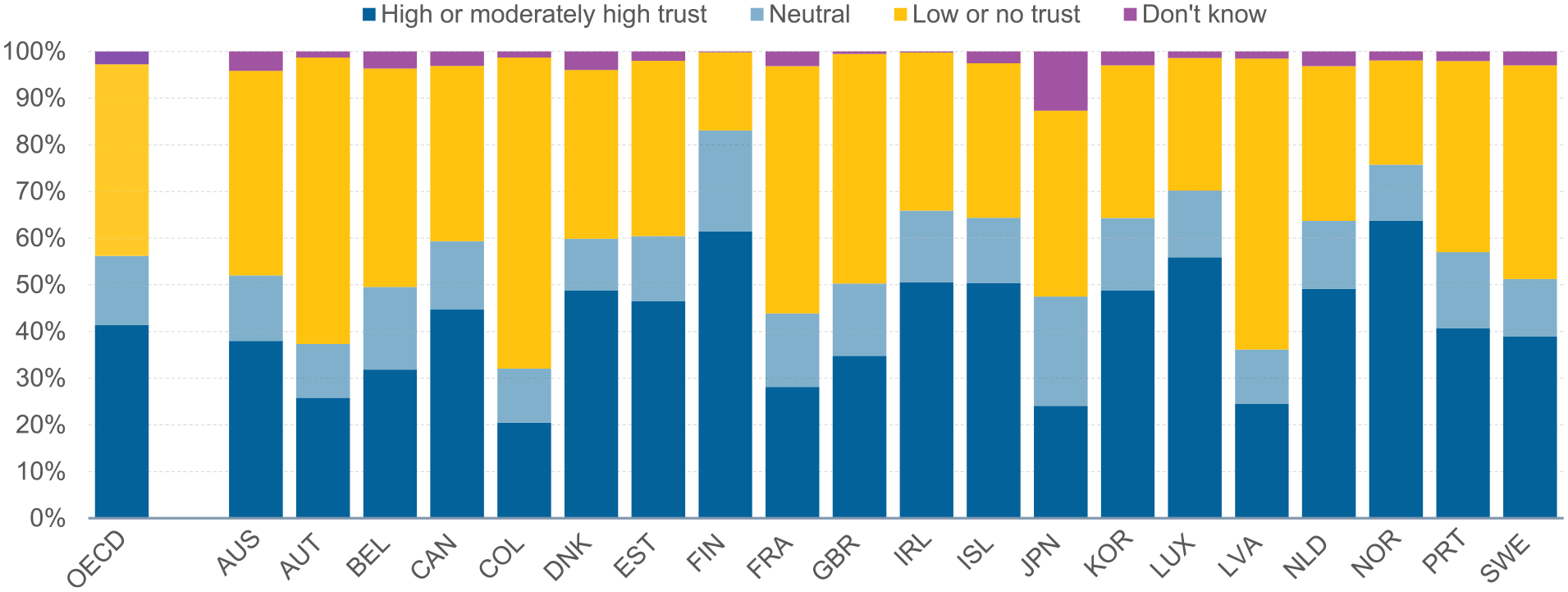
Just over four in 10 people report high or moderately high trust in their national government
Considering public institutions other than the national government, in general, the courts and legal system, police, civil service, and local governments tend to inspire more confidence than do political parties, and parliaments and congresses. That is, public institutions operating in the realm of security and justice enjoy higher levels of trust from the public than those of a more political nature do (see Figure S1 in the Supplemental Material). As is true for trust in national governments, however, trust levels in other institutions differ significantly across and within countries. Such variations highlight the importance of having a nuanced understanding of the political context in which people form attitudes toward different institutions.
A Majority Perceive Governments’ Reliability Positively
The survey includes a number of questions relating to respondents’ assessments of each driver of trust listed in the framework. In the case of the reliability component of the competence dimension, for instance, there are questions examining satisfaction with specific public services, such as education and health care, or related to pandemic preparedness. Overall, most governments are seen as providing public services satisfactorily, being prepared for a new serious pandemic, and being capable of maintaining data security. On average, six in 10 (61.7%) respondents expressed satisfaction with their national health care, and 57.6% reported satisfaction with their education systems (see Figure S2 in the Supplemental Material and note D for a discussion of the implications of answers relating to satisfaction with health care and education).
Levels of confidence in government preparedness for a future pandemic are particularly noteworthy. Even though the COVID-19 pandemic had significant health and economic consequences, nearly half (49.4%) of respondents across OECD countries said they believe their government will be prepared to protect them in a future pandemic, and just one-third (32.6%) of respondents said they do not believe the government will be prepared. This is a key result, as analysis of survey data also shows that positive perceptions of government preparedness for a future pandemic are associated with higher levels of trust in the national government (see Figure 2).
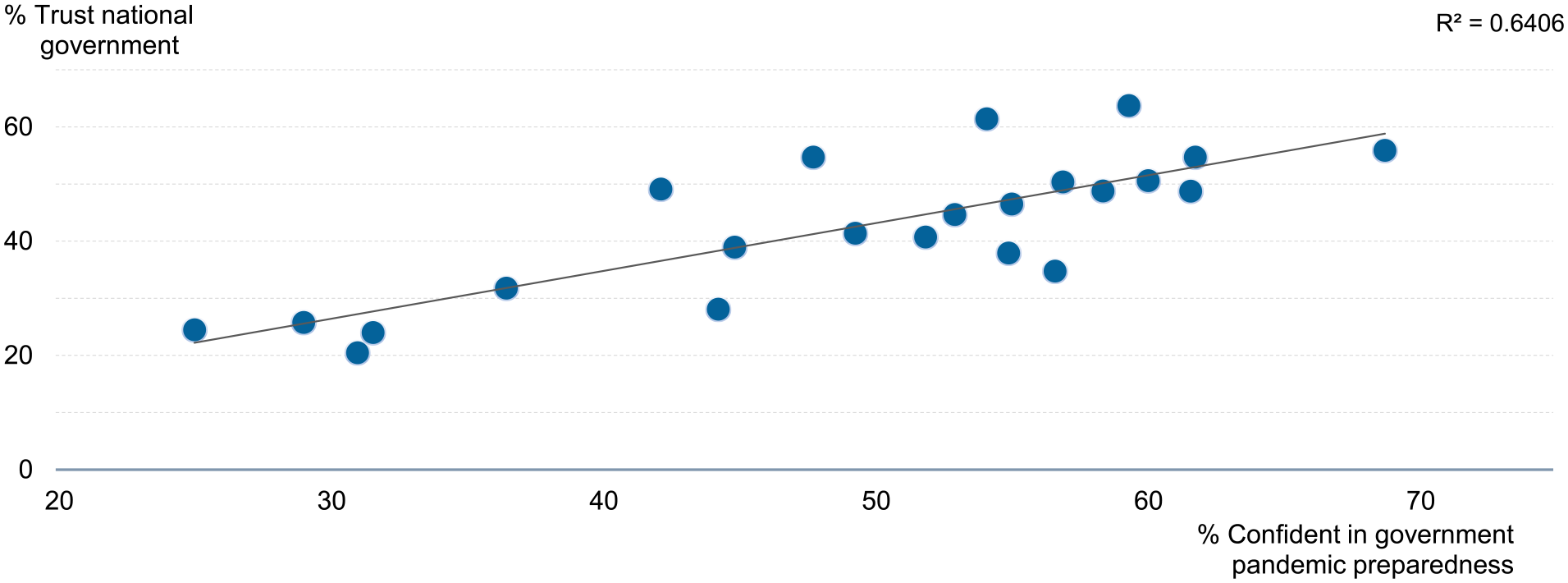
Positive perceptions of preparedness for a future pandemic are associated with higher trust in the national government—and vice versa
Yet Most Governments Struggle to Meet Citizen Expectations for Responsiveness, Integrity, & Fairness
In contrast to respondents’ positive views of their governments’ reliability, people had concerns about the government’s attention to public opinions—as was measured by survey questions meant to assess views on responsiveness, openness, and the extent to which individuals themselves have political voice. The term voice here can be broadly defined as communication directed toward a higher authority—in this case, toward public institutions—with the intention of bringing about change or improvement to an existing objectionable state. 14 In the framework, the concept of responsiveness relates to the likelihood of public institutions making changes in response to feedback; openness relates to the government communicating with, listening to and providing opportunities for feedback; and voice encompasses people’s sense that they are able to participate in government decision making (a quality related to their sense of their own efficacy).
Many respondents do not perceive the government as being responsive to people’s needs and feedback. Just 40.1% of people across countries believe that their government would improve a poorly performing service if they complained. Further, a significant portion of citizens feel that their government is unresponsive to democratic processes and lacks openness, in that it does not provide enough opportunities for them to have a political voice or consider their inputs. Only about a third of respondents (32.9%) said their government would consider opinions expressed in a public consultation (another indicator of openness), and a similarly low number (30.2%) reported feeling that the political system in their country allows people like them to have a say in what the government does (an indicator of voice; see Figure 3).
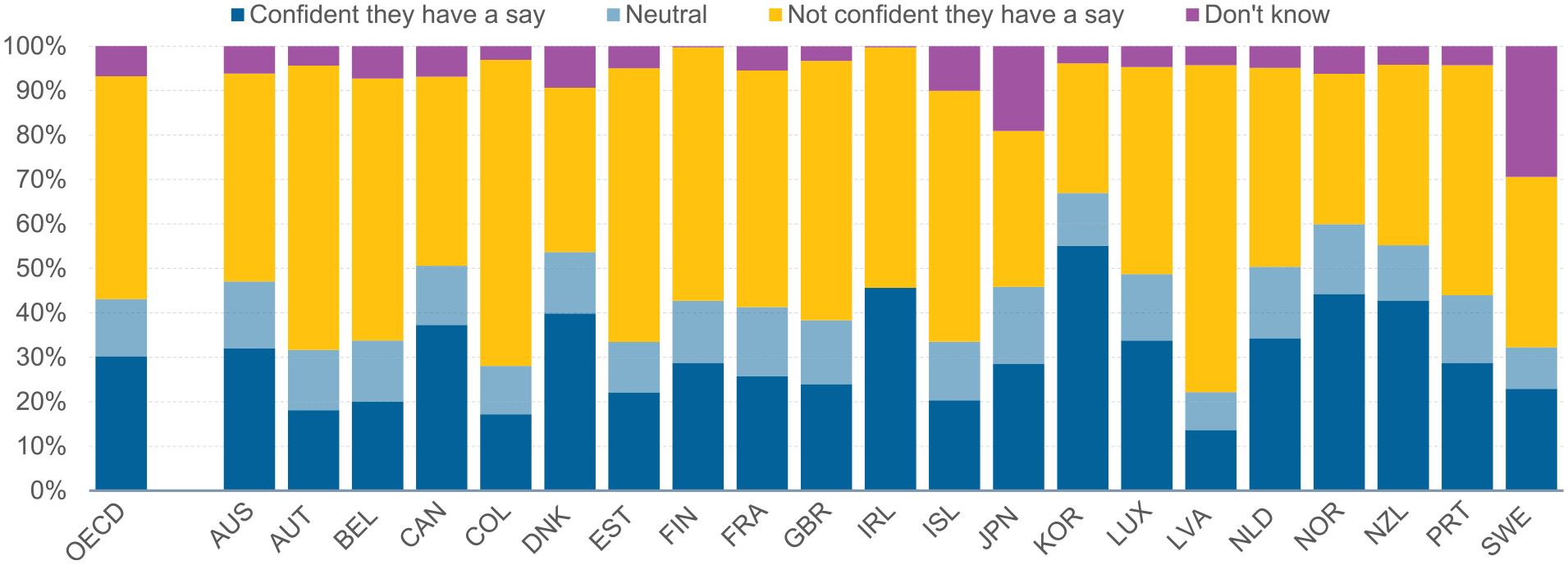
Only one in three respondents say the political system lets them have a say in government decision-making
People’s views already described are compounded by concerns surrounding integrity and fairness. A significant percentage of respondents across countries doubt the integrity of elected officials and public sector employees, with 47.7% of respondents believing that high-level political officials would grant political favors in exchange for the promise of a well-paid job in the private sector and 35.7% believing that a public employee would accept money in exchange for speeding up access to a public service.
In addition, respondents expressed some concerns about fairness. Only 40% of respondents find it likely that public employees will treat people equally regardless of their income, and the fraction decreases to one-third among economically vulnerable respondents. However, perceptions of fairness are not monolithic: The majority (58.5%) of respondents believe that they would be treated fairly if they applied for a government benefit or service, a perception that turned out to correlate with trust in the civil service.
Policy Implications
The findings relating to perceptions of government responsiveness, values, and people’s political agency suggest that to enhance trust, governments may need to take steps to ensure citizens have equal opportunities for fair treatment and to exercise political voice. Yet it is worthwhile to consider that translating diverse opinions and voices into coherent policies can be a struggle in representative democracies because people do not speak with one unified voice. Instead, they make their views known at specific moments; on specific issues; and through various channels, such as elections, referenda, protests, and advocacy. As such, any gathered views may yield contradictory results. 15 In addition to encouraging participation, government leaders need to find ways to aggregate, synthesize, and distill these views and respond to them in a cogent and comprehensible manner that makes people feel heard. When policymakers communicate their decisions and the reasoning behind them in clear and transparent ways, such actions may increase perceptions of political voice and build trust. The literature on individuals’ voice in organizational settings provides further insight into perceptions of fairness. 16 Studies have shown that being able to state opinions can lead to greater perceived fairness compared with when employees are given no voice at all. 17
Results of Regression Analyses & Policy Implications
For governments to develop policies and initiatives to increase trust, they need to know the most important determinants of trust in their public institutions. To assess the drivers with the strongest associations with trust, we conducted a logistic regression analysis that calculated the extent to which individuals’ trust levels in public institutions improved as positive perceptions increased in relation to various trust drivers—namely, those related to reliability, responsiveness, openness, fairness, integrity, and political agency (See Figure 4 and note E for the details of our methodology). We ran separate logistic regression analyses for the national government, the local government, and the civil service. The results remained consistent across various ways of running the analyses, indicating that the findings are robust. 12
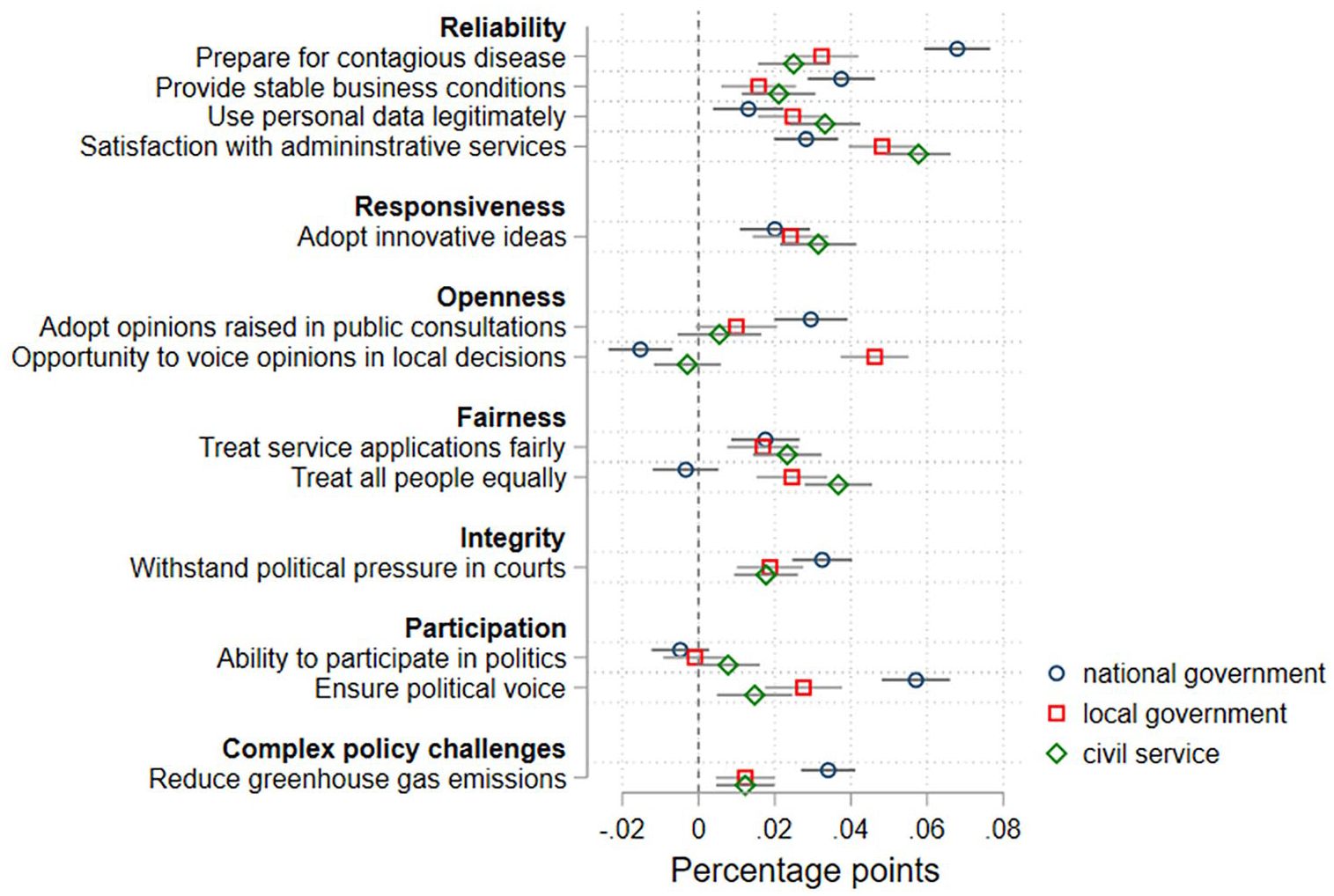
Reliability, openness, & participation are associated with higher levels of trust in national & local governments & the civil service
Note that regression results are correlational. Although strong correlations suggest that certain drivers influence trust, the associations do not prove causality, and the effects can go both ways. For instance, the perception that institutions and policies are effective can foster trust in government, but trust in government can, in turn, enhance the effectiveness of institutions and policies as well as people’s perceptions of effectiveness.
Key Drivers of Trust: Reliability & Voice
Figure 4 summarizes the findings of the regression analyses, focusing on those public governance drivers showing a statistically significant correlation between a public governance trust driver and trust in at least one of the three public institutions analyzed. We found that, on average and across countries, perceptions of government preparedness for a future pandemic (an indicator of reliability) has the largest positive association with trust in the national government. Those perceptions also correlate strongly with trust in the local government and in the civil service. Feelings that one has a say in what the government does (that is, political voice) also seem crucial for building trust in the national government and correlate highly with trust in the local government and the civil service.
The analyses also highlight that although the trust drivers we studied appear to influence trust across most public institutions, the extent and scale of this impact varies between drivers, depending on the specific institution in question. Satisfaction with administrative services stands out as a probable crucial determinant of trust in the local government and the civil service but correlates less strongly with trust in the national government (see the Reliability section in Figure 4). And people’s faith that they will be afforded the opportunity to express their views about local government decisions affecting their community associates only with trust in the local government (see the Openness section in Figure 4). Feeling that people will be treated fairly by public employees regardless of their economic background correlates most with trust in the civil service, although it also correlates with trust in the local government. 12
Policy Implications
Beyond knowing which trust drivers are most likely to enhance trust as perceptions become more positive, policymakers would benefit from having an idea of which drivers to focus on to improve people’s trust in public institutions. Figure 5 gives a sense of the answers for national governments. It indicates, for instance and as mentioned, that improving people’s feelings of voice in the government and improving perceptions that the government is prepared for a future pandemic are important focus areas for governments.
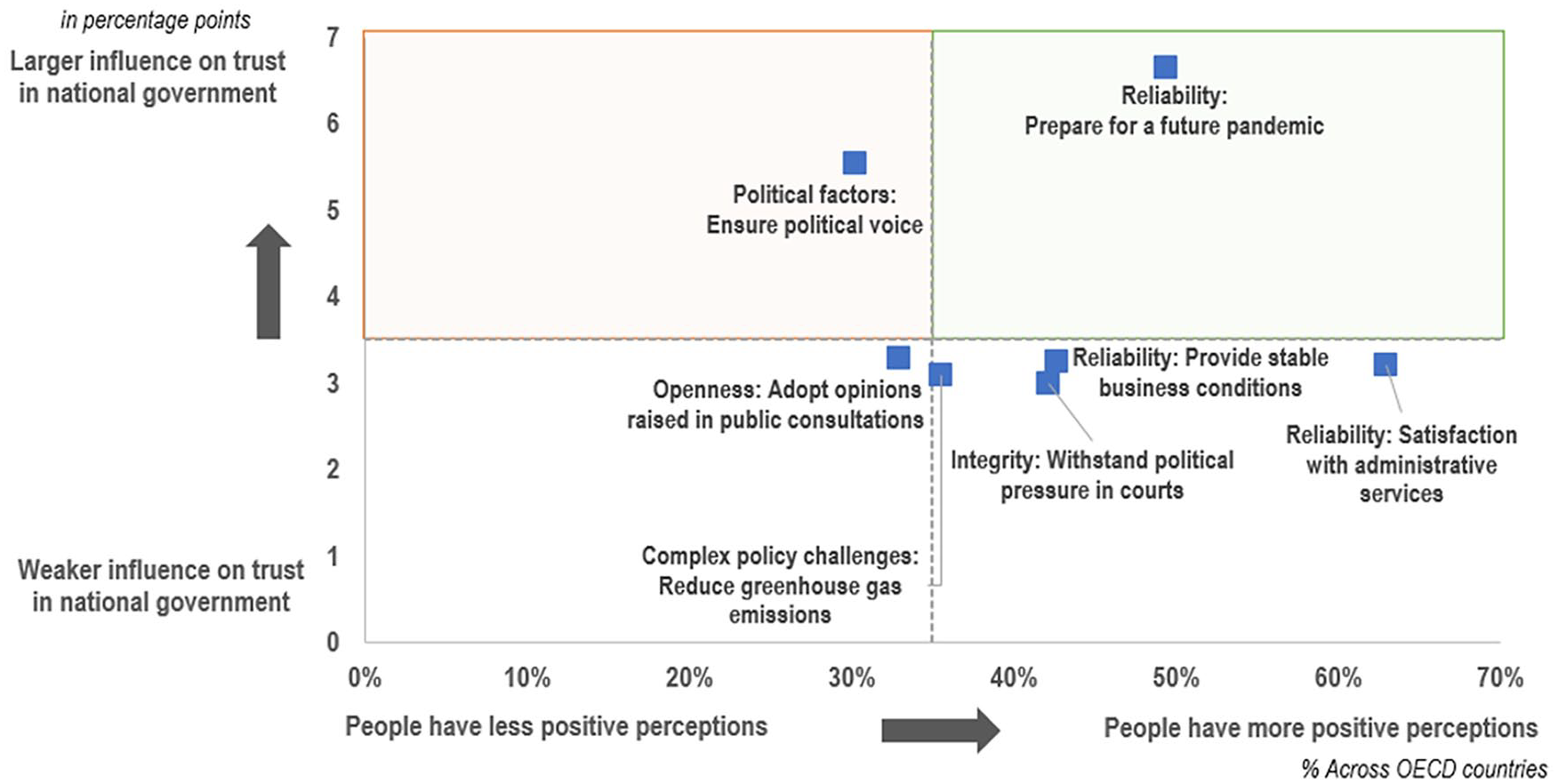
Increasing people’s feeling of having political voice could yield high trust gains in the national government
Improving government reliability, especially in the realm of combating future infectious diseases, is a complex and challenging task, particularly in countries where the standard is already high. On average, people already feel largely positive about the government’s ability to be prepared for a future pandemic, and this goodwill is something that governments can leverage. However, in the case of voice, governments have much room for improvement: Only about 30% of people across countries, on average, are confident that the country’s political system allows people like them to have a say in what the government does, and our regression analysis suggests that these feelings correlate highly with trust in the national government. The low levels of people’s views on voice and openness shown in Figure 5 indicate broad opportunities for improvements. For example, clear and effective communication with the population would be crucial for fostering trust in public institutions that could come from enhancing government reliability and preparedness. When it comes to enhancing political voice and incorporating opinions expressed during consultations with the public, actions may well speak louder than words.
Of course, the differences in survey responses between countries and between demographic groups within those countries mean that policymakers will have to take into account the specific results about, circumstances in, and idiosyncrasies of their own countries before designing trust-enhancing policies. Two context-specific drivers of trust in the central government found in Norway, for example, were people’s evaluation of the government’s efforts in sustaining the welfare system and the feeling of social cohesion in Norwegian society. 18 Similarly, the government’s ability to ensure social cohesion also comes out as an important driver of trust in the Finnish local government. 19 In Portugal, improving perceptions about the government’s responsiveness to people’s feedback provided during public consultations was the largest driver of trust in the local government, an aspect of public governance about which most Portuguese respondents were not quite positive. 20
Insights From Open-Ended Responses: Identifying Drivers Beyond the OECD Framework
The optional, open-ended survey question invited respondents to share any additional thoughts on what influenced their trust in public institutions. The information that can be gleaned from optional and open-ended questions is limited, because the answers do not represent the views of the full set of respondents, as not all of the respondents answered this question and, of those who did, not all went to the same length and detail. For instance, certain demographic groups, including respondents with a higher level of education, those who perceive their social status to be low, and people with low levels of trust in public institutions, were more likely than others to answer the question. Conversely, people who answered “Don’t know” to the other survey questions were relatively unlikely to answer the open-ended question. But the question did result in some useful insights.
To make sense of the answers we received, we used a machine-learning tool known as the Latent Dirichlet Allocation Topic Model, which grouped all of the respondents’ survey answers to the open-ended question according to topics it identified. (For more information on the topic modeling, see reference 21 and note F). Three of the topics—the influence on trust of (a) certain groups and politicians having undue influence and power, (b) government transparency and accountability, and (c) feelings of economic and social vulnerability—were not explicitly covered in the OECD’s framework.
The topics raised varied considerably with country, respondent characteristics, and respondents’ political attitudes. These findings highlight the critical importance of considering such differences when interpreting survey results and designing policies meant to enhance trust. 21 Answers to open-ended questions in the survey and other research also indicate that to build trust, policymakers need to communicate their decisions and the reasoning behind them clearly and transparently.
Sample Government Interventions to Enhance Trust in Public Institutions
Although the 2021 OECD Trust Survey provides strong evidence about which perceptions of public governance are related to trust in public institutions, the data do not point to a set of universal policies that should be enacted to enhance public trust. Evidence of how specific policy changes or interventions can affect levels of trust in public institutions is more sparse and difficult to gather.
Nevertheless, some countries have already used the results of the survey to guide their policies. These examples offer food for thought for other countries, even though the effects have not yet been studied systematically or causally. Country-specific results from the 2021 OECD Trust Survey were helpful to policymakers in individual countries jn efforts to base actions on data and generate evidence specific to their situations.
For instance, Norway launched a “trust reform” in 2022, which aims to enhance public trust by improving government competence, in particular responsiveness. 22 The program goal is to enhance the responsiveness of public services by affording frontline staff greater professional autonomy, which capitalizes on the staff’s expertise and knowledge of the needs of the citizens being served. In line with these ambitions, the details of the reform were not developed using a top-down approach but by a collaboration involving civil society organizations, employee representatives, and management. The trust reform also includes several other measures designed in this way. These include a project by the Ministry of Health and Care to increase full-time positions in health and care services, an effort by the Ministry of Climate and the Environment to simplify the application process for obtaining grants from the Cultural Heritage Fund, a pilot program by the Ministry of Local Government to shorten complaint-processing times, and the fielding of a survey by the Ministry of Labor and Inclusion on employee experiences of management and participation. 23
Consider Ireland. Survey respondents rated their government above average for reliability and fairness but also revealed challenges related to government openness and responsiveness. These findings were instrumental in shaping the Public Service Transformation Strategy to 2030, which explicitly outlines a commitment to the public governance drivers of trust identified by the OECD and includes increasing public trust as one of six high-level goals. 24
Some countries have set up coordination mechanisms to implement their trust agendas. For example, Norway established a committee of state secretaries and an official group involving all ministries to improve coordination and make enhancing trust a critical aim across the administration. 25 Finland has also formed a cross-government working group to examine recommendations from the OECD Trust Survey, determine how to implement the recommendations within existing programs and projects, and identify areas that require further work. 26
In general, governments have also focused on delivering policies and including citizens in the policymaking process by enhancing participation (that is, political voice) and openness. Finland institutionalized national dialogues following the model of the Lockdown Dialogues held there during the COVID-19 pandemic. These dialogues aimed to capture people’s feelings, opinions, and expectations and contributed to identifying issues that could require government attention; they became inputs for shaping policy responses. 27
More case studies about efforts to translate the OECD Trust Survey’s results into country-specific policy recommendations can be found in OECD’s country-specific reports on the drivers of trust in public institutions. For examples, see references 18, 19, 28, and 29.
Conclusion & Outlook
The OECD Trust Survey is an innovative tool for measuring and improving trust and the drivers of trust in public institutions. It enables governments to gain direct insights from citizens on their perceptions and expectations of many aspects of governance. These insights, in turn, can provide opportunities for governments to become more accountable and responsive to people’s needs, priorities, and concerns.
In November 2022, OECD countries acknowledged the OECD Trust Survey’s value as a measurement tool for enhancing governance and agreed to conduct the survey every two years. This decision paves the way to monitoring the main drivers of trust over time and to assessing the impact of various trust-enhancing initiatives. 30
The benefits of these kinds of surveys became even more apparent after 2023, when the 54th United Nations Statistical Commission adopted a revised Classification of Statistical Activities that includes governance as a new domain of official statistics. This inclusion means that governments will increasingly gather statistics on governance, and therefore the public availability of these statistics will increase as well.
Finally, the results from the 2021 OECD Trust Survey, including answers to the open-ended survey question, led to further reflection by the OECD Trust Survey Advisory Group, prompting it to take steps to enhance the survey’s methodological robustness and relevance in the next survey wave. The 2023 OECD Trust Survey includes several new questions covering three areas that emerged as important for assessing people’s trust in public institutions: perceptions of accountability and transparency (relating to checks and balances between government branches), governmental use of evidence and communication of political reforms, and economic and social concerns (such as the public’s views on discrimination and on their own political priorities).
The OECD Trust Survey serves as a powerful tool for understanding the dynamics of public trust across various OECD member countries. The institutionalization of this survey as a biannual exercise in a growing number of countries will enable not only longitudinal but also cross-country comparisons, assisting policymakers in identifying the levers of public governance that can enhance trust in their countries. The data generated offer invaluable insights into how public-sector activities and service delivery can be instrumental to boosting public trust.
Supplemental Material
sj-docx-1-bsx-10.1177_23794607241262091 – Supplemental material for Insights from the 2021 OECD Trust Survey: How people evaluate the trustworthiness of government institutions & implications for policymakers
Supplemental material, sj-docx-1-bsx-10.1177_23794607241262091 for Insights from the 2021 OECD Trust Survey: How people evaluate the trustworthiness of government institutions & implications for policymakers by Mariana Prats, Emma Phillips and Sina Smid in Behavioral Science & Policy
Footnotes
Declaration of Conflicting Interests
The author(s) declared no potential conflicts of interest with respect to the research, authorship, and/or publication of this article.
Funding
The author(s) received no financial support for the research, authorship, and/or publication of this article.

Notes
References
Supplementary Material
Please find the following supplemental material available below.
For Open Access articles published under a Creative Commons License, all supplemental material carries the same license as the article it is associated with.
For non-Open Access articles published, all supplemental material carries a non-exclusive license, and permission requests for re-use of supplemental material or any part of supplemental material shall be sent directly to the copyright owner as specified in the copyright notice associated with the article.
