




Abstract
Maintaining employee trust is essential for the success of an organization. Employees who trust their employers perform better and are more likely to stay in their jobs. We have identified a phenomenon that we call organizational dissociative identity disorder that tends to erode employee trust. The phenomenon is somewhat analogous to the psychiatric diagnosis of dissociative identity disorder, in which a person appears to have multiple personalities. In the case of organizations, it is the perception of employees that dealing with their organization is like dealing with a person who has multiple personalities. Employees tend to experience this perception when they receive directives that seem inconsistent with one another or with previous directives, leading the employees to doubt the ability, the benevolence, the integrity, and often the fairness of their employer. This perception is most likely to occur after a period of organizational change. We propose ways to identify this situation and ameliorate its effects through carefully crafted communications of various types involving stakeholders at all levels of the organization.
Keywords
When two Harvard hospitals merged to form Beth Israel Deaconess Medical Center in 1996, employees found themselves caught between misaligned polices resulting from the clashing missions of the two hospitals. 1 Nurse leaders from Beth Israel Hospital, which had been legendary for the quality of its nursing care and for pioneering a primary nursing model, pushed for adherence to excellence to be the top priority. By contrast, nurse leaders from New England Deaconess Hospital prided themselves on cost-effectiveness and pushed for policies that prioritized an economic logic focused on efficiency and cost cutting.
By 1999, the merged hospitals were losing more than a million dollars a week, forcing its leaders to cut costs. Units were closed and merged amid protests from nurses and doctors. Support for nurses, such as educational programs, was scratched, and 78% of nurses reported rushing to meet patient responsibilities. Nurses in merged units were also frustrated by the need to learn new work practices and computer systems. As the workplace situation deteriorated, frontline nurses lost trust in the nursing leadership, whom they felt were no longer looking out for them or making wise decisions.
When employees lack trust in the organizations they work for, the feeling can have profound consequences for the organizations’ success. A lack of employee trust can degrade employees’ commitment to the organization, eroding their willingness to stay or to contribute to the organization beyond meeting routine responsibilities. 2 One nurse from the merged hospitals observed, “Now people are leaving left and right. I mean, our staff is just walking off the job.” 1 In these ways and others, a lack of employee trust can affect individual and team performances. From an employee perspective, a lack of trust in an employer can lead to dissatisfaction, confusion, and other negative emotions at work, where people typically spend a third of their waking hours. 3
The experience at Beth Israel Deaconess Medical Center exemplifies a phenomenon we call organizational dissociative identity disorder (ODID), which can unintentionally but profoundly weaken employees’ trust in their organizations. A few years ago, two of us (Mayer and Williams) coined the term after observing situations in which employees, when interacting with their organization, felt as though they were dealing with a person who had multiple distinct personalities. 4 A posting on the Glassdoor job search and company review website captures a common scenario: —“problems with management (one boss will have goals for you and his boss will have another set of goals that don’t align).” 5
Because the official psychiatric diagnosis for a person with multiple personalities is dissociative identity disorder, 6 we added “organizational” to “dissociative identity disorder” to create a term that describes the situation in which employees perceive that their organization has developed values, expectations, and policies that are inconsistent with one another or with the organization’s mission statement. (Note that ODID exists when employees sense these contradictions in their organization; conversely, if the organization is objectively behaving in contradictory ways but employees do not perceive the contradictions, then ODID does not exist.)
Both aligned values7,8 and consistency between values and actions 9 are critical for trust. For example, one study found that when mission-driven companies—those that aim to achieve objectives beyond profits to make a difference in the world—could not balance dual social and commercial missions, employees became disengaged and volunteers left. 10
ODID may be a key source of problems in the aftermath of mergers (as in the case of Beth Israel Deaconess Medical Center), acquisitions, and other types of organizational change. Efforts to initiate big changes in organizations often fail to achieve their anticipated benefits.11,12 Frequently cited reasons for merger failures include poor communication and unclear lines of authority between merging firms’ leadership teams. These issues can stem from the competing logics (rules, standards, and values) of top management team members, which raise the risk of ODID and its resulting dissolution of employee trust.
In this article, we delve further into the causes of ODID and the ways it undermines trust. Then we suggest ways to diagnose and address the condition.
What Causes ODID?
As we have already noted, a merger of organizations with differing missions, such as the Harvard hospitals, is one situation that can result in ODID. A leadership change or an environmental shock such as a pandemic or natural disaster can similarly lead top management teams to issue new directives that contradict previous directives, potentially forcing middle managers and supervisors to go back on promises they made to employees. In fact, the likelihood of ODID occurring may rise as the world becomes increasingly turbulent, because chaos makes it harder for an organization to coordinate directives within and across departments. 13 Organizations can also meander into a state of ODID when leadership simply fails to pay attention to how consistent their plans and directives are or as a result of mission drift—when an organization’s direction slowly diverges from its original mission through multiple small decisions made over time.
Defining Trust in Organizations
Before we discuss how ODID can erode employee trust in organizations, we need to be more specific about what we mean by “trust” and “trustworthiness” in this context. Trust is the willingness to be vulnerable to another party whom the trusting party cannot monitor or control. 14 To earn trust or to be trustworthy, employers (or “trustees”) must influence employee perceptions of three key factors: ability, benevolence, and integrity. In other words, trustworthiness comes from the ability to do what the employee needs as the situation demands, benevolence toward an employee’s welfare and interests, and the integrity to adhere to values the employee finds acceptable. This well-accepted model of the trustworthiness of organizations also applies to individuals, such as managers, within organizations.2,15,16 It predicts that anything that impinges on a positive perception of the trustee’s ability, benevolence, or integrity would make the organization seem less trustworthy.
Three Ways ODID Undermines Trust
We conceptualize the way ODID erodes trust in an organization using a concept borrowed from physics: vectors. In physics, a vector, drawn as an arrow, represents a physical force of a certain magnitude (denoted by the vector’s length) acting in a particular direction. In our model, vectors represent the forces of expectations or demands that affect employees—most notably middle managers.4,17 In line with the physical model, these vectors vary in their power over the employee as well as their direction of effect. In ODID, vectors rooted in differing logics, strategic directions, initiatives, and incentives may appear to oppose one another or otherwise misalign. For example, in university settings, the managerial focus on efficiency is often at odds with the academic goal of knowledge acquisition; similarly, when universities engage in biotech commercialization, the economic logic of profits may conflict with the scientific logic of pure discovery. In ODID, these kinds of conflicting directives or priorities are perceived as permeating the organization rather than as a flaw in a particular manager. Figure 1 illustrates how vectors can influence perceptions of contradictions across organizational levels and ultimately lower organizational trust. In combination, these vectors can cause a manager to act in ways that are inconsistent and seem insensitive, undermining trust.
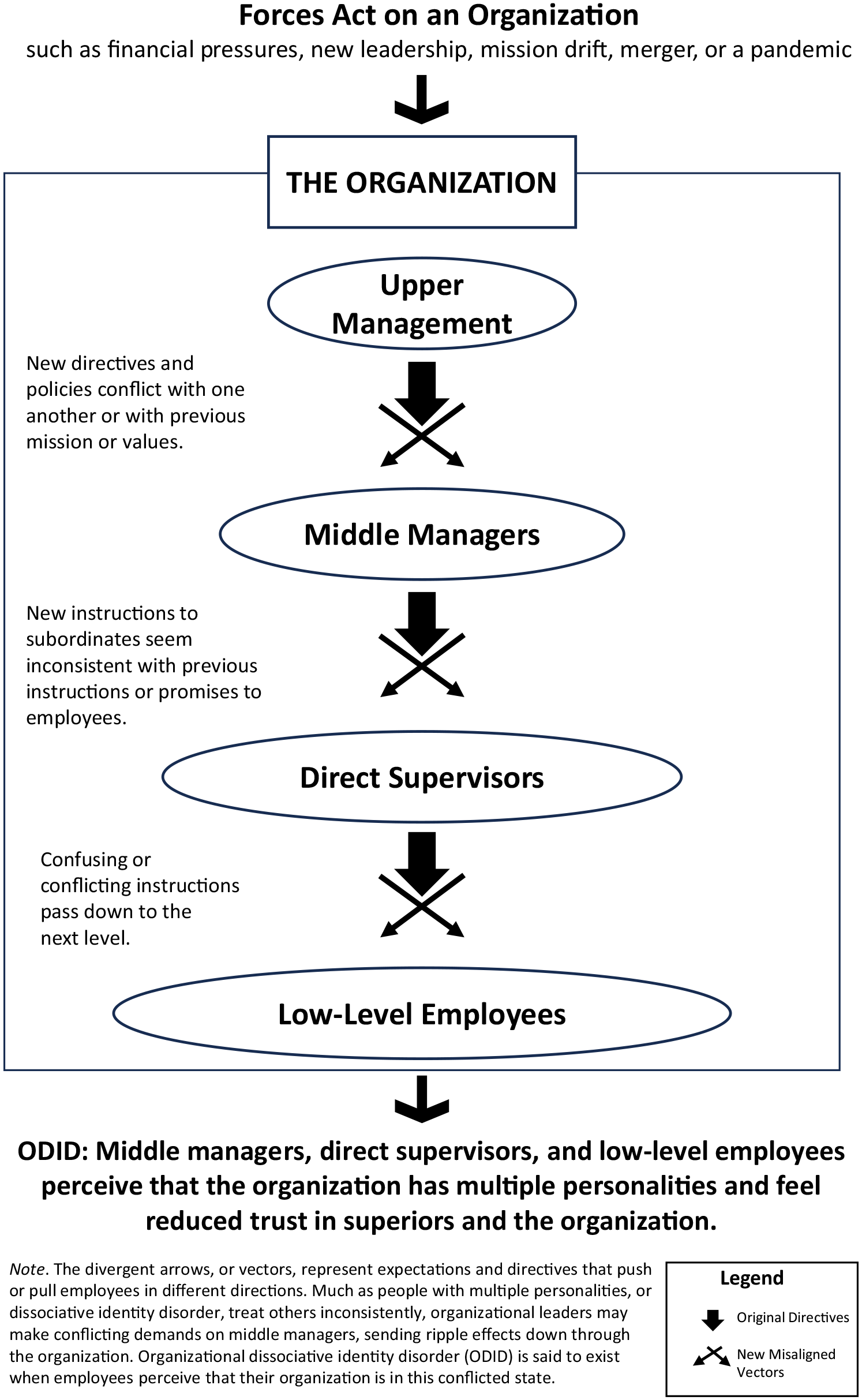
How ODID arises & damages organizations
ODID can damage employees’ trust in an organization by affecting perceptions of its trustworthiness and fairness and by violating unstated psychological contracts between employees and their managers. 13 We next address each of these three problems in turn.
ODID Affects Perceptions of Trustworthiness of the Organization & Its Managers
As we have noted, the perceived trustworthiness of both the organization and particular managers decreases when employees perceive flaws in their ability, benevolence, or integrity. Misaligned vectors can lead to such perceptions when mismatches result in managers taking actions that violate employees’ expectations of fair treatment. Because employees often have no way to determine the ultimate cause of the misalignments or the reasons for managers’ behavior, they frequently attribute the contradictory vectors to the ubiquitous “they” of the organization and its management.
With respect to ability, when leaders assign new tasks or set goals contradictory to existing ones and fail to acknowledge the inconsistency in the new assignments, they may seem incompetent. For instance, middle managers may respond to inconsistent expectations by switching the directives they are giving to subordinates—in some cases significantly and inexplicably—or by passing the conflicting instructions down to their subordinates, leaving them to flounder. These managers are often in the most difficult position in the maze of vectors because they serve as an interface between the top leaders who make the work demands and the subordinates assigned to carry out the tasks that will meet those demands.
Employees may question an organization’s integrity when the organization changes directions in a way that violates previously espoused and accepted values. 18 An organization may, for example, change how it prioritizes opposing goals—for instance, efficiency versus patient safety, profits versus scientific discovery, or speed versus employee safety. Research has found that integrity violations consistently lower trust. 19 When managers receive new strategic directions and directives, they may be forced to go back on promises they previously made to subordinates, which can undermine perceptions not only of their integrity but also of their benevolence. For instance, during the Harvard hospital merger, nurse managers were sometimes required to increase the patient load of the nurses working for them and, at times, had to renege on previously promised vacation days. 1
Some leadership styles—in particular, toxic and destructive ones—may spur a precipitous drop in employees’ trust in an organization affected by ODID. But even a manager who is trying to act responsibly and ethically may behave in ways that undercut trust in an organization when ODID is present. This problem is particularly acute during crises, when leaders may feel too pressed for time to provide employees with clear explanations for their actions or to gather input from them. 20 Additionally, emotional exhaustion resulting from ODID could reduce managers’ ability to do their jobs or communicate effectively with subordinates.
ODID Affects Perceptions of Fairness of the Organization & Its Managers
Misaligned vectors may weaken an organization’s ability to provide what is called “organizational justice”—that is, to operate in a manner that is perceived as fair. The term encompasses three types of fairness that are all highly correlated with integrity and trust: 21 distributive fairness (who receives what rewards); procedural fairness (having and following processes to assure fairness); and interactional justice, which centers on communication and has two facets—informational justice (receiving adequate and timely information about changes) and interpersonal justice (treating employees with respect). 22
Decisions that change employees’ incentives, rewards, or performance standards may directly affect perceptions of both distributive and procedural fairness. For example, one study found that employees doubted the fairness of their company’s procedures for making decisions and administering rewards when those procedures changed during a performance cycle. 23 Informational and interpersonal justice will also influence perceptions of fairness. Another study showed that irrespective of the effect of decisions on an employee, perceptions of fairness increased when managers delivered adequate information in an interpersonally sensitive manner. 24 By contrast, when vectors are misaligned, managers may be unclear about what is required of them, and that confusion may interrupt clear, accurate, and caring communication, leading to perceptions that the organization and its managers are unfair.
ODID Leads to Psychological Contract Violations
Psychological contracts are employees’ implicit beliefs about the terms of their agreements with their employer, including perceived expectations that have not been explicitly codified.25,26 When vectors become misaligned, these contracts may appear to be violated.27,28 This violation is not necessarily known to the employer, because the contract is in the mind of the employee. For example, employees may believe an employer cares about their well-being. That implicit contract may be violated when the employer requires employees to work in a situation that raises their risk of becoming infected with a disease, as occurred at the height of the COVID-19 pandemic. An employee could also perceive a psychological contract violation when an employer suddenly assigns duties that differ from the ones specified when the individual was hired. Changes in this implicit contract, if not agreed to explicitly, may lead employees to believe that the employer’s values are not aligned with their values, causing them to question their employer’s integrity. Such breaches can diminish trust, leading to the motivation and performance problems already discussed.29,30
Ways to Diagnose & Address ODID
We offer several approaches to combating ODID to preserve trust. Some of them require an outside facilitator who can help leaders understand the organization from a different frame of reference and who may have specialized tools for diagnosing organization-level problems. We suggest taking the two diagnostic steps listed below before undertaking the mitigation measures, although the mitigation measures can also be used fruitfully on their own.
Diagnose ODID
Use Sensemaking to Analyze the Effect of Change on Trust
Whether an organization is facing a merger, a potential move to a new location, or a smaller shift in divisions, it is important for leaders to carefully analyze the effects of any major decision on formal roles, informal relationships, and likely employee perceptions to uncover any hidden or unintended negative consequences. 31 This analysis is best achieved through a process called “sensemaking,” in which leaders solicit input from staff (including, importantly, those whose voices are not generally heard) in a proactive attempt to understand how employees are perceiving the changes and the changes’ effects on them. Sensemaking involves combining disparate views to better understand a complex situation and then testing that understanding as a starting point for refining or revamping plans. 20 Asking stakeholders for their views not only can help diagnose ODID but also is likely to be seen as benevolent, increasing trust as well as perceptions of inclusion and procedural fairness.
After Satya Nadella took over the reins at Microsoft in 2014, he held an executive retreat and solicited the perspectives of the leaders of the companies Microsoft had acquired. He also had executives go to various customer sites to gather additional data from people working with Microsoft products. 32 Similarly, bank CEOs have canvased tellers, and biotech CEOs have talked to doctors and patients.20,33 Companies often hire consultants trained in the sensemaking process and who have specialized tools such as the Relational Analytics Survey, 34 which maps how people in the organization interact in their various roles. From there, however, leaders or human resource professionals may take over to teach, serve as role models, and encourage sensemaking at all levels of the organization—an important step, because the successful implementation of many initiatives requires system-wide changes. (See reference 20 for more about how to make sensemaking part of an organization’s culture.)
Whoever implements sensemaking in an organization should pay special attention to middle managers. As previously mentioned, these managers often lie at the crux of perceived contradictions because they need to reconcile or balance their responsibilities to upper-level leadership with changes to their subordinates’ workflow and the effect of the changes on subordinates’ well-being.
Sensemaking should also include a map of the informal relationships that underlie how work actually gets done. As Rendelle Bolton, Caroline Logan, and Jody Hoffer Gittell explained in a 2021 review, these relationships are bound “by shared goals, shared knowledge, and mutual respect,” and they are essential because they “tend to support frequent, timely, accurate, problem-solving communication and vice versa, enabling stakeholders to effectively coordinate their work.” 35 ODID can disrupt these hidden sources of coordination and undermine trust in managers’ decision-making.
Bolton, Logan, and Gittell created an online network survey tool that both leaders and researchers can use to map tasks and informal relationships (https://rcanalytic.com/rc-survey/). Using such a tool can help managers understand how to preserve efficiency or prevent damage to important relationships when specific tasks need to be changed. After the U.S. Veteran’s Health Administration changed the structure of its teams, representatives of the administration partnered with external researchers to map the team membership of nurses and other support staff in 849 primary care units across the country. They then gathered data to assess how membership in more than one primary care team—and the competing vectors multiple memberships created—affected individual and team performance. 36 Assigning individuals to multiple teams lowered team performance, they found, and the outcome was worse for teams tackling complex tasks.
Test the Map
Experimentation and revision are critical but often overlooked components of sensemaking. Once leadership has created an impact map, it is important to test and refine it. A good strategy for doing so is to roll out the new plan or policy change to a small group of employees first, soliciting feedback and making refinements, before moving on to the whole organization. 20 This type of staged rollout is often used for identifying software bugs and has been deployed more recently to assess employee acceptance of new AI-assisted procedures. But it can also serve as an indicator of the impact of initiatives on employees’ perceptions of managers and organizations.
Mitigate ODID’s Effects & Build Trust
Frame the Narrative Through Sensegiving
We have explained that ODID and its concomitant misaligned vectors decrease an organization’s perceived trustworthiness. However, it is not solely perceptions of misalignment that decrease trust; it is also the attributions employees make for the causes of misalignment. 37 If employees believe the cause of a problem, such as a manager’s failure to keep promises, is due to circumstances beyond an organization’s control—say, a pandemic or natural disaster—then their trust in leadership is likely to remain intact. However, if employees believe the cause is internal—for instance, that it stems from a lack of concern for the employees (lack of benevolence), self-interest (lack of integrity), or a failure of leaders to think through an action’s consequences (lack of ability)—then employees’ trust in their organization and managers is at risk.38,39
To prevent this trust erosion, leaders of organizations should communicate openly with staff to help them appreciate the reasons for potentially disruptive changes. One way to do this is through sensegiving: providing others with a coherent picture or narrative to obtain their buy-in. 40 A concept rooted in psychology and behavioral economics, 41 sensegiving frames the narrative in a way that shapes how employees view the causes of, responsibility for, and intentions behind changes and new initiatives.
Employers should engage in sensegiving 42 —whether through company-wide memos, all-hands meetings, or offsite retreats—either before, during, or soon after a leadership change, merger, acquisition, or downsizing. Framing the cause of events also affects employees’ emotional reactions to the events. 43 For instance, although employees are likely to be sad about chance events that cause disruption, they may be angry if the cause is internal and intentional. Either way, managers can reduce stress and negative emotions among employees by framing any negative consequences as “necessary evils,” if they do so carefully (see reference 44 for details). The way necessary evils are framed and enacted has been found to matter for maintaining positive relationships and reducing stress. 44
In an example of sensegiving during the pandemic, Patrick Collinson, CEO of Stripe, a financial services company, wrote an open letter on LinkedIn announcing layoffs and blaming them primarily on “stubborn inflation, energy shocks, higher interest rates, reduced investment budgets, and sparser startup funding.” 45 In contrast, Willam Marshall, the CEO of Planet Labs, a provider of satellite data, personally accepted responsibility for the layoffs at his company, writing to employees, “At the outset, I want to be clear that I am responsible for the decisions that led us here. I know this has significant effects on the lives of our team and their families, and for that I am sorry.” 46
Collinson’s sensegiving directed blame away from the organization, whereas Marshall’s directed blame, anger, and mistrust away from direct managers in his company and toward himself, but in an empathetic way. As long as they are truthfully and accurately reflecting their respective situations, both CEOs are modeling legitimate approaches to sensegiving that direct blame away from the organization’s middle managers and direct supervisors. But if Collinson’s statement were untrue, over time, it would become clear that the top management team lacked both ability and integrity. Thus, although accurate sensegiving can help maintain or rebuild employee trust, inaccurate sensegiving, if discovered, is likely to backfire and further undermine trust.
Be Transparent
Employees perceive their employers are transparent when those employers disclose reliable and clear information in a timely fashion. 47 Transparency has three components: disclosure, clarity, and accuracy. It can come into play during the decision-making process as well as in the analysis of its impact (sensemaking) and the small experiments testing that impact.
The more transparent an employer is, the more its employees will tend to trust the employer. Transparency also helps bolster the impression that an employer is fair, because employees feel they are getting the relevant information about a decision. 48
Unfortunately, the misaligned vectors of ODID are likely to reduce clarity and accuracy and, thereby, perceived transparency. But if an organization can address the results of the sensemaking in its disclosures, managers may be able to nip confusion, mistrust, and feelings of betrayal in the bud. Employers can, for example, explain why they are taking certain actions (clarity) and how they determined that their decisions were optimal for all stakeholders, including the employees (accuracy).
Be Sensitive
Disclosure can miss the mark if it is not carried out with interpersonal sensitivity. Acting with benevolence requires both understanding the unintended consequences of misaligned vectors and caring about those consequences. Demonstrating sensitivity is a powerful way for an organization’s leaders to influence perceived trustworthiness by increasing perceptions of fairness. Put differently, why would employees trust an organization’s leaders when they believed those leaders either did not understand or did not care about the struggles the organization was creating for the employees?
Sensitivity can even prevent counterproductive behavior fueled by perceptions of unfairness. In the 1980s, a Midwestern U.S. manufacturing company introduced a temporary pay cut across two of its plants. At one plant, members of management delivered news of the pay cut in a 90-minute meeting in which they expressed deep regret at the pain it would cause and explained that the strategy would prevent layoffs. The leaders also assured employees that the burden of the pay cut would be shared by everyone. At the other plant, members of management took just 15 minutes to deliver the news of the pay cut and stipulated only that the pay cut was necessary because of lost contracts. After this perfunctory chat, employees tried to tip the scales of justice by stealing inventory to “correct” for the perceived unfairness. 49 By contrast, much lower rates of theft occurred at the other plant, where leaders were apologetic and took time to thoroughly explain why the pay cut was necessary.
Voice: Let Employees Challenge You!
When the misaligned vectors that give rise to ODID affect an organization, employees and middle managers are often the first to recognize it. However, if an organization’s culture does not value and encourage speaking up, misaligned vectors may go unnoticed by those who could correct the misalignment. Because ODID can undermine the trust and psychological safety that employees need to feel comfortable about speaking up, establishing mechanisms for employee feedback such as consultant-led focus groups or anonymous surveys may enable the collection of valuable information while also signaling the organization’s benevolent intentions. Openness to informal feedback, also called employee voice, sends similar signals. 50 Employers can establish informal communication channels to take suggestions for change or improvement. 51 These might include virtual suggestion boxes, a Friday open-door policy, or lunches that bring together employees from different levels of an organization. Because employees may challenge managers’ perspectives through these channels, sharing their views is risky for them. 51 Nonetheless, organizations should encourage employees to speak up because employee voice may both give rise to ideas that help organizations remain competitive 52 and help leaders spot and correct the misaligned vectors that can erode employee trust.
In a field quasi-experiment, one of us (Mayer) and James Davis found that employees’ trust in top management increased when top management replaced a faulty performance appraisal system in response to employees’ concerns. 53 Given that employees tend to equate top management with the organization, the employees in the experiment likely also put more trust in the organization (although the study did not measure this explicitly).
Conclusion
Employers reap many benefits when employees trust them. Employees who trust their employers are likely to demonstrate good citizenship in the organization, do well at their jobs, and be satisfied, committed, and unlikely to quit.2,16
The contemporary lack of trust in government and many institutions may make earning employees’ trust seem daunting. 54 Yet as we have described in this article, trust can be earned through actions that boost perceptions of fairness, ability, benevolence, and integrity. Managers and organizations can heighten these perceptions in various ways. Nicole Gillespie and her colleagues have proposed several practices for building trust during transitions, including empowering employees by consulting them before making decisions that affect them, treating them fairly through equitable and transparent policies, and caring for and supporting them emotionally, such as by listening to their concerns and providing encouragement. 55
The notion of ODID provides a relatively new lens for examining ways that trust may be lost or preserved in organizations that are undergoing change. We encourage leaders to assess ODID in their organizations and improve their communication through sensemaking, sensegiving, transparency, sensitivity, and voice. Listening to employees’ concerns and making good-faith efforts to address them go a long way in building the trust that organizations need to succeed.
Key Points
Who Should Do What?
When faced with an impending change to an organization, such as a merger, restructuring, or move to a new location, leaders should take the following steps to avoid organizational dissociative identity disorder (ODID) and maintain and build employee trust.
Footnotes
Declaration of Conflicting Interests
The author(s) declared no potential conflicts of interest with respect to the research, authorship, and/or publication of this article.
Funding
The author(s) received no financial support for the research, authorship, and/or publication of this article.