




Abstract
Intoduction
Career plateau is a significant professional challenge in nursing, known to negatively affect nurses’ attitudes, work behaviors, and overall well-being. Although psychological resilience has been increasingly recognized as an important personal resource, the pathways through which it influences career plateau remain insufficiently understood.
Objective
This study aimed to examine whether career barriers mediate the relationship between psychological resilience and career plateau among clinical nurses.
Methods
A cross-sectional design was employed, and data were collected between November 15, 2021, and January 25, 2022 at a university hospital in Istanbul using an online questionnaire. The sample comprised 415 nurses. Validated instruments were used, including the Brief Resilience Scale (BRS), the Career Barriers in Nursing Scale (CBNS), and the Career Plateau Scale (CPS). Analyses included descriptive statistics, Pearson correlations, and Hierarchical multiple regression analyses. Mediation was tested using the PROCESS macro (Model 4) with bootstrapping.
Results
Regression analyses indicated that higher resilience predicted lower career barriers and lower career plateau. Mediation analysis revealed that career barriers partially mediated the relationship between resilience and plateau. The indirect effect, though small, was statistically significant, while the direct effect of resilience on plateau remained robust.
Conclusion
The findings provide new insights into how psychological resilience and career barriers interact to shape career plateau experiences among nurses. Supporting resilience may help reduce perceived career barriers and career plateau.
Introduction
Nurses, similar to other healthcare professionals, are frequently reported to experience career stagnation, which can negatively influence their work-related attitudes and overall professional well-being (Abd-Elwareth et al., 2022; Hassan et al., 2020). Multiple factors contribute to these perceptions of career plateau. Personal characteristics, limited opportunities for advancement and professional development, organizational conditions, and individual work experiences all play a role, often resulting in decreased job satisfaction, lower engagement, and reduced emotional well-being (Hu et al., 2022; Yang et al., 2019; Zhu et al., 2021). Despite growing recognition of career plateau as a challenge in nursing, research in this area remains limited. In particular, little is known about the personal and organizational resources that may buffer nurses against career stagnation. Addressing this gap, the present study examines the relationship between psychological resilience and career plateau and explores whether perceived career barriers mediate this relationship.
Review of Literature
Conservation of Resources (COR) theory provides a strong framework for understanding the relationships among psychological resources, career barriers, and career plateau in nursing. The theory indicates that individuals are motivated to acquire, maintain, protect, and build valuable resources, such as time, energy, status, social support, and psychological resilience, which are critical for coping with stress and maintaining psychological well-being. Importantly, COR theory emphasizes that the loss of resources, or even the threat of loss, represents a more potent and corrosive source of stress than the gain of new resources (Halbesleben et al., 2014; Hobfoll, 1989, 2001, 2002).
In the context of nursing careers, key resources include opportunities for promotion, professional development, recognition, and occupational status. When access to these resources is restricted, nurses may experience heightened perceptions of resource depletion, which can trigger stress, withdrawal behaviors, and increased perceptions of career plateau (Hobfoll et al., 2015). From this perspective, career barriers and career plateau can be conceptualized as actual or potential losses of resources tied to professional development, advancement, recognition, and organizational support. Overall, COR theory offers a useful lens for understanding how career plateau emerges and how both individual and organizational factors impact this process. Within this framework, career plateau can be considered an actual or anticipated loss of resources related to professional development, status, and opportunities for advancement (Huaman-Ramirez & Lahlouh, 2023; Hu et al., 2022; Yang et al., 2019).
Career Plateau
The increasing prevalence of perceived career plateau among nurses and other healthcare professionals highlights the importance of addressing this phenomenon as a critical human resource concern, with implications for both individual well-being and organizational sustainability (e.g., Hu et al., 2022; Yang et al., 2019). For example, Hu et al. (2022) reported that a substantial proportion of nurses in clinical settings felt constrained in their careers, both in terms of hierarchical advancement and job content. Similarly, Yang et al. (2019) found that nurses who remained in the same position for extended periods tended to have diminished expectations for career progression, which was accompanied by significant decreases in job satisfaction and organizational commitment. According to the traditional definition proposed by Ference et al. (1977), a hierarchical career plateau is the point within an organization's pyramidal structure where promotion opportunities are effectively exhausted or become highly unlikely. In contrast, Huaman-Ramirez and Lahlouh (2023) describe a job content plateau as a situation in which employees, despite achieving a high level of task mastery, perceive few or no opportunities for new learning, development, or challenges in their roles. Research consistently shows that perceived career plateau has negative consequences for nurses, including reduced job satisfaction, lower organizational commitment, and increased burnout. In addition, such perceptions may reduce nurses’ commitment to the profession and contribute to higher turnover intentions (Chang et al., 2019; Hu et al., 2022; Zhu et al., 2021).
Career Barriers
Research has identified multiple factors that contribute to the development of career plateau. Zhu et al. (2021), for example, highlighted personal factors (e.g., unrealistic promotion expectations, wage dissatisfaction, low motivation to learn, and work–family conflicts), as well as limited career potential (e.g., restricted opportunities to acquire new skills or assuming additional responsibilities). Organizational factors (e.g., insufficient career development support and unfavorable working conditions) and individual experiences (e.g., uncertainty about future career development) were also found to play a role. In accordance with these findings, Chang et al. (2019) and Begum and Sarker (2018) reported that perceived career barriers, such as limited promotion opportunities, inadequate support from supervisors and colleagues, and unfair promotion or performance evaluation processes, not only strengthen perceptions of career plateau but also reduce nurses’ commitment to their profession and their organization. These studies suggest that career barriers function as a structural and perceptual constraint on critical resources, including professional development, occupational status, and recognition, and represent an important determinant of career plateau.
Psychological Resilience
Within the framework of COR theory, psychological resilience is regarded as a fundamental personal resource, reflecting an individuals’ capacity to adapt, recover, and more effectively mobilize and organize existing resources in the face of adversity (Hobfoll, 1989, 2001, 2002). Previous studies have linked psychological resilience to a range of positive career outcomes, including greater career satisfaction, stronger career commitment, enhanced career adaptability, and higher perceived career success (e.g., Hartmann et al., 2020; Cartens et al., 2021). In addition, Timur and Balcı (2023) found that individuals with higher resilience perceive career barriers as more manageable and surmountable, resulting in lower overall perceptions of these barriers. Despite these findings, a review of the nursing literature reveals that the relationships among psychological resilience, career plateau, and career barriers have mostly been examined in isolation. Few studies have tested these variables simultaneously within a comprehensive mediation model informed by COR theory (Polat et al., 2025; Zhu & Li, 2023).
In response to this gap, the present study aimed to examine the relationships between psychological resilience, career barriers, and career plateau among clinical nurses using both direct and mediation models. Specifically, the study tested whether (a) psychological resilience reduces career plateau and career barriers, (b) career barriers increase the perception of career plateau, and (c) career barriers mediate the relationship between psychological resilience and career plateau. Therefore, the study provides both a conceptual model and an empirical contribution to the nursing literature. The conceptual model is presented in Figure 1. Based on this framework, the following hypotheses were proposed: H1: Psychological resilience is negatively associated with career plateau. H2: Psychological resilience is negatively associated with career barriers. H3: Career barriers are positively associated with career plateau. H4: Career barriers mediate the relationship between psychological resilience and career plateau.

Conceptual model of the study.
Methods
Design
This study employed a cross-sectional, descriptive design and adhered to the STROBE checklist for cross-sectional studies.
Sample
Data were collected using an online survey at a tertiary university hospital in Istanbul province, which provides comprehensive services across all medical specialties. The hospital's nursing hierarchy comprises ward nurses, charge nurses, nursing services supervisors, and a nursing services manager, with the Director of Nursing Services in charge of all nursing activities. Data collection was carried out between November 15, 2021, and January 25, 2022. A Google Forms questionnaire was distributed to all nurses via email, and three reminder messages were sent at 15-day intervals to increase participation.
The study population consisted of 1,329 nurses employed at the hospital. Based on a sample size calculation assuming a 95% confidence level, a 5% margin of error, and an estimated incidence of 50%, a minimum of 299 participants was required. To enhance statistical power, all eligible nurses were invited to participate, resulting in complete responses from 415 nurses. Because all questionnaire items were mandatory, no missing data were present. The overall response rate was 31.23%, which may reflect nurses’ intensive workloads and shift-based schedules. A post hoc power analysis indicated an effect size of d = 0.042, a 95% confidence level, and a statistical power of 85% for a linear regression model examining the effects of eight independent variables on the dependent variable, suggesting that the sample size was adequate. To reduce potential bias associated with convenience sampling, nurses from a variety of clinical units and shifts were included in the study.
Inclusion and Exclusion Criteria
Participants were required to be staff nurses employed at the selected hospital during the data collection period and to have at least 6 months of work experience at the institution. Nurses holding managerial or supervisory positions, as well as those employed for less than 6 months, were excluded from the study.
Study Variables
The independent variables included psychological resilience, age, sex, marital status, education, career choice, and work experience. The dependent variable was the perception of career plateau, while career barriers served as the mediating variable.
Data Collection Tool
The questionnaire was developed using previously validated and reliable scales identified through an extensive literature review. All instruments included in this study have been tested in prior research. Data were collected using the Nurse Information Form, which captures nurses’ personal and professional characteristics, and three standardized scales: the Career Barriers in Nursing Scale (CBNS), the Career Plateau Survey (CPS), and the Brief Resilience Scale (BRS). The primary outcome of interest was nurses’ perception of career plateau. A Turkish-language version of the questionnaire was used, incorporating scales that have been validated for the Turkish context.
Career Plateau Survey (CPS)
The Career Plateau Survey was originally developed by Milliman (1992) and adapted into Turkish by Ak and Soybalı (2019) to ensure linguistic validity and reliability. The scale includes 12 items, with the first six assessing job content plateau and the remaining six assessing hierarchical plateau. Responses are recorded on a 6-point Likert scale, ranging from 1 (Strongly Disagree) to 6 (Strongly Agree). Higher scores indicate greater perceptions of career plateau. In Ak and Soybalı's (2019) adaptation study, the Cronbach's alpha coefficient was 0.86, indicating strong internal consistency. In the present study, the Cronbach's alpha for the CPS was 0.754.
Brief Resilience Scale (BRS)
The Brief Resilience Scale (BRS) was developed by Smith et al. (2008) and adapted into Turkish by Doğan (2015), with validity and reliability confirmed in the adaptation study. The scale is unidimensional and comprises six items, three of which are reverse-coded. Responses are measured on a 5-point Likert scale ranging from 1 (Not at all appropriate) to 5 (Completely appropriate). Higher scores reflect greater levels of psychological resilience. In Doğan's study (2015), the Cronbach's alpha coefficient was 0.83, indicating good internal consistency. In the present study, the Cronbach's alpha was 0.804.
Career Barriers in Nursing Scale (CBNS)
The Career Barriers in Nursing Scale (CBNS) was developed by İşçi (2020), with validity and reliability established in a sample of nurses. The scale includes 29 items across five subscales: organizational culture and policies, personal preferences and perceptions, assuming multiple roles, negative thoughts about the profession, and stereotypical prejudices. Responses are recorded on a 5-point Likert scale, ranging from 1 (Does not hinder at all) to 5 (Totally hinders). Total scores can range from 29 to 145 points, with higher scores indicating greater perceived career barriers. In İşçi's (2020) study, the Cronbach's alpha coefficient was 0.944, demonstrating excellent internal consistency. In the present study, the Cronbach's alpha for the CBNS was 0.943. For the purposes of analysis, the total scale score was used, consistent with previous research. While subscale scores were calculated, they were not reported since the study's focus was on overall perceptions of career barriers rather than specific subscales. Higher total scores reflect higher levels of perceived career barriers.
Common Method Bias (CMB)
Procedural controls were applied to minimize common method bias. These included providing clear instructions, assuring participants of anonymity, and avoiding complex or ambiguous items. Participants were informed that there were no right or wrong answers and that all responses would remain confidential, encouraging honest reporting. During data cleaning, responses were screened for completeness and inattentive patterns, and problematic records were excluded prior to analysis. The final dataset included 415 valid responses and was prepared for statistical analysis. To further assess common method bias, Harman's single-factor test was conducted. Results indicated that a single factor accounted for 23.33% of the total variance, well below the 50% threshold, suggesting that common method bias was unlikely to significantly affect the study results (Fuller et al., 2016; Harman, 1976; Podsakoff et al., 2003).
Ethics Approval and Consent to Participate
This study was approved by the Social Sciences and Humanities Research Ethics Committee of Istanbul University (Approval No. 244909) on June 16, 2021. In addition, written permission was obtained from the relevant hospital to conduct the research. The study was conducted in accordance with the ethical principles outlined in the World Medical Association Declaration of Helsinki. All participants were informed of the study's objectives, procedures, and potential risks, and they were reminded of their right to withdraw at any time without consequence. To ensure reliability of responses, participants were encouraged to provide accurate and honest responses. Data were collected anonymously, and no personally identifiable information such as names or contact details was recorded. Only essential demographic information necessary for analysis was collected, and all identifying features were removed from the dataset.
Written informed consent was obtained in accordance with the ethics committee's requirements. On the first page of the online survey, participants were presented with the options “I agree to participate in the study” or “I do not agree to participate in the study.” Only participants who selected “I agree” were able to proceed to the rest of the questionnaire. The ethics committee application explicitly stated that informed consent would be obtained via this procedure and clarified that the collected information would be used exclusively for research purposes, remain confidential, and be anonymized in any publications. Although these procedures aimed to reduce self-report bias inherent in online questionnaires, it is acknowledged that such biases cannot be entirely eliminated.
Statistical Analysis
Statistical analyses were conducted using IBM SPSS Statistics version 25 (IBM Corp., Armonk, NY, USA), with the PROCESS macro (Model 4) employed for mediation analyses. The Kolmogorov–Smirnov test was used to assess the normality of continuous variables, and results indicated that the data were normally distributed. Post hoc power analysis, based on minimum sample size calculations, further confirmed the adequacy of the sample. Descriptive statistics (frequencies, percentages, means, medians, and standard deviations) were calculated, and Cronbach's alpha coefficients were used to evaluate the reliability of the scales. Pearson's correlation test was applied to examine relationships between continuous variables. The Durbin-Watson values (1.85, 1.88, 1.87) suggested no autocorrelation in the residuals, meeting the assumption of independence. Multicollinearity was assessed using tolerance and variance inflation factor (VIF) values; all tolerance values exceeded 0.24 and VIF values were below 4.08, indicating no significant multicollinearity (acceptable thresholds: tolerance > 0.1, VIF < 10). Normality assumptions were further confirmed by examining skewness and kurtosis for CBNS (skewness = −0.246, kurtosis = −0.039), BRS (skewness = −0.008, kurtosis = −0.451), and CPS (skewness = −0.041, kurtosis = −0.384), all of which were within the acceptable range of −1 to +1. Hierarchical multiple regression analyses were used to examine the effects of independent variables on dependent variables. A three-step regression approach was adopted to test the hypothesized mediation process. In Step 1, predictors of career barriers (CBNS) were examined, with psychological resilience (BRS) and demographic control variables included to identify factors associated with the mediator. In Step 2, psychological resilience and control variables were entered to estimate their direct effects on career plateau (CPS). In Step 3, CBNS was added to the model to evaluate its incremental contribution to CPS and to assess the change in the coefficient for psychological resilience, providing an initial test of mediation.
Mediation analyses were additionally conducted using the PROCESS macro (Model 4) with bootstrapping procedures. Common method bias was assessed using Harman's single-factor test, and no missing data were present. All results were evaluated at 95% confidence intervals, with statistical significance set at P < .05. Demographic and work-related variables (age, gender, marital status, education, professional experience, and career choice) were included as control variables in regression analyses to account for potential confounding effects, as prior research has shown associations between these characteristics and nurses’ career development outcomes. The primary aim of the study was to examine the core relationships among the main independent, mediating, and dependent variables; therefore, more complex analyses, such as multigroup comparisons or models controlling for all direct effects of demographic variables, were beyond the scope of this study.
Results
Sample Characteristics
Among the participants, the majority were female (82.4%, n = 342), single (59.5%, n = 247), and held a bachelor's degree (69.4%, n = 288. Most nurses (73.5%, n = 305) reported having chosen the profession voluntarily (Table 1). The mean age of the participants was 32.11 ± 9.50 years (range = 20–58), and the mean length of professional experience was 10.19 ± 9.94 years (range = 1–40). The mean scores for the study scales were as follows: CBNS 89.68 ± 21.84 (range = 29–145), BRS 20.27 ± 4.24 (range = 6–30), and CPS 38.06 ± 8.17 (range = 12–72) (Table 1). Taking into account the ranges of the CPS, CBNS and BRS, the observed averages suggest that nurses in this sample generally perceive moderate career plateaus and barriers, and experience moderate psychological resilience (Table 2).
Sociodemographic Characteristics of the Participants.
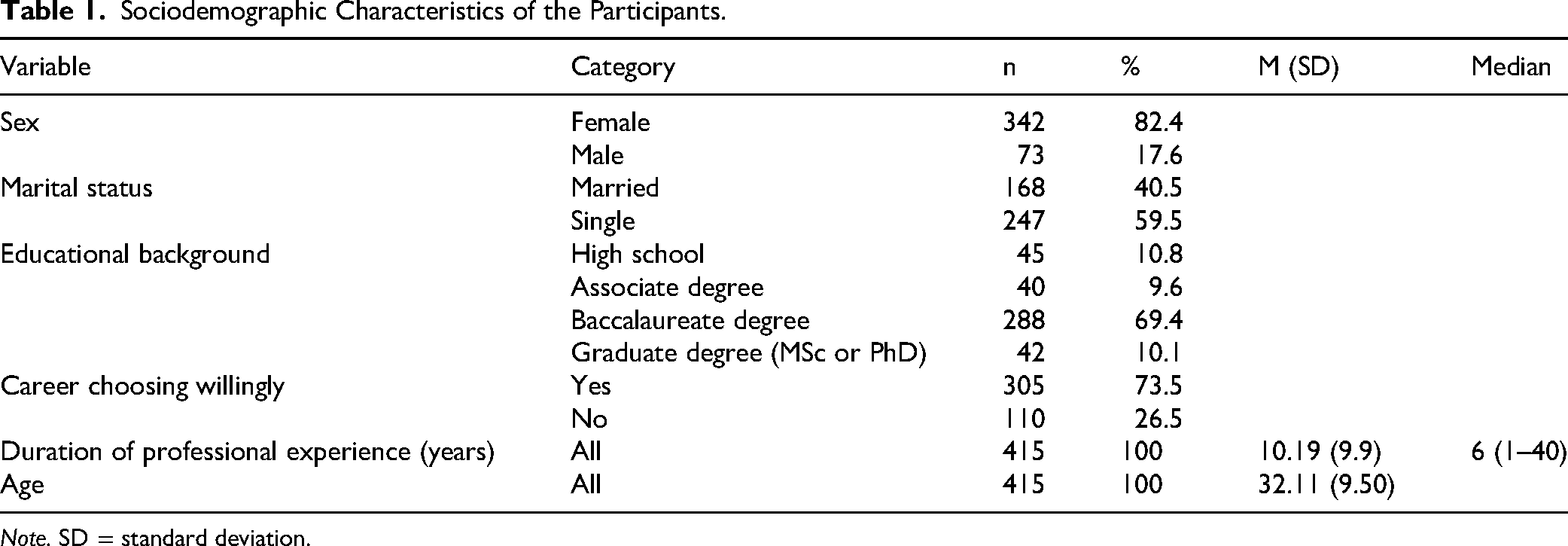
Note. SD = standard deviation.
Descriptive Statistics, Reliability, and Correlations of Study Variables.
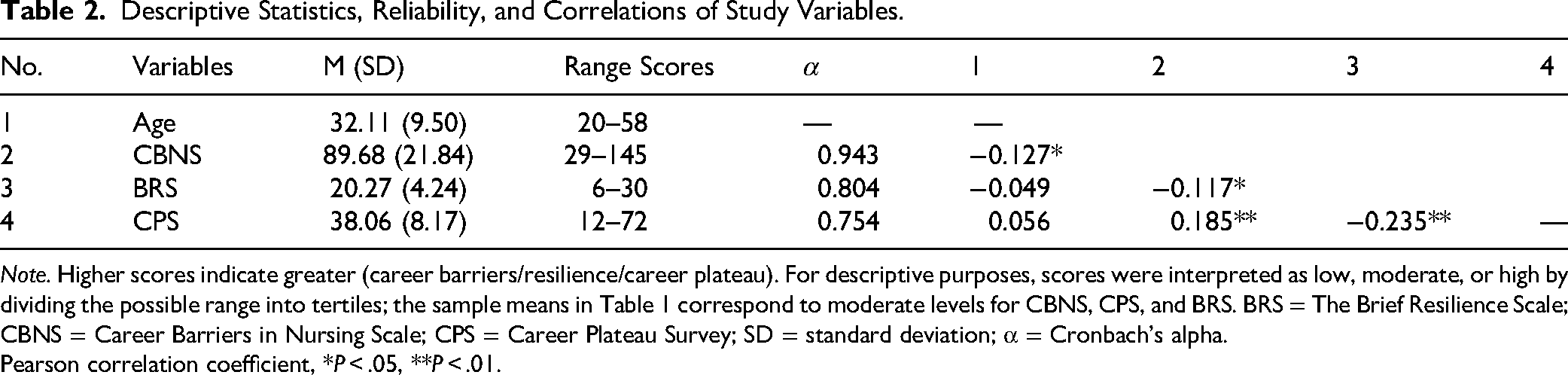
Note. Higher scores indicate greater (career barriers/resilience/career plateau). For descriptive purposes, scores were interpreted as low, moderate, or high by dividing the possible range into tertiles; the sample means in Table 1 correspond to moderate levels for CBNS, CPS, and BRS. BRS = The Brief Resilience Scale; CBNS = Career Barriers in Nursing Scale; CPS = Career Plateau Survey; SD = standard deviation; α = Cronbach's alpha.
Pearson correlation coefficient, *P < .05, **P < .01.
Relationships Between Research Variables
Correlation analyses revealed a small negative correlation between CBNS and age (r = –0.127, P < .05) and between CBNS and BRS (r = –0.117, P < .05), as well as a positive correlation between CBNS and CPS (r = 0.185, P < .01). BRS was negatively correlated with CPS (r = –0.235, P < .01) (Table 2). Although all correlations were statistically significant, their magnitudes were small (|r| < 0.20), indicating weak correlations among the variables.
Results of Research Hypotheses
To test the hypothesized mediation model, hierarchical multiple regression analyses were conducted using a three-step approach (Table 3). Among the control variables, gender and non-voluntary career choice were significantly correlated with perceived career barriers and/or career plateau, while age, marital status, education, and professional experience did not contribute significantly after accounting for the main study variables (Table 3). In Step 1, predictors of CBNS were examined. Both gender and BRS were significant predictors, with female nurses reporting higher perceived career barriers than male nurses (B = 8.08, P = .006). Step 2 examined direct effects on CPS. Psychological resilience and nonvoluntary career choice emerged as significant predictors: higher resilience was associated with lower CPS scores (B = −0.44, P < .001), while nonvoluntary career choice was associated with higher CPS scores (B = 2.07, P = .021). In Step 3, CBNS was added to the model to evaluate its incremental effect on CPS and the change in the resilience–CPS relationship. Career barriers positively predicted career plateau (β= 0.06, P = .014). The effect of psychological resilience on CPS remained significant (β= −0.41, P < .001), while gender was no longer associated with plateau. Nonvoluntary career choice continued to be a significant predictor. Overall, the models explained a small proportion of variance in career plateau (R2 up to 0.098), suggesting that, although predictors were statistically significant, their explanatory power was modest.
Hierarchical Multiple Regression Models Predicting CBNS and CPS.

Note. Multiple linear regression analysis, for gender: 1 = male, 2 = female. For marriage: 1 = married, 2 = single. Career choice: 1 = own will, 2 = Diğer. BRS = The Brief Resilience Scale; CBNS = Career Barriers in Nursing Scale; CPS = Career Plateau Survey.
*P < .05.
The P-values that are statistically significant have been bolded.
Mediation analysis using the PROCESS macro indicated that the unstandardized indirect effect of psychological resilience on career plateau via nursing career barriers was significant (γ= −0.0364, SE = 0.0220, 95% CI [–0.0873, −0.0016]). This finding supports a partial mediating role of career barriers, where higher psychological resilience reduces career plateau in part by lowering perceived career barriers. Accordingly, hypotheses H1, H2, and H3 were fully supported, while H4 was partially supported (Tables 3 and 4; Figure 2). Although the mediation model explained only a small proportion of variance in career plateau (R2 up to 0.098), these results indicate that psychological resilience, career choice, and perceived career barriers are significant, albeit modest, contributors to nurses’ experiences of career plateau.

Mediation model in the study.
Mediation Analysis.

Note. CI = confidence interval (lower, upper); LLCI = lower limit confidence interval; ULCI = upper limit confidence interval; SE = standard error.
The P-values that are statistically significant have been bolded.
Discussion
By examining the relationships among psychological resilience, career barriers, and career plateau among nurses through the lens of Conservation of Resources (COR) theory, this study adds a modest but meaningful contribution to the literature. Specifically, it highlights how both personal psychological resources and structural constraints jointly shape career development in nursing. The findings are consistent with COR theory's core assumptions regarding sensitivity to resource loss and resource gain spirals, showing that psychological resilience not only directly reduces perceptions of career plateau but also indirectly protects against it by mitigating perceived career barriers (Hobfoll, 1989; Hobfoll et al., 2018).
A notable finding of three studies is that nurses who did not enter the profession voluntarily reported higher levels of career plateau. This suggests that the initial motivation to pursue nursing may play a critical role in shaping long-term career trajectories. Prior studies indicate that nursing is sometimes chosen for extrinsic reasons, such as job security, family expectations, or limited university placement options. Such externally driven motivations may prevent the development of a strong professional identity and sustained professional commitment (Bahlman-van Ooijen et al., 2023; Bağrıyanık et al., 2023; Güner et al., 2021; Kristoffersen, 2021). Evidence also suggests that students who select nursing as their first-choice profession demonstrate stronger professional identity, better alignment with career goals, and greater engagement in professional development, while those with lower intrinsic motivation perceive fewer opportunities for growth (Al-Noumani et al., 2024; Liu et al., 2023; Wu et al., 2022; Zeng et al., 2022). While these findings conceptually support the present results, indicating that nonvoluntary career choice may increase vulnerability to career plateau, the cross-sectional nature of this study does not establish causal conclusions.
In terms of gender, female nurses reported higher levels of perceived career barriers than male nurses, yet career plateau scores did not vary between genders. This aligns with previous research suggesting that gender is not necessarily a determinant of career plateau (Liu et al., 2025; Zhu & Li, 2023). However, the literature indicates that female nurses may encounter greater barriers to promotion, leadership access, and professional visibility. Gendered role expectations, institutional biases, and work–life balance challenges can further constrain career advancement (Aca et al., 2025; Baduge et al., 2024). In Türkiye, patriarchal norms and prevailing cultural values have been shown to increase women nurses’ perceptions of career barriers by limiting access to managerial roles and professional visibility (Aca et al., 2025; Türkmen & Eskin Bacaksız, 2021). Interestingly, despite these elevated barriers, women's perceptions of career plateau remained similar to that of men, suggesting that resilience, adaptation, or other unmeasured factors may help buffer the impact of structural constraints. Future research could examine psychological resilience, social support, and organizational support as potential moderators to better understand this gender-related pattern.
The finding that career barriers exacerbate perceptions of career plateau is consistent with both COR theory and prior evidence. Within the COR framework, promotion opportunities, professional development resources, and organizational support are core assets that employees seek to protect. Limitations in access to these resources increase the perceived threat of loss, contributing to stress and burnout (Hobfoll, 1989; Hobfoll et al., 2018). Structural constraints such as inadequate promotion opportunities, limited career development support, and an unfavorable work climate have been associated with higher levels of career plateau in nurses (Begum & Sarker, 2018; Inandi et al., 2022; Zhu et al., 2021). Furthermore, systematic reviews suggest that career plateau not only contributes to burnout and stress but may also exacerbate nursing workforce shortages, in part by increasing turnover risk, underscoring the need for organizational interventions at the policy level (Liu et al., 2025). The present study contributes to the literature by linking perceived career barriers with subjective career plateau and framing barriers as “threats of resource loss” within the COR theoretical lens.
Psychological resilience emerged as a key personal resource in the present study, showing both a direct and negative relationship with career plateau and an indirect protective effect via reduced perceived career barriers. This aligns with prior research demonstrating that resilience, a central component of psychological capital, can mitigate career plateau (Hu et al., 2022). Resilient nurses are better able to adopt effective coping strategies, maintain engagement in continuous learning, and sustain motivation even under challenging circumstances (Wan et al., 2023). Previous evidence also links resilience with positive career outcomes such as greater career satisfaction, optimism, and reduced career anxiety (Aksu & Kuas, 2024; Carstens et al., 2021; Xu et al., 2021). These findings support the view of resilience as a high-level psychological resource that helps nurses feel less “stuck” in their careers. Although the observed effect sizes were small, with modest correlation coefficients and low R2 values, the results remain significant. Even small effects may accumulate over time or at the organizational level, yet they also suggest that additional unmeasured factors influence career plateau experiences (Table 3). Given the cross-sectional design, causal inferences cannot be drawn.
The mediation analysis demonstrated that psychological resilience indirectly alleviates career plateau by reducing perceived career barriers. This supports COR theory, which frames resilience as a resource that not only protects against resource loss but also enables the acquisition and mobilization of additional resources (Hobfoll et al., 2018). Resilient nurses may reinterpret organizational and structural barriers as manageable challenges rather than insurmountable obstacles, engaging in cognitive reappraisal processes that reduce perceived career barriers and, consequently, career plateau (Han et al., 2023; Cooper et al., 2021; Rashnuodi et al., 2022; Yu et al., 2025). In addition, resilience may help nurses sustain motivation for ongoing learning and professional development, further mitigating the impact of organizational constraints (Han et al., 2023; Kıcır & Tütüncüoğlu, 2024; Rashnuodi et al., 2022; Wan et al., 2023; Zhu & Li, 2023). Future studies employing longitudinal or experimental designs are needed to better understand how psychological resilience impacts career barriers and career plateau over time.
Overall, the findings underscore the interactive role of personal resources and organizational factors in shaping nurses’ career development. Evidence indicates that early-career structural support and career development opportunities are key determinants of role transition and retention. Integrating mentoring programs, structured career planning, transparent promotion systems, and resilience-focused training may provide a comprehensive strategy to support sustainable career growth in nursing (Bulut & Özdemir, 2024; Liu et al., 2025; Yeşilyurt et al., 2023). Combining organizational interventions to reduce career barriers with individual- and institution-level programs to strengthen psychological resilience may therefore provide an integrated pathway toward supporting long-term career development and workforce stability.
Strengths and Limitations
This study addresses an important gap in the literature by examining the relationship between career plateau and resilience in the high-stress environment of nursing through the mediating mechanism of career barriers. The study's strengths include its robust methodology, which is based on mediation analysis and uses standard scales to measure psychological resilience, career barriers, and plateau concepts. Advanced statistical methods, such as structural equation modeling, clarify causal relationships. Selecting a sample of nurses increases the specificity of the occupational context of the results, offering practical implications for reducing barriers and contributing to staff retention strategies through resilience training. Additionally, the study adds value to the theoretical literature by adapting career development theories to the healthcare sector, which has a high burnout risk.
Several limitations should be considered when interpreting the findings of this study. First, the cross-sectional design prevents determination of temporal precedence and causal direction among psychological resilience, career barriers, and career plateau. As a result, the observed mediating effects reflect statistical associations rather than confirmed causal pathways, highlighting the need for longitudinal studies in diverse nursing context.
Second, the study was conducted in a single university hospital using convenience sampling, which introduces potential selection bias and limits the generalizability of the results to nurses working in other institutions or regions. Third, the sample was predominantly female, reducing the extent to which the findings can be applied to male nurses and underscoring the need for replication in more gender-balanced populations.
Fourth, all variables were measured via self-report, which may have introduced common method variance and social desirability bias, despite preliminary procedural and statistical controls. Fifth, although the constructs under study are inherently multidimensional, analyses primarily relied on total scale scores, potentially obscuring patterns specific to individual subscales. Future research should explore subscale-level relationships for psychological resilience, career barriers, and career plateau to provide more nuanced insights.
Another limitation is that key contextual variables, such as organizational culture, managerial support, workload, and access to professional development opportunities, were not assessed. Including these factors in future studies could enhance understanding of the organizational mechanisms that shape nurses’ career trajectories. Finally, the relatively low response rate raises the possibility of nonresponse bias, as nurses who did not participate may vary systematically from respondents in terms of workload, attitudes, or professional experiences. Therefore, the findings may not fully represent the target population and could be influenced by these unmeasured differences.
Implications for Practice
The findings of this study suggest that higher psychological resilience is associated with lower perceived career barriers and reduced experiences of career plateau among nurses. Accordingly, healthcare managers should consider implementing interventions that strengthen nurses’ capacity to cope with career barriers and support ongoing career development. Practical strategies may include targeted resilience-building programs, such as short training modules, workshops, or coaching initiatives, which can be integrated into routine in-service training.
The results also indicate that nonvoluntary career choice and higher perceived career barriers are associated with greater experiences of career plateau. Healthcare institutions should therefore review promotion procedures and career pathways to ensure transparent criteria, fair access to advancement opportunities, and alternatives to traditional managerial progression, such as clinical specialization, training assignments, or project-based roles. Providing structured feedback and clear information about internal opportunities may further help reduce perceptions of career stagnation.
Finally, considering the observed relationships among career barriers, career plateau, and psychological resilience, integrating career guidance and professional identity support throughout nursing education may be beneficial. This could include advising prospective students on career choices, aligning career goals with personal values and competencies, and providing mentoring or role modeling during clinical practice.
Conclusion
This study highlights the protective role of psychological resilience in reducing nurses’ perceptions of career plateau. Resilient nurses reported fewer perceived barriers and experienced lower levels of career stagnation, both directly and indirectly through the reduction of career barriers, providing support for the assumptions of COS theory. Career barriers, in turn, emerged as significant contributors to perceptions of plateau, highlighting the impact of organizational structures and support mechanisms on nurses’ career development.
The findings emphasize the importance of nurturing both internal and external resources. Internal resources, such as psychological resilience, and external resources, including supportive leadership, transparent promotion systems, and equitable career pathways, appear critical for sustaining career development. By strengthening these resources, healthcare organizations may help reduce career plateau, enhance job satisfaction, and support the long-term retention and stability of the nursing workforce.
Supplemental Material
sj-docx-1-son-10.1177_23779608261437367 - Supplemental material for The Mediating Role of Career Barriers in the Relationship Between Psychological Resilience and Career Plateau Among Nurses
Supplemental material, sj-docx-1-son-10.1177_23779608261437367 for The Mediating Role of Career Barriers in the Relationship Between Psychological Resilience and Career Plateau Among Nurses by Şehrinaz Polat, Nilgün Göktepe, Tuğba Yeşilyurt Sevim and Leyla Afşar in SAGE Open Nursing
Footnotes
Acknowledgments
We wish to thank the nurses who participated in this study.

Ethical Approval and Consent to Participate
This study was approved by the Social Sciences and Humanities Research Ethics Committee of Istanbul University (Approval No. 244909) on June 16, 2021. In addition, written permission was obtained from the relevant hospital to conduct the study. This research was conducted ethically in accordance with the World Medical Association Declaration of Helsinki. All participants were informed of the study's objectives, procedures, and potential risks and were informed of their right to withdraw at any time. The questionnaire did not request names, phone numbers, or personal details, and all identifying features were removed. All participants provided written informed consent prior to enrollment in the study. The voluntary consent form on the first page of the online survey included the options of either “I agree to participate in the study” or “I do not agree to participate in the study.” Consent was obtained from all participants who agreed to participate in the study, and only nurses who ticked the “I agree to participate in the study” option could proceed to the other pages of the questionnaire form. It was also stated in the Ethics Committee application form that informed consent would be obtained from the participants as mentioned above. The informed consent form included the information that “participants have the right not to participate in the study or to withdraw from the study at any time after participation, that the information obtained from the study will be used solely for research purposes, and that their personal information will be kept confidential, but that anonymized data may be used for publication purposes.”
Author Contributions
All authors have agreed on the final version. Contributions are as follows: Şehrinaz Polat: Responsible for the study's conceptual development, theoretical content, statistical analysis, methodological content, drafting the manuscript, and revising it for critically important content. Nilgün Göktepe: Responsible for the statistical analysis drafting and revising the manuscript. Tuğba Yeşilyurt Sevim: Responsible for the statistical analysis drafting and revising the manuscript. Leyla Afşar: Responsible for the statistical analysis drafting and collecting in the data.
Funding
The authors received no financial support for the research, authorship, and/or publication of this article.
Declaration of Conflicting Interests
The authors declared no potential conflicts of interest with respect to the research, authorship, and/or publication of this article.
Authorship Statement
All authors listed meet the authorship criteria according to the latest guidelines of the International Committee of Medical Journal Editors, and all authors are in agreement with the manuscript.
Data Availability Statement
Data available on request from the authors.
Supplemental Material
Supplemental material for this article is available online.
About the Statistician
The authors have checked to make sure that our submission conforms as applicable to the Journal's statistical guidelines described here. The statistics were checked prior to submission by an expert statistician. The statistician is Atilla Bozdoğan. His email address: atillabozdogan@gmail.com
References
Supplementary Material
Please find the following supplemental material available below.
For Open Access articles published under a Creative Commons License, all supplemental material carries the same license as the article it is associated with.
For non-Open Access articles published, all supplemental material carries a non-exclusive license, and permission requests for re-use of supplemental material or any part of supplemental material shall be sent directly to the copyright owner as specified in the copyright notice associated with the article.
