




Abstract
Introduction
Nursing students, as a vital reserve force for the nursing team, often encounter patient pain in clinical practice, and their empathy for this pain holds significant importance for fostering prosocial behavior and delivering high-quality care; however, the quantitative relationships among empathy for pain, meaning in life, and prosocial behavior remain unclear.
Objectives
To explore the mediating effect of meaning in life between empathy for pain and prosocial behavior among nursing students.
Methods
A multi-center cross-sectional study was conducted from September to October 2024, employing a convenience sampling method. The Empathy for Pain Scale, Meaning in Life Questionnaire and Prosocial Tendencies Measure were used to investigate 432 nursing students in 4 hospitals. Pearson correlation was used to analyze the relationship between variables. Structural equation model was used to construct and evaluate the mediation model. Data analysis was performed using SPSS 26.0 and Amos 24.0.
Results
The empathy for pain score was (3.02 ± 0.68), indicating a high level. The meaning in life score was (43.55 ± 9.42), reflecting a moderately high level. The prosocial behavior score was (93.09 ± 16.41), indicating a moderate level. Empathy for pain, sense of life meaning and prosocial behavior were positively correlated (all p < 0.01). The meaning in life plays a partial mediating effect between empathy for pain and prosocial behavior. The indirect effect value was 0.073 (95%CI, 0.015∼0.136), accounting for 15.90% of the total effect.
Conclusion
The meaning in life plays a partial mediating role between empathy for pain and prosocial behavior of nursing students. Cultivating nursing students’ sense of meaning in life can effectively translate their empathy for patient suffering into tangible prosocial actions, thereby enhancing their clinical practice quality and patient care outcomes. This insight is particularly valuable for understanding how to support the professional development and psychological well-being of nursing interns during their critical transition from education to practice.
Introduction
Prosocial behavior is understood as voluntary behavior directed at benefiting others (Pfattheicher et al., 2022; Suazo et al., 2020). Prosocial behavior can not only enhance individual happiness and social connectedness, but also promote social harmony and stability (Carlo & Randall, 2002). In the field of nursing, good prosocial behavior can not only inspire nurses’ sense of social responsibility and strengthen their social functions, but also promote teamwork, optimize organizational performance, enhance the quality of people-oriented nursing services, and meet people's increasingly diverse and multi-level demands for medical and health services (Feather et al., 2018; Wang et al., 2024). With the development of nursing, the total number of registered nurses in China has reached 5.63 million by the end of 2023, of which about 200,000 to 250,000 nursing students enter clinical practice every year (National Health Commission of the People's Republic of China, 2023). Nursing practice is not only the last stage of undergraduate education, but also an important part of nursing teaching process, but also the first step towards the sacred “angel in white” job. As a strong reserve force of nursing team, nursing students’ high prosocial behavior will contribute to the sustainable development of high-quality nursing services in the future.
Review of Literature
It is reported that the development of prosocial behavior of nursing students is in line with the concept and essence of humanistic care in nursing discipline (Wang et al., 2024). Specifically, the prosocial behavior of nursing students reflects the individual's good social adaptability and high professional quality, and also reflects the maturity of the nursing professional development system and the perfection of the human-centered overall nursing model.
Empathy is defined as the ability to recognize and understand the emotional states of others and to vicariously produce the same or similar emotions (Su et al., 2021). Empathy plays a crucial role in promoting prosocial behavior, according to classical social psychology theory (Gu et al., 2024). When individuals have strong empathy for the situation of others, they are more likely to take actions that benefit others, including (but not limited to) saving others from suffering, allocating more resources to others, correcting injustices against others, and even willing to sacrifice some of their own interests for free. In recent years, studies on the relationship between prosocial behavior and empathy have gradually increased, involving psychology, education, medicine, sociology, behavioral economics and other fields, but there are few studies on the correlation between prosocial behavior and empathy for pain. Empathy for pain is defined as an individual's perception, judgment and emotional response to the pain of others, that is, the state of “empathy” when others suffer pain. It is of great significance to individual survival and prosocial cultivation (Giummarra et al., 2015; Shang et al., 2020). For nursing students, empathy for pain directly influences their clinical performance, quality of patient care, and nurse-patient relationships, making it a critical competency in healthcare settings (Dağ et al., 2022).
The meaning in life is defined as the self-life understood by an individual in the process of exploring self-value and obtaining meaning, as well as the perceived goal value (Steger et al., 2006). Individuals with positive empathy have been reported to have a greater sense of meaning in life (Bu et al., 2024). The meaning in life will affect a person's values, professional identity, creativity, sense of belonging, contribution to society and coping style. Individuals with a higher meaning in life can actively integrate themselves into the group and do meaningful behaviors for the group (Chen et al., 2020). It has been reported that individuals with a stronger meaning in life are clearer about their goals and pursuits in life, and have sufficient ability and confidence to face difficulties and challenges in the face of life pressure, thus improving their social adaptability (Jafary et al., 2011). For nursing students, finding meaning in life enhances professional motivation, reduces burnout, and promotes a patient-centered approach to care (Durant et al., 2025).
At present, the relationship between prosocial behavior, meaning in life and empathy for pain has not been reported, and the quantitative relationship among them is not clear. In scientific research, quantitative relationships help to more accurately describe and understand the relationships between variables. This study intends to build a research hypothesis figure based on the cognitive model for pain empathy (Goubert et al., 2005), explore the quantitative relationship among prosocial behavior, meaning in life and empathy for pain among nursing students, and analyze the mediating role of meaning in life between empathy for pain and prosocial behavior. It provides valuable reference for nursing educators to shape nursing professionals who are compassionate, warm-hearted, and knowledgeable.
According to the cognitive model for pain empathy, nursing students will have the following three stages when they observe the pain of patients: First, cognitive assessment, which includes the perception and understanding of pain, and empathic response. Second, the experience of empathy triggers thinking about the value and purpose of their own lives, making them feel meaningful in helping others. Third, the intern nurses have the intrinsic motivation to take action, that is, the motivation of prosocial behavior. In short, the meaning in life, as a mediating variable, connects the nursing students’ empathy for patients’ pain with their actual prosocial behaviors, and transforms the emotional experience of empathy into the behavioral motivation to help others. Therefore, the following research hypothesis is proposed in this study, and the research hypothesis diagram is shown in Figure 1.

Research Hypothesis.
Materials and Methods
Study Design and Sample
The research adhered to the STROBE guidelines and was a multi-center cross-sectional observational study (Zhang et al., 2025). From September to October 2024, a cluster sampling method was employed to enlist nursing students from four tertiary hospitals in China, for a questionnaire survey. Criteria for inclusion: individuals aged 18 or older, with a minimum internship period of 2 months, who have given informed consent and are willing to take part in the research. Criteria for exclusion: ending the internship prematurely; underwent empathy training within three months prior to this study. For structural equation model analysis, the model's sample size needs to be 10 to 15 times greater than the observed variables (Hayes, 2017). The sample size was estimated based on 10 to 20 times the number of independent variables (2 dimensions for empathy for pain, 2 dimensions for meaning in life, 6 dimensions for prosocial behavior, and 9 sociodemographic variables) (Thomas, 2023). With 19 independent variables in this study and accounting for a 20% non-response rate, the required sample size ranged from 228 to 456. The actual sample size enrolled in this study was 432. Figure 2 shows the flow chart of participant recruitment.
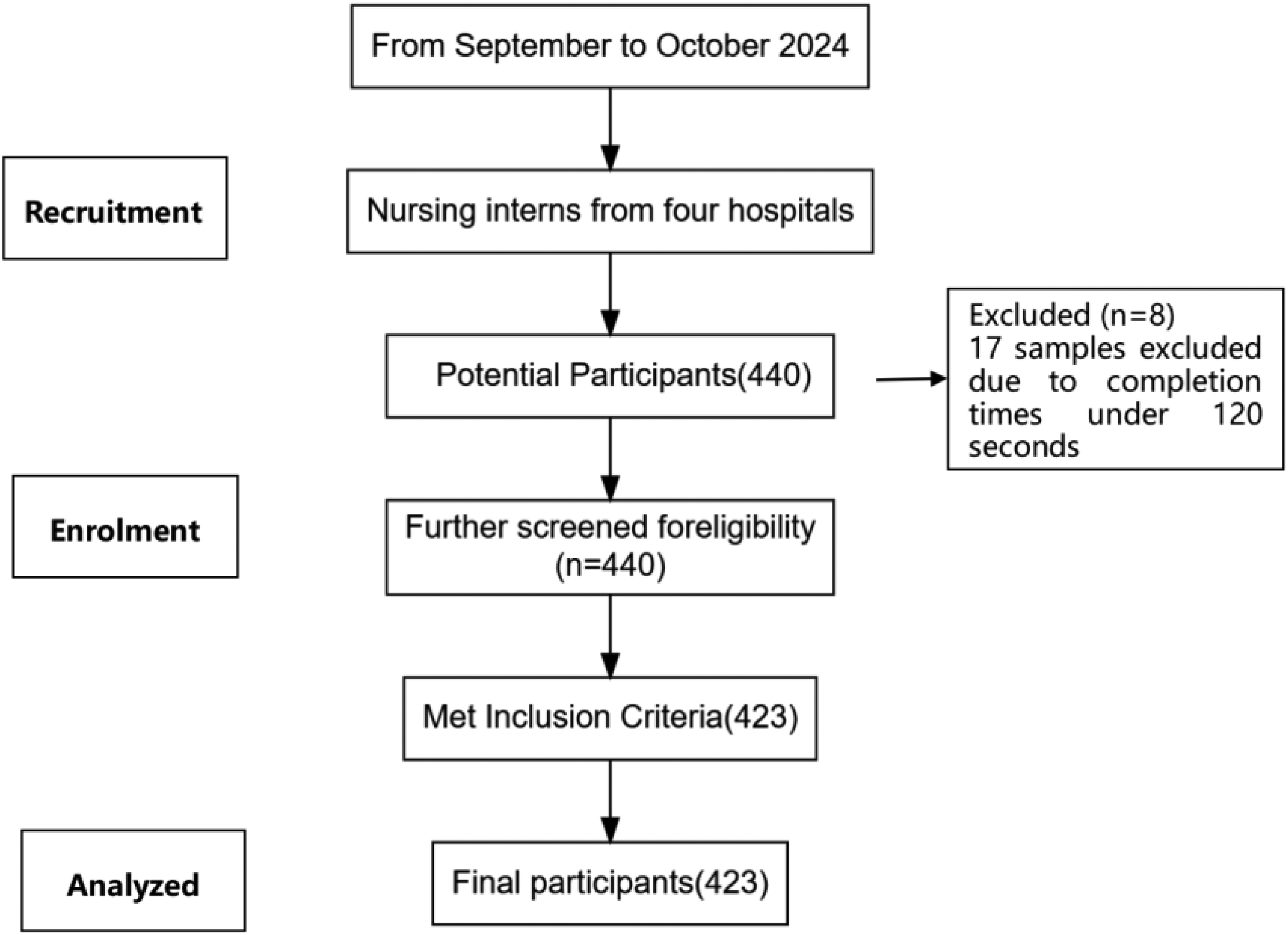
Flow Chart.
Instrument
Sample Characteristics
It was designed by the researcher after reviewing the literature (Hirani et al., 2022), including the gender, age, education, only child, origin of the student, received humanistic care related education, operating room internship experience and interpersonal relationship in internship work.
Chinese Version of the Empathy for Pain Scale
The revised Empathy for Pain scale (Giummarra et al., 2015), developed by Shang et al. (2020), was employed to examine individual empathy for pain and the vicarious experience of observing others in pain. This scale comprises two dimensions: the body and mind discomfort reactions and empathy reactions. It includes four scenarios, each containing 12 identical items, resulting in a total of 48 items. A five-point Likert scale, ranging from 1 (“strongly disagree”) to 5 (“strongly agree”), was utilized for responses. The overall score of the scale was calculated as the average score of all items, while the score for each dimension was determined by averaging the scores of the items within that dimension. There were no reverse-coded items. A score exceeding 3 was indicative of a high level of individual empathy for pain. The Cronbach's alpha coefficient for the scale during its development phase was 0.914, with the alpha coefficients for the body and mind discomfort reactions and the empathy reactions dimension being 0.935 and 0.775, respectively. In this study, the Cronbach's alpha coefficient for the scale was 0.957, with the body and mind discomfort reactions and the empathy reactions dimension yielding Cronbach's alpha coefficients of 0.949 and 0.925, respectively.
Chinese Version of the Meaning in Life Questionnaire
The Meaning in Life Questionnaire (Steger et al., 2006), as revised by Liu and Gan (2010), was employed to assess the degree of individual meaning in life. This instrument is bifurcated into two dimensions: the presence of meaning and the search for meaning, comprising a total of nine items. Responses are recorded on a seven-point Likert scale, ranging from 1 (“strongly disagree”) to 7 (“strongly agree”), yielding a cumulative score between 9 and 63. Higher scores are indicative of an elevated level of meaning in life. The Cronbach's alpha coefficient for the scale during its development phase was 0.710, with the alpha coefficients for the presence of meaning and the search for meaning dimension being 0.810 and 0.720, respectively. In this study, the Cronbach's alpha coefficient for the scale was 0.912, with the presence of meaning and the search for meaning dimension yielding Cronbach's alpha coefficients of 0.883 and 0.867, respectively.
Chinese Version of the Prosocial Tendencies Measure
This scale was originally developed by Carlo and Randall (2002) and subsequently revised by Kou et al. (2007). It is primarily utilized to assess individual prosocial behaviors. The scale comprises 26 items across six dimensions: public, anonymous, dire, emotional, compliant and altruism. A five-point Likert scale is employed, ranging from 1 “very unlike me” to 5 “very like me”, with a total score ranging from 26 to 130 points. The Cronbach's alpha coefficients for the six dimensions of the scale during its developmental phase were 0.710 (public), 0.780 (anonymous), 0.760 (altruism), 0.740 (compliant), 0.730 (emotional), and 0.560 (dire), respectively. In this study, the Cronbach's alpha coefficient for the scale was 0.921, with the Cronbach's alpha coefficients for the six dimensions of the scale during its developmental phase were 0.892 (public), 0.819 (anonymous), 0.872 (altruism), 0.907 (compliant), 0.856 (emotional), and 0.751 (dire), respectively.
Data Collection
The data were collected using an electronic questionnaire (https://www.wjx.cn/). Each participating hospital assigned a staff member to manage the distribution of survey invitations within their facility. The staff member was not the intern's direct supervisor, and participants were explicitly informed that participation was voluntary and unrelated to evaluation. The recommended approach for distributing the survey was for this designated individual to directly send the electronic questionnaire to potential respondents. On the initial page of the electronic questionnaire, participants were informed about the study's objectives, the process for obtaining informed consent, and detailed instructions on how to complete the survey. To maintain data integrity, each mobile device was allowed to submit only one response. The electronic questionnaire system records and saves completed entries in real time, and does not allow submission until all required fields are filled out. A total of 440 completed questionnaires were collected, with 17 being excluded due to completion times under 120 s. The remaining 423 questionnaires did not contain any missing data.
Data Analysis
IBM SPSS version 26.0 was used for data analysis. The sample characteristics were described by frequency and percentage. The empathy for pain, meaning in life and prosocial behavior scores were described by mean and standard deviation. Data normality was confirmed via Shapiro-Wilk tests. Pearson correlation analysis was used to analyze the relationship between among empathy for pain, meaning in life, and prosocial behavior. The Harman single-factor test in exploratory factor analysis was employed to test common method bias. AMOS version 24.0 was used for confirmatory factor analysis and structural equation model construction. The fit degree of the model was evaluated according to fitting index (χ²/df, RMSEA, GFI, AGFI, NFI, CFI, IFI), and the model was modified by modifying index. Bootstrapping analysis was used to test the significance of the mediating effect by the sample, which was taken as a population and repeated 5000 times. The confidence interval was set at 95%. All statistical tests were conducted by two-tailed, and p values of <0.05 indicated statistical significance.
Ethics Considerations
This study was approved by the hospital ethics committee and followed the principles of Declaration of Helsinki. All participants have signed informed consent forms. Official permissions were secured from all participating hospitals. Permission to use the scales was obtained from the adaptors.
Results
Sample Characteristics
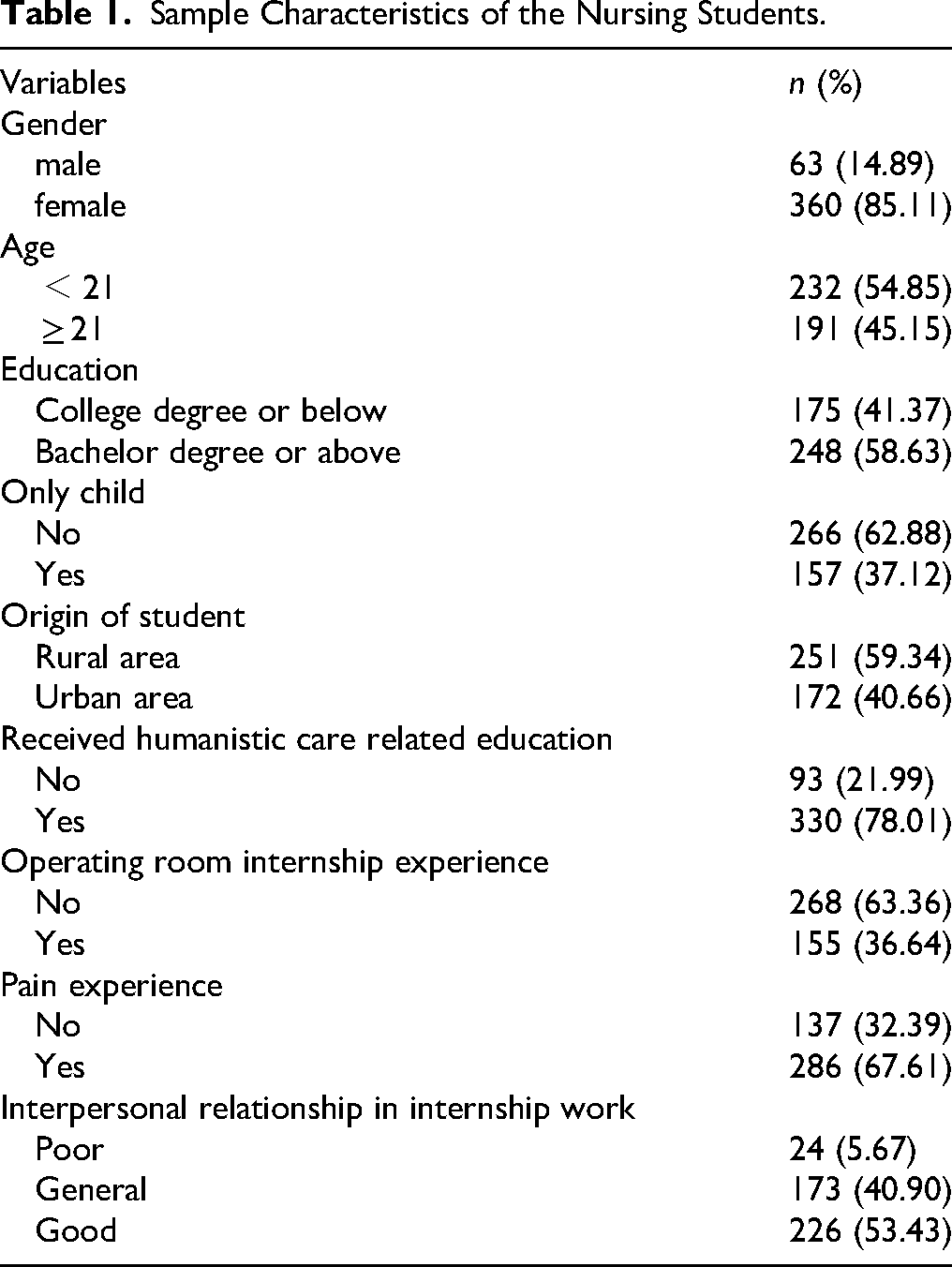
The study sample included 423 individuals aged between 18 and 36 years, with an average age of 21.49 ± 1.41 years. Of these participants, 85.11% were women, 58.63% held at least a bachelor's degree, 37.12% were only children, and 59.34% came from rural backgrounds. Other sample characteristics are shown in Table 1.
Sample Characteristics of the Nursing Students.
Empathy for Pain, Meaning in Life and Prosocial Behavior Scores
The prosocial behavior score of the nursing students was (93.09 ± 16.41), and the average score (3.58 ± 0.63), which was at the medium level (Wang et al., 2024). Among them, the dimension with the highest score was dire and the dimension with the lowest score was public. The empathy for pain score of nursing students was (3.02 ± 0.68), which was higher than that of Chinese medical students (2.52 ± 0.65) (Bi et al., 2021). The score of the body and the mind discomfort reactions was (2.71 ± 0.81), and the score of the empathy reactions was (3.32 ± 0.73). The score of meaning in life was (43.55 ± 9.42), the score of the presence of meaning was (23.89 ± 5.43), and the score of the search for meaning was (19.66 ± 4.99). Table 2 shows the scores for each variable.
Scores for Each variable.

Correlation Between Empathy for Pain, Meaning in Life and Prosocial Behavior
The results of this study showed that empathy for pain was significantly positively correlated with meaning in life scores (r = 0.428, p < 0.01). The results of this study showed that empathy for pain was significantly positively correlated with prosocial behavior scores (r = 0.455, p < 0.01). There was a significant positive correlation between meaning in life and prosocial behavior scores (r = 0.374, p < 0.01). The correlation of variables in each dimension is shown in Table 3.
Correlation Analysis among Variables.

Note. *p < 0.05, **p < 0.01.
Test of Common Method Variance Biases
It is important to conduct a test for common method variance bias when using self-reported data. Six variables had characteristic roots that were more than 1. The first factor could only explain 32.19% of the key standards, which is below 40% (Deng et al., 2018), suggesting that this study did not have significant common method biases.
Mediating Effect Analysis
With empathy for pain serving as the independent variable, meaning in life acting as the mediating variable, and prosocial behavior designated as the dependent variable, a mediation model was constructed, as shown in Figure 3. The results showed that the initial model did not fit well. The maximum likelihood method was used to fit the path coefficient of the model, and modify the model by modified index. Finally, the modified model with good fitting was obtained, as shown in Table 4.

The Mediating Effect of Meaning in Life Between Empathy for Pain and Prosocial Behavior among Nursing Students (Standard Coefficients).
The Fitting Situation of Modified Model.

Note. χ²/df = ratio of chi-square to degrees of freedom, RMSEA = root mean square error of approximation, GFI = goodness-of-fit index, AGFI = adjusted goodness-of-fit index, NFI = normed fit index, CFI = comparative fit index, IFI = Incremental fit index, CI = confidence interval.
Bootstrapping analysis was used to test the significance of the mediating effect by the sample, which was taken as a population and repeated 5000 times. The confidence interval was set at 95%, excluding 0 was marked as significant (Hayes, 2017), and the final results were shown in Table 5. According to the path analysis in the model, empathy for pain had a significant positive predictive effect on prosocial behavior (β = 0.386, p < 0.01), and meaning in life (β = 0.48, p < 0.01), hypothesis 1 is supported. The meaning in life had a significant positive predictive effect on prosocial behavior (β = 0.15, p < 0.01). The mediating effect test showed that the direct effect of empathy for pain on prosocial behavior was 0.386 (95%CI, 0.267∼0.496), accounting for 84.10% of the total effect. The meaning in life had a partial mediating effect between empathy for pain and prosocial behavior, and the indirect effect value was 0.073 (95%CI, 0.015–0.136), accounting for 15.90% of the total effect, hypothesis 2 is supported. Structural path analysis results are shown in Table 5.
Structural Path Analysis Results.
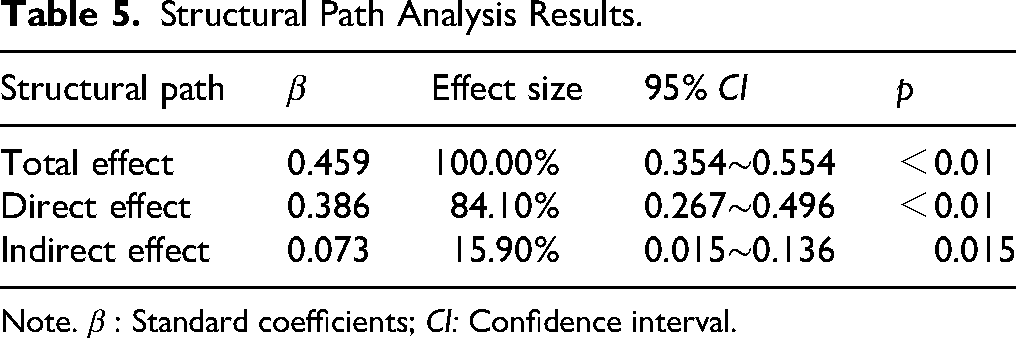
Note. β : Standard coefficients; CI: Confidence interval.
Discussion
This study, for the first time, employs the cognitive model for pain empathy to investigate the mediating role of the meaning in life between empathy for pain and prosocial behavior among nursing students. This research not only broadens the scope of populations studied in relation to prosocial behavior but also deepens our understanding of the interrelationships among empathy for pain, meaning in life, and prosocial behavior. It provides a new intervention path for nursing educators to shape nursing professionals who are compassionate, warm-hearted, and knowledgeable.
The Level of Prosocial Behavior
The results of this study show that the prosocial behavior of nursing students is at a moderate level, which is consistent with the previous verification results in different populations (Chen et al., 2020; Su et al., 2021; Wang et al., 2024). The highest scores of prosocial behaviors are dire and altruism, which indicates that the prosocial behaviors of nursing students are more susceptible to emergent emotions. In this study, 78.01% of nursing students received humanistic care related courses, which is helpful to cultivate students’ consciousness of helping others and the spirit of saving lives and healing the wounded. In addition, when they meet the emergency needs of others, they can take the initiative to help, which is in line with the essence of medical profession, which reflects the sense of responsibility and professional quality of medical students (Moyo et al., 2016). The dimension with the lowest score of prosocial behavior is public, which indicates that nursing students are not willing to actively disclose their helpful behavior. Public is defined as prosocial tendencies carried out in the presence of other people. The nursing students in this study may have internalized a sense of personal mission and responsibility, believing that helping others is a duty rather than an effort to expand influence or gain the approval of others. In addition, 85.11% of nursing students in this study were female, and the study reported that women mostly adopted social avoidance behaviors (Grynberg & López-Pérez, 2018), which resulted in less prosocial behaviors of nursing students in the presence of others.
The Level of Empathy for Pain
The findings of this study revealed that nursing students exhibited a significantly higher empathy for pain score compared to clinical nurses (Dong et al., 2024; Huang et al., 2025; Wu et al., 2023a), indicating a relatively elevated level of empathy for pain. Moreover, the score of empathy reactions dimension is higher than that of body and mind discomfort reactions dimension, which is consistent with the results of a previous study (Wu et al., 2023a). This indicates that the nursing can better empathize with the pain of the patients, the overall empathy reaction is stronger, and the body and mind reaction is moderate. The reason may be related to the study population and the work scenario. After entering the hospital practice, nursing students can recognize signs of pain that are inaccessible in daily life, and the clinical work scenario can also visually present the pain clues and states of patients, which may increase the empathy reaction and thus improve the level of empathy for pain (Hadjistavropoulos & Craig, 2002). In addition, compared to clinical nurses who have prolonged and more frequent interactions with patients, they are more susceptible to body and mind exhaustion when exposed to empathic stress over extended periods. This can easily lead to empathy fatigue, resulting in a diminished capacity for empathy (Marshman et al., 2022).
The Level of Meaning in Life
The results of this study show that the score of meaning in life of nursing students is lower than that of ICU nurses (Fang et al., 2023), which is at a medium to high level. The possible reason is that ICU nurses often come into contact with dying patients, and this work experience will promote their thinking about the continuation and meaning in life, which improves their understanding of the meaning in life and thus obtain a higher meaning in life (Sinclair, 2011). The meaning in life is an important concept of positive psychology, which has a great impact on physical and mental health, and is also a basic quality necessary for future nursing talents (Zhao et al., 2023). In the process of internship, nursing students may face the pressure of nurse-patient conflict, poor role transformation, heavy workload, night shift, etc., which will reduce the sense of accomplishment to a certain extent and affect the cognition of self-value and goal value (Qiu et al., 2023). Therefore, only by correctly understanding the value of human beings and the meaning in life can nursing students better understand the existence and meaning of patients’ lives in their future jobs, and then provide high-quality medical nursing services to promote the development of humanistic nursing.
The Relationship Between Empathy for Pain and Prosocial Behavior
The results of this study show that the empathy for pain of nursing students is positively correlated with prosocial behavior, that is, the better the empathy for pain ability of nursing students, the more active they are in adopting prosocial behavior, which is consistent with the results of previous studies on the relationship between empathy and prosocial behavior (Gamble et al., 2023; Su et al., 2021). The empathic altruism hypothesis states that individuals with stronger empathy traits are more willing to perform altruistic acts to help others out of difficult situations (McCamant, 2006). It has been reported that some forms of prosocial behavior (i.e., consolation, helping, and selfless acts) can be the outcome of empathy (prosocial behaviors motivated by empathy), while other forms of prosocial behavior (i.e., sharing) are not necessarily related with or elicited by empathy (Decety et al., 2016; Kim et al., 2021). Therefore, the empirical relationship between empathy and prosocial behavior will help us to understand the relationship between empathy for pain and prosocial behavior of nursing students. Educators can train nursing students to evaluate pain, master empathy skills, improve empathy ability, and promote prosocial behavior. Across different cultural contexts, individuals’ expressions of empathy and manifestations of prosocial behavior are profoundly shaped by their cultural norms. For instance, collectivist cultures may emphasize mutual aid and cooperation within groups, while individualist cultures may place greater emphasis on altruistic actions driven by personal autonomy (Durant et al., 2025).
The Relationship Between Meaning in Life and Prosocial Behavior
The results of this study show that the meaning in life of nursing students is positively correlated with prosocial behavior, which is consistent with the results of previous studies (Demir-Kassem et al., 2025; Wu et al., 2023b; Wang et al., 2024). The meaning in life plays a dynamic role, and people who attach importance to the meaning of life are more willing to help others and contribute to society, according to the meaning seeking model theory (Pang et al., 2019). On the contrary, individuals with low sense of life meaning lack internal life goals and motivation to pursue the meaning of life, which is easy to cause individuals to treat life negatively, produce depression, anxiety and other psychological problems, and even induce suicide ideation and anti-social behavior (Kang et al., 2017; Snippe et al., 2018). It has been reported that meaning in life plays a mediating role between family ritual and prosocial behavior (Wu et al., 2023b), but another study pointed out that prosocial behavior has a significant direct impact on meaning in life (Demir-Kassem et al., 2025), so the relationship between the two may be two-way. In teaching reform or practice, educators should implement some effective measures to improve nursing students’ sense of life meaning, further interpret the connotation of nursing and help them join the nursing career. For instance, Simulated directed-learning and group discussions on finding purpose in clinical experiences can enhance meaning in life (Tsai et al., 2019).
The Relationship Between Empathy for Pain and Meaning in Life
The results of this study showed that the empathy for pain of nursing students was positively correlated with their meaning in life. Although there are few empirical studies on the relationship between empathy for pain and meaning in life, indirect evidence can be found from studies in related fields to elucidate this relationship. It is reported that good clinical empathy ability can promote the perception of the meaning and value of life (Bu et al., 2024). As a positive inner state, high meaning in life may also promote the improvement of empathy for pain by improving individual empathy and positive behavior (Gu et al., 2024). Empathy for pain, as a category of empathy, is also closely related to meaning in life, but this relationship needs to be further verified in other populations.
The Meaning in Life Plays a Partial Mediating Role Between Empathy for Pain and Prosocial Behavior
The results of this study show that empathy for pain can not only directly affect prosocial behavior, but also indirectly affect it through affecting meaning of life, and the mediating effect accounts for 15.90% of the total effect. This indicates that the meaning of life is an important way to enhance prosocial behavior of nursing students through empathy for pain. The stimulus-organism-response (S-O-R) model points out that external environmental stimuli can affect an individual's behavior decision through organism emotion and cognition (Duong et al., 2024). The S-O-R model is political literacy used to explain the mediation effect. S (Stimulus) stands for external stimulus: In the clinical practice of nursing students, external stimuli may include the pain of patients, emergency situations in medical scenes, humanistic care teaching in nursing education, etc. These external factors can promote the empathy reactions of nursing students (Wang et al., 2022) . O (Organism) stands for internal states, including their cognitive, emotional, and physiological responses. As an internal factor, nursing students’ sense of meaning in life affects their understanding of empathy for pain and their prosocial behavior. Nursing students with a strong sense of meaning of life may be better able to understand and feel the pain of patients, so they are more likely to exhibit prosocial behavior (Jafary et al., 2011) . For instance, a sense of meaning in life can be enhanced through reflective group activities or case discussions in educational practice (Thistlethwaite et al., 2012). R (Response) stands for behavior response, includes their actions and decisions. Prosocial behaviors are part of the response, such as offering help, sympathy, and support. In conclusion, the meaning in life, as a mediating variable, connects the nursing students’ empathy for patients’ pain with their actual prosocial behaviors, and transforms the emotional experience of empathy into the behavioral motivation to help others. This understanding of relationships is essential for the design of effective nursing education and training programs, and can provide lessons for developing a nursing professional reserve with high empathy for pain and prosocial behavior.
Implications for Clinical Practice
In the stage of nursing teaching and clinical practice in colleges and universities, attention should be paid to the cultivation of nursing students’ empathy for pain ability and sense of meaning in life. Specific measures can be taken as follows: First, educators can build a set of systematic and practical empathy for pain training programs, and adopt various measures to promote the cognition of “people-oriented” nursing concept of nursing students and improve their pain empathy ability, which may include pain simulation experience, empathy training, psychophysiological techniques (He et al., 2024) and other measures. Second, in the theoretical teaching stage of the nursing students, the discussion of the meaning in life and humanistic care education are added to guide them to establish correct life values and improve professional self-concept from a positive and optimistic perspective, so as to promote the improvement of the sense of meaning in life (Shi et al., 2021). Through the above measures, it will be able to provide a new intervention path for the prosocial training of nursing students, and inject new vitality into the high-quality sustainable development of nursing service quality in the future.
Strengths and Limitations
First, the results of this study show that meaning in life can affect prosocial behavior, but one study has revealed that this effect can also be reversed, so the relationship between the two may be two-way. Future studies should further verify whether this relationship exists, which will contribute to our understanding of the relationship between the three. Second, this study is limited to nursing students in Wuhan City, China. Third, data collection employed self-report questionnaires, a method advantageous for efficiency and convenience but potentially subject to inherent limitations. Fourth, the findings are grounded in China's medical education and cultural context; further research is required to generalize them to other cultural settings.
Conclusion
The meaning in life plays a partial mediating role between empathy for pain and prosocial behavior of nursing students. Cultivating nursing students’ sense of meaning in life can effectively translate their empathy for patient suffering into tangible prosocial actions, thereby enhancing their clinical practice quality and patient care outcomes. This insight is particularly valuable for understanding how to support the professional development and psychological well-being of nursing interns during their critical transition from education to practice.
Footnotes
Acknowledgements
We would like to thank all nursing interns who participated in this study.

Ethics Approval and Consent to Participate
This study was approved by the Central Hospital of Wuhan ethics committee (number WHZXKYL2024-185) and followed the principles of Declaration of Helsinki. All participants have signed informed consent forms.
Author Contributions
XFH, XLQ and LG conceived study, participated in design and coordination, read and approved the final manuscript. LQ, LL and CX read and approved the final manuscript. WYJM, CGS and WXF participated in data collection and data analysis.
Funding
This work was supported by The Central Hospital of Wuhan grant number 22YJ69.
Declaration of conflicting interests
The authors declared no potential conflicts of interest with respect to the research, authorship, and/or publication of this article.
Availability of Data and Material
The datasets used and/or analysed during the current study available from the corresponding author on reasonable request.