




Abstract
Introduction
Nursing students often experience academic burnout due to the intense demands of their education, affecting their performance and well-being. Personal traits like grit and learning agility have the potential to alleviate burnout.
Objective
This study aimed to evaluate the impact of grit and learning agility on academic burnout among nursing students.
Methods
This study employed a descriptive, cross-sectional design, engaging a random sample of 467 nursing students. The study utilized self-reported online surveys to collect data from nursing students. These surveys included a demographic questionnaire, a short grit scale, a learning agility questionnaire, and a Maslach Burnout Inventory student survey. Descriptive statistics, Pearson correlation coefficient test, and simple linear regression were employed to analyze data in SPSS software (version 23.0).
Results
The majority of the participants demonstrated elevated levels of grit (56.1%), moderate levels of learning agility (55.0%), and moderate levels of academic burnout (53.3%). The study revealed a statistically significant positive association between grit and learning agility (r = 0.274, p < .001), as well as a negative link between grit and academic burnout (r = −0.327, p < .001).
Conclusion
These findings highlight the importance of fostering grit and learning agility in nursing education as a means to mitigate academic burnout. Integrating resilience-building interventions such as mentorship programs and stress management into nursing curricula may enhance students’ ability to deal with challenges and persist in their studies and improve both academic success and long-term professional well-being in the nursing workforce.
Introduction
Nursing students’ mental and emotional well-being is paramount in the often fast-paced and demanding nursing field (Tharani et al., 2017). Academic burnout defined as a psychological syndrome characterized by emotional exhaustion, depersonalization, and a diminished sense of personal accomplishment has emerged as a significant barrier to optimal student performance and future professional engagement (Dall’Ora et al., 2020). Emotional exhaustion is defined as the experience of profound fatigue resulting from the demands of academic responsibilities. Depersonalization, on the other hand, refers to an attitude of detachment or disengagement from academic work. Lastly, personal accomplishment is negatively impacted when students perceive a decrease in their effectiveness in academic pursuits (Schaufeli et al., 2002).
Empirical studies highlight a concerning prevalence of burnout among nursing students stands at approximately 46.0%. Within this prevalence 26.1% experience mild burnout, while 47.7% and 22.7% experience moderate and severe burnout respectively (Arian et al., 2023). Also, the prevalence of job burnout was 44% among males and 66% among females, indicating a higher prevalence among women (Sohrabi et al., 2022). These findings underscore the urgency of identifying protective psychological trait that can buffer against academic stressors.
Nursing students encounter elevated levels of stress as a result of a substantial workload encompassing both academic and clinical responsibilities. Additionally, they contend with a curriculum that offers limited flexibility, a competitive environment among peers, and, in many countries, the need to prepare for a national nurse licensing examination or similar professional certification requirements. These factors collectively contribute to the potential development of burnout among nursing students (Hwang & Kim, 2022; Lee & Lim, 2017). The Conservation of Resources (COR) theory offers a useful lens for conceptualizing burnout, positing that individuals strive to obtain, retain, and protect resources, such as time, energy, and self-efficacy and burnout results when these resources are threatened or depleted. Accordingly, personal traits such as grit and learning agility may serve as vital resources that safeguard students against the erosion of psychological well-being (Hobfoll, 1989).
Review of Literature
Grit and Academic Burnout
Grit is defined as “the perseverance and passion for long-term academic goals” (Duckworth et al., 2007). It reflects the ability to overcome obstacles, persist in the face of difficulties, and maintain a positive attitude towards learning (Duckworth & Quinn, 2009). Academic grit can help nursing students stay focused on their academic goals, cope with academic challenges, reduce burnout, and achieve higher levels of academic success (Hernández et al., 2020; Jung, 2021; Kang & Choi, 2022).
Grit may serve as a resource by enabling individuals to persevere through challenging periods of their education, protecting against burnout and enhancing their mental wellbeing. The emphasis surrounding the impact of academic grit and learning agility on academic burnout among health care students and professionals has been substantial in recent studies. For instance, the study of Kang and Choi (2022) found that grit was negatively correlated with academic burnout, clinical practice, and job seeking stress in nursing students. Also, Al-Zain and Abdulsalam (2022) highlighted the role of grit in reducing academic burnout among dental students. Jumat et al. (2020) identified grit as a protective factor against burnout in medical school students, while Janatolmakan et al. (2021) highlighted the negative correlation between resilience and academic burnout in nursing and midwifery students. Lee et al. (2022) highlighted links between grit and various burnout dimensions among medical students.
Although there is a lot of excitement about the concept of grit as a possibly new factor that can predict and influence academic performance, there are now some doubts and criticisms emerging about the validity and theoretical foundation of the grit construct (Credé et al., 2017). Dixson's recent research on grit in the literature reveals that, in the context of urban high school students, grit is not a dependable predictor of academic success when assessed alongside academic self-concept and educational dedication (Dixson, 2019).
The existence of a higher order structure of grit has not been definitively established, and there is only a moderate correlation between grit and the performance and retention of students (Credé et al., 2017). A systematic review conducted by Lam and colleagues found that grit had a more significant influence on the academic accomplishment of K-12 children compared to university students. The study also revealed that the positive effect of grit on academic achievement varied modestly among students at different grade levels. The observed phenomenon appeared to have a greater magnitude among K-12 pupils compared to university students (Lam & Zhou, 2019).
Additional skepticism arises from longitudinal studies. Gruenberg et al. (2019) found no meaningful connection between Grit-S scores and indicators of academic or professional accomplishment among pharmacy students. Although they observed slight variations in individual Grit-S scores over time, these changes were not linked to students’ GPA or other measures of success. This suggests that grit might be less stable and predictive than previously assumed.
Young-Brice et al. (2023) further challenged the predictive power of grit in their study of associate degree nursing students. They found that Short Grit Scale scores failed to emerge as a significant predictor of academic success or failure, contradicting earlier claims about grit's role in academic perseverance. While grit remains a valuable concept, these criticisms underscore the importance of considering it within a broader framework of personal and environmental factors that contribute to student achievement and well-being.
Learning Agility and Academic Burnout
Learning agility can facilitate nursing students’ learning and development. According to Lombardo and Eichinger (2000), the concept of learning agility encompasses both the inclination and capability to acquire knowledge from past experiences and effectively utilize this knowledge to achieve favorable outcomes in novel or unfamiliar circumstances. In the context of nursing education, the idea of learning agility encompasses a student's inclination to acquire knowledge from errors committed, while maintaining a receptive attitude towards other methodologies or viewpoints. Learning agility can positively influence burnout among students by enabling them to effectively cope with the demands and uncertainties of their chosen profession (Jeon et al., 2022; Lin et al., 2019). Within recent years, the concepts of grit and learning agility have been examined in relation to modifying the effects of burnout (Kang & Choi, 2022; Lee et al., 2022).
Significance of the Study
The prevalence of academic burnout within the nursing student is a noteworthy concern that has the potential to detrimentally impact their scholastic achievements, future role transition into professional practice, and patient care outcomes (Sveinsdóttir et al., 2021; Velando-Soriano et al., 2023; Wang et al., 2019). Therefore, it is important that academic staff identify and foster the attributes that can help nursing students cope with the demands of academia to prevent burnout and preserve their mental wellbeing.
While the association between psychological characteristics such as grit and learning agility, and their influence on academic exhaustion has received increased attention in recent years, there remains a notable research gap that necessitates further investigation. Specifically, the existing literature often focuses on either grit or learning agility individually in relation to burnout. There have been limited researches that has thoroughly investigated the collective influence of these two characteristics on the levels of burnout experienced by nursing students. Hence, the objective of this research was to offer significant understanding regarding the determinants that can mitigate academic burnout among nursing students. Consequently, this knowledge could enhance their psychological welfare, as well as their academic accomplishments and professional competence. This study aimed to evaluate the effects of grit and learning agility on academic burnout experienced by nursing students.
Methods
Design: A descriptive, cross-sectional design was used in the present study. This approach was chosen to efficiently capture the relationships between grit, learning agility, and academic burnout at a specific point in time. While burnout is a dynamic phenomenon that can fluctuate over time, a cross-sectional design was deemed appropriate for this study as it allows for the identification of key associations between these variables, providing a foundation for future longitudinal research. The study has employed STROBE guidelines to enhance the transparency of the research.
Setting of the Study
This study was carried out within the academic setting of nursing faculty at Mansoura University, Egypt. It comprises eight distinct departments. Each department provides different areas of nursing education, for example, mental health nursing, nursing administration, critical care nursing, community health nursing, obstetrics, medical-surgical nursing, and gynecology nursing. The faculty also offers a diverse range of academic programs for both undergraduate and postgraduate students. The study setting was selected for its varied academic environment, facilitating a representative sample of nursing students from multiple specialties and academic levels.
Participants and Sampling Determination
Participants were selected using a simple random sampling method from a pool of nursing students enrolled during the study period. Eligible participants were identified through the faculty's student registry and invited to participate via email and WhatsApp. The inclusion criteria comprised nursing students from all academic years (first year to final year), who were enrolled during the study period. Students on academic leave and those currently engaged in internships were excluded from the study.
For determining the minimum required size of the sample, the study utilized the following formula: Sample size = (Z1−α/2)2 × σ2/d2. The formula takes into account Z1−α/2; if the Z-score associated with a 95.0% confidence interval was 1.96, σ indicates the expected value of standard deviation in the population (σ = 0.53), and d indicates the acceptable margin of error (0.05) (Wang et al., 2019). Hence, the minimum required sample size was set at 432. Oversampling was conducted to address any nonresponses, resulting in 467 final participants. A total of 510 students were invited to participate in the study, and 43 students did not respond, yielding an overall response rate of 91.6%.
Measures
Data were gathered through English self-reported online surveys, including a demographic questionnaire, short grit scale, learning agility questionnaire, and Maslach Burnout Inventory-Student Survey (Suplementary file 1).
The demographic questionnaire included age, gender, and academic level.
Grit was measured using the short grit scale to measure the extent to which students are able to maintain focus and interest, and persevere in obtaining long-term goals (Duckworth & Quinn, 2009). This scale consists of 8 items categorized into two sub-factors: consistency of interest, and perseverance of effort. Each subfactor includes 4 items. Negative items were reversed coded. The items of the scale were evaluated on a 5-point Likert scale with 1 for not like me at all, 2 for not much like me, 3 for somewhat like me, 4 for mostly like me, and 5 for very much like me. The short grit scale is publicly available, and no specific permission was required for its use. In this study, the Cronbach's value was 0.81 for grit; 0.71 for consistency of interest, and 0.81 for perseverance of effort.
The learning agility questionnaire was employed to measure the traits that determine a person's behavioral propensity to engage in and benefit from, training and self-directed learning (Sung, 2021). This questionnaire consisted of 29 item categorized into seven broad areas: change adaptability (3 items), intellectual curiosity (4 items), reflecting experience (4 items), learning responsibility (4 items), systematic thinking (4 items), challenging mind (8 items), logical thinking (2 items). The items were assessed using a 4-point Likert scale, where 1 donated for very little, 2 donated for little, 3 donated for much, and 4 donated for very much. The short grit scale is publicly available, and no specific permission was required for its use .The Cronbach's α value was 0.93 for learning agility and ranged between 0.70 and 0.83 for subscales.
Academic burnout was assessed using Maslach Burnout Inventory-Student Survey (Schaufeli et al., 2002). Necessary permissions and licenses for the utilization of this instrument were obtained from the copyright holder. This survey was utilized to measure academic burnout amongst nursing students. It consisted of 15 items in three sub-factors: exhaustion: (5 items), cynicism: (4 items), and academic efficacy: (6 items with reversed scores). The items were assessed using a 5-point Likert scale, with responses ranging from 1 (strongly disagree) to 5 (strongly agree). The Cronbach's α coefficient for academic burnout in this study was 0.93, whereas for the subscales it ranged from 0.86 to 0.90. To assess the study variables, the total scores of the study variables and their dimensions were divided into three levels: low < 50.0%, moderate 50.0%–75.0%, and high >75.0%.
The instruments were verified and extensively utilized in prior investigations, confirming their dependability and suitability for the target population (Duckworth & Quinn, 2009; Shin et al., 2011; Sung, 2021).The demographic questionnaire underwent evaluation by three subject matter experts to assess content validity.
Ethical Considerations
The study was approved by the Research Ethics Committee of the Faculty of Nursing at Mansoura university (Approval no. P.0514) on August 27, 2023. This study adhered to ethical rights for participants in compliance with the Declaration of Helsinki (World Medical Association, 2013). Participants received comprehensive information regarding the study, encompassing its objectives, methodologies, and possible risks and advantages, via the Participant Information and Consent Form integrated into the Google Form. Consent was obtained by asking participants to select an agreement box before proceeding with the survey. Participation was voluntary, and participants could withdraw at any time without penalty. Confidentiality and anonymity were maintained.
Data Collection Procedures
A pilot study involving 25 participants was conducted to assess the clarity and usability of the survey tools. Based on pilot feedback, minor revisions were made to improve the clarity and usability of the survey tools. This included adjusting the formatting of the Likert scales to ensure consistency across instruments, such as aligning response options horizontally and using uniform labels. The pilot data were excluded from the final analysis to maintain data integrity.
Data collection was conducted online using Google Forms between August 28, 2023, and October 25, 2023. Eligible participants were invited through email networks and WhatsApp groups facilitated by colleagues. To encourage participation, two follow-up reminders were sent at one-week intervals during the data collection period. To minimize missing data, the online survey platform required mandatory responses for all items, ensuring complete datasets for analysis.
Statistical Analysis
Data were analyzed using SPSS software, version 23. Normality was assessed using the Kolmogorov–Smirnov test (p < .05) and by checking skewness and kurtosis values with acceptable ranges (Kim, 2013). Descriptive statistics, including frequency, percentage, mean and standard deviation were used to summarize the data. The assumptions for Pearson correlation and linear regression analyses were checked as follows: normality was confirmed using the Kolmogorov–Smirnov test and visual inspection of histograms; linearity was assessed using scatterplots; and independence of observations was ensured by the study design (cross-sectional data collection).The Pearson’s correlation coefficient test assessed relationships between continuous variables. Simple linear regression was utilized to assess the influence of grit on academic burnout. Statistical significance was set at p < .05.
Results
Characteristics of the Participants
The majority of the participants were women (69.4%), while men accounted for 30.6% of the sample. In terms of academic level, most participants were in their second year (47.1%), and third year (41.1%), with smaller proportions in the first year (3.2%) and fourth year (8.6%). The age distribution showed that the majority of participants were between 18 and 19 years old (88.7%), with a mean age of 18.68 years (SD = 0.72). There were no statistically significant differences in the study variables related to demographic characteristics of the participants (Table 1).
Differences in Study Variables According to the Demographic Characteristics of Nursing Students.
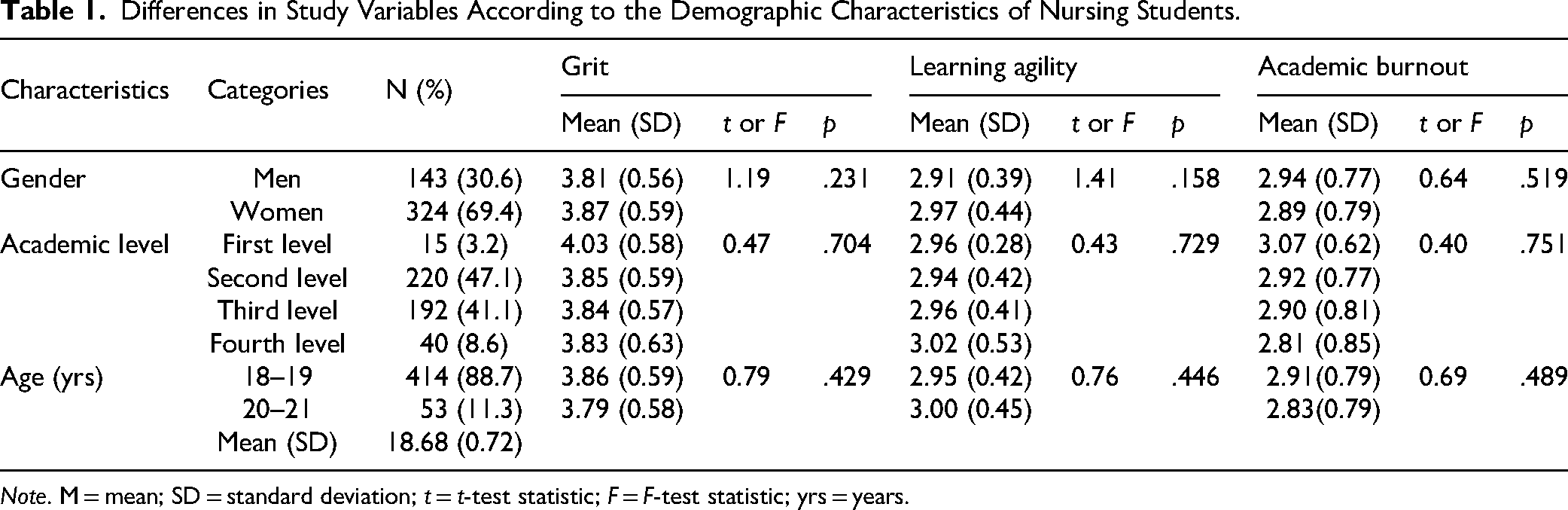
Note. M = mean; SD = standard deviation; t = t-test statistic; F = F-test statistic; yrs = years.
Assessment of the Study Variables
The participants demonstrated relatively high levels of grit (mean = 3.85 ± 0.59), with perseverance of effort (mean = 4.10 ± 0.74) scoring higher than consistency of interest (mean = 3.61 ± 0.68). Learning agility levels were moderate (mean = 2.96 ± 0.42), with intellectual curiosity (mean = 3.12 ± 0.57) being the highest-rated subscale and change adaptability (mean = 2.51 ± 0.63) the lowest. Academic burnout levels were also moderate (mean = 2.91 ± 0.79), with emotional exhaustion (mean = 3.50 ± 0.91) being the most prominent dimension (Table 2).
Mean Scores and Levels of Study Variables.
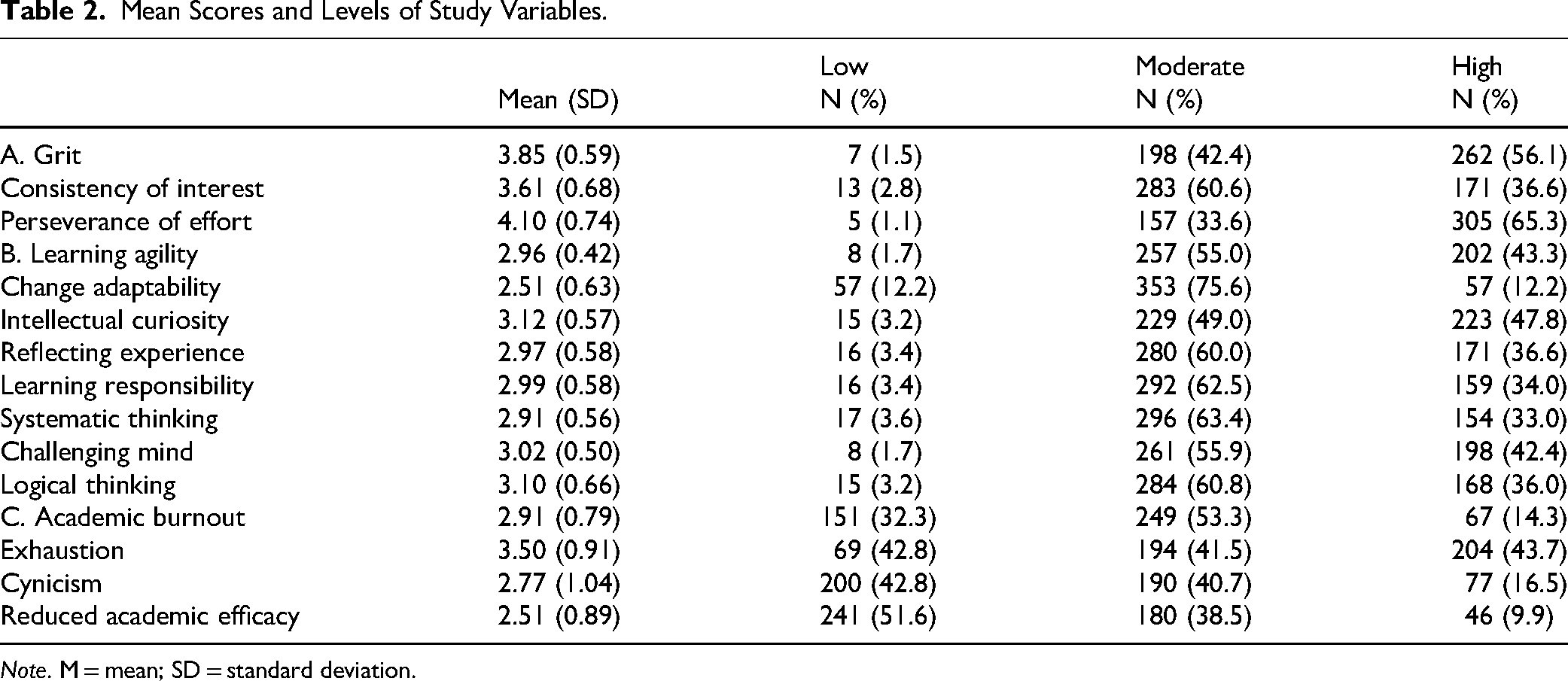
Note. M = mean; SD = standard deviation.
Relationships Between the Study Variables
There was a statistically significant positive relationship between grit and learning agility (r = 0.274, p < .001), whereas grit was inversely correlated with academic burnout (r = −0.327, p < .001) and no statistically significant relationship between learning agility with academic burnout (r = −0.032, p > .05) (Table 3; Figures 1 to 3).

The relationship between grit and learning agility among the nursing students.

The relationship between grit and academic burnout among the nursing students.

The relationship between learning agility and academic burnout among the nursing students.
Relationships Between Study Variables.

The outcomes of the linear regression analysis reveal that grit serves as a significant negative predictor of academic burnout within the nursing student population. As detailed in Table 4, grit exhibited a substantial negative correlation with academic burnout (B = −0.823, t = −7.450, p < .001). The model elucidated 10.7% of the variance in academic burnout (R2 = 0.107; Adjusted R2 = 0.105), demonstrating statistical significance (F = 55.501, p < .001). These results indicate that heightened levels of grit are linked to decreased levels of academic burnout (Table 4).
Predictive Influence of Grit on Academic Burnout Among Nursing Students.

Note. B = unstandardized coefficients; Std. error = standard error; β = standardized coefficients; R² = R-squared; Adj. R² = adjusted R-squared.
Discussion
This study investigated the impact of two important psychological and personal factors, grit and learning agility, on academic burnout among nursing students. Firstly, the study findings indicate that nursing students exhibited high levels of grit. This finding suggests that nursing students may possess a level of determination and resilience that supports their academic and clinical endeavors. These characteristics are essential for a successful nursing career, enabling students to overcome challenges and stay motivated (Cleary et al., 2018). However, further research with a more balanced distribution of students across academic years is needed to confirm these observations and explore how these traits evolve over time.
Regarding studies undertaken with nursing students and other healthcare disciplines, the findings of this study align with prior research indicating that academic grit is prevalent among nursing and medical students (Burke et al., 2022; Munn et al., 2022). However, these findings contrast with those of Al-Zain and Abdulsalam (2022), who reported low grit levels among dental students at KAUFD. Terry and Peck (2020) found that most nursing students exhibited moderate girt level. Calo et al. (2019) reported moderate grit levels among final-year physiotherapy students.
The findings of this study also found that perseverance of effort was higher than consistency of interest among students, indicating that these nursing students were more likely to persist in achieving their goals and tasks. In Egypt, most nursing students have moderate economic status and seek to obtain high grades to better attain academic achievement. Doing this will enable them to gain employment in governmental and private healthcare settings with respectable salaries, thus improving their economic level and satisfying their needs. Similar findings have been report in other empirical studies, in that nursing and pharmacy students persist in achieving their goals (Gruenberg et al., 2019; Terry & Peck, 2020). However, other studies have reported higher consistency of interests more than perseverance of effort among nursing students, suggesting that students who are consistently interested in their field may find it easier to maintain their motivation and enthusiasm throughout their education and careers (Kang & Choi, 2022).
Secondly, this study revealed that nursing students exhibited moderate levels of learning agility. This finding suggests that nursing students possess a certain level of flexibility and openness to new experiences, which can benefit the dynamic healthcare environment. Learning agility allows students to acquire new skills and knowledge efficiently, enabling them to excel in their clinical practice.
This finding also suggests an area for improvement. In the dynamic and often unpredictable healthcare environment, higher levels of learning agility may be necessary for students to effectively navigate challenges, learn from mistakes, and adapt to new situations. The implications of these findings are twofold. First, nursing programs should consider incorporating interventions to enhance learning agility, such as simulation-based training, reflective practice exercises, or problem-based learning activities. These strategies can help students develop the skills needed to thrive in complex clinical settings. Second, educators should recognize that while moderate learning agility may suffice for routine tasks, higher levels may be required for managing high-stress or rapidly changing situations. Future research should explore the threshold at which learning agility becomes a critical factor in reducing burnout and improving academic and clinical outcomes.
In a study conducted by Jeon et al. (2022), the average learning agility score among university students in South Korea was 5.00 with a standard deviation of .74, suggesting a moderate level of learning agility among Korean university students. Regarding learning agility dimensions, intellectual curiosity was highest among the learning agility factors, this may be due to the participating nursing students were keen to explore and learn new information and practices. However, the lowest learning agility factor was associated with change adaptability. This may be due to participants being dissatisfied with diverse clinical rotations, and that may stem from demanding learning activities, and time constraints.
Within this study, it was found that nursing students experienced moderate academic burnout. The moderate levels of academic burnout observed among participants highlight the importance of addressing this issue early in their training to prevent its escalation in their future careers. These findings were opposite to those of Prakash et al. (2023), who found that most undergraduate nursing students experienced high levels of academic burnout, emotional exhaustion, and disengagement. However, in contrast to both sets of findings, Al-Zain and Abdulsalam (2022) revealed that the majority of Saudi-dental students at the University of KAUFD perceived low levels of burnout. The study of Jeon et al. (2022) also reported low levels of academic burnout among University students in Korea.
This study also revealed that grit, learning agility and academic burnout were not associated with demographics of nursing students including age, gender, and educational level. Likewise, Terry and Peck (2020) reported that there were no significant differences in mean scores of grit for various demographic factors such as sex, age group, marital status, first family member to attend university, status of employment. Gruenberg et al. also found no significant differences in grit scores based on gender or undergraduate grade point average of their participants (Gruenberg et al., 2019). However, Al-Zain and Abdulsalam (2022) reported that age had a weak positive correlation coefficient relationship with grit, stress, and burnout among Saudi-dental students. Lee et al. (2022) found that the female students reported higher levels of burnout than male students. Additionally, students who identified as non-white reported lower levels of grit and higher levels of burnout compared to white participants from 14 academic medical centers in the United States. Sveinsdóttir et al. (2021) when further analyzing the level of education based on year of study, found third- and fourth-year undergraduate students were more likely to report significantly higher academic burnout compared to first- and second-year students.
Within this study, there was a significant inverse relationship between academic grit and academic burnout, suggesting that higher levels of academic grit are associated with lower academic burnout. These findings suggest that grit is a crucial personal characteristic for nursing students, as it not only contributes to their academic success but also plays a role in their overall well-being and ability to navigate the challenges of clinical practice (Al-Zain & Abdulsalam, 2022; Gruenberg et al., 2019; Jung, 2021).
These findings aligned with those of Kang and Choi who found that grit is a major factor that can affect nursing students’ academic, practical, and employment processes (Kang & Choi, 2022). Similarly, the previous studies demonstrated a negative correlation between levels of grit and burnout among nursing and medical students (Kim & Lee, 2022; Lee et al., 2022; Terry & Peck, 2020). According to a multicentered cross-sectional survey conducted by Dam et al., there is evidence suggesting that emergency medicine residents who possess higher levels of grit are less prone to experiencing burnout and low well-being (Dam et al., 2019). Conversely, individuals with lower levels of grit are more susceptible to experiencing burnout and low well-being. The findings of a longitudinal study indicated that grit has a crucial role in mitigating the occurrence of burnout among medical students (Jumat et al., 2020). On the contrary, Young-Brice et al. (2023) had pointed out that Short Grit Scale scores were not found to be statistically significant as a predictor of academic success. In this study, Grit-S scores failed to emerge as a significant predictor of success among associate degree nursing students. The Grit-S did not demonstrate predictive success or failure for nursing student.
In a longitudinal study examining the level of perseverance in health professions students, and its relationship to established factors, academic performance, and professional success, Gruenberg et al. (2019) did not find any meaningful connection between the Grit-S score and indicators of academic or professional accomplishment. However, they did observe slight yet noteworthy variations in individual Grit-S scores when reevaluated in the same students approximately one year after the initial survey, without any external intervention. The nature and extent of these changes differed depending on the students’ academic level, and these changes were not linked to the students’ GPA throughout the year. Similarly, the researchers did not discover any significant associations between perseverance and measures of academic or professional achievement in the group of pharmacy students they examined. Nonetheless, they did identify the occurrence of slight yet significant changes in Grit-S scores over time, even in the absence of any intervention. They conclude that the change in direction of Grit-S scores could have resulted from curricular or extracurricular influences.
Findings within this study revealed that academic grit and learning agility were positively correlated, suggesting that nursing students with higher grit levels also tend to experience greater learning agility. This connection is important as it implies that nursing students with academic grit may be more adaptable and open to learning from their experiences than their counterparts. Similar findings have been identified in several studies; the showing of a relationship between grit and resilience and personal and academic well-being (Calo et al., 2019; Stoffel & Cain, 2018). In particular, Calo et al. (2019) found that grit and resilience were positively related among final-year physiotherapy students.
The results of this study indicate that there is no statistically significant correlation between learning agility and academic burnout. This finding contradicts the research conducted by Janatolmakan et al. (2021) indicating a substantial and negative correlation between resilience and academic burnout among students pursuing nursing and midwifery studies. In a recent study conducted by Kennedy and Tevis (2020) discovered that there exists a direct correlation between higher levels of grit and a decrease in emotional weariness and depersonalization, as well as an increase in personal achievement, within the population of general surgery residents.
Although, our study did not find a direct significant association between learning agility and burnout, it is possible that learning agility may play moderating role in the relationship between grit and burnout. The combination of moderate learning agility with relatively high grit levels suggests that while students demonstrate persistence and passion for long-term goals, their ability to effectively adapt and learn from experiences might be more variable. This could indicate that interventions aimed at enhancing learning agility alongside grit-building activities might have a synergistic effect on reducing burnout. Future research should specifically examine these potential interaction effects.
Though our research mostly focused on psychological predictors of academic burnout, such as grit and learning agility, emerging literature emphasizes the significance of educational interventions in improving student performance and involvement. For example, Fathi et al. (2024) showed that attending virtual workshops greatly enhanced occupational health students’ learning across cognitive, emotional, and psychomotor domains. These results point to a possibly synergistic interaction between intrinsic learner traits and educational design. Furthermore, projects for quality assurance, such as the integration of structured enrichment activities like workshops and webinars and the application of ISO 10015 educational management systems may help to foster academic resilience and student happiness even more (Khosravi et al., 2025). Future studies could gain from investigating how psychological resources and institutional policies work together to reduce academic burnout.
Limitations
This study has several limitations that should be acknowledged. First, the use of self-reported data may introduce bias, as participants could provide socially desirable responses or may not accurately recall their experiences. While steps were taken to minimize this bias (e.g., ensuring anonymity and using validated instruments), future studies could incorporate objective measures or mixed-methods approaches to complement self-reported data. Second, cross-sectional design limits our ability to infer causality or capture changes in grit, learning agility, and academic burnout over time. Longitudinal studies are needed to explore these relationships dynamically and identify potential causal pathways.
Third, the study did not account for potential confounding variables, such as stressors outside academic life (e.g., financial difficulties, family responsibilities, or personal health issues), which may influence academic burnout. Future research should consider including these factors to provide a more comprehensive understanding of the determinants of burnout.
Fourth, the sample was drawn from a single academic institution, which may limit the generalizability of the findings to other settings. Future studies should include participants from multiple institutions and diverse cultural contexts to enhance the external validity of the results.
Fifth, the unbalanced distribution of students across academic years may further limit the generalizability of the findings. While the sample included students from all academic levels, the distribution was not perfectly balanced. Future studies should aim for a more balanced representation of students across academic years.
Finally, the timing of data collection (August to October 2023) may have influenced the results, particularly if it coincided with periods of high academic or clinical stress. Future research should consider longitudinal designs to capture variations in burnout and other variables over time.
Implications for Clinical, Education, and Research Practice
The implications of the study's findings hold significant importance for the field of nursing education and the overall well-being of nursing students. Firstly, it is recommended that nursing programs incorporate interventions aimed at promoting both grit and learning agility. To foster grit, interventions could include resilience-building workshops to enhance perseverance, mentorship programs to model sustained effort, and reflective exercises to reinforce consistency of interest. To enhance learning agility, nursing programs could integrate strategies such as simulation-based training to improve adaptability, problem-based learning to encourage critical thinking, and interdisciplinary collaboration to expose students to diverse perspectives. By fostering both grit and learning agility, students can develop a dual capacity for persistence and adaptability, enabling them to thrive in high-stress environments where both resilience and flexibility are essential. Implementing these strategies can help nurse educators equip students to navigate academic and clinical challenges more effectively while reducing their risk of burnout.
Additionally, it is imperative for educational institutions to build robust support systems for nursing students. The provision of readily accessible mentorship programs, counseling services, and stress management workshops is crucial in assisting students in managing the challenges associated with academic education and clinical training. These support systems are vital for ensuring the mental and emotional well-being of nursing students, positively impacting their general welfare, academic achievements, and ability to provide excellent nursing care.
Future research should focus on examining the role of additional non-cognitive factors, such as resilience, self-efficacy, or mindset, to gain a more comprehensive understanding of the determinants of achievement and well-being among nursing students. Longitudinal studies should investigate the threshold at which grit, and learning agility become critical factors in reducing burnout and improving clinical outcomes. Mixed-methods research could also explore how these interventions influence both individual student experiences and institutional outcomes. Ultimately, implementing and evaluating these interventions can transform nursing education, fostering resilient and adaptable practitioners who are better equipped to meet the demands of modern healthcare.
Conclusion
The present study revealed that nursing students had elevated levels of grit, specifically in relation to their determination and persistence in the pursuit of long-term academic and clinical goals. The level of learning agility exhibited by these students was found to be modest, with a notable emphasis on intellectual curiosity. A moderate level of burnout in clinical practice was reported among the nursing students. However, importantly this study revealed a notable correlation between grit and academic burnout, demonstrating that those with higher levels of grit tended to experience lower levels of academic burnout. Nevertheless, it is worth noting that there was no statistically significant direct association observed between learning agility and academic burnout.
Supplemental Material
sj-docx-1-son-10.1177_23779608251346685 - Supplemental material for Unveiling the Impact of Grit and Learning Agility on Academic Burnout Among Nursing Students: A Cross-Sectional Study
Supplemental material, sj-docx-1-son-10.1177_23779608251346685 for Unveiling the Impact of Grit and Learning Agility on Academic Burnout Among Nursing Students: A Cross-Sectional Study by Ibrahim Abdullatif Ibrahim, Atallah Alenezi, Heba Rabea Hagrass and Hoda Reda Abdou in SAGE Open Nursing
Supplemental Material
sj-docx-2-son-10.1177_23779608251346685 - Supplemental material for Unveiling the Impact of Grit and Learning Agility on Academic Burnout Among Nursing Students: A Cross-Sectional Study
Supplemental material, sj-docx-2-son-10.1177_23779608251346685 for Unveiling the Impact of Grit and Learning Agility on Academic Burnout Among Nursing Students: A Cross-Sectional Study by Ibrahim Abdullatif Ibrahim, Atallah Alenezi, Heba Rabea Hagrass and Hoda Reda Abdou in SAGE Open Nursing
Footnotes
Acknowledgments
The authors would like to thank the Deanship of Scientific Research at Shaqra University for supporting this work. The authors express gratitude to Professor Sue McAndrew for her invaluable feedback and guidance, which significantly contributed to the completion of this work. They gratefully acknowledge all the study participants; without them, it would not have been possible to complete this project.

Ethical Considerations
The study was approved by the Institutional Review Board of the faculty of nursing—Mansoura university (Approval number P.0514). The Participant Information and Consent Form was incorporated into the Google Form utilized for data collection and presented to the participants. This form provides a comprehensive overview of the study's objectives, methodologies, and ethical considerations. Prior to commencing the survey, participants were required to thoroughly review the content and select the relevant consent box to indicate their agreement. They were explicitly informed that their participation in the research was entirely voluntary, and they had the option to cease form submission at any point without encountering adverse repercussions. The confidentiality of the collected data was upheld, ensuring the privacy and anonymity of the study participants.
Author Contributions
IAI: writing—original draft (lead); formal analysis (lead); investigation (supporting); writing—review and editing (equal). AA: investigation (lead); writing—review and editing (equal). HRA: formal analysis (supporting); conceptualization (supporting). HRH and IAI: methodology (lead); conceptualization (lead); writing—original draft (supporting); writing—review and editing (equal). All authors have made substantial contributions to the development of the manuscript for submission. They have reviewed and agreed upon the final version of the manuscript that has been submitted for publication.
Funding
The authors received no financial support for the research, authorship, and/or publication of this article.
Declaration of Conflicting Interests
The authors declared no potential conflicts of interest with respect to the research, authorship, and/or publication of this article.
Data Availability Statement
The data that support the findings of this study are available from the corresponding author upon reasonable request.
Supplemental Material
Supplemental material for this article is available online.
References
Supplementary Material
Please find the following supplemental material available below.
For Open Access articles published under a Creative Commons License, all supplemental material carries the same license as the article it is associated with.
For non-Open Access articles published, all supplemental material carries a non-exclusive license, and permission requests for re-use of supplemental material or any part of supplemental material shall be sent directly to the copyright owner as specified in the copyright notice associated with the article.
