



Abstract
Aim
To identify sustainable curricular practices that promote student resilience.
Method
Sophomore students in a four-year baccalaureate nursing program attended a positive psychology seminar and a formal mentoring program led by senior- and junior-level nursing students. Sophomore students ‘resilience was measured pre- and post-intervention using the Predictive 6-Factor Resilience Scale (PR6). Additional rich descriptions from the experience of the mentoring program were obtained in surveys from the study participants and mentors at the completion of the program.
Findings
Quantitative and qualitative results supported a strong increase in resilience.
Conclusion and Implications for Practice
Nursing schools can provide students with sustainable support that promotes resilience.
Introduction
Nursing students ‘journeys through their academic programs are fraught with challenges in both classroom and clinical settings. In addition to the academic rigor of a traditional college education, nursing students have the additional challenges of dealing with the life-and-death situations of professional nurses when they are in the clinical setting.
The COVID-19 pandemic accelerated these concerns as nursing students self-reported higher levels of stress, depression, and anxiety (Urban et al., 2021) and faced interruptions in their face-to-face studies and increased uncertainty about clinical competence (Aslan & Pekince, 2020).
This article reports on a study exploring curricular practices that supported nursing students during a challenging time and measuring the impact of those interventions on resilience in nursing students enrolled in a baccalaureate nursing program at a small, liberal arts college in the Midwest. The research team, comprising two nursing faculty, the Assistant Director of Wellness at the college, and a senior nursing student, aimed to identify practices that could promote the thriving of nursing students in this pre-licensure academic setting.
A Student Success Seminar was implemented for beginning-level nursing students; resilience was measured pre- and post-participation in the seminar using the Predictive 6-Factor Resilience Scale (Rossouw & Rossouw, 2016). The seminar had two elements: students attended a positive psychology seminar called “Happy Hour” and a formal mentoring program in alternating weeks for a total of twelve weeks.
Background
Although students may be familiar with the rigors of the college's general curriculum, nursing students may not yet be adapted to the unique curriculum and demands of nursing courses. Nursing students report a competitive and stressful learning environment related to high academic demands and learning in the clinical environment (Drach-Zahavy et al., 2022; Fruh et. al., 2021; Lekan et al., 2018; Reeve et al., 2013). Other stressors in the clinical setting include fear of making mistakes, conflicts between professional beliefs and reality in practice, and providing care for patients in vulnerable situations (Drach-Zahavy et al., 2022). The COVID-19 pandemic accelerated these concerns as nursing students faced interruptions in their studies and uncertainties about their clinical preparation (Aslan & Pekince, 2020). These elevated stress levels put nursing students at risk for adverse physical and mental health outcomes and attrition (Fruh et. al., 2021). Thus, stress management and wellness habits of nursing students are an important area of research (American Association of Colleges of Nursing, 2015).
The research team aimed to identify sustainable practices to combat negative stress in the nursing curriculum as well as practices that promote stress management and wellness habits in nursing students, and examine their link to resilience. A pilot study was developed that involved a Student Success Seminar to be implemented at the beginning of the nursing curriculum to support students ‘resilience. Interventions were selected to teach stress management, promote wellness and feelings of belonging in the nursing major, and to demonstrate techniques of self-regulation and self-efficacy.
Positive psychology aims to help people flourish in their lives, in their communities, and in the world.
Methods
Intervention One: Positive Psychology Seminar
Introduction to Resilience and Positive Psychology.
Resilience can be defined as an individual's capacity to adjust to adversity, maintain equilibrium, retain some sense of control over their environment, and continue to move on in a positive manner; a resilient person is able to work through adversity by using personal resources like hope, optimism, and self-efficacy (Jackson et al., 2007). It is a quality “of bouncing back and moving on in life after adversity” (Earvolino-Ramirez, 2007, p. 76).
Self-regulation is the ability to switch from a state of excitement or hyperarousal to a state of calm and contributes to building resilience by helping an individual gain the ability to control their emotion when under stress (Jackson, 2007). Self-efficacy is a multidimensional concept centering on an individual's belief that they are in control of their outcomes and can be successful, and their perception that they have tools necessary to do so (Bandura, 1977).
The Happy Hour Curriculum.
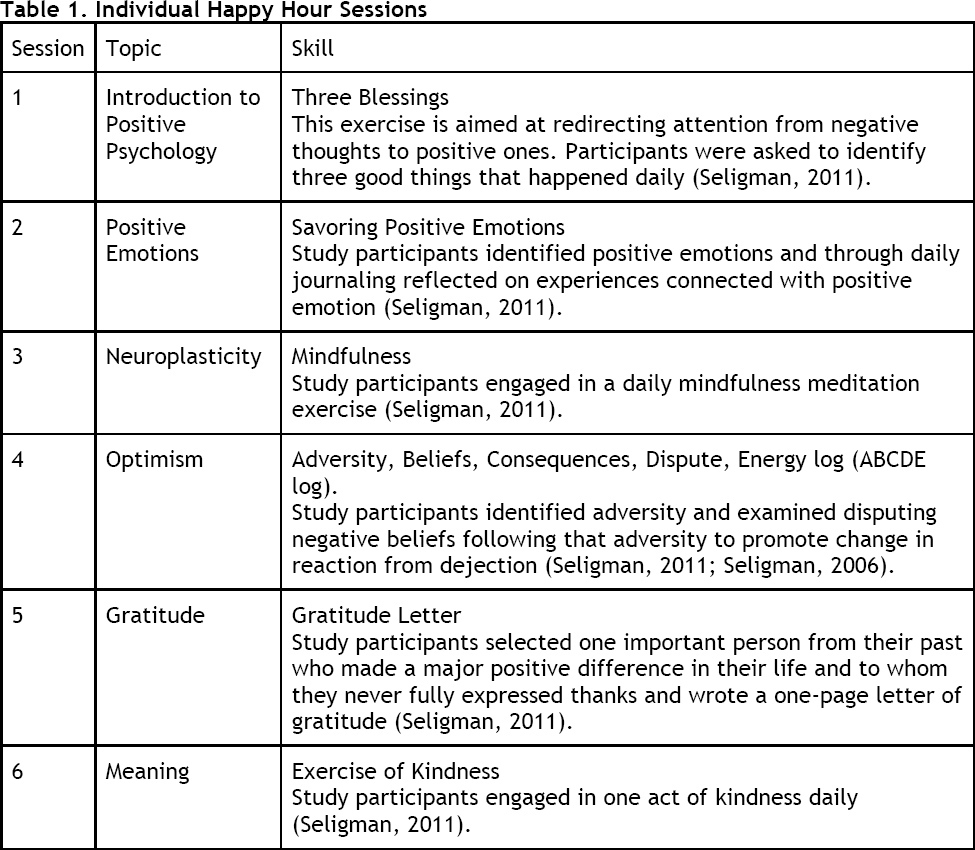
Positive psychology emphasizes the study of human strength and virtue, and aims to help people flourish in their lives, in their communities, and in the world (Seligman & Csikszentmihalyi, 2000; Seligman, 2011). Each one-hour virtual Happy Hour session included a variety of learning methods, including videos, handouts, and group discussion, that provided practical tools for building self-regulation, self-efficacy, and ultimately resilience. Topics and practices covered in individual Happy Hour sessions are outlined in Table 1.
Individual Happy Hour Sessions
Intervention Two: Mentoring Program
Peer mentoring in the undergraduate setting is gaining popularity as an effective strategy to facilitate student success in managing stress levels, by connecting students, establishing professional networks, improving use of campus resources, and encouraging academic participation (Ford, 2015). Caring relationships are associated not only with improved academic performance, but also with increases in measures of resilience, and can have a positive effect on long-term success in life (Froneman et al., 2016). Dennison (2010) discussed that peer mentoring among nursing students provides opportunities for networking which allows students to build self-efficacy as well as a support system within nursing programs. Fortes et. al, (2022) stated that peer mentoring assisted first-generation college students to develop problem-solving skills to cope with academic challenges and perceptions of self-efficacy.
Peer mentoring among nursing students provides opportunities for networking which allows students to build self-efficacy as well as a support system within nursing programs.
To co-create the mentoring program, the research team met with a group of junior-and senior-level nursing students to solicit input on what they would have perceived as meaningful engagement in their first semester as nursing students. A student mentor coordinator position was created, and senior-level nursing students submitted applications to be considered for this position. Once the position was filled, the faculty members on the research team met regularly with the student to identify the overall purpose and objectives for the mentoring program and to develop topics for the biweekly mentoring sessions, based on current evidence from the literature and incorporating the feedback from junior- and senior-level students.
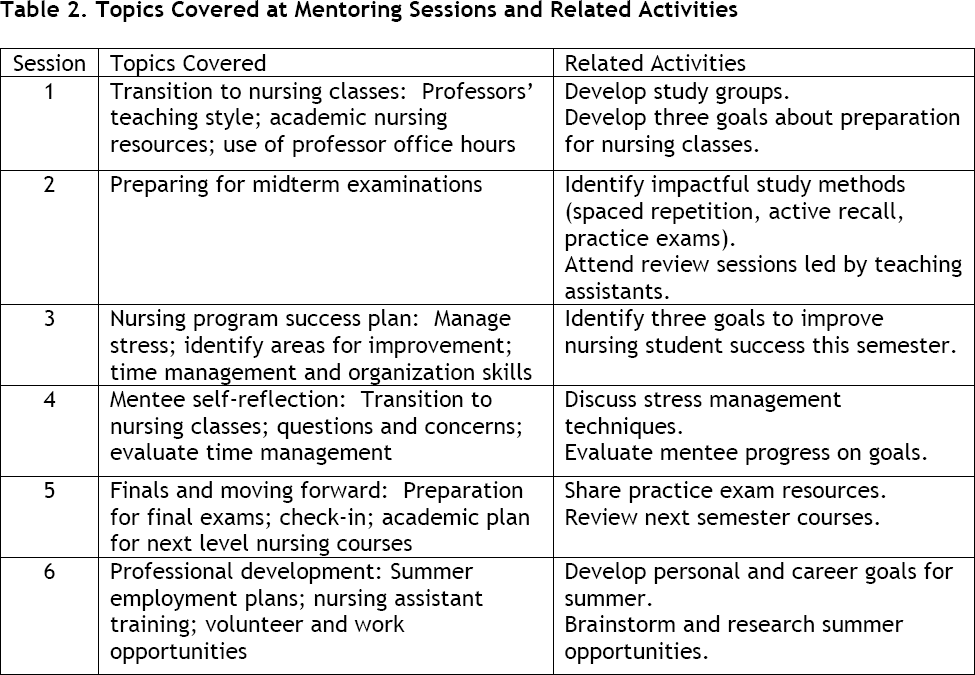
All junior- and senior-level nursing students could apply for the mentor positions. Mentors were selected by the faculty researchers and student mentor coordinator, based on criteria of ability to commit to attending all mentoring orientation and sessions with peers throughout the semester. Once selected, mentors attended a mandatory orientation session that included the purpose of the mentoring program, benefits of a mentoring program as identified in the literature, available resources, and overview of topics to be addressed with mentees at biweekly meetings. An outline of topics covered at mentoring sessions, along with related activities, are included in Table 2.
Topics Covered at Mentoring Sessions and Related Activities
Each mentor/mentee pair signed an agreement demonstrating their understanding of the expectations and their roles in the program. Components of the agreement were:
We agree to meet with each other according to the below schedule via virtual or face-to-face meetings, and only cancel if absolutely necessary.
We agree that the role of the mentor is to _____ .
We agree that the role of the mentee is to _____ .
We agree that what is said in our group meetings are confidential; we will respect each other's privacy.
We agree to respect each other's time.
Mentor agrees to provide honest and constructive feedback.
Mentee agrees to understand that the mentor may not always be able to answer all questions and that you may be referred back to your course faculty.
Mentee agrees to be open to feedback.
Other (as designated by Mentor/Mentee):
Each mentor was assigned to one mentee so they could dedicate full attention to the growth of one individual. For the duration of the semester, mentors completed a mentor check-in form to identify resources needed to facilitate feeling supported and empowered in their mentoring role. The nursing faculty on the research team and the student mentor coordinator followed up on identified needs.
Study Design
This single-site study used a mixed-method design, gathering quantitative and qualitative data to best answer and understand the research problem (Creswell & Plano Clark, 2011). The research team comprised two nursing faculty members, the Assistant Director of Wellness at the college, and the student mentor coordinator, who had primary responsibility for training the mentors.
Ethical Considerations
Approval for the protection of human subjects was obtained from the college's Institutional Review Board. After being allowed the opportunity to ask any questions regarding the study, students provided written consent to participate.
Sample and Setting
Potential participants included pre-licensure students in a traditional baccalaureate nursing program at a midwestern four-year liberal arts college, in the second semester of their second year of college and the first semester of the nursing curriculum (Sophomore Level 1). Participants were recruited via an email from the nursing department chair that included an introduction letter and study details. Of the total class of 24 Level 1 Sophomores, 18 provided consent for participation in the mentoring program and positive psychology seminar, a response rate of 75%. Student study participants were assessed at the beginning and end of the semester (February 2021 to May 2021). Participants were provided with an anonymous numerical code at the initial survey, which was recorded and kept in a secure location by a nursing department staff member who was not on the research team.
Instrument
The Predictive 6-Factor Resilience Scale (PR6) considers health hygiene factors which promote psychological resilience and facilitate healthy adaptation to adversity (Rossouw & Rossouw, 2016). Using a 5-point Likert-type scale, the standard 16-item PR6, which has an internal consistency of 0.8398 (Rossouw et al., 2019), measures 16 factors in seven domains:
Vision, including self-efficacy and goal setting;
Composure, including emotion regulation and ability to recognize, understand and act on internal prompts and physical signals;
Tenacity, including perseverance and hardiness;
Reasoning, including cognitive traits like problem-solving, resourcefulness, and thriving;
Collaboration, including psychosocial interaction;
Health, including physiological health – incorporating regular exercise, nutrition, and sleep hygiene; and
Momentum, measuring approach and avoidance in terms of a sense of direction and openness to new challenges. (Rossouw & Rossouw, 2016)
Intervention 1: Positive Psychology Happy Hour Sessions.
Study participants engaged in six virtual bi-weekly one-hour sessions with the Assistant Director of Wellness and Health Promotion, who was trained in facilitating the Happy Hour curriculum. See Table 1. Each session began with a check-in with each student noting one good thing from the past 24 hours. Participants then debriefed the previous session, followed by new content. The sessions included one skill based on positive psychology, for the participants to learn in the session and practice with one another. Between sessions, participants were asked to practice the specific skill learned. Following each session, study participants received a follow-up email outlining what they had learned and the skill to practice.
Intervention Two: Mentoring Program
Mentor-mentee pairs met virtually or face-to-face, biweekly in weeks alternating with the Happy Hour sessions, covering the topics listed in Table 2.
Results
At the end of the semester, participating Sophomore Level 1 students retook the PR6, using the same anonymous numerical code. Mentees and mentors completed an anonymous, online survey about the mentoring program.
Quantitative Results
Combined PR6 scores from the study participants were numerically coded on a five-point Likert scale ranging from 1, “not at all like me” (most negative) to 5, “very much like me.” Each domain was averaged to produce a comparable score per domain. An overall resilience score (PR6 score) was calculated as the mean of each of the seven domains, ranging from 0 (lowest resilience) to 1 (highest resilience). Results revealed statistically significant increases in the domains of Composure, Collaboration, Momentum, and Health. Results of the PR6 pre- and post-intervention are outlined by domain (See Figure 1) and described further in Table 3.
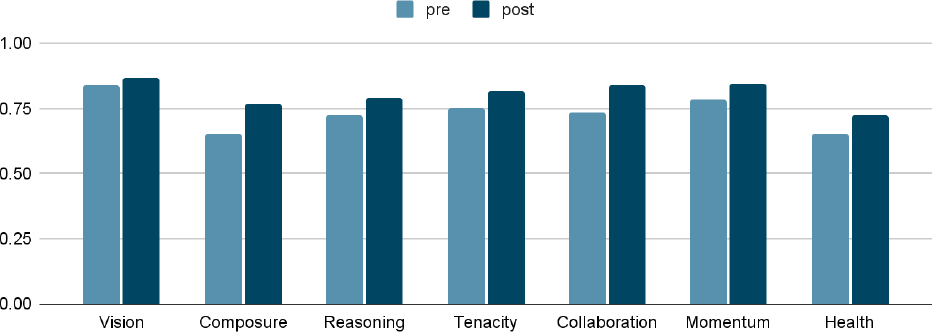
: PR6 Mean Scores Pre-intervention vs. Post-intervention
Pre- and Post-Intervention Mean Scores
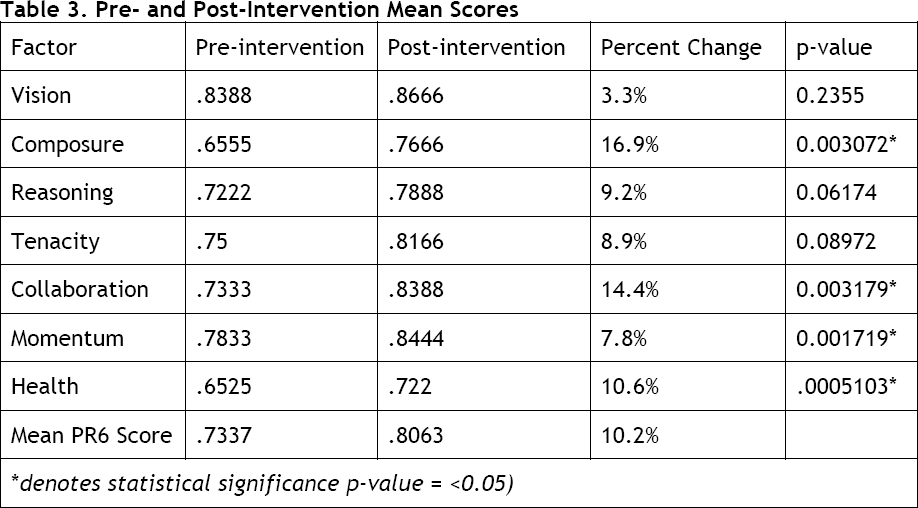
denotes statistical significance p-value = <0.05)
Qualitative Results
At the end of the semester, mentees and mentors were asked to complete an anonymous online survey about the mentoring program. Sixteen of the 19 mentors and the entire group of mentees (18) completed surveys consisting of open-ended questions developed by the research team. The mentee survey questions were:
Post-intervention scores revealed statistically significant increases in the resilience domains of Composure, Collaboration, Momentum, and Health.
How has mentoring contributed to your performance as a nursing student?
How has Happy Hour contributed to your performance as a nursing student? Identify, if appropriate, which sessions of the Happy Hour curriculum you found most helpful.
Compare and contrast the two components of this program and discuss how each component impacted your development as a nursing student.
What would you change about the program?
The mentor survey questions were:
How has mentoring contributed to your growth as a nurse?
What has contributed to your success as a mentor?
What was lacking in the program?
How did you contribute to your mentee's growth?
What would you change about the program?
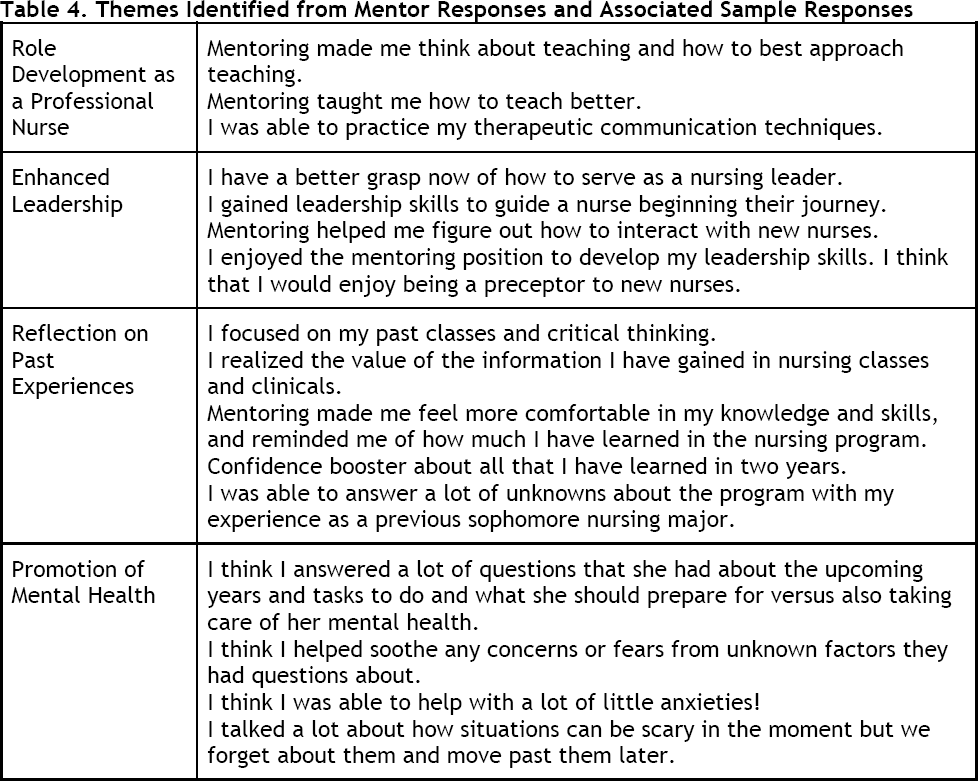
Analysis of responses to the mentor survey identified four themes:
Role development as a professional nurse
Enhanced leadership
Reflection on past experiences
Promotion of mental health
Table 4 identifies themes and provides supporting sample responses.
Themes Identified from Mentor Responses and Associated Sample Responses
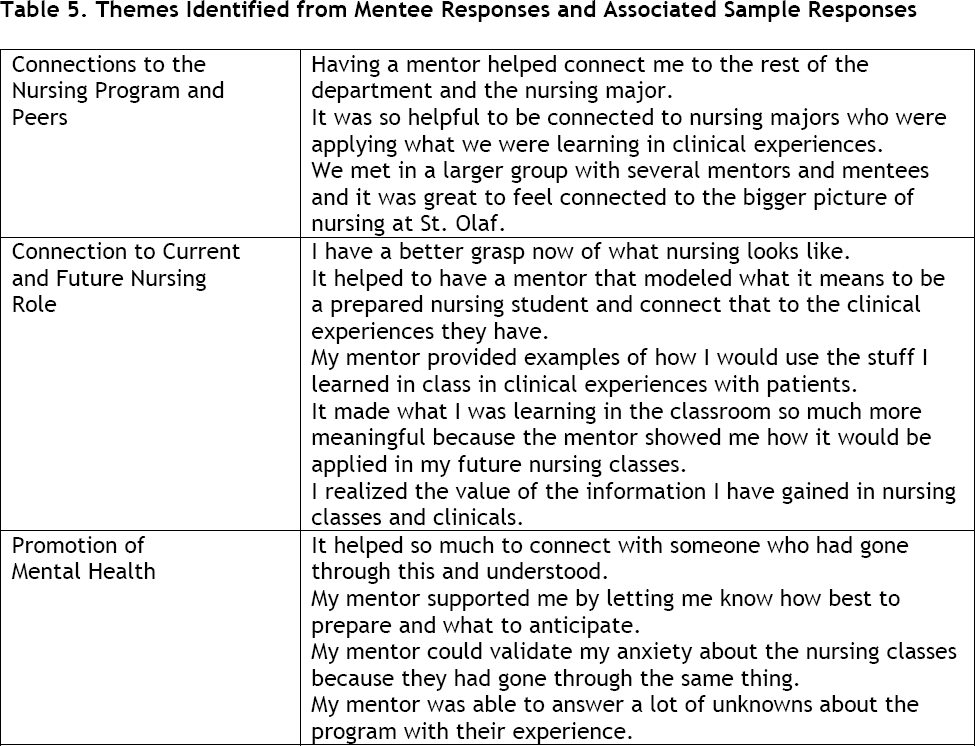
Analysis of responses to the mentee survey identified three themes:
Connections to the nursing program/peers
Connection to current and future nursing role
Promotion of mental health.
Table 5 summarizes the responses.
Themes Identified from Mentee Responses and Associated Sample Responses
Discussion
In studying the data from the PR6 and the post-intervention questionnaires, valuable lessons were learned related to factors necessary to promote resilience in nursing students. The results of this study indicate that the student success seminar, including both the positive psychology and formal mentoring program, contributed to a significant improvement in resilience.
In addition to the academic rigor of a traditional college education, nursing students have the challenges of dealing with the life-and-death situations of professional nurses in the clinical setting.
Mentors discussed the need for structure and preparation when planning mentoring sessions, indicating a need for a mentor guide with structured topic ideas in a centralized location. They also desired to better understand upcoming assignments and exams. To meet this need, mentors could be given a calendar with these activities, to anticipate mentee questions. Finally, some mentors asked for more topic ideas for each session and for training before the semester started.
The mentoring program was implemented during the COVID-19 pandemic, limiting the ability to meet in person. The mentors strongly expressed a need for socialization through scheduled group activities and more individual meetings. A group event with 4-5 mentor-mentee pairs would allow the mentees to explore multiple strategies to solve an issue, possibly contributing to problem-solving and critical thinking skill development.
Mentees also offered valuable feedback on areas for improvement in this program. Themes included intentional mentee-mentor matching and networking with peers. Mentees received descriptions of the mentors to rank in desired order related to their personal, social, and academic needs; allowing mentees to choose their mentor was vital to the success of this program. Students indicated that mentoring was a strong component of the program because it catered to each individual student.
Networking with peers was crucial as mentees became oriented to the nursing program. Discussing the “ins and outs” of nursing for the current semester and throughout the program was beneficial. The program helped students to feel more secure in the program by decreasing the “unknowns.” Mentees believed that they became more confident about their future role as a nursing student and about engaging with fellow nursing students. The mentees appreciated the one-on-one relationship with a more experienced nursing student to provide advice as they transitioned to the student nurse role.
Limitations
Limitations of this study included recruitment from a convenience sample at a single university, which limits the generalization of results to a broad population. Although the study size was small, a participation rate of 75% of potential study participants and nearly 100% response to the survey at the end of the semester provided persuasive data about the change in PR6 scores. Two independent variables were present with a strong pre/post effect. Recommendations for future research would be expanding the number of study participants to include additional sites with more diverse student populations. Suggestions for future study design could include four groups: both interventions, Happy Hour only, mentorship only, and a control site with no interventions. These studies could also include gathering qualitative data from the positive psychology arm.
Conclusion
Despite the aforementioned limitations, this study leads to implications relevant to nursing education. Specifically, this study highlights two possible curricular practices for nursing student success that nursing educators may consider: a positive psychology seminar and a formal mentoring program. For example, a study by Boardman (2016) found that building resilience through concepts of self-efficacy and self-regulation revealed an overall increase in resilience scores in nursing students. In nursing students, resilience training may provide ways to deal with the stress associated with the nursing curriculum and prevent attrition from the major. Nurse educators have the potential to provide sustainable curricular practices to promote student well-being through targeted interventions.
Cite this article
Huehn, S.L., Kuehn, M., Ortiz, J.A., & Al-Helal, R.T. (2023). Implementation of a Student Success Seminar and its correlation with resilience in nursing students: A mixed-methods study. Creative Nursing 29(1), Article 10.
Footnotes
Susan L. Huehn, PhD, MSN, RN, PHN, (she/her), is an Associate Professor and Chair of the Nursing Department at St. Olaf College in Northfield, Minnesota, USA.
MaryBeth Kuehn, EdD, RN, PHN, (she/her), is an Associate Professor of Nursing at St. Olaf College in Northfield, Minnesota, USA.
Jenny A. Ortiz, MA, (she/her), is Associate Director of Wellness and Health Promotions, Student Life Division, at St. Olaf College in Northfield, MN, USA.
Rafa T. Al-Helal, BSN Student, (she/her), is a 2022 nursing graduate of St. Olaf College in Northfield, MN, USA.