



Abstract
Background
Health professionals’ job satisfaction is crucial for health professionals' life which determines health care service quality. This study aimed to estimate pooled prevalence of job satisfaction of health professionals and associated factors in Ethiopia.
Methods
Preferred Reporting Items for Systematic Review and Meta-analysis (PRISMA) was followed to prepare this study. Studies were searched from PubMed (EBSCOhost), Directory of open access journals (DOAJ), Global health, African Index Medicus, IRIS (WHO digital publication), African Journals Online (AJOL), Google Scholar, and Google. Random-effect model was used to estimate the pooled prevalence of job satisfaction and associated factors. Heterogeneity was assessed using I2 test statistics. Publication bias was checked using funnel plot, Egger's regression test, and sensitivity analysis.
Result
The pooled prevalence of health professionals’ job satisfaction was computed from 35 studies, and it was 46.68% (95%, confidence interval (CI): 41.82, 51.54, I2 = 95.8%). Specifically, job satisfaction was 57.56%, 48.80%, 48.57%, 48.48%, 44.56%, 39.20%, and 16.5% among pharmacy professionals, health officers, midwives, nurses, anesthetists, physicians, and health extension workers, respectively. Secured working environment (pooled odds ratio [POR] = 6.50, 95% CI: 3.41-9.58)
Conclusion
Job satisfaction among Ethiopian health professionals is considerably low. Secured working environment, positive relationships among staff, and having a bachelor's enhanced the job satisfaction. Designing strategies to improve safety in the work environment and improved communication among workers could improve job satisfaction.
Background
Job satisfaction is how pleased an individual is with his/her job or the positive feeling individuals have about their jobs, their career, and for whom they work.
1
Health professionals' job satisfaction is vital in improving the performance of health professionals, refining health care services, and upsurge the level of patient satisfaction
The World Health Organization's (WHO) global strategy on health workforces for 2030 outlines that health professionals have the right to have safe and decent working environments and have freedom from all kinds of discrimination, coercion, and violence.
5
In the world, mainly in developing countries, health professionals' job satisfaction is low due to different factors. This is supported by previous studies conducted in different parts of the world. The study findings in Nigeria (3.1%),
6
South Africa (52.1%),
7
Pakistan (14%-41%)8,9 Nepal
Multitudes of factors were reported to affect health professionals’ job satisfaction in the world. Some of the possible factors were as follows: personal characteristics of leaders, managerial competencies of leaders, 14 working environment, job description and time pressure, 8 work environments, poor fringe benefits, dignity, the responsibility given at workplace and time pressure, 9 responsibility, opportunity to develop, staff relations and patient care, 10 opportunity to develop, responsibility, patient care and staff relations. 11 Besides, security in work environment,15–19 coworkers relationship,15,17,20,21 positive supervisor relationship,15,17,19,22 having autonomy,15,23 organizational commitment,15,17 promotion opportunity,15–17,23 being female,22,24,25 marital status,12,19,22 having bachelor of science,22,26–28 workload,22,28 being male,29,30 service year,31,32 recognition at work,16,17,33 salary,17,19 intention to stay,18,25,33 management and leadership,23,34 and being a midwife18,25 were factors identified to be associated with health professionals’ job satisfaction in Ethiopia.
See supplementary file/material for Critical appraisal and factors associated.
The government of Ethiopia tried to improve health professionals' job satisfaction by increasing their salary, duty payment, risk allowance, and implementing Job Evaluation and Grading (JEG). Nonetheless, the health professionals' job satisfaction remains as low as 16.5% in the Oromia region 12 and as high as 74.4% in the Harari region. 13
Thus, this systematic review and meta-analysis aimed to determine the pooled prevalence of health professionals’ job satisfaction and associated factors in Ethiopia. The findings will be very informative for policy-makers and program planners in designing different strategies to enhance health professionals’ job satisfaction and to improve the overall quality of patient care.
Methods
Study Selection and Searching Strategies
Multiple sources were explored to retrieve eligible articles. Databases such as PubMed (EBSCOhost), CINAHL, Science Direct, Global health, African Index Medicus, IRIS (WHO digital publication), African Journals Online (AJOL), and other non-electronic sources (Google Scholar and Google) were searched to get articles. A comprehensive literature search was conducted by two investigators (ZT and ZWB), independently. Searching was conducted using the following key terms: (determinants OR associated factors OR barriers OR predictors) AND (health professionals) OR (health workers) OR (health care providers) OR (Physicians) OR (Midwives) OR (Nurses) OR (Anesthetists) OR (Pharmacy professionals) OR (Pharmacists) OR (Optometry) OR (Optometry professionals) OR (Laboratory professionals) OR (Health extension workers) OR (Public health officers) OR (Health officers) AND (Job satisfaction) AND (Ethiopia). The appropriateness of key terms was verified before the actual search. EndNote × 8 reference manager was used to manage literature. 35
Eligibility Criteria
To conduct this systematic review and meta-analysis, the Preferred Reporting Items Systematic Review and Meta-Analysis (PRISMA) 36 guideline was followed. Study results were explored and evaluated for eligibility using study area, study setups, title, abstract, and full texts before inclusion in this study. Published articles, surveys, and unpublished articles that were conducted in the English language were explored and included in this study. The reference lists of the studies were also searched for additional articles. All articles published until June 2020 were included in the current study. Conference proceedings, qualitative studies, reviews, commentaries, editorial letters, case series/reports, and patient stories were excluded from the present meta-analysis.
Data Abstraction and Critical Appraisal of the Studies
The authors (ZT, TBW and ZWB) conducted data extraction independently from eligible studies using the standardized data extraction format. The data extraction format include: name of the author (s), publication year, study region, study design, sample sizes, event/prevalence, study setting, assessment tools, associated factors, and study population. Joanna Briggs Institute(JBI) checklists of cross-sectional and cohort studies
37
were used to assess the qualities of the studies
Operationalization of the Outcomes and Measurement Tools
The main outcomes of this study were health professionals’ job satisfaction and associated factors in Ethiopia. Health professionals are all health workers in Ethiopia (physicians, Nurses, Midwives, Anesthetists, Pharmacy professionals, Optometry professionals, Laboratory professionals, Dentistry professionals, Public health officers, and health extension workers). The factors affecting health professionals’ job satisfaction were identified by using the odds ratios from the included studies. The binomial distribution formula was used to compute the standard errors for each original study. The “metan” commands were used to compute the pooled estimates using STATA (version 15) software. The pooled estimates were presented with their 95% confidence interval (CIs). In the original studies, health professionals' job satisfaction was measured by different assessment tools such as the Likert scale, mean score, Minnesota satisfaction tool, multi-item scale, demarcation threshold formula, pleasurable/positive emotion, data-driven classification system, and proportion tools.
Statistical Methods and Analysis
STATA Version 15 (STATA Corporation, College Station Texas) software was used to compute the pooled estimates. Both random-effect and fixed effect models were employed to compute the pooled estimates. In the presence of higher heterogeneity among studies, the pooled estimates were computed using random-effects models and were weighted using the inverse variance method. Subgroup analysis was performed by using the study population and assessment tool. The appropriateness of each datum was verified before the analyses of the pooled estimates. The results of this meta-analysis were presented using forest plots, summary tables, and texts.
Publication Bias and Heterogeneity
The asymmetry of funnel plot and Egger's regression test at a 5% significant level 38 were used to assess publication bias. Heterogeneity among included studies was explored using forest plot, I2 test, and the Cochrane Q statistics. 39 The I2 values of 25%, 50%, and 75% were interpreted as a low, medium, and high heterogeneity, respectively. 40 In this meta-analysis, significant heterogeneity was considered when the I2 value was ≥50%, with a P-value <.05. The possible sources of significant heterogeneity were addressed through subgroup and sensitivity analyses.
Results
Selection of Eligible Studies
In the initial search, a total of 235 342 articles were identified of which 2540 articles were removed due to duplication and 22 881 articles were screened using title and abstract. After reading titles and abstracts, 22 842 studies were removed. The full texts of 38 articles were assessed for eligibility criteria. Three studies were excluded due to different outcomes. Finally, 35 articles2,12,13,15–34,41–52 were included in the final analysis of the current systematic review and meta-analysis (Figure 1).

The PRISMA flowchart showing the selection process of studies.
Characteristics of Included Studies
All studies included in this systematic review and meta-analysis were cross-sectional studies2,12,13,15–34,41–52 The included studies were published between 2011 and 2020. Among the studies included in this systematic review and meta-analysis, nine were conducted at the national level, 10 in the Oromia region, six in the Amhara region, four studies in Addis Ababa, three in the Harari region, one study in Tigray, and one in Southern Nations and Peoples Region (SNNPR). From the studies included, two studies were used for factor analysis but not in pooled prevalence analysis20,23 The sample size of the included studies ranged from 43 in the Harari region 13 to 792 in a study conducted at the national level. 47 In this systematic review and meta-analysis, 9090 health professionals were included. The qualities of articles were also assessed using the JBI checklist, and eight articles had the medium quality and 26 articles were categorized under high quality (Table 1).
Summary of 35 Included Studies on Health Professionals Job Satisfaction in Ethiopia.

The Pooled Prevalence of Health Professionals’ job Satisfaction in Ethiopia
Thirty-four articles2,12,13,15–34,41–52 were used to compute the pooled prevalence of health professionals’ job satisfaction. It was found that 46.68% (95%, CI: 41.82, 51.54) of health professionals had satisfaction in their job with a remarkable heterogeneity among the included studies (I2 = 95.8%, P < .01).
Subgroup Analysis
As illustrated in Figures 2 and 3, subgroup analyses were done using the study population and assessment tool. This is done to explore the possible sources of heterogeneity of the included studies. The subgroup analyses were done using study population and the assessment methods (tools) of job satisfaction. However, heterogeneities within and between the included studies remained high. According to the study population; pharmacy professionals had the highest job satisfaction (57.56%, 95% CI: 40.80, 74.33, I2 = 93%, P < .01) but health extension workers had the lowest job satisfaction (16.50%, 95% CI: 11.99, 21.01). The pooled prevalence of job satisfaction using primary studies conducted among all health professionals only was also computed and it was found that 44.50% (95% CI: 36.17, 52.83, I2 = 97.1%, P < .01) were found to be satisfied in their job (Figure 2).

Forest plot showing health professionals job satisfaction in Ethiopia, 2020.
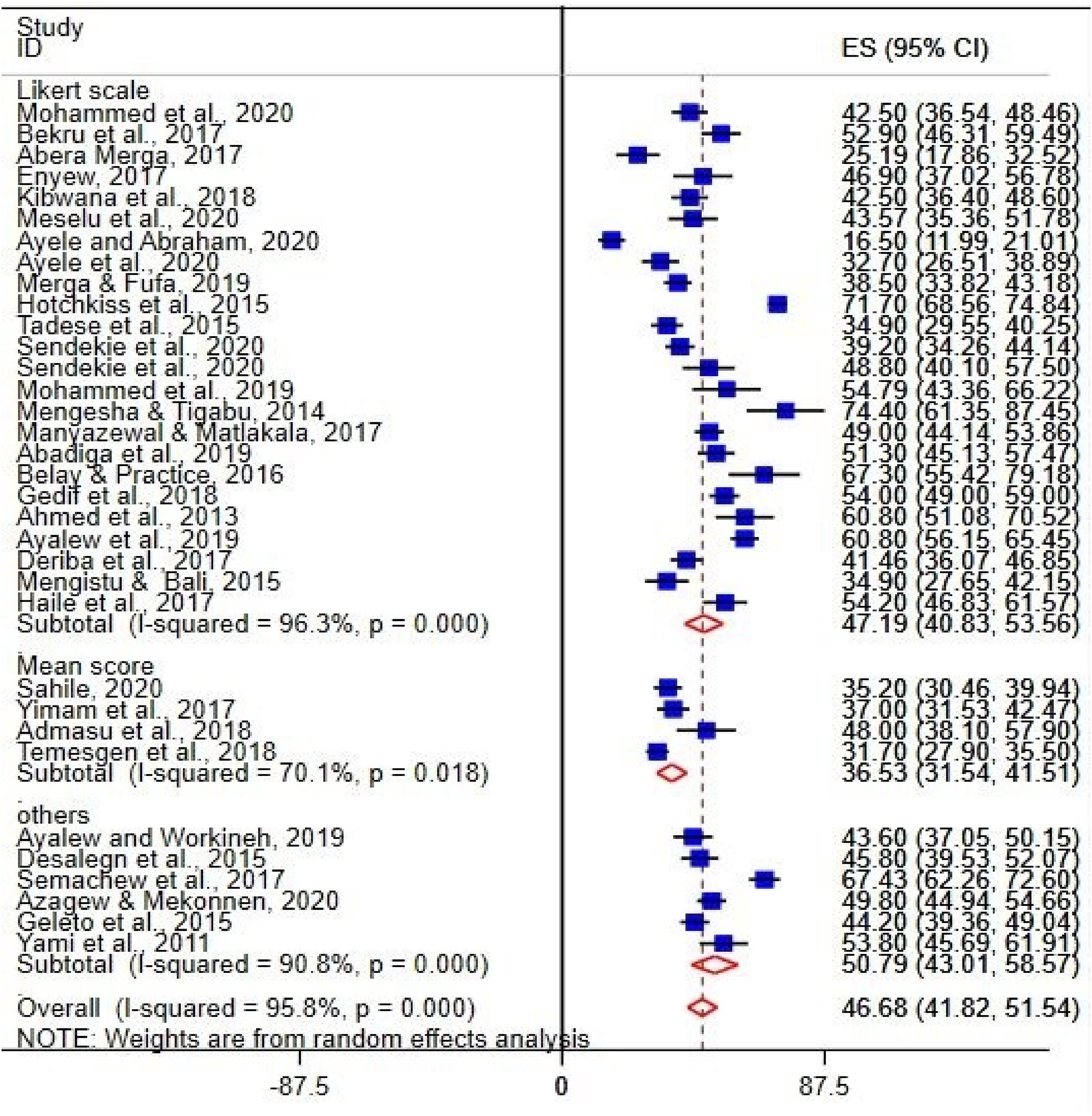
Forest plot showing health professionals' job satisfaction based on job satisfaction measurement in Ethiopia, 2020.
Similarly, subgroup analysis was done using the assessment tool and health professionals job satisfaction was found to be higher in studies classified as others including Minnesota satisfaction tool, multi-item scale, demarcation threshold formula, pleasurable/positive emotion, data-driven classification system, and proportion tools (50.79%, 95% CI: 43.01, 58.57, I2 = 90.0%, P < .01). But, health professionals' job satisfaction was low among studies conducted assessed with a mean score assessment tool (36.53%, [95% CI: 31.54, 41.51, I2 = 70.1%, P = .018] [Figure 3]).
Publication Bias and Heterogeneity
Both the funnel plot and Egger's regression test (P = .911) showed that there is no publication bias (Figure 4). Since there was heterogeneity between studies, we tried to identify the source of heterogeneity by doing univariate meta-regression on prevalence and sample size. However, the result revealed that the sample size was not the source of heterogeneity (B = −0.0004014, P = .978) (Figure 5). Finally

Funnel plot showing the possible sources of bias of health professionals’ job satisfaction in Ethiopia, 2020.
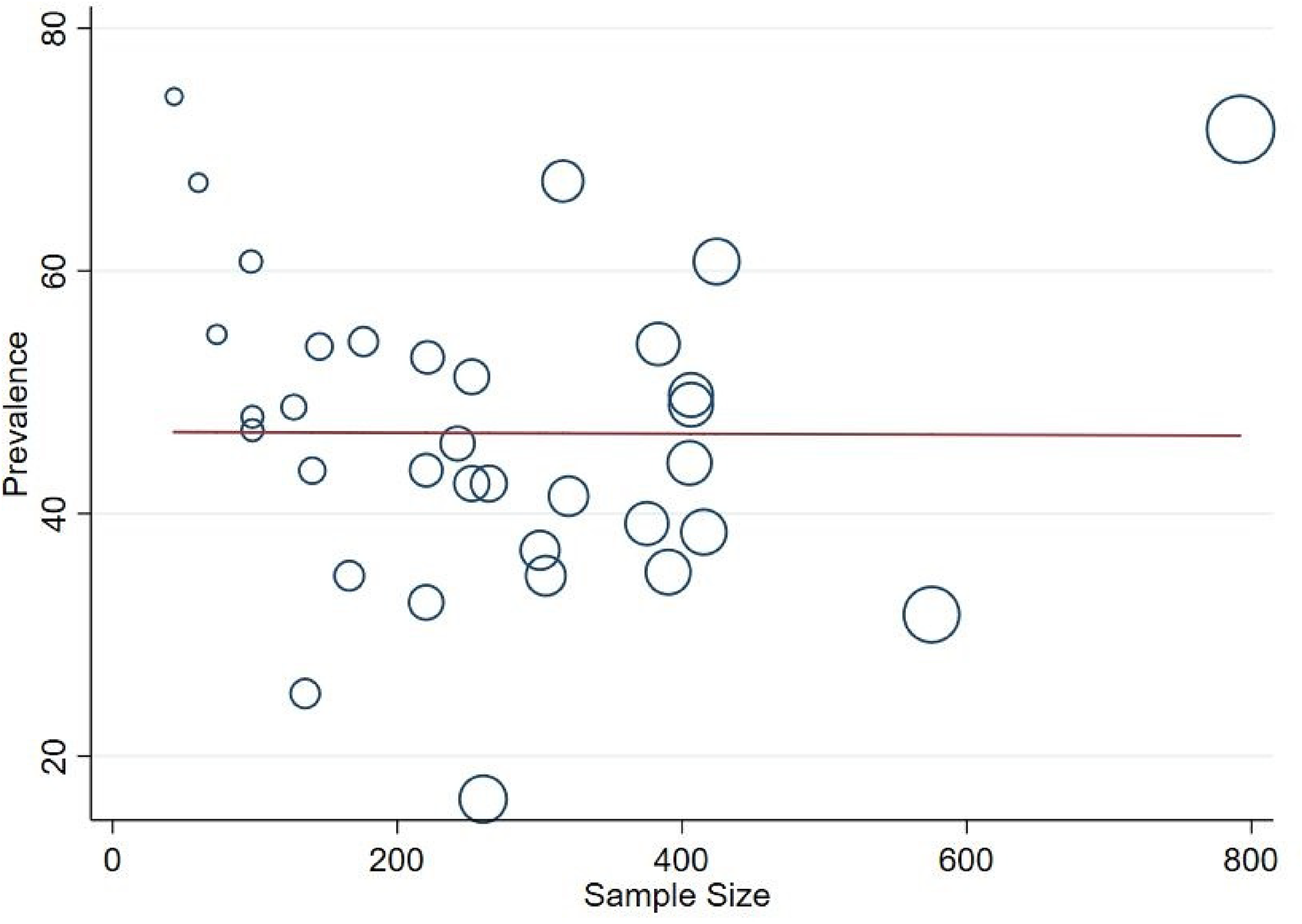
The meta-regression between sample size and prevalence.

Sensitivity analysis.
Factors Associated with Health Professional's job Satisfaction in Ethiopia
In this systematic review and meta-analysis, working environment security, coworkers relationship, having good relationship of supervisors with ordinary staffs, and having BSc degree were found to have statistical significant association with health professional's job satisfaction. The likelihood of job satisfaction among health workers who work in secured work environment was 6.50 times than those working in in-secured work environment (pooled odd ratio [POR] = 6.50, 95%, CI: 3.41, 9.58, I2 = 83.0%, P < .01)
Factors Associated With Health Professionals’ Job Satisfaction in Ethiopia.

*Stands for variables statistically significant at p < 0.05.
Discussion
To our knowledge, this is the first comprehensive systematic review and meta-analysis determining the pooled prevalence of health professionals' job satisfaction and associated factors in Ethiopia.
This systematic review and meta-analysis revealed that the pooled prevalence of health professionals' job satisfaction in Ethiopia was 46.68%. This pooled prevalence showed that Ethiopian health professionals were more satisfied than Nigerians (3.1%),
6
South Africans (20.4%),
11
and health professionals in Pakistan (14%-41%).8,9 All these studies were primary studies conducted in different health care setups, which could be a possible rationale for discrepancies
According to the study population; pharmacy professionals had the highest job satisfaction (57.56%), but health extension workers had the lowest job satisfaction (16.50%). The variation could be accounted for by the fact that pharmacy professionals had better living environments (urban) and professional supervisors because most professional activities of pharmacy professionals are found in the urban areas of the country. On contrary, health extension workers are primarily deployed in the countrysides, mainly in remote areas of the country. In addition, most health extension workers are supervised by nonprofessionals which could cause discomfort on the health extension workers. Variation in the amount of monthly salary could also be the source of discrepancy in the pooled prevalence of job satisfaction between professions. The difference in the autonomy of decision making could also be the source of variation in the interprofessional job satisfaction of health professionals in Ethiopia. 53
Regarding job satisfaction, the subgroup analysis based on measurement scales revealed that there was variation in the pooled prevalence between the measurement scales. The highest health professionals’ job satisfaction (50.79%) was recorded using studies that measured job satisfaction based on the Minnesota satisfaction tool, multi-item scale, demarcation threshold formula, pleasurable/positive emotion, data-driven classification system, and proportion tools. The lowest pooled prevalence of health professionals’ job satisfaction (36.53%) was observed when job satisfaction was assessed with the mean score assessment tool. The possible justification for the difference might be due to the nature of the assessment tools.
In this systematic review and meta-analysis, four factors were found to have a significant association with health professionals’ job satisfaction. We found that health professionals working in a secured working environment were more likely to have job satisfaction. This finding is supported by studies conducted in Pakistan.8,9 The possible explanation for this might be it is human nature to give priority to safety and security. 5 Health professionals who had good coworkers' relationships in their working environment had more job satisfaction. This result is also supported by the study conducted in Nepal where health professionals working in an environment with better relationship among coworkers had better job satisfaction. 10 Coworkers relationship is very important in any working environment, especially for health professionals to give quality care for their patients and successful implementation of their professional duty. Positive communication has a special implication for health professionals because health care is a teamwork which needs good relationship and communication between health care providers. 53 The other identified factor that enhances health professionals' job satisfaction is having a good relationship with supervisors. Health professionals who had a good relationship with supervisors had more job satisfaction. This result is consistent with the findings of a study conducted in Slovenia. 14 Having Bachelor’s degree is also a factor that was associated significantly with health professionals’ job satisfaction. Health professionals who had a bachelor’s degree had more job satisfaction as compared to Diploma holder health professionals. The possible justification might be most of the study participants were diploma workers and unsatisfied with their job, since there is a limited chance for education. The higher workload among health workers with diplomas may be also the source of poor satisfaction in their job.
In general, job satisfaction is more than fulfilling personal needs; rather it determines the overall quality of patient care. It is there for very important to for the organization to be congruent enough with the desires of clinicians and this can improve the efficacy and efficiency of clinicians. This improves the quality of care and the morbidities and mortalities may be improved undoubtedly.54,55
Limitations
Limitations of this review: all of the included studies were cross-sectional, which restricts the assessment of the cause-effect relationships. Including studies performed in the English language only could be the source of either over or underestimation of the pooled prevalence of job satisfaction.
Conclusion
In this systematic review and meta-analysis, health professionals’ job satisfaction in Ethiopia was found to be low as compared to other studies. Working environment security, coworkers relationship, supervisors’ relationship, and having a bachelor degree educational status were significantly associated with health professionals’ job satisfaction. This study suggests developing strategies for working environment security, revise rules and regulations for supervisors and health professionals to improve coworker and supervisors’ relationships, and arrange educational opportunities for diploma health professionals is important to increase health professionals’ job satisfaction in Ethiopia.
Supplemental Material
sj-docx-1-hme-10.1177_23333928211046484 - Supplemental material for Health Professionals Job Satisfaction and Associated Factors in Ethiopia: A Systematic Review and Meta-analysis
Supplemental material, sj-docx-1-hme-10.1177_23333928211046484 for Health Professionals Job Satisfaction and Associated Factors in Ethiopia: A Systematic Review and Meta-analysis by Zelalem Tenaw, Melese Siyoum, Berhan Tsegaye, Tehsale Biku Werba and Zebenay Workneh Bitew in Health Services Research and Managerial Epidemiology
Supplemental Material
sj-docx-2-hme-10.1177_23333928211046484 - Supplemental material for Health Professionals Job Satisfaction and Associated Factors in Ethiopia: A Systematic Review and Meta-analysis
Supplemental material, sj-docx-2-hme-10.1177_23333928211046484 for Health Professionals Job Satisfaction and Associated Factors in Ethiopia: A Systematic Review and Meta-analysis by Zelalem Tenaw, Melese Siyoum, Berhan Tsegaye, Tehsale Biku Werba and Zebenay Workneh Bitew in Health Services Research and Managerial Epidemiology
Footnotes
Acknowledgments
The authors acknowledge all the authors of the original studies included in this systematic review and meta-analysis.
Authors’ Contribution
ZT, ZWB, MS, TBW, and BT conceived and designed the review. ZT and ZWB prepared the draft of the manuscript. The final version of the manuscript is approved by all the six authors.
Availability of Data and Material
All data supporting the conclusions are included in the manuscript (tables and graphs) and with the additional files.
Declaration of Conflicting Interests
The author(s) declared no potential conflicts of interest with respect to the research, authorship, and/or publication of this article.
Funding
The author(s) received no financial support for the research, authorship and/or publication of this article.

Supplemental material
Supplemental material for this article is available online.
Author Biographies
References
Supplementary Material
Please find the following supplemental material available below.
For Open Access articles published under a Creative Commons License, all supplemental material carries the same license as the article it is associated with.
For non-Open Access articles published, all supplemental material carries a non-exclusive license, and permission requests for re-use of supplemental material or any part of supplemental material shall be sent directly to the copyright owner as specified in the copyright notice associated with the article.
