



Abstract
Background
Rural health extension workers (HEWs) are essential for the implementation of the promotion and prevention-based health care policy of Ethiopia. Job satisfaction is believed to be one of the key factors that influence their performance. Information regarding job satisfaction and associated factors are limited in the study area. Therefore, this study was aimed at assessing job satisfaction level and associated factors among rural Health Extension Workers of Sidama Region, Southern Ethiopia.
Method
A facility-based cross-sectional study was conducted among 341 rural HEWs from 1 March to 30 April 2021. Data was collected using trained data collectors using pre-tested and self-administered questionnaires. SPSS version-25 was used for data analysis. Bi-variable and multi-variable logistic regressions were used to observe the association between the outcome variable and associated factors. The outputs are presented using an adjusted odds ratio (AOR) with a 95% confidence interval (CI).
Result
This study revealed that 36.6% (95% CI: 31.6%-41.6%) of the rural HEWs were satisfied with their job. Increased odds of satisfaction were observed among rural HEWs who got training opportunities (AOR: 3.74, 95% CI: 2.01, 6.98), education opportunities (AOR: 3.06, 95% CI: 1.56, 7.46), management support (AOR: 4.59, 95% CI: 2.44, 8.67), supervisor support (AOR: 7.40, 95% CI: 3.84, 14.26), and a better salary/payment (AOR: 4.18, 95% CI: 2.19, 7.88) compared to their counterparts.
Conclusion and Recommendation
The job satisfaction level among rural HEWs in the study area was low. Strategies to stimulate and strengthen recognition of management, supportive supervision, performance-based regular salary increment, and career developments are recommended.
Background
Low income countries, particularly Sub-Saharan Africa often suffer from weak infrastructure, shortage of trained human resources, and poor supply chain management systems which resulted in a huge burden of diseases and deaths.1–5 Countries in this region designed health interventions with various modalities in order to serve the poor and the most vulnerable population.6–9 In such resource-limited settings, community health workers (CHWs) based interventions brought significant and locally acceptable improvements in health systems. 10
Ethiopia is one of the Sub-Saharan African countries the most affected by high diseases burden reflected by high rates of maternal and child mortality. 11 Before the government came up with innovative ways of scaling up the delivery of essential health interventions, in particular through its Health Extension Program (HEP), low access to essential health services contributed to the high prevalence of infectious diseases and mortality rates registered in the country. 10
In response to these challenges, Ethiopia launched HEP in 2004 as a component of the second five years Health Sectors Development Program. A health post is an operational center for health extension workers (HEW). Two trained HEWs are assigned to one health post to serve about 5000 population in a kebele. 12 They provide health services through fixed and outreach bases; spend half of their working time conducting home visits and outreach activities, and the remaining half at their health post providing basic curative, promotive, and preventive services.13–16
Health extension workers satisfied by their job and work environment are believed to be one of the key factors that influence the health sector's performance. 17 Job satisfaction can build up their motivation, performance, and improve the quality, efficiency, and equity of the health services given to the rural community.18–20 Poor HEWs practices contribute to the low use of health services by the rural communities.21–23
Interrelated factors like heavy workloads, lack of professional autonomy, poor supervision, long working hours, unsafe workplaces, inadequate career structures, poor remuneration/unfair pay, poor access to needed supplies, and limited or no access to professional development opportunities, and internal and international migration of workers determines the motivation of the health workforce.21,22,24–29 Understanding the perceptions of the HEWs’ working environment and their levels of satisfaction with their roles is crucial. 20
Despite the fact that rural health extension workers are the backbone for the implementation of promotion and prevention-based quality health care provision for rural communities, there is limited researches/literature in the areas related to factors affecting job satisfaction level of them at the health post level. Therefore, this study was aimed at assessing rural HEWs’ job satisfaction level and associated factors in Sidama National Regional State. 30
Methods and Materials
Study Area
This study was conducted among rural HEWs found in Sidama National Regional State. Administratively, the region is divided into thirty rural districts, six town administrations, and one city administration. It's one of the ten regional states found in Ethiopia and located 273 kilometers south of Addis Ababa, the capital of the country. It is located in the southern part of the country. Hawassa City is the capital of the region. The region is bordered in the north and east by the Oromia region, and in the south and west by the Oromia & south region. Based on the 2007 Ethiopia central statistical agency report estimation, the total population of the region was projected to be 4,369,214. The region has a tertiary hospital, 4 general hospitals, 12 primary hospitals, 137 health centers, 553 health posts, and 173 private facilities. The region has 1703 employed rural HEW during the data collection period. The study populations were all rural HEWs who worked in health posts of rural districts of the region.
Study Design and Period
Facility-based cross-sectional study among rural HEWs was held from 1 March to 30 April 2021 in Sidama Region, Southern Ethiopia.
Inclusion and Exclusion Criteria
All rural HEWs in selected districts who worked at least for a year in the assigned health posts were included. Rural HEWs, who were too sick or mentally not stable to respond to questions, were excluded.
Sample Size and Sampling Procedures
The sample size was calculated by using the single population proportion formula. The computation was made at a 95% confidence level, 5% margin of error, 44.2% of the job satisfaction level taken from the previous study, 26 and 10% non-response rate. The final sample size calculated was 341. A simple random sampling method was applied to select eight rural districts. All rural health extension workers working in health posts found in the selected districts were included in the study.
Variables and Measurements
Independent variables were: socio-demographic/economic (age, ethnicity, religion, marital status, place of residence, education level, monthly income level, service year), job and individual related factors, work load related factors, management and leadership related factors, promotion and training scale and environment and community related factors.
Job satisfaction was a dependent variable which was measured using the mean score computed using a five-point Likert Scale with a value ranging from very dissatisfied 1 to very satisfied. 5 Investigators measured satisfaction level using multi-dimensional job satisfaction scales. To measure the level of job satisfaction of each individual, the mean value of all domains was calculated. The mean value of domains was taken as a cut point value to determine whether a rural health extension worker was satisfied with her job or not. Investigators categorized HEWs who scored mean and above under “satisfied” and the remaining under “unsatisfied”. 26
Operational Definitions
Health post: is the lowest public health services unit at the local level with the main purpose to provide basic health services people who live in rural areas with limited curative and preventive care resources normally assisted by rural health extension workers.
Health extension program: a program that encompasses packages of health promotion, family health, disease prevention & control, and essential curative health services that are provided at household, community or Health post level by trained health extension workers. 31
Job satisfaction: for this research, health extension workers were considered as satisfied with their job if they answered and got the score greater than or equal to the mean value among 24 questions developed to assess the satisfaction level of the respondents.
Rural: a geographic area that is located outside towns and cities; or any population, housing or territory not in a urban area or cities.
Rural health extension workers: are females who completed10th grade of formal education, recruited from the community they serve, are deployed to provide care and preventive services at the health post (community level) after a one-year formal pre-service training; also supervises the community health workers and hold meetings with the community members. 32
Data Collection and Quality Control
Data was collected by pre-tested and self-administered questionnaires. It was prepared in the English language and language experts translated it into the local language (Sidamu Afoo) for easy understanding by respondents. Six data collectors and two supervisors were recruited, and two days training was provided. Pretesting of the data collection tool was done on 17 rural HEWs in Dale District, who were not included in the study. In addition to supervisors, principal investigators checked the consistency and completeness of the questionnaire on a daily basis.
Data Management and Analysis
Data were cleaned and checked its completeness, coded and entered into Epi Info 7, and exported to Statistical software for social science (SPSS) version 25 for analysis. Descriptive analysis was used to summarize the data. Bivariable logistic regression analysis was done for each independent variable with the outcome variable, and variables with a p-value of less than 0.25 were considered as candidates for multivariable logistic regression analysis to control possible confounders. Adjusted odds ratio with 95% CI was calculated to determine the presence and strength of association among predictors and outcome variables. A P-value of less than 0.05 was used to consider statistically significant variables. Finally, the results were described by texts and tables.
Ethical Clearance
Ethical clearance was obtained from Institutional Review Board of Yirgalem Hospital Medical College (IRB). Formal letters were written from the Yirgalem Hospital Medical College to the selected districts health offices and concerned officials were informed about the purpose of the study. Written letter to health posts were obtained from the heads of the health offices. Data were collected after taking written consent from the respondents.
Results
Sociodemographic Characteristics of the Study Participants
A total of 339 HEWs were participated in this study making the response rate of the 99.4%. The mean age (± standard deviation) of the study participants was 28.35 (± 4) years. More than two-thirds, 234 (69%) were above the age of 25 years. Nine in ten respondents were Sidama in ethnicity. Almost all, 326 (96.2%) of the respondents were Protestant religion followers. Regarding marital status, the majority, 286 (84.4%) were married. About half of the respondents, 173(51.3%) attended College Diploma level IV and above. The service year ranged from 1 to 15 years with a mean of 9.34 and SD ± 4.4 years. About half of the respondents, 166 (49%) served more than ten years. The median monthly salary of the respondents in a typical month was 5550 Ethiopian Birr (135.8 United States Dollar) and ranged from 2768 (67.7 US$) to 8017 Eth Birr (196.2 US$). Nearly two-thirds of respondents, 216 (63.7%) lived out of their catchment area. Regarding infrastructure, the vast majority, 322 (95%) of the study participants reported that they were working in the health posts where there is no water and electricity supply (Table 1).
Socio-Demographic Characteristics of the Rural Health Extension Workers in Sidama Regional State, Southern Ethiopia, 2021.

Job Satisfaction of the Health Extension Workers
In this study, slightly more than one-third, 36.6% (95% CI: 31.6%-41.6%) of the rural health extension workers of the study area were satisfied with their job. Among the study participants 63 (18.6%), 135 (39.8%), and 160 (47.2%) were satisfied by their involvement in decisions making, contribution to institution's/organization's goal, and services provided to meet the health need of the community respectively. In terms of support, the factors that satisfied respondents were: supports and guidance received from supervisors 84 (24.8%), supervisors’ commitment to maintaining high quality standards 120 (35.4%), an atmosphere of teamwork supervisor's created 139 (41%), management support 154 (45.4%), easy communication with members from all levels of the organization 184 (53.4%), and technical supports from the health center 231 (68.1%) (Table 2).
Job Satisfaction Level of the Rural Health Extension Workers at Health Posts of Sidama Region, Southern Ethiopia, 2021.
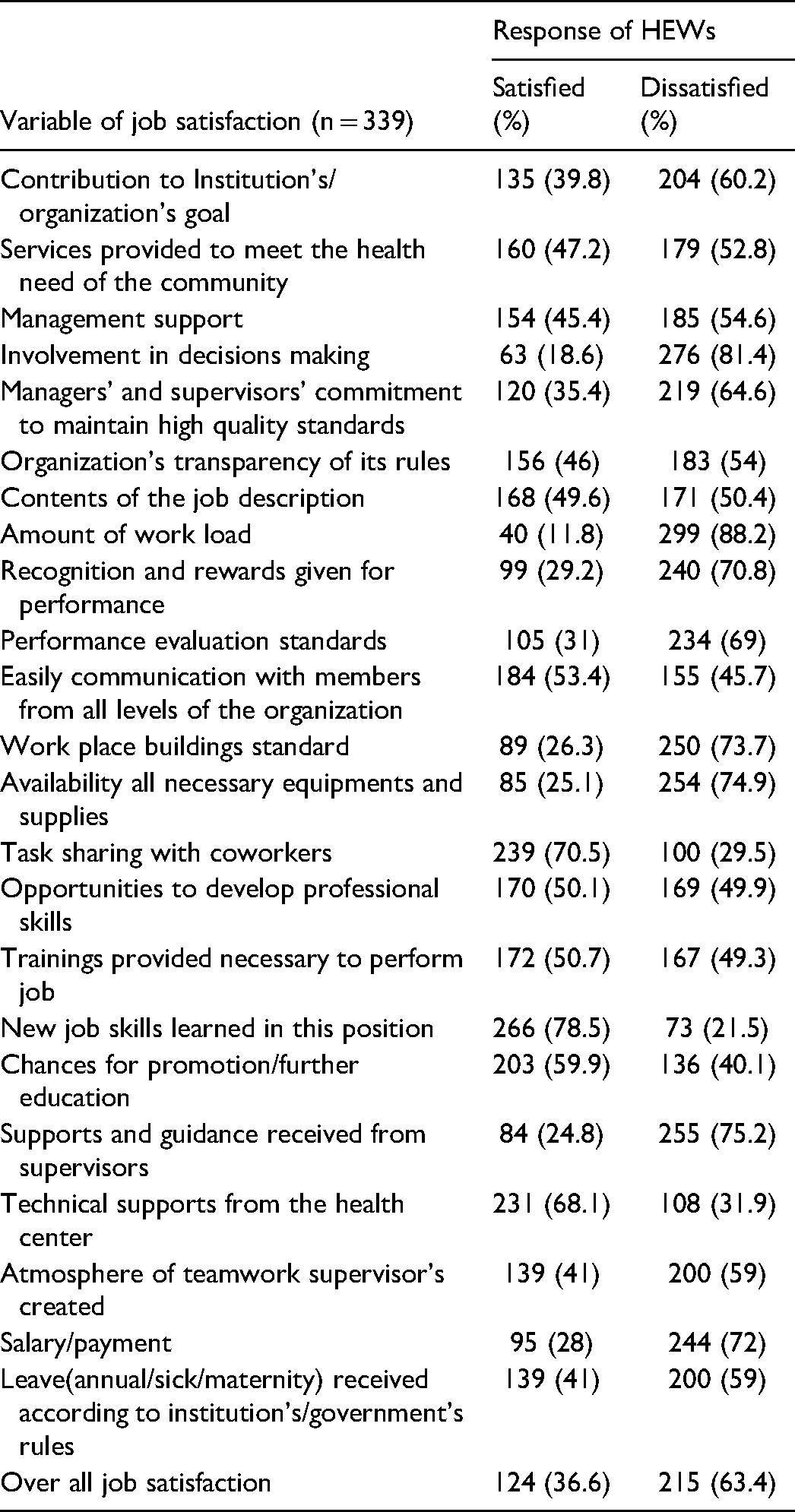
Similarly, the most frequently reported organizations related factors motivated respondents less likely were: the amount of workload 40 (11.8%), recognition and rewards given for performance 99 (29.2%), performance evaluation standards 105 (31%), organization's transparency of its rules 156 (46%), and contents of the job description 168 (49.6%). Two-hundred fifty (73.7%) respondents reported that they were dissatisfied with workplace buildings standard. Only eighty-five (25.1%) study participants were satisfied by the availability of types equipments and supplies necessary to their jobs (Table 2).
Two hundred sixty-six (78.5%) of the respondents reported they learned new job skills at current position. Concerning promotion and incentives, 170 (50.1%), 172 (50.7%), and 203 (59.9%) of respondents were satisfied by opportunities given to develop professional skills, training provided necessary to perform job, and chances for promotion/further education respectively. Only ninety-eight (28%) respondents satisfied by the salary paid to their current position whereas 139 (41%) reported they were satisfied by leave received according to institution's/government's rules (Table 2).
Factors Associated With Job Satisfaction
In the present study, both bivariate and multivariable logistic regression analyses were done to identify the predictors of job satisfaction level among HEWs. Eleven independent variables were associated with job satisfaction in bivariable analyses at P ≤ 0.25 were entered into multiple logistic regression models. In multivariable logistic regression analysis, availability of training opportunity (P < 0.0001), further education opportunity (P = 0.001), amount of current salary/payment (P < 0.0001), management support (P < 0.0001), and supervisor support (p < 0.0001) showed a significant association with job satisfaction level (Table 3).
A Multivariable Analysis Output of the Factors Associated with job Satisfaction among Rural Health Extension Workers, Sidama Region, Southern Ethiopia, 2021.
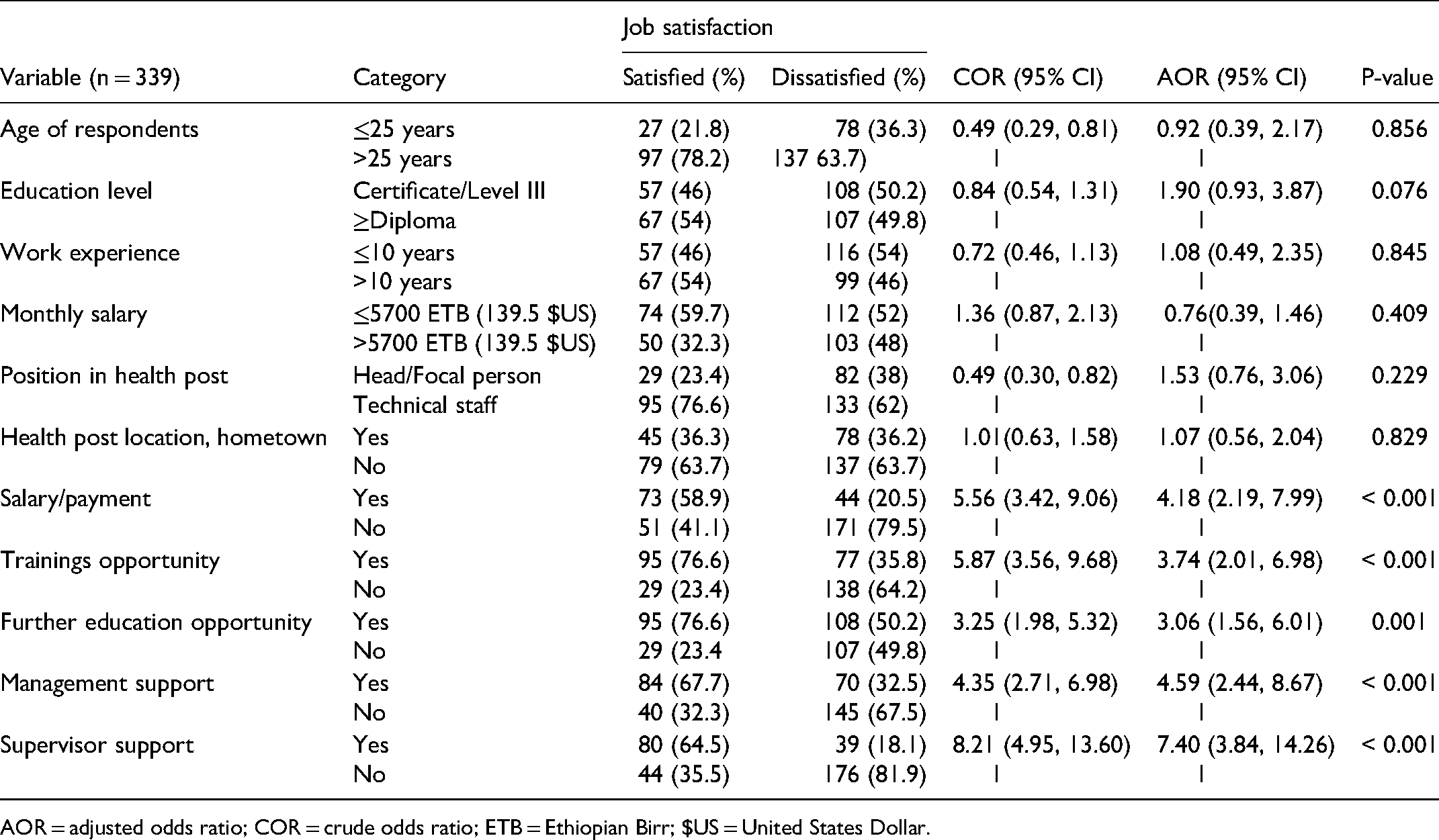
AOR = adjusted odds ratio; COR = crude odds ratio; ETB = Ethiopian Birr; $US = United States Dollar.
Accordingly, increased odds of satisfaction were observed in HEWs who got training opportunities (AOR: 3.74, 95% CI: 2.01, 6.98), further education opportunities (AOR: 3.06, 95% CI: 1.56, 7.46), management support (AOR: 4.59, 95% CI: 2.44, 8.67), supervisor support (AOR: 7.40, 95% CI: 3.84, 14.26), and a better salary/payment (AOR: 4.18, 95% CI: 2.19, 7.88) compared to their counterparts (Table 3).
Discussion
The result of this study presented that the overall level of job satisfaction of the rural health extension workers was 36.6%. This satisfaction level was higher than reports of previous studies conducted in the Shewa Zone of Oromia Regional State, 33 and, Nigeria. 34 This finding is comparable to studies done in West Ethiopia 35 and Pakistan. 36 It is lower than the satisfaction level reported from Gambella Region, 18 Harar City, 26 Northwest Ethiopia, 37 Southwest Ethiopia, 38 South Ethiopia, 39 public health facilities of Ethiopia, 29 and China. 40 This difference could be due to the difference in the study population, setting, time of the survey, socio-economic status, organizational policies including health workers handling, and infrastructure between the study setups.
This study revealed that health extension workers who received stimulating recognition from management were more satisfied with their job compared to their counterparts. This finding was in line with studies carried out in East Shewa Zone of Oromia Region, 33 Harar City, 26 West Ethiopia, 35 and Northern Ethiopia, 37 public health facilities of Ethiopia, 29 Kenya, 41 Eastern Cape, 42 and Iran. 43 This could be explained as recognition has the potential to motivate the HEWs, enhance their skills, create a good attitude toward achieving the common organizational goal, and finally make HEWs more likely satisfied.
Similarly, rural health extension workers who got adequate supportive supervision in their work were more likely to be satisfied as compared to their counterparts. This finding is in line with studies done in the East Shewa Zone of Oromia Region, 33 Northeast Ethiopia, 37 Gambella Region, 18 Kenya, 41 and, Nigeria. 34 This could be explained by the fact that adequate and effective supportive supervision can motivate HEWs leading to satisfaction on their job.
Regarding career developmental opportunities like training and further education, and performance-based salary increment, our study presented they were the strongest determinants of job satisfaction level of the rural health extension workers of the study area. This finding was comparable with the previous studies done in Ethiopia,35,38,44 and Pakistan, 36 and Nigeria. 34 The possible reasons for this could be the fact that training increases the self-confidence and self-esteem of health extension workers, and improves the quality of care that would significantly elevate the morale of HEWs in the organization.
Limitations of the Study
This study was aimed at determining job satisfaction level and associated factors among rural HEWs in the region. However, the study was not free from some limitations. This study was conducted among rural HEWs only, and, therefore, it might not be possible to generalize the findings to all health workers of the region. This study also lacked qualitative aspects in assessing the job satisfaction level among rural HEWs.
Conclusion and Recommendation
The job satisfaction level among rural HEWs in the study area was low. Strategies to stimulate and strengthen recognition of management, supportive supervision, performance-based regular salary increment, and career development were determinants of job satisfaction level. Thus, Ministry of Health of Ethiopia, and Sidama National Health Bureau coordinating with responsible bodies should develop strategies on the identified factors to enhance the job satisfaction level of rural health extension workers. Arranging opportunities for educational development is also one important strategy to enhance the workers’ satisfaction level.
Footnotes
Acknowledgments
The researchers would like to acknowledge Yirgalem Hospital Medical College for funding the study. Last but not least, we also like to acknowledge in heart the staffs of Sidama National Regional Health Bureau, the selected districts health office staffs, the study participants, the data collectors, and supervisors.
Authors’ Contributions
Study conceptualization: AB and AP; data curation: AB and AP; formal analysis: AB and AP, investigation: AB and AP; methodology: AB and AP; software: AB and AP; supervision: AB and AP; validation: AP and NY; writing the original draft: AB; review and editing: AB, AP, and NY.
Declaration of Conflicting Interests
The author(s) declared no potential conflicts of interest with respect to the research, authorship, and/or publication of this article.
Funding
The financial support for this study came from Yirgalem Hospital Medical College. The funding body was not involved in the collection, analysis, and interpretation of data and in the writing of the manuscript.
