




Abstract
This multicase study of two school districts examined the policy boundaries educational leaders frame to define and demarcate the policy issues relevant to mathematics. Drawing on interviews with district leaders, observations of policymaking, and collection of artifacts, I found that meanings (or discourses) about the school subject constrained policymaking for mathematics to student achievement concerns. Subject-neutral policies that treat all subjects equally or ignore subject-matter were sometimes enacted in mathematics-specific ways, but other subject-neutral policies—including equity-minded efforts—were excluded from mathematics. These findings show how even seemingly subject-neutral policies are sensitive to the school subject and the ways meanings about the subject render some policy issues relevant to mathematics while excluding others. The results of this study have implications for how educational leaders and researchers partnering with schools might challenge and reconstruct policy boundaries, especially in ways that allow for more equity-minded policies.
Keywords
We get comments from the community all the time, and not just [RockCity] schools, everywhere. Well, “you guys are doing things that—you should just be focusing on achievement. You’re doing all this stuff around mental health and restorative practices and all these other things. And you don’t need to be doing that.”
For Stone (2011), “Every idea about policy draws boundaries. It tells what or who is included or excluded in a category” (p. 36). Policy boundaries define, demarcate, and legitimize which policy issues are relevant to schools. In the opening quote, the district leader described some community members’ policy boundaries that include a focus on achievement while delegitimizing work on mental health and restorative practices. As another example, recent debates regarding equity, race, and gender in education legitimize certain topics as appropriate for schools while excluding other topics. Although education leaders are most powerful in influencing the direction of work (e.g., Coburn, 2006; Penuel et al., 2013), we know little about how they define policy boundaries for the educational systems they oversee. Greater understanding of the policy boundaries operating in schools can inform how education leaders and researchers partnering with schools might challenge and reconstruct boundaries, especially in ways that allow for more equity-minded policies.
Research has highlighted the role of the school subject in education policymaking (e.g., Burch & Spillane, 2003, 2005) and the ways the specific meanings, traditions, and histories of the subject shape how education leaders design and enact policy (Grossman et al., 2004). For example, scholars have described how the “new math” reforms that developed around the world beginning in the 1960s (Davison & Mitchell, 2008) were informed by each country’s “unique school mathematics—a product of its history, culture, and traditions, and conforming to its social, political, and educational systems” (Kilpatrick, 2012, p. 569). However, this emerging body of research, while offering insight into the complexities of policymaking in particular subjects, has not yet examined how policy boundaries are shaped by the unique social and cultural meanings attached to particular subjects. For example, mathematics is often viewed as an “abstract” and “ultra-rational” discipline (Ernest, 2004, p.11), where mathematical concepts are independent of the contexts in which they are applied (Crisan & Hobbs, 2019; Thanheiser, 2023). How might such views include or exclude issues of cultural responsiveness from policymaking for school mathematics?
In this study, I sought to provide insights into the ways education leaders from two school districts framed policy boundaries for mathematics education and when and how the subject-matter enters this boundary work. My findings show that even seemingly subject-neutral policies (Grossman et al., 2004) that treat all subjects equally or ignore subject matter (e.g., grading policies and policies for advanced courses) still unfold differently across different content areas and that meanings about mathematics render some policy issues relevant to the subject while excluding others. In the following, I describe the conceptual ideas orienting my analysis toward policy, boundaries, and subject-matter.
Conceptual Framings
Policymaking and Boundary Framing
I conceptualize policy as a discursive social practice involving meaning making about how things should or should not be (Levinson et al., 2009). This policy-as-discourse perspective (Ball, 1993) focuses on the ways policymakers employ discourse—meanings, assumptions, and ideologies reflected in and enacted through talk, text, and language (Gee, 2014)—to limit which policy issues are “possible or desirable, or . . . impossible or undesirable” (Bacchi, 2000, p. 49). In these ways, policy as discourse acts as a “boundary that cuts off parts of something from our view while focusing our attention on other parts” (Stone, 2011, pp. 252–253).
Boundaries are conceptual distinctions that define and categorize objects, ideas, and people (Lamont & Molnár, 2002). Categorizing identifies “things as a this but not a that” (van Hulst & Yanow, 2016, p. 99, emphasis in original), which creates “in-group/out-group distinctions” (Silver, 1997, p. 488). In emphasizing differences between groups (Jaworsky, 2016), boundaries act as a mechanism for social exclusion, which can reproduce inequity (Lamont, 1992). Boundary shifting—expanding or contracting boundaries—can foster access and inclusion (Cherry, 2010; Zolberg & Woon, 1999). Posselt et al. (2017), for example, found that one graduate physics program increased access for underrepresented students by expanding the boundaries defining the “best” physics student.
One way that boundaries are revealed or constructed is through frames. For Goffman (1974), frames condense complex social situations so that individuals can “locate, perceive, identify, and label” phenomena in their lives (p. 21). Social movement and collective action scholars have since borrowed this concept to consider how frames are deployed strategically to mobilize support and legitimize the activities of an organization (Snow & Benford, 1988). In policy analysis, frames and frame analysis have been employed to understand how individuals define the substantive content of a policy problem in different ways (e.g., Munter at al., 2023; Torres, 2023; Woulfin et al., 2016). Frames can be diagnostic (i.e., defining problems) or prognostic (i.e., offering potential solutions to a problem; Snow & Benford, 1988). In promoting a particular problem definition or solution (Entman, 1993), frames divert attention away from other potential problem definitions and solutions (Benford & Snow, 2000; Woulfin, 2015). Thus, a frame indicates the boundaries of a particular policy issue because it “opens up and legitimizes certain avenues of action and closes off and delegitimizes others” (Coburn, 2006, p. 344). Along these lines, this study examined how district leaders framed policy boundaries around mathematics education, to legitimize some problems and solutions as relevant for the subject while ignoring other problems and solutions.
Boundary framing (Silver, 1997) or boundary work (Gieryn, 1983) involves actors identifying unique characteristics of a group that distinguish it from other groups (Johnston & Baumann, 2007). Sex education curriculum, for instance, have been defined by heteronormativity and the dangers (rather than the pleasures) of relationships and sexuality (Harrison & Hillier, 1999). This boundary work legitimizes certain topics as appropriate while excluding other topics. With mathematics, defining the subject as “neutral” and “apolitical” (Ernest, 2018, p. 17) closes off providing opportunities for students to use mathematics to critique societal inequities (e.g., Gutstein, 2016). Negotiation can occur over objects and whether they fall inside or outside the boundaries (Gallo-Cruz, 2012). In defining the boundaries around protected student speech, for example, the U.S. Supreme Court deemed student speech inconsistent with school values as falling outside the boundaries (Ehrensal, 2012).
Boundaries can shift when individuals or objects (whether they are abstract or concrete) cross from one group to another, physically or discursively (Akkerman & Bakker, 2011). For example, thermodynamic theory acts as a boundary object when it crosses a variety of science and engineering disciplines, taking on unique meanings in each of those communities (Christiansen & Rump, 2008). Individuals also act as boundary crossers (or spanners) to bridge information among different communities, which can result in organizational learning and change (Farrell et al., 2022). In one school district, Brezicha and Hopkins (2016) found that a community-based organization served as a spanner between the school district and its community, helping facilitate the district’s uptake of more equity-minded policies.
Policymaking and the Mathematics Subject-Matter
Grossman et al. (2004) argued that school subjects operate as specific contexts for policymaking, where the subject-matter context filters how individuals make sense of and enact policy for the subject. Building on this theoretical foundation, researchers have documented the ways that subject subcultures in schools—characterized by unique norms, histories, and practices related to the subject—mediate teachers’ interpretation and implementation of policy (e.g., Elstad et al., 2019; Sutton & Knuth, 2020) as well as school and district leaders’ efforts to support instructional improvement and system-building (e.g., Burch & Spillane, 2003, 2005; Seeber et al., 2024). For example, mathematics and English are often considered the most core or important subjects in schools, receiving preferential treatment in instruction and curriculum reforms (Grossman & Stodolsky, 1995; Spillane & Hopkins, 2013).
Discursively, this paper takes that the subject-matter context shapes policymaking by providing dominant discourses (Fairclough, 2015) that render certain meanings about the subject as taken for granted and commonsense (Nguyen, 2024). Because discourse imposes limits on which policy issues are seen as possible or impossible (Bacchi, 2000), policies are more likely to be successful if they align with existing discourses (Coburn, 2006; Snow et al., 1986), whereas unsuccessful policy changes are those that contradict or are incompatible with the underlying discursive structure (Courtney & Mann, 2021). For example, researchers have found that education leaders often frame policy problems around high-stakes outcomes instead of student experiences or issues of equity (e.g., Feniger, 2020; Munter et al., 2023), likely because such frames connect to high-stakes accountability policies that privilege results over, say, relevance or student-centered teaching (e.g., Trujillo, 2013). Mathematics in particular is especially susceptible to such accountability policies because it is one of the most tested subjects (Dee et al., 2013), occupying one of the top positions in the subject hierarchy (Lynch & McGarr, 2016).
In what follows, I describe discourses about mathematics that might be dominant in schools’ mathematics subject-matter contexts and therefore shape boundary framing. In addition to discourses about mathematics as a core subject (described earlier), Burch and Spillane (2003, 2005) found two other dominant discourses about mathematics in policymaking: Mathematics is sequential, where prerequisite information must be mastered before progressing to more complex topics (Darby, 2007; Hargreaves, 1994; Sherin et al., 2004; Siskin, 1994), and mathematics is a well-defined discipline with agreement over what counts as mathematical knowledge (Crisan & Hobbs, 2019; Grossman & Stodolsky, 1995). Regarding the latter, that there is some sort of “truth content of mathematics” (Rowlands & Carson, 2002, p. 98) stems, in part, from the narrow focus of mathematical activity on abstraction, generalization, and the use of universal rules (Pais, 2011), where mathematical concepts are independent of the contexts in which they are applied (Crisan & Hobbs, 2019; Thanheiser, 2023).
Such boundaries between mathematical knowledge and cultural/contextual knowledge (Nasir et al., 2008) are, however, incompatible with mathematics instruction that is culturally responsive or takes a social justice approach, which involves drawing on students’ local knowledge (Civil, 2007; Enyedy & Mukhopadhyay, 2007) and engaging students in using mathematics to explore sociopolitical issues (Frankenstein, 1990; Gutstein, 2016) “meaningful to their lives” (Gutiérrez, 2012, p. 20). This aligns with what Gutiérrez (2012) called the “critical” dimensions of equity, particularly, issues of ‘identity’ and ‘power.’” When identity and power are considered, students can draw on their personal, cultural, and linguistic resources when participating in schools, especially in ways that provide them with a voice. From such a perspective, mathematics is a human activity (Obreque & Andalon, 2020; Thanheiser, 2023) for engaging in social, cultural, and political work (Rubel, 2017), which necessitates that mathematics teaching involves supporting students’ identities as doers of mathematics (Aguirre et al., 2013).
However, when mathematics is understood as universal and objective, and therefore neutral, value free, and color-blind (Ernest, 2018), mathematical ability is constructed as innate and fixed (Hottinger, 2016), with “normal” differences in students’ needs and capacities (Oakes et al., 1997). This perspective rationalizes that only some students are successful in mathematics, which legitimizes the ranking of students along a mathematical sequence from “basic” or “below grade level” to “advanced” or “honors.” Researchers have found that tracking and ability grouping practices are more common in mathematics than in other subjects (Grossman & Stodolsky, 1995; Grossman et al., 2004) because many mathematics teachers view tracking as meeting students’ varied needs (Siskin, 1994) and perceived mathematical abilities (Horn, 2007).
However, for Oakes et al. (1997), tracking is reinforced by norms about race and class that interact with fixed conceptions of intelligence to maintain racial sorting and segregation. Indeed, a racial hierarchy of mathematics ability exists that positions African American, Latinx, and Native American students as less mathematically capable (Martin, 2009), whereas the “White male math myth” (Stinson, 2013) reinforces views that mathematics is a discipline in which the successful are White middle-class males (Ernest, 2018). Such hierarchies of students and their mathematical competence are linked to and reinforced by mathematics-as-sequential discourses, which likely have intensified in recent decades with neoliberal pushes for standardization and accountability. For example, calls for measures of proficiency have produced language for ranking children (e.g., “on track” or “behind”; Adiredja & Louie, 2020), where such hierarchies of students are legitimized through high-stakes testing that translates learning to “objective” numbers (e.g., test scores; Taubman, 2010; Yeh et al., 2021).
With mathematical knowledge so well defined, it is unsurprising that calls for equity in mathematics have focused primarily on issues of achievement. In educational policymaking, this has manifested as a tunnel-vision focus (Feniger, 2020) on standardized outcomes, overlooking the ways students experience schools (Munter et al., 2023) or critical issues of identity and power (Gutiérrez, 2012). Gutiérrez (2008) described this narrow focus on achievement disparities between student groups as a “gap-gazing fetish,” which contributes to deficit discourses about historically marginalized students (e.g., Carey, 2014; Valencia, 2010). For Adiredja (2019), deficit discourses about students are interconnected with cultural views about mathematics as objective, where the privileging of formal mathematical knowledge makes invisible student’s informal and developing understandings. Yet, beyond issues of achievement, educational policy discourse continues to purport a dichotomy between equity and mathematics education (Aguirre et al., 2017). For example, in the Common Core State Standards, mathematical content and skills are literally separated from equity through separate application documents for supporting specific student groups.
Policy Boundaries and the School Subject
For Thanheiser (2023), “how we define mathematics determines what we might include/exclude” (p. 1). This study integrates ideas about subject-matter, policy, and boundary work to examine how discourses about the subject shape the ways districts frame boundaries to legitimize some policy issues as relevant to the subject while excluding others. To understand how particular policies might be positioned relative to a subject’s policy boundaries, I draw on the distinctions by Grossman et al. (2004) of the three different relationships that policymakers try to establish between policy and subject-matter in their policy designs.
First, schools engage in subject-neutral policies that, by design, treat all subjects equally or ignore subject-matter. For example, policies concerning nutrition, transportation, and school safety ignore subject-matter, whereas policies for student–teacher ratio apply equally across all school subjects. Second, subject-specific policies target a specific subject without regard to others. By contrast, subject-differentiating policies explicitly set priorities among multiple subjects. For example, while adopting new curricular materials for mathematics (mathematics-specific policy) supports mathematics instruction without regard to other subjects, allocating more minutes in the instructional schedule to mathematics than social studies or science (mathematics-differentiating policy) treats mathematics differently than other subjects, reflecting discourses that the subject is more core. Although subject-differentiating policies sometimes intentionally distinguish between school subjects (as in the example of instructional minutes), other subject-differentiating policies might prioritize one subject without mentioning others (e.g., providing instructional coaches only for mathematics).
Regarding classroom teaching and learning, instructionally focused policies can be any of the three types. For example, policies promoting a set of high-leverage or core practices (e.g., Forzani, 2014) for all teachers to enact regardless of content area are subject neutral because they treat all subjects equally. Policies that require additional assessments in mathematics and English are subject-differentiating, whereas policies to support teachers’ facilitation of discourse in mathematics classrooms through new professional development are mathematics-specific because they ignore other subjects.
The emerging research on the role of subject-matter in policymaking has focused primarily on subject-specific or subject-differentiating policies. For example, researchers have found that schools often privilege mathematics and literacy/English language arts over other subjects through subject-differentiating policies that provide additional resources to those subjects (e.g., Burch & Spillane, 2003, 2005; Spillane & Hopkins, 2013). Less research, however, has been focused on subject-neutral policies, even though researchers have argued that subject-neutral policies unfold differently across content areas because the subject-matter context filters different meanings for the same policy (Grossman et al., 2004). This highlights a distinction between policy intention/design and policy enactment. Although subject-neutral policies are intended to ignore subject-matter or treat subjects equally, in enactment, such policies can cross into the boundaries of specific subjects and take unique meanings in each. For example, in examining 5 years of a school’s initiative to adopt project-based learning (PBL), Sutton and Knuth (2020) found that while the social studies department adopted PBL policies by the end of the initiative, the English department had abandoned PBL. The researchers suggested that the extent to which departments adopted PBL was shaped by “the extent to which the underlying principles of PBL aligned with each department’s teaching culture” (p. 118).
Although there has been some research on teachers’ implementation of subject-neutral policies, less is known about how education leaders and policymakers frame such policies in relation to subjects’ policy boundaries. This paper contributes to this gap by highlighting the role of the mathematics subject-matter in school district leaders’ boundary work. Figure 1 represents how this study understands policy boundaries for mathematics (represented by a dashed circle) as demarcating subject-neutral policies outside the boundaries from mathematics-specific policies and mathematics-differentiating policies (that prioritize mathematics over other subjects) inside the boundaries. Through the mathematics subject-matter context, dominant discourses about the subject (represented by the gray box) render certain meanings about the subject as taken for granted and commonsense. Dominant discourses about mathematics include those previously described related to the subject’s core, sequential, and well-defined nature. In boundary work, these discourses serve two functions (represented by gray arrows): (a) framing mathematics’ policy boundary and therefore defining what is included as mathematics-specific and mathematics-differentiating policies and (b) crossing some subject-neutral policies into mathematics by assigning unique mathematics-specific meanings. Some subject-neutral policies cross and are legitimized as relevant to the subject, whereas others are ignored and excluded from the subject’s policy boundary.

Conceptual framework.
Informed by these ideas, this study sought to answer two research questions: (1) In what ways are the policy boundaries around mathematics education framed in school districts? and (2) How are discourses about school mathematics enacted in such boundary framing? In so doing, this paper makes two main contributions to research on educational policymaking. First, in making visible the policy boundaries operating in schools, this study reveals how subject-neutral policies are still sensitive to the school subject, as some policy issues are legitimized in mathematics, while others are excluded. Second, in highlighting discourses about school mathematics, this study provides insights into why boundaries are sometimes crossed for a subject and yet other times are impervious to change. In so doing, I provide implications for how researchers and education leaders might challenge and reconstruct boundaries, especially in ways that allow for more expansive and equitable policymaking in mathematics.
Methods
District Contexts
This paper draws on data from a larger research project involving a multicase study of two school districts in the same U.S. Midwestern state: RiverTown and RockCity (pseudonyms). Case study is particularly appropriate for investigations where distinguishing between the case and context is not clear (Yin, 2015), as in this study, where policymaking and boundary framing operate within broader discursive contexts, including that of the school subject. RiverTown was situated in a small, rural community comprised of almost 8,000 residents. Across four schools (grades pre-K–2, 3–5, 6–8, and 9–12) and one technical education center, RiverTown served almost 1,500 students. By contrast, RockCity was situated in a much larger micropolitan community of >125,000 residents, serving almost 18,000 students across 34 schools. Although RiverTown’s students were predominantly White and low income, the RockCity student population was more racially and economically diverse. Table 1 provides student demographic information.
Demographic data for RiverTown and RockCity in 2022
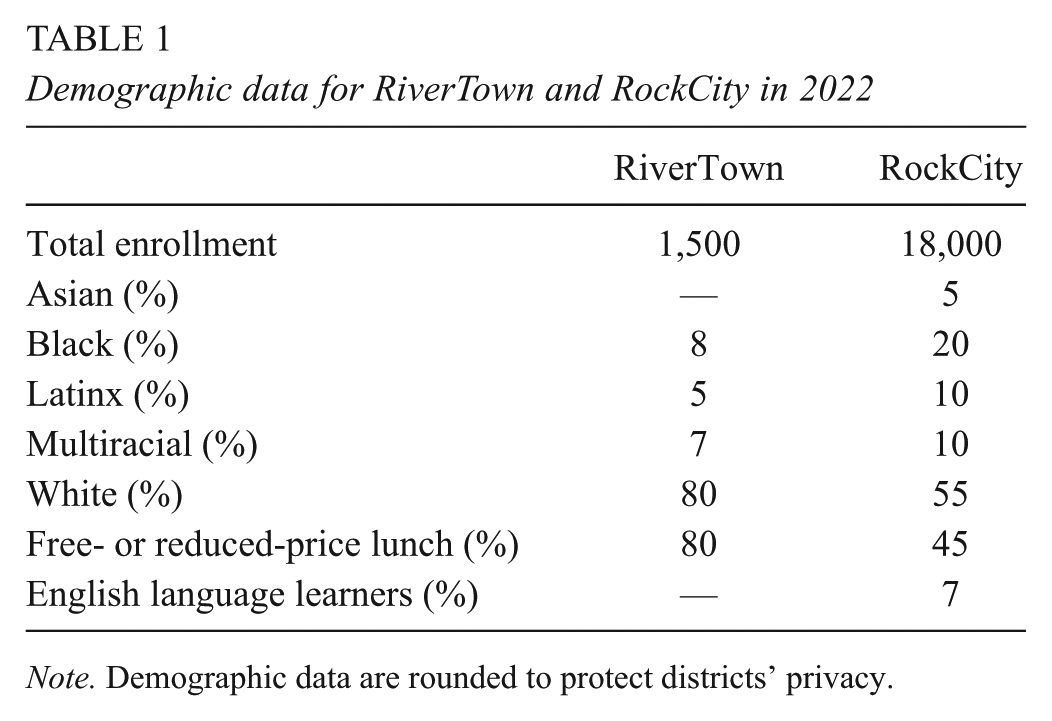
Note. Demographic data are rounded to protect districts’ privacy.
For the 2020–21 academic year (the time of case selection), both districts performed below the state average on the annual standardized mathematics assessments. In the state RiverTown and RockCity were situated, students in grades 3–8 were tested annually in mathematics and English language arts as well as science in grades 5 and 8. Typically during grades 9–12, students had end-of-course exams for Algebra I, English II, Biology, and Government.
One goal of the larger research project was to investigate the dominant discourses about school mathematics that characterized each district’s subject-matter context (Nguyen, 2024). This earlier analysis revealed that both RiverTown and RockCity’s mathematics subject-matter contexts were characterized by dominant discourses about school mathematics as a core, sequential, and well-defined subject. First, mathematics was considered a core subject because it was heavily tested and mathematical skills were perceived to be useful in other contexts (e.g., college and career). Second, mathematics was viewed as sequential, where mastery of prerequisite skills is necessary for learning more complex topics. Third, mathematics was understood to be a well-defined subject with agreement over the content because mathematics is objective, skills-based, and “black and white.” Although discourses about mathematics as a core, sequential, and well-defined subject were frequently employed by district leaders, written in policy texts, and enacted in district-wide practices for assessment, intervention, and tracking, discourses about equity and mathematics pedagogy were less common. Building on this, this study examined how these dominant discourses about the subject were enacted in framing the policy boundaries around mathematics.
Data Collection
Data collection occurred between January 2022 and January 2023, consisting primarily of 30 semistructured 1-hour interviews with 16 leaders from the two districts. All interviews were audio recorded and transcribed. I also conducted >160 observation hours of district policymaking (e.g., board meetings, district leadership meetings, mathematics team meetings), where I recorded detailed field notes on the substance of the meetings as well as participants’ interactions during them (including some direct quotes). Finally, I collected 156 relevant artifacts (e.g., district strategic plans and reports, meeting agendas and presentations, curricular documents, internal newsletters, public communications).
I interviewed participants twice, at the beginning and end of data collection. At RockCity, I interviewed the assistant superintendents of elementary and secondary education; the chief equity officer; the director of school improvement; the director of the assessment, intervention, and data office; the director of the curriculum and instruction department; and the elementary and secondary mathematics coordinators. With a small central office, RiverTown had no specialized units nor leaders explicitly charged with supporting mathematics education. So I interviewed the superintendent; the chief academic officer; the district instructional coach; principals of the pre-K–2, 6–8, and 9–12 buildings; the assistant principal of the 3–5 building, and the director of the technical education center. The RiverTown 3–5 building assistant principal and the RockCity assistant superintendent of elementary education only participated in the first interview.
Guided by a set of questions (Brenner, 2006), interviews were semistructured so that I could be responsive to individuals and emerging topics (Merriam & Tisdell, 2016). The first set of interviews was conducted in person at the district and elicited participant’s (a) responsibilities, (b) perspectives on perceived challenges and policies in the district, (c) views (i.e., discourses) and perceptions of the district’s and others’ views about school mathematics, and (d) interactions with others in the district (which informed observations). Appendix A outlines the first interview questions. The second set of interviews was conducted via Zoom because these interviews involved graphic elicitation (Bagnoli, 2009; Bravington & King, 2019), the use of diagrams to elicit conversation and participant sensemaking.
Graphic elicitation is helpful when communication about complex ideas can be aided by visuals. In my study, I shared with participants a diagram (Figure 2) I constructed that represented my initial conjectures on the district’s policy boundaries and elicited their sensemaking about and interactions with the diagram. The diagram was constructed based on analysis of the first round of interviews, observations, and policy artifacts up to that point (data-analysis techniques will be further discussed in the next section). The creation of the diagram was iterative (Crilly et al., 2006), where I experimented with different shapes, sizes, and colors and the arrangements of these objects. Here, I considered the extent to which the diagram accurately and accessibly facilitated communication of my emerging findings, which triggered new ideas and informed revisions (Bennett, 2002). For example, interviews confirmed my conjecture that the metaphor/image of circles would help elicit participants’ boundary work regarding why some policies prioritized some subjects over others based on where policies fell alongside (inside/outside) the subject’s circle.

Diagram used for graphic elicitation interviews with (a) RiverTown and (b) RockCity leaders.
To support participants’ sensemaking of the diagram, I sequentially revealed aspects of the diagram through a series of slides, and for each layer, I provided a brief verbal explanation of what the objects and labels referred to (and not why I constructed the diagram the way I did). Appendix B provides the second interview questions, and the sequence of the slides. At each slide, I invited participants to share their reactions. Specifically, I probed individuals’ perspectives on (a) the accuracy of the boundaries and where policies were positioned relative to those boundaries and (b) their sensemaking about the ways boundaries and policies were framed in relation to the school subjects. I also invited participants to physically interact with the diagram by regrouping policies as well as creating new boundaries (i.e., circles). As such, graphic elicitation served as a form of respondent validation (Merriam & Tisdell, 2016), where I solicited feedback on emerging findings.
Data Analysis
To uncover districts’ policy boundaries (Research Question 1), my analysis began with identifying policies that were the object of ongoing framing (Benford & Snow, 2000; Coburn, 2006). I considered a policy to be a source of ongoing framing if multiple people or artifacts referenced the policy and/or it was the topic of conversation in multiple observations. Then, informed by the distinctions offered by Grossman et al. (2004) described earlier, I categorized each policy based on its relationship to school mathematics: mathematic-specific policy, mathematics-differentiating policy, or subject-neutral policy. Then I wrote analytic memos about the ways mathematics-specific policies, mathematics-differentiating policies, and subject-neutral policies were discursively described in different ways (Dubuisson-Quellier & Gojard, 2016; Jaworsky, 2016). This helped to create initial conjectures for policy boundaries that were operating in the district, which were used to construct the diagram for graphic elicitation. Then, I analyzed the graphic elicitation interviews and compared them with the preceding data-analysis round to refine and revise those diagrams (Figure 3 shows the final diagrams).

Policy boundaries at (a) RiverTown and (b) RockCity.
From all data collected, I wrote analytic memos about how policies within the same boundary were framed in similar ways and how those framings differed from policies outside the boundary. This helped me to establish characteristics for in-group status (Gieryn, 1983) for each boundary. Starting with initial open codes (Corbin & Strauss, 2015), I considered how specific polices did or did not meet those characteristics (Gallo-Cruz, 2012), which helped me to iteratively refine my codes. I also examined boundary crossing (Akkerman & Bakker, 2011) and the ways that subject-neutral policies discursively moved across boundaries to take on unique meanings across the subjects.
For Research Question 2, I employed the methodologic tools of discourse analysis to analyze how different discourses about school mathematics were employed in boundary framing. In policy research, discourse analysis is useful for uncovering the ways discourses make possible and available specific ways of understanding policy issues (Anderson & Holloway, 2020; Lester et al., 2017). In this study, discourse analysis was helpful for understanding how discourses about school mathematics—language, text, and talk about the subject—filtered and provided unique meanings for making sense of policy issues in the subject.
Drawing on the dominant discourses about mathematics found in each district described earlier (i.e., discourses about mathematics as core, sequential, and well defined), I examined whether certain discourses were employed to (de)legitimize particular policies for mathematics and how differences in school subjects were used to rationalize differences in policymaking. Table 2 provides analysis examples for policy boundary framing. Here, I considered how policies aligned with individuals’ personal discourses about mathematics or invoked social discourses about the subject (e.g., Coburn, 2006). Inversely, I considered whether certain policies were incompatible with dominant discourses about mathematics (e.g., Courtney & Mann, 2021). Through an iterative approach, I developed hypothetical statements for the mechanisms through which discourses about school mathematics were enacted in boundary work, constantly revising my hypothesis and clarifying the instances when mechanisms were (not) applicable.
Examples of qualitative analysis of policy boundary framing

Findings
In investigating RiverTown’s and RockCity’s policy boundaries for mathematics, I found that three main mechanisms in which dominant discourses about mathematics as a core, sequential, and well-defined subject were enacted in boundary framing. Specifically, dominant discourses (a) framed policies for the subject around the problem of student achievement, while gatekeeping which subject-neutral policies became relevant to the subject by (b) crossing some subject-neutral policies into mathematics and (c) excluding others. In RiverTown and RockCity, these mechanisms operated on mathematics’ policy boundary, in addition to other subjects’ policy boundaries and a classroom instruction boundary. These boundaries are represented in Figure 3 with dashed circles, where the boundary name is written in italicized text.
In addition to mathematics-specific policies that targeted the subject without regard to others (e.g., adoption of new mathematics textbooks), the policy boundary for mathematics included mathematics- and ELA-differentiating policies that directed additional resources to these subjects and not others (e.g., intervention, tutoring at RiverTown, and instructional coaching at RockCity). These subject-differentiating policies existed at the pink intersection between the boundaries of mathematics and ELA and reflected a finding that emerged early in my data collection: the two subjects were prioritized in policymaking because they were the most core and tested. Outside specific subjects’ policy boundaries were subject-neutral policies that, by design, treated all subjects equally or ignored subject-matter. I found that subject-neutral policies were more likely to cross into mathematics (i.e., take on unique meanings in the subject; represented in Figure 3 by the italicized and color-coded names of the policies) if they were already inside the classroom instruction boundary. This boundary included subject-neutral policies that directly affected classroom teaching and learning (e.g., standards-based grading and tracking) while excluding other subject-neutral policies that indirectly affected instruction (e.g., attendance and behavior). Notably, in both districts, equity-minded policies (i.e., equity trainings at RockCity and sense of belonging at RiverTown) were subject-neutral and excluded from mathematics.
The following sections are organized by these two policy boundaries defining mathematics education and classroom instruction. After first describing the boundary, I explain the corresponding mechanisms through which discourses about school mathematics were enacted in framing the boundary or policies in relation to the boundary.
Mathematics’ Policy Boundary
Inside the classroom instruction boundary were boundaries for specific subjects, including mathematics, ELA, and other subjects. For mathematics, the policy boundary was narrowly framed around the problem of student achievement—as measured by a variety of different data sources—because it was one of the most tested subjects. For example, the RiverTown instructional coach explained: We’ve seen a trend in some of those standards we teach for math and ELA to be lower than others, and so those help us identify areas for growth. For [state] testing, we can see the number of students that are scoring at “below basic,” “basic,” “proficient,” or “advanced.” And when you have a large number of kids scoring in a certain level in ELA or math, that makes you think “okay, maybe we need to make that an initiative.” To help boost those scores (interview).
Recall that in RiverTown and RockCity, mathematics was understood as a well-defined subject because it was objective and neutral. This allowed mathematical knowledge to be abstracted and quantified with test scores, where language from accountability policies constructed a sequence of mathematics learning—from “below basic” to “advanced.” The number of students who were on the “basic” end of that sequence indicated to the district the subjects that were “areas for growth,” where growth was simply “boosting those scores.” This blending of accountability language with mathematics as core, defined, and sequential discourses served to narrowly define mathematics initiatives around the problem of achievement.
That is, achievement was constructed as a criterion for in-group status, where policies included inside the mathematics boundary directly addressed student achievement and specifically targeted mathematics as a priority subject. In the following, I provide examples of this mechanism, where district leaders engaged in boundary work to rationalize certain policies as meeting this achievement criterion for in-group status.
Mechanism 1: Constructing Achievement as Criterion for Mathematics-Specific and Mathematics-Differentiating Policies
In both districts, mathematics and ELA received additional resources and attention that were not available to other subjects through mathematics- and ELA-differentiating policies (e.g., intervention, progress monitoring at RockCity, and tutoring at RiverTown). For example, through federal and state funding (from the U.S. Elementary and Secondary Schools Emergency Relief grants), RockCity hired instructional coaches for ELA and mathematics at the elementary school level. Mathematics was specifically targeted because, according to the assistant superintendent of elementary education, “Math has really taken a hit right now. Guess what we did. Hey, hire instructional coaches for it” (interview). So, coaching fell within the policy boundaries of mathematics because it met the criterion of supporting student achievement.
Across both districts, intervention also addressed student achievement, targeting mathematics and ELA. Mathematics was targeted in RockCity and the RiverTown high school but not in the RiverTown elementary and middle schools because, according to the RiverTown grades 3–5 building assistant principal, “We decided to do reading because we’ve looked at our [state assessment] scores, and that’s one focus that we really need to work on. Because really, if you can read, you can do other subjects.” Here, ELA was prioritized over mathematics not only because of achievement concerns but also because literacy was perceived to be more core given that it is important for learning other subjects. So, mathematics was targeted for intervention when achievement scores indicated a problem, such as at RiverTown high school where “Math Labs,” an elective that students took in conjunction with their core mathematics classes, addressed students’ “skill deficit” (RiverTown high school principal, interview) based on standardized test scores. Intervention was perceived to be particularly necessary in mathematics because “math is unique in that one skill builds upon the next, like building blocks [and] . . . math is very black and white so it’s easy to see, in regard to you can’t do fractions, you can’t do fractions.” According to the high school principal, since mathematics is well defined (“Math is very black and white”), teachers can visibly identify which students need additional support (“You can’t do fractions”). This mathematics intervention, however, needed to mirror the subject’s sequentiality (“One skill builds upon the next”), where students master prerequisite topics in Math Lab before learning newer content in their core course.
As with mathematics-differentiating policies, mathematics-specific policies also addressed the problem of achievement. At RockCity, in a meeting deciding new curricular materials for elementary mathematics (observation: December 2022 elementary mathematics curriculum meeting), the elementary mathematics coordinator suggested that the district might select materials “more focused on conceptual understanding and going deeper, instead of just about answers and computations.” The assistant superintendent of elementary education responded: I don’t disagree with anything that you’re saying. Our student outcomes, when we talk about starting the academic school year out with, for instance, I’m just going to use the iReady [district assessment] as a metric. Less than 10% [of students] have a level of proficiency. . . . So I think the question is understanding philosophical differences with regard to, are we looking at the process of the students’ learning versus the outcome of student learning. We’re still being held accountable to those outcomes.
Although the assistant superintendent acknowledged issues of pedagogy (“philosophical differences with regard to . . . the process of the students’ learning”), they explained that such instructional issues were overshadowed by the student learning outcomes that the district is held accountable to (from the state, community, etc.). Here, accountability discourses penetrated district policymaking to narrowly constrain curricular policymaking to achievement concerns (rather than instructional quality) because mathematics is a core and heavily tested subject.
While achievement and student learning often were measured by standardized test scores, RockCity leaders were also concerned with course-taking patterns. The mathematics coordinators in particular partnered with a local nonprofit organization to support the enrollment of students of color in advanced mathematics courses (artifacts: 2021–22 and 2022–23 strategic plans for both coordinators). Although there was some concern here about equity, policy attention was constrained to “gap-gazing” (Gutiérrez, 2008) between the participation of White students and minoritized students in advanced mathematics courses.
Overall, across both RiverTown and RockCity, mathematics-as-core discourses provided resources for making sense of policy issues (low achievement) and in which subject this issue was a problem (mathematics and ELA, because they are the most tested). Here, the problem of achievement also constrained equity concerns to gaps in advanced coursework. Interacting with mathematics-as-core discourses also were discourses about mathematics as a sequential and well-defined subject, which rendered the subject especially compatible with accountability and intervention structures that narrowly defined mathematical competence through test scores along a sequence from “below basic” to “advanced” students.
Classroom Instruction Policy Boundary
In addition to policies for specific subjects, RiverTown and RockCity engaged in subject-neutral policies that ignored subject-matter or treated subjects equally. In framing subject-neutral policies, district leaders distinguished between policies that directly affected classroom instruction (e.g., instructional coaching; science, technology, engineering, and math [STEM]; rigor) from those that only indirectly affected instruction (e.g., attendance, behavior, students’ mental health). Separating these two sets of policies was the “classroom instruction” boundary, summarized by the RiverTown director of technical education as “They’re kind of opposite sides of the spectrum. So here [outside the instruction boundary] are the things that we’re seeing that are not really related to teaching and learning. And then these [inside the instruction boundary] are the things that are related to teaching and learning” (interview).
In framing this boundary, district leaders explicitly discussed that issues indirectly affecting teaching and learning needed to be addressed prior to effective classroom instruction. For example, the RockCity director of curriculum and instruction shared that you have to Maslow before you can Bloom. You have to get them ready to learn before they can access the learning. You could put all of these things in place as far as high-level instructional strategies, but if you can’t get them there and engaged, it doesn’t matter [interview].
Here, getting students “ready to learn” (i.e., efforts that address Maslow’s hierarchy of needs; Maslow, 1943), such as supporting attendance and behavior (“If you can’t get them there and engaged”), was perceived to be prerequisite to high-quality instruction (i.e., efforts that address Bloom’s taxonomy; Bloom et al., 1956). This served to position such efforts outside the classroom instruction boundary.
Inside the “classroom instruction” boundary (but outside the subject-specific boundaries) were subject-neutral policies directly supporting teaching and learning. For example, at RiverTown, instructional coaching focused on the Artisan Themes of Teaching, a set of instructional practices promoted as being applicable across all subjects (artifact: May 2022 instructional coach presentation to the board). Sometimes, however, subject-neutral instruction policies unfolded differently across content areas, crossing into specific subjects and taking on different meanings in each. For instance, although RockCity’s efforts to support “Tier 1” instruction (i.e., high-quality whole-class instruction) involved a set of high-yield instructional strategies for all subjects (artifact: instructional walks observation tool), content coordinators provided professional development that highlighted and supported implementation of different Tier 1 strategies for their specific subjects (artifact: November 2022 secondary professional development schedule).
As another example, to support standards-based grading at RiverTown and standards-referenced grading at RockCity, district leaders worked with teacher teams to develop proficiency scales, priority standards, and common assessments for each content area. At RockCity, whether assessments took the form of tests (as in mathematics) or projects (as in art) depended on what performing looked like in each subject (observation: May 2022 secondary standards-referenced grading meeting). In the following, I describe the two remaining mechanisms through which discourses about school mathematics were enacted in leaders’ boundary work to negotiate whether subject-neutral policies crossed and took specific meanings in mathematics.
Mechanism 2: Crossing Some Subject-Neutral “Instruction” Policies into Mathematics
Subject-neutral policies often crossed into the mathematics policy boundary when the mathematics subject-matter context produced meanings of mathematics as the priority subject. For example, a recent policy effort at RiverTown was to increase rigor through “enrichment courses” and “other extended learning opportunities” (artifact: 2021–26 continuous improvement plan). The high school in particular was adopting more Advanced Placement (AP) and dual-credit courses for each of the core curriculum subjects, which included mathematics, ELA, science, and social studies (observation: July 2022 board meeting).
Although the rigor policy applied to all core subjects, the order in which subjects were assigned an AP course revealed that subjects were not treated equally. Specifically, mathematics was prioritized, with calculus as the first AP course offered in RiverTown (during the 2022–23 academic year). For the high school principal, this was because the AP exam is very skill-based attainment in the math portion. In the literature portion, in U.S. history, it’s very subjective about what gets covered on the test year to year. The math is—you know kids are going to have to do these things. Whereas you have 100 multiple choice questions of any area of American history, it can be very subjective. So we feel like we have a better chance to be successful with our students in math. And gateway math skills dictate whether students are successful in college or not [interview].
Here, mathematics as core discourses—because “gateway math skills” are important for college—intersected with mathematics-as-defined discourses. Regarding the latter, not only was mathematical activity seen as “very skill-based,” there also was clarity on what will be assessed on the AP mathematics test. By contrast, because literature and history were more “subjective,” these subjects were deprioritized as the target for the first AP course. In fact, ELA and U.S. history were the last planned AP courses (observation: July 2022 board meeting), with AP physics next up for adoption. Here, mathematical skills were considered important for science learning—another reason mathematics was considered a core subject—because physics was seen as a “mathematically-based study of the laws and principals that govern the universe” (artifact: high school career and educational planning guide).
In both districts, tracking was another subject-neutral policy that crossed and took unique meanings in mathematics. Although the policy to assign students to different tracks applied to all the core subjects, tracking still unfolded differently across subjects, with the earliest and most acceleration opportunities in mathematics. RiverTown and RockCity leaders employed a combination of mathematics-as-core, mathematics-as-sequential, and mathematics-as-defined discourses to explain this increased tracking in mathematics. For example, the RockCity curriculum and instruction director shared that “when you say advanced math, people say things like algebra, geometry, calculus, those kinds of things. Whereas ELA, what’s advanced for ELA is defined by 45 different ELA people. Is it British literature? Is it more intensive American literature?” (interview). Here, the curriculum and instruction director explained that there was an agreed-on sequence for how mathematical topics progress—from algebra, to geometry, to calculus. By contrast, what is considered advanced ELA varied from person to person. This definition and sequentiality distinguished mathematics from other subjects, rationalizing increased tracking.
Moreover, mathematics had a special status with families and community members, which reproduced social discourses about the core function of mathematics. For example, in explaining why RiverTown received community resistance for previously not offering Algebra 1 in eighth grade, the superintendent shared I received phone calls from parents about why there wasn’t an Algebra 1 class offered in eighth grade. I’m like, I don’t know. I was just told this is what we were going to do. And I think parents are used to that model. It is seen as a status thing. If your child is placed in algebra, then obviously they are a gifted, bright student [interview].
That parents “used to that model” were concerned when the district did not offer eighth grade algebra suggests that tracking was important to the community because algebra functioned as a form of social status that positioned students in the accelerated mathematics track as “gifted, bright.” Such indicators of mathematical competence were only possible when there were nongifted students in the lower track, where such exclusion of students constructed mathematics as a scarce, economically valuable resource (Pais, 2014; Straehler-Pohl & Pais, 2014).
Alluding to this exclusion of students, five RiverTown and RockCity leaders described tracking as a mechanism for segregation. For example, one RockCity director explained that “without a lot of careful monitoring, it can also become a have and have-nots, and it becomes a way of almost having non-minority classes and minority classes. . . . It becomes almost segregation, almost an unforeseen consequence” (interview). Although tracking operated across many subjects in both districts, it crossed the most into mathematics—in the form of early and increased acceleration opportunities. Reproduced by discourses about mathematics as a core, sequential, and well-defined subject, tracking constructed meanings about advanced courses as a form of social status for students and families. Advocation for and hoarding of this mathematical social status resulted in segregation and the perpetuation of the racial hierarchy of mathematical ability (Martin, 2009).
Mechanism 3: Excluding Other Subject-Neutral Policies from Mathematics
Although subject-neutral “instruction” policies often crossed into mathematics (as described earlier), there were some exceptions, such as RockCity’s efforts to support place-based learning—engaging students in learning through the places, ecologies, and communities they live. Several RockCity leaders explained that they “feel like there’s just more opportunities out there with science and social studies, or they’re more accessible. Like math, when we think of it, we think of doing problems” (secondary mathematics coordinator, interview). Here, narrow definitions of mathematical activity as doing problems inside the classroom prevented meaning making about the contexts and places in which mathematical concepts could be applied. This contrasted with science learning in the outdoor classroom and social studies instruction through the city’s African American Heritage Trail (artifact: fall 2022 RockCity curriculum and instruction newsletter). Discourses about mathematics as context-free, where mathematical activity is focused on abstraction and generalization, rendered place-based learning as incompatible with mathematics, outside the subject’s boundaries.
In addition, subject-neutral policies that indirectly affected teaching and learning were excluded from the “classroom instruction” boundary and the mathematics policy boundary. For example, both districts engaged in equity-minded policies that attended to the ways students’ identities shaped their school experiences and how they participated in schools (Gutiérrez, 2012). In RiverTown, leaders worked to support students’ sense of belonging, where students felt like they were valued and contributing members of the school community (and not necessarily the content classroom). To understand students’ belonging, RiverTown leaders conducted a survey asking students about their inclusion in the school or district generally, such as extracurricular involvement and their relationships with students and staff (artifact: April 2024 high school report to the board). At the technical education center, survey questions included “I feel like an outsider” and “Adults like some students based on their status in the community.”
At RockCity, all staff were engaged in equity trainings that supported learning about cultural competence, issues of privilege and oppression, and how people’s intersectional identities shaped their experiences. These trainings were the same for everyone regardless of the subject teachers taught. Acknowledging the subject-neutral nature of equity trainings, the chief equity officer explicitly highlighted the boundary between equity trainings and subject-matter: “Our teachers will go to training on their core subjects and spend time with their academic coaches, but equally important is understanding the why and the how. . . . You have to have that equity and restorative practices underpinning all of the other work” (interview). In naming (van Hulst & Yanow, 2016) two types of trainings—content area and equity/restorative practices—the equity officer established the two as separate, which served to harden the boundary separating equity and “all of the other work” (i.e., content areas). This policy boundary was reinforced by a social boundary between the curriculum and instruction and equity departments. Four district leaders explicitly explained that supporting equity training was the responsibility of the chief equity officer and their department and not that of curriculum and instruction.
This subject-neutral framing of equity-minded policies was compatible with dominant discourses about school mathematics operating in the districts. For example, at RockCity, one mathematics coordinator explained that equity trainings were about helping you see the inequities in our world. And your privilege and your understanding of other people’s privileges. Very global. . . . Within mathematics, the equity isn’t necessarily about, it doesn’t have to be about privilege. People can have a negative attitude about their mathematics and still be a very privileged person in other ways. But we also know that there is definitely a gap in mathematics and people of color [interview].
Here, the coordinator indicated that while equity trainings supported individuals’ learning about how power and privilege operate in society, equity in mathematics instead centered on issues of achievement gaps, which aligned with the achievement criterion that defined the mathematics policy boundary. Further, in stating that “people can have a negative attitude about their mathematics and still be a very privileged person,” the coordinator ignored the ways power still operates in and through the mathematics classroom (e.g., tracking in mathematics functioned as a mechanism of segregation). This framing of mathematics reflects discourses about mathematics as well-defined because it is supposedly neutral, value free, and color-blind (Ernest, 2018). In highlighting such differences between meaning making about issues of equity in mathematics as compared with equity trainings, the district leader reinforced the framing of equity trainings as outside the subject’s policy boundary.
Districts’ equity-minded policies also were excluded from mathematics because they were incongruous with meanings about the well-defined subject. For example, in discussing RiverTown’s policy efforts to support student belonging, the director of technical education explained that “I know teachers who say my job is to teach math. Like my job is not to make sure that they’re okay emotionally” (interview). Here, in relaying some teachers’ perspectives about mathematics, the district leader distinguished mathematics teaching and learning from students’ emotional well-being and therefore their sense of belonging in the mathematics classroom. Implicit in this boundary framing were mathematics-as-defined discourses, where students’ emotional selves are irrelevant to mathematical work of abstraction and generalization because mathematics is, supposedly, universal and objective. Discourses about the neutrality of mathematics prevented meaning making about students’ belonging in mathematics classrooms, which excluded such policies from the subject.
Discussion
This study sought to describe how educational leaders in two districts participated in boundary work to frame policy boundaries around mathematics education. In this section, I discuss my study’s two main contributions. First, my findings reveal that subject-neutral policies can unfold differently across content areas, where some policies specifically crossed into and prioritized mathematics, whereas others were excluded and framed as incompatible with the subject. Second, in examining how the subject-matter acted as a context for boundary work, I provide insights into the idea that “how we define mathematics determines what we might include/exclude” (Thanheiser, 2023, p. 1). Specifically, I highlight that mathematics-as-core, mathematics-as-tested, mathematics-as-sequential, and mathematics-as-defined discourses narrowly framed policies relevant to mathematics around the problem of achievement, which excluded policies incompatible with these dominant discourses from the mathematics boundary. Finally, I discuss the implications of my findings for research and practice. Although this study centered mathematics, my attention to policy boundaries and subject-matter context is relevant to education research across content areas.
Policy Boundaries: Filtering Subject-Neutral Policies
My study illustrates the theoretical value of taking policy boundaries as the object of research because it helps researchers uncover which subject-neutral policies cross into mathematics and take on subject-specific meanings. Specifically, my findings revealed that RiverTown and RockCity leaders participated in boundary framing to legitimize some subject-neutral policies as relevant to mathematics (e.g., rigor, tracking) while excluding others (e.g., student belonging, place-based learning). In crossing into particular subjects, subject-neutral policies diverged from policy intent/design and acted similar to subject-differentiating policies. For example, rigor policies at RiverTown treated mathematics differently from other subjects by prioritizing the subject to receive the first AP course.
In both districts, I also found that subject-neutral policies inside the “classroom instruction” boundary were more likely to cross into mathematics than those outside the boundary. For Grossman et al. (2004), “policy initiatives that support extra nutrition, mental health, or integrated support services, for example, are unlikely to be affected by subject-matter as a context. Presumably, better services of this sort will support students’ ability to learn in general” (p. 9). This was indeed the case in RiverTown and RockCity. By contrast, I found that policies that directly addressed the relations among teachers, students, and the content (e.g., standards-based grading, Tier 1 instruction) were more likely to be shaped by subject-matter differences and therefore crossed into specific subjects. Because crossing can shift boundaries (Akkerman & Bakker, 2011), these findings suggest filtering subject-neutral “instruction” policies as a useful starting point for disrupting boundaries, implications I address in the next section.
In crossing some subject-neutral policies into mathematics yet excluding others, I found that policy boundaries at RiverTown and RockCity had implications for equity, access, and inclusion (Cherry, 2010; Posselt et al., 2017). Specifically, policy boundaries sustained inequities (Lamont, 1992) by filtering additional tracking structures into mathematics while also framing equity-minded policies attending to students’ identities (Gutiérrez, 2012) as peripheral to and incompatible with the subject. In both districts, discourses about mathematics concealed norms about race, class, and intelligence that operated covertly to maintain racial sorting (Oakes et al., 1997) and perpetuated a racial hierarchy of mathematics ability (Martin, 2009). To shift policy boundaries in ways that support greater equity, it is important to understand the mechanisms through which the subject-matter acted as a context for boundary framing, which I turn to next.
Subject-Matter Context: Making Meaning about Mathematics
Consistent with research finding that educational leaders most often identified outcomes-related problems (e.g., Feniger, 2020; Munter et al., 2023), I found that discourses about mathematics as a core and heavily tested subject brightly defined RiverTown’s and RockCity’s policy boundaries for mathematics around the problem of achievement. This was at the expense of attention to instructional quality (as seen in policymaking for mathematics curricular materials) or more critical issues of identity and power (Gutiérrez, 2012). At RockCity, equity in mathematics was defined around achievement, particularly “gap gazing” (Gutiérrez, 2008) between student groups’ course-taking patterns.
Additionally, like other researchers (e.g., Burch & Spillane, 2003, 2005; Seeber et al., 2024), I found that mathematics received preferential treatment in the form of subject-differentiating policies that directed additional resources to the subject. While mathematics often was prioritized because it was core, sometimes ELA received additional resources instead of mathematics (e.g., intervention at RiverTown elementary and middle schools). This highlights that boundary framing for subject-differentiating policies is a negotiation between competing subject demands, especially given the finite time and resources districts have. Such boundary framing, then, involves the negotiation of discourses about other subjects alongside the mathematics subject-matter context.
Similarly, I found that district leaders negotiated whether subject-neutral policies fell inside or outside the boundaries of mathematics (Gallo-Cruz, 2012) by drawing distinctions (Dubuisson-Quellier & Gojard, 2016; Silver, 1997) between subjects (e.g., mathematics and social studies) or mathematics and educational issues (e.g., student belonging). Specifically, discourses about the definition and sequentiality of mathematics constructed the subject as particularly compatible with intervention and tracking structures that rank and order students (Adiredja & Louie, 2020), especially compared with less linear and defined subjects such as ELA and social studies. At the same time, mathematics-as-defined discourses hardened the boundary between equity and mathematics (Aguirre et al., 2017) because students’ identities and belonging were seen as extraneous to the abstracted generalizations of mathematical activity (e.g., Pais, 2011).
In these ways, dominant discourses about mathematics as a core, sequential, and well-defined subject imposed limits on which subject-neutral policies were seen “as possible or desirable, or as impossible or undesirable” (Bacchi, 2000, p. 49) in mathematics. Echoing prior research findings, at RiverTown and RockCity, subject-neutral policies crossed into mathematics (e.g., rigor, tracking, intervention) if they invoked widely accepted discourses about the subject (e.g., Coburn, 2006). In contrast, subject-neutral policies were excluded from mathematics (e.g., place-based learning, equity) when they contradicted or were incompatible with underlying discursive structures about the subject (Courtney & Mann, 2021).
Implications for Research and Practice
The results of this study illustrate the importance of research attending to policy boundaries, in addition to subject-matter as context. By understanding how meanings about the subject penetrate leaders’ boundary framing, it becomes possible to shift underlying discursive structures about the school subject and subsequently reshape the policy boundaries that legitimize which issues are relevant to and worthy of policy action in mathematics.
My findings point to two policy boundaries and three mechanisms through which the mathematics subject-matter context shaped boundary work. Additional research is needed to understand the external validity of these findings, in which sorts of districts these boundaries and mechanisms operate, and the possibilities of others. Because the U.S. state in which RiverTown and RockCity were situated has been subjected to similar accountability policies as other states and countries internationally (Smith, 2014), it is possible that mathematics-as-tested and mathematics-as-core discourses would constrain the subject’s policy boundary around achievement in educational systems under similar testing pressures. Alternatively, it would be fruitful for future research to specifically focus on districts where equity-minded policies addressing critical dimensions of identity and/or power (Gutiérrez, 2012) cross into mathematics. Intentional sampling of districts of this sort would inform the discourses that facilitate the reshaping of policy boundaries, especially in ways that promote greater equity.
Because boundaries can reproduce inequity (Lamont, 1992; Posselt et al., 2017), these implications are particularly relevant for education leaders and researchers working to pursue educational equity. That school features persist unless they are contraindicated by new discourses (Courtney & Mann, 2021) suggests that shifting policy boundaries will require new meanings about school mathematics. For example, with RiverTown and RockCity, filtering equity-minded policies into mathematics will require not only challenging mathematics-as-defined discourses that precluded attention to students’ identities in classrooms but also the emergence of new discourses that legitimize seeing the cultural and political nature of mathematics (Rubel, 2017) and the ways mathematics can support students to “read and write the world” (Gutstein, 2016, p. 455).
That subject-neutral policies still interacted with the school subject suggests that educational leaders should intentionally plan for these interactions in their policymaking. Here, my finding that subject-neutral “instruction” policies were more likely to cross into specific subjects suggests a useful starting point. For policies addressing the relations among teachers, students, and the content, leaders might examine how the school subject filters policy meanings and intentionally work to support implementation in specific content areas. For example, at RiverTown, to support subject-neutral instructional coaching, leaders might consider how specific instructional strategies could be implemented in certain subjects, including how some strategies might be more or less applicable in some subjects than in others.
In districts like RockCity with a large, departmentalized central office, subject-neutral policies outside the instruction boundary might be filtered into specific subjects through boundary crossing among individuals and units. Recall that RockCity’s policy boundary separating equity trainings and mathematics was reinforced by the social boundary between the equity and curriculum and instruction departments. Here boundary spanners bridging central office units can facilitate the sharing and connecting of information, which can lead to organizational learning (Farrell et al., 2022), like new collective understandings about equity in mathematics.
Finally, I wish to discuss the value of graphic elicitation as a method for data collection. In this study, eliciting district leaders’ sensemaking and interpretations of my diagram served as a form of member checking around initial findings that emerged during preliminary data collection and analysis (Crilly et al., 2006; Sahakyan, 2023). Additionally, I found that communicating about complex and abstract concepts such as policy boundaries and subject-matter context was facilitated by the diagram (especially circles as a metaphor). In this study, graphic elicitation helped me to investigate district leaders’ boundary framing, although I imagine it also can reveal insights about other educational issues, such as school choice (e.g., by interacting with spatial maps), teacher agency (e.g., Oolbekkink-Marchand et al., 2017), or coherence in teacher education programs (e.g., Nguyen & Munter, 2024).
Footnotes
Appendix A: Interview 1 Protocol
Appendix B: Interview 2 Protocol
Acknowledgements
The author thanks the district leaders who participated in this research and the reviewers for their comments and suggestions on improving this paper.
Declaration of Conflicting Interests
The author declares no potential conflicts of interest with respect to the research, authorship, and/or publication of this paper.
Funding
The author received no financial support for the research, authorship, and/or publication of this paper.
Open Practices
Data are restricted access. Interview protocols are included as appendices in this paper.

Note: This manuscript was accepted under the editorial team of Kara S. Finnigan, Editor in Chief.
Author
PHI NGUYEN is an assistant professor at the University of Illinois Chicago in the Learning Sciences Research Institute and the Department of Mathematics, Statistics, and Computer Science. Her research lies at the intersection of mathematics education and education policy and leadership, focusing on the policy and organizational contexts in which individuals (learn to) teach mathematics.