




Abstract
Previous research has demonstrated how policies and procedures governing community engagement within K–12 school districts can function as barriers to advancing racial equity. Much of this work suggests that K–12 school board meetings, purported to be democratic spaces of deliberation and public engagement to inform district-level policymaking, do not always serve that purpose. This qualitative study builds on this existing literature by exploring how racialized norms within K–12 school boards can shape the ways in which board members manage community engagement in contentious times. Drawing on insights from the theory of White Institutional Spaces, we describe how existing norms of order, balance, neutrality, and adherence to traditional hierarchies in school boards primarily function as ways to uphold the status quo and continue to operate to the detriment of marginalized communities.
P
Drawing on qualitative case study methodology (Merriam & Tisdell, 2015), we use interviews with board members, virtual board meeting observations, news articles, and school board documents, including meeting agendas, meeting minutes, and policies, to interrogate the process through which one school board developed a policy banning Black Lives Matter posters and LGBTQ+ pride flags from its school campuses. Analysis of board meeting agendas, minutes, and recordings suggests that racialized norms (i.e., a desire for balance and political neutrality) guided community meetings on the proposed policy. Furthermore, analysis of board member interviews allows us to connect these norms to board members’ beliefs about race and racism, suggesting that these beliefs can influence actions and priorities when responding to community members’ concerns.
Furthermore, this paper is guided by Moore’s (2008) conception of White Institutional Spaces, which explains that certain frames collectively help to organize the practices and norms in organizations and institutions. Such frames provide leaders with a distinct cognitive lens through which they interpret information and engage in decision-making (Bensimon, 1989). Our analysis continues this tradition by explaining how racialized frames can also inhibit the ability of school boards to address community concerns in ways that prioritize those most at risk of being harmed. For example, the concept of “order” is an organizing frame that has been taken up in racialized ways that historically have been employed to silence or police various forms of protest or dissent. In his Letter from a Birmingham Jail, King (1992) critiques White moderates’ steadfast commitment to this concept of “order” by juxtaposing their desire for what he calls a negative peace (the absence of tension) with a positive peace (the presence of justice). As such, this paper contends with how norms, such as a commitment to balance or neutrality, can function as masks for intentional policy positions in educational decision-making, as well as simultaneous barriers for marginalized voices to influence policymaking in local arenas.
This is critical as school boards continue to debate a number of contentious policies regarding teaching about race and racism in schools, school closures disproportionately impacting communities of color, and public attacks on LGBTQ+ students and staff (Pappano, 2024; Walsh, 2024). Given the results of the 2024 U.S. presidential election, the rapid pace of diversity, equity, and inclusion (DEI) bans, and limited recourse from federal courts, this study speaks to the challenges that marginalized communities may face in attempting to advance equity and justice in schools through advocacy at school board meetings.
Review of the Literature
Traditional Role of K–12 School Boards
School boards have been designed to serve as critical institutions that facilitate education policy development (Asen, 2015). In their roles as educational actors and policymakers, board members’ core responsibilities often include ensuring general accountability, and efficacy of operations and reporting among educational institutions, stakeholders, and communities (i.e., fiscal management and use, hiring, school performance and outcomes, integration of curriculum, development of policy, and equity, access, and representation of communities) (Campbell & Greene, 1994). Additionally, research produced by the Center for Public Education at the National School Boards Association offers eight key characteristics of effective school boards (see Table 1).
Characteristics of Effective School Boards
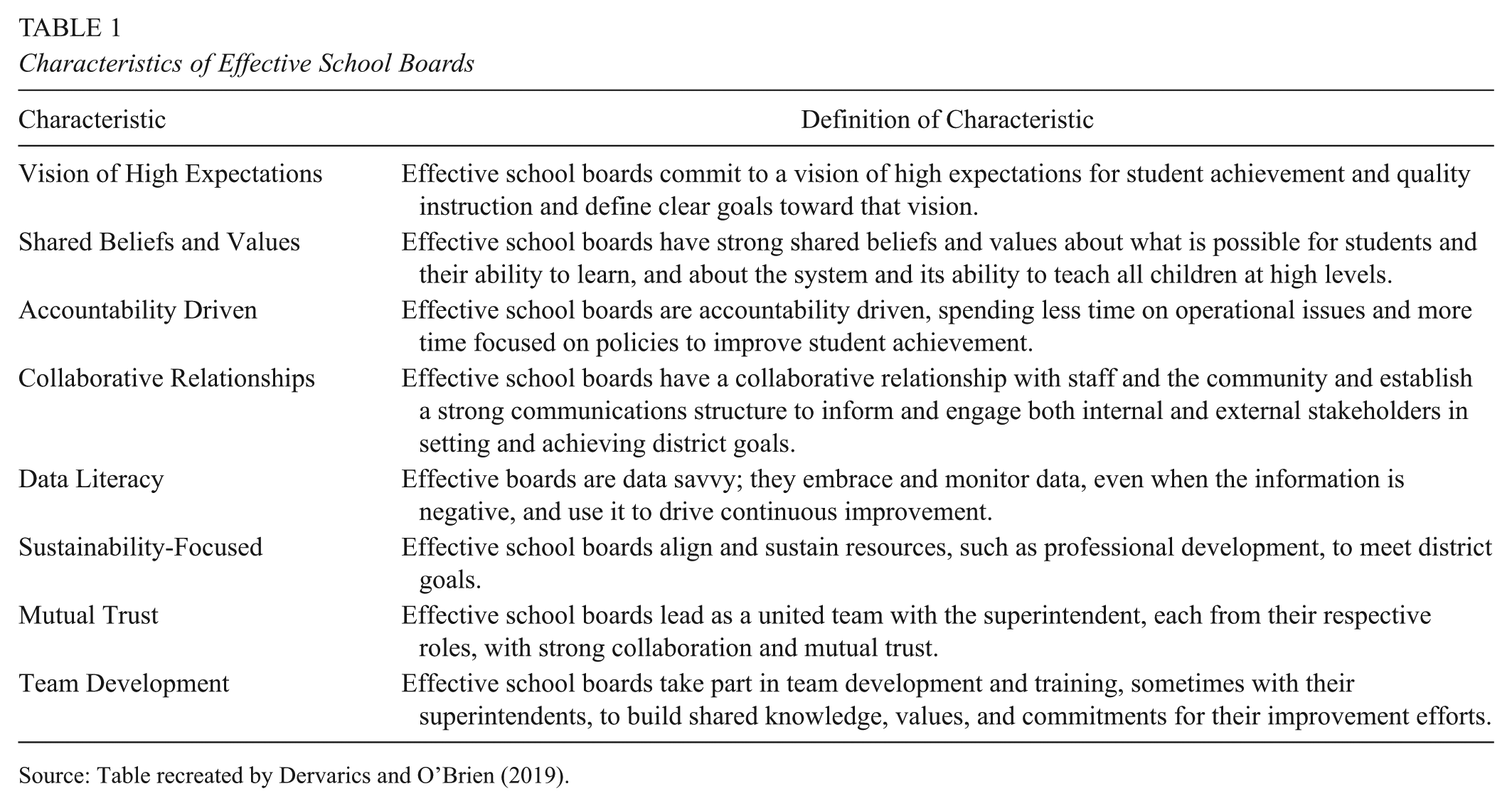
Source: Table recreated by Dervarics and O’Brien (2019).
However, boards’ abilities to engage in these effective practices are ultimately contingent upon the locale and state of the board, as well as the innate hierarchical structure, management, and orientation or ideologies of the board members themselves (Jeong et al., 2023). Whereas school boards have great potential to serve in the best interest of educational progress and innovation, the inherent flexibility among school boards and how they internally operate and govern can also be counterproductive to their inherent responsibilities and the needs of their educational communities and constituencies. Problems within school boards, prompted by the nature of their internal governance and hierarchy, can include (1) the centralized and/or inequitable distribution of power among board members; (2) the integration of special interests, personal politics, and conflicts of interest, (3) inconsistent turnover and restructuring of school board member roles and personnel; (4) misallocation and/or misappropriation of funds and resources; (5) underrepresentation and lack of equity; and (6) general lack of accountability and oversight of school boards themselves (Ford & Ihrke, 2016).
School Boards and Educational Decision-Making
While much of the extant literature related to school boards and decision-making is primarily focused on how school board members interact with superintendents (Mountford, 2004; Petersen & Williams, 2005; Thompson, 2014; Tripses et al., 2015; Weiss et al., 2014), there is considerably less scholarship exploring school board decision-making and management of racial issues. Some empirical research focusing on school board decision-making has suggested that many school boards defer much of the decision-making process to the district superintendent (Blanchard & Kline, 1977; S. R. Lutz, 1983). Therefore, rather than serving as daily administrators for schools and districts, their subsequent primary role has been to develop and make decisions related to district-level policies (Danzberger & Usdan, 1994; Ford & Ihrke, 2018; F. W. Lutz, 1980).
Moreover, there remains a critical gap in inquiry and understanding of how institutional and systemic factors and policies shape school board management of racialized issues within their communities. Limited scholarship emphasizes the structural constraints, power dynamics, and governance and operational norms that inform how board members engage, respond, and potentially dismiss racialized issues (Daramola et al., 2024; Sampson & Bertrand, 2022). As institutional decision-making can have a considerable impact on local communities (Ewing, 2018), board member representation and alterations to surface-level policies are often not enough to inform critical change and effectively address community needs and perspectives regarding racialized issues (Fraga & Elis, 2009; Woulfin & Yurkofsky, 2025).
Importantly, school boards have also been vocal decision-makers throughout history when racialized issues of local control emerge. Some of the most famous U.S. Supreme Court decisions have involved decisions made by school boards to maintain and uphold racist educational policies (e.g., Brown v. Board of Education of Topeka, 1954; Swann v. Charlotte-Mecklenburg Board of Education, 1971). Even today, school boards’ decisions related to school closures, reopenings, and mask mandates related to the COVID-19 global pandemic have illuminated the power that school boards wield and the decision-making processes that they undertake. Empirical research has attempted to explore the interactions between school board members and how school boards engage in decision-making (Ford & Ihrke, 2016; Grissom, 2010; Merz, 1986). However, school boards have largely “varied in their management, operation, and priorities in response to their local economic, political, social, and religious contexts” (Land, 2002, p. 232). Grissom (2010) specifically noted that “decision-making on a school board is a political endeavor, undertaken under the microscope of community members and the media” (p. 623), an observation that has notable implications for the ways that school board members manage racial issues within their schools.
Board-Level Community Engagement
School boards, like all political institutions and organizations, conduct their daily business through a variety of organizational routines and practices, which can broadly be characterized as the “collective daily practices that people engage in to get things done” (Diamond & Lewis, 2019, p. 836). A critical component of school board business involves regular engagement with constituents (e.g., school and district staff, families, students, community partners, etc.). Engagement can take many forms, including community forums, town hall meetings, and study sessions, but the predominant opportunity for community engagement with the school board is often centered around public comment at school board meetings (Collins, 2021; Kenney, 2020; Tracy & Durfy, 2007). Yet, prior research illustrates how board-level community engagement and communication can often prioritize procedure (i.e., how information was communicated or how feedback was received) as opposed to prioritizing what was learned from the engagement opportunities (Briscoe & Khalifa, 2015). Furthermore, researchers have consistently demonstrated the extent to which such policies regularly operate in opposition to meaningful community input, particularly regarding debates over contentious issues (e.g., LGBTQ+ rights, racial tensions, religion in schools, school closures, etc.; Daramola et al., 2024; Enoch-Stevens et al., 2022; Henderson, 2023; Sampson & Bertrand, 2022). These practices, norms, and routines can often lead to perceptions within the community that the school board is largely unresponsive to their concerns and committed to predetermined decisions despite the veneer of community input (Downing, 2024; Ewing, 2018).
This phenomenon of what can appear to be unresponsiveness is unsurprising given two important aspects that scholars have identified when studying such routines. Diamond and Lewis (2019) explain that routines can be viewed through the lens of the ostensive aspect (i.e., the ideal of the routine) and the performative aspect (i.e., the way the routine is practiced in reality). Routines such as public comment opportunities at school board meetings can appear to be ostensibly inclusive. Yet, the public comment process can often be a highly regulated, intensely formal ritual with complex rules and routines that nominally ensure that the public has the opportunity to inform district-level policymaking, while realistically maintaining the racialized status quo (Bertrand & Sampson, 2024).
K–12 School Boards as White Institutional Spaces
Moore (2008) describes the concept of White institutional spaces “as an analytical tool with which to interrogate the intersecting mechanisms that contribute to the reproduction of white privilege and power” (p. 14). Moore (2008) also draws on Lewis’ (2003) contention that “even in demographically nonwhite spaces, tacit White norms remain embedded in the school institution as a result of broader institutionalized racism in education” (p. 26) This concept is grounded in previous understandings of race and institutional racism (e.g., Bell, 1993; Lewis, 2003; Ture & Hamilton, 1967) and the staying power of Whiteness as not only a racial category or identity, but rather, as Harris (1993) argues, an exclusive and elusive property to be protected at all costs, including in and by K–12 school boards.
For example, in Cummings vs. Richmond County Board of Education (1899), school board members sought and won the right to deny Black students a high school education by closing the only Black high school for what were described as “economic reasons,” and ultimately forcing Black students to cease further education after elementary school. In Mendez vs. Westminster School District of Orange County (1946), school board members sought to continue their policy of unequal, racially segregated schools, even going so far as to send members of the same family to different schools. School boards have long functioned as White institutional spaces through their (1) power largely concentrated in White leadership even in communities of color (National School Boards Association, 2018), (2) meeting policies and procedures that disenfranchise the voices of communities of color and uphold Whiteness as a property (Bertrand & Sampson, 2022), and (3) a longstanding legacy of engaging in tacit White supremacy through decision-making around access to equitable resources based on race.
Educational Leadership and the Influence of Racialized Norms and Beliefs
The foundational presence of structural racism and White supremacy in our society greatly impacts political systems and organizations (Bonilla-Silva, 1997; Bonilla-Silva, 2006; Omi & Winant, 2014). An important critique of traditional theories of organizations has been the recognition that organizations are not race-neutral structures operating outside of the constraints and limitations of systemic racism and White supremacy (Ray, 2019). Instead, racism deeply impacts hierarchies and tasks within organizations (Wingfield & Alston, 2014), practices and routines within organizations (Diamond & Gomez, 2023; Diamond & Lewis, 2019), and decisions that organizational actors make (Thornhill, 2019).
We can see evidence of school boards operating as White Institutional Spaces (Moore, 2008) that are committed to the absence of tension in the dramaturgy of public events that are designed to display rationality, order, and competence. The illusion of rationality is combined with the dramaturgy of the proceedings, including the call to order, the often solemn nature of the board meeting, and even the physical location of the board members, often being seated on a raised dais. The performative pomp and circumstance are reified through specific policies and routines that govern the rules of engagement, which regularly limit public participation to the point at which it becomes an illusion of democratic participation (Edelman, 1988). This illusion is upheld through strict limitations on speaking times, lengthy and often hidden procedures for engaging in public comment, and board policies that govern the ways that board members are able to respond to the public (Collins, 2021). The official nature of these meetings can provide cover for political leaders, as Edelman (1988) explains that the use of formal rules of engagement, raised daises, and similar trappings of decorum and order “… evoke a sacred, as do inauguration flags, imposing buildings, and judicial robes” (p. 98). He goes on to describe these spaces as symbols that “… help erase the sense of guilt, humiliation, or injustice that acquiescence would create if public officials were seen as ordinary people conferring valuable benefits on some and imposing severe sacrifices on others” (p. 98).
While this performance is important, we should also note that not all public actors always adhere to this political script. In fact, Sampson and Bertrand (2022) describe myriad ways that community members engage in discursive tactics to subvert the performative aspects of school board meetings in order to ensure that their voices are heard. Their research suggests that there may be unique, community-driven opportunities to create spaces for meaningful democratic engagement. In the following sections, we explore what these spaces may look like in practice.
Research Design
This substudy is drawn from a larger study on K–12 school boards and educational decision-making. Using a qualitative case study design (Merriam & Tisdell, 2015), the larger study sought to understand how board policies, systems, structures, and routines influenced board-level policy and decision-making processes related to issues of race and racism. During the initial data collection process, the Cardinal School District (a pseudonym) emerged as a key opportunity to gain a deeper understanding of the process through which a newly elected, politically conservative majority on a school board engaged in policymaking regarding culturally affirming symbols in schools (i.e., Black Lives Matter posters and LGBTQ+ pride flags). This paper specifically focuses on the ways that racialized beliefs appear in organizational norms in moments of community conflict.
Qualitative case studies undertake in-depth explorations and analyses of bounded systems and/or phenomena using a variety of methods, including, but not limited to, interviews, observations, and document analyses (Merriam & Tisdell, 2015). The inherent benefit in utilizing case study methodology is that it lends itself to the integration of multiple methods of inquiry due to its focus on the bounded unit of analysis, rather than a singular method (Merriam & Tisdell, 2015; Stake, 2005; Yazan, 2015). Merriam and Tisdell (2015) explain that in deciding whether a study can be classified as a case study, one must be sure that the phenomenon of interest is intrinsically bound, with an end “to the number of people who could be interviewed or to observations that could be conducted” (p. 39). For the purposes of this study, the bounded cases involve the processes that the Cardinal School Board undertook in 2021 to develop a new policy banning teachers, students, and staff from displaying Black Lives Matter posters and LGBTQ+ pride flags, deemed politically divisive symbols, within their schools.
Site Selection
Using criterion sampling (Patton, 2002) as a guide, one major city in the Western United States was selected as a focal site, and as the study continued, additional sites within the larger metropolitan region were selected, including the Cardinal School District. This type of sampling requires sites to meet a “predetermined criterion of importance” (Patton, 2002, p. 238). Two main criteria were utilized for site selection in this study: primarily that the board members in the given school districts must (1) be popularly elected and (2) the school district must have navigated some form of racial issue post-2020.
Background and Context
Cardinal is a small suburb of Evergreen (both pseudonyms), about 20 miles away from a large urban center. Described as “idyllic” by one of the participants, this rural community is nestled among rolling green hills dotted with small family farms (see Table 2 for more information about the Cardinal School District demographics).
Cardinal School District Demographics
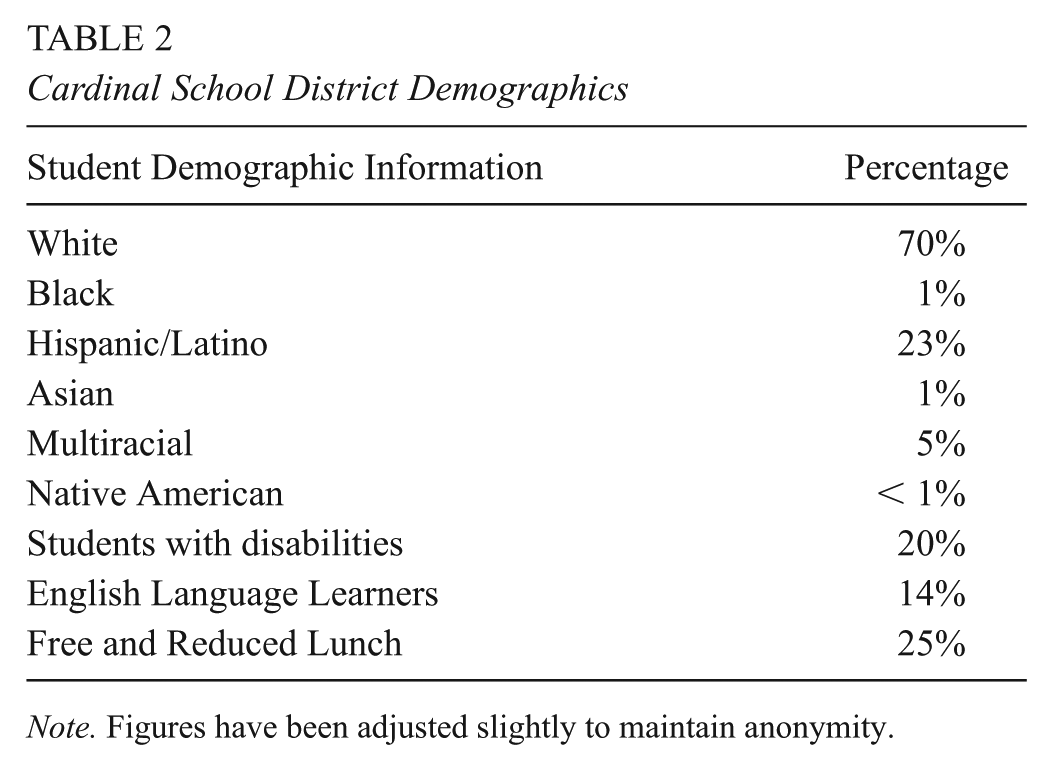
Note. Figures have been adjusted slightly to maintain anonymity.
In the aftermath of the 2020 presidential election and the Summer 2020 movement against racial injustices, the Cardinal School District underwent a series of political shifts that deeply impacted the work of its school board. Like many districts during the summer of 2020, the Cardinal School Board was tasked with considering an antiracism resolution after the murder of George Floyd in May 2020. The final vote on the resolution was 6-1 in favor of committing the district to ideals of antiracism, with the sole vote against made by one of the White male board members. In the aftermath of this vote, community members expressed concern and outrage about the member’s decision to vote against the resolution. While this board member eventually responded by releasing an open letter to the community in the local newspaper and reading the letter at a subsequent board meeting, beliefs about racism and the role of the school board in upholding “traditional values in education” became a flashpoint as the community underwent a school board election that ultimately resulted in a new board composed of a 4-3 politically conservative majority that was in place during the data collection phase of this study.
Data Collection
The data for this study were collected between May 2022 and March 2023. Data sources were six interviews with five school board members (one member was interviewed twice), virtual observations of relevant school board meetings (n = 17 hr and 8 min), and board-level policy documents such as public comment guidelines, school board meeting minutes, school board meeting agendas, and school board equity and anti-racism policies or statements (n = 19). Participants were recruited through direct emails, and 60-minute interviews were conducted virtually with five board members, using a semi-structured interview protocol guided by video elicitation methods (see Appendix A for the interview protocol). One board member, Amelia, was interviewed twice because she had previously served as the board chair prior to the 2021 election. See Table 3 for board member demographics.
School Board Member Demographics (Self-Reported)
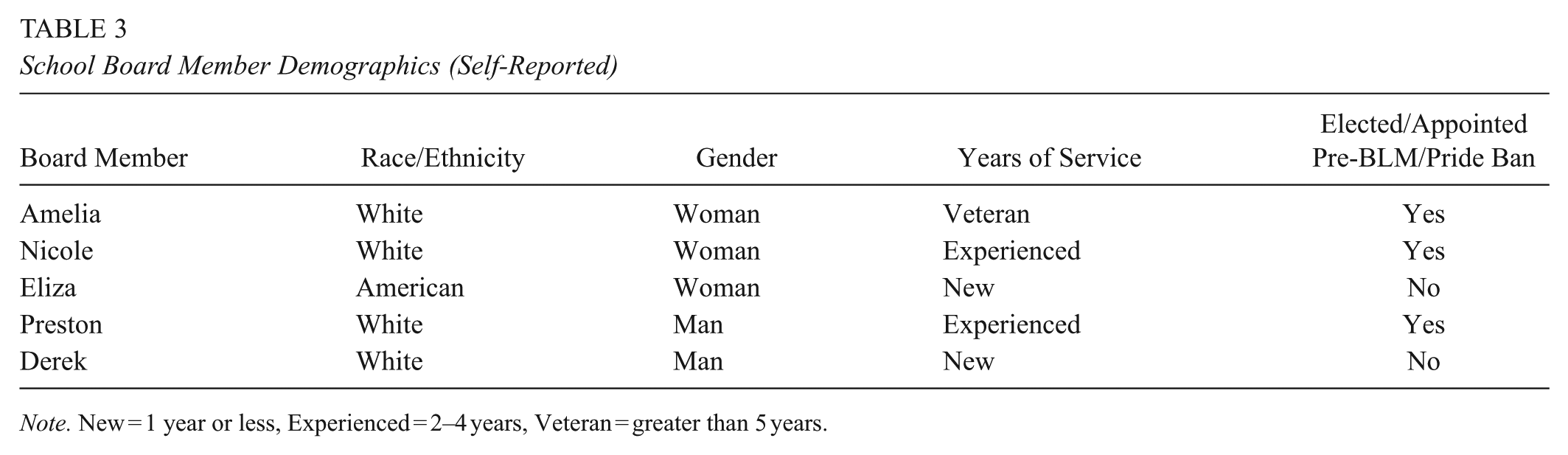
Note. New = 1 year or less, Experienced = 2–4 years, Veteran = greater than 5 years.
Elicitation methods have been used in previous research to encourage participants to discuss sensitive or controversial topics that they might otherwise not be willing to discuss (Sayre, 2006). Heightened awareness of issues of race and racism, in combination with the political sensitivity of school board members, necessitated a methodological approach that overcomes participants’ potential reluctance to share sensitive information, in addition to controversial opinions. Researchers have also argued that video elicitation techniques can be critical interventions that allow practitioners to engage in “an interactive learning environment in which they can build their practice system and gain new knowledge from their own practice experience” (Li & Ho, 2019, p. 3).
The specific video elicitation example that was used in this study was a news media report describing a student-led protest at the school district headquarters after a student wore a Ku Klux Klan hood in a high school locker room. This video provided an entry point into participants’ understandings of issues of race and racism, the school board’s role in responding to these issues, and potential mechanisms, tools, and desired responses when addressing them. Each interview began with several rapport-building questions related to participants’ backgrounds and experiences, followed by the selected video elicitation. Participants were asked to share their initial thoughts regarding the success of the school board in navigating the crisis, as well as how they would have handled the crisis.
All of the documents were publicly available and were downloaded from the district’s website. Observations were virtual and occurred after the initial interviews and document analysis. As data collection occurred close to 1 year after this policy development process, the observations were solely focused on addressing the research questions, and the observation protocol was deductive by design. The specific board meetings that were analyzed in this study were chosen after reviewing board meeting agendas and minutes that detailed which meetings were most relevant to understanding how the Black Lives Matter/LGBTQ+ pride ban came to be. The purpose of these observations was more targeted and specifically sought to better understand the public comment and engagement process as it had unfolded at board meetings that were directly related to the development of the Black Lives Matter/LGBTQ+ pride ban.
Data Analysis
The data were analyzed using a variety of analysis methods loosely guided by Miles & Huberman’s (1994) three-part data analysis process, including (1) data reduction, (2) data displays, and (3) conclusion drawing and verification. One of the ways that Miles and Huberman (1994) suggest making sense of the data through the reduction process is the use of analytic memos and data displays. Analytic memos (see Appendix B) provide an opportunity for researcher reflexivity that encourages a deeper level of analysis and insight related to how the emergent data help to answer the research questions (Clarke, 2005; Saldaña, 2013; Stake, 1995). Data displays (Miles & Huberman, 1994) also offered an opportunity to visualize the data in ways that encouraged pattern identification across data sources, including interview data, policy documents, and board meeting observations. For instance, preliminary analysis of the interview and policy document data helped to inform the subsequent deductive analysis of the board meeting observations (see Appendix C). Relevant quotes and notes from the analytic memos were included in a data matrix in Microsoft Excel that was organized by theme (e.g., balance, order, political neutrality).
This approach proved useful in identifying nuances and complexities in the ways that public comment procedures differed across data sources. For example, analyzing multiple data sources helped to compare how board members’ espoused conceptions of effective community engagement during racial conflicts in interviews, as compared to the enactment of community engagement in practice, as evidenced by virtual observations and meeting minutes. Similarly, the second interview with Amelia was important because she was able to provide key information and clarification on preliminary analysis from the board meeting observations, inadvertently offering an important opportunity for member checking because her second interview occurred after preliminary data analysis was completed.
As qualitative scholars committed to equity-oriented approaches to research, policy, and practice, we approach this work with a deep understanding of the ways in which policies have been designed and upheld to perpetuate marginalized groups within our society. As such, this work seeks to illuminate how norms can shape community engagement in hopes that this work may provide useful insights to design strategies to overcome barriers to effective board-community relations.
Findings
This section is organized into two subsections. The first draws primarily on interviews with board members to understand their beliefs about issues of race, racism, and issues of equity in education. The second builds on this analysis to interrogate the ways in which these beliefs were operationalized through how Cardinal School Board members managed their community’s response to policies banning Black Lives Matter and LGBTQ+ pride symbols. Specifically, this section highlights broader patterns of board leadership, norms, and governance around contentious, racialized policymaking. Hence, these findings are organized around observed racialized norms that functioned as policy positions and barriers for marginalized voices.
Board Members’ Beliefs About Responding to Issues of Race, Racism, and Equity in Education
Board member interviews offered an invaluable window into the ways in which members understood racialized issues and how these conceptions informed their decision-making. Soon after beginning the video elicitation portion of the interview, three of the Cardinal board members expressed staunch opposition to board members getting involved in district-level responses to issues of racism and equity. These members were explicitly opposed to the board playing any significant role in the response to the Ku Klux Klan incident portrayed in the video elicitation. One striking similarity between two of the three board members was their almost immediate questioning of the very premise and authenticity of the racist act itself. For example, Preston wondered aloud whether the act had even taken place, sharing: People are so willing to cynically misconstrue things that are innocent as racist now that, like, as just a human being, I don’t put any credence in what I just saw until I see the photo, and then I’ll judge for myself if he was actually trying to do a Klan hood or not.
Similarly, Eliza dismissed the seriousness of the incident, noting “I think kids do stupid things” and “I have not seen the picture, so I don’t know. It’s very hard for me to say yes or no, you know?” She went on to connect this racist incident to one that previously occurred within their district, recounting: There was some kind of [similar] incident around here that turned out, from my understanding, turned out to not be exactly what was reported that they did on Snapchat. . . I found out later that it was a lot of misinformation.
While Derek did not question the veracity of the incident itself, he immediately pivoted to expressing skepticism about the existence of systemic racism in society as a whole. He explained: I love America. Do I think that there’s racism that goes on? Absolutely. Do I think we’re a systemically racist country? No, I don’t. You know, it’s not just. . .I think typically, you, being a Black man, you’ve got a different experience than I do. But I’ve got Black friends, my doctor is Black. He goes camping with us. You know, I have been in the military, I’ve had friends of all nationalities and colors. And, you know, I think it’s what makes this country great is that we’re such a mix of people. And, you know, to me, I judge a person by their character and not the color of their skin. And I think that that’s how everyone should, you know, conduct themselves, but obviously, there’s evil in the world, and people are going to do bad things.
This worldview helped to shape Derek’s response to the racist incident as he went on to share: You know, we’re dealing with kids. And so I think you’re seeing more and more these days that kids are starved for attention. And you know, whether or not they act out in positive ways, some are going to act out in negative ways to get the attention, whether it’s positive feedback or negative feedback. Kids are kids. So I think we always have to keep that in mind when we’re dealing with situations like this.
Collectively, these three responses provide critical insight into how Preston, Derek, and Eliza, and potentially like-minded board members in other contexts, understand their role as board members when faced with racial crises. These board members predominantly saw themselves as rational, logical defenders of due process for the students accused of committing racist acts. By questioning the validity of the incident itself and, more broadly, the existence of systemic racism, their understanding of the role of the board was to remain neutral in times of crisis as a means of protecting the process. In fact, Preston described their role as similar to that of the Supreme Court, explaining: The board, at the end of the day, for disciplinary matters, is kind of like the Supreme Court. We’re the final say on violations, so the reality is that the Board should not have any role until it gets to an appeal. Because otherwise, they’re coloring their own judgments right ahead of time. They’re, you know, not giving the student the presumption of innocence that they deserve.
Summarily, this group of board members advances a traditionalist, limited vision for the school board as an appellate body with little to no ability to respond to calls for action from the communities that they serve. It should be noted that this view was not monolithic on the Cardinal School Board.
Amelia, who previously served as Cardinal School Board chair, passionately pushed back against this vision. As she described two incidents of racial violence that had recently occurred within the district, and the lack of response from the school board, her frustration was palpable. She shared: The board was silent as a board. As individuals, of course, some of us made public statements about it, but some were just completely silent. And in fact, one board member actually defended the actions of the student and said that he felt really bad for him because now he’s getting so much pressure and he’s suicidal and feeling awful about himself. So it was turning the perpetrator into the victim.
This focus on the rights of the student accused of perpetrating racial violence is in stark contrast to the focus of other board members in response to this video elicitation. Instead, Amelia, along with Nicole, advanced a more expansive understanding of the role of the school board with the understanding that the board does not have to be silent during moments of racial conflict, but instead, can serve two central purposes: (1) supporting the superintendent and (2) reaffirming the district’s vision and values.
After observing the video prompt, both Amelia and Nicole, while sympathetic to the concerns of the student protesters, ultimately distanced themselves from a more managerial crisis response role. Nicole expressed a clear hesitation in responding because she was not a part of the board leadership at that time. Reflecting on a separate crisis within her district, she explained: You know, I’m hesitant of coming out publicly, because that’s not my . . . you know, the board chair is our spokesperson. And I have spoken to a couple of news media during this situation, but I’m very careful because I don’t feel that’s my position.
These conceptions of organizational hierarchies appear to be critical to the ways that board members understand their roles. Yet, even as Nicole conveyed her hesitancy to respond publicly, she acknowledged that individual board members who were not serving in leadership could use their positions to ensure that a thorough investigation is completed. She suggested that in this particular case, “If the superintendent hadn’t started investigations, we would ask them to do that, and then we would be asked to be kept in the loop as much as we can.” Nicole’s statement illustrates how the board may not always publicly respond, but their beliefs can be felt through their policymaking role and oversight responsibilities, which can ultimately shape the overall district response.
Board Members’ Beliefs and Institutional Norms and Practices
When describing her experiences as a board member prior to the 2021 school board election and subsequent attempts to remove Black Lives Matter and Pride symbols from Cardinal schools, Amelia explained that her initial years as a board member were fairly typical of most school boards, with a focus on managing the district budget and hiring district leadership. However, when describing the state of the board at the time of our interview, she described a significant shift, sharing: We got two new board members that came on very aggressive right out of the gate, like, “This place is broken and we’re here to fix it.” And everyone was kind of like, “Whoa.”. . . It was really startling for these two members when they joined to just come out of the gate saying, “Our district is awful.”
She explained that the new board members were affiliated with “this big push that was very orchestrated and organized, mostly by outside groups, to bring in incredibly conservative members” instead of the “very moderate and very sort of cautious” current board composition. Derek, one of the Cardinal School Board members elected during this election, explained a communal outcry for “get[ting] back to a traditional education,” which further facilitated this change in board composition. During one of the first meetings of the Cardinal School Board with its newly constituted 4-3 conservative majority, the board moved to enact its agenda focused on “traditional education” by introducing a ban on Black Lives Matter and LGBTQ+ pride flags within Cardinal schools.
When characterizing the shock of some within the Cardinal community that the new board would introduce this policy, just a year after the district adopted its anti-racism resolution, Amelia did not recall this being a prominent issue within the Cardinal community. However, media reports and board meeting records indicate that there were at least some Cardinal community members who were concerned about Black Lives Matter posters posted in an elementary school (see Figure 1).
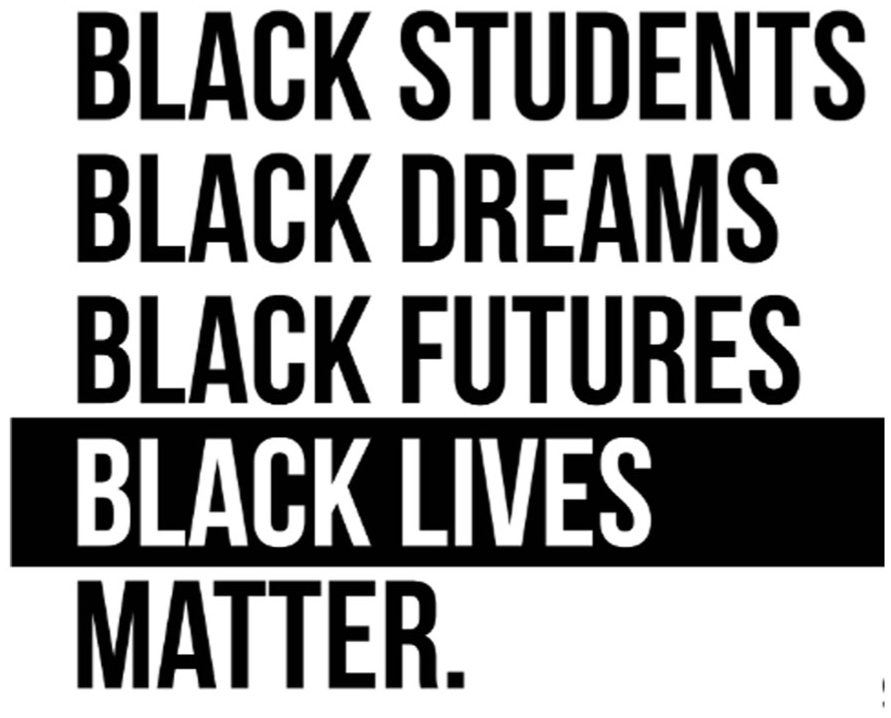
The Black Lives Matter poster displayed in Cardinal Elementary School.
In response to several dissatisfied parents who opposed these signs and insisted “that they’re too political for a school setting,” the school’s principal released a public letter explaining his decision to allow staff members to post the Black Lives Matter posters. His letter emphasized the importance of supporting the BIPOC community during a time of fear and pain, likening it to prioritizing care for a hurt child on the playground. He continued by addressing misconceptions around Black Lives Matter signage and school-based political agendas. In the board meeting immediately following the release of the principal’s letter, the board received a total of 96 public comments concerning the district’s antiracism efforts and the Black Lives Matter signs in Cardinal schools, with 86% of the comments expressing support for the district’s actions. This coalition of supporters included district alumni, current parents, current students, concerned community members, along faculty and staff. Public comments against the district’s actions were few and far between but broadly focused on disagreements with statements made by the national Black Lives Matter organization, citing concerns over political agendas and a desire to prioritize education over politics.
Racialized Norm 1: Political Neutrality
The rationalization of the Cardinal School Board’s actions as being focused on broader goals of education rather than division is a useful example of the ways that certain frames, like political neutrality, can be taken up in seemingly innocuous ways but instead function as racialized markers that influence policy and practice. During the first meeting of the new year in Cardinal, the new board chair began his tenure by committing to “change, the need for civility, correcting divisiveness in the community and on the board, and setting aside politics to focus on education for every single student.” Several of the conservative, White Cardinal School Board members expressed beliefs that allow us to understand who they aimed to speak for when they claimed discussions of race and racism were “divisive.”
For example, during the initial debate regarding the Black Lives Matter and Pride symbols ban, one board member expressed concern about the well-being of “the kids that those flags don’t make feel comfortable, like police officers’ children.” Similarly, Derek explained, “There’s a distrust now. I think there’s been things that have happened locally, with regards to that stuff [Black Lives Matter and Pride flags in schools] where parents feel, you know, betrayed or they feel like they’re [the school district] doing things in secret.” Not so subtly hidden between the lines of these statements are the racialized ways in which the board members are signaling their views on who considers the acknowledgment of race and racism as divisive.
Preston openly acknowledged how the supposed “divisiveness” within the community was driven by perceptions that greater racial inclusion, which could potentially de-center Whiteness, was a mobilizing factor in enacting his agenda on the board. In our interview, he explained that due to the current political environment: We’re just in this completely different situation where we have boatloads of problems and incredible division. We have, you know, a pandemic and we have riots, and we have, you know, all of this animus, and we’re just dealing with this ideology that’s trying to kick out the underpinnings of Western society. And people who support Western society and who think that the Enlightenment was a good project, and think that equal opportunity is the way to go. Those people have a right to stand up and say, “No, we’re not just going to let this go. We’re going to have this fight.” And so we’re having the fight.
Even after the successful attempt to ban Black Lives Matter and Pride symbols from Cardinal Schools, Preston explained that he and the conservative majority were not finished with what he characterized earlier as “the fight.” He continued by advocating for “revis[ing] the district’s antiracism statements to get all the ideological language out of it. And transform[ing] Cardinal School Board policies to move away from equity language towards equal opportunity.” As we concluded our conversation, he shared, “I just want us all to have an equal shot, regardless of our skin color, or our genitalia, or any feature that we were born with.” Preston’s words allow us to interrogate some of the fundamental concerns regarding the (im)possibilities of community-centered policymaking at the school board level and become critically mindful of how ideals of civility, traditional hierarchies, and a commitment to political neutrality have previously served, given that these norms can also be characterized as norms of Whiteness.
Racialized Norm 2: Order and Balance
Both Amelia and Nicole explained that throughout the contentious process of banning the Black Lives Matter and Pride symbols, their ability to shape and challenge the process was limited due to the board’s governance model that relied heavily on norms of order and balance—particularly related to respecting the chair as the board leader and spokesperson. Amelia notably struggled with these norms, explaining how her thinking had evolved since the board began its efforts to ban these symbols. She shared, “I refuse to stay silent on these things. You know, you can have board etiquette, which is important, but this is beyond etiquette, right? I mean, this is racism and homophobia and oppression.”
Amelia’s shift from staying silent to publicly speaking out against the actions of the board majority suggests that while norms around traditional hierarchies in boards may have been useful or even important in the past, the blatant disregard for the lives and experiences of marginalized groups makes this focus on civility and order a moot point. As a counterpoint to the actions of the board majority today, she explained: I’d been a member for about 4 years, operating under this principle of when a decision is made, we all stick together, you know? We present a united front . . . to now saying bullshit to that. Like, I’m not going to go along with this because it is hateful and awful, and you’re literally destroying my kids’ schools. Like I see it. It’s right before my eyes, and I’m not staying silent on that. So, you know, I’ve gotten some pushback from people who think that it’s not “professional” [air quotes used]. It’s been tough but also super rewarding, right? Like, we don’t often get platforms to say, “No, I’m taking a stand against this because it’s awful.” So being able to do that is hard, but it’s good.
Through this quote, Amelia offers a vision of board-level leadership that suggests that traditional norms of board governance may not be suitable when attempting to center the needs of marginalized communities. Rather, if the needs of these communities are to be served, board members may have to engage in behaviors that could be deemed unprofessional or combative, but at least have the potential to push back against inequitable or oppressive policies and practices.
Engaging in such behaviors proved difficult during the politically complex process of banning the Black Lives Matter and Pride symbols. Much of what occurs during such contentious debates at the school board level can be determined by the established board leadership. In particular, the board chair and vice-chair wield an immense amount of power in determining both the overall direction of how the board is organized and functions, in addition to how the board navigates moments of tension and dissent that are commonplace in school boards. Amelia, a former board chair, highlighted the vagueness of public meeting laws in her state, noting they leave significant discretion to the chair and “how they want to run” board meetings, including whether to allow public comment. While this flexibility can help address localized issues, it can also complicate managing meetings amid division and dissent. In some ways, it is easy to see how providing such wide latitude to local boards to govern their own affairs could help ensure that the board has the flexibility to address specific, localized issues as they arise. However, as was observed in how the Cardinal School Board chair led the board through this conflict, such flexibility can also be detrimental to the meaningful inclusion of impacted stakeholders.
For example, in the case of the Cardinal School Board, the school board chair leveraged his authority and procedural rules to advance the conservative majority’s goal of combating perceived political agendas and indoctrination in schools. By controlling public comment sessions, he facilitated an illusion of a divided community, despite clear evidence of majority opposition to the proposed Black Lives Matter and Pride flag ban. This manufactured division allowed the board to justify enacting the policy as a means to move beyond controversy and refocus on education. Specifically, as Amelia explained, the current board chair and Preston, as vice-chair, often “weaponized Robert’s Rules [of order] or meeting procedures to gain an upper hand during board meetings.” Instead of offering an open opportunity for community members to voice their concerns or support for the policy, the board chair chose to manufacture a spectacle of a divided community through the way that he organized the session in service of what he described as “efficiency and balance.”
One such example of this commitment to order and balance occurred at a special board meeting solely designed to be a virtual public comment session for community members to share their opinions about the proposed BLM and Pride symbol ban. At first glance, it appeared that this specially-called board meeting featured a divided community on this issue. For example, one supporter of the proposed ban shared, “Schools should be places of learning, not ideological petri dishes for indoctrination.” Another stated that “School is a place for learning, it is not a place to push what you believe onto young minds. We voted out a majority liberal board and voted in a conservative board.” Alternatively, a current Cardinal student shared, “I have firsthand experience of the difference that diligent expressions of support can make. I am not political. I am human.” A recent Cardinal graduate explained that during their time in Cardinal schools: Never once did a student come with a concern that a BLM [Black Lives Matter] or Pride flag was a distraction to their learning. This culture war threatens the lives of students. There are consequences to your actions. The blood of my peers will be on your hands.
Throughout the night, the balance of opinions appeared to be evenly split, with community members alternately voicing support and opposition to the proposed policy. However, Rachel explained, in one of our interviews, that this was a carefully coordinated opportunity to demonstrate community division orchestrated by the board chair: This was the chair saying, “I want to have even representation from both.” So if we got 20 people saying yes to this, and you know, 50 people saying no, he made sure those 20 people were heard at the expense of the others. There was definitely a lot of dishonesty on [the chair’s] behalf, with a lot of manipulation of the comments to make it appear like it was evenly split.
At one point, five Cardinal students appeared on screen, crowded into one room, sharing that they were protesting both the potential policy adoption and the way that the board chair limited community input. Confirming Amelia’s assertion, when the time came for their chance to speak, one student furiously commented, “You’ve told us that the priority goes to students this meeting, but I’ve only seen two groups of students get to speak before me. The voices of minority students are not being heard.” Every Cardinal student who testified at this special session voiced opposition to the proposed ban.
The board chair acknowledged how this issue seemed to have divided the community, noting that the board had received over 500 emails about this issue alone. As the board chair transitioned the meeting to the next business item on the agenda, he reminded the audience that he was not a racist and would work with anyone. However, it seemed as though the conservative bloc of board members chose to work amongst themselves to formally decide to ban Black Lives Matter and Pride symbols. However, following this public comment session and further discussion amongst the board, the ban on Black Lives Matter and Pride flags in Cardinal schools was ultimately adopted in a divided 4-3 vote.
Discussion
The case of the Cardinal School Board provides evidence of the potentially illusory nature of democratic engagement, specifically through the ways that board leadership utilized the public comment process to manufacture an optical illusion of a neutral board listening to a seemingly closely divided community and making a rational, emotionless decision. However, board meeting minutes and recordings demonstrate that the conservative majority appeared committed to enacting the Black Lives Matter and Pride symbol ban from the first board meeting, rendering moot the advocacy by the broad coalition of Cardinal community members to allow these symbols to remain on Cardinal campuses. In this way, we can see how board-level community engagement can appear to be focused on making sure that community members have an outlet “to be heard” regardless of whether or not the outlet is accessible or meaningful. Public engagement during such racialized conflict, then, may devolve into a performative ritual that checks a box for community-engaged, “good governance” rather than deeply engaging with marginalized community members about their hopes, ideas, and visions. It is also unsurprising that the board members who expressed disbelief in the nature of racism were the same members advocating to ban these symbols. Likewise, the members who believed in a more active approach to responding to racist incidents were those who pushed back against the retrenchment of the board’s previous commitment to anti racism and equity.
Based on observations of school board meetings, review of board meeting guidelines, and conversations with community and board members, White normative frames and logics can often be found in the ways that school board meetings are organized, such as a staunch commitment to order, civility, and neutrality, regardless of the situation or circumstance. Policing forms of protest through advocating norms of civility and decorum is not a new phenomenon and has been widely utilized to dismiss the concerns of marginalized communities (Banks, 2018; King, 1992). By focusing on how community outrage is expressed rather than the substantive ideas of what communities are advocating for, elite political actors who largely hold the power to change policy and practice can continue to uphold inequitable policies because community members’ concerns are not received in a palatable package. Put simply, in situations when school boards rigidly adhere to such norms, it may be prudent to question where the board will respond in a way that is favorable to marginalized communities. This may be particularly true in spaces such as the Cardinal School Board, where a belief in systemic racism is in opposition to the majority of the board’s stated worldview.
Lastly, these findings link the understanding of school boards as apolitical, nonpartisan institutions to the continuation of the racialized status quo. Some board members expressed a belief that in recent years the school board has become increasingly politicized in contrast to its prior status as a neutral, nonpartisan space dedicated to serving the students and families of the school district. However, this characterization of apolitical neutrality is historically inaccurate, as school boards have always been political spaces. Critical theorists of race and racism have long questioned the idea that policymaking and policies are, or even can be, neutral, given how racism, White supremacy, and anti-Blackness are foundational components of the American legal system (Bell, 1992a; Crenshaw, 1988; Dumas, 2016; Harris, 1993; Moore, 2020). In arguing for a depoliticized school board, participants are (knowingly or unknowingly) supporting a commitment to an ideal that has been used to limit the rights of minoritized and marginalized communities. We can see recent evidence of these logics throughout the United States as state and local policymakers engage in efforts to limit political indoctrination or divisiveness in K–12 schooling (Bridgeforth & O’Neal, 2024; O’Neal & Bridgeforth, 2025), where “apolitical” is shorthand for race-neutral and likewise, “political” is synonymous with race-consciousness. Researchers continue to document and illustrate the many ways that these efforts are strategic and coordinated (Alexander et al., n.d.) in addition to costing school districts an estimated $3.2 billion in the 2023–2024 academic year (Rogers et al., 2024).
Implications for Research, Policy, and Practice
One of the promises of democratically elected school boards is that they can provide opportunities for concerned citizens to be involved in education policymaking for their communities, “representing the belief that education does not constitute a technical policy area open only to specialists” (Asen, 2015, p. 3). This allows those with expertise in various areas to leverage their experiences to serve the needs of the community, while also nominally providing community members with meaningful opportunities to take part in the vision-setting and policymaking aspects of school district affairs. However, the findings from this study demonstrate that such opportunities may be few and far between at some school board meetings. To address these concerns, we offer several recommendations for research, policy, and practice that could help school boards better serve marginalized communities.
Research
Findings from this study provide an important potential foundation for much-needed future research on K–12 school boards. Through this study, we have detailed how school boards can operate in ways that prioritize the illusion of democratic engagement over purposeful inclusion of marginalized and minoritized communities in district decision-making. While we know that this is a particularly challenging problem, future research must focus on potential solutions to board-level community engagement that move beyond a technical-rational approach to institutional change in favor of an equity-minded (Bensimon, 2007), community-driven process that brings together K–12 school boards with racially minoritized communities to transform existing systems of public engagement and deliberation. This work could help to identify the conditions that may be required for boards to engage in this work, while also piloting novel models for public engagement that exist outside the confines of public comment at board meetings.
Study findings also highlight the importance of specificity when we attribute a statement, policy, or position to “the board,” particularly because we are often only hearing from a member of board leadership as opposed to individual board members. This realization underscores the importance of future research on the role of the school board chair in promoting or inhibiting racial equity efforts, particularly as this study has illuminated how much power the board chair wields (e.g., setting the agenda, speaking on behalf of the board, running the board meeting). While there is a growing body of research on school boards and the ways that they function (Kitchens & Goldberg, 2024; Knight-Abowitz, 2025; Sampson, 2024), a targeted focus on the roles, responsibilities, and powers of board leadership may provide a wealth of information and opportunities for research to promote more equity-minded school board leadership, especially as we can predict that racial tensions will continue in our schools.
Policy and Practice
Although state laws regarding public meetings require board meetings to be open to the public, they also often provide board leadership with significant leeway in adapting procedures for public involvement, including severely restricting public comment if they so choose. As we observed in the case of the Cardinal School Board, this practice can limit opportunities for marginalized communities to voice their concerns when racial crises occur within the district. Based on the lessons learned from this study, we suggest that state-level governments should play a more significant role in establishing guidelines for more meaningful opportunities for public involvement in local school board meetings. This might involve setting more stringent standards for who must be offered opportunities to speak at board meetings, specifically making space for populations that have historically been marginalized within the given community. While the Cardinal School Board case suggests that boards committed to setting a certain policy may do so regardless of the composition of speakers during public comment, these additional guidelines may discourage board leadership from knowingly manipulating the public comment section to paint a false picture of a closely divided community on a given issue or crisis.
Conclusion
Initially constructed as institutions to manage the finances and operations of schools within a given community (Land, 2002), previous literature explains that school boards have undergone significant reforms in order to root out corruption and bring about more inclusive, representative forms of governance. However, this literature also informs us that these ideals have been slow to materialize in practice, as some boards have continued to concentrate power in the hands of elite political actors as they and the “administrative bureaucracy worked to blunt the demands of the people” (Feuerstein, 2002, p. 18; i.e., marginalized and minoritized communities).
Findings from this study offer an important opportunity to reflect on the affordances and limitations of school board governance, particularly related to community-centered policymaking. Bell’s (1992b) theory of racial realism provides a particularly useful lens to guide this conclusion. In conceptualizing the theory of racial realism, Bell (1992b) argues that “the struggle by Black people to obtain freedom, justice, and dignity is as old as this nation” (p. 363). He explains that since the inception of the United States, leaders have suggested that American institutions, such as the courts and legislatures, can provide an avenue for racial equality and upward social mobility. However, he goes on to question the futility of this suggestion, instead characterizing these institutions as “instruments for preserving the status quo and only periodically and unpredictably serving as a refuge of oppressed people” (ibid., p. 364).
Acknowledging this reality could lead to a disposition of frustration and despair due to the recognition that much of what these institutions will pursue is related to their continued accumulation and maintenance of power in decision-making. Yet, to return to the words of Derrick Bell (1992b), we believe it is critical that we ground our goals in racial realism; that is, a recognition that: We must simultaneously acknowledge that our actions are not likely to lead to transcendent change and, despite our best efforts, may be of more help to the system we despise than to the victims of that system we are trying to help. Nevertheless, our realization, and the dedication based on that realization, can lead to policy positions and campaigns that are less likely to worsen conditions for those we are trying to help, and will be more likely to remind those in power that there are imaginative, unabashed risk-takers who refuse to be trammeled upon. (p. 378)
What might these policy positions and campaigns look like in practice, given the limitations of school boards as spaces for racial redress? Recognizing this reality, we aim for this work to contribute to conversations about what we might be able to do in what Ross (2021) characterizes as “meantime in between time” (p. 232), where we focus on what can be done in the near and medium term to mitigate the suffering of marginalized communities. For instance, if we are to imagine a world where community engagement with school board leaders may lead to a positive peace and the presence of justice, we must consider the kinds of organizing strategies that elect and elevate those whose beliefs in equity and justice are unshakeable. We must consider that in an ever-changing world where unprecedented challenges have become the norm, our strategies and tactics for community voice must be equally as fluid and nimble to meet the challenges of the moment. As such, we encourage all who are interested in addressing these harms to vigorously take up this challenge in working together to build a better, more just world.
Footnotes
Appendix A
The following interview protocol guided the larger study focused on K–12 school boards and educational decision-making, specifically regarding racial crises in school districts.
Appendix B
Appendix C
Funding
The authors disclosed receipt of the following financial support for the research, authorship, and/or publication of this article: The research reported here was supported by a National Academy of Education/Spencer Foundation Dissertation Fellowship and a USC Rossier School of Education Dean’s Research Grant. The views expressed are those of the authors and do not necessarily reflect the views of the National Academy of Education, the Spencer Foundation, or the USC Rossier School of Education.
Open Practices Statement

Authors
JAMES C. BRIDGEFORTH is an assistant professor in the College of Education and Human Development at the University of Delaware; email:
AMANDA PICKETT is a PhD candidate in the College of Education and Human Development at the University of Delaware; email: