




Abstract
School choice policy shifts the responsibility of accessing high-quality schools from the state to parents, yet there is little research on how parents subjectively experience the burdens of choosing schools. In this case study, we conducted interviews and focus groups with 36 parents attending traditional public, charter, and private schools across six school districts in Colorado, Louisiana, and Michigan to examine bureaucratic hassles in choice policy. We outline the administrative burdens of choice policies and how local policy design influenced the costs parents experienced. Despite policy efforts to improve equity and access in school choice, families dealt with uncertainty and waiting periods and ultimately felt disempowered by the process. School choice, we argue, placed a double burden on low-income Black and Latinx families through the learning, compliance, and psychological costs of choosing as well as the burden of responsibility for their child’s educational success.
Introduction
School choice policies, including charter schools, open enrollment, and school vouchers, seek to expand educational options for families by allowing students to attend a school other than their zoned or neighborhood public school. Choice policies often target children from racially minoritized groups and children living in poverty, who are more likely to attend underinvested schools (Scott & Holme, 2016), with the purported aim to empower families to access high-quality options not previously available to them (Scott, 2013). Yet researchers have found that school choice also can reproduce or widen inequalities in access to high-quality schools (Fong & Faude, 2018; Jennings, 2010; Lacireno-Paquet et al., 2002; Lenhoff, 2020; Lubienski et al., 2009). Low-income Black and Latinx families are disproportionately more likely to navigate the school choice landscape (Jabbar & Lenhoff, 2019; Scott, 2005) given their unequal access to high-quality educational opportunities. Rather than engage in the multilayered process of public school choice, parents with more resources often can move into the attendance zone of their choice or retain that option as a backup if they do not gain admission to a desired school.
School choice policy shifts the responsibility of accessing high-quality schools from the state to parents, introducing what Potterton (2020) called a dynamic of parental accountability. Many caregivers encounter administrative burdens when wading through the sludge of information about schools and during the application process, which can undermine access to these programs (Moynihan et al., 2014; Thaler, 2018). Although there is a large body of research on the effects of participating in school choice programs (e.g., Berends, 2015a; Bettinger & Slade, 2019; Schneider & Buckley, 2006) and on parents’ decisions, including what schools they choose and why (e.g., Erickson, 2019; Jabbar & Lenhoff, 2019), there is less research on how parents experience the administrative burden of school choice and how such burdens impact equity and access. There is a robust body of literature exploring administrative burden in other policy contexts, such as welfare and housing, and we aim to bring these ideas to the literature on school choice. Drawing on prior research, we frame administrative burden as the subjective experience of costs associated with a policy’s implementation (Burden et al., 2012), including learning, compliance, and psychological costs, and we explore how these burdens interact with specific policy designs, including those meant to reduce inequities.
Although some research in education has documented the learning costs in school choice policy, such as the need to gather information and learn about multiple schools, their eligibility criteria, and so on (Hastings et al., 2007) and others have examined the compliance costs, including the time spent completing applications and meeting deadlines (Fong & Faude, 2018), very little research has examined the psychological costs of school choice or how different policy designs influence these burdens.
The existing research on the psychological costs of school decision making focuses primarily on White middle-class anxiety about choice (Cucchiara, 2013; Roda, 2017; Roda & Wells, 2013; Williams et al., 2008). These are key perspectives to understand because the anxieties and concerted cultivation parenting practices of White middle-class parents can influence the designs of choice systems in ways that can promote opportunity hoarding (Calarco, 2018; Lutz et al., 2021; Sattin-Bajaj & Roda, 2020). However, it is also important to examine the experiences of low-income or racially minoritized families, whose frustrations and anxieties may differ in important ways (Lareau et al., 2021; Pattillo, 2015; Pattillo et al., 2014; Szabo, 2022). Although some studies found that low-income families experience increased agency and efficacy when choosing a school (e.g., Wolf & Stewart, 2014), others have found limited agency and empowerment (e.g., Cuddy et al., 2025; Pattillo, 2015; Scott, 2013), putting in much effort only to be chosen by a low-quality option. Given that low-income families and families from oppressed racial groups are already at greater risk for poor health outcomes, due to discrimination and lower access to resources (Hurd et al., 2014; Paradies, 2006), the anxiety produced by choosing, especially from many options (Schwartz, 2004), may increase the costs that racially minoritized families bear when making school choices, especially when compounded with the stressors of poverty and racism. Of course, lacking the option to exit a low-resourced school also can contribute to stress, but our focus is on the stresses associated with the administrative burdens of school choice. Therefore, it is critical to understand how and under what conditions school choice policies generate administrative burdens on families from marginalized groups and the costs they bear.
Despite some attention to administrative burden in education (e.g., Bettinger et al., 2009; Bird et al., 2021; Dynarski & Scott-Clayton, 2006; Fong & Faude, 2018; Gándara et al., 2023), few studies have examined the experience of burden from the perspective of policy targets, what scholars have called “burden perceptions” (Baekgaard & Tankink, 2022, p. 17), particularly using qualitative methods. If the conception of burden is subjective, as it has often been defined, then it is critical to understand how the targets of public policies experience the associated costs. Scholars have called for greater conceptual clarity in how burdens are experienced by citizens and how different types of burdens (e.g., learning costs, compliance costs, and psychological costs) relate to one another (Baekgaard & Tankink, 2022). We explored these issues by asking the following research questions: What administrative burdens (i.e., learning, compliance, and psychological costs) do parents experience in the school choice process? and How does policy context influence the costs of administrative burden?
We conducted a comparative case study using data from in-depth interviews and focus groups with parents from six school districts with varying school choice policy contexts to examine how families choosing schools experience administrative burdens, including the learning, compliance, and psychological costs of choice policies (Herd & Moynihan, 2019). We targeted high-poverty schools serving large proportions of students of color. Although it is an exploratory aspect of our paper, we compared parents’ experiences across different cities and different policy designs to examine how policies of school choice differentially shape the burdens parents experience, that is, how application procedures and centralized information systems can influence the variation in parents’ experience of administrative burdens, with implications for policy redesign or alteration.
We found that the process of choosing schools has its own set of administrative burdens and that local context and policy design influenced the extent and types of burdens parents felt when selecting schools. Most important, our work revealed the great psychological costs that result from expansive school choice policies, focusing primarily on the experiences of low-income families and families of color. School choice, we argue, places a double burden on families through the learning, compliance, and psychological costs of choosing in a stratified and segregated context as well as the burden of responsibility for their child’s educational outcomes. Our work illuminates one of the key mechanisms—administrative burdens—through which inequity in access to education persists in the context of school choice. Our findings thus build on prior research to illustrate another important mechanism through which school choice policy may further entrench inequities, even in the context of policies designed to reduce burdens.
Background
The concept of administrative burden synthesizes perspectives in sociology and public policy, such as “red tape, political sociology, street-level bureaucracy, policy feedback, and program take-up” (Moynihan et al., 2014, p. 43) as well as economic and business concepts such as sludge, ordeal mechanism, and friction (Herd et al., 2023). These concepts all describe interactions between governments and citizens who receive social services and how various barriers impede access to essential services and programs. Moynihan et al. (2014) described administrative burden as the cumulative costs of wading through the sludge of bureaucratic processes (Herd & Moynihan, 2019), such as paperwork, wait times, fees, and in-person interviews (Sunstein, 2022; Thaler, 2018). Administrative burden includes learning costs (e.g., time to learn about the program, eligibility guidelines, and how to complete tasks), psychological costs (e.g., stress, frustration, stigma, anxiety, and a sense of loss of power or autonomy; Baekgaard & Tankink, 2022), and compliance costs (e.g., time filling out forms and waiting).
Research on administrative burden often focuses on the experiences of individuals who access programs (“burden perceptions”) or on the rules or policies that public officials adopt (“state actions”) (Baekgaard & Tankink, 2022, p. 17). Yet it is important to attend to the interaction between state actions and burden perceptions. Different types of rules, or policies, might influence how people experience them. Furthermore, Baekgaard and Tankink (2022) argued that while Herd et al. (2023) and Moynihan et al. (2014) provided a useful framework by delineating three types of costs that citizens experience (i.e., learning, compliance, and psychological costs), these burdens, in practice, often overlap and interact, and more research is needed to examine how and when they do so. For example, learning about a policy or rule or performing the tasks necessary to comply with a policy to receive benefits might generate psychological costs (e.g., stress; Baekgaard & Tankink, 2022).
Administrative burdens can have a big impact on access to vital resources because people often put off tasks with these types of burdens (Herd & Moynihan, 2019), and they have disproportionate impacts on the poor, differently abled, and people of color. Time is a finite resource that diminishes with increases in poverty; the poor have a greater cognitive burden because they must carefully weigh every option to maximize scarce resources. Complex and bureaucratic systems that use means testing, such as claiming welfare benefits or redeeming housing vouchers, “steal” or take time from low-income families and other historically marginalized groups who are more likely to need governmental services but who may have fewer resources to put toward navigating the processes to do so (Barnes, 2021; Bertrand et al., 2004; Cohen, 2018; Ray, 2019)—what recent scholarship has labeled racialized administrative burdens (Ray et al., 2023).
Burdens in Education
Education includes numerous burdens. Researchers have acknowledged these burdens and even developed interventions to reduce them, particularly in higher-education contexts, where students must navigate complex rules about financial aid eligibility, fill out forms to access aid, navigate credit requirements, and submit lengthy applications to universities (Baker & McCloud, 2023; Bettinger et al., 2009; Castleman & Page, 2014; Gándara et al., 2023; Hoxby & Turner, 2013). Next, we review literature on administrative burdens in school choice policy, including learning and compliance costs, psychological burdens, and how they interact with structural inequality in society and schools.
Learning and Compliance Costs in School Choice Policy
In K–12 school choice and enrollment processes, bureaucratic hassles and complexities create administrative burdens for families that can reproduce or widen inequality in the choice process (Fong & Faude, 2018). Families must learn about multiple school options, clarify timelines, and comply with application procedures and deadlines. Consider the case of a parent navigating school choice in a large urban district that includes many charter schools, a neighborhood school, and other choices such as private schools, magnet schools, and options to attend a school outside the district. This parent’s potential choice set—the set of schools they can consider—might include more than 100 options. Families not only need to learn about and select options but also rank them (learning costs) and complete applications and enrollment paperwork to meet the various deadlines for the district, independent charters, and interdistrict programs to which they plan to apply (compliance costs). Of course, all public schools require some enrollment paperwork (e.g., forms, documents, and verification), but here we are focused on the specific and additional paperwork required simply to engage in the choice system (e.g., applications to multiple schools with no guarantee of admission or centralized application systems ranking choices). After this choice process, which includes admission or assignment to a school, there remains the usual paperwork to enroll the child in that selected school.
Studies have examined how programs that reduce information costs, such as sharing simplified fact sheets about school options with families, can improve parents’ decisions about schools (Cohodes et al., 2022; Corcoran et al., 2017; Hastings et al., 2007; Valant, 2014), but we do not know how families experience these efforts to simplify information about options. Some studies in this area have shown the consequences and the disproportionate impact of compliance costs (e.g., meeting deadlines) by race. For example, using administrative data and interviews with 33 parents in Boston, Fong and Faude (2018) showed how missing a deadline for registration resulted in Black kindergarteners enrolling in less preferred schools, which suggests that bureaucratic processes can exacerbate inequities in school choice outcomes.
Psychological Costs of School Choice Policy
Although some of the studies described tap into psychological dimensions of choice, such as the greater burden on parents of color when trying to assess schools’ racial climates, along with other features of schools (Posey-Maddox et al., 2021), less research has examined interactions between psychological factors such as stress and administrative burdens that result from school choice. One study examined whether too many school options can be cognitively taxing for parents and found that sharing a shorter list of school choices with families resulted in more optimal decisions (i.e., selecting schools with higher test scores) but did not examine the psychological costs, that is, whether fewer choices reduces stress or anxiety (Hastings et al., 2009). Other studies noted that some parents are less involved, and therefore less burdened, in the school choice process, especially when selecting secondary schools (Condliffe et al., 2015), where their children may play a greater role (Phillippo et al., 2019; Sattin-Bajaj, 2014). Or parents may be less likely to worry or partake in choice due to several factors, including the social and demographic factors of both the schooling options and the families, trust in neighborhood schools, and expectations about the academic strength of the child, among others (Sattin-Bajaj, 2014).
However, due to the changed landscape of public education, with major growth in the number of students attending charter or magnet schools nationwide (Berends, 2015b; Cuddy et al., 2025) and the recent rise in school voucher policies (Education Commission of the States, 2025), most families are likely to encounter navigating schooling options for their child at some point. We focus on the administrative burdens experienced by families who participate in the school choice process. Research has shown that the act of choosing schools stirs up parental anxieties. There is a small body of research on anxiety in schooling decisions, focusing primarily on White and middle-class parents’ anxiety about school choices (Cucchiara, 2013; Roda & Wells, 2013). School quality can be determined by nebulous factors such as the demographics of the student body or hearsay from social circles (Hailey, 2022; Holme, 2002; Lareau & Goyette, 2014). Some studies have focused on liberal parents who choose more diverse schools as an expression of their values and identity (Cucchiara & Horvat, 2014; Ellison & Aloe, 2019a), yet there are often barriers to families being able to fulfill these goals (Roda & Wells, 2013). For example, Roda and Wells (2013) examined how White parents experience immense anxiety about their children’s futures due to widening inequality in society and go to great lengths to get them into the “best” schools. The researchers found that additional work of seeking out these schools, including moving or renting apartments in specific school zones or going on school tours and gathering information, generated a great deal of stress for parents. This added stress, combined with general anxiety about maintaining their advantage and the lack of many diverse school options, also pushed them to make decisions that ran counter to their desires to attend more diverse schools and led them to ultimately enroll in elite and segregated schools (Roda & Wells, 2013). Beyond economic mobility concerns, there is a lack of understanding about what factors might contribute to these anxieties, what the psychological costs are for parents from marginalized backgrounds, and whether state actions exacerbate, reproduce, or reduce the experience of burden.
There is also a subset of research examining low-income, Black, and Latinx parents’ experiences of choice, highlighting the unique anxieties and stress that accompany the process of selecting a school. These studies found layered stressors. For low-income families, participation in activities that are part of selecting a school, such as wading through copious information and attending open houses and meetings with school staff, cost both time and money families often cannot afford to spare (Pattillo et al., 2014; Yoon & Lubienski, 2017). Choice, then, introduces extra risk and therefore stress. For example, a parent trying to keep a job must weigh the tradeoff of taking time off from work (i.e., losing pay and potentially the job itself) to better understand the landscape of school options by visiting schools. This means that even for families who want to participate in school choice, the effort required to do so becomes increasingly difficult when they are struggling with poverty—forcing caregivers to make choices between keeping their family afloat and finding a quality school for their child—with less payoff (Pattillo et al., 2014). In many cases, less privileged parents take on the stressors of school choice only to make greater compromises on their ideal preferences (Saatcioglu & Snethen, 2023) or to feel that they are being chosen instead of choosing (Ellison & Aloe, 2019b)—removing the potential agentic or empowering aspect of choice.
Black and Latinx families, both low income and middle class, also face unique constraints in school choice that add to stress and anxiety. In many cases, school choice is layered on top of the stresses associated with raising children in the context of racism, navigating and protecting children from that in both educational and on-education settings (Brantley, 2025; Lewis-McCoy, 2020). In their study of Black middle-class families, Lareau et al. (2021) found that the search for a school “provoked significant anxiety and worry” (p. 494). These emotions stemmed from a lack of viable options that matched families’ criteria for quality schools: strong academics and diverse student bodies that had a critical mass of Black students (30%). Similarly, Butler and Quarles (2024) and Brown (2022) noted that Black and Latinx families seeking schools that are both academically strong and racially, physically, and socially safe found their choices to be limited, fraught with compromise, and ongoing because the racial climate in school requires vigilance, especially for Black students (Tyson & Lewis, 2021). Given broader patterns of school segregation and stratification, families could not access schools that matched their desired characteristics and were forced to compromise and compensated by either gathering and systematically evaluating data on available schools or trusting a close, strong tie in their social network to ensure that they made the next-best choice. Low-income Black families faced similar barriers. They valued school safety, structure, and postsecondary preparation (Butler & Quarles, 2024; Pattillo, 2015) but experienced limited access to good options based on their own socioeconomic barriers and on the structure of choice in Chicago. For low-income Black families, choice was a burden, which added another element of uncertainty and lack of control to their already precarious lives. The literature on Latinx parents’ experiences with school choice remains limited. Most studies explore what motivates parents to leave their traditional public school and take advantage of school choice but spend less time on the process of making that choice (e.g., Mavrogordato & Stein, 2016; Szabo, 2022). However, these authors noted that language barriers add a layer of complexity and stress for immigrant Latinx families, making accessing information and navigating the process more difficult.
Structural Constraints in School Choice Policy
Research on school choice has explored structural constraints in selecting schools. Much of this literature distinguishes between the experiences of wealthy versus nonwealthy parents or the experiences of White parents versus parents of color. This distinction is important because lower-income parents or parents from historically marginalized backgrounds generally live in proximity to lower-performing and underresourced schools (Duncan & Murnane, 2011; Powell, 2007; Tate, 2008) and have fewer resources to seek out higher-performing options (e.g., money to send their children to private school, pay for transportation, or move into areas with higher-performing schools). These differences in access to resources can shape the how families of different classes approach choice, with wealthier parents seeking higher-performing and niche schooling options to maximize their child’s access to individualized, elite education, whereas parents with fewer resources tending to prioritize safety first while also seeking academically strong schools (Brown, 2022; Lutz et al., 2021). To the extent that education is key to social mobility, the stakes are also higher for these groups, and some Black communities view school choice as a means to resist oppression and seek collective uplift (Cooper, 2007; Stulberg, 2014).
Studies exploring the experiences of Black and Latinx parents in large urban centers found some common themes (Ellison & Aloe, 2019b); parents reported exiting their neighborhood schools because of concerns over safety, poor academic scores, lack of investment in school resources (e.g., big classes and poor building maintenance), poor school climate, and poor staff quality (e.g., high turnover, lack of experience, and vacancies; Baker et al., 2018; De Brey et al., 2021; Hamlin, 2020; Holme et al., 2018). In turn, they seek out schools with positive school climates, small classrooms, dedicated teachers, good academics, and good student support systems (Cooper, 2007; Ellison & Aloe, 2019b; Neild, 2005; Pattillo, 2015). Some parents also see school choice as a subversive act, hoping to resist structural inequality and enact empowerment and active parenting (e.g., the belief that parents need to fight for their children; Ellison & Aloe, 2019b). Anti-Black racism is a critical part of Black parents’ school decisions—and due to structural inequalities in school quality, they often must make racialized tradeoffs, weighing racially inclusive environments against high-quality curriculum or resources (Posey-Maddox et al., 2021). These racial opportunity costs are particularly high for students of color attending predominantly White schools, where they may face racial exclusion, harsher discipline, or other forms of violence (Venzant Chambers, 2022).
These structural inequities mean that the stakes are higher for marginalized families seeking to switch schools and that even parents using the same resources and strategies (i.e., relying on personal networks and word of mouth) in school choice ultimately can end up in very different and unequal schools (Bell, 2005). Compounded inequalities factor into both the choice sets of families and their ability to engage the choice process (i.e., which burdens are most pronounced). Choice sets are shaped by distance, location, transportation, and other geospatial factors and by parents’ background, including race, class, social capital, and disability status (Waitoller & Lubienksi, 2019), what Cooper (2007) terms “positioned school choices” (p. 508). There are reasons to believe that administrative burdens operate differently based on one’s position. A Black middle-class parent may experience a greater psychological burden agonizing over the implications of making the wrong choice, whereas a low-income parent may find the time required and tradeoffs associated with compliance activities overwhelming. Of course, it is important to acknowledge that there are administrative burdens even when remaining within a traditional public school, such as those that arise through accessing special education services (Valle, 2009) as well as work that might be required to lobby the school or district to make needed improvements (Fine, 1993; Oakes et al., 2006; Warren et al., 2009). Our focus here is on the unique and specific administrative burdens of school choice systems. These burdens may decrease once a family is enrolled in a desired school, or their satisfaction may override the negative experiences, as is the case for social welfare policies that have administrative burdens but yield essential services (e.g., food aid, unemployment, etc.). Regardless, it is important to take seriously the design of public systems and consider ways to decrease these burdens on families, particularly those from the most marginalized groups.
Low-income families and families of color thus may experience the burdens of choice differently than White middle- and upper-class families. Those experiencing poverty and other precarities are likely to have the burdens compounded. Furthermore, it is important to understand how the administrative and bureaucratic processes of choosing schools vary across different choice policy contexts and the implications for equity and access. This study begins to fill this gap by synthesizing parent perspectives from six school districts with different policy contexts. This analysis allowed us to analyze similarities across parent experiences and contrast parent perspectives based on the policy infrastructure for choice available in their contexts.
Data and Methods
In this study, we conducted a comparative case study (Yin, 2013), drawing on in-depth parent interviews and focus groups across six school districts with varying school choice policy contexts to deepen our understanding of administrative burdens in school choice policy.
Data Collection
Our data come from a larger comparative case study in which we explored how school choice policy design is related to equity and access. We conducted our research in three states (Colorado, Louisiana, and Michigan), sampled for their variation in choice policy design 1 (see Table 1). All these states had charter school policies, inter- and/or intradistrict choice options, and Louisiana operated a voucher program that funded students to attend private schools. Within each state, we then selected a large urban district (Denver, New Orleans, and Detroit), and we included a suburban district in Louisiana and a suburban and rural district in Michigan. All these districts provide important variations in governance structure and choice context. Although the suburban and rural districts represent more typical districts with a small number of charter schools, Denver and Detroit have sizable charter populations, and New Orleans includes only charter schools. The six districts represent variation in school choice policy contexts: traditional district governance, centralized portfolio model, managed market, and fragmented governance. Sites with traditional district governance (the suburban and rural sites) had local school boards overseeing schools, with a small number of charter schools, if any, that either operated independently or with limited support and communication from the central office. Denver, with a sizable charter school population, was characterized as a centralized portfolio model (Bulkley et al., 2020), in which charter schools have autonomy but are overseen by an involved public school district that provides some centralized support, enrollment processes, and expectations. New Orleans operates a managed market (Bulkley et al., 2020), in which all schools are autonomous charter schools authorized by the school board or state, with some common regulations and a centralized enrollment system. Detroit represents a fragmented governance model, with many different charter school authorizers, districts, and management companies and no unifying governance or enrollment systems. Michigan also has open enrollment across the state, which influences choice options statewide in rural, urban, and suburban districts. (See Appendix C for district-level characteristics.) For this study, we focused specifically on the administrative burdens experienced by parents engaging in choice systems in these different policy contexts. Therefore, we drew on data from parent interviews and focus groups as well as our analysis of the policy contexts in each site.
Choice context
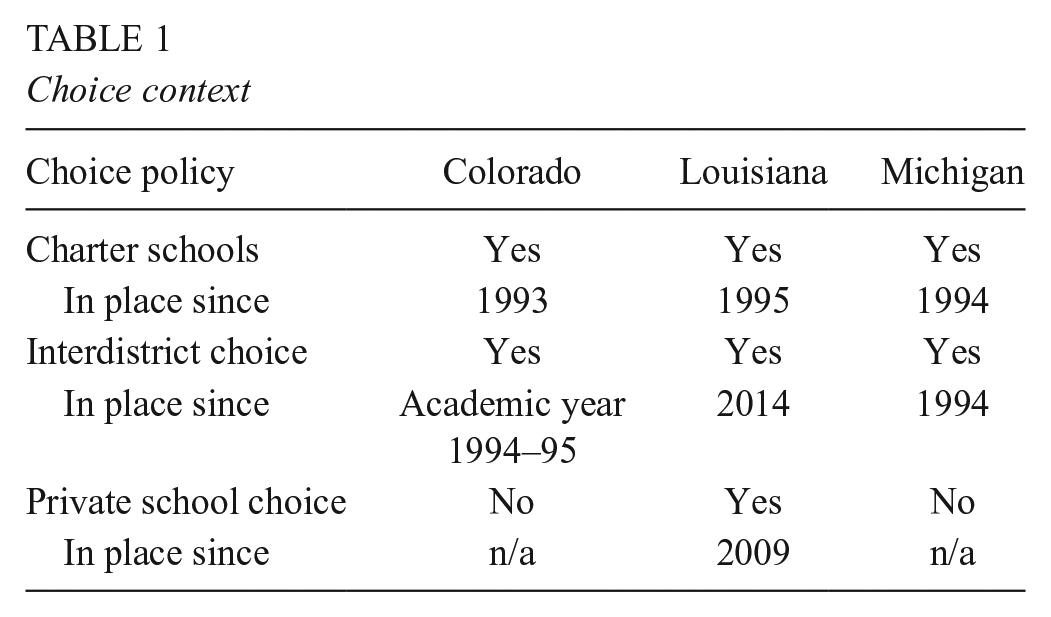
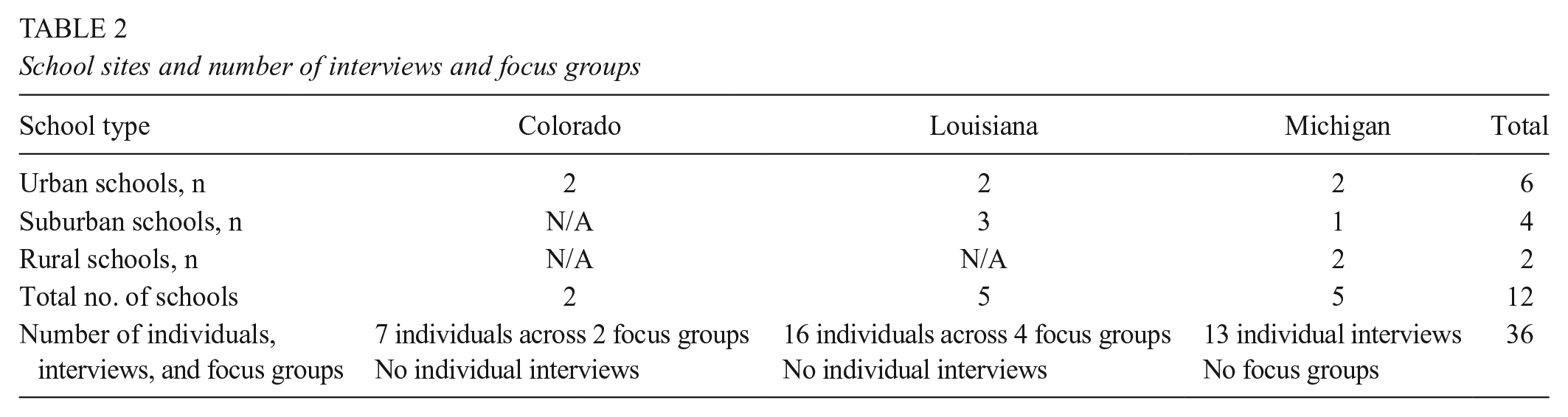
Overall, we spoke with 36 parents whose children attended traditional public schools, charter schools, and voucher-accepting private schools. Although all these parents selected schools within a school choice marketplace with different schooling options, some selected charter schools or voucher-accepting private schools and others chose traditional public schools in or outside of their catchment zones. Most schools were elementary schools, but we spoke with parents at a middle school in Colorado (i.e., Fir Middle School). Additionally, the charter schools in both Louisiana and Michigan served students in grades pre-K–8, and the voucher-accepting private school in Louisiana served students in grades pre-K–12. We conducted 15 individual parent interviews and six parent focus groups (with two to five parents in each group) from urban, rural, and suburban districts in Louisiana, Michigan, and Colorado (see Table 2). To identify parents, we first sampled schools as part of a broader case study approach, selecting based on school type (e.g., charter, voucher-accepting private, public) and student demographics (e.g., enrolling a majority of students of color, low-income students, or English learners based on the goals of our broader study, which focused on equity and access in school choice). Therefore, our schools had student populations that were either similar to the overall district or had higher concentrations of students of color or low-income students. (Tables 3 and 4 provide more information about the schools in our study.)
School sites and number of interviews and focus groups
Schools and districts in study by geographic setting

Names are pseudonyms.
School site characteristics

We then conducted focus groups or individual parent interviews at each site depending on what was most feasible at each school site based on the principal’s recommendation. We sought to conduct focus groups with a range of families, selected by school leaders to participate. We asked school leaders to intentionally select five to six parents with varying experiences at the school and including at least one parent of a child with special needs. However, in some schools it was not possible to coordinate a focus group, so we instead conducted individual parent interviews. In addition to variation in school type, our sample of parent participants included a range in terms of age, race, gender, and income (see Table 5).
Participant demographics

We used protocols based on Patton’s (1990) framework of both formulated and more informal, open-ended questions (see Appendix A). To capture information on choice decisions and perceptions of choice systems, we probed on the timing and logistics of choice. We collected data between November 2019 and March 2020. In the sites with centralized enrollment (New Orleans and Denver), most interviews were conducted prior to the application window opening. Across all sites, interviews were conducted before admissions notifications were sent for the following year. Interviews lasted ~30–45 minutes, whereas focus groups took between 30 minutes and 2 hours. During the interviews, we assured participants that their individual responses would not be shared with the principal or school leadership.
Data Analysis
We recorded and transcribed all interviews and focus groups. 2 We used Dedoose to code transcripts, employing a hybrid coding method (Miles et al., 2014) in which we first developed a deductive coding scheme informed by the existing literature and then added codes inductively as we read through the transcripts (Miles et al., 2014). There is no agreed on approach to analyzing focus group data. Some scholars analyze the data at the group level, whereas others do so at the individual level (Onwuegbuzie et al., 2009). Because our aim was to understand individual parents’ experiences with the choice process rather than interactions and collective meaning making among parents, we focused on individual statements in focus groups, which then could be analyzed alongside our individual interviews. Specifically, we analyzed each individual parent in the group separately, coding each individual parent’s contributions to the focus group (Krueger & Casey, 2015; Onwuegbuzie et al., 2009). Such approaches isolate individual perspectives from focus group transcripts and treat them as standalone data points for analysis. To implement this, we created copies of the focus group transcripts, one for each speaker (e.g., “Speaker 1”), and then coded that transcript to represent that speaker’s perspectives. Although we recognize that the data are uneven, in that we have far more text from the interviewee respondents than from the focus group participants, this approach allowed us to analyze both sets of data at the individual level.
Once we created the individual transcripts, we coded broadly in Dedoose for the different categories of administrative burden in school choice policy, including stress, anxiety, and the psychological costs of choice (e.g., frustration); learning costs (e.g., information, research); compliance costs (e.g., completing applications); and the factors that appeared to reduce costs (e.g., prior experience with systems). See Appendix B for our codebook. We also captured several other dimensions of parents’ experiences, including their perceptions of whose responsibility it was to find a “good” school, the quality of options available, and how choice intersected with race, class, or students’ educational needs. After establishing interrater reliability, each transcript was coded by a single coder, and we met regularly as a team to ensure consistency in the coding process.
After coding, we explored coded categories, relationships between codes, and patterns across sites using our research questions as a guide. We divided up the codes across team members, who each wrote detailed memos for each code/category to capture key themes and explored differences by site, class/background, and policy design using administrative burden and administrative capital theory to explain how families navigated these systems. For example, a memo on application procedure codes focused on first describing the nature of the burdens across sites, using the 132 coded excerpts. The team member created inductive subcategories for these codes, for example, “repetition of bureaucratic tasks,” “forms and paperwork,” and “application timing and deadlines.” Then, in the memo write-up, each subcategory included themes/emerging findings and evidence (i.e., quotes, examples, and interpretation). After describing the general themes, the team member compared the excerpts by site (e.g., six school districts) for differences by choice policy design (e.g., centralized or decentralized enrollment processes) and noted consistent themes across sites. We all reviewed the memos; a subset of team members determined the outline for the key findings and results; and we verified these with the full group, particularly the researchers who collected the data and were most knowledgeable about the local context.
Limitations
Although we believe that there are many strengths to our study design, including the variation in sites and school types, the large sample of largely low-income parents of color, and the unique timing of our data collection within the enrollment window, we recognize several limitations in our recruitment approach, our sample of choice parents, and our uneven sources of data. The parents in our study were identified by school leaders, not researchers, at selected schools that were part of a broader case study research design. This recruitment approach had some benefits and some limitations. School leaders likely have unique insights into the families enrolled in their schools due to the nature of school choice recruitment and admissions. They may be able to identify a more diverse range of families than researchers could through direct recruitment because some families may be more comfortable responding to a principal’s invitation than to an invitation from a researcher who they do not know. A principal also may have more insight into the choice process and possible identification of families with students with disabilities. That said, we recognize that principals may have sought to invite parents who they believed would reflect favorably on the school or the principal. Although we asked them to vary the participants in the focus groups as much as possible to represent the diversity of families at their campuses, we cannot be sure how these participants were selected, and this process might introduce bias. If there is bias here, it likely skews toward parents who are more satisfied with the school and potentially the school choice process. Additionally, all our participants were parents in schools of choice (although some were traditionally public schools in choice marketplaces) who volunteered their time to speak with us, and although we made efforts to schedule interviews and focus groups around parents’ schedules, this necessarily limited our sample to parents who could devote a part of their day to the interview and those who were at least somewhat engaged in the school-choosing process rather than those who may have enrolled in their zoned school by default. We therefore include in our discussion ideas for future research that would expand on what we were able to learn with our current sample.
We have uneven data on family characteristics. Parents were asked if their child received special services but were not required to disclose such information. Additionally, our data on caregivers’ race/ethnicity, income, and class are not consistent across sites, and there are some missing data. We did not systematically ask about participants’ income or class status, but we sampled from schools that served a majority of low-income students. We sought to fill out the lack of consistency in questionnaire completion by drawing on interview-based signals of class (e.g., workplace/occupation and whether they were employed), where possible, whether the interviewee disclosed that their child had special needs, and the racial/ethnic presentation of participants, although we recognize the limitations of such approaches. We also did not capture data on parent education, nativity, or language. We therefore focused our analyses on overall themes and differences between choice context rather than on differences in family characteristics.
Finally, when presenting our results, we pooled findings from interviews and individual statements made in focus groups to represent parents’ perspectives and experiences. We recognize that there are limitations; of course, the interview data and quotes are richer, longer, and more in-depth given that the individuals had more time to speak in an interview than in a focus group. However, we were still able to glean their general experiences with the burdens of school choice.
Parent Stress, Anxiety, and the Role of Administrative Burdens in School Choice
We found that school choice policy generates its own set of administrative burdens, including learning costs, such as information seeking; compliance costs, including completing school application forms, waiting to meet with staff to assist, and waiting for the outcome of a lottery; and psychological costs, due to the stress and anxiety associated with the selection of a school. We found that these costs are related to and interact with one another. Compliance and learning costs can generate psychological costs, such as stress, uncertainty, and a sense of powerlessness.
In this section we highlight how the local context and especially the school choice policy design influenced the extent and types of burdens parents felt when selecting schools. We focus specifically on how two policy components—systems of information and enrollment policies—influenced parents’ experiences of school choice burdens. In many contexts with school choice, critiques about access and equity have led districts to attempt to reduce the costs and burdens associated with school choice by, for example, centralizing information or streamlining application systems. Traditional district governance sites (i.e., the suburban and rural sites in Michigan and Louisiana) and the fragmented governance model (in Detroit) lacked both centralized information sources (e.g., a parent guide to all options) and centralized enrollment systems (e.g., a common application for school options). In contrast, both New Orleans and Denver had centralized information systems and centralized enrollment systems, which included district and charter schools. We found that these levers influenced parents’ experiences of administrative burdens in school choice, particularly with learning and compliance costs, but largely failed to reduce the psychological costs, the stress and anxiety, from selecting schools.
Learning and Information Costs: Researching and Selecting Schools
Under school choice policies, parents are tasked with researching and selecting a school from the available set of options—forms of learning costs. As one parent in New Orleans said during a focus group, “You just got to search,” (Sycamore Parent 2, Black), and another echoed, “Do your research” (Magnolia Parent 2, Black, New Orleans, focus group). In an interview, one Detroit parent said, “You have to do the footwork” (Maple Academy Parent 3, Black, Detroit). In total, 24 of 36 parents reported conducting extensive research, going on school tours, or seeking formal information about schools. Although families across sites experienced learning costs associated with school choice, we found some limited evidence that the extent of costs varied depending on policy design and, in particular, centralized information sources on school options.
Across sites, parents voiced frustration about the lack of information on websites during the choice process. However, this experience varied across sites with different information system designs. This frustration was greater in the cities and suburbs that did not provide pooled information on school options. In Detroit, for example, where there was no centralized parents’ guide or information source, parents who selected charter schools described how little of the information they sought could be found online, especially on nontested subjects, curriculum, and courses offered. One Detroit charter parent wanted to know “what their curriculum was like. I would’ve liked to know [that] they didn’t have books,” referring to the practice of not providing textbooks and standardized curriculum to teachers in some area charter schools (Aspen Academy Parent 3, Black, Detroit, interview). Another parent said it “was shocking to find out” that the school she considered for her child had no special classes such as Spanish or art, information that had not been available online. And another parent noted that much of the online information was “outdated” (Pine Parent 2, White, Michigan suburb, interview).
Families in Detroit, without centralized information sources, thus reported greater logistic challenges in tracking down the information they needed about schools. In one suburban district, the school system was in flux, and new schools were opening. At this site, there also was no published parents’ guide or centralized source of information, and parents found the number of new schools and the constantly changing choice environment complex and confusing, and they were unable to make decisions based on prior knowledge. Some cities, such as New Orleans and Denver, tended to have more information overall and provided information to parents through an enrollment guide, which listed all school options and provided details about them. This reduced search and learning costs in that families did not have to first attempt to figure out the array of options (as was the case in Detroit). However, families noted that the information included in such booklets was still complex because it could include >100 school options and was not always in the categories parents preferred, as noted earlier. One parent indicated that it was not sufficient to rely on website data, that parents must “visit the schools, because from what I saw on the internet, the school’s website, [and] the pictures is not what I saw when I toured the school. So, you have to be hands-on. You have to actually go there, visit, you know, talk to the principal” (Magnolia Parent 2, Black, New Orleans). In a focus group, this parent described the process: So. I would start with Orleans Parish and see what charters we have, or what schools we have. Look at the [test] scores for the schools. That’s the most important thing. Do tours, go to the schools, schedule a tour. And what’s the ratio? You know, you want your child to be diverse. So, I say [our school] is very diverse because our population for Hispanic is like 30%, I think.
This quote illustrates the broad range of information parents were seeking: First, they needed to determine the set of options available to them—“What schools we have.” Then they sought out information about the schools, such as test scores, demographics, and class size. One parent said that they had to take a district-led class to understand the school performance and rating system.
Learning about each of the options was a significant hurdle, and even with all this research, some information was not easy to find. A parent in Denver noted that the information received in the centralized enrollment guide was not sufficient because it did not speak to the school culture or climate: “What was hard for me was the information that they give you is vague. . . . they tell you how they rated as far as [the district] rates them. . . . But what those things don’t tell you is, are the staff and admin going to be open to you coming in and volunteering whenever you feel like it, are they going to require things of me that I’m not willing to do? Those sorts of things are hard to figure out. . . . There’s no way of knowing that based on the little pamphlet of information they give” (Fir Middle School Parent 2, Denver, interview). Other parents described how schools held the power and determined what information to share or withhold, even in more centralized systems. For example, a Denver charter school parent said in their interview, “When we talked to [the district], they said, ‘No, we don’t have any information. We were waiting for information from the school’ . . . because the school knows how many seats they have. . . . So it depends a lot on the school” (Fir Middle School Parent 3, Latino, Denver). These information gaps and asymmetries created even more uncertainty for parents during the choice process.
Thus, even in places with centralized information on schooling options, which reduced search and learning costs for families, parents still experienced stress and uncertainty due to the perceived quality of choices they had and because, even with these information systems, they lacked information on the school characteristics they sought.
Compliance Costs: Frustration and Anxiety of Application Procedures, Wait-lists, and Interviews
The enrollment process (e.g., application, admissions, or lottery) across sites involved compliance costs: paperwork, wait times, and uncertainty about the outcomes. Parents had to submit some paperwork, beyond the standard school enrollment paperwork, to enroll in a school of choice, whether it was a charter school, voucher-accepting school, or traditional public school that was not their zoned or assigned school. Parents, across sites, typically noted that they had “no problems” with the paperwork, that it was “super easy,” “super simple,” and that it was “not stressful.” Although we anticipated that the applications would create salient compliance costs for parents, most parents described them as straightforward. Only seven parents reported the application process itself as stressful, particularly for parents who worked or when families had multiple children and wanted to ensure that they were in the same school or in nearby locations. However, as we describe below, these compliance costs varied across sites, depending on the extent of centralization in the application and admissions processes.
Across all sites, parents noted that although the paperwork itself was not too burdensome, there were planning costs over a longer horizon than some parents expected. The timeline to make decisions and submit applications started earlier than some parents anticipated. One parent in Denver said in an interview, “It was like a year ahead. I mean, we were looking for elementary schools late, and we were nine months away from our kid going into school. So you have to start early. You don’t know that necessarily. But you have to” (Juniper Parent 1, Black, Denver). One parent accidentally missed the deadline to send her child to an “exam school” in Detroit and blamed herself: “Yeah. I didn’t know what the deadline was. Yeah, I wasn’t on top of it like I should’ve been. So I missed it” (Maple Academy Parent 2, Black, Detroit, interview). Because parents assigned themselves the responsibility of school choice, they also blamed themselves when the outcome was not optimal. As a parent in New Orleans noted, “If you’re lazy and don’t take heed to it, you’re going to miss out on your child going to a good school—a school that you actually want them to go to” (Sycamore Parent 1, Black, New Orleans, focus group). This parent described how parents who waited too long or submitted their applications late were responsible for their child ending up in a less desired school. Parents’ decisions about schools thus were tied up with general parental anxiety and ideas of what it meant to be a “good” parent. Parents who felt a stronger sense of responsibility, or pressure, to choose the right school experienced more stress.
Centralized enrollment processes (e.g., a single or common application form), which we saw in Denver and New Orleans, theoretically should ease the burden in terms of time spent completing various school-specific forms. Indeed, these systems did reduce compliance costs by allowing families to fill in one online form rather than deliver individual applications to different schools and by reducing the complexity of multiple timelines for decisions. For example, in Detroit, where there was no centralized enrollment system in charter schools, each school might have its own deadline, and a parent might gain admission to multiple schools, thereby holding multiple seats and further contributing to stress in the system. This inefficiency was addressed by centralized enrollment processes in New Orleans and Denver.
Yet the uncertainty around admissions still generated stress and anxiety, and we found that parents in cities with mandatory or forced choice systems—in New Orleans, for example—experienced greater pressures than parents who opted into choice, that is, had an assigned or neighborhood school but enrolled in a different school that they perceived to be better. One New Orleans parent said of the common application enrollment system, OneApp, during a focus group, “I cried throughout the process” (Cypress Parent 4, Black, Louisiana suburb, focus group). In New Orleans, parents still reported that it was “a waiting process.” Another parent shared in a focus group, “I just filled out the OneApp and then just waited” (Sycamore Parent 1, Black, New Orleans). The wait, and the uncertainty during that wait, created some stress for these parents. Some New Orleans parents were affected by another form of “forced choice” in the case of school closures during and after the application window, as noted earlier, which forced parents into repeating the application and search process multiple times.
Some parents in New Orleans expressed weariness with the application process, sharing that it was “a lot,” even if they claimed it was “not stressful.” One parent said, “As long as they don’t be giving all that paperwork and stuff, I’m good. Because, I don’t know, that’s a lot. It really is. But it’s not stressful. It’s just something that you have to do” (Sycamore Parent 1, Black, New Orleans, focus group). This parent suggested that the enrollment process is “not stressful” because it is a necessary and normalized part of school choice. She went on to say, “I wouldn’t say it’s stressful because that’s something that you got to deal with until they get out of [school].” These compliance costs thus had become normalized, “something that you have to do.” The application process can be especially costly for parents who work. One New Orleans parent who worked full time noted, “They got to also think about the parents that actually do work, who don’t have the time to take off, to go and sit, and find a OneApp [application enrollment process] place and then take them all the paperwork. It’s stressful” (Sycamore Parent 1, Black, New Orleans, focus group). OneApp was a common application in New Orleans that could be completed online. During enrollment periods, there were district-provided and public spaces to enroll for families without internet access at home. But parents noted that these public spaces were busy, and this created a burden on parents, particularly those who were working.
Although some parents described the paperwork itself as “pretty straightforward,” they complained about the repetition of these tasks, even if their situation didn’t change. One parent in a traditional public school district in Michigan, who used open-enrollment policies to send her children to a different school, noted: “My only complaint would be you have to fill it out every single year. . . . If they know my kids are coming back, I still have to fill out the same three or four papers every school year. For each child individually. And it’s obviously not that big of a deal because it’s just fill out paper. But if I had a complaint that would be it” (Pine Parent 5, White, Michigan suburb, interview). Similarly, parents in a New Orleans focus group noted about filling out forms, “You’ve got to do this every year until they graduate” (Sycamore Parent 2, Black, New Orleans), and “Every year, you have to do it all over again with the paperwork and stuff” (Sycamore Parent 1, Black, New Orleans).
For some, this repetition was exacerbated by the unexpected closure of some schools. In New Orleans, where district and state leaders have regularly closed schools for underperformance, some parents experienced multiple school closures, which left them searching for a new spot for their children. Parents who had described the process overall as “not stressful” reported feeling stress when their school was slated for closure. One parent said, “I just don’t feel like going through that process all over again” (Sycamore Parent 1, Black, New Orleans, focus group). Her children had already moved from a prior school that had closed: “[My daughter] loved that school. She wanted to stay there until she graduated, . . . but since [it] closed, we had to hurry and pick a school. And we wind up here” at a school that was again on a closure list. She noted that the school district should have informed them of the possible closure “back when we [were] doing OneApp,” the common application form. Another parent from the same focus group also shared this sentiment: “Now we got to do it all over again. . . . I guess, one year, we’ll get it right. And it will be this year coming up . . . because I’m not going back and forth. . . . The OneApp, the paperwork, the whole nine. It’s a lot” (Sycamore Parent 1, Black, New Orleans). Although this parent had said that the process was not stressful in general, she noted that this repetition was “because we got to do this OneApp all over again. And this is the time when it becomes stressful. It really does. This makes it become stressful, right here. Us having to start all over again.” This parent expressed the frustration she felt with making this decision yet again for her children and the impact that constant movement was having on them. She noted that someday “we’ll get it right,” seeming to blame herself for ending up in a school that was closing. In other words, there was minimal psychological cost from the application process the first time, when it was normalized, but when families apply numerous times and under more stressful conditions (i.e., closure), this adds psychological costs in disproportionate ways.
Similarly, in Denver, which also had a centralized process, parents in focus groups described a great deal of waiting: That the waiting process, no information process, no information from the district, no information from the schools you applied to. No information nowhere until two weeks prior to school. You don’t know if your kids are going to go to your local school. (Fir Middle School Parent 3, Latino, Denver)
This parent noted, “After filling out the form, what do you need to do? . . . What’s the times or what’s the process to get some answers?” Although multiple participants across sites discussed uncertainty around application timelines, this was particularly acute in Denver, where all five of our participants voiced frustration with not knowing where their children will be going, in some cases until a few weeks before school started. In contrast, in Michigan, children were assigned somewhere to go—a default option—and families engaged in choice only when they wanted to find something better. There was always a default or backup option. Some of the schools in suburban Michigan had “plenty of room” at the time of application, “so we never kind of worried about that” (Pine Parent 1, White, Michigan suburb, interview).
Some parents in choice systems that were not centralized described even more anxiety and uncertainty because of the timing of the process, which did not always align across schools. In a suburban district in Louisiana, two parents said that they did not learn about choice outcomes until shortly before the school year started. One charter parent said, “They can call you at any time” (Willow Parent 4, White, Louisiana suburb, focus group), and she was prepared to move her child to another school even midyear. Another parent in a suburban site with no common application described the stress of the application process, saying: “It was very stressful. . . . Most moms that I know are stressed about the school process” (Cypress Parent 2, Black, Louisiana suburb, focus group). In Detroit, parents struggled to keep up with different timelines for “exam schools,” which required a test, alongside the other charter school and open-enrollment deadlines. The waiting period and managing multiple school timelines made the process more complicated in places that did not have a citywide centralized enrollment system.
Centralized systems also promised to remove the problem of selection by schools, such as cream skimming. This was the aim of the centralized enrollment system in New Orleans, for example, but other sites did not have such protections. Some of the enrollment processes families reported on not only created administrative burdens but also were selective and could discourage some families from applying or enrolling in their schools. A few parents described enrollment procedures such as having to bring in a physical application, participate in an interview process, or take an exam. One parent in a suburban charter school in Louisiana said in a focus group, “When you turn in an application, you have to physically bring it in. . . . You can’t mail it, you can’t fax it, you can’t email it over. You have to physically walk in and take the time out of your day to bring that in, bring in your shot records, bring in your birth certificate, bring in your proofs of income—and make sure the form’s filled out. . . . I’d say about 95% of our parents are good. . . . You want to be involved. . . . And it’s not just like, ‘here’s my kid’” (Willow Parent 3, White, suburb). Although this parent was satisfied with the selection process that could screen out parents, these practices can prevent others from applying. A Michigan charter school parent noted that they “did have to interview,” where the school “said [that] they would like to interview [my son] . . . to sit down and talk to him and see where he is” (Aspen Academy Parent 3, Black, Detroit, interview). The parent also had applied to exam schools in Detroit, which were selective and had a high reputation, but one of her children was “not a good test taker” and would get “test anxiety,” so she did not send him there. She noted that she “wished that every school would be as good as the [exam] schools, but . . . that is very trying. It’s almost like a three-hour test just to get in. . . . That’s a lot.” This added a layer of psychological cost as the parent considered the stress placed on the child.
In places without common application and notification timelines, families learned about admissions decisions at the last minute, and the timing of notices about school placement and the wait involved also created stress. One parent said, “You do still have to accept the scholarship by a certain amount of time, so you don’t lose it, . . . and that is tricky. . . . Because then when he got a scholarship, he got a different school from here, and we wanted [my two kids] together. So that part was a little. . . . the form was simple, it was just trying to see if you could get in” (Cypress Parent 2, Black, Louisiana suburb, focus group). In this case, again, the parent noted that the form itself was simple, but the deadlines created pressures and fears that her children would not be able to attend the same school.
When describing how it felt when she did not know whether her child would receive the voucher, one parent said, “I was very stressed. I cried.” A parent applying to a charter school that held a lottery similarly noted, “Okay, they’re going to pull five names. You might get in. Even though they pulling five names, they only might have three spots. So it’s still like the luck of the lottery” (Willow Parent 1, other race, Louisiana suburb, focus group). This parent also described how she found out at the last minute of their enrollment in a school. Her child got in “a week before school started” because “somebody dropped out.” As one parent noted of the process, even in a centralized system like Denver, “the application is easy, but after filling the application is a nightmare” (Fir Middle School Parent 3, Latino, Denver, focus group), referring to the wait and uncertainty. This waiting, more than a cost of compliance, created psychological costs of uncertainty and stress.
Psychological Burdens of Choice
Despite seeing some variations across sites, what was notable was the high level of stress and anxiety among all parents, even in cities that had robust information and enrollment systems. Thirty parents reported this psychological stress directly, and almost half of these parents were in Michigan, 13 were in Louisiana, and only three were in Colorado. Despite efforts to improve equity and access to schools in some sites, by streamlining information or centralizing enrollment processes, all families dealt with uncertainty and waiting periods, and many ultimately reported feeling disempowered by the process. As noted earlier, most parents reported that the process of applying to different schools of choice was simple and not too burdensome; the psychological costs, the stress, came from the act of having to choose, the repetition of the application procedures, the responsibility of finding the “right school,” and the timing and uncertainty regarding the outcome.
Parents took on full responsibility for their child’s education, which created stress. When we asked about who was and who should be responsible for ensuring that their child received a high-quality education, parents overwhelmingly said the responsibility, or burden, was on parents—28 parents believed this to be the case. In a focus group, one parent in Denver shared, “I think that, as parents and caregivers, we have a responsibility as well” (Fir Middle School Parent 1, Denver), and as noted earlier, parents believed that those who did not do their “research” on schools were to blame for ending up in a less desirable school.
School choice shifted the responsibility of securing high-quality education for a child from the state or district to parents. Parents, in theory, were empowered to choose, but the low-income parents and parents of color in our study, due to the stratified and segregated nature of public schools, reported a great deal of pressure to navigate the system and find a suitable school for their child. One parent likened the school choice process in Denver to “trying to pick a college for our kindergartener” because he was “touring schools and talking to people” (Juniper Parent 1, Black, Denver, focus group). He noted the anxiety around the decision: “As a new parent, you’re frightened that you’re going to put them in the wrong school to learn. And I mean it’s a lot of pressure, because you have all of these options, all these choices.” A parent of two Black children described the high stakes of education for her children, calling out race explicitly in the interview: “Well, education to me is important because they are young, Black males, and I think with an education, their lives would be a lot better” (Aspen Academy Parent 2, Black, Detroit, interview). For low-income families of color, school choice—if they made the “right” choice and could access desirable schools—offered the potential of upward mobility in an unequal society.
Discussion
Our findings show how families experienced the various administrative burdens in school choice policy and how the costs experienced by participants also interacted with one another; learning costs, the search for sufficient and adequate information about school options, created uncertainty and hesitancy—psychological costs—when the information parents sought was not easily accessible or transparent. Overall, we argue that administrative burdens are an important component of the bureaucracy of school choice, and policymakers have a critical role to play in (re)designing choice systems in more equitable ways.
Our work contributes to existing theory and literature on school choice. Prior research has shown how burdens in choice policy are racialized (Gándara et al., 2023) and gendered (Brown, 2022) and can be a form of administrative racism (Starke et al., 2018). These burdens also can be intentional, or by design (Moynihan et al., 2014), because they may seek to discourage and encourage use of choice by some parents based on status and social construction (Jabbar et al., 2022; Schneider & Ingram, 2017). Our work illuminates how school choice policies can shift burdens from the state to parents and how families can internalize the failure to successfully navigate these administrative burdens, that is, when they miss deadlines or believe that they did not gather sufficient information. School choice thus places a double burden on families through the learning, compliance, and psychological costs of choosing as well as the burden of responsibility for their child’s educational success. Every minor misstep in the process—missing a deadline or not completing a form, as some families in our study noted—not only costs families time, money, and other tradeoffs, but they also believed that it reflected on them as parents and had tangible consequences for their children.
Parents in our study described a deep sense of responsibility for their child’s education, which, in their highly unequal contexts, was pitched as the key to upward mobility or exiting poverty. Low-income parents, the majority of whom were parents of color in our sites, may expend a greater percentage of their limited resources on the search process. Low-income families in New Orleans, for example, emphasized the need for parents to take on the burden of selecting schools—“do your research”—even blaming themselves when a school closed for performance issues because they felt that they should have selected a higher-performing school. They also internalized failures resulting from compliance costs—missed deadlines and lack of information—placing blame on themselves. Ultimately, people interact with government services to access essentials—health, education, food, employment, citizenship, and voting—and these are deeply connected to responsibility for one’s family, dignity, and agency.
We did not have a comparison group, but future research could explore how these burdens vary or compare with those experienced by White middle-class families. With a larger sample, researchers might examine how the experience of burdens varies across families with different parental education levels, immigration statuses, and languages. Furthermore, although our focus was on parents’ experiences navigating choice systems, future work could explore how students experience the burdens of choosing (e.g., Phillippo, 2019). Our study was conducted during a period of choice and during the application window so that we could capture in real time the burdens families experience; however, longitudinal research could build on our work to follow up with families after they have been notified of their enrollment for the following year, which could reveal whether the stress or anxiety is increased or reduced once a placement/assignment is made. Because this study focused on parents in charter schools or schools of choice, we cannot speak to the experiences of parents who might have opted out of choice systems perhaps, in part, because of these administrative burdens or due to structural constraints, transportation barriers, or language or cultural barriers, or of parents who do not have school options beyond their neighborhood school, which, if the school is underresourced, could be its own source of stress or anxiety. Heavy administrative burdens can create a system where only some parents are able or willing to take on the additional stress and burden involved in engaging in school choice systems, leaving families with greater time constraints or fewer resources out of a system that is designed to create more equity.
Our work also reveals links between school choice, administrative burdens, systemic inequality, and policy design. When families choose in highly unequal contexts, where they have limited choices of high-quality schools, the interaction of the administrative burden of choosing with the outcome of that process generates stress and anxiety, magnifying otherwise small hassles. The process can seem futile because the array of choices is so poor. As Posey-Maddox et al. (2021) have argued, “there is no ‘right’ school choice for Black families; such choices remain elusive” (p. 58) because such families must make racialized tradeoffs and remain watchful even once they have made an initial decision, weighing their other options continuously because they had racialized experiences in the school (e.g., experiencing racial microaggressions or tracking of their child). We argue that this form of racialized stress may be exacerbated when racially minoritized families interact with administrative burdens in the process. Of course, it is important to note that not having choices also could be stressful because families may have to lobby their schools and districts for essential services or necessary improvements.
Especially for low-income parents in New Orleans in schools slated for closure, administrative burdens in choice added stress to a process intended to create agency and empowerment. Our work aligns with previous critiques of school choice for only empowering families in superficial and market-oriented ways—expanding consumer “buying power” to low-income families by offering more school options—rather than empowerment through public investment and broadening community engagement in schools (Scott, 2013). Our work also builds on research that examined the psychological impacts of school closures—how communities “mourn” shuttered schools (Ewing, 2018). Future research should explore the added effect of school closures on the psychological costs and learning costs of school choice—how families must navigate their next move when their school is closed and the additional burden this creates. The experience of school closures is not evenly distributed among choosing families. Research has documented the disproportionate impact of declining enrollments and school closures by race and class (Ewing, 2018; Pearman et al., 2023), often driven by gentrification. Some parents in our study had experienced multiple school closures, even though their children were still in elementary school, and more quantitative research is needed to examine these patterns of families experiencing multiple school closures and the potential compounded effects. Our work thus reveals another mechanism through which choice is not ostensibly neutral but racialized.
Our work has some limitations related to the nature of the sampling and data collection. First, we relied on principals to identify within-school participants, which might mean that families who were more satisfied with their school decisions were recruited by principals to participate, as discussed earlier. Yet, our work reveals the immense challenges that even these positively selected families experience in navigating school choice, completing applications, and enrolling in school systems. Second, our data collection included a mix of focus groups and individual interviews, and our analytic approach highlighted the individual statements made in focus group settings, which are naturally shaped by the contributions of peers in the group. Finally, our study focused on schools serving predominately low-income students and students of color rather than comparing different socioeconomic or racial/ethnic groups. Therefore, we cannot say whether families in our study experienced greater burden than other groups, and we encourage future scholars to take up such comparative work.
Despite these limitations, our work does show how the theory of administrative burden can elaborate our understanding of school choice processes, and our work has implications for policy, particularly in the design and implementation of school choice. Previous research on school choice and its administrative burdens has rarely engaged with how policy design (e.g., information mechanisms and enrollment processes) can influence the costs that families experience. Our study therefore explores these connections between policy design and administrative burdens, yet our small and varied sample allowed us only to draw some tentative conclusions.
It is important to reveal the burdens of school choice to design more equitable systems. First, providing clear and easily accessible information about schools is critical to reducing the burden on parents. Families in Detroit, who lacked centralized information sources, perceived greater challenges in navigating school choice. Incomplete or difficult-to-access information shifts the responsibility of information gathering to families and requires significant investment of time. This has been the focus of much intervention—the efforts to reduce learning costs for parents. Second, parents reported anxiety around meeting various deadlines and uncertainty about whether their children would be admitted to certain schools. These psychological and compliance costs have received less attention from scholars and policymakers. Using centralized enrollment systems and more transparency around admission procedures reduced the complexity for families, as in New Orleans, by streamlining the process into one application. Often these changes were brought about due to concerns about equity and access in charter school systems (Harris, 2020). However, families still experienced stress and uncertainty due to school closures. Policymakers can give serious consideration to parent stress, anxiety, and uncertainty when redesigning school choice systems, weighing these considerations alongside other goals of quality and desegregation and integration. For example, leaders in San Francisco have recognized this as a key goal, creating school choice “zones” for more predictability rather than families potentially being assigned to any of the 70 or more options across the city (San Francisco Unified School District [SFUSD], 2024). Even when school choice leads to positive outcomes, such as improved test scores (Harris, 2020) or most families receiving one of their top school choices (Harris et al., 2015; SFUSD, 2024), systems can work to mitigate the uncertainty and stress in the process, recognizing this as a measurable and laudable goal in and of itself.
Finally, although we did find variation in the experience of burdens across cities, which had different information systems and enrollment mechanisms, such instrumental changes in school choice are unlikely to significantly address the equity challenges inherent in market-based systems due to resistance and entrenchment (Zancajo et al., 2022). Beyond these tactics to reduce existing administrative burdens in school choice systems, policymakers thus should consider other forms of empowering parents in search of high-quality education, including structural and financial policies to improve resources in public schools and engage families in key policy decisions (Scott, 2013).
Footnotes
Appendix A: Protocols
Appendix B
Codebook (Selected Codes)

| Code | Description/options | Example(s) |
|---|---|---|
| DESCRIPTORS | Codes that capture demographic or other information at the document level (not applied to excerpts) | District, school type, state, demographics, occupation, number of children, years in school, status |
| CODES | Apply to the text of transcripts, tagged to excerpts | |
| Stress/anxiety/psych burden of choice | Psychological costs of choice (e.g., frustration): stress/anxiety; also structural concerns/worries about the policy as well as the stress or emotional strain of not getting into a desired school; other similar words might be upset, pressure, and worry; code also used for anything else related to stress or anxiety not captured below. | “The whole process is just frustrating.” |
| Stress/anxiety/burden, reduce | Anything described that reduces stress or anxiety (e.g., choosing a good school, a policy/program/support they received, or being satisfied with the school they chose); strategies used to reduce stress (familiarity, etc. through social networks); anything to go through an easier process to make these choices; satisficing, or a “good enough” decision for a school, limiting the options you consider in some way; discussing reducing uncertainty through these ways | “We are so happy with the school we selected.” |
| Burden-choice- application procedures, compliance costs | Specific stresses related to applying to schools; procedures required to find and apply to schools causing worry or stress, including lack thereof (also policies or procedures that reduce burden/stress); |
“The OneApp is not stressful. It’s just something you have to do.” |
| Choice, responsibility | Whose responsibility/burden it is to find a high-quality school; do they view it as their own responsibility or the district’s? Include sentiments of wishing choice would go away, as well as desires to choose schools themselves | “It’s up to the parent to do the research.” |
| Choice, options | Feeling stress over the lack of good options, good choices, quality, matching schools to needs of child/family, and preferences. Also, how participants perceive the quality of either TPS or choice schools, and what evidence they provide (quality of school, “quality” of parents at the school, etc.). Includes any discussion of not wanting to go to their “home” or assigned school | “It’s tough because I don’t feel like I have a lot of schools I really want my child to go to.” |
| Choice, strategy/learning | Concept of learning costs; getting the knowledge to complete the paperwork or other steps involved in school choice; learning to be persistent; any strategy described that could take up significant mental resources and/or be evidence of administrative capital; using social networks to gather information | Which school to list first, trying to get priority for certain schools; visiting schools; doing your research; knowledge that what they say in profiles is not always accurate. |
| Choice, timing | Anything pertaining to the timing of the choice, namely when do participants start thinking about schools or about the next school or a possible switch? | The idea of always choosing or always considering applying |
| Choice, prior experience | Prior experience with choosing, education or experience with networks and how that influences their perceptions | “Well, I went through it two years ago for my other child, so I know the drill.” |
| Choice, agency/control | How participants feel about their agency in choice; was it forced by school closure or school policy (e.g., all choice system)? Do they feel like they have limited options or many options? Feeling like they have/do not have agency and control. | — |
| Choice, uncertainty | Anything about the general uncertainty in choice; not knowing if you got into the school; anything about lotteries, not having enough information about a school, or lacking key information | “You put in the OneApp and then you just wait. You don’t know how it will turn out.” |
| Choice, overload | Anything about having too many options | — |
| Choice, interactions | Interactions of choosing with other stressors and anxieties, loads, etc.; |
Of influence: Economic stressors or parenthood anxiety in general influences school choice decisions and exacerbates/reduces school choice stresses |
| Choice, gender | Anything explicit in the transcript relating to how the decisions, or stresses, are gendered (inferred connections between gender and their responses are analyzed using descriptors separately). | “All moms are stressed by school choice.” |
| Choice, race/class | Anything explicit in the transcript relating to how the decisions, or stresses, are racialized or classed (inferred connections between race and their responses are analyzed using descriptors separately); also includes seeking diversity or comments about the diversity of a school. | Leaving a neighborhood school because of its racial makeup; how they perceive their own social class in relation to a school they chose/left. |
| Choice, special educational needs | Anything related to access, stress, decision making, or resources for parents with students with disabilities, special needs, gifted and talented programming, etc., language needs | — |
Appendix C
District-Level Characteristics

| State | Geographic setting | School district | Enrollment | % Charter | % Black | % Latinx | % White | % Poverty | %Students with disabilities | % English learners |
|---|---|---|---|---|---|---|---|---|---|---|
| Louisiana | Suburb | Amber School District a | 50,000 | 8% | 35% | 40% | 20% | 80% | 13% | 17% |
| Urban | Orleans Parish School Board | 45,037 | 98% | 79% | 9% | 8% | 85% | 13% | 6% | |
| Michigan | Suburban | Ruby School District a | 3,871 | 0% | 95% | <5% | <5% | 77% | 10% | <5% |
| Urban | Detroit Public Schools Community District | 49,001 | 70% | 82% | 14% | 3% | 83% | 14% | 11% | |
| Rural | Teal School District a | 615 | 12% | 0.03% | 18% | 57% | 60% | 16% | 8% | |
| Rural | Jade School District a | 439 | 0% | 0.01% | 16% | 80% | 45% | 7% | 6% | |
| Colorado | Urban | Denver Public Schools | 89,061 | 23% | 14% | 53% | 26% | 62% | 12% | 31% |
Names are pseudonyms.
Acknowledgements
Thanks to Taylor Allbright, Katy Bulkley, Carlin Conner, Eupha Jeanne Daramola, Andy Eisenlohr, Taylor Enoch-Stevens, Carolyn Herrington, Kate Kennedy, Amanda Lu, Julie Marsh, Haley Nelson, Chris Torres, and Sandy Waldron for their research support.
Declaration of Conflicting Interests
The authors declare no potential conflicts of interest with respect to the research, authorship, and/or publication of this article.
Funding
The research reported here was supported by the Institute of Education Sciences, U.S. Department of Education, through Grant No. R305C180025 to the administrators of the Tulane Educational Fund. The opinions expressed are those of the authors and do not represent views of the institute or the U.S. Department of Education. This research also was supported by Grant P2CHD042849 awarded to the Population Research Center at the University of Texas at Austin by the Eunice Kennedy Shriver National Institute of Child Health and Human Development. The content is solely the responsibility of the authors and does not necessarily represent the official views of the National Institutes of Health.
Open Practices

Note: This manuscript was accepted under the editorship of Dr. Kara Finnigan.
Notes
Authors
HURIYA JABBAR is an associate professor of education policy at the Rossier School of Education at the University of Southern California. Her research uses sociological and critical theories to examine how market-based ideas in pre-K–12 and higher education shape inequality, opportunity, and democracy in the United States.
HANORA TRACY is a doctoral candidate in sociology at Tulane University. Her research interests are accessibility and inequality in education as it relates to race, language, and ability; English as a second language, bilingual, and multilingual special education students; and teacher retention rates as they relate to student success.
EMILY GERMAIN is a researcher at the Learning Policy Institute. She studies the implications of urban education reforms for historically marginalized communities, the relationship between schools and communities, and how policy and politics shape both the labor markets and practice of education leaders and teachers.
SARAH WINCHELL LENHOF is an associate professor of educational leadership and policy studies and the Leonard Kaplan Endowed Professor in Wayne State University’s College of Education. Her research focuses on education policy implementation and access to equitable educational opportunities, with a focus on how collaborative research with practitioners and community members can facilitate systemic improvement.
JACOB ALONSO is a PhD student in Urban Education Policy at the University of Southern California Rossier School of Education. His research focuses on the geospatial analysis of equity and school choice, how schools respond to demographic change, social justice school leadership, and democratic engagement in schools.
SHIRA HADERLEIN is a researcher at Mathematica, Inc. Her work focuses on the role of federal, state, and local policies in improving educational outcomes for underserved students.