




Abstract
State education agencies have increasing influence over educational policy and practice, with responsibilities ranging from vision setting to monitoring compliance with accountability policy. Although state education agency leaders are well positioned to advance change, capacity building at this level of the education system has been traditionally limited. Research–practice partnerships (RPPs) represent a promising venue to support the ability of state leaders to facilitate educational change. In this qualitative study, we drew on semistructured interviews with state education agency leaders and observations of RPP meetings to examine the state-level structures that pose challenges to leaders’ efforts to make change and how participating in an RPP can support leaders in addressing these challenges. Findings reveal how RPP engagement supported state leaders with navigating complex organizational silos and bureaucratic processes by promoting relationship building and supporting the use of evidence-based resources. These insights may inform future research and capacity-building efforts at the state level of the education system.
Keywords
Introduction
State education agencies (SEAs) fulfill diverse and influential roles within the complex system of education governance in the United States. These roles and responsibilities have expanded significantly over time as shifts in federal policy have placed SEAs at the center of issues including academic standards, assessments, accountability programs, curriculum, teacher certification, and school reform (Brown et al., 2011; Hodge et al., 2016; Leider et al., 2021; Smarick & Squire, 2014; Weiss & McGuinn 2016). Thus, state-level education leaders have become increasingly well positioned to influence a wide range of education issues, including pressing equity issues. A small body of research provides examples of such influence, including bolstering school turnaround efforts (Dunn et al., 2016) and supporting districts in ensuring students’ equitable access to education during the COVID-19 pandemic (Reich et al., 2020; Willse, 2024). Much of what has been previously written about SEAs has focused on high-ranking individuals in top leadership positions (e.g., chief state school officers and superintendents) as primary agents of change (Brown et al., 2011). Less is known about the challenges midlevel SEA leaders navigate in their efforts to advance change or how to effectively support their work. In fact, capacity-building opportunities at this level of the education system have been limited historically (Hopkins et al., 2022; Smarick & Squire, 2014).
On the basis of this study, we provide novel insights into the role of midlevel SEA leaders as potential agents of change by examining research–practice partnerships (RPPs) as a venue to support their capacity building. RPPs foreground collaboration between researchers and practitioners focused on addressing urgent problems of practice to promote educational equity (Farrell et al., 2021a). Although a small body of scholarship reveals how such collaborations can support state-level leaders in using research (e.g., Conaway, 2020; Hopkins et al., 2019), much remains to be learned about how RPPs may support leaders in advancing equity-focused change. Using qualitative case study methods, we examined how RPP engagement could support state leaders with promoting equity-focused change across multilingual learner (ML) policy and practice. 1 Drawing on a structure-agency framework (Datnow, 2005), we examine the following research questions: (a) What SEA structures pose challenges to leaders’ efforts to make change? and (b) How does participating in an RPP support leaders in advancing change within these structures? Findings from this study reveal that RPP engagement served as a powerful support for leaders’ equity-focused change efforts. This work provides actionable insights to inform future capacity-building efforts at the state level of the education system.
Study Context: An RPP with State Leaders
This study is situated in a multistate RPP that joins researchers with leaders in ML-focused roles in state departments of education across all regions of the country. The voluntary group was initiated in June 2020 and at the time of this study included 17 state education agency leaders across 16 states and six university researchers. 2 The state leaders participating in the RPP served in varied roles focused on supporting ML students, such as program coordinators, educational consultants, support specialists, and data and research analysts. Almost all of these roles are positioned at the midlevel within state agencies. In alignment with state members’ priorities, the partnership focused on a pressing equity issue in education—improving policy and practice for ML students.
Despite significant increases in the ML student population over the last 20 years and federal civil rights law that requires equal access to educational opportunity, many ML students continue to be served by schools and educators that are inadequately prepared to support them (National Academies of Science, Engineering, and Medicine, 2018). State education leaders are well positioned to address these inequities because they oversee implementation of several ML-focused policies such as identification, reclassification, and monitoring of academic achievement as well as providing support to districts and schools that struggle to meet progress expectations. Recognizing the influential role of state leaders in ML-focused situations, the RPP was guided by three main goals: (a) to use research evidence to inform decision making, (b) to examine state policies and practices that support MLs, and (c) to engage in leadership that upholds ML civil rights and advances equity.
To advance equity-focused change in ML policy and practice, the partnership aligns with key features of RPPs as outlined by Farrell et al. (2021a). Building on prior work by Coburn et al. (2016), the authors provide an updated definition of RPPs as long-term collaborations bringing together researchers and practitioners with a diversity of expertise “aimed at educational improvement or equitable transformation through engagement with research” (p. 5). Within this definition, engagement with research can range from producing new original evidence to building a “body of knowledge” by drawing on existing studies (p. 8). In our partnership, researchers and state leaders from across the country collaboratively engage with existing research evidence to improve ML programs and policies.
During meetings, RPP members engage in small groups focused on particular problems of practice (e.g., improving support for newcomer ML students, developing statewide frameworks for ML education, attending to ML students in statewide literacy efforts, etc.). Within these small groups, researchers and leaders examine existing research to develop evidence-based resources that can be tailored and used in leaders’ unique contexts (Weddle, 2023). Although much of the research evidence used in the partnership is focused on ML policies, programs, and outcomes, the group also engages with research on effective leadership approaches. Alongside engagement with research, the partnership also serves as a space for leaders to learn from each other’s experiences and approaches. Outputs stemming from this RPP collaboration include evidence-based policy briefs, leadership guides, webinars, and journal articles.
In addition to developing evidence-based resources to advance equity for ML students, the RPP is also characterized by equitable internal processes (Farrell et al., 2023). The cross-state partnership was intentionally designed to promote trust, and collaboration routines within the RPP were jointly developed based on feedback from all members (Weddle, 2023). Such routines include topic-focused breakouts, the use of flexible discussion protocols, and processes for sharing key takeaways (Weddle et al., 2024).
Literature Review
We grounded our investigation in two bodies of literature: the role and challenges of SEAs and the principles of RPPs.
Influential Role of SEAs
SEAs fulfill diverse and evolving roles within the complex system of education governance in the United States. Although specific responsibilities vary across states, SEAs fulfill five primary roles. They (a) provide the state’s educational vision and goals; (b) develop and implement the state’s standards and assessments; (c) design and implement the state’s accountability system; (d) administer, implement, and oversee state and federal funding and other programs; and (e) communicate about critical educational issues with stakeholders across the state (Weiss & McGuinn, 2016, p. 30). In some states, SEAs fulfill additional roles including managing low-performing schools, providing professional learning opportunities, overseeing teacher and education workforce development, and driving educational reform and innovation. The ability of an SEA to take on additional roles within its state may be related to laws, funding, context, or capacity.
On a macro level, SEAs are positioned within a complex national educational landscape, bridging between the federal government and thousands of school districts (Manna & McGuinn, 2013). State education leaders often work in concert with governors, state legislatures, and federal-level staff, as well as with districts and schools, to support implementation of policy and programming at the local level. Within their work, state education leaders navigate an intertwined relationship between state and local control in education (Fuhrman & Elmore, 1990). States enact mandates and guidance that influence practice at the local level, whereas district and school policy also can mediate or amplify state influence. Various factors shape these levels of influence, such as how states react to public and professional opinions, how districts manage state and local priorities in schools, and how local interest holders influence state policy (Fuhrman & Elmore, 1990).
Although SEAs fulfill some common functions across states, the structure and reach of these agencies vary across diverse state contexts (Shaw & Griffith, 2015). In some states, decision-making power is concentrated at the state level, whereas in other states, significant power resides with local districts. Authority may be consolidated or distributed among governing institutions, and the degree of public participation in policymaking can vary considerably. States may serve hundreds of small districts or a few large districts, and the approaches employed to advance educational programming can vary significantly (Shaw & Griffith, 2015). Activities for each SEA are influenced by the particular strengths and assets of the agency, local norms, and the specific authority granted to the SEA by the state’s constitution, legislature, and regulations (Weiss & McGuinn, 2016).
Compounding the complex system of education governance that serves as a backdrop to state-level work, the core functions of SEAs have shifted over the past several decades. Several decades ago, SEAs were often small, low-profile organizations responsible for performing a narrow set of compliance-based tasks such as administering small federal programs, distributing funds, and collecting data (Smarick & Squire, 2014). Test-based accountability policies such as No Child Left Behind (2002) and, subsequently, the Every Student Succeeds Act (2015) expanded SEA authority over curriculum, assessment, teacher certification, and school improvement (Anagnostopoulos et al., 2013). Programs such as the Obama administration’s Race to the Top incentivized (and in some cases rewarded) states for enacting sweeping reforms, advancing the roles of SEAs and centering them in the public spotlight (Brown et al., 2011).
SEAs now fulfill broad roles in education governance related to state education goals, assessments, accountability systems, state and federal funding, and supporting districts with professional development and curriculum (Weiss & McGuinn, 2016). With greater influence and flexibility in the education system, some agencies have begun to expand their focus beyond compliance with federal regulations, state mandates, and use of funds toward a broader focus on supporting districts and schools with improvement efforts (Weiss & McGuinn, 2016), positioning leaders within these agencies to promote equitable change.
SEA Leaders: Positioned to Make Change
Recent research provides compelling examples of how SEA leaders can influence change across the education system. In one instance, SEA leaders collaborated with districts to support school turnaround efforts (Dunn et al., 2016). This cross-governmental effort enabled SEA leaders to build district capacity and promote sustainable change through the creation of systems and frameworks that promoted alignment across state and district departments and a process of changing culture. Recent research demonstrated how SEA leaders partnered with district leaders to uphold civil rights law during the COVID-19 pandemic (Hopkins et al., 2022). Further reflecting state leaders’ influential roles, Reich et al. (2020) found that SEA leaders provided districts with beneficial guidance during the educational turbulence of the COVID-19 pandemic, helping to promote more equitable access to learning.
Although state leaders are well positioned to make change, contextual and organizational challenges complicate efforts toward equitable improvement. Many state agencies lack the capacity to implement innovative K–12 initiatives at scale and are often designed for more compliance-based tasks (Brown et al., 2011; Smarick & Squire 2014). Leaders also must navigate formal organizational structures of SEAs, characterized by bureaucratic red tape, complex hierarchies, and segmented or siloed units (Brown et al., 2011; Goertz et al., 2013). Broadly, organizational silos refer to the separation of different types of employees by discipline or department, often resulting in a lack of knowledge sharing or collaboration across departments in an organization (Kirwan et al., 2022). For example, departments within SEAs often align with distinct federal programs, such as Title I, or special education, and collaboration across these departments is typically limited (Russell et al., 2015).
In addition to challenging organizational structures, state-level leaders also navigate pushback against antiracist and inclusive educational efforts, including attacks on critical race theory. These trends in education policy and politics further complicate efforts to promote equity-focused change across states. Over half the states in the United States have passed or are considering legislation to restrict education about race, racism, and diversity (Pollock et al., 2022), constraining equity-focused work in state agencies across both conservative and liberal states (Weddle & Hopkins, in press).
In light of the expanded and complex role of SEAs, there is a need for deeper research examining leadership at this level of the education system (Brown et al., 2011; Hopkins et al., 2022). Building the evidence base on SEAs may help scholars and policymakers better understand whether and how state education leaders can promote equitable change. Perhaps more pressing than the need for research, SEA leaders historically have had limited opportunities to engage in capacity building (Smarick & Squire, 2014). We argue that there is an urgent need to address this gap and support state leaders’ work as potentially influential drivers of educational reform. This study examined RPPs as a venue to support capacity building at the state level of the education system, specifically for midlevel state leaders engaged in equity-focused work.
RPPs: Potential Venues to Support SEA Leaders as Agents of Change
RPPs represent a promising pathway for supporting state education leaders with equity-focused change efforts. RPPs are defined as long-term collaborations that connect researchers and practitioners in the pursuit of a common vision for “educational improvement or equitable transformation through engagement with research” (Farrell et al., 2021a, p. 4). These partnerships honor the diverse knowledge and experience of all partners and can involve practitioners at any level of the education system, from classroom teachers to district-, state-, and federal-level leaders.
Engagement with research differentiates RPPs from other collaborative efforts that focus on service delivery and advocacy (Penuel & Hill, 2019). Studies have suggested that connection with researchers can increase practitioners’ access to research and sometimes facilitate the use of research in decision making (Penuel et al., 2017). Additionally, partnering with researchers also can support practitioners’ efforts to create more equitable and just education systems (Farrell et al., 2021a). For example, recent research has demonstrated how an RPP focused on racial justice developed equity-centered data systems by engaging racially minoritized youth, family, and community expertise in collaborative work with researchers (Ishimaru et al., 2022).
Within RPPs, improvement goals are collaboratively defined and pursued by all partners (Coburn et al., 2021, p. 15). As such, building trust and cultivating relationships across members of the partnership are integral to the success of RPP efforts (Henrick et al., 2023). In their work mapping roles in an RPP, Sjölund et al. (2022) described the integral role of brokers, the researchers or practitioners in a partnership who work to cultivate relationships between members of the two (or more) organizations involved in the partnership. Brokering requires significant time and effort but can help to develop strong institutional ties that enable partnerships to manage turbulence, such as changes in leadership (Tseng et al., 2017).
RPP work is complex, requiring participants to navigate different organizational norms and potentially conflicting goals and, in some cases, to compete for limited resources (Borys & Jemison, 1989; Cohen-Vogel et al., 2018; De Lima, 2010; McCann & Galbraith, 1981). Prior literature has shown that when RPPs successfully navigate these complexities, such partnerships can impact educational decision making (Coburn et al., 2021) and expedite change through collaboration and close coupling of research with practice (Cohen-Vogel et al., 2018). By uplifting practitioner knowledge and expertise, effective RPPs ensure that the collaborative work is aligned with partners’ goals.
Knowledge and ideas developed within a productive RPP can spread to participants’ broader organizational contexts through collaboratively developed routines, strategies, or interventions (Farrell et al., 2022). Broader dissemination of RPP knowledge and ideas depends on the organization’s ability to recognize the value of new information, adapt it, and apply it to their contexts (Cohen & Levinthal, 1990; Farrell & Coburn, 2017). Successful RPPs support partners with the complex process of integrating RPP knowledge into their work. Importantly, when leaders integrate RPP ideas into the collective knowledge, routines, and policies of their organizations, there is great potential for broader equitable outcomes (Farrell et al., 2022).
Although much of the RPP literature focuses on partnerships between researchers and practitioners at the school and district levels, there is some evidence that RPPs can serve as venues for educational change at the state level. A developing body of scholarship indicates that collaboration with researchers can enable state leaders to use research evidence to inform their work (Conaway, 2020; Conaway et al., 2015; Hopkins et al., 2019; Weddle, 2023) and enact equity-focused leadership practices (Weddle et al., 2024). Our study also examined the benefits of RPP engagement for state-level leaders in common roles across multiple, diverse states.
Conceptual Framework
To examine how RPP engagement can support leaders with navigating the challenges and complexities of their work, we considered the interplay between agency and structure (Datnow, 2005; Hopkins et al., 2022). Agency can be understood as an individual’s capacity for action (Archer, 2003) regardless of whether and how that individual exercises it (Datnow et al., 2002). Within research on educational change, agency often refers to the capacity of educators or leaders to make a difference to the current state of affairs (Datnow, 2020; Priestley et al., 2012). Although this framing positions all leaders as having the potential to serve as agents of change, such capacity is deeply intertwined with—and mediated by— structure. Biesta and Tedder (2007) characterized the relationship between agency and structure, indicating that individuals do not simply act within their environments but rather that their environments also shape their actions. Effectively, a leader’s ability to exercise agency is deeply connected to the structural realities of their role. Agency may shift depending on the interplay between individual effort, structure, and available resources.
Scholars have identified several structural factors enabling and constraining the enactment of agency in education settings, such as governance frameworks, organizational arrangements, resources, demographics, and regulations or rules (Datnow et al., 2002; Donaldson & Woulfin, 2018; Fullan, 2016). With respect to state education leaders, we considered how state policies and SEA organizational hierarchies might mediate agency. We also considered organizational norms and goals as key features of structure. Such organizational factors might include who is viewed as responsible for ML education within an SEA, statewide goals for education, and norms related to collaboration. Prior research has demonstrated that these structural and cultural factors play an influential role in shaping state leaders’ efforts to implement policy (Hopkins et al., 2022).
Drawing on this conceptualization, we considered how engagement in an RPP might bolster state leaders’ capacities to function as agents of change by providing access to new resources and supporting them with navigating the structures shaping their work. The capacity for SEA midlevel leaders to exercise agency may be limited by several factors, including few opportunities to engage in capacity building (Smarick & Squire, 2014) and structural challenges such as bureaucratic rules and regulations, complex hierarchies, and organizational silos (Brown et al., 2011; Goertz et al., 2013).
Because RPPs promote collaboration with leaders and educators to address contextualized problems of practice (Coburn et al., 2013; Farrell et al., 2021a), such partnerships may be promising venues to support midlevel SEA leaders in navigating the unique challenges of their roles. The RPP in which this study is situated aims to support leaders with improving ML policy and practice through accessing and using relevant research (Weddle et al., 2024). Previous research has pointed to RPPs as a mechanism for education leaders to use research evidence to inform their decision making (Penuel et al. 2017; Wentworth et al., 2017). In the present partnership, collaboration was facilitated to attend to the realities of promoting change from the midlevel of SEAs because leaders are encouraged to adapt and tailor RPP resources for use in their specific contexts. As described in the following sections, we drew on interviews and meeting observations to examine whether and how such RPP engagement supports midlevel SEA leaders in their complex work.
Methods
To examine how engagement in an RPP can support state education leaders as agents of change, we used qualitative case study methods. Case study methods support in-depth investigation of a phenomenon within its real-world context (Yin, 2018) and often include triangulation from various sources of data (Creswell & Poth, 2016). For this study, data were collected in a multistate RPP bringing together researchers and state education leaders. Members of the RPP worked toward a shared transformative vision of elevating ML students across statewide policy and practice.
Data Collection
Data for this inquiry included 53 interviews and 40 hours of meeting observation collected between June 2020 and May 2022. Ten state leaders were members of the RPP since it began and engaged in four rounds of interviews between June 2020 and March 2022. Seven additional leaders joined in the summer of 2021 and participated in one interview taking place in January 2022. At that time, we also interviewed five university researchers and one staff member from the Council of Chief State School Officers participating in the RPP. The interviews included questions about the roles and responsibilities of state leaders within their agencies and their experiences engaging in the RPP and information about their state contexts (e.g., ML population size and demographics, state language policies, and statewide priorities). Interviews also included opportunities for state leaders to share about the obstacles they face in promoting ML equity and how they conceptualize their roles as leaders. An example interview protocol is included in Appendix B.
In addition to the interviews, we conducted 40 hours of observation during virtual RPP meetings that occurred every 3 weeks on Zoom. During these meetings, members collaborated in small groups focused on using existing research to address problems of practice, such as promoting ML attendance and engagement during the COVID-19 pandemic and supporting district leaders with effective use of state ML funds. During meeting observations, our focus was on corroborating or complicating themes identified in the interviews.
Data Analysis
Analysis was an iterative process and began with using qualitative coding software to analyze all interview data employing both deductive and inductive methods. We started with a set of deductive thematic codes adapted from the literature on RPPs and state education agencies as well as constructs from our conceptual framework. Examples of deductive codes include compliance, state policy, ML population size, effective RPP routines, impact of RPP, and advocacy. During the coding process, we also identified inductive codes, resulting in additional codes aligned with participants’ perspectives (e.g., transformative approach to leadership and influence over decision making). Our full codebook is provided in Appendix A.
Following the coding process, we engaged in memoing to identify patterns across the interviews, helping us develop initial claims. These initial claims were corroborated with observation notes from virtual RPP meetings. The research team engaged in regular conversations to make sense of these multiple forms of data and refine our emerging assertions. To ensure the accuracy of emerging findings, we also engaged in extensive member checking (Creswell & Poth, 2016). Specifically, the second author presented preliminary findings after each round of interviews to the group during subsequent RPP meetings. State leaders and researchers engaged in open discussions of the findings, where leaders offered additional details or clarified aspects of the findings to better align with their experiences. These generative conversations resulted in more nuanced and accurate findings. Importantly, these member-checking routines also promoted transparency about the research process.
Throughout this inquiry, we aimed to engage in equitable collaboration and protect the confidentiality of our participants. To promote equitable collaboration, RPP structures were intentionally designed to promote power sharing between researchers and state leaders. Boundary objects, such as shared notes documents, and practices such emailing meeting recordings, agendas, and notes following each meeting promoted shared ownership and transparency. Previous research within this partnership revealed that such practices also helped participants to remain engaged amid busy schedules (Weddle, 2023).
Further reflecting power sharing, RPP inquiry cycle topics were generated by leaders using surveys and polls. Every few months, state members were asked to share their current problems of practice to develop a list of potential collaboration topics and to then rank their preferences. The most highly ranked option served as the focus of upcoming partnership work. Navigating differing priorities is a core challenge for RPPs (Denner et al., 2019), and this voting routine helped to ensure that leaders’ priorities drove the focus of joint work. Centering leaders’ perspectives ultimately promoted alignment between the partnership and their goals, supporting the health of the RPP (Henrick et al., 2023). Within the partnership, traditional hierarchies between research and practice also were disrupted by the multiple ways researchers supported joint work, including note taking, following up on next steps, and serving as thought partners outside formal RPP spaces (Weddle & Oliveira, in press).
Throughout this study, we also prioritized confidentiality and choice for RPP members. Participation in interviews was voluntary and optional for members and had no impact on state leaders’ opportunities to engage in the partnership. Additionally, we were attentive to the political nature of the positions held by our state leader partners and the potentially sensitive content of the interviews. To maintain privacy for our partners, we omitted individuals’ names and any identifying details in all phases of our analysis and writing. Thus, our findings are presented as themes across the broader case of the RPP.
Positionality
We served dual roles as researchers studying and participating in the RPP. The first author is a graduate student researcher who supports the RPP by attending all meetings, engaging in small-group collaboration, and conducting annual interviews with RPP members. She also brings experience as a former high school teacher of ML students, with a commitment to culturally and linguistically responsive education. The second author is a faculty member and cofounder of the RPP and was asked to facilitate because of her background supporting and researching collaboration across diverse contexts. As cofacilitator of the RPP, she developed meeting agendas based on partners’ feedback, handled logistics for the Zoom meetings, and oversaw next steps stemming from conversations (e.g., refining resources, inviting presenters, etc.). She also served as co-advisor of the Council of Chief State School Officers English Learners Collaborative, which deeply informed how she approached ML equity issues. As both members and researchers of the partnership, we have built trusting relationships with state leaders engaged in the RPP that ultimately provided us with a deep understanding of their perspectives.
Findings
We organized our findings in response to our research questions: (a) What SEA structures pose challenges to leaders’ efforts to make change? and (b) How does participation in an RPP support leaders with advancing change within these structures? We identified two primary structural challenges mediating SEA leaders’ work: organizational silos and bureaucracies such as slow and hierarchical approval processes and organizational cultures that often promoted the status quo. Findings also revealed how RPP engagement supported leaders with exercising agency to address these challenges. The RPP supported leaders in navigating organizational silos by providing a new network of national support and with strategies to improve collaboration within each leaders’ SEA. Further, the RPP supported leaders in advancing change within complex bureaucracies by providing evidence-based resources.
Structural Challenges of SEAs
Silos Constrained Equity-Focused Work
Analysis of interviews and observations revealed how silos within state agencies slowed leaders’ equity-focused work. Leaders described silos as organizational, with separation between departments within their SEAs. Across interviews, leaders described how a lack of consistent collaboration across departments challenged their ability to promote equitable outcomes for ML students. One leader described how these silos resulted in the misalignment of programs across departments, diminishing their ability to promote ML equity across the SEA, stating The other [priority] is making sure that we work well together at the Agency because there are silos. I think that sometimes we do not know about each other’s work, and we do not know how to tweak our [work] to leverage what other people are doing and vice versa. I have been doing a lot of work with [the College and Career Office], because they have programs that are not in line with our strategic priorities or the instructional shifts that we want to see with Multilingual Learners. So, it is hard because [other offices] develop these programs, and it does not effectively promote equitable outcomes.
This leader emphasized that programs developed across silos in other departments often failed to incorporate the equity-centered priorities and practices of her office, potentially perpetuating inequitable outcomes for ML students.
Another leader echoed the need to break down silos to better promote equity for MLs, stating, “There is not a true understanding—and this is at every level—state level, district level, school level—of what it means to have shared responsibility for the success of English learners or multilingual learners.” The leader went on to explain that while she was sometimes “consulted” by other offices within the agency to provide input at the end of a project, she was “not often meaningfully integrated in a way that is building the capacity of others.” This leader indicated that it was challenging to effectively advocate for MLs when she was not fully integrated throughout the process of program or policy development and that silos prevented a “deep understanding of what it means to be inclusive.” She described a perspective held by “folks who are not directly in that [ML] field” that creating programming that is “good for all kids is good for English Learners” and that such programs are “inclusive” and “culturally responsive.” However, the leader pointed out that a focus on all students is often not inclusive because such approaches are not actually “highlighting and calling out what those specific [ML] needs are.” The leader emphasized that to be truly inclusive of the specific needs of MLs, “we need to be more conscious of building the capacity of folks in other offices, other fields, other content areas to develop that [ML-focused] perspective.” For this leader and several others in the RPP, one-off consultations and colleagues’ limited understanding of ML students and families were reflective of silos that constrained equity work across the agency.
Finally, some leaders functioned as the only individuals in ML-focused roles within their organizations and therefore described experiencing a heightened sense of isolation. This limited opportunities to collaborate on transformative ML work or discuss questions related to ML-specific mandates or programs. One leader described themselves as a “singleton,” the only person at their agency whose work was fully devoted to serving ML students. Although this leader described some advantages associated with their singleton status, such as being the go-to “expert” on topics related to ML students, she also noted challenges related to fostering buy-in for her work. She connected these challenges to her role as the sole advocate for MLs at the agency and a midlevel employee with limited organizational power.
Bureaucratic Structures Further Complicated Leaders’ Work
SEA leaders were challenged by several bureaucratic structures, including slow and hierarchical approval processes, organizational cultures rooted in maintaining the status quo, and lack of positional authority in midlevel roles. As described in more detail below, these structures mediated leaders’ efforts to promote equity-focused change for ML students.
Across states, leaders described how slow bureaucratic processes limited their ability to respond promptly to equity issues. The slow pace of SEA work often stemmed from hierarchical approval processes requiring multiple layers of review to release guidance, making it difficult for leaders to support districts in addressing issues that were unfolding quickly in practice. For example, leaders wanted to provide prompt guidance to districts about serving ML students and families during remote learning and were often frustrated by long SEA approval processes. One leader emphasized that as a midlevel employee, they were subject to the “hierarchy approval process” within their agency that delayed their equity-focused work. Another leader described a similar challenge, sharing We have a new superintendent. . . . he likes to read every single thing that we put out and “red pen” it. So, you can imagine that puts a real damper on trying to put out [timely information] for districts.
These bureaucratic processes often stymied change, slowing RPP members’ transformative efforts to increase ML students’ access to high-quality and asset-focused learning opportunities.
In addition to navigating bureaucratic processes, leaders also described how the organizational culture of their agencies often favored maintaining the status quo (e.g., upholding compliance) rather than more transformative leadership approaches. In this study, we conceptualized transformative approaches to leadership within the context of SEA leaders’ work through examples of state leaders framing their work as pushing beyond policy compliance to advance equity. One leader exemplified a more transformative leadership style, rooted in open conversation and relationship building with districts, rather than focusing solely on compliance. The leader said What I have done to the best of my ability is really tried to shift this idea of compliance to “what is best for kids right now?” We know compliance is important, but we also know what is most important right now is what is good for kids. And [districts] have appreciated that, which I think has been very helpful in the relationships that we’re developing.
Although many leaders described using transformative leadership approaches, they noted the tension between transformative approaches that move beyond compliance and SEA organizational cultures that often promote adherence to the status quo. One leader explained that while they considered themselves to be “somebody who wants to do more transformative things,” other colleagues in their SEA were “more comfortable with technical [approaches].” Another leader emphasized that state agencies “tend to default to the way it has always been.” Similarly, a leader described how engaging in transformative work requires operating outside the status quo, sharing, “It is like charting a new way.” She went on to explain that equity-focused work often takes longer to achieve because it is beyond the “common practice” expected within SEAs.
Leaders also shared challenges related to advancing change from their midlevel organizational positions, resulting in limited positional authority. Because most state leaders in the RPP occupied these midlevel roles, they had to navigate complex hierarchies in their efforts to make change. Across interviews, leaders described how a lack of positional influence within the SEA hierarchy limited their scope of influence. One leader emphasized this point, stating There are times that it is quite challenging because I am not a manager. I have worked at the state agency for ten years. I feel valued there. I feel like people care about the things that I say, but we are still very hierarchical and bureaucratic. And so, there are times when it is hard for me to leverage important new ideas and perspectives and projects because of my role.
This perspective was reflected across almost all interviews, with most leaders sharing that they had limited formal authority and thus depended more heavily on relationships to advance equity-focused change.
Interviews also suggested that some leaders were able to rely on their ML policy or data expertise to navigate, but not completely mitigate, challenges associated with limited positional authority. Although these leaders typically did not have authority to make final decisions on policy, their roles as ML program or ML assessment experts allowed them considerable influence in some decision making. One midlevel leader stated, “Basically our office comes up with our policies. . . . we get lots of support from the upper ranks in our department. So [state guidance] goes through a review process, but everybody respects our expertise and they do not really question our decisions.” Another leader described having influence in refining the state accountability system due to her specific expertise with ML data and reporting. The leader explained that while setting policy is outside of her role, data can provide influential “evidence for making changes to policy.” Several leaders highlighted that within their midlevel positions, they may not directly dictate policy but were able to exert influence.
RPP Engagement Supported State Leaders in Exercising Agency to Advance Change Amid Challenges
Findings revealed several ways that cross-state RPP engagement supported leaders in addressing challenging structures and acting as agents of change. As explored in the following sections, engagement in the RPP supported leaders in navigating organizational silos and bureaucratic structures by providing a new network of support and strategies to foster shared responsibility for MLs within their agencies. The RPP also served as a space to develop evidence-based resources aligned with leaders’ current work.
Navigating Silos Through a National Network of Support
Engagement in the cross-state RPP provided state leaders with new opportunities to collaborate with researchers and state leaders in common roles, helping to alleviate challenges associated with individual silos or singleton status within their SEAs. Across interviews, leaders described the value of social networking within the cross-state partnership and praised the depth of relationships and trust between members. One leader described social support provided by RPP members as helping her to navigate uncertainty within her role, stating Many times, like right now today, actually, I got this [question about] whose responsibility it is to serve private school students that are ELs, when the school is getting some funding for them. I’m like, “I don’t know.” . . . Now, I can call [another RPP member] and ask, “How do you handle this?“
This leader indicated that prior to joining the RPP, she had few colleagues whom she could turn to about difficult questions specific to serving ML students. The RPP provided a network of leaders in common roles with whom leaders could share questions, helping to alleviate the effects of silos. Leaders also shared appreciation for the different expertise researchers brought to the space, including insights that extended beyond a particular state context. One leader shared, “Researchers have the broad view and evidence base. . . . it is particularly important to hear and to connect and co-develop with you all.” Another leader shared I look forward to not only engaging with state colleagues but also having access to researchers who are experts in this. . . . Having access to your expertise as the facilitators and also access to colleagues and so that we can all share and learn from each other. That is why [the RPP] has been really rewarding for me.
As reflected in this quote, researchers both provided access to relevant evidence and helped to foster connections across states by facilitating RPP collaboration.
Further illustrating how RPP collaboration served as a network of support, we observed many exchanges in which leaders turned to RPP members for advice and support. In a breakout session during an RPP meeting, one leader described discovering that another state leader was also working on improving statewide support for newcomer ML students, which led to deeper collaboration. Specifically, these two leaders connected outside the RPP to “share ideas and resources” about supporting newcomer students. Similarly, a different leader discussed how they met with RPP members outside the official partnership meetings to collaborate, stating [State leaders] and I have been meeting outside of the group, in between sessions, because all three of us are trying to develop statewide ML plans. And that started [in the RPP]. We have now done this a couple of times in between [RPP meetings]. It is the smaller group of the three of us saying, “Okay, what have you done? How is it going? What do you think you want to do next?“ And just talking through our processes and just having each other as thought partners, to figure out how to do the work as we are doing it.
State leaders also shared examples of reaching out to researchers between meetings for additional support related to current challenges (e.g., to access research on identifying and supporting dually identified students).
As reflected in these examples, relationships developed in the RPP provided state leaders with collaborators for their work beyond the formal boundaries of the partnership. These new support networks were much needed because many leaders navigated challenging silos within their state contexts. Importantly, frequent opportunities to connect in small groups within the RPP seemed particularly helpful for fostering the development of supportive relationships across members.
Breaking Down Silos with Strategies to Build State-Level Support for MLs
Across the period studied, RPP members also supported one another with strategies to improve collaboration across SEA departments, working to break down silos within their SEAs to build state-level support for MLs. For example, one leader sought input from RPP members about how to meaningfully engage stakeholders in the development of an equity-focused ML framework in her state. Other leaders in the RPP responded by suggesting collaborating with several departments across the SEA to better promote shared responsibility of the initiative and to foster cross-agency buy-in. Based on this feedback, the inquiring leader formed a steering committee that included leaders from departments across her SEA. In subsequent RPP meetings, members further supported this leader’s efforts to engage interest-holders beyond the initial steering committee. One leader suggested that each steering committee member invite a colleague to join meetings, increasing the sphere of influence across the agency. Another leader provided an example from their own context about how to approach garnering feedback on the framework from local-level leaders. In this way, RPP members supported one another with advancing equity for MLs by bolstering collaboration within their agencies, disrupting silos.
Further reflecting how RPP members strategized to break down silos, leaders also supported one another in elevating ML students within broader statewide literacy initiatives. During recent RPP discussions, members shared concerns that national efforts to improve literacy were not reflective of the needs and talents of ML students. Several leaders brainstormed about how to encourage literacy training companies hired by their SEAs to incorporate effective practices for ML students. Two leaders noted that better attending to MLs in these literacy initiatives would require collaboration with other offices across their SEAs. Building on this point, a leader suggested that internal SEA conversations were needed before engaging in external advocacy to national literacy training companies. She went on to describe the importance of “getting on the same page within the agency” as a foundation for broader advocacy. Others agreed and worked together to develop helpful talking points. As explained in the following section, research also played a key role in supporting RPP members’ advocacy. During an RPP meeting, state leaders indicated that the RPP enabled them to better advocate for MLs within their agencies and with external stakeholders by equipping them with relevant research and talking points to draw on when needed.
Navigating Bureaucratic Structures with Evidence-Based Resources
State leaders across the RPP used evidence-based resources developed in the partnership to support their work. Importantly, these resources were intentionally developed to align with partners’ current problems of practice (e.g., promoting family engagement during remote learning, improving support for refugee students, etc.). In the development of resources, the group drew on the diverse expertise of state leaders, researchers, and consultants by using intentional protocols that provided opportunities for all members to contribute (Weddle et al., 2024). Amid bureaucratic structures within their SEAs, state leaders were able to leverage these RPP resources to provide more timely support to districts.
Reflecting on the value of evidence-based resources developed in the RPP, one leader described using these tools to provide urgent support for districts and schools amid the pandemic: The documents that have come out of our [RPP] that we can share—and give the field concrete ways to do some of what they are trying to do—are beyond invaluable for someone that is leading at the state level. . . . Being able to have conversations and share some of what I have learned, share some of what has been developed, and say “This is happening in other states, and let me tell you some of what other states are doing.” That helps beyond what you can even imagine when you are in a position like mine.
Another leader described how particular RPP resources might be relevant for different districts at different times, stating I think all of those resources are valuable and important. . . . Maybe somebody is struggling with attendance, but not the funding. So, what we do is we share whatever resources we have. We make it a point to share those with our field. Because it might not be relevant to them at this moment, but it might become next semester, or next quarter.
Leaders also reflected on the ability of the RPP to quickly produce useful resources and the responsiveness of the RPP to emerging issues in the field. One leader expressed appreciation for the researcher who facilitated resource development within the RPP, stating, “I cannot believe how much you [RPP researcher] have created and done. It has just been so fast.” Another leader commented on the RPP’s responsiveness, sharing that their suggestions were consistently added to upcoming RPP meeting agendas.
Finally, State Leaders Shared that RPP Resources Helped Bolster Their Expertise and Credibility in Their Relational Work
Although most state leaders in the RPP had limited positional authority in their midlevel roles within SEAs, several leaders described opportunities to advocate for ML equity through relational influence. One leader explained, “We can certainly influence in positive ways through our engagement in public spaces, in meetings, and technical assistance inquiries.” Across the partnership, leaders shared examples of leveraging the credibility associated with the collaborative work of the RPP to support their relational change efforts. One leader shared how developing evidence-based resources with national partners provided credibility that bolstered her influence, despite having limited positional authority within the SEA: Being a part of the group lends credibility to some of the things that I am trying to do. . . . I can make ties to the [RPP], and I am able to say, “Look, we went through an inquiry process, so this is not just an idea that I had, but this is something that I have consulted [research] experts and colleagues on.”
For this leader and several others, connecting their individual work to broader initiatives across states and relevant research evidence seemed to support their efforts to improve ML policy and practice. One leader described this as using resources from the RPP to build enthusiasm for ML-focused work within her SEA. She stated I think the resources and having resource development be the priority of this [RPP], that’s been really helpful to bring those conversations forward in the agency. So I am not saying, “This is my idea.” I am saying, “This is the collaborative ideas of a group of researchers and state agency people who have come together.” And so it builds enthusiasm internally as well.
RPP collaboration and resources supported midlevel state leaders in advocating on behalf of MLs amid challenging structures. Ultimately, aligning RPP activities and outputs with the realities of leaders’ roles helped to ensure that the partnership supported their equity-focused change efforts.
Discussion and Conclusion
This study sought to explore structures that challenge state education leaders’ efforts to make equitable change and how participation in an RPP can support leaders with addressing these challenges. Findings from observations and interviews revealed how organizational silos and bureaucratic processes constrained leaders’ efforts to promote ML equity. Organizational silos stifled collaboration across SEA departments, whereas bureaucratic structures, such as complex hierarchies, further limited SEA leaders’ abilities to respond promptly to equity issues. Findings revealed several ways that RPP engagement supported state leaders in navigating these challenges. Specifically, RPP engagement provided a new network of support and strategies for leaders to foster shared responsibility for MLs within their agencies. The partnership also served as a space to develop evidence-based resources that supported leaders’ change efforts. Building on these findings, we offer several implications for theory, practice, and future research.
Implications for Theory
This study adds to a scant body of empirical literature examining the role of SEAs in education governance and changemaking. Although prior work has detailed the expanding role of SEAs in education policy (Smarick & Squire, 2014; Weiss & McGuinn 2016) and the potential of SEA chiefs and superintendents to function as agents of change (Brown et al., 2011), this study provides a novel empirical contribution by focusing on the influential roles of midlevel leaders. Such leaders work as intermediaries with districts and make up a majority of the workforce within SEAs, yet few studies systematically examine their potential for changemaking. Our findings shed light on the structural challenges shaping their work, including organizational silos, slow approval processes, complex hierarchies, and organizational cultures that maintain the status quo. Although these factors constrained leaders’ ML-focused work, we found that RPPs can play a powerful role in supporting leaders with navigating structural challenges.
Our findings expand the RPP literature by providing new empirical evidence of the benefits and challenges of RPP engagement at the state level of the education system. Building on prior research examining the relationship between structure and agency (Biesta & Tedder, 2007), our work provides evidence that the ability of state leaders to promote change is deeply connected to the structures shaping their professional contexts. Thus, it is important to tailor RPP work to reflect the realities of leaders’ roles. Our findings suggest that RPP work is more effective when partners attend to the contextual structures that mediate how leaders exercise agency. For example, it was important to attend to the relational influence members had as midlevel SEA leaders and to develop resources and strategies to leverage this relational influence. Most excitingly, our findings suggest that RPPs can support state leaders with exercising agency toward equity-focused change.
Findings from this study also extend previous theorizing about infrastructuring within RPPs (Penuel, 2019). Attending to infrastructuring, defined as “activities that aim to redesign components, relations, and routines of schools and districts that influence what takes place in classrooms,” (Penuel, 2019) can help to promote more lasting educational change. Within this previous work, infrastructuring required a balance between tailoring or mangling innovations to align with the existing context and pushing for infrastructure redesign to disrupt systemic inequities. Applying these concepts to this study, our findings reveal the benefits of collaboratively designing resources that state leaders can tailor for use within their unique state contexts. Further reflecting on infrastructuring, engagement in the RPP supported leaders in breaking down silos in their SEAs, a key infrastructure challenge mediating their efforts to advance ML equity.
Implications for Practice
Our work highlights the complexities of work within SEAs and reflects the need for capacity building tailored to state education leaders. Our findings suggest that many state leaders are situated in siloed roles with little opportunity to collaborate with other leaders who navigate common challenges or share similar transformative goals. Findings demonstrate how RPPs can serve as a promising venue to support leaders in navigating complex SEA structures, breaking down organizational silos, and building capacity for changemaking.
Findings also reveal how trusting relationships within the partnership helped members to navigate uncertainty and singleton status in their roles and to alleviate challenges related to SEA silos. Leaders leveraged RPP relationships outside the formal bounds of the partnership, meeting independently to collaborate on common problems of practice. These relationships developed within the RPP seemed to be as valuable (if not more valuable) to members as engagement with research. Building on literature that positions trust and relationship building as features of effective RPPs (e.g., Farrell et al., 2021b; Henrick et al., 2023), our study demonstrates that relational support is both a powerful foundation and an outcome of collaboration with SEA leaders. This may inform how future RPPs are facilitated and assessed, for example, by considering expanded support networks as a partnership goal.
In addition to supporting the development of trusting relationships, the RPP also provided a venue for leaders to address common problems of practice. The resulting capacity building helped leaders to navigate silos and foster shared responsibility for ML students within their agencies. In this sense, the partnership supported state leaders with building social capital (Bourdieu, 1986) that bolstered their influence with colleagues. Although this study focused specifically on leaders in ML-focused roles, leaders in a range of SEA positions may benefit from support in navigating silos and increasing their influence. Our findings demonstrate the benefits of collaborating with researchers and role-alike colleagues from other contexts to jointly develop innovative change ideas.
Our findings also highlight how RPPs can support SEA leaders specifically in midlevel roles. To promote change efforts, midlevel SEA leaders must navigate organizational structures such as hierarchies, silos, and bureaucratic red tape (Brown et al., 2011; Goertz et al., 2013; Hopkins et al., 2022). Although the leaders in our partnership reported having limited organizational power to make sweeping changes to policy and practice, they were able to leverage their positions as experts (e.g., ML program or ML assessment experts) and use relational influence to make change. The RPP bolstered leaders’ capacity to navigate slow bureaucratic processes by quickly providing relevant resources and supported their expertise by providing evidence-based approaches aligned with current problems of practice. These partnership approaches may support future RPPs with attending to the unique contexts and challenges of mid-level leadership.
Implications for Future Research
It is important to consider this study’s limitations, which may also inform future research. Analysis of interview and RPP meeting observation data shed light on state leaders’ perspectives related to advancing equity-focused change in ML education. However, data collection did not include direct observation of leaders’ work in their contexts. Future research could more closely examine how state leaders use RPP resources in their work with districts or within their SEAs. Such research might take the form of a case study following particular state leaders as they advance equity-focused change. It is also important to note that our study primarily included only one leader per state. Thus, future research is needed that includes multiple midlevel leaders from the same SEA because this could deepen understanding of how leaders’ agency is also shaped by their individual beliefs, efficacies, and previous experiences alongside structural dimensions. Such research could generate new evidence on state leaders’ varied capacities and readiness to make change.
More empirical research is needed to examine capacity building for changemaking at the state level. For example, how might other types of partnerships beyond RPPs (e.g., learning communities and technical assistance relationships) support equity-focused change at the state level of the education system? Additional studies are also needed to expand on or complicate findings from our work. For example, we found that leaders leveraged cross-state resources to bolster credibility of their work. Future research is needed to more deeply explore why and how these cross-state resources were influential, which may include tracking how particular RPP resources are used within SEAs. Finally, future research is needed to explore the structures shaping changemaking in a range of SEA roles. How might the challenges and opportunities of state-level work differ for leaders in content or data-focused roles? Such research can inform future efforts to support equity-focused change across the education system while attending to the diverse structures that mediate leaders’ work.
Footnotes
Appendix A
Conceptual categories, codes, and definitions
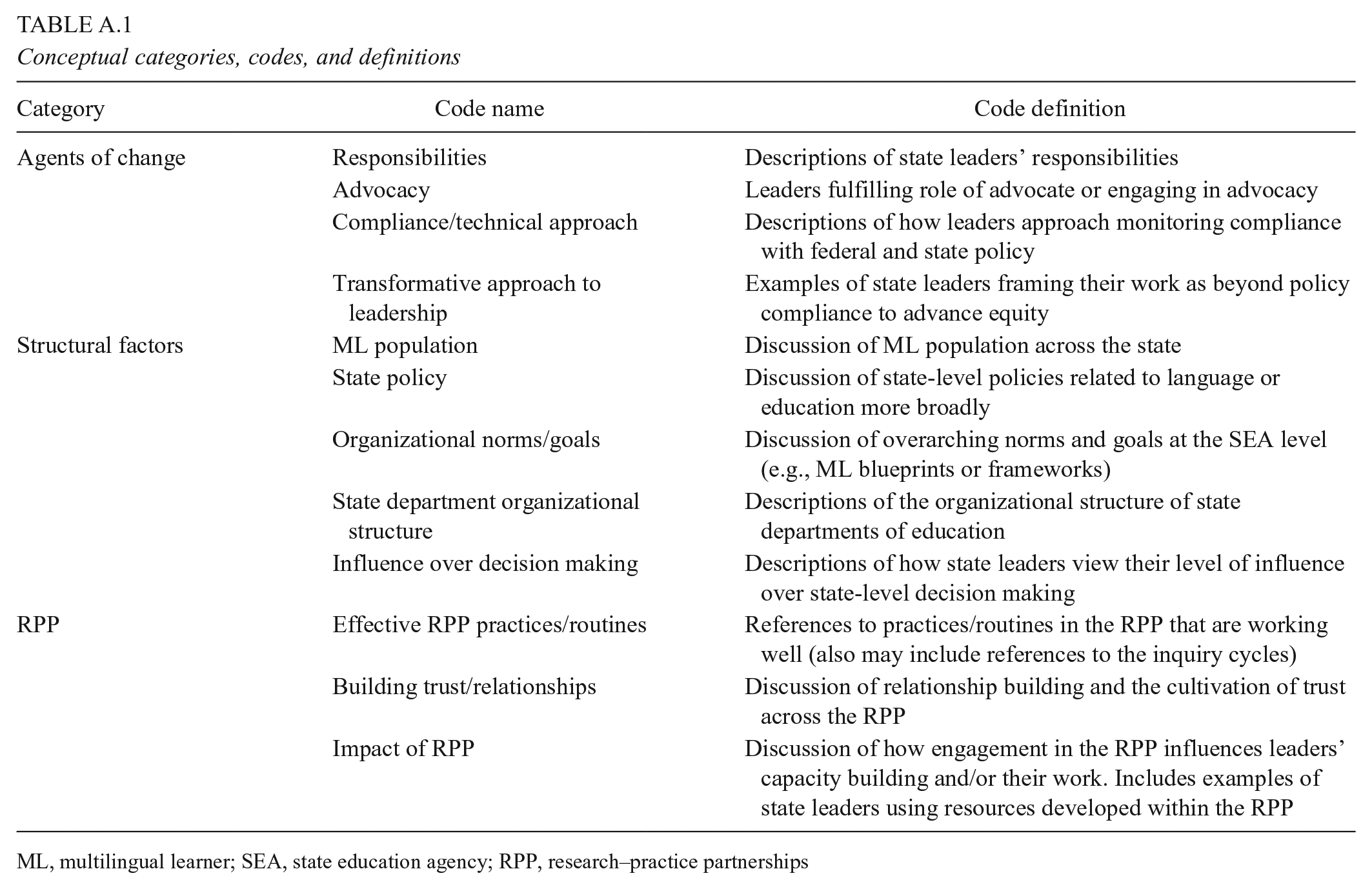
| Category | Code name | Code definition |
|---|---|---|
| Agents of change | Responsibilities | Descriptions of state leaders’ responsibilities |
| Advocacy | Leaders fulfilling role of advocate or engaging in advocacy | |
| Compliance/technical approach | Descriptions of how leaders approach monitoring compliance with federal and state policy | |
| Transformative approach to leadership | Examples of state leaders framing their work as beyond policy compliance to advance equity | |
| Structural factors | ML population | Discussion of ML population across the state |
| State policy | Discussion of state-level policies related to language or education more broadly | |
| Organizational norms/goals | Discussion of overarching norms and goals at the SEA level (e.g., ML blueprints or frameworks) | |
| State department organizational structure | Descriptions of the organizational structure of state departments of education | |
| Influence over decision making | Descriptions of how state leaders view their level of influence over state-level decision making | |
| RPP | Effective RPP practices/routines | References to practices/routines in the RPP that are working well (also may include references to the inquiry cycles) |
| Building trust/relationships | Discussion of relationship building and the cultivation of trust across the RPP | |
| Impact of RPP | Discussion of how engagement in the RPP influences leaders’ capacity building and/or their work. Includes examples of state leaders using resources developed within the RPP |
ML, multilingual learner; SEA, state education agency; RPP, research–practice partnerships
Appendix B
Acknowledgements
The authors are grateful to our state-leader partners for their time, thoughtfulness, and continued engagement in collaboration. We also express our gratitude for the support provided by the William T. Grant Foundation and Council of Chief State School Officers. Thank you also to the journal editors and reviewers for their helpful feedback.

Notes
Authors
HANNAH GOLDSTEIN is a graduate research and doctoral candidate in education policy at the University of Pittsburgh. Her research addresses how leaders implement transformative policy and practice across state and local levels of the education system. Her work also explores the role of research–practice partnerships in driving equity-oriented systems change.
HAYLEY WEDDLE is an assistant professor of education policy at the University of Pittsburgh. Her research draws on qualitative methods to explore how education leaders implement policies in ways that enable or constrain equity. Across her work, Haley develops reciprocal partnerships between educational leaders, policymakers, and researchers.