




Abstract
In recent decades, parallel literature has documented the magnitudes and effects of teacher turnover and the impact of state school finance reforms (SFRs). In this paper, we examine SFRs as possible mechanisms to improve teacher salary, turnover, and job satisfaction by using nationally representative data from 2000 to 2016 and leveraging variation in SFR timing. We find that SFRs increased teacher salaries by approximately $4,000 and reduced teacher turnover by three percentage points, on average, though gains in both outcome measures took up to a decade to emerge. We observe larger salary gains among teachers in high-poverty and high-minority school contexts, though declines in their corresponding turnover behaviors were similar to average findings. As policymakers seek to address heightened concerns regarding teacher retention and shortages, our findings suggest targeted salary policies may improve rates of teacher attrition.
Keywords
Introduction
A longstanding body of literature has documented the “revolving door” of teacher turnover in P–12 public schools (Ingersoll, 2001). Much recent evidence has established the deleterious effect of teacher turnover on student outcomes, particularly in schools that serve large shares of economically disadvantaged and minority students (Hanushek et al., 2016; Ronfeldt et al., 2013; Steele et al., 2015). For example, teacher turnover is 50% higher in high-poverty school contexts (Ronfeldt et al., 2013) where it is especially pronounced in certain critical subject areas like STEM (Nguyen & Redding, 2018). Though a range of policy mechanisms have been attempted to reduce teacher turnover, especially through financial interventions, turnover remains a critical issue of policy import. The improved understanding of the policies that may improve (or fail to improve) teacher turnover, therefore, may guide future policy efforts and the allocation of scarce educational resources.
Though teacher salaries represent the largest P–12 school expenditure (Ingersoll et al., 2018), low salaries long have been considered an important determinant of turnover decisions (Loeb et al., 2005). Many of the policies crafted to reduce teacher turnover have centered on either targeted or broad teacher salary interventions. Targeted interventions often focus on specific teaching subjects like STEM (Feng & Sass, 2018), on high-poverty school contexts (Clotfelter et al., 2008; Fulbeck, 2014), pay for performance (Yuan et al., 2013), or teacher recruitment (Fowler, 2003). Many school districts, however, may be constrained in their abilities to apply such interventions by limited capacities to raise additional revenues. Districts may also allocate existing revenues according to preferences for other education expenses including class size reduction, support staff, or noninstructional expenditures.
In recent decades, state school finance reforms (SFRs) injected substantial investments in P–12 schools in attempts to decouple local property wealth and school funding levels, a relationship which rendered many districts ill-equipped to increase school resources through local capacities (Reschovsky, 1994). Much of this spending has been directed to broad-based increases in teacher salaries and teacher hiring (Brunner et al., 2020). SFRs, particularly those precipitated by the court-ordered overturning of existing state funding systems, generated substantial improvements in cross-district spending inequality (Card & Payne, 2002). Indeed, the Rose v. Council for Better Education 1989 Kentucky ruling ushered in the so-called adequacy era, after which courts directed adequacy-based financing mandates to aid districts serving the largest shares of low-income students (Candelaria & Shores, 2019; Sims, 2011). In turn, SFRs produced large positive effects on student achievement and long-term outcomes, particularly for economically disadvantaged students, stemming from increased state funding to low-income districts (Candelaria & Shores, 2019; Jackson et al., 2016; Lafortune et al., 2018). Though much of the increases in spending were directed to teacher salaries, these increases may not have been distributed uniformly across states and districts.
One source of potential spending heterogeneity lies in teacher union characteristics. Researchers have considered the relationship between teacher quality, salary, and union status. For example, Figlio (2002) finds higher teacher salaries attract higher-qualified teachers, but only in nonunion school districts. In the context of SFRs, recent work has extended this focus to investigate teacher outcomes including impacts on salary and new teacher hiring within contexts of varying prevailing teacher union strength. Specifically, Brunner and colleagues (2020) find union strength is a key determinant of the allocation of SFRs to teacher salaries, new teacher hiring, and local tax relief. Though SFRs may direct large increases in state aid to low-income districts, their effects on teachers and students may be blunted through the allocation of aid to noneducational goods.
In this paper, we seek to connect the heretofore disparate literatures pertaining to SFRs, teacher turnover, and union strength, including an examination of heterogeneity in education contexts. In particular, we seek to address a gap in the extant literature as to whether SFRs affect teacher turnover and, if so, the extent to which effects vary by school characteristics (high-poverty and high-minority schools), union strength, and teacher characteristics (i.e., experience). Utilizing nationally representative, repeated cross-sectional data from five School and Staffing and National Teacher and Principal Survey waves from 1999–2000 to 2015–2016, we leverage variation in the timing of SFRs (Lafortune et al., 2018) to estimate the effects of SFRs on teacher salaries, turnover, intent to leave a teaching position, and teacher satisfaction. Within our event study and difference-in-differences frameworks, we examine the intersection of SFRs and teacher union strength (Brunner et al., 2020) while accounting for key contemporaneous teacher accountability policy reforms (Kraft et al., 2020). Whereas Brunner et al. (2020) are principally concerned with the effects of SFRs on teacher salary and the moderating effects of unions, our most significant contributions are focused on estimating the relationship between SFRs and teacher turnover and additional teacher satisfaction outcomes related to SFRs. Further, we evaluate heterogeneity in response to SFRs along several dimensions, including school poverty and racial composition and teacher subject matter and experience.
Our analyses indicate SFRs increased teacher salaries, with average gains of approximately $4,000 and larger gains for teachers in low-income and high-minority schools, though each took up to a decade to emerge following state reforms. We estimate positive effects for teachers in other contexts including high-income and low-minority schools, findings typically smaller or less precisely estimated. Highly experienced teachers may have witnessed gains at the expense of novice teachers. Consistent with findings documented by Brunner et al. (2020), salary gains were concentrated in district contexts of high teacher union strength. Similar to salary estimates, we observe reductions in teacher turnover and teacher-reported intentions to leave a teaching position approximately a decade following state reforms, corresponding with the timing of salary increases. Our estimates suggest that though SFR-driven gains in teacher salaries were concentrated in the school contexts of their greatest need, they took significant time to develop following state reforms, as did meaningful changes to teacher turnover behaviors. These findings may bear on future policy interventions related to teacher turnover in heterogeneous state, district, and school contexts.
Literature Review
School Finance Reforms and Teacher Unions
Over the past five decades, nearly every state revised its school funding formula, many through state supreme court mandates (Jackson, 2018) and the remainder at the behest of state legislatures. Many of these SFRs were initiated to more equitably distribute state resources to low-income school districts by attempting to decouple local school funding from local property wealth. SFRs generated large positive treatment effects for student outcomes, including achievement, educational attainment, and long-term income, particularly among students in low-income districts (Candelaria & Shores, 2019; Jackson et al., 2016; Lafortune et al., 2018). SFR-driven funding changes also modestly reduced racial funding gaps between white and non-white student populations (Rothbart, 2020). SFRs, however, did not generate uniform impacts on teachers.
If SFR aid demonstrates a flypaper effect, it may be spent in different ways, particularly as it relates to teachers. Brunner and colleagues (2020) find that the allocation of SFR-generated state aid varied starkly across union environments. At the mean level of teacher union power, 64 cents of every dollar of SFR aid flowed to school districts. In strong teacher union states (the 90th percentile), nearly every dollar of SFR state aid flowed to schools; 80% of these funding increases augmented the compensation of existing teachers. A one-standard-deviation increase in union power increased SFR allocations to teacher compensation by 51 cents beyond the statistically insignificant 32-cent average estimate. Conversely, in weak teacher union states (the 10th percentile), districts spent 80% of additional state aid on local tax relief and made small investments to hire new teachers; student-teacher ratios remained unchanged. These findings help contextualize prior empirical estimates of SFRs that have produced flypaper effects (e.g., Card & Payne, 2002) and crowd-out effects (e.g., Lutz, 2010; Steinberg et al., 2016).
In addition to their contributions to the SFR literature, Brunner et al. (2020) contribute to a mixed body of evidence concerning the effects of teacher unions on school outcomes. Attributes of teacher union contract restrictiveness, timing of union contracts, and other measures of union power may influence the allocation of school resources to teacher pay. Lovenheim (2009) finds teacher unions increase teacher employment but do not affect teacher pay. Conversely, Cook and colleagues (2020) attribute the allocation of new Ohio tax revenues in large part to the timing of collective bargaining agreements; bargaining negotiations made immediately after tax increases resulted in higher teacher salaries, whereas those made before tax increases led to increased expenditures on support services and on new teachers. Only the latter resulted in improved student achievement. These estimates would appear to support prior findings by Hoxby (1996) that the rent-seeking attributes of teacher unions may exert negative impacts on student achievement.
Additional research documents the relationship between union contract flexibility and spending outcomes (Strunk, 2011) and the effect of bargaining laws on student and teacher outcomes (Brunner & Squires, 2013; Lovenheim & Willén, 2019). Whereas union contract flexibility may not exert any influence on teacher salaries (Strunk, 2011), state laws mandating collective bargaining reduce long-term male student earnings and labor market participation (Lovenheim & Willén, 2019). In states that mandate bargaining, there exists a positive relationship between more powerful unions and both starting salaries and returns to experience, and a negative relationship with teacher-student ratios—relationships that reverse in states that prohibit bargaining (Brunner & Squires, 2013).
Teacher Mobility
Though the teacher mobility literature is large enough to support robust systematic reviews and meta-analyses (Guarino et al., 2006; Nguyen et al., 2020), no previous work has considered how SFRs affect teacher attrition. Despite this gap in the literature, much of the previous work on teacher attrition informs a theory of how SFRs mechanically may impact attrition rates, both for mobility between schools and exiting the profession entirely.
Incentives that encourage a teacher to stay or leave incorporate both supply and demand dimensions (Grissom et al., 2016). Teachers choose to supply labor with expectations about benefits, including salary, nonsalary monetary benefits (e.g., health insurance), and nonpecuniary benefits. Similarly, the decisions made by school leaders to demand teacher labor are also multifaceted, including the types of resources that will be allocated directly to teachers (salary and benefits), resources to benefit job performance and satisfaction (e.g., teaching materials, professional development, smaller class sizes, support staff, and the number of class preparations), and how decisions are made to retain teachers (e.g., tenure, evaluation, or counseling teachers out of the profession). Although some of these elements are based on nonmonetary personal interactions, such as positive principal and teacher fit (Bartanen & Grissom, 2023), or factors beyond teacher and school leader control, such as student demographics (Lankford et al., 2002; Newton et al., 2018), many factors that impact a teacher’s and school leader’s labor decision may be sensitive to financial considerations.
In our research, we consider previous scholarship that has shown how different inputs into these decisions have impacted teacher attrition. The most widely examined portion of this literature considers how teacher compensation affects attrition rates. In studies that have considered the association of teacher salary and turnover, the overall finding is that an increase in salary has a small, yet significant, effect on lowering teacher attrition rates (Nguyen et al., 2020). Further, a salary increase relative to a nearby district does more to lower attrition rates than higher salaries for all teachers, as higher salaries attract teachers who are willing to switch schools but do not necessarily reduce the number of teachers leaving the profession altogether (Hanushek et al., 2004; Imazeki, 2005). The movement of teachers between schools can have a sorting effect, as high-quality teachers tend to respond more to school racial or socioeconomic characteristics rather than to higher salaries, though incentive programs also can induce movement (Clotfelter et al., 2008, 2011).
School leaders also may use additional funding for services that complement or improve teacher experiences. First, class size reductions may decrease rates of teacher attrition (Isenberg, 2010). Smaller class sizes are associated with reduced teacher turnover in some circumstances (Djonko-Moore, 2016), though not in others (Nguyen et al., 2020). Second, investments in the professional development of teachers could reduce teacher attrition. Previous research found evidence to this effect among math and science teachers (Ingersoll & May, 2012). Third, investments in teacher mentoring have been associated with reduced teacher mobility (Helms-Lorenz et al., 2016; Ronfeldt & McQueen, 2017), as senior teachers aid novice teachers during their early years when the likelihood of teacher turnover is highest. Across all of these interventions, lower performing teachers are the most likely to leave the profession (Feng & Sass, 2017; Goldhaber et al., 2011), so developing and aiding teachers can serve the dual purpose of bettering student outcomes and lowering teacher mobility.
Finally, school accountability reforms may influence teacher turnover. Increased accountability often leads to increased turnover, particularly in low-performing schools (Clotfelter et al., 2004; Ingersoll et al., 2016). In the No Child Left Behind era, every state passed some type of change to teacher accountability policies, reforms contemporaneous to many SFRs. These changes included reforms to teacher evaluation, tenure, collective bargaining, the payment of union dues, and teacher examinations pertaining to basic skills, core content, and pedagogical knowledge. In addition, many states won Race to the Top grants and implemented Common Core State Standards, programs that required changes to accountability practices. Kraft and colleagues (2020) examine variation in the timing of the passage of these state policies to estimate the effect of accountability practices, many including high-stakes consequences, on the supply of teachers and on teacher job satisfaction. They find accountability reforms reduced the supply of new teachers while harming teacher perceptions of job security and autonomy.
Conceptual Framework
In the context of Brunner et al.’s (2020) work documenting the heterogeneous teacher salary response to SFRs by union strength, we focus the contribution of our work on extending our knowledge of SFR impacts specific to teachers, with a primary focus on turnover. Figure 1 illustrates a conceptual framework tracing the potential relationship between SFRs and teacher outcomes. From local government decisions to invest SFR revenues in schooling or nonschooling inputs, to decisions around how schooling input investments are allocated, SFRs may not exert uniform impacts on teachers. Therefore, it remains important both to estimate their intermediate effects on teacher salary and their effects on turnover behaviors and other secondary outcomes like job satisfaction. 1 In addition, mediating variables, including teacher union characteristics and contemporaneous policy reforms (e.g., teacher accountability), and moderating factors, such as teacher characteristics (e.g., experience), and school and student characteristics (e.g., student poverty, race, and ethnicity) may magnify or attenuate the effects of SFRs on teacher outcomes in ways instructive to future policymaking, particularly in high-needs school contexts.

Conceptualizing the effects of school finance reforms on teacher outcomes
Although much has been documented related to SFRs and teacher turnover, the relationship between the two remains a crucial area of study. SFRs generated large gains in spending in low-income school districts, though spending increases varied by union contexts. Additional exploration of the effects of finance reforms on teacher salaries, especially in hard-to-staff schools and hard-to-staff subject areas, may inform district and state labor practices. Further, the relationship between finance reforms and teacher mobility presents an important area to which little attention has been devoted, particularly contextualized within the expanding literature concerning teacher unions.
Data & Empirical Methods
This paper uses a unique dataset from 2000 to 2016 combining data from the National Center for Education Statistics (NCES), the Bureau of Labor Statistics (BLS), the U.S. Census Bureau, and documented lists of state policy changes and financial reforms. From NCES, we use the Schools and Staffing Survey (SASS) and its supplement, the Teacher Follow-Up Survey (TFS), 2 as well as the new iteration of the SASS, the National Teacher and Principal Survey (NTPS). Specifically, we use the 1999–2000, 2003–2004, 2007–2008, 2011–2012, and 2015–2016 SASS/NTPS waves. Utilizing a stratified probability sampling design based on the Common Core of Data, SASS/NTPS consist of nationally representative samples of teachers and schools for public schools in the United States. 3 They include a comprehensive set of teacher and school characteristics and, critically important for our analyses, teacher salary (the teacher’s base salary for the entire school year), teacher reports of whether they are provided adequate school materials and their salary satisfaction, and intention to leave teaching. From the TFS, we observe teachers’ actual turnover behavior (whether they stay in their current school, switch school, or leave the profession). We note the NTPS 2015–2016 survey wave does not include turnover behavior. In short, we have measures of teacher salary, intentions, and satisfaction from 2000 to 2016 and turnover behaviors from 2000 to 2012. 4 See online appendix Table A1 for a full list of variables.
Measures of School Finance Reforms, Union Power, Salary, Intentions, and Turnover
We obtained a comprehensive list of SFRs from Jackson et al. (2016), Lafortune et al. (2018), and Brunner et al. (2020). Our primary coding is based on the coding developed by Lafortune and colleagues (2018). 5 We leverage SFRs for two reasons. First, as discussed previously, SFRs led to large increases in school spending, spending that often was focused on teachers (Brunner et al., 2020). Second, the plausibly exogenous timing of SFRs (Jackson et al., 2016; Lafortune et al., 2018) avails an identification strategy whereby effects linked to spending increases may be interpreted in a causal manner. This empirical approach allows us to identify and further analyze findings regarding heterogeneous SFR spending on teacher salaries and to document the heretofore unexplored relationship between SFRs and teacher turnover. Also, as demonstrated by Lafortune et al. (2018), we note many states passed several SFRs over the considered analytic time period. Because many of these SFRs had little to no impact on state education finances, we consider the SFR that had the highest impact on state education spending as the relevant intervention. 6 As such, though SFRs were not identical in different states, we focus on the SFRs that produced meaningful changes to school spending regimes across diverse contexts.
Our primary measure of union power is based on the Fordham Institute index, combining administrative and original survey data across five dimensions of union power: (1) resources and membership, (2) involvement in politics, (3) scope of bargaining, (4) state policies, and (5) perceived influence (Winkler et al., 2012). Although this measure of union strength does not vary longitudinally in our dataset, the included measure draws on data temporally proximal to the time that many of the analyzed SFRs were first implemented. Given the limitations associated with this measure, however, including its nonlongitudinal nature, we view our analyses with union strength as supplementary, to probe how union strength may moderate the effects of SFRs. We show each state and their union strength by quartile in online appendix Table A2.
Our dependent variables of interest include teacher salary, teacher intentions to leave teaching, and turnover behaviors. Teacher salary is the teacher’s report of their annual salary. Teacher’s intent to leave teaching is a binary variable, where a 1 indicates that teachers reported they plan to leave teaching as soon as possible and 0 otherwise, including options such as “staying until eligible for retirement benefits” (see online appendix Table A1). We categorize teacher turnover behaviors as movers and stayers. Stayers are teachers who remain in the same school as in the baseline year and movers are those who do not remain in the same school. In some analyses, we separate movers into leavers and switchers, where switchers are teachers who switched to a new school and leavers are teachers who left the teaching profession.
State, School, and Teacher Controls
Since the Fordham index was created in 2012, there are two primary concerns: (1) the index may be endogenous to the SFR, and (2) it is a static measure that does not change over time. To address the first concern of endogeneity, where there are unobserved, underlying conditions in states with strong unions that may be more likely to implement SFR, we supplement our analysis with measures of state mandated collective bargaining (CB) and state right-to-work status. To the extent that these additional measures do correlate with these underlying conditions, including them as controls would reduce potential bias that the index may induce on our estimate of the effects of SFR, similar to Kraft et al. (2020). Additionally, we also include a set of plausibly exogenous control variables to account for state-specific political and educational conditions such as measures of the political ideology of the state senate and state house of representatives, evaluation reform implementation, elimination of teacher tenure, implementing Common Core State Standards, requiring teacher candidates to take basic skills licensure tests or content area licensure tests, and winning a Race-to-the-Top grant (Caughey & Warshaw, 2018; Klarner, 2013; Kraft et al., 2020).
Because our primary outcomes vary with school and teacher characteristics, we also account for this variation by employing a comprehensive set of school and teacher controls. For teacher characteristics, we include the teacher’s gender, race/ethnicity, age; whether they have graduate degrees; the selectivity of their undergraduate institution; if they have a standard certification; and if they are a member of the union. With regards to school characteristics, we control for school urbanicity, size, grade level; the shares of students eligible for free or reduced-price lunch (FRPL); minority students; students with individualized education programs (IEP); and students classified as limited English proficiency (LEP), respectively. The full list of controls can be found in online appendix Table A1.
Empirical Approach
To examine the effects of SFRs on teacher salary, teacher intentions, and turnover, there are two main analytic approaches, one using a standard difference-in-differences (DID) model and one using a dynamic event study. First, we discuss the two-way, fixed-effects DID model:

where
Year of SFR Implementation

Note. Year of SFR implementation drawn from Lafortune et al. (2018).
The main drawback with this DID model is that it does not decompose how the effects of SFRs may vary over time; in other words, it provides a weighted average treatment estimate of the effects of SFRs over the postpolicy periods. Moreover, if there are heterogenous treatment effects by groups, the estimate may be biased. 8 Relatedly, as SFRs were implemented at various times, a staggered DID is more econometrically appropriate (Marcus & Sant’Anna, 2021). As such, we rely on the staggered DID or event study approach as our main specification to examine the effects of SFRs. This nonparametric event study specification can be written as:

Lags and leads are binary variables indicating that a particular state was a given number of time periods away (i.e., SASS/NTPS survey wave) from implementing its SFR in the respective time period. J and K lags and leads are included respectively. A single lag, the first lag prior to SFR implementation, where j = 1, is omitted. The coefficients of interest are the lags, indicating differences in pretreatment trends between SFR states and non-SFR states, and the leads, where each lead k represents the effects of SFRs in the kth period after implementation relative to non-SFR states. Nonsignificant estimates on the lags would suggest that SFR and non-SFR states followed similar trends prior to treatment, and significant estimates on the leads would suggest that SFRs impacted teacher outcomes. In conventional DID parlance, significant findings on the lags would suggest nonparallel trends between SFR and non-SFR states, weakening our claim that these two groups are comparable prior to treatment.
Pretreatment Differences and Parallel Trends
As we show in the results section, in the event study specification (Figures 2a to 2f) we find little to no evidence of pretreatment differences in our outcome measures between SFR and non-SFR states, providing evidence that treated and nontreated groups are comparable prior to treatment. For instance, in panel A of Figure 2, we observe insignificant lag estimates for teacher salary. Moreover, the positive estimate on lag 3 provides some evidence that increase in teacher salary in subsequent lags and leads are not simply following a trend parameter. 9 Furthermore, we also examine parallel trends across treatment with multiple time periods and some never-treated states using the Callaway and Sant’Anna (2021) approach, considering both parallel trends of SFR states compared to: (1) states that are never treated within the analytic timeframe; and (2) a “supergroup” of both never-treated states and states that are not yet treated but will be treated later in the analytic time frame. For instance, Texas is never treated in the analytic time frame, so it would be included in both never-treated states as well as the supergroup; California, on the other hand, is included only in the supergroup for the years preceding 2004 prior to its SFR. We then regress the outcome on the never-treated states or the supergroup separately. Full results can be found in online appendix Table A3. We find no violations of the parallel trends’ assumptions at traditional significance levels, though our 2008 treated states do experience a two-percentage-point decline in teacher turnover prior to SFR interventions significant at the 10% level. Despite this relatively small difference, the observed pretreatment stability of the outcome trends before intervention lends further credibility to our findings.
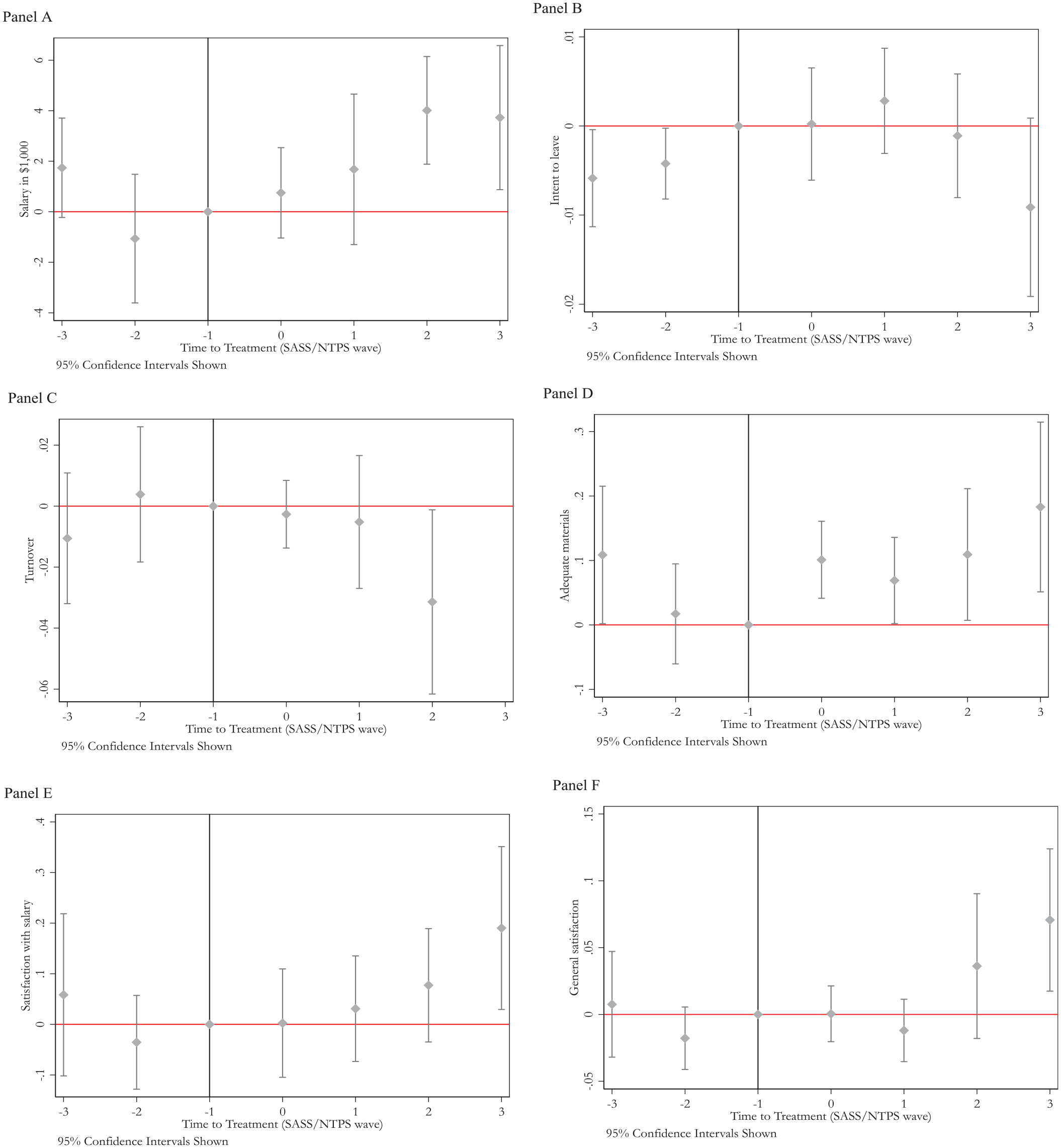
Teacher salary and turnover trends, dynamic staggered DID analysis.
Results
Table 2 presents teacher and school characteristics for the overall sample as well as for the SFR and non-SFR samples weighted for national representation (unweighted characteristics are reported in online appendix Table A4). Nationally, about three-quarters of teachers are women, 84% are white, 10% are novice teachers, 50% have graduate degrees, three-quarters have union membership, one-quarter of schools are urban, 39% are low-income schools (majority-FRPL), and 28% are majority racial minority schools. Descriptively, most teacher and school characteristics for the SFR and non-SFR samples are similar to the national sample except teachers in the SFR sample are more likely to have attended selective colleges, have graduate degrees, have union membership, and teach in urban schools.
Descriptive Statistics of Teacher and School Characteristics for the Analytic Sample
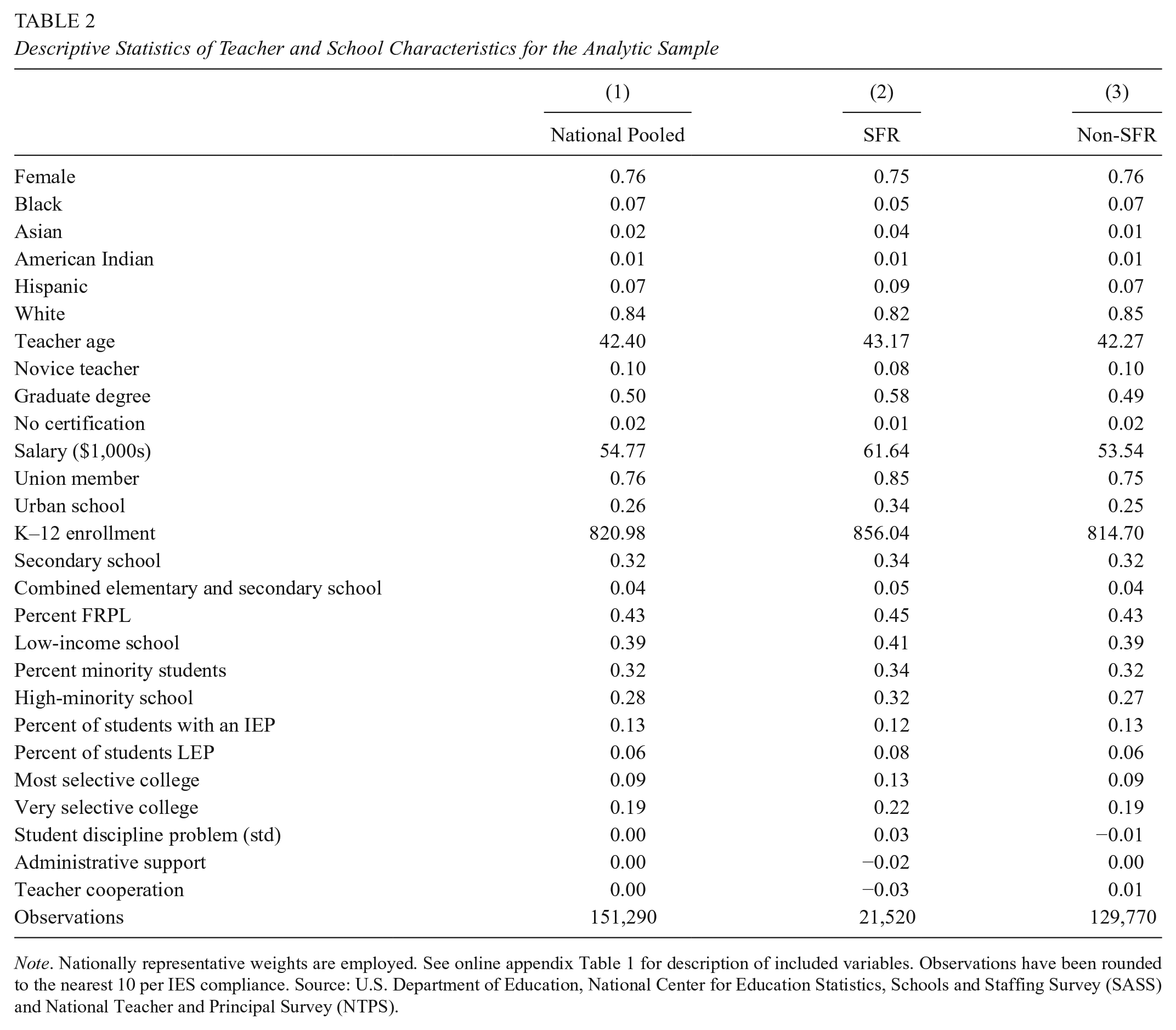
Note. Nationally representative weights are employed. See online appendix Table 1 for description of included variables. Observations have been rounded to the nearest 10 per IES compliance. Source: U.S. Department of Education, National Center for Education Statistics, Schools and Staffing Survey (SASS) and National Teacher and Principal Survey (NTPS).
Examining our outcome measures of interest (Table 3), we observe the average teacher salary is about $54,770, 2 percent of teachers indicate they intend to leave their teaching positions as soon as possible, and the turnover rate is about 14% over the analytic time frame. We also examine these outcomes for various subgroups of interest. We find, as expected, novice teachers earn less than teachers near retirement and are less likely to indicate they intend to leave teaching. Both groups are more likely to turn over than the full sample of teachers. Teachers in weak union states report an average salary around $47,750, relative to $60,980 for teachers in strong union states. Moreover, they are also more likely to turn over relative to their counterparts. In low-income schools, teachers, on average, are paid $52,780 compared to $56,040 for teachers in high-income schools. In comparison, teachers’ salaries in low-minority schools, schools that are more likely to be located in rural areas, are about $54,250 compared to $56,110 for teachers in majority minority schools, which are more likely to be located in urban areas.
Salary, Intent to Leave, and Turnover
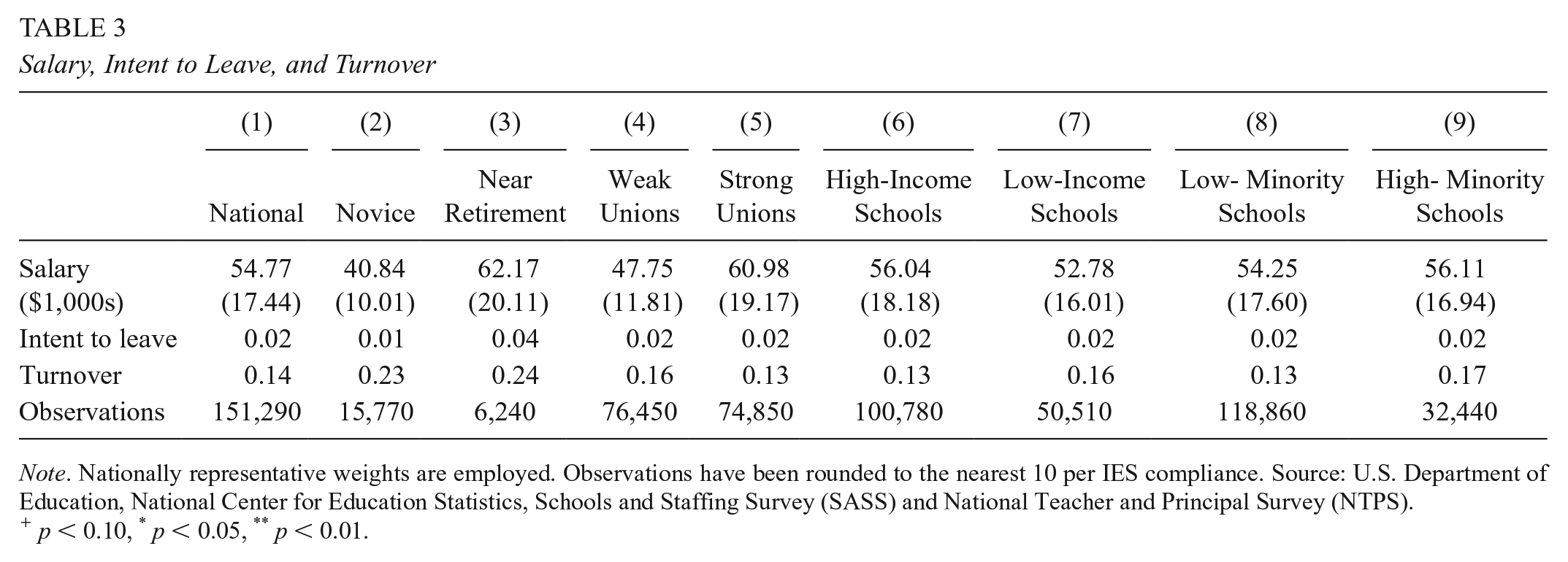
Note. Nationally representative weights are employed. Observations have been rounded to the nearest 10 per IES compliance. Source: U.S. Department of Education, National Center for Education Statistics, Schools and Staffing Survey (SASS) and National Teacher and Principal Survey (NTPS). + p < 0.10, * p < 0.05, ** p < 0.01.
In our regression estimates, first we examine the effect of SFRs on teacher salary nationally and for the various subgroups (Table 4). We find that SFR impacts on teacher salaries vary significantly by time period. Specifically, consistent gains approaching or exceeding $4,000 are reached by Lead 3 (Model 1 of Table 4), or approximately 8 to 12 years following state reforms. As discussed previously, SFRs may have differential effects for novice and veteran teachers who are near retirement as states may earmark salary increases for more veteran teachers. We examine whether SFRs have differential effects for these two groups in Models 2 and 3. In Model 2, we observe there is some marginally significant evidence that, while SFRs may increase salaries for all teachers on average, they likely accrue more quickly and more substantially for veteran teachers than novice teachers. In low-income schools we find SFRs increased teacher salaries by $4,500 to $6,000 approximately a decade following reforms. These increases at times contrast with increases witnessed by teachers in high-income schools. In lead 3, for example, teachers in low-income schools witnessed average salary gains of approximately $5,820, more than $3,000 more than those in high-income schools; results in lead 1 were substantively similar while the point estimate for teachers in low-income schools was higher in lead 4 but statistically similar to teachers in high-income schools. These findings are closely mirrored by salary estimates for teachers in high- and low-minority schools. Taken together, these results indicate that SFRs augmented teacher salaries in traditionally under-resourced and disadvantaged schools, at times more than teachers in high-income schools. 10
Effects of SFRs on Teacher Salary

Note. Lag 1 is the comparison group. Nationally representative weights are employed. Heteroskedastic-robust standard errors clustered at the state level are in parentheses. All models include teacher and school controls as well as state controls with state and year fixed effects. Observations have been rounded to the nearest 10 per IES compliance. Source: U.S. Department of Education, National Center for Education Statistics, Schools and Staffing Survey (SASS) and National Teacher and Principal Survey (NTPS). + p < 0.10, * p < 0.05, ** p < 0.01.
Second, we assess whether SFRs significantly impacted teacher intentions to leave their current school and subsequently observed turnover behavior (Table 5). SFRs reduced teachers’ intentions to leave their respective schools and observed turnover behavior following three and four survey waves, respectively (after approximately 8 to 12 years). These findings correspond closely to the observed timing of salary increases. Regarding a teacher’s intent to leave, we estimate null effects until four survey waves following treatment, when we find suggestive evidence of a one-percentage-point reduction in turnover intention. There is some indication that reductions in leaving intentions are driven by SFR-state teachers who serve in schools with majority FRPL students; these teachers are two percentage points less likely to say that they plan on leaving the classroom. We found no differences in stated intentions across other classifications, including teachers in high-income, low-minority, or high-minority schools. We also observed turnover behavior, again finding statistically significant evidence of SFR-driven reductions of three percentage points after three survey waves. Across all of the different subgroups we analyzed, there is no strong statistically significant indication of differential subgroup effects, though we do note larger magnitude reductions (five percentage points) among teachers in low-income schools.
Effects of SFRs on Teacher Intentions and Turnover Behaviors

Note. Nationally representative weights are employed. Heteroskedastic-robust standard errors are in parentheses. All models include teacher and school controls as well as state controls with state and year fixed effects. Observations have been rounded to the nearest 10 per IES compliance. Source: U.S. Department of Education, National Center for Education Statistics, Schools and Staffing Survey (SASS) and National Teacher and Principal Survey (NTPS).
p < 0.10, * p < 0.05, ** p < 0.01.
Next, we leverage SASS data on teacher opinions of school materials, salary satisfaction, and general satisfaction to assess alternate or complementary mechanisms through which SFRs may have affected teachers. In Table 6, our results indicate that teachers who experienced an SFR were more likely to indicate they have adequate materials, with results most concentrated in low-income schools and high-minority schools. Importantly, these results emerge immediately following SFRs, differing from the observed timing of effects on salary and turnover. Relatedly, teachers also indicated more satisfaction with salary a decade after reforms, findings consistent with observed increases in their average salaries. Similarly, salary satisfaction results were most pronounced in high-minority schools. Effects on teachers’ general satisfaction were more modest and also concentrated in high-minority schools. These analyses suggest teachers were more likely to express general satisfaction and satisfaction with their salaries and materials due to SFR changes, likely motivating observed effects on teacher intentions and turnover. In particular, these findings are also concentrated among teachers in historically disadvantaged school settings, the primary focus of SFRs.
Effects of SFRs on Adequate Materials, Satisfaction with Salary, and General Satisfaction

Note. Nationally representative weights are employed. Heteroskedastic-robust standard errors are in parentheses. All models include teacher and school controls as well as state controls with state and year fixed effects. Observations have been rounded to the nearest 10 per IES compliance. Source: U.S. Department of Education, National Center for Education Statistics, Schools and Staffing Survey (SASS) and National Teacher and Principal Survey (NTPS).
p < 0.10, * p < 0.05, ** p < 0.01.
Heterogeneity and Supplemental Analyses
In addition to the observed effects of SFRs on overall turnover, SFRs may also affect various forms of turnover heterogeneously. As such, we explore whether SFRs affect rates of switching and leaving teaching positions separately in online appendix Table A5. On the one hand, we find SFRs reduced rates of switching positions to a greater extent than leaving, though improvements were witnessed most notably in high-income and low-minority schools. On the other hand, though we estimate null overall effects on rates of leaving, we do observe significant declines in leaving behavior among teachers in low-income schools, six percentage points after three survey waves. In short, these results largely reinforce our main findings, particularly with respect to the timeline over which SFR effects emerge. Moreover, even though SFRs increased teacher salary more in low-income and high-minority schools than in high-income and low-minority schools, SFRs had a larger effect on switchers in more advantaged schools than in more disadvantaged schools. We note, however, that we do have some significant pretreatment differences in some cases, and as such, we view these results as exploratory and interpret them with caution.
Lastly, we also conducted exploratory analyses to examine whether SFRs may have influenced teacher quality. In the absence of data measuring teacher contributions to student learning (e.g., value-added measures), we estimate SFR effects on characteristics that may proxy for elements of teacher quality, including experience, certification, graduate degrees, and bachelor’s degree school selectivity (online appendix Figure A1). Though we find modest evidence indicating an increase in teacher experience and bachelor’s degree selectivity, we find little consistent evidence in our data to suggest SFRs substantively changed the composition of teacher quality.
Robustness Checks and Sensitivity Analyses
To examine how sensitive our results are to different modeling choices and specifications, we conduct several robustness checks and sensitivity analyses. First, some might argue political ideology, state characteristics, or teacher characteristics may be endogenous to the likelihood of adopting an SFR or teacher union membership may be related to union strength in the state. If true, then it would be better to exclude them as controls in the model. As such, we run a series of models that exclude teacher and school covariates and state-level policy covariates (online appendix Table A6). These results are substantively similar to the main results in both direction and statistical significance, easing concerns that our covariates are overly restrictive or that they include endogenous regressors. We also explore whether our results are robust to alternate specifications. In particular, we use approaches by de Chaisemartin and D’Haultfoeuille (2020) and Wooldridge (2021). 11 The results from de Chaisemartin and D’Haultfoeuille’s event-study approach are substantively similar to our main findings, and the estimates are also similar (Models 1–3 of online appendix Table A7). The results from Wooldridge’s two-way Mundlak’s approach (2021) suggest there may be small but significant gains in leads 1 and 2, and then a substantial increase of more than $6,000 in lead 3. We do not observe significant findings on teacher intentions and actual turnover behaviors, though the turnover estimates here are similar in timing and direction to our main estimates.
In terms of union strength, we also estimate the effects of SFR for states in quartiles 1 and 2 and then separately for quartiles 3 and 4. We note there is not enough variation in union strengths by state to do an event study for each quartile of union strength (quartile 1 for instance would not have at least 2 lags), hence we group quartiles 1 and 2 together and then quartiles 3 and 4 together. These results suggest that SFRs had the most meaningful effects for states of strong union strength with increases of $4,730 and $3,940 by leads 3 and 4, respectively, and little to no effect for states in the bottom two quartiles (online appendix Table A8). There may also be concerns that our estimated effects of SFRs may be diminished by including states that previously implemented SFRs in the 1990s in the comparison group. In other words, if SFRs have a delayed effect on teacher salary, as our results suggest, then the inclusion of states such as Arizona, Idaho, and Texas that experienced SFRs in the 1990s in the comparison group may actually attenuate our estimates of the current SFRs. To explore this possibility, we excluded the 12 1990s-era SFR states from analysis (online appendix Figure A2). These results are substantively similar to our main findings and provide further evidence that SFRs increased teacher salary with more limited effects on teacher turnover. 12
Limitations
We recognize a few notable limitations to our study. First, we leverage repeated cross-sectional data collected every four school years, not annual longitudinal data, which limits what we are able to examine in terms of the timing of SFRs and the various teacher outcomes. Second, there are different ways to operationalize SFRs, each potentially yielding different states as the appropriate comparison groups. In our main analysis, we follow the primary coding developed by Lafortune and colleagues (2018), also examining the extent to which our results are sensitive to how SFRs may be operationalized. However, there may still be other ways of considering SFRs that may yield different results. For instance, if we consider SFRs that had little to no impact on state education finances, then our estimates of the effects of those SFRs would be attenuated relative to the SFRs we consider. Third, similar to prior works (e.g., Brunner et al., 2020), our measure of union power is nonlongitudinal in nature, thus limiting variation in terms of low and strong union strength and treated and nontreated states. As such, we view our analyses scrutinizing union strength as exploratory.
Discussion and Conclusion
We categorize our findings in three domains, results which both confirm prior evidence related to SFRs and extend the extant literature, particularly with respect to teacher turnover and satisfaction. First, we find that after the introduction of increased state spending due to the exogenous shock of SFRs, there is a heterogeneous impact on teacher salaries across school settings and the time since reforms took place. The majority of significant results took about a decade to emerge, with average gains of approximately $4,000 in salary after three survey waves. Teachers in low-income and high-minority settings witnessed larger impacts, salary increases of approximately $4,500 to $6,000 annually. There is also suggestive evidence gains were captured mostly by experienced teachers, as near retirement teachers received sizeable salary bumps after SFRs. These delayed salary effects are consistent with existing literature. Lafortune et al. (2018) find increases to state investments in the lowest quintile of school districts by income peaked approximately nine years after reforms took place. Similarly, Jackson et al. (2016) find investments in the bottom three quartiles of districts by prevailing spending took time to improve following court-ordered reforms, reaching statistically significant levels after seven years; spending improvements in the districts predicted to increase spending the most following reforms took at least six years to emerge. In short, the somewhat-delayed effects of SFRs on teacher salaries are consistent with findings related to total spending.
Second, confirming previous findings (Brunner et al., 2020), strong unions successfully capture the increased spending due to SFRs in the form of higher salaries, with suggestive evidence SFR states with strong unions saw experienced teachers gain more than experienced teachers in weak union states. This may be interpreted as rent-seeking behavior, as the employed experienced teachers have a concerted interest in capturing salary gains, whereas future novice teachers were not present to self-advocate for higher salaries or increased hiring. Brunner et al. (2020) find these strong union states also experienced stronger student achievement gains. We hypothesize this may be due to a range of factors, including reductions in teacher turnover and improvements in teacher resources. Still, we also know many states enacted finance reforms alongside a host of other education policy changes as state houses witnessed political change, which makes this singular story less clear (Kraft et al., 2020; Candelaria et al., 2021).
Third, we contribute novel findings extending the SFR evidence base to examine the relationship between SFRs and teacher turnover and satisfaction. In light of the observed increases in teacher salaries, particularly for teachers in high-poverty or high-minority schools, we find significant average reductions in teacher turnover rates approximately a decade after the statewide SFR took place. We are unable to definitively parse these results among teachers in different school types, especially for teachers in schools targeted by statewide reforms. We find suggestive evidence teachers in stronger union contexts reduced their turnover more than those in weaker contexts. Our additional exploratory analyses suggest some teachers, particularly those in high-minority schools, were more satisfied with their salaries due to SFRs and similarly reported increased general satisfaction. Consistent with salary and turnover findings, results related to teacher satisfaction emerged a decade or more after reforms took place. However, teacher satisfaction with the adequacy of their school materials emerged immediately following SFRs, suggesting school leaders used SFRs to supplement teacher material support in the immediate aftermath of new funding legislation.
Though beyond the broader scope of SFRs, the legacy of Act 10, a 2011 Wisconsin reform that weakened the power of the state’s teachers’ unions, offers a complicated yet illustrative comparison. Following the reform, average teacher salaries declined and turnover increased (Baron, 2018). Increased turnover was driven by those over 55, the minimum retirement age, by 18 percentage points from 17% to 35% (Roth, 2019). Increased turnover also persisted five years following the reform, 22% (1.5 percentage points) above prereform levels (Roth, 2019), and statewide achievement declined amid the significantly increased turnover (Baron, 2018). Taken together, our findings suggest the intersection of SFRs, union power, teacher salaries, and teacher turnover warrants further scrutiny.
One of the mechanisms by which monetary investments in current teachers can improve student outcomes is by reducing teacher turnover (Ronfeldt et al., 2013; Steele et al., 2015). Previous research anticipates that although higher salaries can have a positive effect on teacher turnover behavior, the preponderance of the research evidence shows that a $1,000 increase in salary only reduces the risk of teacher turnover slightly (Nguyen et al., 2020), suggesting that a substantially larger increase may be needed to generate an economically significant impact. Other research specifically concerned with teachers’ opportunity costs predicts only a slight increase in teacher retention (0.48%, an increase from 82.12% to 82.6%) if teachers’ salaries were raised to be equivalent with competing professions in terms of wages ($3,160, or a 12.2% raise) (Feng, 2009), a slightly smaller average increase than identified here.
Previous literature examining the ties between teacher salaries and teacher mobility considers between-school teacher salary comparisons and the effects on teacher mobility. We provide new evidence regarding SFRs, which increased spending in the low-resourced districts (Candelaria & Shores, 2019) but did not necessarily raise teacher salaries to be competitive across districts. These larger salary interventions have been shown to be one of the chief mechanisms for discouraging teacher movement between schools (Imazeki, 2005). Future research should seek to understand what effect salary parity can have in terms of teacher turnover across districts in substantially different contexts.
Despite the previous literature linking SFR-generated spending increases to a range of positive student outcomes (Jackson et al., 2016; Lafortune et al., 2018), there remain unexplored mechanisms by which this increase in funds may have generated improved student outcomes. The present research extends collective understanding of one of those mechanisms, indicating a positive relationship between SFR-induced teacher salary increases and reductions to teacher turnover rates, though several years after reforms took place. As we continue to understand how increased financial resources can lower teacher attrition rates and produce better student outcomes, more research is needed to understand which factors contributed to changes in teacher attrition decisions and which did not. Future research remains necessary to better understand how SFRs and other school finance interventions may shape teacher behavior, evidence that could provide insights into how best to confront resource constraints faced by schools and teachers.
Supplemental Material
sj-docx-1-ero-10.1177_23328584231174447 – Supplemental material for The Effects of School Finance Reforms on Teacher Salary and Turnover: Evidence from National Data
Supplemental material, sj-docx-1-ero-10.1177_23328584231174447 for The Effects of School Finance Reforms on Teacher Salary and Turnover: Evidence from National Data by Tuan D. Nguyen, J. Cameron Anglum and Michael Crouch in AERA Open
Footnotes
Acknowledgements
The authors thank the AERA Open editors, anonymous reviewers, and participants at the Association for Public Policy Analysis and Management (APPAM) and Association for Education Finance and Policy (AEFP) annual conferences for constructive feedback and suggestions.
Authors’ Note
All authors contributed equally.
1.
We note that “primary” and “secondary” outcomes of interest are intended to reflect importance rather than a temporal sequence. In other words, we are most concerned with observed turnover behavior and also interested in additional teacher outcomes, including satisfaction and intent to remain or leave a teaching position, which is related to, but not perfectly predictive of, actual turnover (e.g., Nguyen et al., 2022).
2.
We use the TFS principal report on teachers’ statuses the year following the baseline survey rather than the current and former teacher questionnaires. This allows us to generate the mobility status for every teacher in the SASS.
3.
We note that the SASS’s stratified probability sampling design allows it to be representative at the state and national levels with appropriate sampling weights.
4.
As the SASS ran through the 2011–2012 survey wave (subsequently replaced by the NTPS), all our data regarding teacher turnover is representative at the state level.
5.
Lafortune et al. (2018) analyze both court-ordered and legislative SFRs. Importantly, a number of states passed multiple SFRs, many in close temporal succession, and other states passed SFRs that generated little, if any, meaningful change in state funding. Lafortune et al. (2018) employ Monte Carlo simulations to identify “the most consequential reform” in each of these states (p. 8); these simulations test for the possibility of multiple significant reforms, possibly due to “political and legal maneuvering with little consequence for school spending or student achievement” ( , p. vii). As a result, the identified “consequential reforms” are those that resulted in structural breaks in the progressivity of the distribution of state aid to school districts, an expressed goal of SFRs. We rely on their identification of consequential SFRs and their respective timing.
6.
Indeed, per , over our analytic time period some states passed inconsequential reforms without passing a consequential reform (i.e., Arizona, Connecticut, Idaho, Missouri, New Jersey, Ohio, Oregon, South Carolina, Tennessee, Texas) whereas others passed consequential and inconsequential reforms (i.e., Arkansas, Maryland, Montana, New Hampshire, New York, North Carolina, Washington).
7.
We note that the timeframe of much of the second half of our data (less for our turnover data which concludes in 2012) coincides with the Great Recession and its aftermath, economic conditions that led to reductions in school spending (Anglum et al., 2021) and teacher and staff layoffs (Evans et al., 2019). The vast majority of the SFRs we examine, however, occurred prior to the onset of the Great Recession, easing concerns of a Great Recession–induced selection bias (e.g., selection into or away from SFR treatment). Those that occurred from 2008 on were the direct result of court order (Washington [Lafortune et al., 2018]) or legislation subsequent to court involvement (Indiana [Hoskins, 2009] and New Hampshire [Lewis & Borofsky, 2015]). Finally, nearly three times as much variation in Recession-era employment loss occurred within rather than across states (Shores & Steinberg, 2019).
8.
The weights are proportional to the timing of treatment and are disproportionately higher for those treated units in the middle of the panel. For a thorough explanation, please consult Athey and Imbens (2022) and .
9.
We note these marginally statistically significant lag 3 estimates on national salary are driven principally by teachers in high-income and low-minority schools, estimates similar or slightly smaller in magnitude to positive effects seen in leads 3 and 4. Importantly, though suggestion of lag 3 pretrends are shared in the national intention to leave estimates, they are not shared in the observed turnover estimates. In sum, though we note these deviations, we do not observe evidence that they contribute to a trend parameter in these outcomes, rather that they may slightly temper our interpretation of post-treatment results.
10.
We note that due to the lack of consensus on how interaction effects should be conducted in a staggered DID, we do not formally test these differences. However, in our exploratory analysis (interacting a binary variable for high/low income or minority schools with the lead term), we do find suggestive evidence that the differences in lead 3 term are statistically significant (results available upon request).
11.
The approach by de Chaisemartin and D’Haultfoeuille (2020) addresses the concerns of negative weights due to heterogenous effects over time or across group. Their approach solves this issue of negative weights. Wooldridge’s two-way Mundlak’s approach (2021) provides an alternate estimator to the two-way fixed effects that is more flexible and has the asymptotic efficiency properties. Moreover, this estimator is more efficient with large datasets than .
12.
In addition to these robustness and sensitivity analyses, we explore the possibility of cross-state treatment spillover (i.e., SFR effects in states adjacent to SFR states) and placebo timing of SFRs (i.e., exploring whether the effects of SFR implementation vary from their stated year of passage per Lafortune et al., 2018). Our main findings remain robust to each of these analyses (available upon request).
Authors
References
Supplementary Material
Please find the following supplemental material available below.
For Open Access articles published under a Creative Commons License, all supplemental material carries the same license as the article it is associated with.
For non-Open Access articles published, all supplemental material carries a non-exclusive license, and permission requests for re-use of supplemental material or any part of supplemental material shall be sent directly to the copyright owner as specified in the copyright notice associated with the article.
