




Abstract
Aim:
This in vitro study evaluated the effect of polishing methods on the color stainability of 3D-printed permanent restorations while immersed in colorant beverages (distilled water, tea, coffee, and red wine) for 30 days.
Materials and Methods:
A total of 120-disc-shaped samples (10 mm × 1.5 mm) were fabricated using a stereolithography printer (Formlabs 3B, Formlabs, Massachusetts) with a three-dimensional (3D)-printable permanent resin (Permanent Crown, Formlabs, Massachusetts). The samples were polished with mechanical polishing, Optiglaze (GC Dental Products Corp, Aichi, Japan), or Vita Akzent LC (VITA Zahnfabrik, Bad Säckingen, Germany) (n = 40). Initial color measurements were performed using a spectrophotometer (VITA Easyshade V; Vita Zahnfabrik). Then the samples were divided into four different subgroups depending on beverages immersed in distilled water, coffee, tea, and red wine (n = 10). After immersion in beverages for 30 days, color measurements were repeated. Color changes were calculated using the CIEDE2000 color change (ΔE00) formula. ΔE00 was evaluated according to 50:50% color perceptibility (PT00 = 0.81) and acceptability (AT00 = 1.81) thresholds. A two-way analysis of variance (ANOVA), Tukey HSD test with Bonferroni adjustment, and paired-sample t-tests were used for statistical evaluation.
Results:
The highest ΔE00 was noted in mechanical polishing groups (p < .001). Red wine caused the most significant discoloration in the mechanical polishing group (p < .05). ΔE00 of mechanical polish groups showed a significantly higher color change than the perceptibility and acceptability thresholds (p < .001). Optiglaze can reduce 3D-printed permanent restoration discoloration caused by all beverages, Vita Akzent LC can reduce discoloration caused by tea and red wine.
Conclusion:
Glaze materials can reduce the restoration discoloration caused by colorant beverages.
Introduction
Materials and production techniques used in dentistry are advancing due to computer-aided design and computer-aided manufacturing (CAD-CAM) technology. CAD-CAM technology allows chair-side production of ceramic materials with higher durability, biocompatibility, and mechanical properties. With the recent advances in technology, three-dimensional (3D) printers have also started to find a place in dental applications. With 3D printing, complicated geometrical-shaped dental restorations with minimal material waste can be fabricated at lower costs.1,2 Surgical guides, occlusal splints, definite casts, complete dentures, temporary crowns, and partial fixed prostheses can be fabricated by using 3D printers with various 3D-printable resins.3,4 The fast production procedure and high precision of 3D printers are promising for chair-side applications, and the development of new 3D-printable resins and technologies is intensifying. However, concerns about the mechanical, optical, and biological properties of 3D-printed restorations still stand.1,3–5
3D-printable resins for permanent restorations are now available on the dental market. Manufacturers stated that the esthetic, mechanical, and biological properties of the resins are improved by adding ceramic fillers to the content of 3D-printable resins and permanent single crowns, inlays, onlays, and veneers can be produced. Artificially aged permanent molar crowns provided acceptable fracture and wear resistance. 6 The potential for long-term use emphasizes the optical properties of these resins.
Color stability of 3D-printable resins is important for long-term use. 3D-printable resins showed higher stainability than the milled and conventional materials.7–11 The 3D printer technology, low polymerization rate, and water sorption of 3D-printable resins can explain higher color stainability.10,12 Previous studies4,10,13 have reported different results regarding the effect of 3D-printing technology on the discoloration of 3D-printable resins. While a previous study stated that 3D-printing technology did not affect the discoloration of 3D-printable resins when the samples were subjected to 5000 thermal cycles in distilled water, other previous studies determined the effect of 3D-printing technology on the discoloration of the 3D-printable resins when the samples immersed for 30 days in distilled water. The colorant beverages exposed and the duration of exposure affect the amount of discoloration of 3D-printed restorations.10,11,14 Surface treatment may also affect the color stainability of the 3D-printed restorations. 14 A previous study 14 reported lower color stainability values in glazed 3D-printed restorations than in polished 3D-printed restorations. Glaze materials fill micrometer-sized pores and defects and decrease microleakage of the restoration surface. Thus, decrease the color stainability of 3D-printed temporary restorations.14,15 Glaze materials may limit the water absorption capacity of polymers. 16 However, glaze or surface sealants can lead to problems due to low abrasion resistance, weak retention to resins, and uneven spreading on resin surfaces.17,18 Manufacturers recommended sandblasted resin surfaces to achieve adequate retention of glaze materials on resin surfaces. In a previous study, 18 the highest color stainability was achieved in glazed resins after polishing discs and polishing wheels. However, another study reported macro-roughed resin surfaces after sandblasting which caused non-homogenous spread of glaze materials and smoothness fluctuations on resin surfaces. 19
3D-printable resins for permanent restorations are relatively new materials. Mono-colored restorations can be produced by using 3D printers with 3D-printable resins. For mimicking the appearance of natural teeth for adequate esthetic, glaze materials are generally needed to be applied on 3D-printed permanent restorations. The effect of colorant beverages on the color stainability of 3D-printed permanent restorations has not adequately been evaluated in previous studies. The purpose of this study is to evaluate the color stainability of 3D-printed permanent restorations with different surface polishing methods after 30 days of immersion in distilled water, tea, coffee, and red wine. The null hypothesis was that the different surface polishing methods and beverages after 30 days of immersion would not influence the color stainability of 3D-printed permanent samples.
Methods
In this study, a disc-shaped sample was digitally designed by using open-source 3D design software (Blender v2.77a; The Blender Foundation). 120-disc-shaped samples (10 mm × 1.5 mm) were fabricated using a stereolithography printer (Formlabs 3B, Formlabs, Massachusetts) with Permanent Crown (Formlabs A2, Massachusetts). Printing orientation was set to 0 degrees1,4 and the thickness of the printed layer was set to 50 µm. The samples were produced according to the manufacturer’s recommendations. After the printing process, samples were washed with an automatic washing machine (FormWash, Formlabs) containing 99% pure isopropyl alcohol for 3 minutes. Samples were dried with compressed air and allowed to air dry for 30 minutes. The post-curing process was carried out with FormCure (Formlabs) at 60°C for 20 minutes. Supports were separated using a handpiece with a cutting disc. The post-curing process was carried out again. To ensure the retention of optical glaze materials and surface standardization, all surfaces of the samples were roughened with 600-grit silicon carbide sandpaper. The dimensions of the specimens were measured using a high-precision digital caliper (MarCal 16 EWR, MAHR GMBH, Wien, Austria) with an accuracy of 0.01 mm.
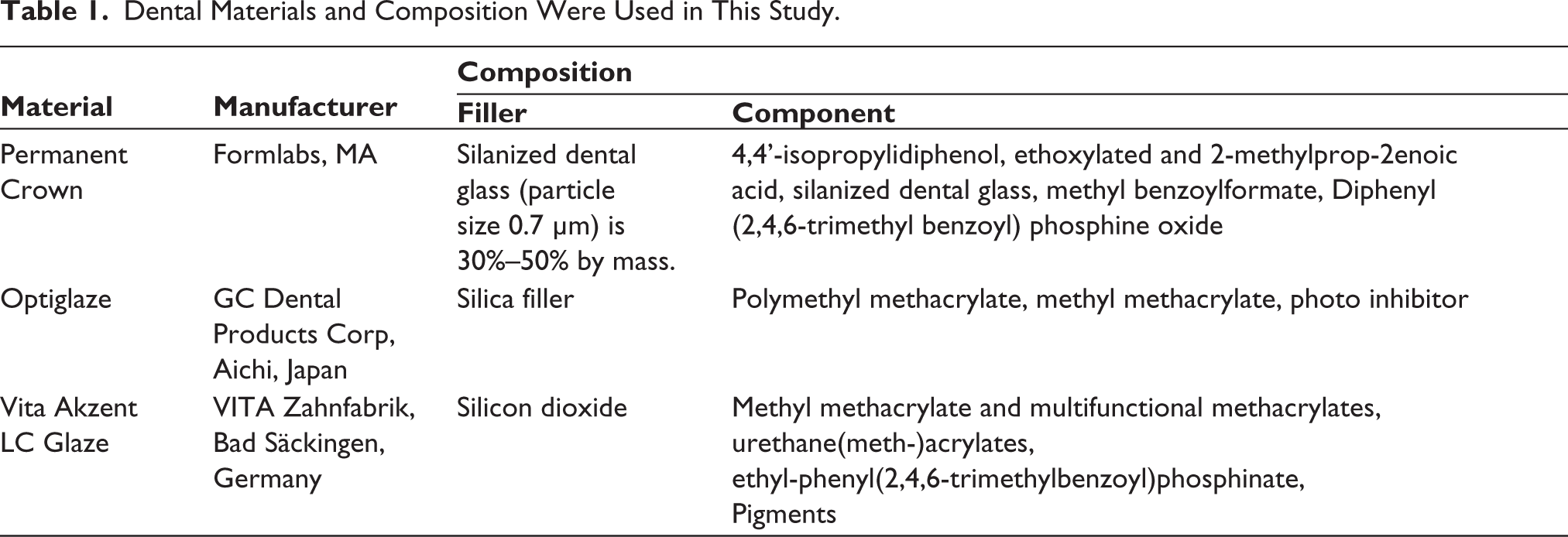
Samples were divided into three groups including mechanical polishing, Optiglaze (GC Dental Products Corp, Aichi, Japan), and Vita Akzent LC (VITA Zahnfabrik, Bad Säckingen, Germany) (n = 40). Polishing methods were applied to all surfaces of the samples. Mechanical polishing was carried out by gently polishing samples using a low-speed handpiece with a dental composite polisher (Diatech, Coltène/Whaledent AG, Altstätten, Switzerland) for 30 seconds. One thin coat of Optiglaze and Vita Akzent LC were applied in one direction to the surface with a brush in optical glaze groups. The surface of the samples was not dried with an air syringe. The samples were light-cured with a light-curing device (Labolight DUO, GC, Japan) (Optiglaze for 90 seconds and Vita Akzent LC for 180 seconds). The commercial names, manufacturers, and composition of evaluating dental materials are listed in Table 1.
Dental Materials and Composition Were Used in This Study.
The groups were divided into four groups according to colorant beverages: distilled water, tea, coffee, and red wine (n = 10). Initial color measurements were performed using a spectrophotometer (VITA Easyshade V; Vita Zahnfabrik) before immersing samples in colorant beverages. L, a, and b coordinates were recorded according to the Commission Internationale de l’Eclairage (CIE) system. A single researcher recorded the color coordinates of each sample on a black background with a 2-degree observation angle in the center of samples under D65-led illumination. 13 Measurements were repeated three times for each specimen. The mean of three measurements was recorded as L, a, and b coordinates of the sample. The spectrophotometer was calibrated before each measurement.
The coffee solution was prepared by adding 2 g of coffee (Nescafe Classic, Nestle, Istanbul, Turkey) to 200 ml of boiling water (at a pH of 5) and the tea solution was prepared by adding one tea bag (Yellow label, Unilever, Istanbul, Turkey) to 200 ml of water (at a pH of 5.5). Red wine (Villa Doluca Classic, Istanbul, Turkey) (at a pH of 3.5) was not diluted. Then the samples were kept in beverages (2.5 ml for each well) in a dark environment at 37°C for 30 days. The solutions were renewed weekly.
Color measurements were repeated under the same conditions by the same researcher after immersion for 30 days. The samples were rinsed in distilled water and dried with an oil-free air syringe before measurements. The color difference was calculated according to the CIEDE2000 color change (ΔE00) formula:
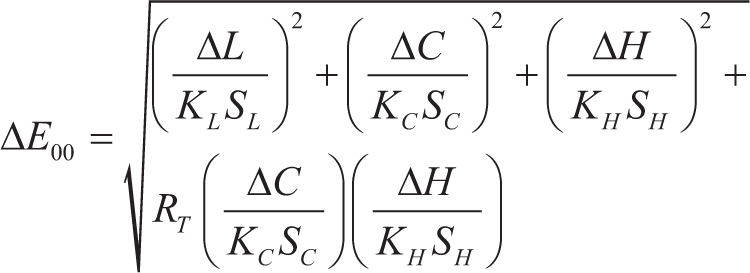
where ΔL, ΔC, and ΔH are the CIELAB metric lightness, chroma, and hue differences, respectively. The SL, SC, and SH are the weighting functions for the lightness, chroma, and hue components, respectively. The KL, KC, and KH values are the parametric factors and were set as 1 in this study. ΔE00 was evaluated according to results of a previous research 20 ; 50:50% color perceptibility (PT00 = 0.81) and acceptability (AT00 = 1.81) thresholds.
Sample size was calculated using results of a previous study 14 on the 3D-printed restorations by using statistical software (G Power 3.1.9.4. software, Heinrich-Heine-Universitat Düsseldorf, Germany). The number of samples required for each group was determined as 10. All statistical analyses were performed using SPSS software (IBM SPSS Statistics for Windows, Version 22.0; IBM, Armonk, New York). Intergroup normality and homogeneity of variance were tested by using Shapiro–Wilk and Levene tests, respectively (α = .05). A two-way analysis of variance (ANOVA) was performed to evaluate the effect of surface treatment, stain solution, and their interaction on ΔE00 after 30 days of immersion. The Tukey HSD test with Bonferroni adjustment was used to compare intergroup differences. The mean ΔE00 was tested against a 0.81 perceptibility threshold and 1.81 acceptability threshold by using a paired-samples t-test (p < .05).
Results
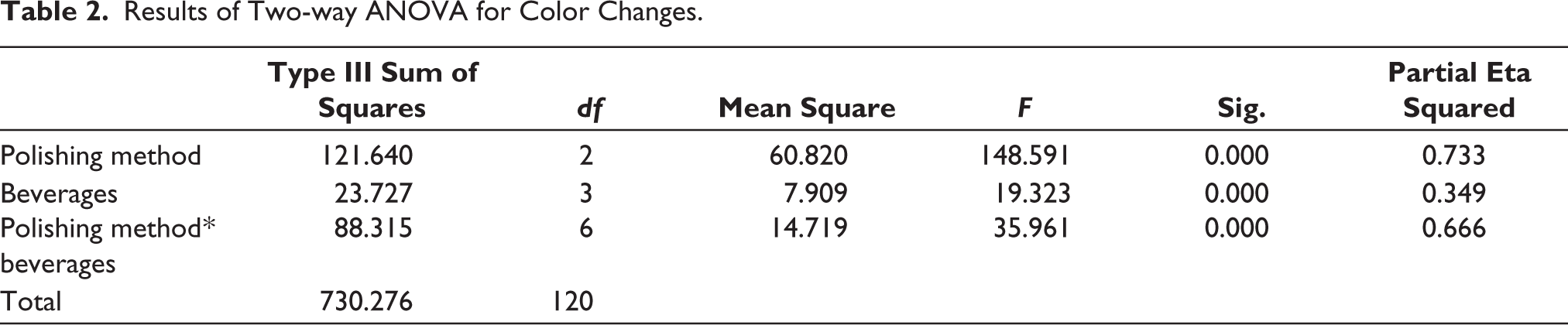
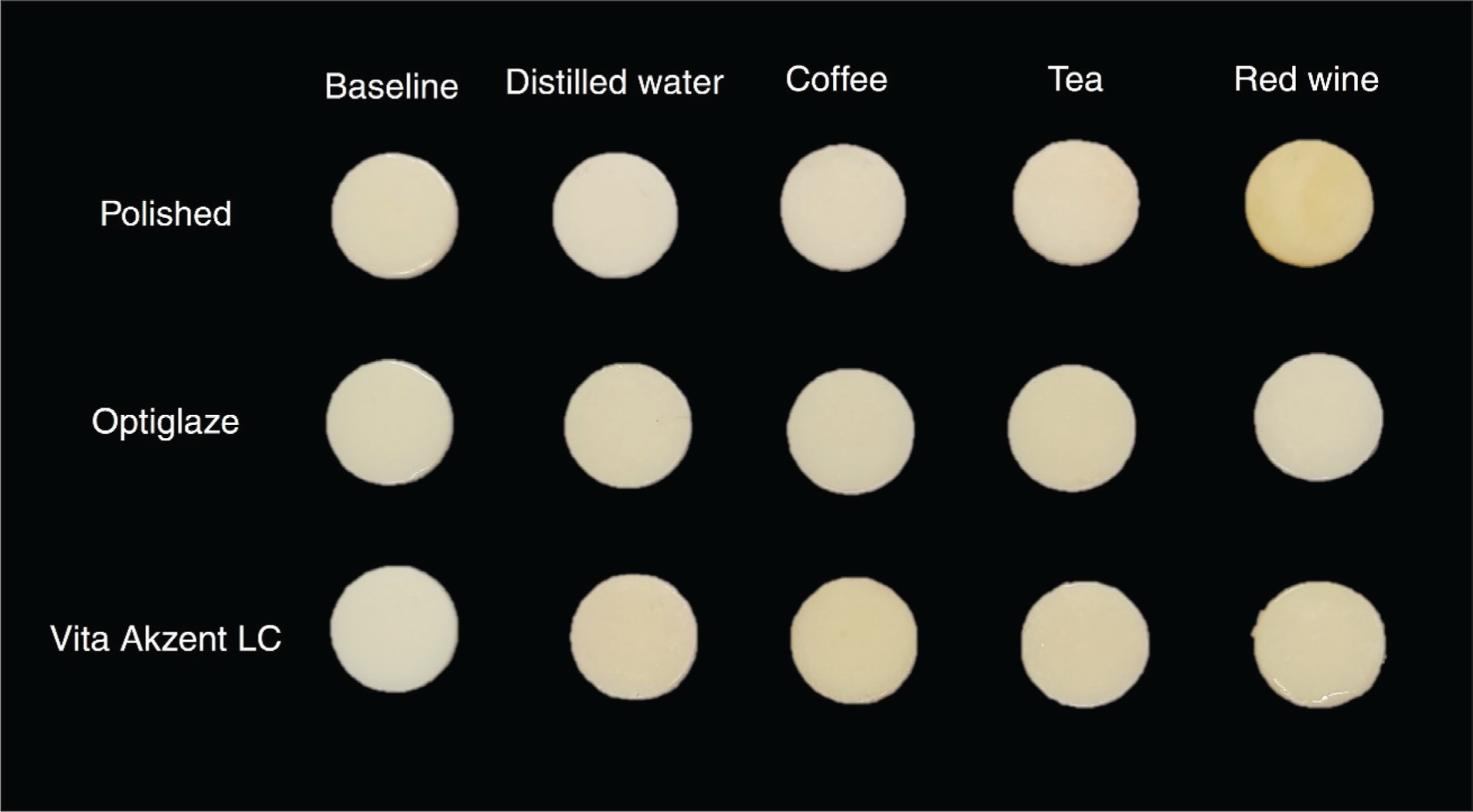
Two-way ANOVA results are presented in Table 2. Polishing methods, colorant beverages, and their interaction affected ΔE00 (p < .001). Lower mean ΔE00 was noted in the Optiglaze group (0.76 ± 0.30) than in Vita Akzent LC (1.83 ± 0.78) and mechanical polishing (3.22 ± 1.81) groups (p < .001). A significant difference was observed between Vita Akzent LC and mechanical polishing groups (p < .001). The coffee group (2.46 ± 1.31) showed a significantly higher ΔE00 than the tea group (1.96 ± 1.38) and the distilled water group (1.23 ± 0.54) (p = .016 and p < .001, respectively). No significant difference was observed between the red wine group (2.10 ± 2.19) and the coffee or tea group (p > .05). A significant difference was observed between the tea and distilled water groups (p < .001). The mean ΔE00 and group differences of this study are given in Table 3. The photographs of 3D-printed permanent resin discs in the polishing methods groups at baseline and after immersion in different colorant beverages for 30 days are given in Figure 1.
Results of Two-way ANOVA for Color Changes.
The Mean Values (± Standard Deviation) for Color Change Values (ΔE00) and Group Differences.

3D-printed Permanent Resin Discs in the Polishing Methods Groups at Baseline and After Immersion in Different Colorant Beverages for 30 Days.
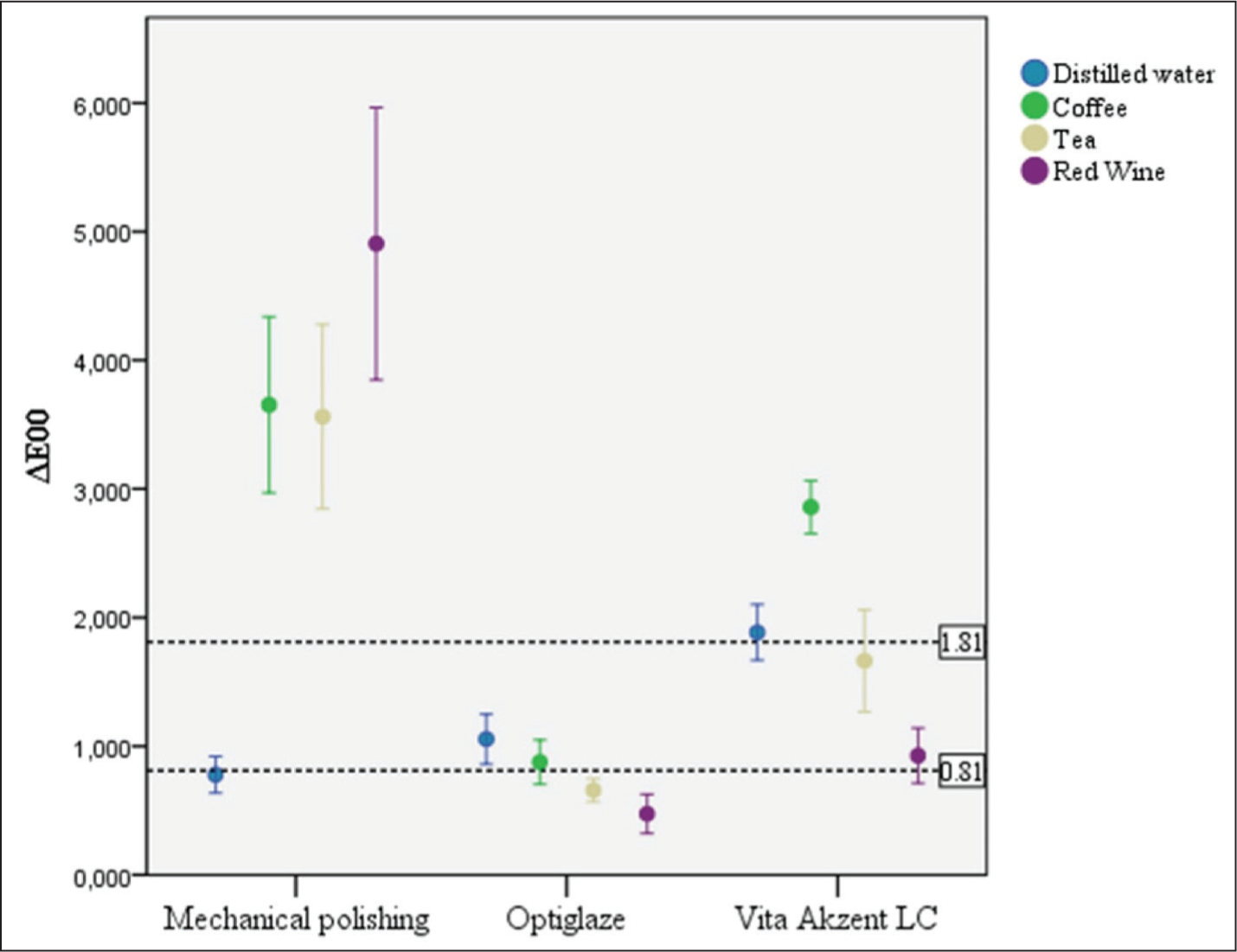
ΔE00 was evaluated against the 0.81 perceptibility threshold and 1.81 acceptability threshold (Figure 2). For mechanical polishing groups, ΔE00 was significantly higher than the perceptibility and acceptability thresholds for coffee, tea, and red wine (p < .001). There was not a significant difference between the perceptibility threshold and distilled water group (p = .634). For Optiglaze groups, lower ΔE00 was noted in tea (p = .004) and red wine (p = .001) groups than the perceptibility threshold. There was not a significant difference between the coffee group and the perceptibility threshold (p = .402). ΔE00 in distilled water was higher than the perceptibility threshold (p = .018) and lower than the acceptability threshold (p < .001). For Vita Akzent LC groups, there was no significant difference between ΔE00 in distilled water and the acceptability threshold (p = .456). ΔE00 in coffee was significantly higher than the acceptability threshold (p < .001). ΔE00 in tea was significantly lower than the acceptability threshold (p < .001) and higher than the perceptibility threshold (p = .001). There was no significant difference between ΔE00 in red wine and the perceptibility threshold (p = .249).
Discussion
In this study, polishing methods, colorant beverages, and their interaction influenced the color stainability of 3D-printed permanent restorations (Table 2). Higher discoloration values were noted in mechanical polishing groups. Immersion in coffee caused higher discoloration of 3D-printed permanent samples than immersion in tea and distilled water. Optiglaze application induced color stainability of samples (Table 3). So, the null hypothesis was rejected.
Guler et al. 21 stated that being immersed in coffee in a dark environment for 24 hours would simulate approximately 30 days of in-vivo discoloration. In this study, the coloring method with different beverages was adopted and all samples were stored in beverages in a dark environment at 37°C for 30 days to simulate 900 days of in-vivo discoloration which is equal to over two and a half years of regular consumption.
In this study, color coordinates were measured with a digital spectrophotometer (Vita Easyshade V). Although Vita Easyshade V is designed for in-vivo color measurements, it has also been used for in-vitro measurements in many studies and its accuracy and reliability have been demonstrated.8,13,15,22,23 CIELAB color difference formula (ΔE) has been used to evaluate color changes in dental restorative materials. However, in the last decade, researchers have been reporting color changes using the CIEDE2000 color change formula (ΔE00), which has been proven to be more accurate in the visual perception of color change.24–26 Paravina et al. 20 published color difference thresholds for tooth color resin restorations (50:50% perceptibility = 1.2 and acceptability = 2.7 for CIELAB units; and 50:50% perceptibility = 0.81 and acceptability = 1.81 for CIEDE2000 units). In this study, the CIEDE2000 color change formula was used and ΔE00 units were compared with 50:50% perceptibility = 0.81 and acceptability = 1.81 thresholds.
To prevent bacterial plaque accumulation, restorations should have smooth surfaces either mechanical polishing or glazing. 27 The smoothness of the restoration surface also affects color changes in restorative materials, especially resins.17,28 Smoother surfaces can be achieved by applying glaze materials or surface sealants. 17 However, surface treatment especially sandblasting is recommended by manufacturers due to the mechanical retention of glaze materials on the surface of restorations. The sandblasting procedure can cause macro-roughness that induces a non-homogenous spread of glaze materials and smoothness fluctuations on the restoration surface. 19 Although surface roughness was not evaluated in this study, roughening was performed with sandpaper instead of sandblasting to prevent low-viscosity glaze materials from being thicker in some areas and thus affecting color measurements.
Stainability of permanent resin restorations is an essential factor for long-term use, especially in the esthetic zone. Previous studies reported higher discoloration values of 3D-printed restorations than conventional and milled resin restorations.7,8 Researchers suggest optical glaze applications on 3D-printed restorations to increase color stability.14,15 Almejrad et al. 14 stated that the effect of optical glaze materials on the color stainability of 3D-printed temporary restorations is related to colorant beverages. This study indicated that mechanically polished samples had higher values of ΔE00 after 30 days of immersion, except the distilled water group. The highest ΔE00 was noted in the samples immersed in the red wine. Kang et al. 29 stated that commercial red wines contain variations in ethanol (12%–13.5%), pH, tannin, and red pigment that can affect discolorations. Acid and ethanol cause matrix degradation on the resin surface which increases the absorption of pigments to the surface of resins. And also ethanol softens and decomposes the resin matrix. 29 These properties of red wine may have caused more discoloration to be observed in samples immersed in red wine in this and previous studies.9,14,29–31
Glazing materials provided protection from discoloration for milled and 3D-printed samples. 15 However, when the immersion distilled water groups were examined, higher discoloration values were noted in the Vita Akzent LC group than in the mechanical polishing group. This result may be related to the surface roughness due to weak retention of glaze material to resin or uneven spreading of glaze material on resin surfaces. 18 Lee et al. 32 stated that surface roughness affects the degree of scattering or reflection of the light of the spectrophotometer on the material. Rougher surfaces may reflect the light of the spectrophotometer at different angles which can cause the spectrophotometer to give incorrect color coordinates.18,32 Additionally, a lower degree of conversion of glaze material in the Vita Akzent LC group immersed in distilled water also explained the higher discoloration values. 8 In this study, surface roughness measurements or microscopic imaging and evaluation of the degree of conversion were not performed, which can be considered a limitation.
According to previous studies, discoloring beverages influence color changes differently. Alharbi et al. 8 reported the highest color changes in mechanically polished samples immersed in coffee. Contrary to the results of Alharbi et al., 8 there was no significant difference between mechanically polished samples immersed in tea or coffee in this study. Almejrad et al. 14 reported the highest color changes in immersed red wine groups and stated glazing materials were effective on color changes when the samples were immersed in coffee, but not in red wine. In this study, color changes of Optiglaze applied groups immersed in coffee were lower than those of mechanical polishing groups (p < .001), which agreed with the results of Almejrad et al. 14 In contrast, the lowest ΔE00 values were noted in glazed groups immersed in the red wine. ΔE00 of Optiglaze samples immersed in red wine was lower than the perceptibility threshold (p = .001). There was no significant difference between ΔE00 of Vita Akzent LC and the perceptibility threshold (p = .249). The contrary in the results of this study and a previous study 14 could be explained by different colorant beverages exposed and immersion durations of the colorant beverages.10,11,14
In this study, ΔE00 values of Optiglaze were lower than those of Vita Akzent LC groups (p < .001). Optiglaze and Vita Akzent LC are polymethyl methacrylate-based photoactive resins (Table 1). The color stainability of resins is affected by the chemical content of the resin used, the monomer, the polarity of the monomer, the initiator, the filler content, and the cross-links formed. 17 Having hydroxyl side groups affect the hydrophilicity of resins which is an important factor for water absorption rate affecting color stainability. 29 In Vita Akzent LC groups, a higher absorption rate of the coffee to the surface may cause higher discoloration values. 8 The higher susceptibility of Vita Akzent LC to coffee stains can be explained by the oxidation of unreacted residual monomers of the glaze matrix. 8 The difference ΔE00 between the glaze groups may also be explained by the filler sizes of glaze materials used in this study. 17 In Vita Akzent LC groups, ΔE00 immersed in tea and red wine was calculated above the acceptability threshold (0.81 < mean ΔE00 < 1.81) and significantly lower than mechanical polishing groups (p < .001). The results of this study indicated that the application of optical glaze material on 3D-printed permanent restorations decreases color stainability.
One limitation of the study was that the immersions were completed in a laboratory environment. Although, Rutkunas et al. 33 stated that the major cause for color change of resins is colorant beverages; smoking, saliva composition, thermal changes, and brushing could also affect the color stainability of resins.14,15,34 Therefore, it can be said that this study cannot fully replicate clinical conditions. Additionally, a 3D-printable permanent resin and a 3D printer technology were used. Future in-vivo studies are needed to evaluate the long-term color stainability of 3D-printed permanent restorations produced with different 3D-printable permanent resins and 3D printer technologies.
Conclusion
Within the limitations of the present study, it was concluded that the surface polishing method, colorant beverages, and their interaction affected the color stainability of 3D-printed permanent restorations. The highest mean ΔE00 values were achieved in mechanical polishing groups. The lowest mean ΔE00 values were achieved in the Optiglaze groups. Coffee caused the most significant discoloration on the 3D-printed permanent restorations. While Optiglaze can reduce 3D-printed permanent restoration discoloration caused by tea, coffee, and red wine, Vita Akzent LC can reduce discoloration caused by tea and red wine.
Footnotes
Declaration of Conflicting Interests
The authors declare that this manuscript has not been presented in a scientific congress.
Ethical Approval
Not applicable
Funding
The authors received no financial support for the research, authorship, and/or publication of this article.
Informed Consent
Not applicable