




Abstract
Aim:
To characterize the lip print pattern in a study population and to ascertain its potential for sex determination.
Materials and Methods:
A cross-sectional study was conducted among 300 undergraduate students (144 males and 156 females). Simple random sampling was used. Lip prints were obtained with lipstick and were classified according to Suzuki and Tsuchihashi classification. Data were analyzed with the Statistical Package for Social Sciences (SPSS) version 22 (IBM Corp., Armonk, NY, USA). The prevalence of lip print patterns was presented as frequencies and percentages, and the test of significance of gender difference was done with chi-square at the 95 percent confidence interval.
Result:
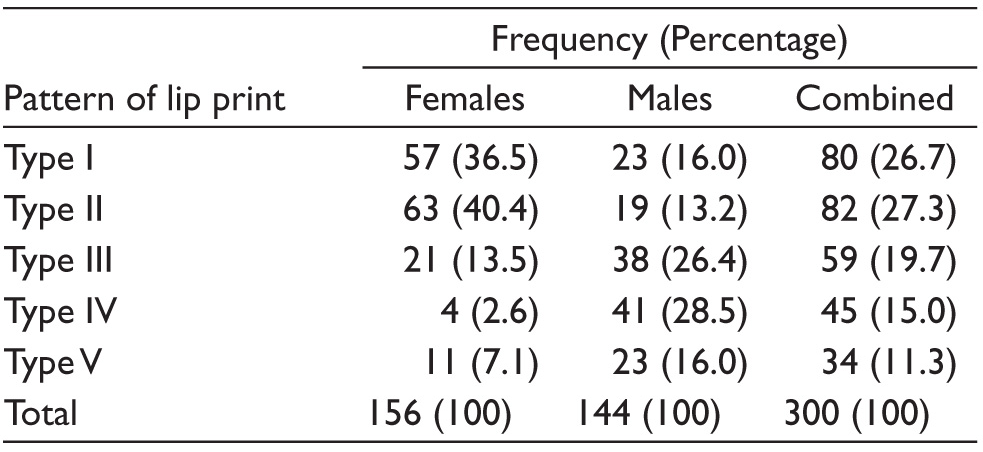
No two lip print patterns were found to be the same. There was a significant difference in the lip print patterns of females and males. In females, the pattern with the highest frequency was type II (40.4%). This was followed by type I (36.5%), type III (13.5%), type V (7.1%), and type IV (2.6%). In males, the pattern with the highest frequency was type IV (28.5%). This was followed by type III (26.4%), types I and V (each 16.0%), and type II (13.2%). When both sexes were considered together, type II was the most frequent pattern.
Conclusion:
Lip print is unique to individuals and it has potential for sex determination. The most prevalent patterns in females and males were type II and type IV, respectively.
Introduction
Crime is a global menace, and its rate is on the increase. Criminals use several techniques to evade law enforcement. As procedures for investigating crime are becoming more technical and sophisticated, criminals are also evolving in their techniques, with the aim to beat the law. 1 This observation, therefore, justifies the need for further research in forensic science to explore new methods of individual identification, which is the key issue in crime investigation.
Lip prints are the characteristic pattern of the fissures in the form of elevations and depressions on the labial mucosa (sulci labiorum) present in the zone of transition, between the inner labial mucosa and the outer skin. 1 The study of the lip print pattern is called cheiloscopy. Lip prints can be identified in the sixth week of intrauterine life, and once it is developed, it does not change throughout life.2–5 Lip print is unique to individuals just as the fingerprints of individuals are unique.6–8 Lip prints of parents, children, and siblings have been shown to have some similarities. 6 It has also been shown that lip print can be recovered after severe alterations of the lips, such as trauma, inflammation, or diseases. 5
Lip print can be retrieved from windows, doors, cigarettes, cups, glasses, clotting, and paintings in the scene of crime. 4 It is not only the visible lip prints that are important but also the invisible lip prints (latent prints) are equally important. The edges of the lips have sebaceous glands and sweat glands, the secretions of which may produce the latent prints. 5 These latent prints may be visualized using a florescent dye, 6 aluminum powder, or magnetic powder. 9 Lip print retrieved from a crime scene can be a substantive tool that can aid in crime detection, or that can form a basis upon which other investigative processes are based. Perhaps, many criminals are aware of fingerprints and possibility of being identified by it, but not many are aware of lip print as a forensic tool because it is a less commonly used technique. 4 Therefore, cheiloscopy can be useful in forensics. When lip prints are retrieved from a crime scene, they can provide some information on the character of the event, the number of persons involved, the sexes, cosmetics used, the habits, occupational traits, and the pathological changes of the lips. 4
This present study was carried out to bridge the research gap created by paucity of the literature on lip print pattern in our region. The objective was to characterize lip print patterns in our environment and to ascertain its potential for sex determination.
Materials and Methods
Study Design
This was a cross-sectional study. It was carried out among undergraduate students of the College of Health Sciences of Nnamdi Azikiwe University, Nnewi Campus, Anambra State of Nigeria. The study lasted for three months, from July 2019 to September 2019. The sample size was 300 (144 males and 156 females), and the age range was 18–26 years. Ethical approval was obtained from the Ethics Committee (NAU/CHS/NC/FBMS/173) of the Faculty of Basic Medical Sciences of the Institution, and individual consent was obtained from the subjects.
Sampling Criteria
Simple random sampling was used. The total number of students in our college was 1800 (<10,000). The sample size (nf ) was calculated from the equation = n/[1 + (n/N)],10, 11 with the 95 percent confidence interval level, and it was 317. There was no bias or dropout noted in the study.
The inclusion criteria were subjects who are of Igbo origin, whose parents and grandparents are of Igbo origin, and who do not have any trauma or congenital anomaly of the lips. The exclusion criteria were subjects who are not of Igbo origin, subjects with lesion(s) of the lips or anomaly of the lips, and subjects with any known allergy to lipsticks.
Study Method
Lip prints were obtained using a red, nonglossed lipstick. It was applied evenly with a single stroke over the vermilion border. Subjects were asked to rub both lips to spread the lipstick evenly. Thereafter, a lip impression was collected on the glued side of a strip of cellophane tape, which was applied to the lip from right to left. The prints were collected while the mouth was closed. This is because lip prints collected with the mouth open are ill defined. 4 The tape was then removed in a single swing and it was stuck to the A4 bond paper. A magnifying lens was then used to study the lip print patterns on the entire lip. Only the lip prints in the middle portion of the lips were put into consideration. This is because lip prints in this region have been shown to be most visible. 7
Observational Parameters
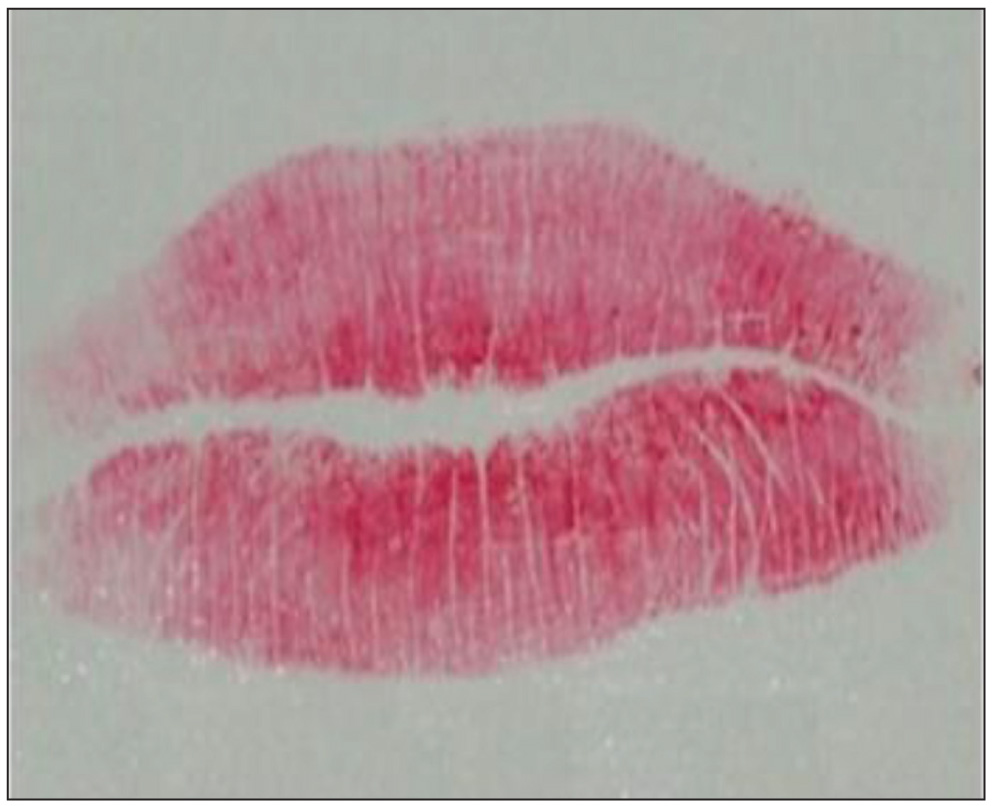
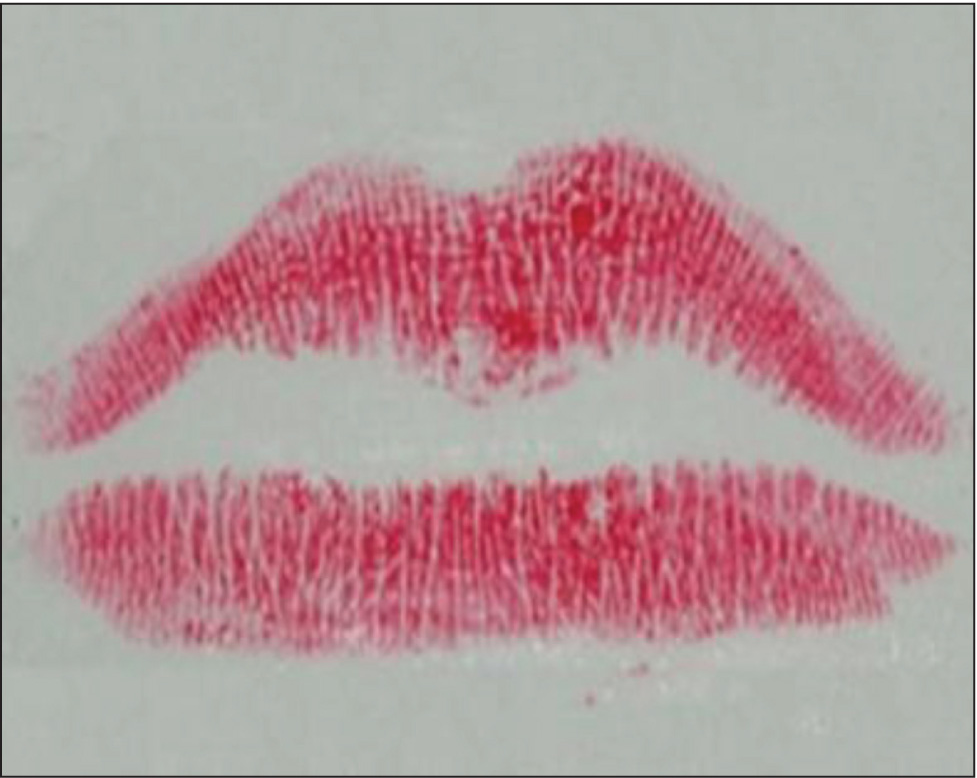
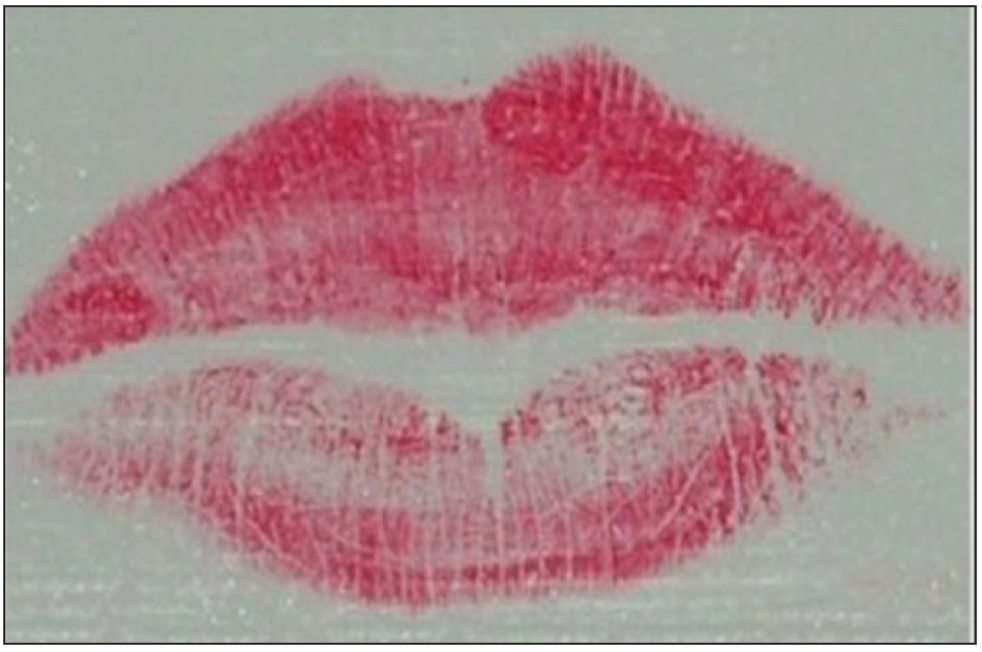
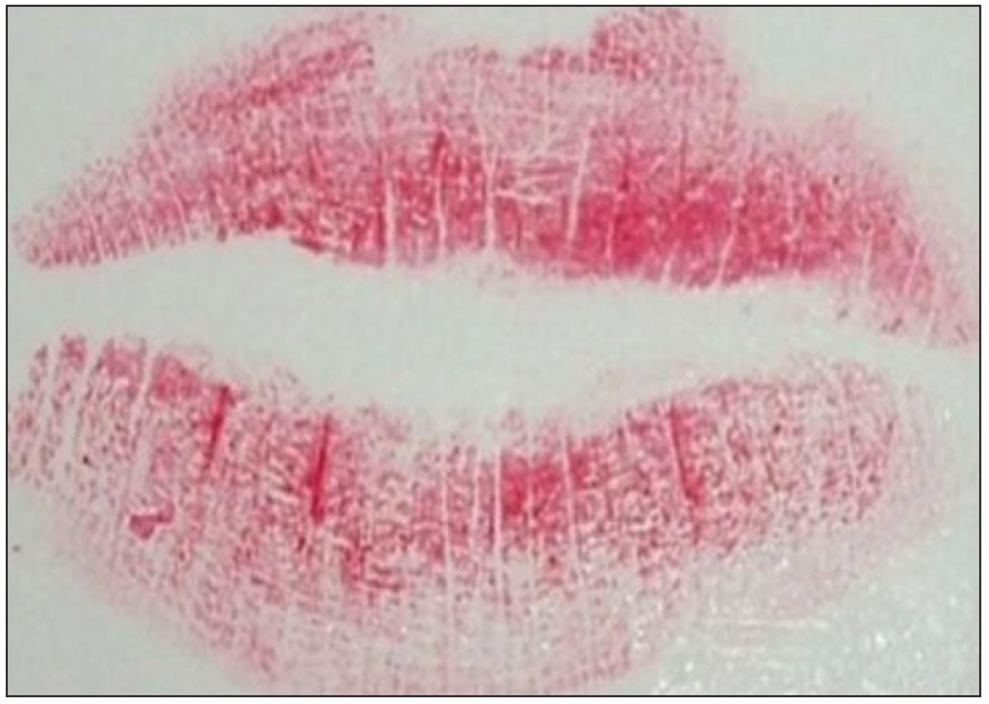
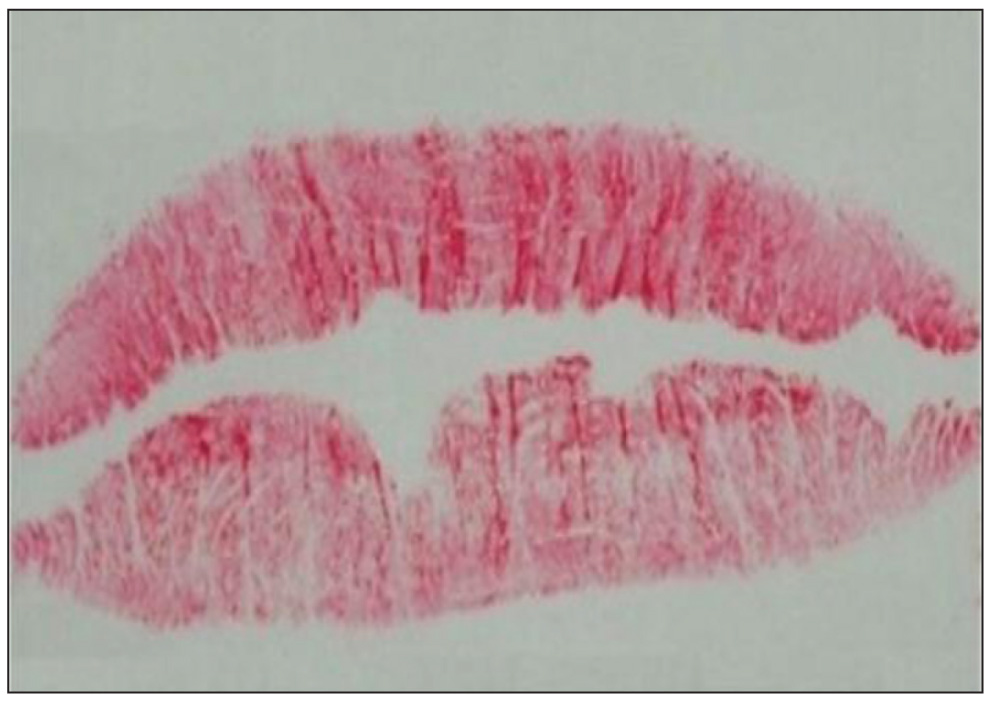
Lip print patterns were classified based on Suzuki and Tsuchihashi classification as reported by Pushpa and Bajpe 12 : type I: a clear cut groove running vertically across the lip or that do not cover the entire lip (Figure 1); type II: branched lines (Figure 2); type III: intersected grooves (Figure 3); type IV: reticular pattern (Figure 4); and type V: the pattern that did not fall into any other type, types I–IV (Figure 5).
Statistical Analysis
The data were analyzed using Statistical Package for Social Sciences (SPSS) version 22 (IBM Corp., Armonk, NY, USA). The prevalence of lip print patterns in males and females was expressed as frequencies and percentages because the data were categorical. The test of significance of gender difference was done using chi square. The P value was set at .05 (95% confidence interval).
Results
The data obtained from the present work revealed that no two lip print patterns were exactly the same. The frequency of lip print patterns in female subjects is listed in Table 1. The pattern with the highest occurrence was type II, while the least frequent pattern was type IV.
Table 1 also shows the frequency of occurrence of lip print patterns in male subjects. The most frequent pattern in males was type IV, while the least frequent patterns were types I and V. When all the lip prints of males and females are put together, type II lip print pattern was the predominant pattern (Table 1).
Frequency Distribution of Lip Print Patterns Among the Subjects
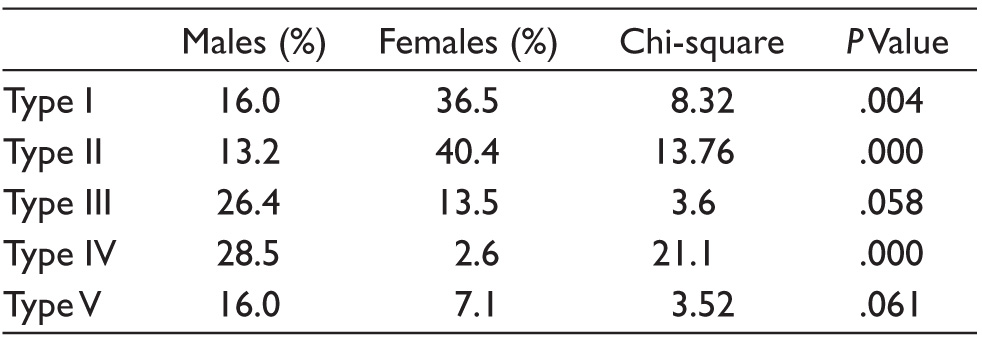
Females have significantly higher frequencies of types I and II patterns than males (Table 2), while males have significantly higher occurrence of type IV pattern than females. However, males have higher frequencies of types III and V than females but the difference was not significant (Table 2).
Difference in Frequency of Occurrence of Lip Print Pattern in Males and Females
Discussion
Crime is a global problem. As science and technology are being advanced, criminals also advance in their skills and expertise. 1 There is, therefore, a need to explore other newer methods to curb the burden of crime. Lip print dermatoglyphics is one such emerging areas to explore. 6 The lip print is one of the evidence that can be recovered from a crime scene. It can be obvious or latent. Obvious prints can be photographed, while latent prints may be picked up by the use of aluminum or magnetic powder. 9 There are many classifications of lip print pattern in the literature. These include Martin Santos classification, Renaud classification, AfcharBayat classification, and Jose Maria Dominguez classification. 6 In the present study, we made use of Suzuki and Tsuchihashi classification as reported by Pushpa and Bajpe, 12 because it is the most commonly used system of classification. 6
In the present work, no two lip prints had the same pattern. This finding adds to the body of evidence that supports the uniqueness of lip print. It was similar to the findings of Timsinha and Kar, 2 Multani et al., 1 and Costa and Caldas. 5 There was also statistically significant difference in the lip print pattern between males and females in the present study. This was also reported by other authors.6, 8 The findings show that lip print pattern has the potential for identification of gender.
The findings from the present work showed that the most frequent lip print pattern in females was type II (40.0%). This was followed by type I (36.5%), type III (13.5%), type V (7.1%), and type IV (2.6%). It was similar to the findings of Timsinha and Kar, 2 Costa and Caldas, 5 and Šimović et al. 6 However, it did not agree with the findings of Multani et al., 1 Pushpa and Bajpe, 12 and Ezemagu et al., 13 who reported that type I was the most predominant in females. It did not also agree with the study of Ahmed et al. 8 who reported that type III was the most predominant in females. These differences may be due to racial factor.
In the present work, the most predominant pattern in males was type IV (28.5%). It was followed by type III (26.4%), type I (16.0%), type V (16%), and then type II (13.2%) was the least frequent. The finding did not agree with the report of Ahmed et al. 8 who reported that type I was the most frequent pattern in Egyptian population. Topczyłko et al. 14 reported that type II was most frequent in males, while Multani et al., 1 Costa and Caldas, 5 and Šimović et al. 6 reported type III as the most predominant pattern in males.
Type II was the most predominant pattern in the entire population in the present work. Multani et al. 1 reported type I as the most predominant in the entire population.
In the present work, the middle portion of the upper and lower lips were studied for the lip pattern because the lip print patterns are most visible in that area. We did not find disparity in the lip print patterns between the upper and lower lips; some authors 5 reported disparity in the lip print patterns between the upper and lower lips.
There are some short comings in the study of lip print patterns. Occasionally, the prints obtained from a crime scene may be poor and, therefore, will make interpretation difficult. There is not yet standardization in the protocol of obtaining and interpreting the lip print patterns. 6 This varied methodology may affect results obtained from different places. Be that as it may, the lip print still offers hope of advancement in new techniques of the forensic science. It may be helpful in the study of DNA.6, 13 The secretions that may have produced lip prints, especially the latent prints, may yield material for the DNA study, which will further render important clue in crime investigation.
Conclusion
The study of lip print patterns is an emerging area in forensic science which can add up to already existing techniques of identification in investigating crime. The findings of the present study give evidence to the uniqueness of lip print and its potential for gender identification among the Igbo people.
Footnotes
Declaration of Conflicting Interests
The authors declared no potential conflicts of interest with respect to the research, authorship, and/or publication of this article.
Funding
The authors received no financial support for the research, authorship, and/or publication of this article.