




Abstract
Purpose:
The objective of this in vitro study was to evaluate the influence of ceramic thickness and pre-heating of luting agents on their physical properties.
Materials and methods:
The materials RelyX Arc, RelyX Ultimate, RelyX Veneer, and Filtek Z350 Flow were handled at different temperatures (23°C or 54°C), inserted into matrix, and photoactivated through ceramic disks (0.75 mm or 1.5 mm). The following tests were performed (n=8): degree of conversion, Knoop Hardness, cross-link density, water sorption, solubility, and ultimate tensile strength. Data were analyzed using three-way analysis of variance and Tukey’s test (α=0.05).
Results:
Regarding ceramic thickness, the thinnest ceramic resulted in higher values of Knoop Hardness (p=0.027). The lowest temperature (23°C) resulted in a higher solubility (p=0.0257), and water sorption (p=0.0229) values. There was also statistical difference among the materials: RelyX Arc showed a higher degree of conversion and ultimate tensile strength, followed by RelyX Veneer, RelyX Ultimate, and Filtek Z350 Flow. For Knoop Hardness and cross-link density tests, RelyX Ultimate showed the highest values, followed by RelyX Arc, RelyX Veneer, and Filtek Z350 Flow. For water sorption and solubility, RelyX Veneer showed the highest values, followed by RelyX Arc, RelyX Ultimate, and Filtek Z350 Flow.
Conclusion:
Pre-heating interfered with water sorption and solubility, whereas ceramic thickness only affected Knoop Hardness; the physical properties of the materials are dependent on their composition.
Introduction
In recent years, ceramic restorations have been frequently used due to their excellent esthetics, biocompatibility, and long-term stability. 1 However, the luting agent may not polymerize properly due to the attenuation of the optical power of light, caused by the interposition of ceramic between the photo-curing unit and the resinous material. 2
The difficulty in achieving effective activation through indirect restorations has led to a major discussion that revolves around the use of light-cured luting agents. Because these materials are only physically activated, there is a decrease in monomer conversion efficiency in situations of lowered irradiance reaching the resinous material. 3 Factors such as ceramic opacity, color, and thickness may negatively interfere with light transmission through indirect restorative materials. 2
The chemical activation that occurs in dual cements could compensate for the attenuation of light passing through a ceramic material, improving monomer conversion rates and material properties. 4 However, these dual agents contain more amines; when these components oxidize, there is a significant color change of the luting agent, resulting in compromised esthetics of the restorative procedure. 5 Thus, the use of light-curing luting agents should be considered in cases where esthetics are paramount, as long as they are restricted to adhesive procedures of thinner restorations, such as laminated ceramics and veneers.6,7
Previous studies have suggested that handling resinous materials at increased temperatures, ranging from 50°C to 60°C, could result in improved conversion rates, regardless of the polymerization conditions.8–10 However, most studies were directed at dual luting agents, which leaves questions about the behavior of physically activated materials with regards to temperature changes.
Therefore, the aim of this in vitro study was to evaluate the influence of pre-heating and ceramic thickness on the degree of conversion (DC), microhardness (KHN), cross-link density (CLD), ultimate tensile strength (UTS), water sorption (WS), and solubility (S) of different resinous materials. The hypotheses tested were: (1) pre-heating of luting agents would improve their physical properties, (2) ceramic thickness would affect the physical properties of luting agents, and (3) monomeric composition would influence physical properties of the tested materials.
Materials and methods
Preparation of samples
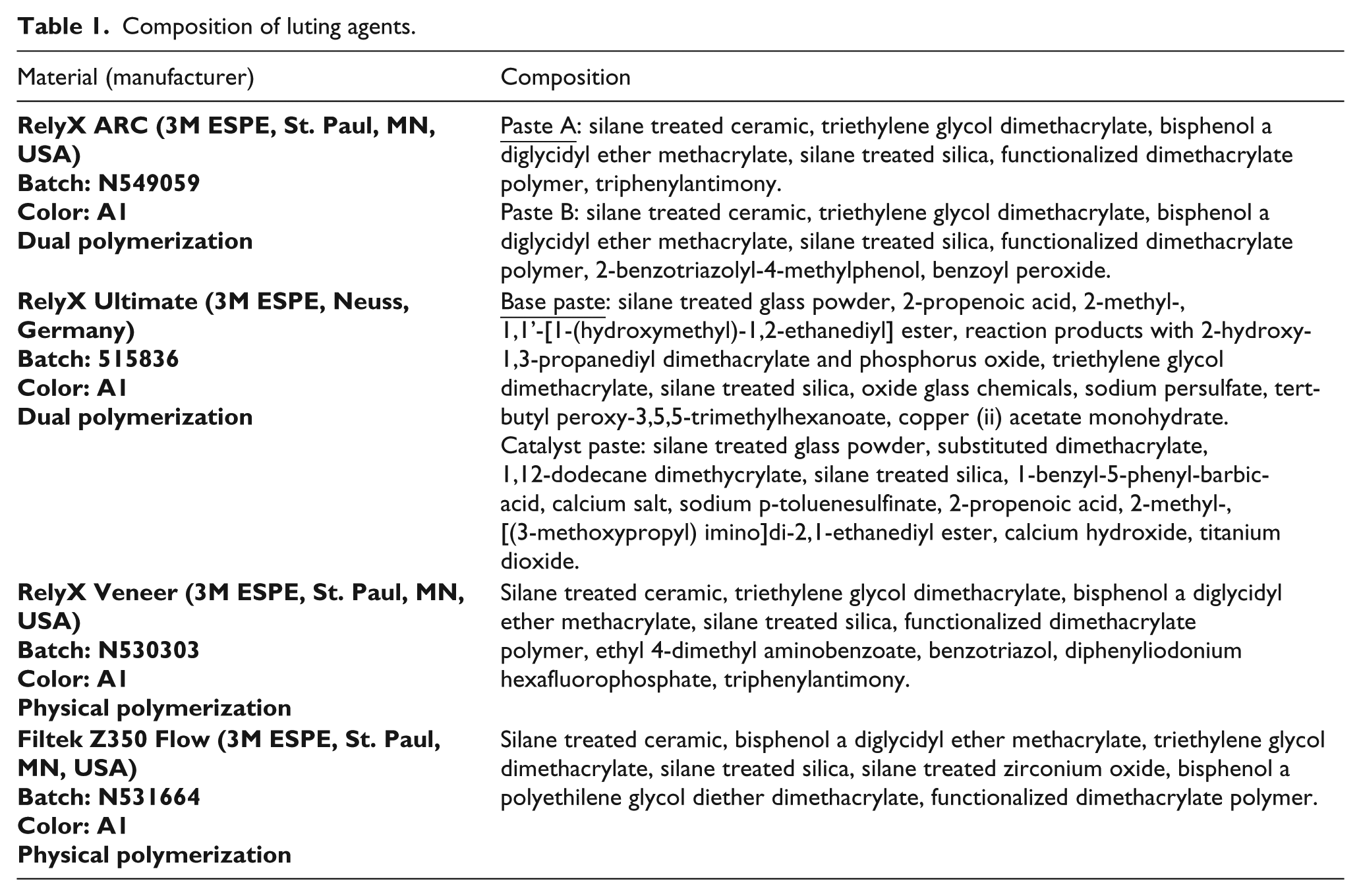
The luting agents used in this study were RelyX Arc (RXA), RelyX Ultimate (RXU), RelyX Veneer (RXV), and Filtek Z350 Flow (FLK). Details of the materials are presented in Table 1. RXA and RXU resin cements had their base pastes and catalysts equally distributed on hand-mixing paper placed on a glass plate. All the materials tested, the glass plate, and the spatula were then incubated for 1 h at 54°C in a digital bacteriological incubator (Model 502, Fanem, Guarulhos, SP, Brazil), or kept for 1 h at room temperature (23°C), according to the experimental group. After this period, RXA and RXU were hand mixed for 15 s and immediately placed into a cylindrical silicone mold (5 x 0.5 mm) or an hourglass-shaped matrix (0.5 mm thick, 8 mm long, 4 mm wide, and 1.5 mm constriction), according to the methodology to be applied. For RXV and FLK materials, which do not require hand mixing, a portion of material was placed on hand-mixing paper on a glass plate at 54°C or 23°C for 15 s prior to insertion into the silicone mold. The temperature of the luting agents was controlled using an infrared digital thermometer (Scan Temp ST-600, Incoterms, Porto Alegre, RS, Brazil).
Composition of luting agents.
Following material placement into the silicone matrix, it was covered with a polyester strip and either a 0.75 mm- or 1.5 mm-thick lithium disilicate ceramic disk (IPS e.max, Ivoclar Vivadent, Amherst, NY, USA). The polymerization was carried out for 40 s by positioning the tip of an LED curing unit (LED Bluephase 16i; Vivadent, Bϋrs, Austria) on the ceramic disc. The irradiance of the device (1519 mW/cm2) was determined using a power meter (Ophir Optronics, Har-Hotzvim, Jerusalem, Israel) and the tip-area calculated with a digital caliper (Mitutoyo South American, Suzano, SP, Brazil). The interposition of a ceramic disc with a thickness of 0.75 mm or 1.5 mm attenuated light irradiance to 756 mW/cm2 and 636 mW/cm2, respectively.
The samples were stored in specific plastic wells and maintained at 37 ºC for 24 h in a dark container to prevent the passage of light.
DC
The cylindrical samples used for DC (n=8) were polished with P2500 and P4000 abrasive paper (Buehler Inc., Lake Bluff, Il, USA) for 40 s for each sandpaper, and then brought to the Fourier transform infrared spectrometer (Spectrum Optics 100, Perkin Elmer, MA, USA) to obtain the absorbance spectrum using an attenuated total reflectance (ATR) device. The materials were placed on the horizontal face of the ATR and absorption spectra of polymerized and unpolymerized material were obtained from 16 scans in the region between 1800 and 1400 cm-1 at a resolution of 4 cm-1. The DC was calculated by the ratio (R) between the peak height of the aliphatic C=C (1638 cm-1) and aromatic groups (1608 cm-1) of polymerized and unpolymerized material, according to the formula:

Knoop KHN
After obtaining DC, the samples (n=8) were taken to a KHN tester (Model S-HMV, Shimatzu, Kyoto, Japan) using a diamond pyramid indenter to perform KHN readings on the top surface. The load used was 25 g for 10 s. Five indentations were performed, one in the center and the others at a distance of 100 μm from the central indentation. The average of the five indentations was calculated for each sample.
CLD
Cross-linking was indirectly evaluated by the percent reduction on KHN (% MHred) following storage in absolute ethanol. After the initial KHN reading (MHi), all specimens were immersed in 100% ethanol for 24 h. After this period, the samples were removed from the solution, dried, and stored at 37ºC for 24 h. Then, a second KHN reading (MHf) was performed. The CLD was calculated using the following formula:

UTS
Samples manufactured in an hourglass shape (n=8) were fixed on a Geraldeli device using cyanoacrylate gel (Super Bonder gel, Loctite), so they could be tensioned in the universal testing machine EZ Test (Shimadzu, Kyoto, Japan) at a constant speed of 1 mm per min until rupture. Before testing, the cross-sectional area of the fracture place was measured using a digital caliper (Mitutoyo South American, Suzano, SP, Brazil). The UTS results were calculated by dividing the fracture load value (N) by the surface area (mm 2 ) and were expressed in MPa.
WS and S
WS and S tests were carried out in accordance with ISO 4049 (2009), with a few modifications (sample dimensions, photoactivation protocol, and number of samples). Cylindrical samples were newly fabricated (n=8) and submitted to initial desiccation in silica gel to remove the remaining water. The specimens were weighed daily in a high-precision analytical balance (Shimadzu AUW220D, Kyoto, Japan) until a constant mass (m1) was obtained, with a variation lower than ± 0.01 mg for three successive weightings. The initial diameter and thickness were measured at four equidistant points using a digital caliper. These measurements were used to calculate the sample volume in cubic millimeters. After that, samples were immersed in 1.5 mL of distilled water and stored at 37ºC, where they remained for 7 days. After this period, samples were washed and dried with paper towels, and weighed using an analytical balance to obtain the mass (m2). The samples were again placed in a desiccator with silica gel at 37°C until a constant mass (m3) was achieved. The WS and S values were calculated in micrograms per cubic millimeter using the following formulae: WS = (m2-m3)/v and S = (m1-m3)/v.
Statistical analysis
The experimental design of this study consisted of three factors: material (four levels: RXA, RXU, RXV and Filtek Z350 Flow), ceramic thickness (two levels: 0.75 mm and 1.5 mm), and temperature (two levels: 23°C and 54°C). The response variables DC, KHN, CLD, UTS, WS, and S were analyzed by three-way analysis of variance and Tukey’s test (α=0.05).
Results
DC
The DC results are summarized in Table 2. For all materials, temperature conditions (p>0.05) and ceramic thickness (p=0.239) showed no influence on DC. Statistical difference (p<0.001) was found among the different materials, with RXA showing the highest DC, followed by RXV; RXU and FLK had the lowest values, without significant difference between them (p>0.05).
Degree of conversion (SD) according to material, temperature, and ceramic thickness.
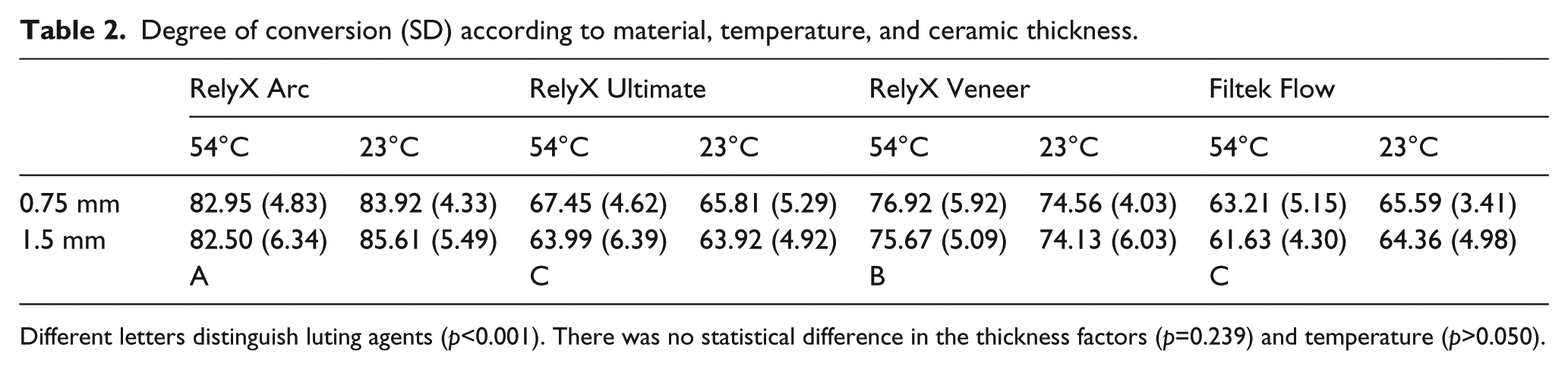
Different letters distinguish luting agents (p<0.001). There was no statistical difference in the thickness factors (p=0.239) and temperature (p>0.050).
Knoop KHN
The KHN results are shown in Table 3. Temperature did not influence the KHN values of any of the materials tested (p=0.099). Regarding ceramic thickness, a statistical difference (p=0.027) was found, with the thinnest ceramic (0.75 mm) yielding higher KHN values when compared to the 1.5 mm-thick ceramic. Among the different materials, there was statistical difference (p<0.001), where RXU presented the highest KHN values, followed by RXA. RXV and FLK, with the lowest values, showed no statistically significant difference between them (p>0.05).
Microhardness (SD) according to material, temperature, and ceramic thickness.
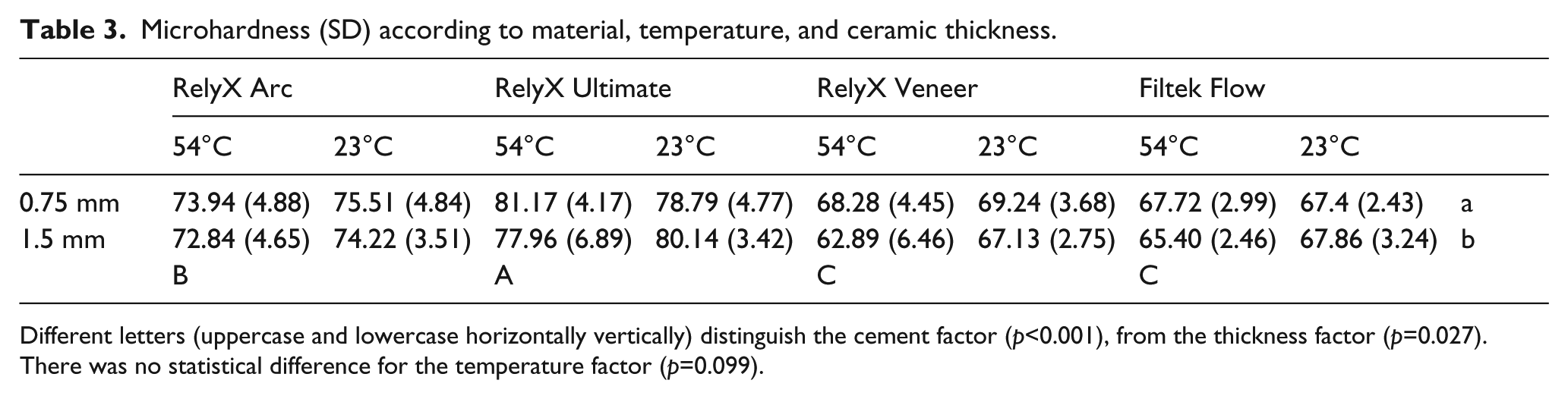
Different letters (uppercase and lowercase horizontally vertically) distinguish the cement factor (p<0.001), from the thickness factor (p=0.027). There was no statistical difference for the temperature factor (p=0.099).
CLD
The CLD results, determined by the material hardness percent reduction, are shown in Table 4. Temperature (p>0.05) and ceramic thickness (p=0.1127) did not affect the values of CLD in any material. There was a statistical difference (p<0.001) among the CLD of the different materials; RXV showed the highest hardness reduction, whereas RXU showed the lowest loss in hardness after immersion in alcohol. Values for FLK were similar to RXV and RXA, and RXA results were statistically similar to FLK and RXU.
Microhardness loss percentage (SD) according to material, temperature, and ceramic thickness.
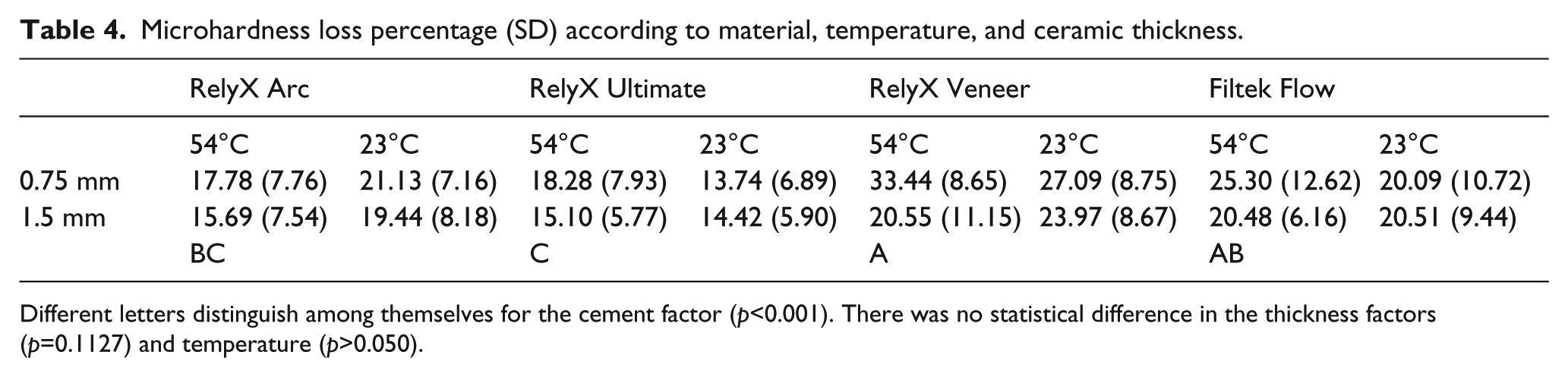
Different letters distinguish among themselves for the cement factor (p<0.001). There was no statistical difference in the thickness factors (p=0.1127) and temperature (p>0.050).
UTS
UTS results are shown in Table 5. Temperature (p=0.088) and ceramic thickness (p>0.05) showed no statistically significant effect on UTS. Comparing the materials, RXA showed the highest UTS values (p<0.001), followed by RXU and FLK, with no significant differences between these two (p>0.05). RXV was statistically similar to the other materials tested.
Ultimate tensile strength (SD) according to material, temperature, and ceramic thickness.
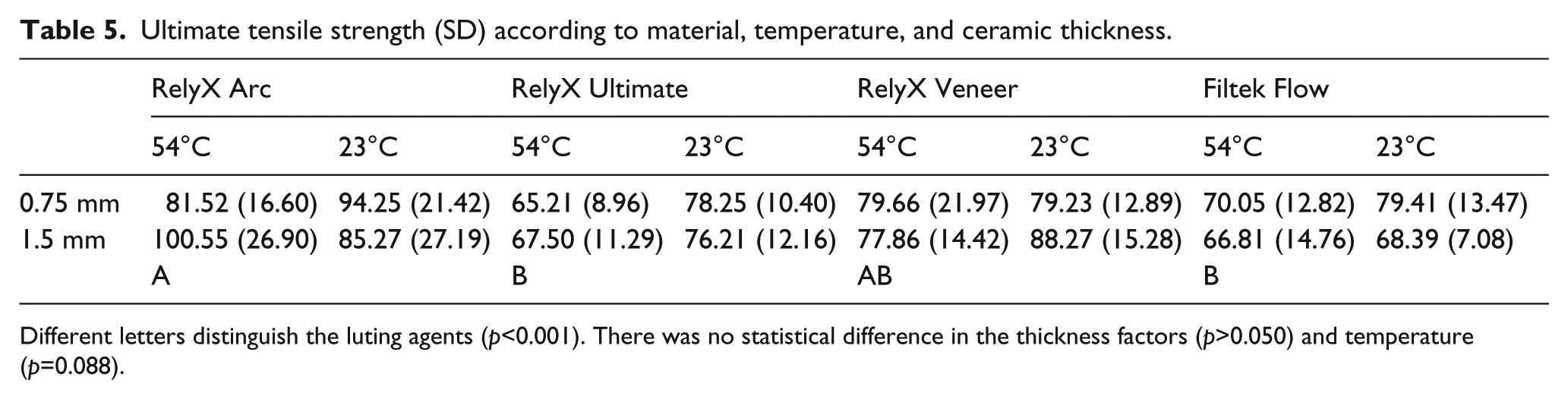
Different letters distinguish the luting agents (p<0.001). There was no statistical difference in the thickness factors (p>0.050) and temperature (p=0.088).
WS
The WS results are shown in Table 6. Ceramic thickness did not affect WS values significantly (p=0.212). Regarding temperature, statistical difference was found (p=0.0229), with higher WS obtained by handling at the lowest temperature (23°C), when compared to 54°C. There was a significant difference (p<0.001) among the materials, where RXV showed the highest WS values, followed by RXA, RXU and FLK. RXU was statistically similar to RXA and FLK.
Water sorption (SD) according to material, temperature, and ceramic thickness.
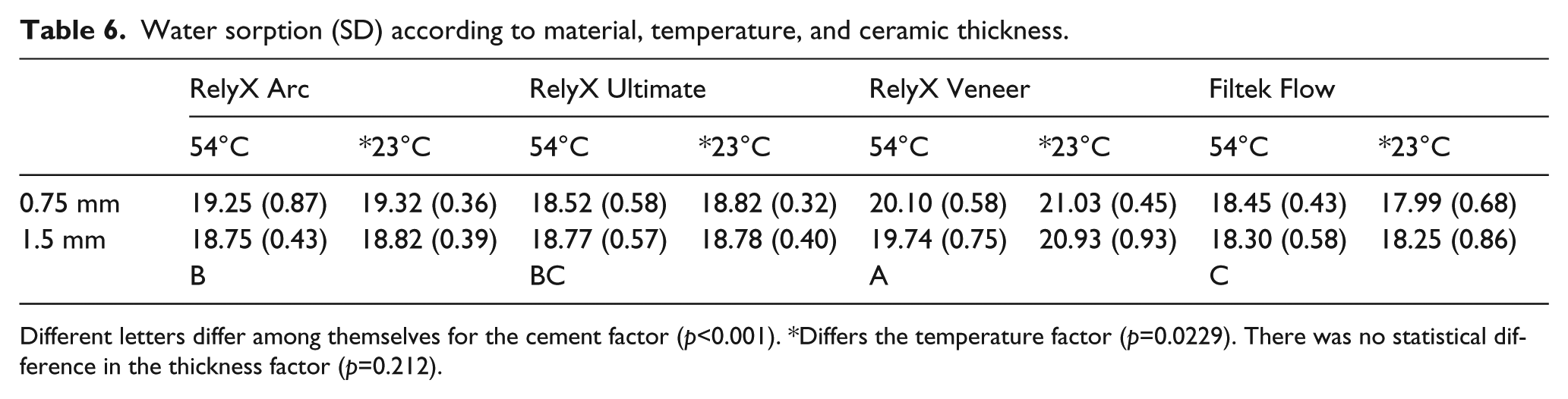
Different letters differ among themselves for the cement factor (p<0.001). *Differs the temperature factor (p=0.0229). There was no statistical difference in the thickness factor (p=0.212).
Solubility
The S results are shown in Table 7. Ceramic thickness did not affect S values (p=0.3019). Regarding temperature conditions, a statistical difference was found (p =0.0257), where the lowest temperature (23°C) yielded higher S when compared to 54°C. There was also a significant difference (p <0.001) when materials were compared. RXV showed the highest S values, followed by RXA, RXU and FLK. RXU and FLK showed no significant differences between them (p >0.05).
Solubility (standard deviation) according to material, temperature, and ceramic thickness.
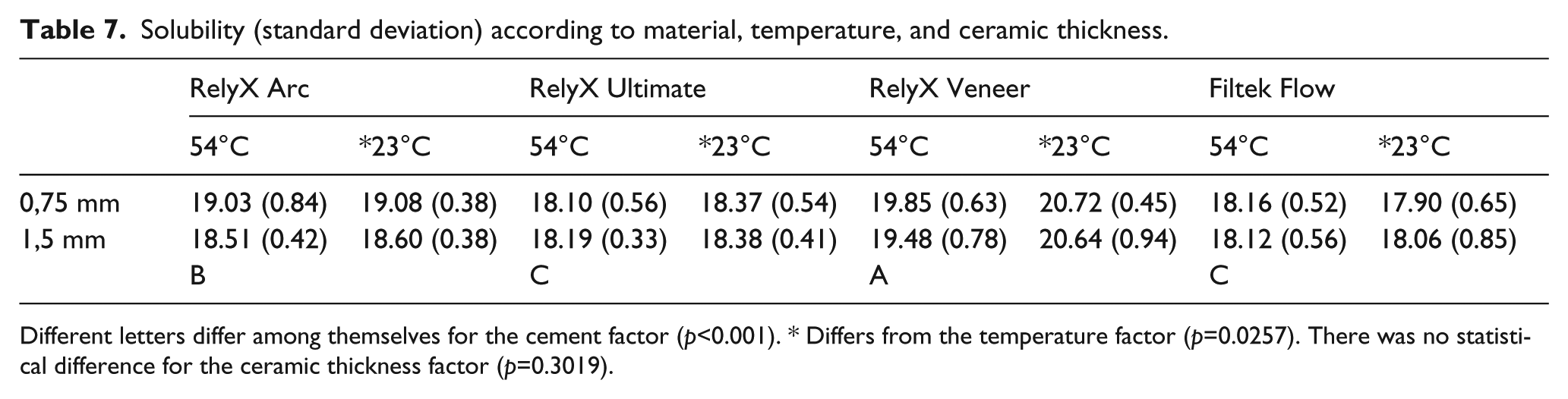
Different letters differ among themselves for the cement factor (p<0.001). * Differs from the temperature factor (p=0.0257). There was no statistical difference for the ceramic thickness factor (p=0.3019).
Discussion
Some studies have recommended the pre-heating of resin-based materials prior to their application.9–15 The energy generated by the material pre-heating increases the collision rate between non-reactive groups and free radicals, which would result in a more complete polymerization reaction.9,10,12 However, the present study found no significant difference in DC, KHN, CLD, and UTS tests when the materials were preheated. These results corroborate previous studies,14,15 which found no influence of heating in monomer conversion, probably due to the rapid drop in temperature during material handling and hand mixing. According to Daronch et al., 13 when a compound is heated to 60°C and removed from the heat source, its temperature drops 50% after 2 min and 90% after 5 min. In this study, after 15 s of hand mixing, the measured temperature of preheated materials had dropped to 29.76°C for RXA, 28.9°C for RXU, 29.25°C for RXV, and 29°C for FLK. Moreover, very small amounts of the material were used for sample preparation, which may have contributed to a rapid return to room temperature.16,17
When considering the WS and S data (Tables 6 and 7), there were significant differences when comparing the temperatures of 23°C and 54°C. In general, WS is correlated to interaction with groups susceptible to hydrolytic degradation, such as ester (OC=O), ether (-O-), and hydroxyl (-OH) present in monomers, to the characteristic three-dimensional polymer network formed, or to penetration through the interfaces present between filler particles and matrix.18,19 The increased temperature probably led to a small increase in CLD of the formed polymer, sufficient to increase its hydrophobic character, however, without significant effect on the other properties tested. Thus, the first hypothesis was partially accepted.
FLK showed lower WS, but was similar to RXU. According to the manufacturer’s specifications, FLK contains the BisEMA monomer, which is less hydrophilic than BisGMA (due to the absence of hydroxyl groups) and establishes weaker hydrogen connections when it interacts with water molecules. 20 RXU, in contrast, according to the manufacturer’s specifications, contains 1,12-dodecanediol dimethacrylate, a monomer diluent with hydrophobic characteristics that can be implicated in the smaller values of WS seen for this material. 20 For RXU and RXA, the WS values could be related to CLD (Table 4), because the groups with the highest cross-link concentration, with a denser three-dimensional network, also had lower WS. 21 In contrast, RXV showed lower CLD and higher WS. Furthermore, a relationship between WS and S values was observed. Greater amounts of water absorbed caused greater amounts of components to leach from the resin cement. 22
Concerning ceramic thickness, there are reports in the literature proposing that the use of indirect restorations less than 2 mm thick does not compromise the DC of dual-curing resin cements.23,24 For the materials with physical polymerization, DC values would be expected to change depending on the dimensions of the ceramic used. However, the lowest thickness used for testing such materials, coupled with high irradiance of light emitted by curing device, would probably resemble the DC of the tested materials in the current study. 25
According to present results, only KHN (Table 3) showed to be significantly influenced by thickness. The photoactivation beneath a ceramic disc that is 0.75 mm thick resulted in higher KHN values when compared to a disc that was 1.5 mm thick. This may be related to the CLD, although no difference was found concerning DC (Table 2). The monomer composition and characteristics of the formed polymer network may have determined the KHN properties of the material.26,27 The reaction rate also affects the characteristics of the polymeric network, because quick photoactivation promotes various growth centers, providing more covalent bonds between different chains. A low polymerization rate for a chemical activation results in fewer growth centers, forming a more linear polymer structure with a decreased KHN. Thus, polymers with similar DC may have different cross-link densities and therefore different KHN. 28 Hence, the second hypothesis was also partially accepted.
Regarding the materials tested in the current study, RXU had a lower DC, but higher KHN and CLD values. One can assume that this material exhibited rapid polymerization because of greater quantities of free radicals and growth centers, resulting in a polymer with greater CLD and greater KHN.28,29 On the other hand, the rapid formation of a cross-linked polymer network may limit the mobility of free radicals and cause a significant concentration of remaining carbon double bonds. 26 Thus, there is the formation of heterogeneity sites from the start of polymerization, resulting in high density polymer zones among unreacted monomers and oligomers (microgels). The resulting polymer has a morphology containing microgels entrapped in polymeric pellets that are connected to other clusters, 28 which might have contributed to a lower DC for RXU.
When considering UTS, RXU had significantly lower values than RXA, and was similar to RXV and FLK, which can be explained by the lower conversion obtained by this material. The sites of the material formed by monomers and oligomers (microgels) are weak points in the structure, which may have started rupturing during traction force, lowering UTS values (Table 5).
RXA showed higher DC, CLD, and UTS values, while presenting intermediate KHN results. Regarding DC, RXA has equal proportions of BisGMA and TEGDMA monomers, improving monomer conversion due to increased mobility of the chain; BisGMA rigidity is offset by TEGDMA flexibility, 30 and the amount of remaining double bonds decreases, giving a higher DC. 31 For UTS, the proportion of BisGMA monomer may had an influence on the good performance of this material, because BisGMA has a high viscosity and molecular weight, besides the bulky aromatic groups in the central region of the molecule, making a more rigid structure.32,33 On the other hand, the KHN of this material was lower when compared to the other dual-curing agent analyzed (RXU), which may be related to structural heterogeneity of the polymer network formed by RXA during polymerization. 29
The light-cured materials, RXV and FLK, in turn had lower KHN; light attenuation by interposition of a ceramic disc negatively affected their physical polymerization. FLK also had worse values of DC, UTS, and CLD. RXV had a superior DC than FLK, due to the fact that this material has an activation system based on camphorquinone+EDMAB+DFI (diphenyliodonium hexafluorophosphate salt), which may have provided a better conversion rate. A possible explanation for the mechanism leading to improved DC in RXV by this activation system is that camphorquinone transforms into an exciplex state, formed with the onium salt, and it receives an electron. The salt then decomposes into phenyliodine and a free phenyl radical. The phenyl radical has the potential to initiate the polymerization reaction of methacrylate monomers. Furthermore, methacrylate radicals that are generated at the onset of polymerization can cleave the carbon-iodine bond of the second product of salt decomposition, phenyliodine, or even salt, thus generating more radicals and promoting polymerization reaction. 34 Hence, incorporation of the onium salt in the photoinitiator system may have yielded higher DC values and intermediate UTS values for RXV when compared to FLK, a physical activation system without DFI. Considering that monomer composition interfered with the physical properties of the tested materials, the third hypothesis was accepted.
The composition of luting agents is an important factor to determine their physical properties. With respect to the physical properties tested, the dual-curing resin cements generally produced better results. However, due to their color change being well described in the literature, it would be interesting to be able to choose cements with physical light curing properties when cementing ceramic veneers.
Conclusion
Within the conditions of this study and according to the presented results, it can be concluded that pre-heating of luting agent at 54°C decreased WS and S of the materials, while ceramic thickness significantly affected only superficial KHN. The physical properties of the materials were dependent on their composition.
Footnotes
Declaration of conflicting interests
The author(s) declared no potential conflicts of interest with respect to the research, authorship, and/or publication of this article.
Funding
The author(s) disclosed receipt of the following financial support for the research, authorship, and/or publication of this article: The authors would like to thank Sao Paulo State Research Foundation (FAPESP: 2013/11304-0) for financial support.