




Abstract
Background:
This in vitro study aimed to evaluate the amount of polymerizing light passing through hybrid ceramic specimens in different shades and thicknesses.
Methods:
Rectangular-shaped feldspathic ceramic computer aided design and computer aided manufacturing (CAD-CAM) blocks and translucent and high translucent polymer infiltrated hybrid ceramic CAD-CAM blocks in four different shades (1M1, 1M2, 2M2, and 3M2) were sectioned in four different thicknesses (0.8, 1.5, 2, and 3 mm), and a total of 48 groups (n = 10) were obtained. Feldspathic ceramic specimens served as the control group. The light transmission of each ceramic specimen was measured three times by using a light-emitting diode and a radiometer. Data were statistically analyzed by using univariate analysis of variance (ANOVA) followed by one-way ANOVA, Tukey honest significant difference, and Tamhane T2 tests (α = 0.05).
Results:
Translucent polymer infiltrated hybrid ceramic specimens exhibited significantly (p < 0.001) lower light transmission values than high translucent polymer infiltrated hybrid ceramic and feldspathic ceramic specimens, whereas feldspathic ceramic specimens exhibited significantly (p < 0.001) higher light transmission than translucent and high translucent polymer infiltrated hybrid ceramic specimens. The amount of light transmission significantly (p < 0.05) decreased when the shade value decreased and the thickness increased.
Conclusions:
Polymer infiltrated hybrid ceramic specimens showed lower light transmission values than feldspathic ceramic specimens, and the amount of light transmission was affected by the ceramic shade and thickness.
Introduction
The use of ceramic restorations has become a common treatment modality in restorative dentistry. 1 One of the key factors that affects the long-term survival of ceramic restorations is the success of resin–ceramic bond strength,2–5 which substantially depends on the degree of resin cement polymerization. 6 The translucence properties of ceramic restorations provide the diffuse transmission of light 7 and, hence, allow the use of dual-cure and light-cure resin cements in cementation of ceramic restorations. 8 A direct relationship exists between the degree of resin cement polymerization and the intensity of light transmission through the ceramic material.9,10 Several factors, including the shade, thickness, and translucency of the restoration, as well as the distance, duration, output power, and type of curing light, affect the intensity of light passing through the ceramic restoration during the cementation process.6,9,11–16 Each factor should be carefully evaluated to provide the optimum resin cement polymerization.
Computer aided design and computer aided manufacturing (CAD-CAM) systems have continuously evolved since the early 1990s. 17 The increasing use of CAD-CAM systems, along with developments in material science, have resulted in the emergence of new restorative materials. 18 Of these, resin-matrix ceramics, which comprise an organic matrix filled with high levels of ceramic particles,19,20 have gained popularity more recently. 21 Resin-matrix ceramics can be subdivided into different categories according to their microstructure and organic content: resin nanoceramics (Lava Ultimate, 3M ESPE, St. Paul, MN, USA) and polymer infiltrated hybrid ceramics (VITA Enamic, VITA Zahnfabrik, Bad Säckingen, Germany).19,20,22 These new chairside CAD-CAM blocks are more resilient than conventional ceramics; thus, they can be quickly and easily contoured and polished. 23
Polymer infiltrated hybrid ceramics consist of a feldspathic ceramic network (86% by weight) and a methacrylate polymer (14% by weight) network.23,24 The continuous interpenetration of these two networks offers various advantages, such as reduced brittleness and hardness, improved flexibility and fracture toughness, and ease in machinability. 25 Several studies have evaluated the optical properties of polymer infiltrated hybrid ceramic blocks26–31; however, only a few have focused on the light transmission.26,27
The aim of this study was to evaluate the light transmission of high translucent and translucent polymer infiltrated hybrid ceramics in four different shades and thicknesses by comparison with feldspathic ceramics. The null hypothesis was that no significant differences would be found in light transmission values between the feldspathic and polymer infiltrated hybrid ceramics, regardless of the ceramic shade and thickness.
Materials and methods
A flowchart that summarizes the methodology of the present study is shown in Figure 1. Feldspathic ceramic blocks (Cerec Blocs, Sirona Dental Systems, Bensheim, Germany) in S2-T, S2-M, S3-M, and S4-M shades and high translucent and translucent polymer infiltrated hybrid ceramic blocks (VITA Enamic, VITA Zahnfabrik, Bad Säckingen, Germany) in 1M1, 1M2, 2M2, and 3M2 shades were embedded into acrylic resin (Paladent, Heraeus Kulzer GmbH, Hanau, Germany), and then all ceramic blocks (12 mm × 14 mm × 18 mm in size) in each shade were sectioned into rectangular-shaped specimens in thicknesses of 0.8, 1.5, 2, and 3 mm. The sectioning process was conducted by using a precision cutter (IsoMet 1000, Buehler, Lake Bluff, IL, USA) under water cooling at a speed of 300 rpm, and 48 groups were obtained (n = 10 in each group). Following the sectioning process, all ceramic specimens were polished with 600, 800, 1000, and 1200 grits of silicon carbide abrasive papers (English Abrasives, English Abrasives & Chemicals Ltd, London, UK), ultrasonically cleaned in distilled water for 5 min, and then evaluated with a digital caliper (ABSOLUTE Digimatic Caliper Series 551, Mitutoyo, Tokyo, Japan) for the required final thickness (±0.1 mm).
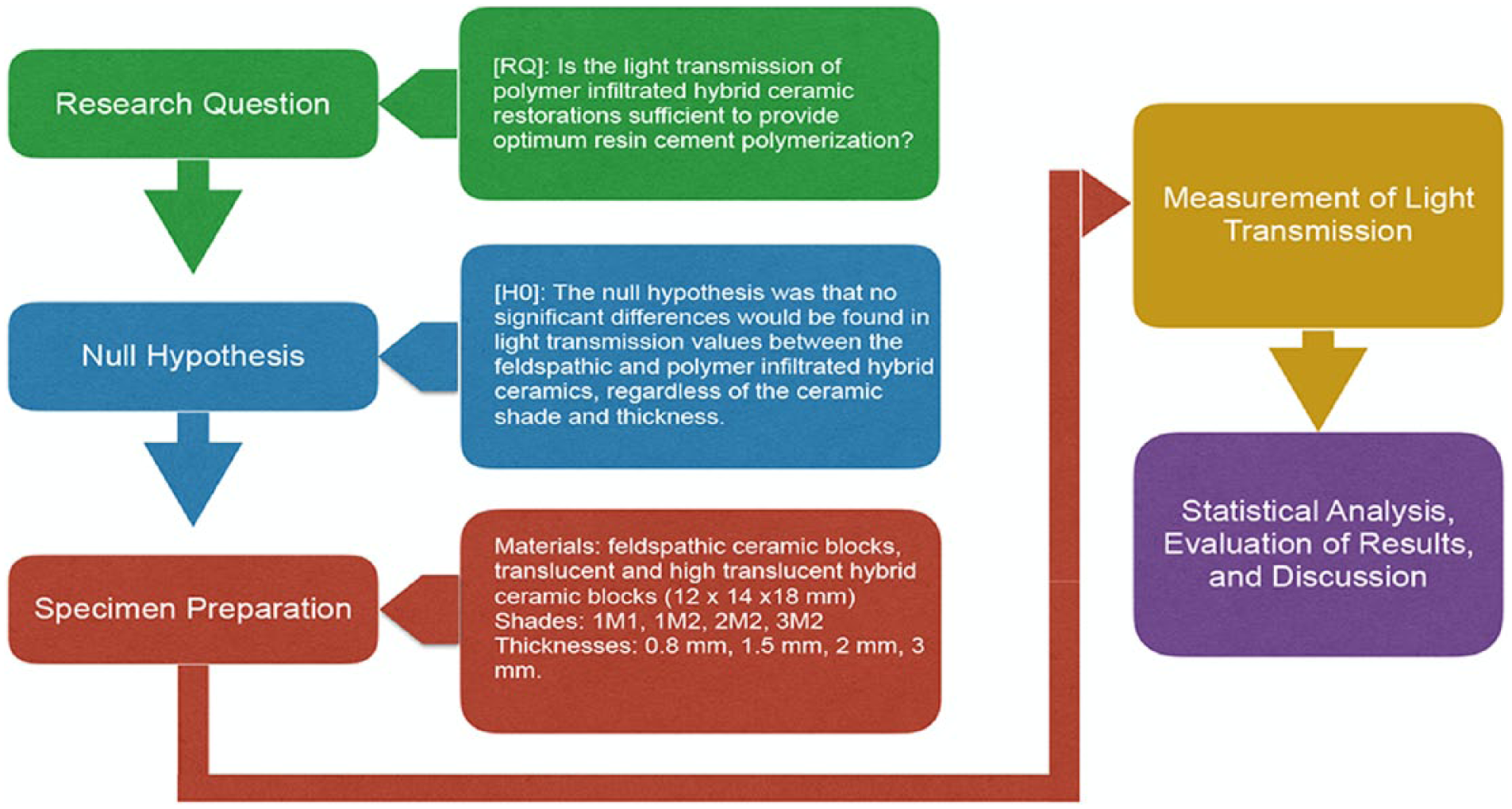
Flowchart of the study.
The light transmission of each ceramic specimen was measured three times by using a light-emitting diode (LED; LED.F, Woodpecker Inc., Guanxi, China; output power: 1600–1800 mW/cm2; wavelength: 420–480 nm) and an external radiometer (LED Radiometer, SDI Limited, Bayswater, Victoria, Australia). A silicon impression mold that blocked the light infiltration was prepared. Each ceramic specimen was placed on the radiometer’s optic eye, and the light probe (8 mm in diameter) was positioned perpendicularly to the specimen and then irradiated for 5 s (Figure 2). The average value of three measurements was considered as the mean light transmission value (mW/cm2) of each specimen. S2-T, S2-M, S3-M, and S4-M shades of feldspathic ceramics were converted to 1M1, 1M2, 2M2, and 3M2 shades, respectively, by using the shade conversion scale specified in the manufacturer’s instructions. Data were statistically analyzed (IBM SPSS Statistics V21.0, IBM Corporation, Armonk, NY, USA) by using univariate analysis of variance (ANOVA) followed by one-way ANOVA tests, Tukey honest significant difference (HSD) tests, and Tamhane T2 tests, and the significance level was set at 0.05.
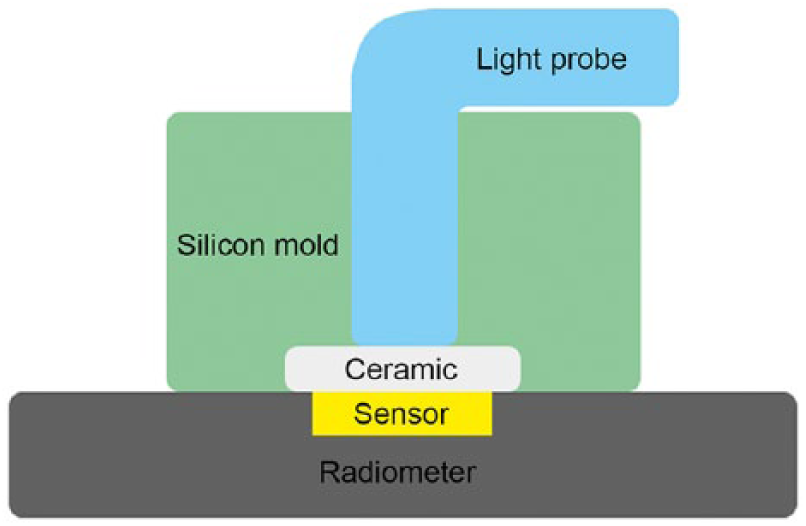
Diagrammatic presentation of the measurement method.
Results
The univariate variance analysis (Table 1) showed significant differences among ceramic shades, ceramic thicknesses, and ceramic materials (p < 0.001). In each material group, one-way ANOVA test results showed significant differences (p < 0.001) among the ceramic shade groups in the same thickness, and among the ceramic thickness groups in the same shade. One-way ANOVA results also showed significant differences (p < 0.001) among the ceramic materials in the same shade and thickness. Within the same shades and thicknesses, translucent polymer infiltrated hybrid ceramic specimens exhibited significantly (p < 0.001) lower light transmission values than high translucent polymer infiltrated hybrid ceramic and feldspathic ceramic specimens, whereas feldspathic ceramic specimens exhibited significantly (p < 0.001) higher light transmission than translucent and high translucent polymer infiltrated hybrid ceramic specimens. The amount of light transmission constantly decreased when the ceramic thickness increased. In each material group, all thickness groups in the same shade were significantly different (p < 0.001) from each other. Moreover, the amount of light transmission decreased when the shade value decreased. Within the same materials and thicknesses, 1M1 shade groups exhibited the highest light transmission values, whereas 3M2 shade groups exhibited the lowest light transmission values. Mean light transmission values, standard deviations, and the results of multiple comparisons are listed in Table 2.
Results of univariate variance analysis.
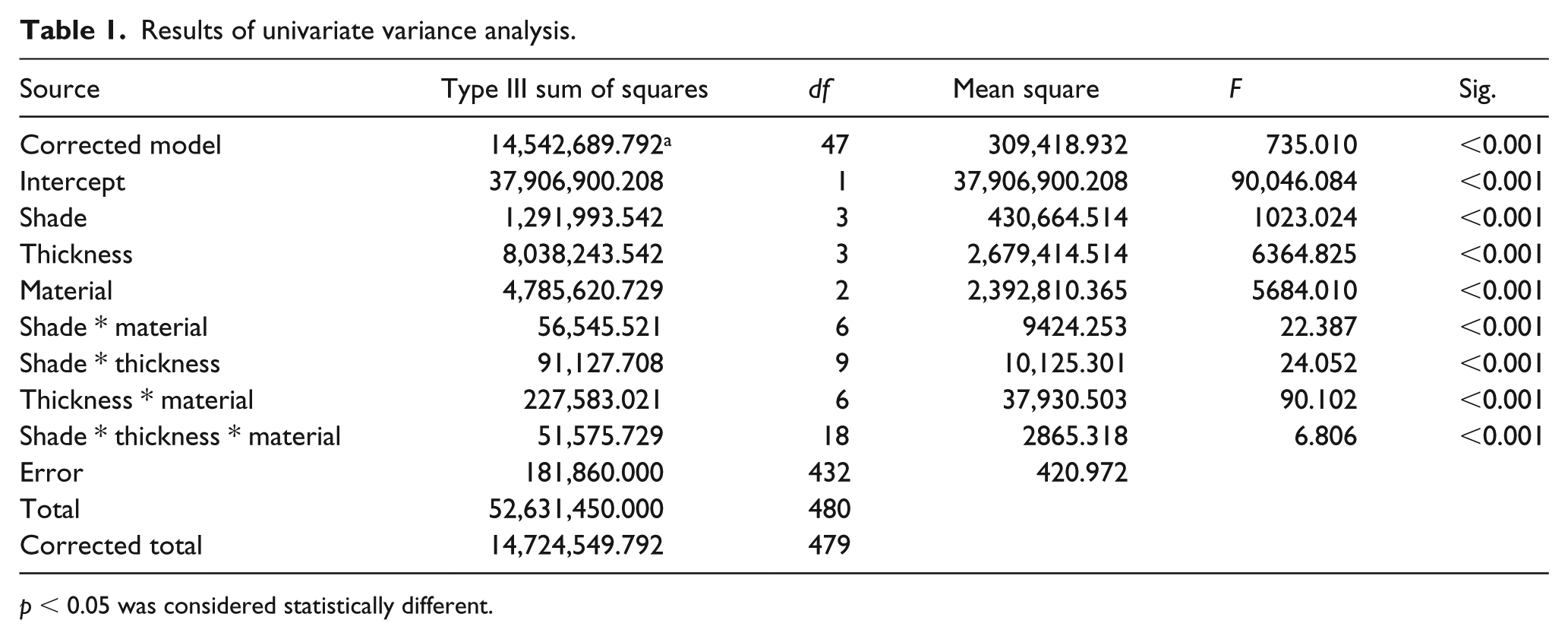
p < 0.05 was considered statistically different.
Mean and standard deviation (SD) of transmitted light values (mW/cm2) with statistical summaries.
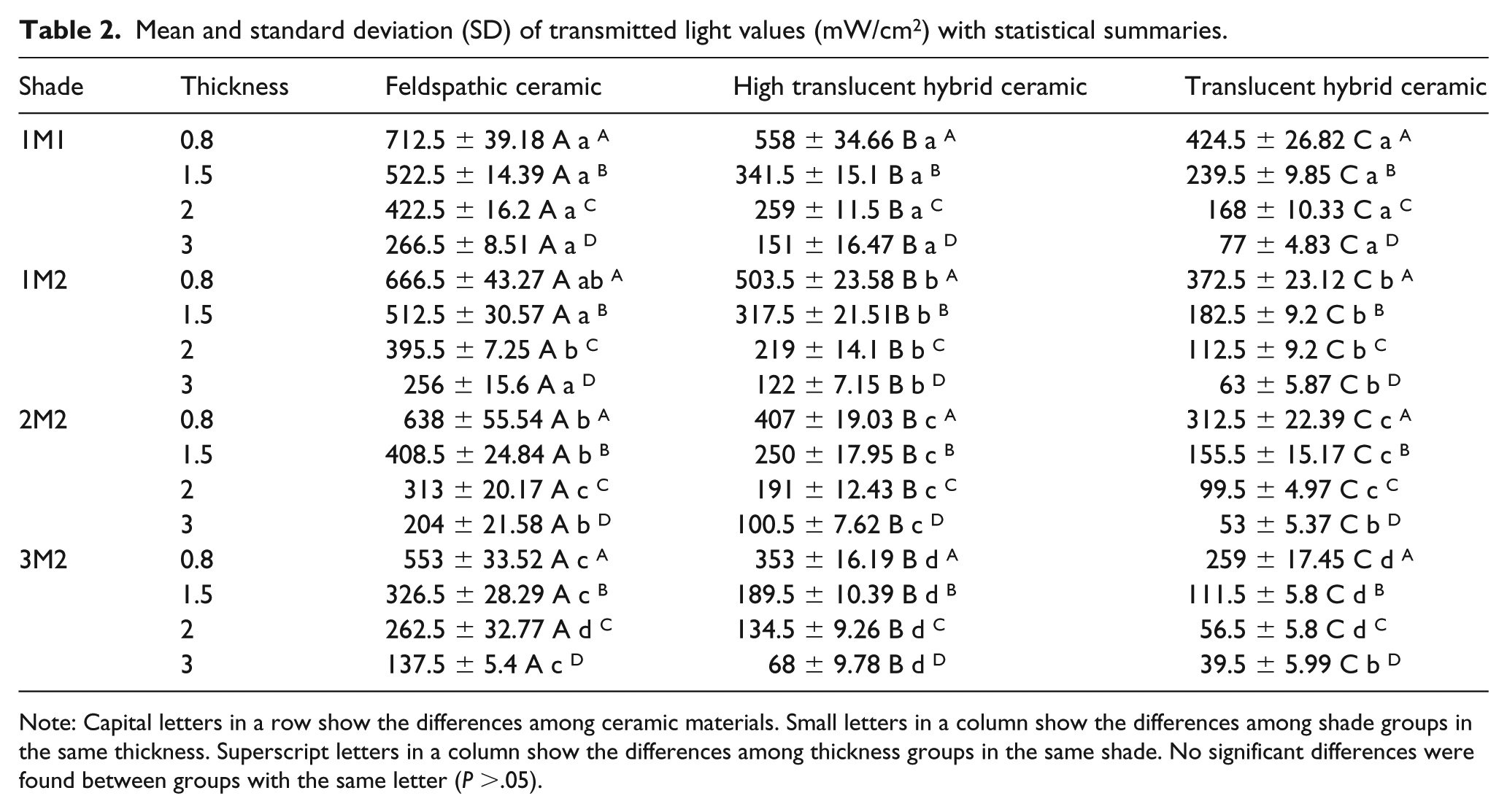
Note: Capital letters in a row show the differences among ceramic materials. Small letters in a column show the differences among shade groups in the same thickness. Superscript letters in a column show the differences among thickness groups in the same shade. No significant differences were found between groups with the same letter (P >.05).
Discussion
The degree of resin cement polymerization plays a significant role in the clinical longevity of ceramic restorations, 6 and is directly related to the intensity of light transmission, which is affected by several factors, including the shade and thickness of the restoration and the type of curing light.6,9,11 Recently introduced polymer infiltrated hybrid ceramics exhibit a high level of mechanical performance and optimum physical properties. 25 However, few studies evaluated the light transmission of these materials.26,27 Stawarczyk et al. 26 evaluated the light transmittance of monolithic CAD-CAM materials and concluded that polymer infiltrated hybrid ceramics had the lowest transmitted irradiance. Material-specific recommendations are required for optimum resin cement polymerization. 10 Therefore, this study evaluated the light transmission of high translucent and translucent polymer infiltrated hybrid ceramics in four different shades and thicknesses, and the null hypothesis was rejected in the direction of the obtained results.
As stated previously, the thickness of ceramic restoration is an important factor affecting the light intensity,6,9 which is recommended as 300 mW/cm2. 12 The minimum thickness in incisal edges and functional occlusal cusps should be 1.5 mm to ensure the clinical longevity of restorations. 22 In this study, most of the polymer infiltrated hybrid ceramic specimens, which had a thickness of 1.5, 2, and 3 mm, showed a light transmission value <300 mW/cm2, and this result was in accordance with the results of previous studies.26,27 Stawarczyk et al. 26 found that the intensity of light transmission significantly decreased by increasing the thickness of ceramic specimens from 1 to 2 mm. Egilmez et al. 27 evaluated the light transmission of resin nanoceramics and polymer infiltrated hybrid ceramics and realized similar findings. However, the maximum thickness of ceramic specimens was 2 mm in those studies. This study also evaluated the light transmission at the thickness of 3 mm in a large shade range and revealed that the intensity of light was at a very low level. Cardash et al. 4 evaluated the effect of porcelain color on the hardness of resin cement and recommended the use of dual-cure resin cements for ceramic restorations, which had a thickness of 2 mm or more. Therefore, dual-cure resin cements along with powerful light curing units can be recommended in the cementation of thick restorations, such as inlay, onlay, and endocrown.
Translucency and light transmission are interdependent factors7,26 that are affected by the crystalline structure, grain size, and pigments within the structure. 5 If most of the light is diffusely transmitted and only a part is scattered, the material can be considered as translucent. 7 In the present study, high translucent polymer infiltrated hybrid ceramics exhibited higher light transmission values than translucent ones, as expected. On the other hand, both hybrid ceramics presented lower light transmission values than feldspathic ceramics. Similarly, Stawarczyk et al. 26 obtained the highest light transmission values from resin nanoceramics along with feldspathic ceramics and the lowest light transmission values from polymer infiltrated hybrid ceramics. Different types of resin-matrix ceramics may exhibit different optical properties and hence show different results. 27 As mentioned previously, polymer infiltrated hybrid ceramics, also known as polymer infiltrated ceramic networks, have a high level of ceramic content, and the polymer part constitutes 14% of the whole structure by weight.23,24 The organic polymer part contains tetraethyleneglycol dimethacrylate (TEGDMA) and urethane dimethacrylate (UDMA) monomers. 26 The low transmitted irradiance of this material may be associated with the density and grain size of the ceramic matrix, 26 and the interpenetrating network of organic and inorganic contents. 27
The results of this study also showed that the intensity of light transmission significantly decreased as the shade value decreased. Similar results were found to those of previous studies.4,13,14 Peixoto et al. 13 reported that darker ceramic shades transmitted less light than lighter ceramic shades. Passos et al. 14 also found a significant decrease in the degree of conversion of dual-cure resin cement as the chroma saturation increased. As is known, ceramic materials contain some pigments, and these are capable of absorbing some transmitted light.14–16 The amount of light absorption is believed to increase in darker ceramic shades.
In addition, spectrophotometric analysis is a common method for evaluating the light transmission of ceramic materials, even though the edge loss effect may occur and lead to errors in measurement. 32 In this study, the intensity of light transmission was measured by means of a radiometer covered by a silicone impression mold, which was used to block light infiltration. 11 In this way, no shadow occurred on the ceramic specimens and, thus, the reliability of measurements was promoted.
In the present study, a glaze firing was not conducted for feldspathic ceramic specimens, and all specimens were only mechanically polished due to their different glaze protocols. Only one type of resin-matrix ceramic material was evaluated, and the intensity of light transmission was measured in flat specimens. Moreover, the degree of resin cement polymerization was not evaluated. Other types of resin-matrix ceramics and natural ceramic restorations may show different results, and evaluation of the resin cement polymerization may provide more information.
Conclusions
Within the limitations of this study, the following conclusions were made:
polymer infiltrated hybrid ceramics exhibited lower light transmission values than feldspathic ceramics;
the intensity of light transmission decreased when the shade value decreased, and the thickness increased.
Footnotes
Declaration of conflicting interests
The author(s) declared no potential conflicts of interest with respect to the research, authorship, and/or publication of this article.
Funding
The author(s) disclosed receipt of the following financial support for the research, authorship, and/or publication of this article: This work was supported by the Scientific and Technological Research Council of Turkey (grant number of 114S763) and by Ondokuz Mayıs Scientific Research Coordination (Grant No.1905.14.001).