




Abstract
Objective:
In order to optimize the properties of dental zirconia, the sintering process involves firing zirconia to elevated temperatures for an extended time that can take several hours. The aim of this study is to investigate the effect of firing temperature and firing duration on the hardness of dental zirconia to indicate the optimum sintering conditions.
Methods:
Thirty-six zirconia specimens in shape of bars were randomly assigned to nine groups. The zirconia specimen groups were sintered using a sintering furnace with different firing temperatures (900°C, 1200°C, and 1800°C) and firing durations (6, 9, and 12 h). A total of 108 hardness measurements were conducted for all specimens (12 hardness readings per group). For each of the specimen groups, micro Vickers hardness test was performed using a load of 1 Kgf (9.807 N) and the Vickers hardness number was computed. Statistical analysis using Kruskal-Wallis test was conducted to examine the significant differences on Vickers hardness number HV among the specimen groups according to the firing parameters with 0.005 p-value used as an indicator.
Results:
Results suggest that there is an association between the increase in the hardness number and the increase in firing duration at a given firing temperature. The results also indicate that there is an association between the increase in the hardness number and increase in firing temperature at a given firing duration.
Conclusions:
The greatest rate of hardness increase with time is associated with groups of firing temperature 1200°C. The highest rate of hardness increase with temperature happened during the first 6 h of sintering process. On the other hand, there is no significant increase in the hardness number when increasing the firing temperature beyond 1200°C.
Keywords
Introduction
Biocompatibility, excellent mechanical properties, and durability have always been essential requirements for dental crowns and bridges. 1 The introduction of zirconia-based ceramics as restorative dental materials has generated considerable interest in the dental community because the superior mechanical properties of zirconia 2 and high survival rates for Zr crowns range from 89% to 100% with a mean follow-up time of 3.7 years. 3
The sintering process provides the energy to stimulate the individual powder particles to bond together to remove the porosity present from the compaction stages. This process involves heating zirconia, which usually contains 3%–5% yttria (Y2O3) as a stabilizer, at elevated temperatures in order to optimize the properties of zirconia for attaining the desired mechanical properties.2,4,5 Even though modern sintering technology has reduced clinical operation times significantly, the zirconia sintering procedure still takes several hours. 4
The basic definition of hardness is the resistance a material exhibits to permanent scratches which take place in the form of localized plastic deformations.6,7 High hardness is a vital requirement for materials used for dental prostheses to eliminate surface scratches and ensure wear resistance. 8 The mechanical properties of zirconia strongly depend on its grain size according to the concept of grain-boundary strengthening or Hall–Petch strengthening principle.2,9 Hall-Petch demonstrated that the strength increases with the inverse square root of grain size in polycrystalline materials and ceramics. 10
This is explained by the fact that decreasing the grain size will impede the mobility of dislocations and dislocation generation within the crystal structure of the material. This results in an increase in the material resistance to plastic deformation, that is, an increase in the material yield strength. 6 Extensive research has been carried out on studying the effect of the sintering process on the strength properties of zirconia4,11–19; however, researchers have not treated the hardness of zirconia in much detail and the hardness property in relation to the sintering process was given less attention. Since hardness is the material resistance to localized plastic deformation, it is assumed that achieving suitable hardness of dental zirconia depends on the sintering procedure to produce the required grain size.
The aim of this study was to indicate the optimum sintering conditions by investigating the influence of firing temperature and firing duration on the hardness of dental zirconia.
Materials and methods
Materials
The experiments in this research study were conducted using Zirconium Oxide Dental Blanks StarCeram Z-Nature (H. C. Starck GmbH, Germany). The composition and properties of this material according to the manufacturer datasheet are listed in Table 1.
The composition and properties of StarCeram Z-Nature (H. C. Starck GmbH).

Sample preparation
Thirty-six zirconia specimens in the shape of bars were cut from the dental blank in dimensions of 28 ± 0.2 mm length 1.6 ± 0.2 mm width, and 0.35 ± 0.2 mm thickness measured by means of a digital caliper with an accuracy of ±0.01 mm. The obtained 36 specimens were randomly assigned to nine groups of four specimens each.
Experimental parameters
All zirconia specimen groups were sintered using zirconia sintering furnace SiNTRA (ShenPaz Dental LTD) with heating rate 10 deg/min with different firing temperatures and duration as shown in Table 2. After sintering, each group of specimens was tested for hardness.
Experimental parameters: firing temperatures and duration with heating rate 10 deg/min.

Hardness test
After sintering, the surface of the samples was cleaned and polished (without using any chemicals) and prepared for micro indentations hardness testing. Hardness test was performed in the Material Engineering Laboratory (Al-Quds University) using micro Vickers hardness tester 404SXV with Dual Indenter (Jinan Precision Testing Equipment Co., Ltd) using a load of 1 Kgf (9.807 N). Vickers hardness number (HV) was calculated from the load divided by the surface area of the indentation. The Vickers hardness number is computed using the following equation:

Where P is the applied load in (kgf), d is the average length of the diagonal in (mm).
The Vickers hardness in Giga-Pascal and be calculated:

Results
Statistical analysis
Test for the normality of data was conducted using Kolmogorov-Smirnov test. The Kolmogorov-Smirnov test indicates that the HV results do not follow a normal distribution [D(108) = 0.25, P < 0.001]. Based on the results of Kolmogorov-Smirnov test, one-way non-parametric ANOVA statistical analysis using Kruskal–Wallis test was used to determine the statistically significant differences between the specimen groups having different sintering parameters. The null hypothesis of the Kruskal–Wallis test is that the mean ranks of the groups are the same. To test the null hypothesis, the p-value is used. If the p-value < 0.05 the null hypothesis is rejected indicating statistically significant differences. If p-value > 0.05 the null hypothesis is accepted and the differences are not statistically significant. This analysis was performed using IBM® SPSS® 23 statistical software.
Hardness test
Table 3 and Figure 1 summarize the findings of the Vickers hardness number for all specimen groups. There were differences in HV values reported for each experimental group. Evidence of significant differences have been found on Vickers hardness number between all specimen groups using Kruskal-Wallis test statistical analysis (χ2 = 26.342, p = 0.001). The minimum HV value was 14.80 ± 0.10 [GPa] for Group1 with firing temperature and duration were 900°C for 6 h. On the other hand, the maximum HV value was 24.89 ± 0.28 [GPa] for Group9 with firing temperature and duration of 1800°C for 12 h. Interestingly, there was no evidence for significant differences on Vickers hardness number between specimen groups (6, 7, 8, 9) using Kruskal-Wallis test statistical analysis (χ2 = 5.401, p = 0.067 > 0.05). This result indicates that there is no significant increase in the hardness number when increasing the firing temperature beyond 1200°C.
Vickers hardness number HV for all specimen groups.


Vickers hardness number HV for all specimen groups.
Effect of firing duration on hardness values
To investigate the effect of firing duration in hours, the results of Vickers hardness number HV as a function of firing duration are reported and plotted at different firing temperatures (900°C, 1200°C, and 1800°C) as shown in (Figure 2).

Vickers hardness number HV for different firing temperatures.
Statistical analysis using Kruskal-Wallis test was conducted to examine the significant differences on Vickers hardness number HV as a function of firing durations. It is apparent from the results shown in Figure 2 that the specimen groups with firing temperature 900°C had a significant increase in the Vickers hardness number when increasing the firing duration (χ2 = 7.261, p = 0.027). The same behaviors can be also seen for specimen groups with firing temperature 1200°C and 1800°C which had a significant increase in the Vickers hardness number when increasing firing duration with statistical values (χ2 = 7.200, p = 0.027), (χ2 = 8.018, p = 0.018 ) respectively. These results suggest that there is an association between the increases in the hardness number when increasing the firing duration at a given firing temperature.
Effect of firing temperature on hardness values
The next section of the results was concerned with the effect of firing temperature on the Vickers hardness number HV. Results shown in Figure 3 present the analysis of hardness number as function of firing temperature at different firing durations (6, 9,and 12 h).

Vickers hardness number HV for different firing durations.
Kruskal-Wallis test was conducted to examine the significant differences on Vickers hardness number HV as a function of firing temperature. In Figure 3, there is a clear trend of increase in the Vickers hardness number when increasing the firing temperature. The specimen groups with firing durations of 6 h had a significant increase in the Vickers hardness number when increasing the firing temperature (χ2 = 8.067, p = 0.018). The same behaviors can be also seen for specimen groups with firing durations of 9 h and 12 h which had a significant increase in the Vickers hardness number when increasing firing temperature with statistical values (χ2 = 7.200, p = 0.027), (χ2 = 6.489, p = 0.039) respectively. These results indicate that there is an association between the increases in the hardness number when increasing the firing temperature at a given firing duration.
Discussion
The behavior of Zirconia biomaterial at different sintering conditions has been investigated by many research studies such as.20–22 In many cases the focus point was to explain Zirconia microstructure and grain size in relation to sintering conditions. In such studies, SEM is an essential visual tool for investigation where Zirconia grain size showed a correlation to the sintering temperature and duration as shown in Figure 4.20,21 On the other hand, applied research studies focused on the performance of Zirconia and mechanical properties in relation to sintering conditions. Such applied studies gave less attention to SEM and imaging tools and relied more on the quantitative analysis of the measured Zirconia properties at different sintering conditions. 22
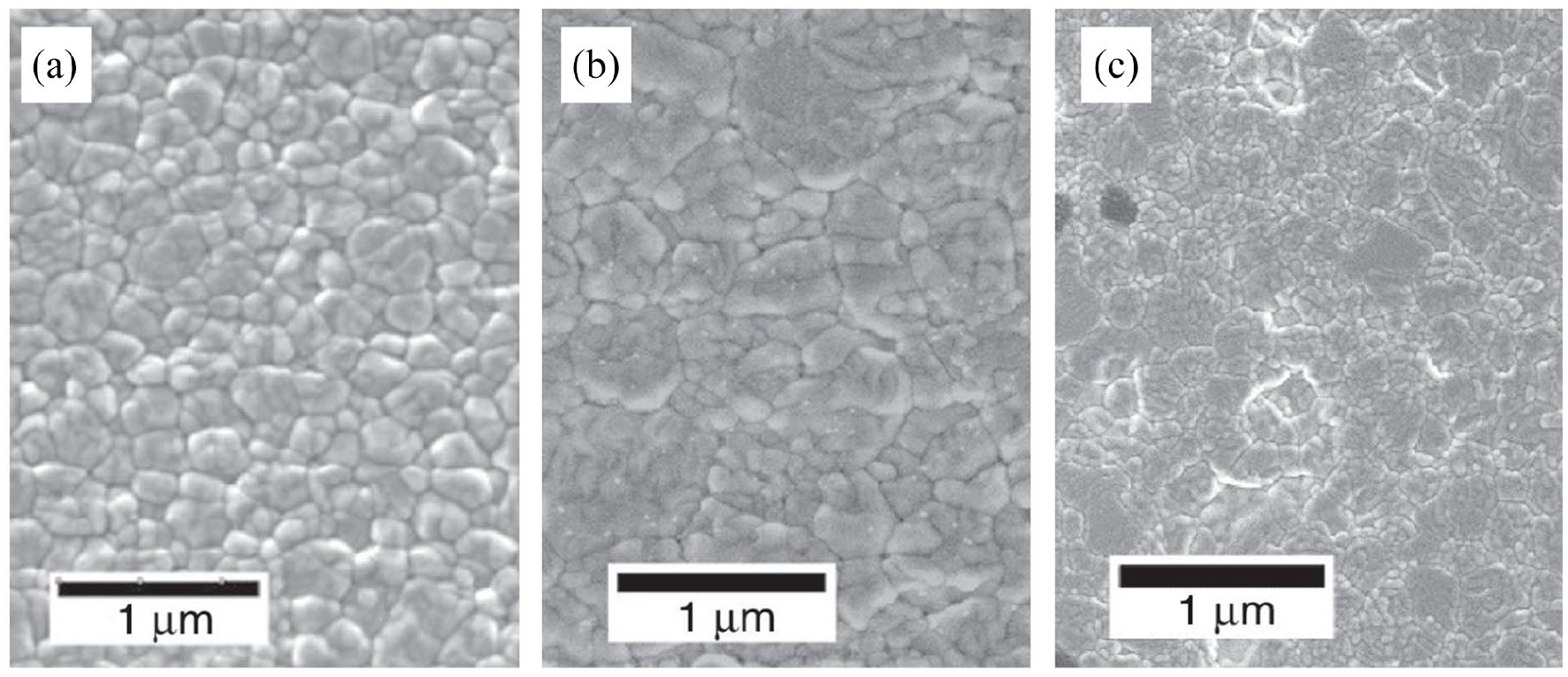
SEM picture of zirconia showing different grain sizes sintered at different temperatures as reported by Amat et.al (2019). (a)1400oC. (b)1500oC. (c)1600oC.
Vickers hardness for zirconia was reported for different sintering scenarios with different firing durations and firing temperatures. The hardness ranged from 14.80 ± 0.10 GPa to 24.89 ± 0.28 GPa. These values seem to be consistent with findings of previous studies found in the literature; however, most of these published values were reported without describing the details of the sintering parameters and firing conditions.13,16,17,23,24
Hardness as a function firing duration at a given firing temperature
From the data in Figure 2, we can see there was a significant positive correlation between the hardness number and the firing duration at a given firing temperature. The longer sintering duration increased density of the sintered compacts and reduced the grain sizes which did contribute significantly to increase in hardness. 25 The rate of hardness increase with time is defined as:

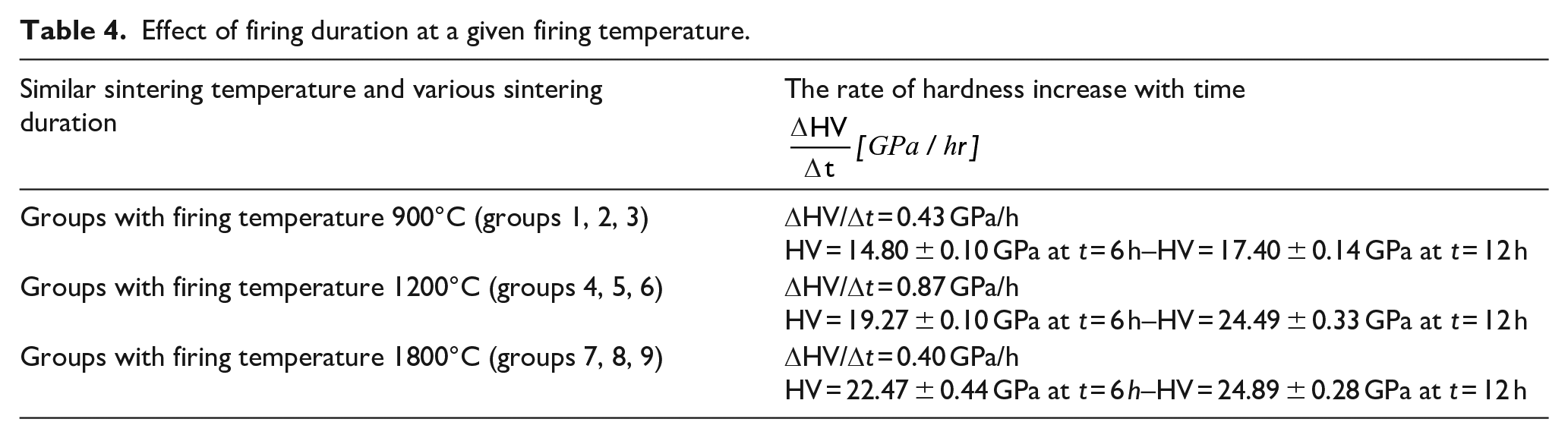
The specimen groups with firing temperature 900°C (groups 1, 2, 3) had a significant increase in the Vickers hardness number when increasing the firing duration from a mean hardness number HV of 14.80 ± 0.10 GPa at t = 6 h–17.40 ± 0.14 GPa at t = 12 h with a rate of hardness increase ΔHV/Δt = 0.43 GPa/h. The positive correlation between the hardness number and the firing duration is also apparent at specimen groups with firing temperature 1200°C, 1800°C.
In the case of specimen groups (4, 5, 6) with firing temperature 1200°C, the mean hardness number HV increased from 19.27 ± 0.10 GPa at t = 6 h to 24.49 ± 0.33 GPa at t = 12 h with a rate of hardness increase ΔHV/Δt = 0.87 GPa/h.
For the specimen groups (7, 8, 9) with firing temperature 1800°C the mean hardness number HV increased from 22.47 ± 0.44 GPa at t = 6 h to 24.89 ± 0.28 GPa at t = 12 h with a rate of hardness increase ΔHV/Δt = 0.40 GPa/h. From these results in Table 4, it can be seen that by far the greatest rate of hardness increase with time is associated with groups with firing temperature 1200°C.
Effect of firing duration at a given firing temperature.
Hardness number as a function firing temperature at a given firing duration
Significant positive correlation between the hardness number and the firing temperature at a given firing duration is confirmed by analyzing the data in Figure 3. This finding is explained by the fact that the microstructure of sintered ceramic is affected by higher sintering temperature that creates a more densified material with smaller grain size which significantly increases the hardness. 26 The rate of hardness increase with temperature is defined as:

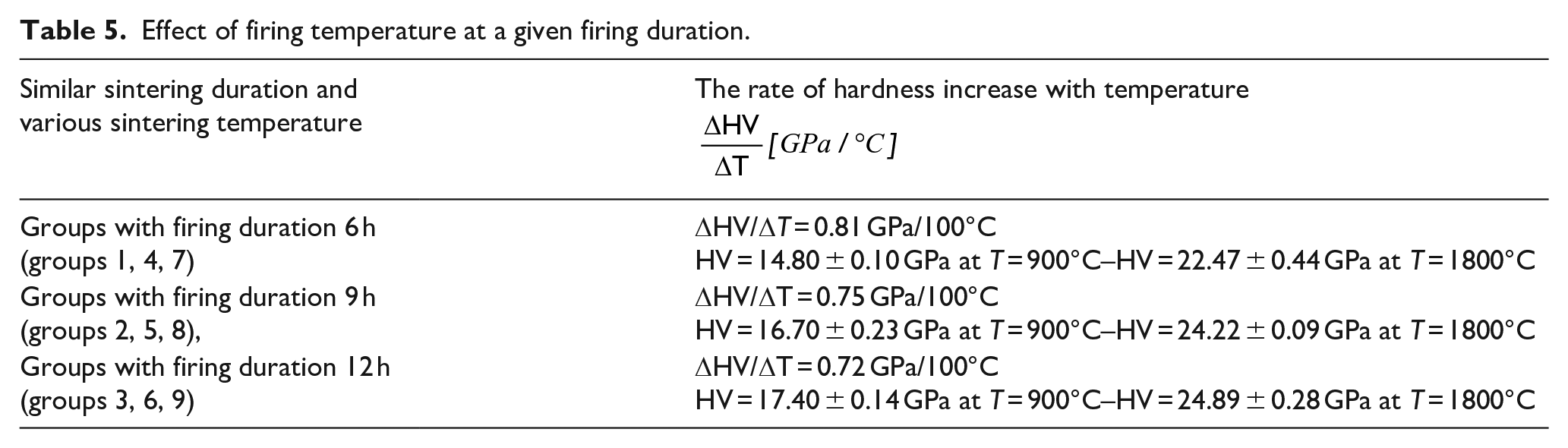
The specimen groups with firing duration 6 h (groups 1, 4, 7) had a significant increase in the Vickers hardness number when increasing the firing temperature from 900°C to 1800°C resulting in an increase in the mean hardness number HV from14.80 ± 0.10 GPa at T = 900°C–22.47 ± 0.44 GPa at T = 1800°C with a rate of hardness increase ΔHV/ΔT = 0.81 GPa/100°C.
Correspondingly, the positive correlation between the hardness number and the firing temperature is also apparent at specimen groups with firing temperature 9 h and 12 h.
In the case of specimen groups with firing duration 9 h (groups 2, 5, 8), the mean hardness number HV increased from 16.70 ± 0.23 GPa at T = 900°C to 24.22 ± 0.09 GPa at T = 1800°C with a rate of hardness increase ΔHV/ΔT = 0.75 GPa/100°C. Similarly, in the specimen groups with firing duration 12 h (groups 3, 6, 9) the mean hardness number HV increased from 17.40 ± 0.14 GPa at T = 900°C to 24.89 ± 0.28 GPa at T = 1800°C with a rate of hardness increase ΔHV/ΔT = 0.72 GPa/100°C. From these results in Table 5, it can be seen that greatest rate of hardness increase with temperature happened during the first 6 h of sintering process.
Effect of firing temperature at a given firing duration.
Conclusions
This study was conducted to indicate the optimum sintering conditions by investigating the influence of firing temperature and firing duration on the hardness of dental zirconia. This study has shown there is a significant positive correlation between the hardness number and the firing duration at a given firing temperature. Also, Significant positive correlation between the hardness number and the firing temperature at a given firing duration. Based on findings of this study, it can be concluded that the greatest rate of hardness increase with time is associated with groups of firing temperature 1200°C and that highest rate of hardness increase with temperature happened during the first 6 h of sintering process. On the other hand, there is no significant increase in the hardness number when increasing the firing temperature beyond 1200°C.
These results can explained by the fact that at a given firing temperature, increasing the firing duration increases the density of the sintered zirconia and reduces the grain sizes, which contributes significantly to increase in hardness. It has also shown that at a given firing duration, increasing the firing temperature affects the microstructure of sintered zirconia, which creates a more densified material with smaller grain size, thus, significantly increasing the hardness. Overall, our results demonstrate that the Hardness follows the Hall–Petch dependence with the grain size, and the hardness of dental zirconia depends on the firing temperature and firing duration.
Footnotes
Declaration of conflicting interests
The author(s) declared no potential conflicts of interest with respect to the research, authorship, and/or publication of this article.
Funding
The author(s) received no financial support for the research, authorship, and/or publication of this article.
