



Abstract
In the age of higher education globalization and marketization, regional development of higher education in China diversifies as a result of the processes of decentralization both localize and stratify the Chinese institutions. The higher education sector in Shenzhen has developed rapidly over the last four decades and it is now home to a number of leading universities and colleges as an emerging education hub in South China. This paper aims to understand the local process in Shenzhen, through a case study of its higher education sector, drawing on interviews with city policymakers and university managers as well as other extent literature and materials. By dividing the process into three different phases, this paper begins by providing a periodized description of the higher education development in the city. Then, it summarizes Shenzhen’s experience in promoting its higher education through negotiating with and navigating within the existing policy framework. Finally, it concludes by discussing a potential ‘Shenzhen model’ of higher education development and providing further information for international scholars to better understand the higher education development in the city context of China.
Introduction
With the global rise of China’s higher education (HE), increasing academic attention is being paid to the Chinese HE sector and the effects of the HE restructuring from the 1990s onwards (Mok, 2005; Ngok & Kwong, 2003). In particular, in the last decade there has emerged a large body of literature about the globalizing trajectory of Chinese HE. The discussions have focused on its process of internationalization (Brooks & Waters, 2011; Cheung, 2012; Hvistendahl, 2008; Mulvey, 2020; Yang, 2018, 2020), regionalization for the Asian context in general (Chao, 2014; Knight, 2012; 2014) and regionalization for the specific role of China (Wen, 2016; Xie et al., 2022; Yang, 2012). These discussions have attracted researchers in education studies, as well as from related social sciences. When in many areas of China, as in many developed economies, the model of development has been increasingly knowledge-based, the HE is also playing an important role in the regional and/or metropolitan innovation systems (Braczyk et al., 2003; Cooke et al., 1998; Iammarino, 2005; Uyarra, 2010). However, within this good collection of work realizing the rising significance of Chinese HE in fostering development and innovation for the wider national or regional environment, less attention has been paid to China’s HE at the city or municipal scale.
The linkage between the university and the city as a historical-laden perspective has recently been brought back due to the need to acknowledge their multi-faceted relationship of “distinct but interrelating physical, social, economic and cultural dimensions” (Goddard & Vallance, 2013, p.1). While Goddard and Vallance argue that the shifted focus to the city broadens the “previous dominant concern in the field on universities as agents of knowledge-based development in the economic and political spaces of regions” (2013, p.1), there has been contextual relevance to city-level cases in the Chinese context specifically. Indeed, the restructuring of Chinese HE since the 1990s has heightened the geographical stratification of the HE sector, following the regional stratification and the rise of core cities in China (Liu, 2015; Wang, 2008; Xu, 2021). This spatially uneven pattern of HE development is underpinned by the post-reform decentralized system of HE governance and finance in China (i.e., the central-local ‘two-level’ management system), in which local governments are becoming both the main regulators and funders (Mok, 2005; Xu, 2021). Therefore, both the globalizing and localizing trends of knowledge production in China have made city-level case studies an important source of understanding the changing nature of Chinese HE, given the spatially differentiated development of HE at the city level.
The city of Shenzhen, China’s first special economic zone (SEZ) since the Reform, has become one of the most developed cities in the country and a leading global technology hub (Harris, 2017). The past four decades have witnessed a remarkable economic development in the SEZ – its gross domestic product (GDP) surpassed that of Guangzhou in 2017 (National Bureau of Statistics of China, 2018; Statistics Bureau of Guangdong Province, 2018), and that of Hong Kong in early 2019 (Caixin, 2019), securing its status as one of the top four cities of mainland China, along with Beijing, Shanghai, and Guangzhou. Simultaneously, HE in Shenzhen has also developed rapidly since its inception in 1983, with sharp rises observed in public funding as well as student enrolment over the years (Figure 1). Although enrolment fluctuated throughout the 1980s, 1992–1995 and 1997-2004 saw two waves of massive expansion in HE enrolment: it doubled between 1992 and 1995 and more than quintupled from 1997 to 2004. By 2020, 52,394 students were enrolled in Shenzhen’s HEIs, over 50 times the number in 1990. Student enrolment and year-on-year growth in Shenzhen’s HE institutions (1983–2020) (Shenzhen Statistics Bureau, 2022).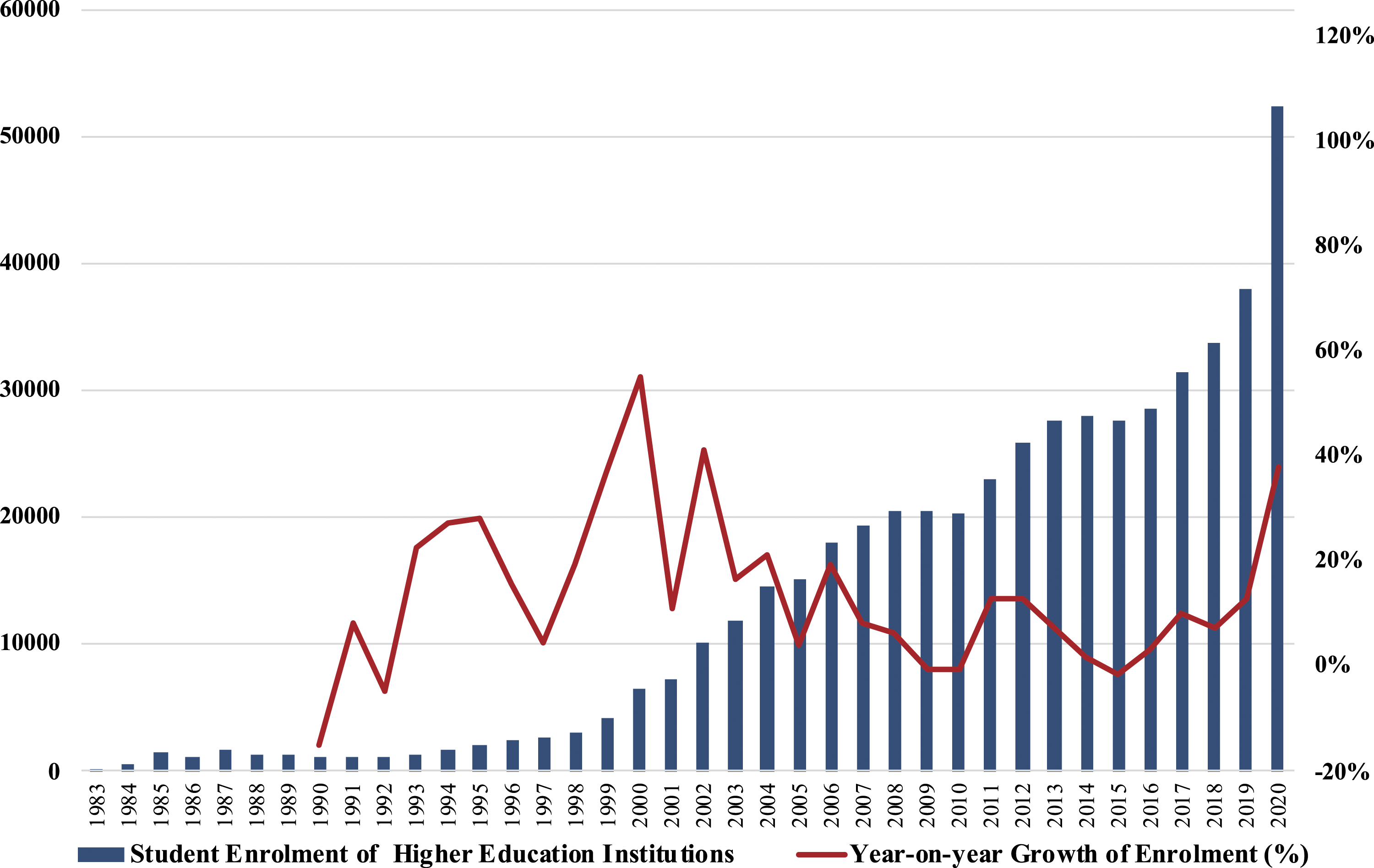
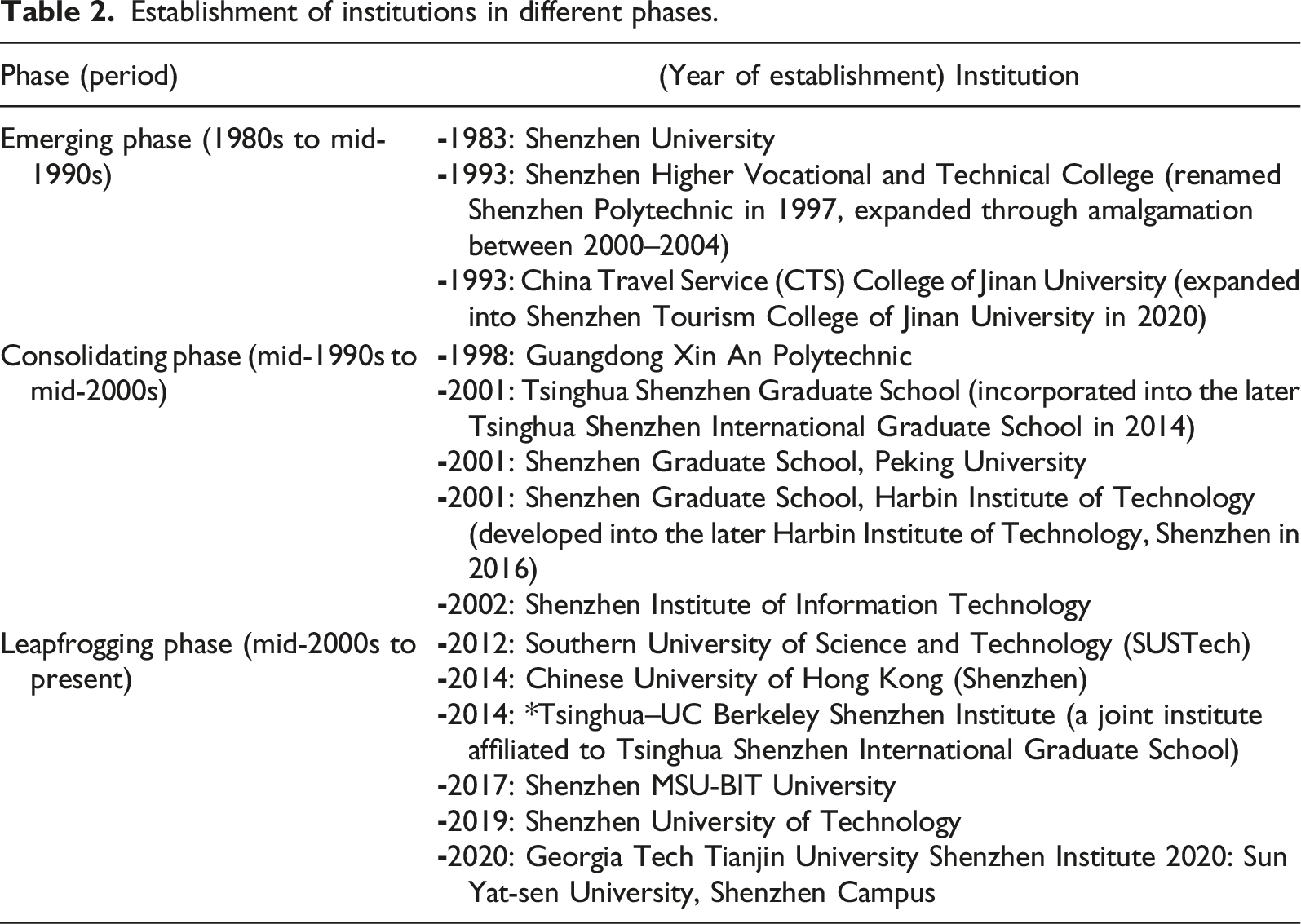
According to official statistics, since the 1980s, Shenzhen has developed 15 institutions of HE (see Table 2), with 6,999 full-time teachers and 136,200 current students (Shenzhen Statistics Bureau, 2022). Importantly, it seems that the remarkable development of HE in Shenzhen and the rise of the city is often associated with the relevant policy framework at different scales. For example, Shenzhen’s HE is often placed at the center of strategy and planning at the municipal and regional levels, such as the making of a global education hub in Southern China, articulated in the Opinions on Accelerating the Development of Higher Education (Shenzhen Municipal Government, 2016), and the establishment of a national innovation city within the Greater Bay Area 1 (GBA) stated in the Outline of the Guangdong-Hong Kong-Macao Greater Bay Area Development Plan (State Council, 2019). However, although there is a growing body of literature on the development of HE in Shenzhen (Li & Wu, 2021; Mok et al., 2020; Xie et al., 2022), considering the city’s significance among Chinese cities it remains largely understudied.
This paper provides an empirical study of HE development in Shenzhen, focusing on two specific objectives: (1) what is the development model of Shenzhen’s HE and, (2) what can we learn from this developmental model? Having presented the research methods, to better represent the developmental trajectory of the HE sector and the efforts of Shenzhen’s government as the main actor, the paper provides a systematic review of the three different phases of HE development in the city. This section introduces the establishment and development of the local institutions and the changing planning and support by the local government during these three time periods, each of roughly ten to fifteen years. Then, based on the understanding generated from the interviews, the paper summarizes some extant literature regarding the Shenzhen experience in moving towards its unconventional and rapid development in HE. This includes the strategies of exceptional support from local government, developing local public universities at a high standard, and introducing high-quality branch campuses. Finally, the distinctive ‘Shenzhen model’ of development is discussed and some practical suggestions to aid international scholars’ understanding of the local development of HE in China are provided.
Research Methods
Interviewees and affiliations.
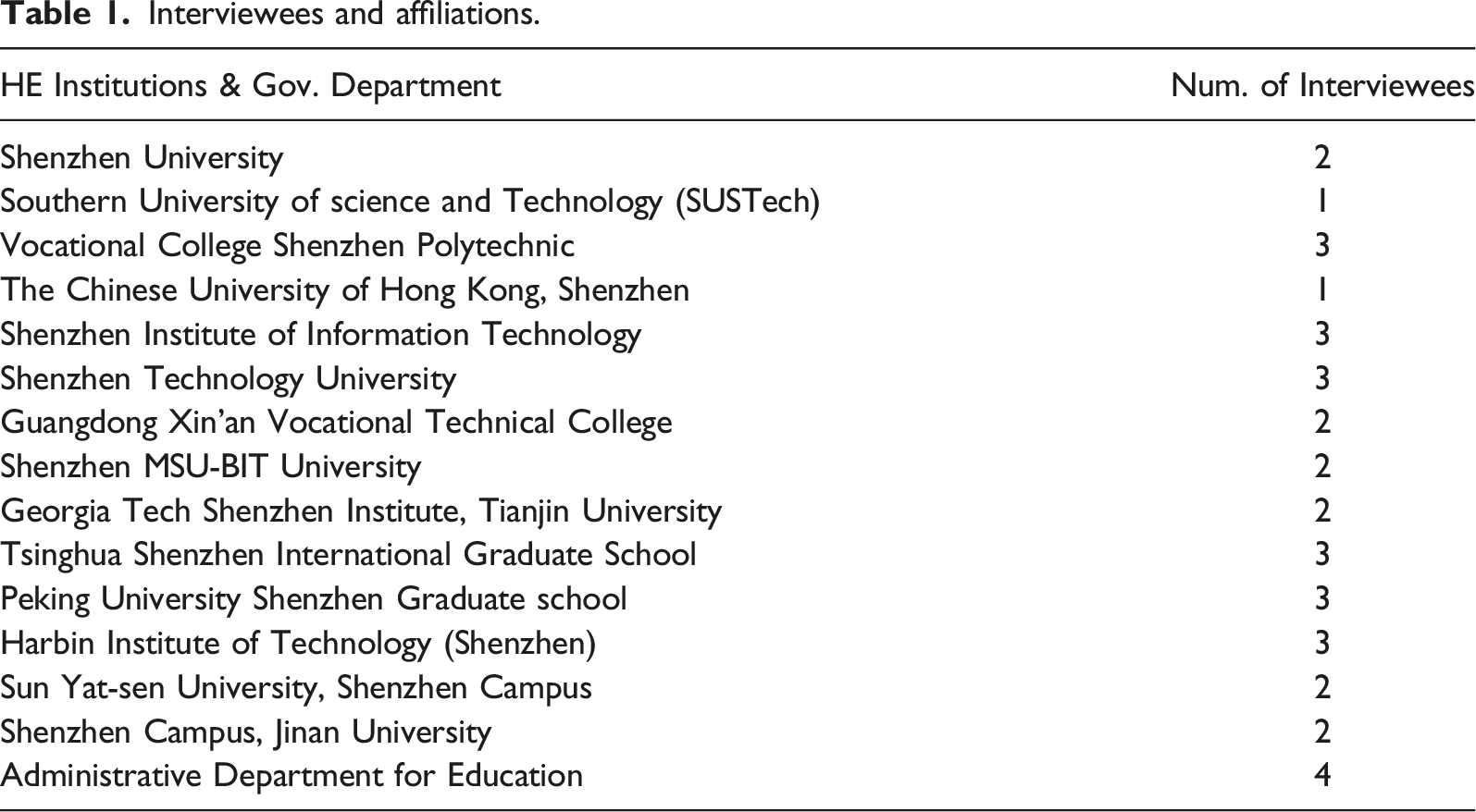
This study applied the same frame in interview questions about the trajectory of Shenzhen’s HE reform and development so that we could compare and validate the data between participants and with other materials. Although participants had differentiated focuses and preferences, the main narratives in their interviews generally agreed with each other and supported mutuality and cross-validation (e.g., with publicly available statistical data, and public archives). This helped to improve the quality of the interview data and these narratives enriched our understanding of HE from their perspectives as practitioners. The first author of the article is considered as an ‘outsider’ who did not have any prior experience of HE in Shenzhen before the study while the second author was an ‘insider’ who worked in a university in Shenzhen. The process of writing this article allowed the authors, from their different perspectives as an ‘outsider’ or an “insider’, to maintain an objective understanding, which facilitated the production of a legitimate narrative (Liu & Burnett, 2022) about HE development in Shenzhen. The interview data was analyzed using an inductive approach based on the grounded theory, and we formed our findings with the emerging themes from the narratives of the interviewees. Therefore, based on the empirical evidence, we developed our understanding of the trajectory regarding the wider socio-economic background of the city and the related discussions in the literature. In this process, we produced some interesting findings, such as the fact that although Shenzhen’s municipal government does not have nominal authority over the local institutions, it can still exercise actual power through other forms of authority, including its responsibility regarding university finance.
The Three Phases of Shenzhen’s HE Development
Based on the history of industrial upgrading in Shenzhen, the work of other Chinese researchers (e.g., Chen, 2020; Tang, 2014) and the interviewees, this study divides the developmental trajectory of Shenzhen’s HE into three phases: emerging (1980s to mid-1990s), consolidating (mid-1990s to mid-2000s), and leapfrogging (mid-2000s to the present) (see Table 2). In general, these phases match the three stages of industrial upgrading in Shenzhen discussed by Chen (2020).
Establishment of institutions in different phases.
The Emerging Phase
The 1980s until the mid-1990s constitutes the emerging phase of HE in Shenzhen. During this period, Shenzhen had two local-affiliated public institutions, Shenzhen University and the Shenzhen Higher Vocational and Technical College. They were the first institutions of academic HE and vocational HE, respectively, and laid the foundation of HE for the emerging SEZ. According to official statistics, between 1987 and 1994, HE in Shenzhen produced an average of 1,166 graduates per year, and it had 978 full-time teachers by 1994 (Shenzhen Statistics Bureau, 2022). While the government-led construction of HE echoed the national strategy of the 1980s, ‘core cities running universities’ 2 中心城市办大学, HE development in Shenzhen during this period was focused on serving the pragmatic needs of the local economy.
During this period, local government expected that local HE would predominantly serve the emergent export-oriented processing industries. In the early stage of Reform and Opening Up, Shenzhen began its free market experiment. Post 1985, Shenzhen confirmed its policy of industrial development, summed up as capital relies mainly on foreign investment, production consists mainly of processing and assembly, and products are mainly for export (Tang, 2014). This policy – and its geographic proximity to Hong Kong – attracted a large number of labor-intensive industries to Shenzhen, as the SEZ specialized in low-end processing industries (i.e., processing materials or given samples, assembling supplied components and compensation trade).
Against this background of urban development then, HE in Shenzhen met the demands for vocational skill training for low-end processing industrial workers, and for the continuing education and degree upgrading of civil servants in the local government.
Normally, during the evening at six or seven, [most of the people on the street] were going to the Yeda 夜大 [i.e., night school/evening college, an early name for colleges of continuing education, where students studied part-time, mostly during the evenings or weekends], or the television university [an early name for the Chinese equivalent of the Open University, when distance courses were mostly taught through the medium of television]. That was very impressive. (Former Official C, local education department)
In serving the pragmatic needs of the local market for specific vocational skills and degrees, HE in Shenzhen during this period focused on developing continuous education and vocational education. The local need for highly skilled talents was largely covered by the syphon effect of Shenzhen with its advantageous salary standards and abundant opportunities (Gao, 1983). Thus, the government of Shenzhen and its local industries came to rely upon an influx of talent.
The Consolidating Phase
The mid-1990s to the mid-2000s was the consolidating phase for Shenzhen’s HE. During this period, HE development divided into two main strands: academic and vocational. In the former, the local government strategically collaborated with leading domestic institutions to establish their graduate schools in the local educational market, aiming to effectively develop and expand graduate education in Shenzhen. In the latter, Shenzhen followed the national adjustment movement, in which secondary or smaller vocational schools were merged to expand and strengthen local vocational higher education. While the previous local institutions of vocational higher education were strengthened through the merger, another local institution was also established in a similar manner. The expansion and development of both strands of local HE closely paralleled the local economic transition in Shenzhen. Alongside the local industrial relocation and upgrading, local HE was focused on the development of postgraduate education and expansion of vocational higher education. In this process, the government of Shenzhen was the main actor.
The development of academic HE was primarily achieved through the strategy of ‘alternate location schooling’, or yidi banxue
3
(异地办学) with the focus on postgraduate education. Specifically, Shenzhen established the Shenzhen Virtual University Park (SZVUP) in 1999 and Shenzhen University Town (SZUT) in 2002. In this cooperative relationship, the government was the main planner and funder, and the cooperating institutions supplied Shenzhen with advanced research capacity and highly skilled talents (Ba, 2010). For example, the SZUT was modelled after University College London as well as drawing on the experience of many England’s universities in hosting foreign postgraduate research students (Liang, 2002, pp.343–352). A former head of the educational administrative department explained how HE meets the requirement of professional elites in the city:
[Why do we need Shenzhen University Town?] We saw the emergence of high-end demand [for higher education] … As I said to the city leaders, the corporate executives and senior managers based in Shenzhen were flying to Beijing and Shanghai for further education, because the local institutions were not good enough … Shenzhen University Town is not only for a few hundred postgraduate students, but also for knowledge updating for [senior managers] in the enterprise cluster.
The town was conceived as a community shared by the introduced institutions, and an important base for fostering university-industry cooperation. With the general planning and investment of the Shenzhen government, the SZUT was built to host the three graduate schools of Tsinghua University, Peking University and the Harbin Institute of Technology. Postgraduate education was also offered by Shenzhen University, the existing local institution, which acquired the right to confer master’s and doctoral degrees in1996 and 2006, respectively.
During this period, the local government developed the two vocational higher education institutions, the Shenzhen Polytechnic and the Shenzhen Institute of Information Technology. After 2000, Shenzhen’s vocational higher education was expanded alongside the relocation and upgrading of local industries, thus shifting the focus increasingly onto vocational HE (Xu, 2016) through the incorporation of vocational schools into the Shenzhen Polytechnic in the years 2000–2004, and the establishment of the Shenzhen Institute of Information Technology by merging three vocational schools in 2002.
With generous investment from local government and close cooperation with local industries, vocational HE in Shenzhen during this period thus expanded and developed into a national leading sector (National Development and Reform Commission, 2021; Yu et al., 2002). For example, in 2006, Shenzhen Polytechnic was listed in the National Demonstration Higher Vocational Colleges Construction Plan and allocated special funds from central government and special support for “key construction disciplines” (i.e., special funding programs to strengthen certain disciplines from the central government). The first private vocational college in Shenzhen, the Guangdong Xin’an Vocational and Technical College, opened in 1998. As the only private institution in Shenzhen, Xin’an was a supplement to the predominantly public HE system and had an annual student enrolment of about 1500 by 2021.
The development of HE in Shenzhen during this period was driven by the local government in order to keep up with the development of high-tech industries in the local economy. Beginning in 1995, the politico-economic circumstance of Shenzhen decreased noticeably due to the nationwide massification of its special economic policies and a steep slowdown in its economic growth, resulting in considerable controversies on the continued legitimacy of the SEZ (Tang, 2014). The local government of Shenzhen had to accelerate its program to adjust the economic structure through the project of industrial upgrading, a process referred to as ‘emptying the cage, changing the birds’ (tenglong huanniao 腾笼换鸟) (Lim, 2018), in an attempt to make space for capital and technology-intensive industries. On the one hand, the emergence of high-tech industries generated much greater local demands for research and development. The local government of Shenzhen realized the local significance of advanced HE: while there was increased local demand for scientific and technological research and talents from the emergent high-tech industries, they also had to face the declining economic attractiveness of Shenzhen for top talents nationwide (Chen, 2020) and thus strategically transformed the development mode to focus on academic HE. On the other hand, the transformation of the industrial structure also drove the expansion and development of vocational HE: while the relocation of labor-intensive industries had reduced the local demand for certain vocational secondary schools, the emergence of high-tech industries then stimulated the tertiary vocational colleges to expand and develop.
The Leapfrogging Phase
The mid-2000s to the present constitutes the ‘leapfrogging’ phase of Shenzhen’s HE development. During this period, the local government has established several institutions in diverse forms based on previous experience: independent establishments, cooperative establishments with domestic institutions, and cooperative establishments with foreign institutions. With support from the central government, the Southern University of Science and Technology (SUSTech) became an exemplar of the independent establishment mode, in which the local government was able to break through national institutional constraints and build a high-level research institution in the name of “national comprehensive supporting reform”. 4 In particular, the speed and quality of HE development in Shenzhen was exceptional, marking the emergence of a ‘special zone’ of HE, and its progress towards becoming an important HE hub of southern China by 2025 (Opinions on Accelerating the Development of HE, 2016).
During this period, the local economy in Shenzhen transformed into an innovation-driven model. However, as the local economic structure became more dependent on locally-based research and development, the local HE institutions could not fully support the ongoing scientific and technological innovation. This was specifically due to the local lack of high-quality research universities and research platforms, and the small size of the SZUT (Chen, 2020). Research and development (R&D) in Shenzhen was once significantly concentrated in the local enterprises: “more than 90% of R&D institutions are set up in enterprises, more than 90% of R&D personnel are concentrated in enterprises, more than 90% of R&D funds come from enterprises, and more than 90% of service invention patents come from enterprises” (Tang, 2014, p.16). One participant explained how HE is expected by the city:
About the relationship between HE and the city, we often talk about these points to the city leaders. The first is that HE cultivates innovative and entrepreneurial talents for the city. Because we are twenty years ahead of the development in inland areas, the locally cultivated talents are more suitable for the city. The second is that HE serves as an engine of urban innovation. Shenzhen, as the national innovative city, needs its HE to be the foundation of locally-based innovation and scientific and technological research.
Other aspects are that HE can be the source of high-class culture. Any world-class city has its own collection of high-quality universities, and Shenzhen needs its high-quality HE if it is going to be world class. As we know, HE is the talent pool for the city. Leading HEIs can be an important source of high-level talents for the city. For example, now we have over 30 academicians of the Chinese Academy of Sciences and Chinese Academy of Engineering.
Against this background, the local government of Shenzhen decided to change its HE strategy by increasing the speed of development, aiming to ‘leapfrog’ the development of HE.
5
One of the most distinctive characteristics of HE development in Shenzhen is that “it was achieved through the exceptional support of local government, aiming for the unconventional development of HE in scale, quality, structure and efficiency” (Xu, 2022, p.9). On the one hand, the government accelerated the pace in establishing local institutions: in 2010 it established the Southern University of Science and Technology, and in 2017, the Shenzhen Technology University (SZTU). The former is a public research university established and funded by the local government and approved by the Ministry of Education as a national reform experiment. The latter is a public university established through the government-led integration of application-oriented subjects from Shenzhen University and new subjects set up to meet local demand, focusing on undergraduate education and specializing in applied technology. One participant explained how the city drove HE reform:
Why are we playing the ‘reform card’? Because [the local government] does not have authority over the local institutions, and we want to accelerate the development. In addition, the relationship between HE and the city’s socioeconomic development is very close. Every institution is established according to the needs of the developmental stage of Shenzhen. … HE development in Shenzhen is characterised by its keeping pace with the city’s development.
The use of cooperation strategy in HE between the local government and nationally/globally prestigious institutions expanded, new cooperative modes were introduced, and institution sizes grew. In terms of Sino-foreign cooperation in running institutions (including cross-border institutions), the local government introduced two new cooperative universities (the Chinese University of Hong Kong, Shenzhen, and the Shenzhen MSU-BIT University) and two institutes (the Tsinghua-Berkley Shenzhen Institute and the Georgia Tech Shenzhen Institute, Tianjin University) through tripartite cooperation agreements. Through the cooperation with leading domestic institution, the Sun Yat-sen University, its Shenzhen Campus was established. Importantly, these newly founded institutions were all permitted to recruit undergraduate students, unlike the graduate schools which only took postgraduate students, and were thus able to expand the scale of local HE rapidly.
The Shenzhen Experience of HE Development
Throughout the three phases, HE development in Shenzhen shaped localized experience along its evolution. Although this ‘Shenzhen experience’ of HE development emerged from a SEZ with a unique trajectory of economic development and institutional reform, it still echoed certain general patterns of HE development found in similar East Asian countries, such as Singapore and Japan. For example, Mok et al. (2020) drew on the framework of the developmental state, primarily developed from those countries, to examine and understand the changing role of Chinese local government in fostering innovation-centric entrepreneurship and creative industries through policies in and beyond HE from the 1980s onwards. Moreover, considering its increasingly central positionality in the national institutional reform experiment, Shenzhen, then the first SEZ and now the Pilot Demonstration Zone, 6 produced the experience that was nationally transformative for other Chinese cities. This trajectory of local experiment followed by nationwide implementation has been discussed in the literature about the logic of China’s institutional reform and policy implementation in HE (Lim, 2018; Liu, 2018b). Based on these grounds, therefore, this section discusses the ‘Shenzhen experience’ aiming for not just exceptionalism, with the focus on the following three themes: exceptional support from local government, developing local public universities at a high standard, and introducing high-quality branch campuses.
Exceptional Support from Local Government
In China’s predominantly public HE system, governments are the main funders, although non-state actors have been encouraged to participate in the sector in various ways (first stated in the 1998 Higher Education Law). In the case of Shenzhen, the local government is the main funder as well as the main facilitator of non-state actor participation and of public-private partnerships. Throughout all the phases, there was a close connection between the government funding and the development strategy of HE in Shenzhen. Financial expenditure as the steering instrument of local government is evident in the changing strategy statements in policy documents that deliberately directed and paced Shenzhen’s HE development seen in the quote mentioned earlier: from “education should develop in step with the economy” in 1983, to “education should be a few steps ahead” in the early 1990s, to “realizing the ‘leapfrogging development’ of HE” first stated in 2004, to “promoting ‘leapfrogging development’ of HE” further stated in 2016 (Xu, 2022). One interviewee commented on the overall planning of HE for the city:
Since I joined the department during the 2000s, [the local government] has followed two main ideas of HE development. One is to pay equal attention to locally established institutions and introduced ones, which also matches the wisdom of Reform and Opening Up in Shenzhen. The other is to keep a balance between quantity and quality in the development.
Specifically, since the acceleration of HE development in the early 1990s, Shenzhen’s government began to fund local institutions based on the ‘per student funding standard’, a locally specific parameter of funds for individual undergraduate and postgraduate students, generally more than three times that of most public institutions nationwide and twice that of institutions in other cities in Guangdong (Xu, 2022). As a result, HE expenditure in Shenzhen has increased by an average of 20% annually, and its total expenditure is exceeded only by Beijing and Shanghai. Such high financial expenditure is:
due to the urgent demands of Shenzhen for HE development, and the importance attached to it by the consecutive government and party committees of Shenzhen. (Former Official B, local education department)
As well as the increase in HE expenditure, the local government also provides strategic planning support for local HE. On the one hand, Shenzhen’s government supports local institutions to participate in the national and provincial construction of world-leading universities. This support drives the local institutions to compete at the international, national, and subnational levels, which helps to form a mutually beneficial relationship between them. For example, in the two rounds of high-level university construction projects in Guangdong in 2015–2017 and 2019–2021, Shenzhen allocated a minimum of 6.4 billion yuan (approximately 960 million dollars) in special funding to the selected local institutions 7 on top of the regular funding (Xu, 2022). On the other hand, the government uses funding allocations strategically to ‘encourage’ local institutions to serve local and national interests. Both competitive and non-competitive special funds are central to the Shenzhen government’s strategic funding programs which cover various high-level talent introduction programs, scientific and technological research and development, key laboratory construction programs, etc. This strategic funding also includes matching funds for social donations to local institutions, in order to encourage diversification of their funding sources.
Developing Local Public Universities at a High Standard
The local public universities and their rise have been indispensable to the leapfrogging development of HE in Shenzhen. Local public universities are normally the core of the local ‘edu-scape’ in hubs of HE around the world (see, for example, Olds (2007) and Sidhu et al. (2014) on Singapore as a global education hub). Currently, there are three public universities which originated in Shenzhen: Shenzhen University (1983), the Southern University of Science and Technology (2012) and Shenzhen Technology University (2019) as well as two public vocational higher institutions, the Shenzhen Polytechnic (1993) and the Shenzhen Institute of Information Technology (2002). Importantly, these institutions were all planned and established at a high standard so that they could develop rapidly in order to participate in the intensifying domestic and international competition. This is particularly exemplified by SUSTech and the Shenzhen Polytechnic.
As the flagship of local HE and the key project in Shenzhen’s vision for innovation (Overall Planning for a National Innovative City of Shenzhen (2008-2015)), SUSTech was established in 2012. Its establishment met the needs for local development of HE and for national institutional reform in HE. In the hope of “building a local high-quality university of technology in a short time” (Xu, 2020, p.1), the local government of Shenzhen not only managed to persuade the central government to confer special privileges on SUSTech (e.g., the right to award master’s and doctoral degrees at its establishment, and the setting of the university council as the primary policy-making body), but also planned and built the institution to world-class standards (e.g., having a student-faculty ratio of 1:6.8 and recruiting many faculty members with foreign experience). For example, Shenzhen’s special talent introduction scheme, with its globally competitive salaries and research funding has attracted a faculty, of which over 60% (about 820) have work or research experience in the world’s top 100 universities, and more than 65% (about 890) were recognized as middle- or high-level talents in Shenzhen by 2021 (SUSTech, 2022). An interviewee who witnessed the process admitted that:
When Shenzhen was designated as an experimental zone for national reform in 2009 (i.e., Comprehensive Coordinated Reform Plan of Shenzhen), the Southern University of Science and Technology in construction was the recipient of an excellent opportunity for development as the experimental institution of national institutional reform in HE. This title is important, because without this ‘hat’ [a Chinese metaphor for the title], even the Ministry of Education could not do it, because there are so many regulations. (Former Official B, local education department)
Founded in 1993, Shenzhen Polytechnic is an exemplar of vocational HE in Shenzhen. Formerly the Shenzhen Higher Vocational and Technological College, and the earliest vocational college in Shenzhen, it was established in the early 1980s when HE emerged in Shenzhen. It then expanded in the early 2000s as HE expanded rapidly and two other vocational schools were merged into the renamed Shenzhen Polytechnic in the years 2000–2004. During the 2000s, Shenzhen Polytechnic became one of China’s leading vocational colleges for two main reasons. One was that the institution had formed close partnerships with local industries which actively participated in teaching and research. For example, some senior technicians and managers of local enterprises were employed as part-time teachers, and firms also co-founded training, and research and development centers in cooperation with the colleges (Yu et al., 2002). A second reason was that, with the special support from the local government, it was successful in winning domestic competitions and support from the central government. Specifically, it became one of the key national vocational and technical colleges in 2002, and one of the first listed institutions in the 2006 National Demonstration Higher Vocational College Construction Plan to receive special funds from the central government. These close partnerships also directly supported the development of local industries. For example, in 2015, about 89% of higher vocational graduates remained in Shenzhen to take up local employment (Xu, 2016).
The development of local public universities improves the overall development level of local HE in general through stimulating competition and cooperation. While the nine institutions established locally, whether through domestic or international cooperation, or by the private sector, have enriched and expanded the form and content of Shenzhen’s HE, the five local public universities remain the core of local HE. Given their number of students and full-time teachers and amount of research funding, these public universities play a leading role for local institutions in serving national and/or provincial strategies. In this sense, the local public universities, leading in quantity and quality, can effectively shape the overall process, competitive or cooperative, among other local institutions.
Introducing High-Quality Branch Campuses
Through the cooperation between government and universities, the introduction of high-quality branch campuses has become the key to HE development in many places (see, for example, Miller-Idriss and Hanauer, 2011; Olds, 2007). As an important part of the leapfrogging development phase of HE in Shenzhen, the introduction of branch campuses has had two main strands: introducing top domestic universities in China through yidi banxue and prestigious overseas institutions under the Sino-foreign cooperation framework (including cross-border cooperation with Hong Kong and Macau). By encouraging the establishment of domestic and foreign high-quality educational resources, Shenzhen has forged a globalized system of knowledge production. One participant noted:
I believe in general that HE development in Shenzhen is very open and inclusive, and is not bound to any fixed ideals or model. … We think about how it can be done and done well. In fact, it is also the practical approach of Shenzhen, not sticking to one opinion, nor one way. It follows the development of the times, as there are changes in national policies, we adjust the development ideas. But in the end, we want to expand the scale and improve the quality.
Shenzhen was one of the first cities in China to introduce branch campuses of domestic institutions (i.e., the yidi banxue model), making it one of the most attractive educational destinations in China. Shenzhen needed to introduce branch campuses because, as the first SEZ in China, its rapid socio-economic development highlighted the relatively slow development of the local HE sector. This is not surprising given the nature of HE. Thus, in the early 2000s, the Shenzhen local government decided to introduce high-level graduate schools by building branch campuses of domestic institutions to attract and retain skilled talents in research and development. As the home of these branch campuses, Shenzhen enjoyed politico-economic advantages and historical opportunities. Since the local government’s decision to introduce leading graduate schools through the establishment of Shenzhen University Town, Shenzhen has been a major attraction in southern China, with bright prospects for high-tech industries and sufficient government funds for establishing new institutions (Liang, 2002). As an interviewee from the local education department said:
[The institutions] decided to come at the end of the 1990s … First, they came for Shenzhen’s public finances [because then] the central funding for HE in Tsinghua and Peking universities was way less than it was in the late 2000s. Second, Shenzhen had the resources for scientific and technological development, which was needed by the [local high-tech] market. Additionally, Shenzhen was close to Hong Kong and had a more internationalized environment. (Former Official B, local education department)
With the development of the three introduced institutions, Shenzhen has become an important hub for yidi banxue institutions. The newly established Shenzhen Campus of Sun Yat-sen University 8 (2020) shows that Shenzhen remains an attractive destination for China’s top universities to set up local branches.
Sino-foreign cooperation has also been important for introducing branch campuses. In the 2010s, Shenzhen successively introduced the Chinese University of Hong Kong (Shenzhen), Tsinghua Berkeley Shenzhen College, Shenzhen MSU-BIT University, and the Georgia Tech Shenzhen Institute, Tianjin University (although there were also a number of unsuccessful cases). Although the introduction of branch campuses under the framework of Sino-foreign cooperation (the 2003 Regulations on Chinese-Foreign Cooperation in Running Institutions and its 2004 Implementation Plan) faced systematic and practical difficulties, the use of tripartite agreements (i.e., between a Chinese institution, a foreign institution, and the local government) greatly facilitated the process as the local government provides financial support according to the needs of the different types and levels of introduced branch campuses. Specifically, each cooperative institution is granted local funding for specific purposes (such as purchasing university infrastructure and teaching equipment) as well as for educational expenditure.
[We are] working on the process of persuasion … [The Ministry of Education] may support you in the end and be moved by sincerity [of the local government]. [They may feel that] if they don’t support this, the institution wouldn’t be able to do well. (Former Official A, local education department)
This generous financial support secures the construction and operation of these cooperative institutions. Also, whenever these institutions encounter problems, the government in the cooperative relationship with the institutions can also help to solve them by utilizing its positionality as an SEZ and the central authority in local reform experimentation. For example, according to the Regulations, the Chinese University of Hong Kong (Shenzhen) was initially supposed to be named the Shenzhen Chinese University of Hong Kong but the Hong Kong office of the university insisted that the alternative name would be more beneficial for the reputation and development of the cooperative institution in Shenzhen. The Shenzhen government then stepped in to actively reconcile the opinions of the Ministry of Education and the Hong Kong office, and the suggested name was eventually approved.
Concluding Discussions
The timeline narratives and discussions of Shenzhen’s HE above convey an emerging yet clear sense of the ‘Shenzhen model’ in HE development. As the study has shown, the model parallels the evolution of the economic development and governance modes in Shenzhen and some of its similarities go beyond the theoretical framework of the developmental state in East Asian countries where state-led development and state-owned sectors play the leading roles. As Shenzhen’s local government has transformed its role towards becoming a service provider, strategically fostering the resources and energy of the HE institutions (Mok et al., 2020), we can see a (re)centralization of the HE governance in the developmental processes. Specifically, as a result of the exceptional strategic support from the local government, Shenzhen is capable of developing local public universities at a high standard and effectively introducing high-quality branch campuses. In this sense, the ‘Shenzhen model’ in HE development can be understood, through its strategic planning and funding, as a mode of government-driven development with the shifting focus(es) on the city’s needs of the time (e.g., the introduction of highly skilled talents) and a sustainable future (e.g., the process of industrial upgrading).
This paper contributes to a periodized understanding of HE development in Shenzhen, with reference to the evolution of the industrial relations with and governance in local HE, and a discussion of the emerging ‘Shenzhen experience’ along the way. With a few notable exceptions (Chen & Kenney, 2007; Hayhoe & Pan, 2015; Kang & Jiang, 2020; Mok et al., 2020; Mok & Jiang, 2017), academic attention focused on HE in Shenzhen is still lacking, and this study enriches the literature on this focus and, more importantly, on a structured developmental history of it that may potentially inspire future research. Interestingly, looking at the process of HE development in Shenzhen and its evident coupling with its urban development as well as the increasingly intensified strategic planning and regional competition across and beyond China (Wu, 2007, 2015), the study speaks to the wider debates on the changing nature of HE, in particular, its role in urban development and transformation at the local and municipal levels (Charles, 2006; Rocks, 2017; Schenk, 2019; Walsh, 2009). The study thus highlights the potential of case studies focusing on the sub-national/municipal scale of China, through which the changing relationship between the local government and universities situated in the wider context of China could be examined. While providing the basic yet important information about the evolving development of HE in Shenzhen, we have refrained from describing it from a more theory-bounded perspective. Concentrating on making the case for Shenzhen, there is a potential exceptionalism about the case demonstrated. Future research could apply more comparative perspectives, in particular from another national context.
Footnotes
Declaration of conflicting interests
The author(s) declared no potential conflicts of interest with respect to the research, authorship, and/or publication of this article.
Funding
The author(s) disclosed receipt of the following financial support for the research, authorship, and/or publication of this article: This work is supported by Research of Shenzhen Philosophy and Social Sciences Planning (SZ2021D031), the Research of Educational Science Planning Project of Guangdong [2020GXJK372; 2021GXJK188] and Research of Educational Science of Shenzhen [YBFZ20037].
