




Abstract
China’s expansion in higher education has also given rise to developing university towns in sub-cities to deal with increasing enrollments and contribute to broader socio-economic development. Taking Xiasha University Town in Hangzhou as a case study, this paper adopts a tripartite framework of teaching, research, and service to investigate the role of university towns in human capital and skills development, regional innovation, and social and community services. This paper is the first to systematically evaluate Hangzhou’s largest university town after more than two decades since its development; it also provides a more nuanced and contextual approach to university town developments similar to others in China or broader learning region integrations globally. Documentary research and interviews from relevant stakeholders were utilized to collect data. This study presents the three dimensions contextualized within Xiasha and points to issues that can further improve such through a more efficient resource-sharing scheme, a focused discipline orientation, more significant investments in research and development, and a more active role in community engagement.
Keywords
Introduction
The role of higher education (HE) for development, exhibited through the massification of the sector alongside the persistent calls for human resource generation, has seen a shift in initiatives for this sector in recent times (Marginson, 2016; Mok, 2016). From the micro-variations view of education to a more global approach to knowledge spaces, the push for more remarkable advancements brought by the latter has seen the emergence of the learning regions for regional development (see Brock, 2018; Brocka, 2013). Alongside this, the greater role of HE in terms of providing for more specific training, knowledge generation and exchange, has pushed for government policy re-orientations to drive for a more integrated HE sector to its community (Symaco & Wan, 2017). The last two decades similarly marked a tremendous development for higher education and urbanization in Mainland China (or China, as referred to in this paper). From 1998 to 2019, the number of colleges and universities in China increased from 1,022 to 2,688; the gross enrollment of higher education increased from 9.76% to 51.6%, and the total number of students increased from 1.08 million to 26.96 million (Ministry of Education, 2020). Higher education remains a priority in China, where this sector is expected to complement the country’s needs for development. Expanding the scale of HE in provinces and cities across the country is noted, with the similar aim to promote the transformation of Higher Education Institutions (HEIs) and strengthen the roles of “university towns” for development (Hu, 2008). To this end, university towns have flourished while increasing urbanization is also noted since the country’s Open Door Policy of 1978 (Gu, 2012; Wu et al., 2013).
The role of university towns as a new type of urbanization has also been argued (see Yang, 2009) yet, little is known about the development of university towns in the country. While literature is replete with learning region initiatives discussed in other sections, the Chinese model of urban development alongside the rise of city university town clusters (vs a broader take on regional development of knowledge spaces) is limited. Existing university town studies in China mostly focus on the urban development dimensions (Kim & Cocks, 2020), lacking a more critical and defined contextualization of actual knowledge generation and employment. However, as similar to the learning region spaces in Western text, the formation of university town explicitly also contributes to greater regional development, as discussed in further sections of this paper. What makes this university town development in China unique is how such developments may unfold in various locations as situated in a single city. As will be examined in this paper, the development of university towns in China, with special reference to Xiasha district in the city of Hangzhou, is only one among the four (4) such existing developments in the City. University towns in Hangzhou are all within reasonable proximity of each other, with Xiasha being the largest among the all university towns (with 14 constituent HEIs).
This paper will discuss the broader role of university towns in China’s development and urban agglomerations, the function of different stakeholders in constructing such, and the challenges faced by university towns. Based on the learning regions framework (Chatterton & Goddard, 2000), this paper will analyze the multi-effect of university towns on the new urban development in Hangzhou. This paper is the first to systematically evaluate such role of Hangzhou’s largest university town after more than two decades since its development in 1999; it also provides a more nuanced and contextual approach to university town developments similar to others in China or broader learning region integrations globally. Issues relating to regional development as supported by HEIs are investigated under the tripartite framework of teaching, research, and service, especially relevant for a more sustainable approach and policy re-orientations in higher education.
University Towns and the Learning Region
The role of universities in development is highlighted in literature, from its transformation from an exclusive community of scholars to active agents for innovation, mobility, and sustainability (Chao, 2017; Etzkowitz, 2008; Oplakanskaia et al., 2019). HEIs in regions highlight the interrelating physical, social, economic, and cultural dimensions between the two, where universities drive overall development through job formations and enhanced social mobility, knowledge spillovers in industries, among others (Brock, 2018; Florida, 2002). Studies have also focused on the role of regional business innovations, human capital formation, social, cultural and environmental development, and regional capacity building (EU, 2011; OECD, 2008), though the level of significance may vary from different perspectives. Four key areas through which universities most commonly engage in regional development are highlighted by an EU report (2011), namely by enhancing regional innovation through their research activities; promoting enterprise, business development and growth; contributing to the development of regional human capital and skills; improving social equality through regeneration and cultural development. Similarly, the promotion of urban economic development and industrial transformation through generating knowledge, technology, and talents is also documented (Chatterton & Goddard, 2000; Qie, 2007).
While the rise of university towns also proposes the formation of new urban development through increasing human capital dimensions in localities (Wang & Tang, 2020), its intricate relations show the cooperative ties between the conventionally identified missions of universities (i.e., teaching, research, and service) to regional development (skills, innovations, culture, and community). This Institution/Region Value-Added Management Process developed by Chatterton and Goddard (2000) serves as the tripartite framework in this paper, where the formation of university towns adds to the dimension of new urban development emphasizing the role of learning regions in the broader development of countries. This paper further contextualizes learning regions to “learning localities” where such is interrogated in terms of contributing to socio-economic advancement.
University towns either evolve naturally or is initiated by governments (Hu, 2008; Yang & Chen, 2003). The former follows the European and American models, where university towns in Europe are often hundreds of years old, usually located in big cities, which goes beyond the development of HEIs but also sustains the core of political, cultural, and social dynamics (Li et al., 2014). The American university towns development, on the one hand, as investigated by Gumprecht (2008), shows that a university/college town is any city where a college or university and the cultures it creates exert a dominant influence over the character of the community. Adding further the difference in development between the European and American university towns and how cultural and religious diversity has led to the proliferation of the latter. The formation of university towns is akin to new urban development where the establishment of either draws from settlements of scholars or the formation of HEIs.
In China, the development of university towns is a state-led initiative, drawing from the proposed benefits of a learning region. The training of relevant human capital and relations with industry is expected to promote regional growth. The concept of the “learning region” was introduced some time ago with the idea that “regions are becoming focal points for knowledge creation and learning. . . function as collectors and repositories of knowledge and ideas, and provide the underlying environment or infrastructure which facilitates the flow of knowledge, ideas and learning” (Florida, 1995, p. 527). The prime role of universities in teaching provides the needed skills for the populace to harness human capital development. In Chatterton and Goddard’s (2000) framework, this refers to promoting a learning society where “education provision is changing as a result of demands to create more regionally relevant education systems (p. 484). This agenda highlights the similar role of university towns where HEIs are geographically clustered that “enhance collaborative provision and create a regional learning system” (Chatterton & Goddard, 2000, p. 484).
Additionally, the promotion of technical capabilities needed to further this process is crucial, where knowledge spillovers from HEIs to the industry is highlighted through the promotion of research and development. This “shifting production of knowledge” (see Gibbons et al., 1994) highlights university and industry collaborations that promote the “growth of regionally-based industrial clusters (Chatterton & Goddard, 2000, p. 488). In this set up, the third function of universities through community services is also emphasized in university towns regional development. The symbiotic relations between HEIs and the community is crucial, where close collaboration results to mutual benefits for both since HEIs with their “multi-territorial and inter-disciplinarity, are institutions that are firmly placed to interpret global issues on a local scale (Chatterton & Goddard, 2000, p. 490). Similar calls on this third function of universities are observed in literature (Busacca, 2020; Symaco & Tee, 2019; Yean & Abdul Rahim, 2021), where a more sustainable approach to HE services is envisioned.
Higher Education and Development in China: University Towns and Learning Regions
The concept of the learning region finds importance in China, where both provincial and municipal governments have incorporated the establishment of such developments into policy agenda providing special financial resources for its establishment, coupled with the massification of higher education in the country (Cheng & Gu, 2011; Lin et al., 2013 ). China’s Outline of the National Medium- and Long-Term Program for Scientific and Technological Development (2006–2020) set the guidelines for building an innovation-oriented country, namely that of “indigenous innovation, focus in priority fields, enabling development, and leading the future.” The Outline also aims to establish regional systems with diverse characteristics and strengths (The State Council of China, 2006). In this vein, creating a learning region is seen as an effective model to promote regional innovation systems. The expansion of higher education has additionally witnessed the emergence of university towns across different regions of China, where HEIs have been regarded as key actors in promoting the needed development for regions (Deng, 2013). Considering also that the Government drove the establishment of most high-technological development zones and regional innovation systems, Deng and Liu (2014) emphasize that China should strengthen the endogenous power of regions by making use of geographical proximity, regional embeddedness, and human capital agglomeration for development, this coupled by an efficient interaction of different stakeholders within localities. The geographical advantage of university towns also allows the sharing of resources (i.e., workforce, infrastructure, among others), again highlighted by an active engagement among stakeholders for broader development (Chen et al., 2014). Additionally, Zhang et al. (2020) pointed out the significance of sharing education resources in university towns through inter-campus resource-sharing potentials and a more comprehensive management framework among the HEIs.
The construction of university towns in China is principally a state-led project (Li et al., 2014). For local governments, the structure of university towns is conducive to strengthening the city’s power or driving urban area, such as the founding of a new urban district, satellite city, among others. In addition, it aims to promote the high-technological development of the region, thereby improving overall urban ecology (Hu, 2008; Wang et al., 2012). However, universities in city centers in the country also find it challenging to provide the surging demand for HE attributed to poor infrastructure (Gu & Wang, 2003). This challenge has, in turn, paved the way to the urgent development of new campuses, which contribute to the running space and improvement in the education environment, promoting resource-sharing and qualitative teaching in the process. The significant rise of university towns in China is thus documented, where more than 60 university towns were built across the country between 1999 and 2002 (Gu, 2012).
On the other hand, China’s urbanization ratio had also risen from just 18% in 1978 to 36% in 2000 and above 50% in 2012 (Li et al., 2014; Wu et al., 2013). Wang et al. (2012) also investigated the spatial distribution of the university towns in China, which indicated a more clustered dimension from the richer east coast (68%) to lesser numbers pushing inland to the poorer west (8%). In both cases, capital cities also gather the majority of university towns. Despite the documented rise of university towns in China, studies highlighting the country mainly focus on land use mechanisms and the construction production processes (Ruoppila & Zhao, 2017; Ye et al., 2014).
As highlighted in the geographic cluster of HEIs, this new form of urbanization contributes to the development of learning regions as discussed in literature (Brocka, 2013). As exemplified in this section, the massification of higher education has similarly pushed for the expansion of university towns, alongside the call for broader advancement through the promotion of innovative learning regions, as supported by policy orientations in the country. The following sections will discuss the development of university towns in Hangzhou, focusing on the Xiasha university town (referred to as Xiasha in this paper) and its roles in education, research and community service in line with development goals.
University-Towns Development in Hangzhou
As the capital city of Zhejiang Province in China, Hangzhou accommodates nearly one-third of the total HEIs in the Province, also demonstrated by its unique background of establishing university towns. Considered as one of the more prosperous provinces in the country, Zhejiang exhibits rapid economic development and technological innovations. Home to the e-commerce giant Alibaba, it ranks 4th in terms of Gross Domestic Product (GDP) in China, next only to Guangdong, Jiangsu and Shangdong Province in 2019. Since the country’s reform and its Open Door Policy in 1978, it has since increased from 16th to 4th in terms of per capita GDP in 2019. Before its established set of HEIs, earlier years saw the lack of sufficient and high ranking HEIs in the Province, where the higher education sector was challenged to meet the industry’s demands. In 1998, the provincial government began the conceptualization of university towns to complement the needs of the region. As a result, the Planning for the Reform and Development of Higher Education in Zhejiang Province (2000–2020) was launched and underlines the need to “construct a number of university towns and expand the space for the development of higher education,” promoting the “sharing of public education facilities and the socialization of logistics service.”
There are currently five (5) university towns in Hangzhou. Each of the university towns has its distinct features. The largest in terms of size which is the focus of this paper, the Xisha University Town, is mainly dominated by science and engineering HEIs. It collaborates closely with the Hangzhou Economic & Technological Development Area (HEDA) to provide talents and technological support to industries. As the largest university town in Hangzhou City, Xiasha University Town is an essential base for Hangzhou to develop a modern manufacturing industry, an export-oriented economy, and conduct scientific research (Tong, 2020). In line with establishing university towns in the city, the transfer and merging of HEIs are evident in broader literature (see Zhang & Huang, 2016; Zhang & Zhang, 2021). For instance, in 2000, the Zhejiang Chinese Medical College moved from its 4.67 hectares (ha) of land location from the downtown area to a new campus with nearly 20 ha of space. Since then, four large-scale university towns, namely Zhejiang Xiasha University town, Binjiang University town, Xiaoheshan University town, and Zijingang Campus of Zhejiang University started. The total planned area of the four university towns is nearly 2,000 ha, with a construction area of over 7 million square meters and an investment of about 15 billion Chinese Yuan (CNY), which can accommodate 222,000 college students (Fang, 2003).
Methodology
This study utilizes the most recent documentary research sources from official government documents to investigate the role of a university town in development in Hangzhou (taking Xiasha as a case study). It also links to the tripartite framework of teaching, research and service practices (Chatterton & Goddard, 2000), relevant to the learning region context in literature. Relevant governmental yearbook and statistical bulletins of the Hangzhou Bureau of Education; the Hangzhou Economic and Technological Development Area (HEDA) yearbook; Zhejiang Education Examination Academy (ZEEA); “Compilation of Science and Technology Statistics of Higher Education” handbook were utilized. Documentary data from HEIs also considered, alongside relevant higher education policy and planning documents of Hangzhou. This paper also uses interviews from pertinent stakeholders of Xiasha regarding the characteristics and issues in university towns and broader development. For this study, six (6) managers from different HEIs located in Xiasha University Town who are in charge of policy planning and administrative processes were purposefully selected and interviewed (see Table 1).
Interview Participants.

The interviewees were asked to elaborate on the following themes and issues: (a) their perceived main contributions of university towns to regional development; (b) main obstacles faced by university towns in terms of engaging in regional development initiatives, and the approaches and factors that influence such participation; (c) the needed interface among various stakeholders (government, industry, and university) to contribute to broader regional development. To ensure ethical issues are addressed, this paper confirms the anonymity and confidentiality of the interviewees. Informed consent was also pursued, alongside the participants’ revalidation of their interview statements to complement the authenticity of the findings.
This study uses a semi-structured Interview approach to identify keys issues and factors faced by university town development in China as perceived by relevant stakeholders in HEIs, guided by the tripartite framework as earlier defined. Semi-structured interviews allow one to gain insights into practices and experiences relevant to the understanding of educational issues involved (see Seidman, 2012). Documentary research is also employed to provide a complete picture of the evolution and current situation of university towns in China, as exemplified through Hangzhou. This research also allows for more information about the context and further the study’s validity through the triangulation of data available (Fitzgerald, 2012). All the interviews were digitally recorded and transcribed verbatim, accompanied by notes and memos (Chen, 2018). The analysis of data follows Strauss (1987)’s suggestion of open coding, axial coding and selective coding to generate themes. Feedback from interview participants was also utilized to revalidate the themes and issues emerging as aforementioned. The use of multiple sources of evidence further established by the chain of evidence in this case study also marks its validity (Yin, 2015). The possible limitations of the translations in research (in this case, Chinese to the English language) is remedied by the linguistic and cultural background of the researcher, where such interpretations “is often influenced by researchers’ knowledge and understanding of intimate language and culture” (Fray, 1970 as cited in Regmi et al., 2010). The issue of conceptual equivalence in the translations (see Emmel, 1998 as cited in Regmi et al., 2010) were also addressed through a series of verified translations among the researchers.
Findings
The following sections will discuss the tripartite framework of teaching, research and service in learning regions as adapted in this paper through (a) the development of human capital and skills development by (i) widening access and adjusting disciplines and (ii) resource-sharing and mutual credits recognition, (b) regional innovation by (i) research and development (R&D) investment and income of technology transfer and (ii) promoting the collaboration between HEIs and industries, and (c) social and community development by providing social services and access to resources to the community. Issues relating to each of the dimensions as contextualized in this paper are also discussed.
Human Capital and Skills Development
Widening access and resource-sharing
Considered as the prime role of universities, the teaching of relevant skills to students is crucial, where it is argued that the “knowledge transfer on legs,” namely embedding knowledge in students and graduates, is one of the most effective mechanisms for knowledge transfer (OECD, 2008, p. 144.). The formation of university towns has played an essential role in human capital formation in Hangzhou, where HEIs in the City have constantly adapted to the demands of human capital formation through their capacities of widening access and adjusting disciplines through new campus construction, relocation or expansion. In the late 1990s, the gross enrollment ratio (GER) of higher education was 14.7% in Hangzhou, though higher than the average from Zhejiang Province (8.96%) and China (9.76%), was still lower than that of the world average (18.18%). With the development of university towns, a significant increase in GER in Hangzhou was recorded, from 50.37% in 2008 to 67.31% in 2019 (Hangzhou Bureau of Education, 2020). There are currently 40 HEIs in Hangzhou, where four university towns accommodate the majority (i.e., 26) of the HEIs. More than 60% of the total enrollments of about half a million in the City are found in university towns. The Xiasha University Town alone accommodates more than 182,500 students in 2017, with a total faculty staff of 18,600 (HEDA Local Chronicles Editing Committee Office, 2018). The push for discipline construction is also manifest, as seen in the rise of offerings in Xiasha, wherein in 2005, there were 219 undergraduate majors offerings, 171 field specialties, and 78 master degree programs. Ten years later, five universities have upgraded to doctoral degree-granting universities, with 10 disciplines offering doctoral programs. The number of key laboratories has also risen from 20 in 2011 to 38 in 2017 (HEDA Local Chronicles Editing Committee Office, 2018). Given that university towns can house varied HEI types (i.e., comprehensive universities to technical vocational colleges), its capacity to train talents needed for city development is well defined.
“Over 60% of our graduates work in HZ, which have made great contribution to the local economy”.
“We have made great efforts to cultivate talents for digital economy. In the past 10 years, we have over 40000 undergraduates working in HZ, of which around 25000 in the digital economy field. These graduates make the fast development of enterprises in the field. Besides, we have over 1000 graduate students working in the informational software and information technology service.”
Resource-sharing is one basis of legitimacy in constructing university towns, which pushes the “agglomeration effect” (Gao, 2014; Pan et al., 2002; Zhang & Huang, 2016; Zhang & Zhang, 2021). In this context, HEIs can optimize and share needed resources through their geographical proximity. Similarly, in the case of Xiasha, this physical gathering of HEIs in university towns is witness to an increased share of resources, for instance, through inter-collegiate course taking and inter-collegiate recruitment of faculty, all of which contribute to the broader improvement of teaching and learning. This resource-sharing through mutual credits recognition (e.g., elective courses) has been practiced in Xiahsa since 2004, where students from one HEI can take classes from another within the university town. Additionally, in 2005, Xiasha initiated faculty inter-collegiate recruitment to solve the academic staff shortage. All of its 14 HEIs joined the project, which saw more than 80 academic staff sign the agreement of inter-collegiate recruitment (Liu & Fang, 2006). This initiative has seen a marked increase in 2008, where more than 500 academic staff have signed for the said project (Wang & Wo, 2008). Xiasha has since led this inter-collegiate staff recruitment in Hangzhou. This practice has seen its extension to the rest of the City since 2015. The initiative has recruited more than 2,800 faculty members, with 240,000 teaching hours, which benefitted more than 260,000 students (HEDA, 2016). In addition, more than 600 elective courses are provided by different HEIs, with a total of 63,000 students taking these inter-collegiate courses. Five universities continue to deliver minors for undergraduate students from other HEIs, and more than 600 students have participated in this. Further cultivation and training of graduate students were also achieved when in 2013 where a mutual credits system was formed among seven HEIs in Xiasha (Department of Education of Zhejiang Province, 2013). Like the Logistics Training Base of Zhejiang Technical Institute of Economics and the Public Training Base of Hangzhou Vocational & Technical College, various experimental training resources are also open to institutions within Xiasha (HEDA Local Chronicles Editing Committee Office, 2016, p. 250).
Issues in human capital skills and development
The unique discipline focus of HEIs in each of Hangzhou’s university towns have created a more comprehensive HEI system, offering new disciplines within the city in line with their respective expansions. Based on the Enrollment Plan for Higher Education Institutions in Zhejiang Province (2017), all 4-year HEIs have established economy, management, and law disciplines alongside new enrollments in Xiasha, while 13.5% of new enrollments account for ICT related fields (Zhejiang Education Examination Academy [ZEEA], 2017). Despite these gains, the Hangzhou Urban Master Plan (2001–2020) emphasizes that Xiasha should promote four (4) leading industry disciplines within its HEIs. In addition, it sets out the need to also provide offerings in four emerging industries, including the development of the automobile and accessories, new energy and new materials, cultural and creative industry, and modern logistics. However, though HEIs in Xiasha began to set new major offerings related to these industries, the enrollments rate was dismal. Only 0.8% of total enrollments in 2017 were related to the four leading industries offerings (ZEEA, 2017).
Despite the push for resource sharing in Xiasha, issues relating to the actual operation due to transportation inconvenience and perceived course quality, among others, exist. For instance, the minors program, which was participated by seven HEIs during its inception in 2006, continued to face challenges and had to be adjusted year by year due to student enrollments. As a result, by 2015, only three minors offerings were operated, that is, Accounting from Hangzhou Dianzi University (HDU), Finance from Zhejiang Gongshang University (ZGU), and Quality Management Engineering from Hangzhou Normal University (HNU). In addition, three factors hindered the successful operation of inter-collegiate minors program: (i) the minors offering were not considered attractive enough; (ii) students have limited information about the said programs and; (iii) the management of such offerings were not well maintained and seen as an added burden and an additional task for the staff (Liu, 2011).
“My students complained to me that it is difficult for them to find the detailed information of the minors. So they are not sure whether the minor is suitable for them or they can be benefited from the minor.”
“At the beginning of the construction of Xiasha University Town, the resource sharing was mainly driven by the government, as well as the ‘expectation’ of the public. However, in the process of real operation, we find that there is a lack of both the awareness and the management system that can support the resource sharing.”
This resource-sharing problem is also mirrored in the rest of Hangzhou. Despite the confirmation of every HEIs of the importance and relevance of resource sharing, HEIs with less than a 20% sharing rate of laboratory facilities are found in most institutions. This lack of efficient utilization of resources also stems from the absence of evaluations once government funding has been achieved, and wherein much focus is given to the competitive nature of securing funding (Zhang, 2008).
“In my opinion, the higher education institutions in Xiasha are in a situation of competition, rather than cooperation or resource sharing. They compete for the funding from government, industry and also the reputation from the public.”
Regional Innovation
Research and Development (R&D) Investments and Collaboration Between HEIs and Industries
While the significant roles of research and technological outputs in development are acknowledged, crucially, geographical proximity influences HEI-industry relations where knowledge transfers and spill-overs inherent in learning regions are rooted in universities’ symbiotic and proximate ties businesses (OECD, 2008). Regional innovation depending on R&D functions of HEIs are further influenced by related expenditure and resource generation, alongside collaboration with industries. In China, R&D expenditure and other innovation indicators such as the income of technology transfer, patents application and approvals have risen steadily over the past decades. For instance, an R&D expenditure of 24.2 billion CNY in 2005 has seen an increase to 89.9 billion CNY in 2014, and while there were 7,000 patents approved in 2005, 92,000 approved patents were witnessed in 2014 (Ministry of Education & Ministry of Science and Technology, 2016; MOE, 2018). A similar trend is seen in Xiasha, where the total R&D expenditure of HEIs has increased almost steadily since 2010. For instance, as detailed in Table 2 below, the R&D expenditures of Zhejiang Science Technology University (ZSTU) and Hangzhou Dianzi University (HDU) have almost doubled from years 2010 to 2017. On the one hand, the Hangzhou Normal University’s (HNU) R&D expenditure is nearly four times more in 2017 (189.5 million CNY) compared to 2010 (49 million CNY).
R&D Expenditure of Selected Universities in Xiasha University Town (in Thousands, CNY).
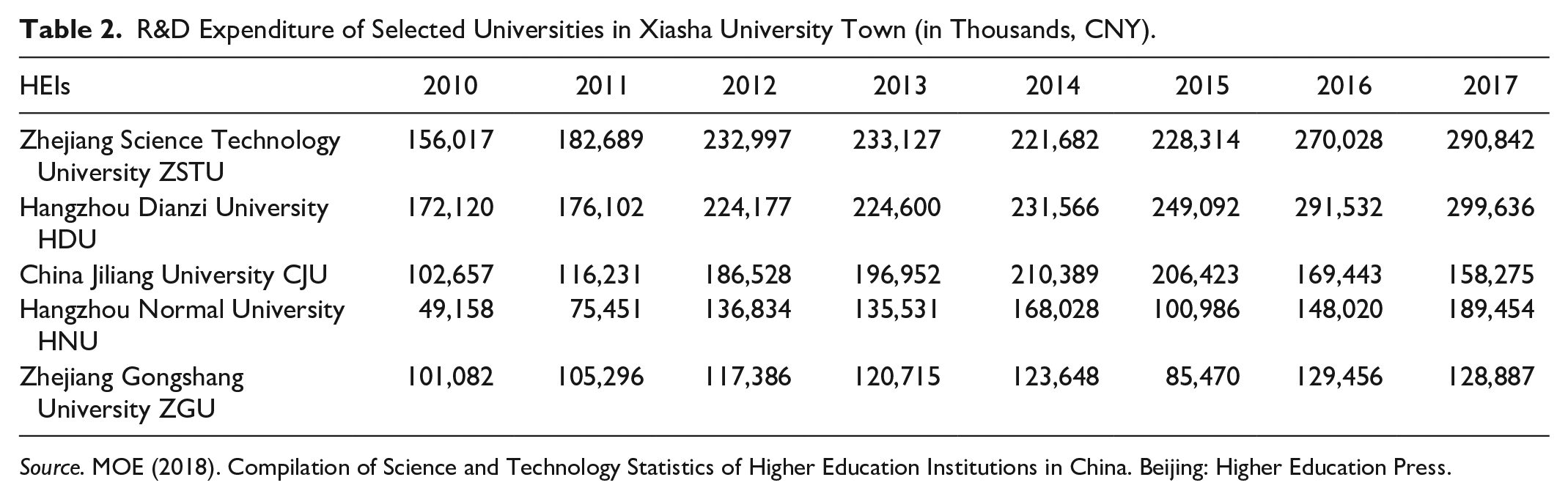
Source. MOE (2018). Compilation of Science and Technology Statistics of Higher Education Institutions in China. Beijing: Higher Education Press.
Collaboration with industries and government is documented in HEIs in Xiasha, where apart from technological parks as detailed below, relations with varied HEIs for talent cultivation and technology transfers is evident.
“Our college has cooperated with Qiantang New District to build several organisations to promote the deep cooperation between our college and local enterprises.”
Other HEIs in Xiasha have also pushed this initiative with industries and local governments. For instance, the Zhejiang Sci-Tech University (ZSTU) signed agreements with local districts in Hangzhou City and Lishui City to promote joint research and development institutes with leading local enterprises, which has resulted in more than a hundred scientific and technological achievements. The Hangzhou Dianzi University (HDU) also established collaborations with 52 local industries and local governments, resulting in three technology transfer centers in the cities of Ningbo, Lishui, and Shaoxin (HEDA, 2018). Additionally, Zhejiang Jiliang has actively pushed for technology transfers where more than 400 collaboration and technological transfers agreements were signed with local enterprises, including more than ten agreements on quality inspection systems, among which include the China Quality Certification Center and Guizhou Provincial Bureau of Quality Supervision (HEDA, 2018).
Also, in terms of industrial relations, the Hangzhou Economic and Technological Development Area and Xiasha have collaboratively developed 12 university entrepreneurship parks (Table 3) to promote technology transfer and encourage teachers and students to start their businesses. With a planning area of 120,000 m2 for such parks, more than half have been used, and more than 270 start-ups have been settled in the entrepreneurship park, of which 80% are created by university teachers and students (Hangzhou Cultural and Creative Industry Office [HZCCIO], 2015).
Examples of University Entrepreneurship Parks in Xiasha University Town.

Source. Compiled by authors.
Additionally, the promotion of entrepreneurship education is seen as a vehicle to promote further regional innovation. The former, coupled with an increase in R&D initiatives linking to entrepreneurial projects, is seen. By the end of 2015, close to 1,400 start-ups were created by university graduates within Xiasha. This initiative has employed more than 7,000 people, adding to broader socio-economic development and has a remarkable 85% survival rate. Moreover, such start-ups initiated by students exhibit an exceptional output value. For instance, one company’s output is valued at over 100 million CNY while another six has over 10 million CNY (HEDA Local Chronicles Editing Committee Office, 2016, p. 106).
Issues in regional innovation
At present, both the national and local governments in China are vigorously promoting the collaboration of enterprises and HEIs to address socio-economic challenges. However, issues in both HEIs and the industry are still present despite the push for more R&D investments. In terms of faculty engagements, there is a hindrance in terms of their willingness to fully participate in actual industry collaborations as individual faculty members or universities’ reputations rely more on national and international reputational systems for establishing research priorities and evaluating performance (e.g., publication in international journals and focus on national discipline priorities). This focus on national and international agendas often sidelines locality and regional needs priorities (Uyarra, 2010). For instance, the “Double First-Class” project in China, which advocates for creating both first-class universities and disciplines, veers faculty staff efforts in pursuing discipline-oriented research as set by the national government, which might not always reflect the contextualized needs of the region. As for industries, the main goal of establishing profits over talent cultivation or research innovations is present (Gong, 2018).
“Affected by the discipline-oriented concept and traditional model of research, HEIs do not have a systematic understanding of university’s role to regional development, the optimisation and upgrading of local industrial structure, the development of local high-tech industry, the comprehensive utilisation of resources and the sustainable development of local economy and society.”
“Many enterprises focus on the short-term development, so they are not every active to participate in the cooperation which may need long-term commitments to show its benefits.”
A mismatch between industries and HEIs are also accounted for. While enterprises are based on markets, pursuing profits and efficiency, universities are said to focus more on talents cultivation and equity, thus defining the diverse nature of both systems (Zhuang, 2018). This issue also prevents a more optimal model between universities and industries which can readily respond to the needs of both sectors.
“The research and teaching of our college does not have much connection with the actual needs of the enterprises. Besides, the enterprises always look to top universities for cooperation, rather than vocational colleges. “
This mismatch is also mirrored in the decreasing R&D expenditure from industries, despite the increase in total R&D expenditure. For instance, for ZSTU’s 61.7 million CNY R&D expenditure in 2014 to only 50.2 million CNY in 2017, CJU’s almost 50 million CNY in 2014 to an estimated 36 million CNY in 2017. Additionally, incomes in technology transfers are also relatively limited. Except for two HEIs, there are negligible incomes in other institutions (Table 4) despite the push for more technological transfers in Xiasha.
Incomes of Technology Transfer of HEIs in Xiasha (in Thousands CNY).

Source. MOE (2018). Compilation of Science and Technology Statistics of Higher Education Institutions in China. Beijing.
Social and Community Development
Providing social services and access to resources
Through community engagement, the university’s third function highlights the increasing focus of education for sustainable development, where HEIs have since placed their role in developing communities surrounding it (Busacca, 2020; Symaco & Tee, 2019). This social responsibility remit is also observed in Xiasha, where improved social mobility is achieved through training the locality in line with the labor skills requirements of industries, relating to the human capital formation target as aforementioned. For instance, the advanced manufacturing industry of HEDA located in Xiasha is gradually transitioning from a labor-intensive to a more knowledge-intensive skills base. HEIs in Xiasha, through its higher vocational colleges, formulate targeted training courses for this new generation of laborers, responding to the operational conditions and need of industries. As a result, this newly trained generation of the labor force can integrate a higher level of knowledge in their workplace, improving their parents’ generation alongside their ability to pursue better career prospects. For example, the Zhejiang Technical Institute of Economics (ZTIE) has conducted various training programs for close to 120,000 laborers. In addition, ZTIE collaborated with the Federation of Labor Unions in HEDA to provide professional skills and quality improvement training and service for the group while offering continuing education for other regional industries through specialized academic degrees or advanced academic degrees (HEDA, 2018).
“Driven by government, the Xiasha Community develops very fast in the past few years (. . .)In such context, the service to community should be planned and relevant to its further development.”
Also, as part of the broader community services, voluntary and community actions are provided in Xiasha, where various Schools of Law in HEIs located within the university town established a Centre that provides free legal services to its population since 2011. Considered as a sub-city of Hangzhou due to its scope, this pro-bono legal services benefits more than 700 industrial enterprises, 14 HEIs and 400,000 people within the district. This service provides free legal assistance on industrial injury compensation, medical and labor-industry disputes, among others. The legal service center also provides internships for college students within the university town. Community services are also evident, for instance, through the outreach programs of the Communications University of Zhejiang (CUZ), where a total of 869 such programs were organized in 2017 and participated by more than 13,000 volunteers (HEDA, 2018). Collaboration with service industries is also maintained, such as Zhejiang University of Water Resources and Electric Power’s (ZUWREP) involvement in the treatment and service of the City’s water. It has set up the “Five Water Treatment” (Wu Shui Gong Zhi) project, where more than 300 faculty staff took part, in addition to over 100 scientific service programs for the City. The ZUWREP continues to expand services for the water industry by developing related water conservancy programs with sectors. In 2017, it organized 60 training programs relating to this cause, with more than 5,000 participants in such programs (HEDA, 2018).
The various university activities also play an essential role in enhancing the cultural development of the region. The concentration of museums within Xiasha also encourages cultural activities. Related activities such as CUZ’s programs invited the Zhejiang Yue Opera Theatre and the Zhejiang Drama Ensemble to provide performances for the academic community and residents alike. Related arts programs like the University Student Arts Festival and the Hangzhou College Student Drama Festival also add to arts and culture appreciation, promoting the “overall popular cultural reputation of a city of region” (Chatterton & Goddard, 2000, p. 491).
Issues in social and community development
Relating to the resource-sharing capacities of HEIs within university towns as aforementioned, the establishment of university libraries in Xiasha has further improved this dimension within its HEIs where eight such libraries utilize such purpose. However, despite this, most facilities are still not open to the general public due to security reasons and the preservation of historical documents.
“More and more citizens call for the opening of university libraries. We also think about it. But we find that there are many risks, such as campus security, library resource occupancy, insufficient management funds and personnel settings.”
Another key concern in the relocation of HEIs in university towns is the possible “dilution” of campus culture due to the more prominent and modernized feature of the new campus, which might bear losing some of the unique cultural characteristics acquired in history (Ye et al., 2014). Apart from this physical dimension, the cultural representations of migrating to an often undeveloped community sever the ties to the broader compact and cultural relations it once had with its old location (Li, 2010), often also compelling the “town” and “gown” scenario which reinforces the divide between universities and the local community (O’Mara, 2012). This divide can also push the lack of engagement of HEIs with the local community, with a less than comprehensive approach also resulting from the lack of priority by the faculty staff
“ There is a lack of planning for service to the community. Most of the activities are quite fragmented. . .”
“The faculty is not motivated to participate in the social service. In the current evaluation system, they are mainly evaluated by teaching and research. The lack of faculty engagement affects the quality and professional of social service.”
Discussion and Closing Remarks
The role of learning regions in broader development highlights the need to further engage HEIs in optimizing this contribution (Benneworth, 2018; Boucher et al., 2003). As exemplified in the idea of learning regions through the establishment of university towns, this paper adopted a tripartite framework of teaching, research and community service (Chatterton & Goddard, 2000) as reflected in the expansion of higher education in Hangzhou, China. Rising from a reclusive and impoverished context, significant economic gains have since been witnessed in the country since its Open Door Policy of 1978. Alongside this change is the push for greater socio-economic development by harnessing the needed human capital resources through relevant HEIs. The massification of HE in China, as aforementioned, has equally led to the rise of urbanization and development of university towns. Propelled by national agendas for development, HE’s role is still well-defined, and the push for greater collaboration with industries is evident.
The function of HEIs in teaching and contributing to human capital skills and development is witnessed in Xiasha, through widening access and more significant resource-sharing mirroring the defining feature of HEIs to “educate through the dissemination of its knowledge base” (Chatterton & Goddard, 2000, p. 484). This context of education provision has seen a shift in regional demands, highlighting highly contextualized local needs from providing the needed specialized technical training to pursuing more significant access to HEIs for broader social mobility of populations. In China’s case, the push for greater advancement has also placed a similar call in its HE sector.
This push for human capital formation, evident in the country’s agenda, is similarly maintained in Hangzhou’s case. The provincial government has actively played a role in developing university towns by issuing relevant education policy. For example, the 10th and 11th Five-Year Planning for the Development of Education in Zhejiang Province clearly define the need to promote university towns. This initiative has elicited a shift from higher education expansion ideals to the construction of new urban centers that will host university towns. The late 1990s saw this drastic move where four university towns were simultaneously developed in Hangzhou, pushing for the ideals of new urban development and increasing Zhejiang’s HE competitiveness as a whole. The provincial government issuance of the “Opinion on Implementing the Construction Plan of Provincial Key Colleges and Universities in 2014” similarly reinforced this notion by allocating special financial resources for selected universities to promote enhanced competitiveness at the national level, the majority (5) of which were located in Xiasha. But despite this, issues in human capital formation and resource-sharing issues still abound, where a more efficient resource-sharing scheme and focused discipline orientation are desired.
“Each university should have their characteristics, rather than develop a comprehensive discipline system. Resource sharing should be strengthened by preferential policy and the improvement of management mechanism.”
This issue is echoed by Chatterton and Goddard (2000), where “making greater provision for more locally-based higher education” (p. 484) is deemed equally crucial over national and international dictated markets. Since locally-oriented courses that are “closely connected the growing industries of regions, can offer graduates greater chances of success and mobility in the regional labour market” (Chatterton and Goddard, 2000, p. 486).
“Scientific planning is needed to cultivate talents. What type of talents does the industry need in the next five years? in which fields? We need to do systematic investigation and demand-analysis. Nowadays there is ‘blindness’ in talent cultivation, and HEIs are lack of autonomy.”
Additionally, the role of research as illustrated through regional innovations in this paper emphasized the role of R&D investments and the significance of industry collaborations with HEIs. Policies that promote cooperation between university towns and the local economy through R&D is stressed. For example, in 2008, the Hangzhou municipal government and the Zhejiang Provincial Education Department signed an agreement for strategic cooperation between the Hangzhou Economic & Technological Development Area (HEDA) and Xiasha, marking the beginning of joint efforts between the city of Hangzhou and the provincial education department in developing industry relations. This agreement has paved the way for all 14 HEIs to establish industrial linkages (Liu & Fang, 2006). Additionally, the “Indigo and Blue Plan” (Qin Lan Ji Hua) was promoted in 2011 to push for innovation and entrepreneurial activities in Xiasha. This Plan encourages and supports experts from universities and scientific research institutes to create start-ups and form patents and other projects in line with the acknowledged contribution of HEIs and industries in innovations and knowledge capital. In essence, the spatial agglomeration of Xiasha university town serves the collection of scientific and technological innovation enterprises or industries driven by knowledge and talents (Zhang & Zhang, 2021). It is vital to enhance the efficiency and effectiveness of communication channels to produce an optimal effect on regional integration and information sharing, thus contributing to improved economic development (Zhang & Zhang, 2021). This case also attributes to an example of a Chinese view of entrepreneurialism, where even in a State-led context, universities can be considered as proactive internally motivated institutions (Ruoppila & Zhao, 2017)
The construction of high-tech development zones and university towns is also consistent with Hangzhou’s master plan and layout. By adopting a polycentric urban development strategy (Zhang et al., 2018), Hangzhou successively established four (4) national development zones in the suburbs in the early 1990s, one of which is the HEDA located in Xiasha. This strategy allows industries to relocate from compact urban centers to the suburbs with the provision of tax incentives, larger spaces and more modern infrastructure while at the same time linking with relevant HEIs (Zhang et al., 2018). The Hangzhou City Master Plan (2001–2020) also acknowledges the need to establish education and scientific parks in university towns such as Xiasha (Hangzhou Municipal Planning Bureau [HZMPB], 2016). But while regional policies continue to encourage more outstanding industrial relations, R&D expenditure and income transfers from industries in Xiasha can be improved. A limited number of statistics in industry investments is available, as exhibited in this paper, with a steady decrease over the years and inactive income transfers from industries despite the policies pushed by the provincial government to support this. The need for better collaboration with different stakeholder is maintained since R&D expenditure from industry allows for integrating the practical challenges by industries to HEIs. At the same time, HEIs can also achieve financial independence through industry contributions (Clark, 1998).
“It is important to establish a governance committee which is comprised of representatives from government, HEIs, industry and community, to take in charge of the coordination of university town and industry, to coordinate the relations among HEIs as well as the resource allocation in the university town, so as to realise the sharing of various resources to the maximum extent. Besides, this committee should also promote the connection between the demand of industry and relevant HEIs.”
This lack of cooperative relations among stakeholders is mirrored through the limited research and development capacity and low rate of knowledge transfer as required by industries in the country (Deng, 2013; Li & Fan, 2012). The need to improve this crucial relationship between HEIs and industries was also recently emphasized when the national government launched the “Implementation Plan of Constructing National Pilots of Industry and Education Integration” in 2019 to construct 50 pilot cities nationally, where industry and education integration is formed in the next 5 years. In effect, the Hangzhou government has pushed for establishing a more coordinated and integrated development between HE and industries (Hangzhou Government, 2020).
Community service is also seen as an integral part of HEIs functions, as explained in this paper where initiatives in Xiasha’s push for greater involvement with localities. Regarded as custodians of cultural assets, HEIs can, directly and indirectly, contribute to the vibrancy of their cities through performance and related activities (OECD, 2008). Its third function in terms of extending community service through the creation of a wider knowledge base, among others, is also noted (Brocka, 2014; Thien, 2021). Facilities that offered public access and organized cultural activities, as seen in Xiasha, university towns can play a more crucial role in promoting social, cultural, and sustainable urban development. Moving forward, greater involvement of HEIs is desired for community engagement as exemplified by stakeholders:
“Xiasha is a young sub-city. The most important thing is to cultivate university students’ sense of social responsibility, making the service to community a part of every students’ university life.”
“The rapid urban construction and industrial transformation of Xiasha may lead to new issues like ecological problems and new inequity. Therefore, service to community should extend from economy-oriented, to a broader scope (. . .) and those who are vulnerable should have the opportunity to access to the service.”
This paper shows that in the course of university town development, HEIs contribute to form a learning region by focusing on socio-economic development through skills, innovations, culture and community. The establishment of a university town on the periphery may also attract students from other regions, thereby contributing to further urban development as aforementioned, which can then have a positive impact on the cultural diversity of increased human capital development of localities (Aagaard Thuesen et al., 2020; Benneworth, 2018; Wang & Tang, 2020). Aagaard Thuesen et al. (2020) also explored the counter-movement as experienced by young students themselves. It is, however, acknowledged that the limited number of interview participants solely focused on the university sector may serve as a limitation, though the existing narratives in government document policies and statistical information provided for a nuanced triangulation of the themes evolving from the interviews. Contextualizing the case of Hangzhou in this paper through Xiasha university town allows us to interrogate the role of greater technical capacities to HE development, among others, with the prime function of the City in developing such facilities for the whole of China. The importance of university towns is also distinct in Hangzhou, given the simultaneous creations of this in the City. This development paves the way for a greater understanding of the focus of such structures and interrogates issues surrounding it, learning from the case of Hangzhou when identifying challenges for other university towns in the country. Its creation is also a new urban development, drawing strength from collaborative partnerships among industries, government and society. Despite the recognized role of teaching, research, and services in learning regions as exemplified in related studies in this paper, we realize the limitations and issues facing this tripartite framework as we investigated university town formations in China. Such challenges allow us to define further necessities needed to ensure that a more collaborative framework to teaching, research, and services is achieved in line with education for development goals.
In recent years, the Xiasha University Town has made full use of its human resource advantage to enhance regional scientific and technological innovation’s competitiveness and increase the endogenous power of economic and social development. For instance, it is estimated that the output value of the high-tech industry accounts for 70% of the total output value in Xiasha (Tong, 2020). However, as in the case with similar cases of clusters of knowledge spaces, there may be obstacles to overcome, such as lack of teaching resources exchange and the need for a more improved interface between HEIs, industries and communities, among others. This case study brings a valuable theoretical contribution to broader education and development literature while also contextualizing further the tripartite functions of teaching, research, and service related to advancement. Additionally, future studies may be done regarding the role of the university town in regional development; this may focus on the specific part of university towns and the sustainable development of a region, or on systems and mechanisms of innovations, which may promote and enhance the clustering effects and integration of universities and industries. A replication of this study in other regions of university town developments in China may also be pursued to highlight highly localized factors that may affect the optimal effect of developments. Defining a learning region through the tripartite framework of teaching, research and service, university towns also allow for “learning organisations (to) emerge and together enrich their various overlapping learning zones or regions” (Duke, 1998, in Chatterton & Goddard, p. 494) while identifying relevant issues in this development allows for the sustainability of practice to flourish.
Footnotes
Declaration of Conflicting Interests
The author(s) declared no potential conflicts of interest with respect to the research, authorship, and/or publication of this article.
Funding
The author(s) disclosed receipt of the following financial support for the research, authorship, and/or publication of this article: The paper is supported by The National Social Science Fund of China (Grant No. 20FJKB011).