



Abstract
This article examines public attitudes on the local innovation system of Shenzhen with a focus on the role of the local government and higher education (HE). Based on data collected from an online platform, Zhihu, this article examines netizens’ perceptions of local government, institutional environment, HE and labour force development. Text analysis reveals that netizens hold relatively positive attitudes towards the local government and the future development of Shenzhen due to its fair institutional environment. Local HEIs needs to be further developed to support Shenzhen’s economic transformation but the close linkage with Hong Kong universities help to mitigate the challenges in human capital supply. This paper presents a novel way of examining public perceptions on local innovation systems and the case of Shenzhen also provides policy lessons to other cities aiming at developing innovation centres.
Introduction
Innovation and entrepreneurship are viewed as an important means for promoting economic growth thus leading to increasing interest in building innovation and entrepreneurship centres among local policy makers (Binz & Truffer, 2017; Filippopoulos & Fotopoulos, 2022; Schumpeter, 2000). Since early 21st century, governments around the world have devoted considerable efforts in promoting innovation and entrepreneurship. Represented by the triple helix theory and quadruple helix theory, innovation system theorists identify the linkage among government, industry, HE, and civil society to be important in building local innovation systems (Carayannis & Campbell, 2014; Etzkowitz, 2008; Leydesdorff, 2012). Empirical research by using data from panel survey and industry suggests the abundance of smaller firms, cheap labour supply, educated workers, and favourable climate to be positively associated with entrepreneurial city and regional economic growth (Kaplinsky & Kraemer-Mbula, 2022; Samila & Sorenson, 2011). The importance of HE to local innovation systems was thus highlighted by both researchers and policy makers. While extended research has explored the relationship between different sectors in developing local innovation systems, few research has tried to analyse the topic from the public opinion’s perspective. Understanding the public voices and perceptions are important as it allows policy makers and researchers to identify issues in current system and to develop strategies to better address public concerns (Bendz, 2017). Nonetheless, theoretical discussions of governing the local innovation systems have often relied on evidence from official statistics or citizen surveys. Such research methods are ineffective in approaching demographic groups and social topics that are usually underrepresented in panel surveys. This article thus aims to contribute to extant literature by focusing on analysing public attitudes towards the local innovation system of Shenzhen by using data gathered from social media.
More particularly, this article focuses on two specific aspects in Shenzhen’s local innovation system: the role of the local government, and opinions towards the innovation ecosystem in general. Using 453 online posts obtained from Zhihu, China’s most popular Q&A platform, this article aims to examine how people perceive the local innovation environment of Shenzhen, with a particular focus on public policies issued by the municipal government. Using social media data to support social science research has become an increasing trend (e.g. Anderson et al., 2017; Zhu et al., 2019). Given its volume and coverage, social media can compensate for the shortcomings of traditional data collection methods and have been increasingly used to support findings of research from different disciplines (Coppola & Mondola, 2012; Zhu et al., 2019). In comparison with regular surveys, social listening can better approach demographic groups and social topics that are usually underrepresented in panel surveys (Cole-Lewis et al., 2015).
This paper chooses Shenzhen for analysis as the city has been China’s pilot site since 1978. Shenzhen is viewed as China’s entrepreneurial city and its local HE system viewed rapid development in recent decades. A recent survey from Lingnan University shows that 62% of Shenzhen residents have a strong sense of belonging to their community and around 90% of them view Shenzhen as an innovation centre (Lingnan University, 2020). However, there is no research on public’s view on the separate aspects of Shenzhen’s innovation system. This paper contributes to the existing literature by exploring the netizents’ views on the government, institutional environment, and HE and labour force development. The next section further introduces the local innovation system in Shenzhen. Thereafter, the paper summarises the theoretical debates on the role of governments in developing innovation centres and introduces the analytical framework guiding data collection and analysis. After presenting the data collection and analysis methods, the main findings are discussed. The paper concludes by highlighting its theoretical and practical implications. The limitations and future research directions are also discussed.
Literature Review
Local Innovation System in Shenzhen
Key Policy Documents and Initiatives Issued by Shenzhen Government to Promote Innovation Centric Development.
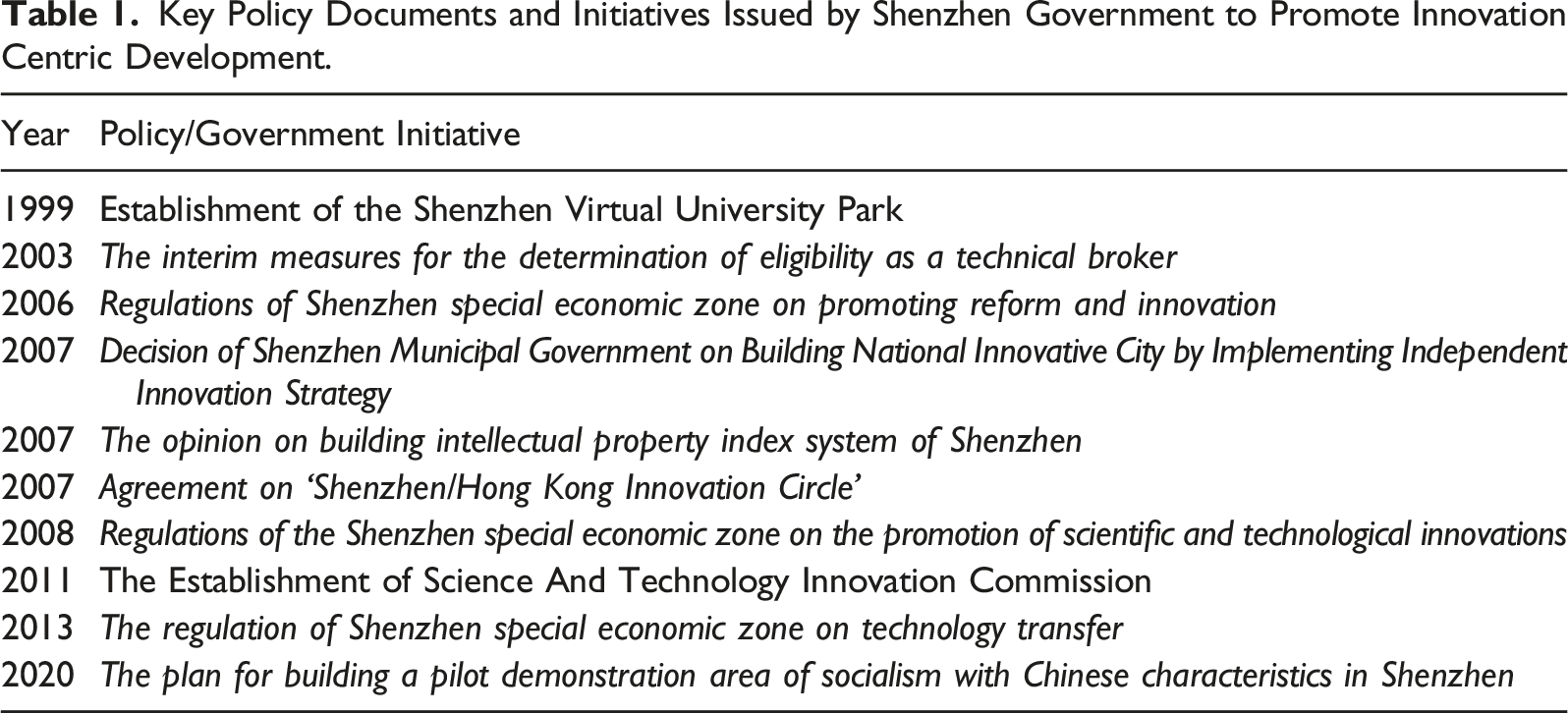
The first theme of Shenzhen government’s pro-innovation policies is to eliminate intuitional barriers for ‘concerted action' of different stakeholders (Kuhlmann & Rip, 2018). The active private sector and autonomy of local governments in the implementation of policies allow Shenzhen government to reform local institutional systems with a focus on encouraging different stakeholders to proactively participate in the development of the innovation-centred system. In February 2019, the central government published its plan to develop the Hong Kong–Macau–Guangdong Greater Bay Area to promote technology, innovation and economic vibrancy (State Council, 2019). The blueprint aims to develop the Greater Bay Area, which consists of nine cities in Guangdong Province and two Special Administration Areas (SARs) under the ‘One Country, Two Systems’ principle, into a counterpart of Silicon Valley by 2035. The development focus of Shenzhen is to transform the city from the ‘bridgehead’ of China’s reform and opening-up to a global innovation and entrepreneurship hub. In August 2019, the central government further announced its plans to turn Shenzhen into a national pilot demonstration area and offered greater flexibility to support its development (State Council, 2019).
The second theme in Shenzhen is to develop local higher education sector. With the development of knowledge economy, universities are increasingly viewed as key actors in promoting local innovation development through knowledge transfer and technology development. The compressed development of Shenzhen makes higher education an underdeveloped sector. Over the past decades, Shenzhen government issued a substantial portion of policies to attract universities from other cities to collaborate with Shenzhen through setting branch campuses or research institutes while investing greatly in its local universities. As of the year 2021, there are 14 universities in Shenzhen while only 3 are local independent institutions.
Talent attracting is another pillar of Shenzhen’s innovation related policies. Because of the limited educational capacity of the local universities, Shenzhen’s industry and business sectors have a heavy reliance on educated workers from other cities. Data from Shenzhen government suggests that around 70% of the population in Shenzhen are non-local, which makes Shenzhen a city of migrants in China (Shenzhen Statistical Shenzhen Statistics Bureau, 2019). Shenzhen government introduced its leading talent-attract plan, the Peacock Project (Kong Que Ji Hua), to attract high-level overseas talents and professional teams to work in Shenzhen in 2011. The Project provides financial incentives, housing benefits, and long-term residential permits to selected candidates.
In 2015, Chinese central government introduced two national initiatives, the Massive Innovation and Entrepreneurship initiative and Made-in-China 2025, with the aims to boost technological innovation, stimulate industrial growth and strengthen employment (State Council of China, 2015, 2017). Shenzhen has been put under the spotlight as China’s entrepreneurial city and the frontier of reformation. Realising the limitations of its past resource intensive development pattern, Shenzhen government has been seeking to transform the city from a manufactory hub to an innovation centre. With the above-mentioned initiatives, Shenzhen has become an emerging innovation power in the region, providing an ideal site to learn governance of innovation systems in China and East Asia. Although Shenzhen government has been actively promoting innovation since 1990s, how public perceive the policies remain unknown. The case of Shenzhen is of important because it offers critical reflections on governance transformation in fostering innovation and entrepreneurship (Mok et al., 2020). Shenzhen used to be the gateway city that links mainland China to the rest of the world and the frontier city in China’s economic reform and opening-up and it continues to serve as a favoured pilot site for China’s reform policies given its ‘charter city’ status (O’Donnell et al., 2017; Romer, 2010). The case of Shenzhen is therefore of importance to not just China study scholars, but also policy makers and social policy specialists interested in innovation policy studies.
HE and Local Innovation Systems
Based on their different focus and scope, literature on innovation systems can be divided by national, regional, or sectoral boundaries (Cooke, 2001; Diercks et al., 2019). At first innovation was viewed as a linear process of knowledge transaction from higher education institutions (HEIs) to industry and the related literature focuses on the interplay between firms and other agents involved in innovation (Lundvall, 1992). With the development of globalisation, there is increasing interest in the competition of different systems and the governance of innovation systems. Cooke et al., (1998) argues that in the international context, there are three different governance types of local innovation systems: grassroots, network, and dirigiste. In the grassroots model, innovation is a result of the market driven system with little government intervention and coordination. In contrast, in a dirigiste system, the central government plays a leading role in the development of the system. The network model represents a more collaborated type of innovation systems where multi-level networks were established to coordinate actions and agreement between different actors and governments at different levels.
The innovation system theory was further developed the by the triple helix theorists by configuring the changing dynamics between government, industry, and HE (e.g. Cai & Etzkowitz, 2020; Etzkowitz, 2008; Leydesdorff, 2016). In the triple helix perspective, the role of government differs greatly among innovation systems because of the dynamic among agents. In a state-dominated model, a strong state exists to encompass the academia and industry through direct or indirect policy interventions. The model was exemplified by the innovation system of France during 1980–2000, the Soviet Union and that of Cuba and Brazil in the era of the military regime (Senz, 2008). The laissez-faire model is characterised by the separation of the three spheres. Clear institutional boundaries exist amongst industry, university and government, and they only interact with one another modestly when necessary. Industry takes a leading role in this model while all agents having distinctive institutional roles. Unlike the former two models which emphasise the primacy of a certain institute, the triple helix model focuses on the overlay of the three institutions. The triple helix model emphasises the permeability of institutional boundaries and the emergence of hybrid organisations, which encompass the elements from university, industry and government (Ranga & Etzkowitz, 2013). The interaction and overlay may take the form of personal circulation, information exchange and other institutional collaborations (Etzkowitz, 2008; Leydesdorff, 2000).
A question the triple helix theory fails to answer is under what circumstances can increased interactions across spheres lead to synergies (Leydesdorff, 2016). Carayannis and Campbell (2009) proposes to introduce the civil society as a helix of innovation systems and addressing the importance of the ecosystem that the helices working in, thus forming the quadruple helix model. The quadruple helix model places particular emphasis on cooperation in innovation within systems. More significant considerations were also given to the importance of environment and ecosystems (Carayannis et al., 2018).
The above elaboration on related literature suggests the relationship between government and innovation systems can be understood from policy perspective, political perspective, and institutional perspective. General governance arrangements in promoting local innovation system development include visionary blueprints, human resource mobilisation, network formation, and legitimation (Bergek et al., 2015; Sandén & Hillman, 2011). Given the special characteristics of Shenzhen reviewed in section two, it is important to analysis the institutional dimension and human resource dimension in the innovation system of Shenzhen with a particular focus on the role of the government. This paper thus chooses to focus on the online attitudes towards the institutional environment and labour force development in Shenzhen.
Data and Method
There is an increasing volume of literature studying public opinions on key social issues (Berens & Gelepithis, 2019; Buss, 2019; Kühner & Chou, 2020) but the public’s attitudes on innovation system development received relatively little attention. Moreover, most of the extant literature use citizen survey to evaluate people’s perceptions on certain issues and policy, which has shortcomings in understanding topics that are under-represented in the survey. This paper chooses social listening as the research method to explore public perceptions on Shenzhen government’s initiatives to build the local innovation system. Such a method can better recap public perceptions on the government and its policies as some Chinese residents might feel uncomfortable with such topics in face-to-face interview or written survey. Data from social media can be a more effective means in finding people with relevant experiences. Zhihu was chosen for this research for three reasons. Firstly, Zhihu is the most popular Q&A website in the Chinese community. As of 2018, Zhihu has over 220 million registered users, 30 million questions and 130 million answers. Over 84% of its users are under 35 years old and around 80% have at least HE diploma, thereby providing rich amounts of data for this research (Tech.Sina, 2018). Secondly, the contents of Zhihu are topic oriented, thereby making this social media meaningful for the content analysis. Thirdly, Zhihu allows users to post longer texts compared with other popular social media in China. For example, Weibo, the Chinese version of Twitter, imposes a word limit of 140 for common users.
Strategic keywords were used in Zhihu to collect relevant questions and answers from all publicly available posts. The data collection began by searching for iterative questions that include the keywords chuangxin, chuangye and Shenzhen. Chuangxin and chuangye, which means ‘innovation and entrepreneurial’, is the root of various concepts relating to innovation and entrepreneurship in Chinese. For example, entrepreneurs are called chuangye zhe, whereas incubators are called chuangye yuanqu. Questions containing at least one answer were saved, and all answers under these questions were collected using R.3.6.2 followed by a manual refinement to remove irrelevant posts, government posts and advertisements by agents. A total of 453 posts from 50 questions were retained for further analysis in June and July 2019. Manual content analysis was performed by using R.3.6.2 and AntConc 3.5.8.0. Specifically, the original Chinese posts were segmented by R for thematic analysis in AntConc. After removing irrelevant and government posts from the dataset, more than one million words from the 453 answers were retained for further analysis. All the posts were assigned a code to indicate their sources. For example, the code for the first post under Question One is Q1A1 and the third post under Question two is Q2A3. Thematic analysis was conducted after data cleaning. The next section reports the opinions of Zhihu users on different aspects of local innovation system in Shenzhen based on the data analysed.
Online Opinion Towards Local Innovation System
Local Government
The attitudes of netizens towards local government were measured in three steps. Firstly, all posts containing the terms ‘policy’ and ‘government’ were collected by using the concordance tool in AntConc. Secondly, these posts were tagged either ‘positive’ or ‘negative’ according to their contents. Those posts with contents unrelated to Shenzhen were tagged as ‘irrelevant’. Some posts can have more than one tag if several aspects of government or policy were mentioned. The table below summarises the distribution of different attitudes towards the Shenzhen government and policy.
As shown in Table 2, netizens generally hold a positive attitude towards the Shenzhen government and policy in their posts. Amongst the 66 relevant posts, 59 showed a positive attitude towards the local policy. The strong proactive attitudes towards Shenzhen government can be ascribed to two reasons. Firstly, similar to every website and social media in the mainland, Zhihu is subject to Internet censorship by the Chinese government. Therefore, some anti-government comments may not be viewable to the public, and some netizens may self-censor their posts before their publication. Secondly, the analysis reveals that most netizens perceive the Shenzhen government to be better than other local governments in the mainland. What entrepreneurs need is not government support. The best support don’t set too much administrative barriers. The Shenzhen government is quite efficient. At least it is much better than Beijing. If you don’t believe in me, try to register a company in Beijing (Q1A1). I would prefer Shenzhen… it is friendly to people from other places. Compared with the other three cities (Beijing, Shanghai and Guangzhou), guanxi plays a less significant role in Shenzhen (Q48A3). Attitudes of Netizens Towards the Shenzhen Government and Policy.
Frequency of Geographic Locations Mentioned in the Posts.
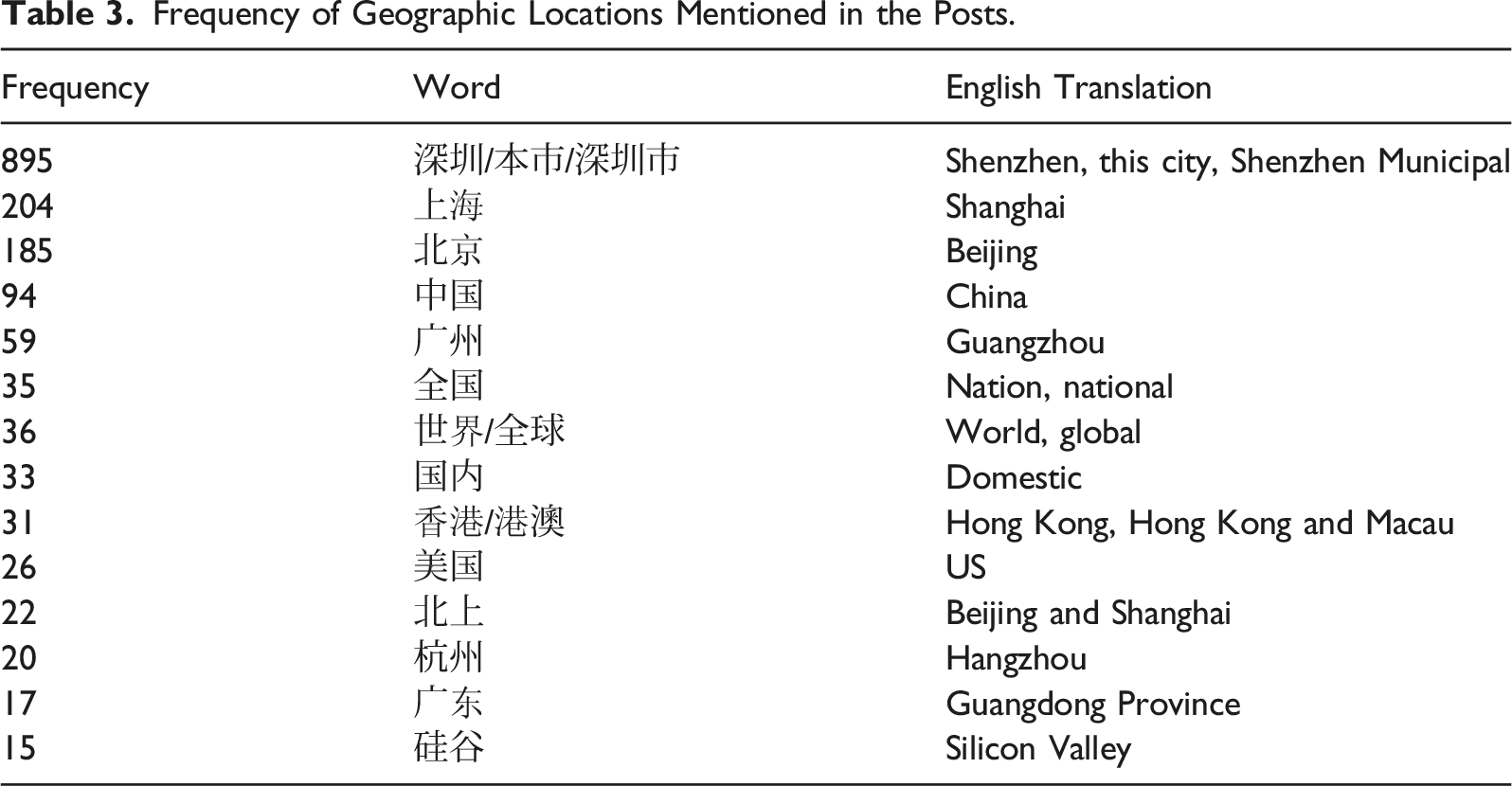
The geographic location and SEZ status of Shenzhen were identified as two factors that contribute to its policy advantage. Local entrepreneurship policies were praised for their broad coverage and efficient implementation. Some of these affirmative posts are presented as follows: As an SEZ, Shenzhen has a more liberal policy environment compared with other Chinese cities (Q10A14). Shenzhen has a developed policy system that covers every important stage in entrepreneurship (Q2A5).
Two major characteristics of the Shenzhen government were identified from these posts, namely, ‘generous in offering stipends’ and ‘efficient in facilitating a good regulatory environment’. There are many pro-entrepreneurial policies in Shenzhen. Anyone graduated from university within five years can apply for an entrepreneurship stipend ranging from 50,000 to 300,000 yuan and can apply for an interest-free loan of up to 3 million yuan (Q20A2).
These characteristics were supported by data from a large-scale survey of Shenzhen residents. Specifically, more than 68% of the survey respondents answered that if they had to live anywhere in the world, they would choose to live in Shenzhen (Lingnan University, 2020). As mentioned in the previous chapters, the Shenzhen government was the first local government to issue pro-entrepreneurship policies in the mainland. Since the 2000s, a great number of policies were issued by the Shenzhen government to provide financial and institutional support for potential entrepreneurs. Given the city’s goal to transform itself from a labour-intensive economy to a knowledge-intensive one, the municipal government has increasingly encouraged innovation-centric entrepreneurship. A pro-entrepreneurship environment that actively involves the government, HEIs, industry and society was developed as a result of these efforts (Kang & Jiang, 2020).
Whilst some posts have praised Shenzhen for its policy advantages, some netizens also voiced out their concerns regarding the sustainable development of Shenzhen and questioned whether the city can retain its policy advantages after 40 years. I don’t think Shenzhen has any advantage when competing with Beijing, Shanghai, Guangzhou or even Suzhou. It used to have some policy advantages, but now they do not exist anymore. Tianjin is developing so fast through its heavy investments, whilst Shanghai is building a free trade zone, but what about Shenzhen? It has lost its policy advantages in promoting entrepreneurship even within Guangdong Province. Other cities, such as Zhongshan, has more advantages in doing that. Once Shenzhen’s export-oriented economy slows down, its economic validity and potential will be challenged (Q1A11).
The economic success of Shenzhen during the early years of the reform is a combined result of its geographic advantage and political freedom brought by its SEZ status (Chen & Kenney, 2007). During that period, only few cities were able to implement a large number of market-oriented policies. However, after 40 years of economic reform, almost every city in the mainland opened their doors to foreign companies, whilst their respective local governments were able to adopt flexible measures in controlling their economy. Therefore, the comparative policy advantage brought by its SEZ status may no longer holds.
Institutional Environment
A key concept in understanding the institutional environment in Chinese context is guanxi, which is often viewed as a product of specific historical and institutional arrangements that are linked to resource exchange (Michailova & Worm, 2003; Nee & Opper, 2012; Walder, 1986). The analysis of the netizens’ comments reveals that guanxi is believed to play a less influential role in Shenzhen. Most of the posts praised the entrepreneurship environment in Shenzhen given the much fewer guanxi practices in the city compared with other cities. Likewise, most of these posts compared Shenzhen with other mainland cities instead of international ones. When discussing which mainland city is better for young entrepreneurs, one netizen shared, I would prefer Shenzhen… it is friendly to people from other places. Compared with the other three cities (Beijing, Shanghai and Guangzhou), guanxi plays a less significant role in Shenzhen (Q48A3). Shenzhen is more friendly to young people… guanxi is more important in Beijing. After all, it is a place filled with bureaucrats. (In Beijing) it would be easier to do anything if you have guanxi (Q13A8).
However, some informal practices persist through guanxi. Both the following posts are about registering public bank accounts in Shenzhen. The first post (Q12A8) complaints that banks require too many documents to open a public account, while the second one (Q10A5) reveals that this requirement can be waived if one is willing to pay a guanxi fee. Informal practices facilitated by personal networks or guanxi have historically served an important role in the Chinese economy and politics (Saxenian, 2003). Companies having guanxi with the local government are more likely to receive favourable treatment and win government contracts. The use of guanxi here is instrumentality driven because guanxi acts as an instrument that facilitates monetary transactions and enables administrative convenience. If you’re going to start a business in Shenzhen, you would first find it very difficult to register a public account for your company. It requires a rental contract, certificates issued by the house management office and electricity bills etc.… (Q12A8). If you want to register a public bank account for your company, you need to present an official rental contract to the bank. If you don’t have one, no worries, you can find an agent to do that for you. Of course, you need to pay a guanxi fee for that. The cost depends on which bank you are applying for. They charge differently (Q10A5).
As a common practice, most banks require applicants to present an official rental contract before they can register public bank accounts. Some banks may also require applicants to provide billing statements. However, many SMEs do not have all of these documents because they rent self-built houses that do not have property deeds. Self-built houses, illegal buildings or chengzhongcun are special characteristics of Shenzhen that have attracted increasing attention from social science researchers (e.g. Bach, 2010; O’Donnell et al., 2017). The inability to provide an official rental contract has become a significant barrier of disadvantaged groups in Shenzhen (Goodburn, 2015).
HE and Labour Force Development
List of HEIs in Shenzhen.
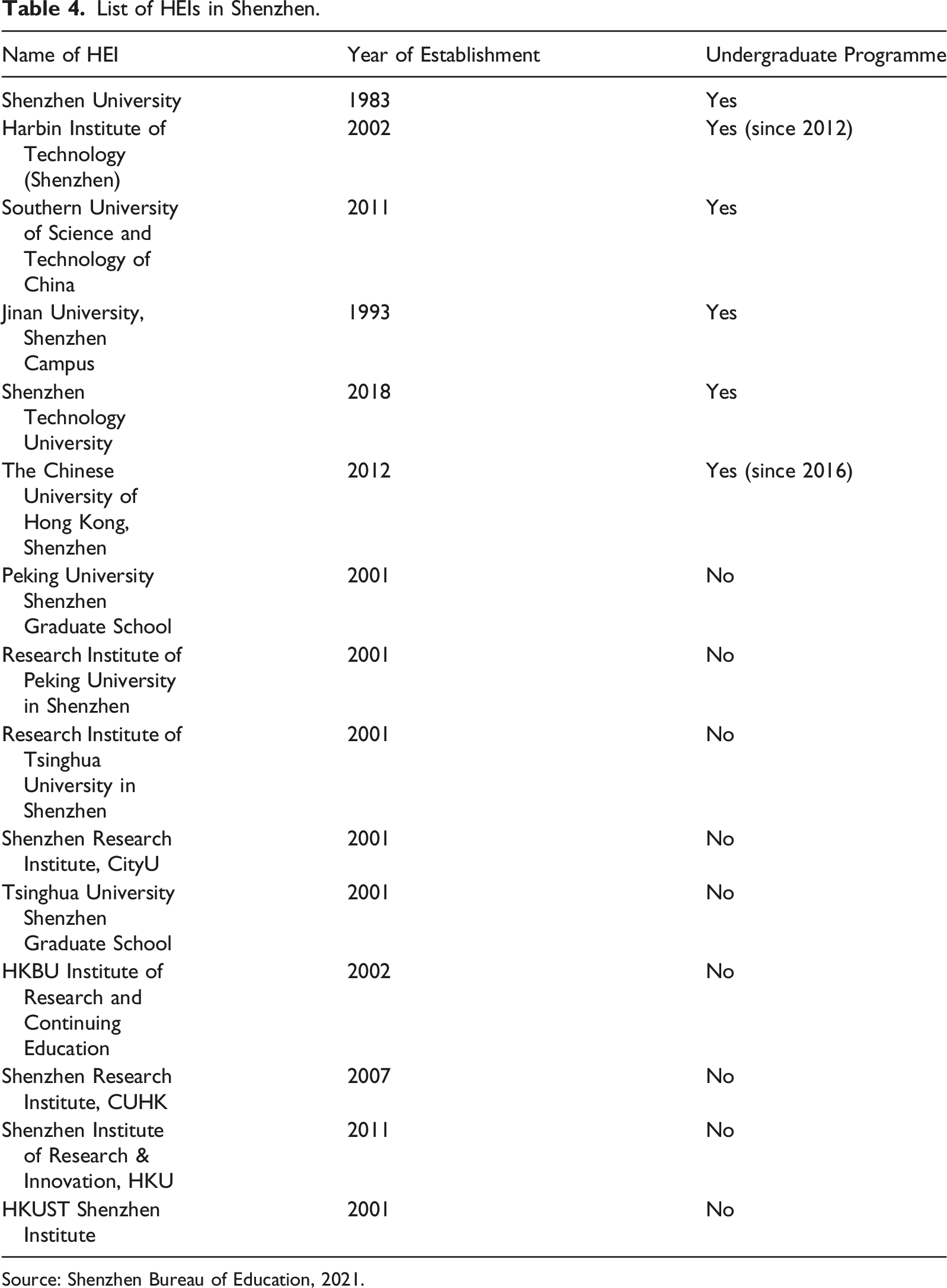
Source: Shenzhen Bureau of Education, 2021.
In addition to the academic exchange and talent flow facilitated by institutional cooperation, university graduates from Hong Kong, specifically those from the mainland, serve as important cross-border flow of human capital. Hong Kong is a favoured destination of students from mainland China for studying abroad. As of academic year 2018 to 2019, 101,797 students were enrolled in UGC-funded programs in the eight public universities in Hong Kong and among them, 12,322 were mainland Chinese students (UGC, 2019). Moreover, a significantly high number of students were enrolled in self-funded programmes. The influx of students from the mainland contributes to Hong Kong’s talent pool as the local society faces serious ageing issues, and the return of these students to the mainland after their graduation promotes a knowledge circulation amongst Hong Kong, Shenzhen, other mainland cities and the rest of the world.
The analysis of Zhihu data also reveals that netizens agree lack of leading universities is a barrier for the development of innovation system in Shenzhen as universities are valuable in talent attracting, research conduction, and knowledge transfer. In a post which compares the innovation systems of Shenzhen and Beijing, a netizen shared the difficulties faced by Shenzhen based start-up in labour force development: Shenzhen does not have well-known universities thus it does not have continuous supply of human capital. It’s difficult for start-ups to find ideal talents as the top talents come to Shenzhen for TenCent or Huawei only (Q1A17). Without top universities, where comes top research outputs? Without top research, where comes leading high-tech industry? DJI is viewed as a representative of Shenzhen’s high-tech industry, but its technology and founder originate from Hong Kong (Q17A2).
The second post further points out that lack of strong local universities will constrain the future development of Shenzhen’s innovation system. Because the local universities need further development to meet the demand for educated labour force, the development of Shenzhen largely relies on people migrated from other cities. Shenzhen portraits itself as an urban city with open and inclusive environment for migrants. However, the analysis of the online discussions shows rising housing price undermines Shenzhen’s attractiveness to young people. As of 2019, Shenzhen has the most expensive housing prices in the mainland and has been classified as one of the top five cities in the world with the most expensive housing (Financial Times, 2019). In accordance with the existing literature, many netizens identified rising costs as a barrier that prevents entrepreneurs from moving to the city: If we don’t consider its housing prices, Shenzhen is a heaven for start-ups. Unfortunately, the housing prices in Shenzhen are so high that even Huawei can’t afford them (Q17A27). Shenzhen has great entrepreneurship policies, and many of its people have an entrepreneurial spirit. However, living in the city produces too much stress that it damages an individual’s long-term development (Q11A3).
The rising housing prices in Shenzhen influence not just rent but also labour prices, thereby significantly increasing the financial burden of start-ups and giant companies. Therefore, setting up branch offices in neighbouring cities with significantly lower living and rental costs has become an increasingly common practice amongst companies in Shenzhen. In 2018, one of the city’s leading enterprises, Huawei, moved its R&D department from Shenzhen to a neighbouring city along with thousands of other SMEs (Chai, 2018). This move is commonly viewed as a warning to Shenzhen because of its soaring housing prices, which led many people to believe that the city is too expensive to be competitive.
However, leaving Shenzhen is not an easy decision to make. The city has good regulatory environment that is hardly to be seen in other mainland cities. The concentration of human resource and well-developed transportation system are also mentioned as advantages that reduces the cost. Enterprises that choose to move to other cities can experience difficulties in recruiting educated workers because young people are not willing to move away from the metropolis. Senior and newly recruited local workers do not have the required technical knowledge, thereby threatening the quality of products. Moreover, the institutional environments in small cities greatly vary. Local governments are usually inefficient in handling enterprise applications and securing administrative approvals may take a long time. Giant enterprises, such as Huawei, usually have high negotiating power with the local government. Therefore, they usually enjoy the favourable treatment deprived from most SMEs. Driven by these factors, few SMEs leave Shenzhen. Some netizens also view rising housing prices and regulatory requirements as advantages that benefit Shenzhen’s local development because low value-added industries are more likely to be influenced by these factors. The self-built houses in Shenzhen also help lower the labour costs in the city as they provide affordable housing in the city centre. Rising costs work as a filter that kick high-pollution industries out of Shenzhen. It is good for the city’s development in the long run (Q10A22). There are lots of self-built houses (chenzhongcun) in Shenzhen that significantly reduce the housing costs for employees and help employers lower their costs (Q1A40). Shenzhen government is supportive while governments in other cities might set excessive barriers to enterprises, which will cause great financial loss (Q1A10).
Discussion and Conclusion
The case of Shenzhen offers policy lessons for cities aiming to promote innovation-centric entrepreneurship. The above analysis shows that the Shenzhen government plays a strategic role in facilitating knowledge synergies amongst different agents. The government works as a generous resource provider for the development of local HEIs and has shown increasing efforts in improving its role as service provider to both its enterprises and citizens, thereby presenting an example of multiple network governance (Mok et al., 2019). Like other metropolises, Shenzhen lost its advantage in cheap labour after urbanisation and the rising real-estate price is pushing migrants and enterprises away, but the city maintains its attractiveness to young graduate entrepreneurs by creating an efficient institutional environment. A survey on Hong Kong people’s opinions on the Greater Bay Area shows that 44.7% of the Hong Kong youth prefer to work in Shenzhen than in other Mainland cities (Mok et al., 2019). Despite these advantages, Shenzhen still faces several challenges in achieving its goal of becoming an international innovation centre.
Knowledge production in Shenzhen is dominated by industries, where enterprises are the major performers and funders of R&D activities. Despite the government’s efforts to develop local HEIs, universities in Shenzhen require further development to gain international recognition and meet the local demand for educated workers. At its current stage, knowledge production in Shenzhen largely relies on human capital flow from other cities. Shenzhen has been successful in attracting talents from other cities. However, the inflow of migrants and the rapid economic expansion have introduced other issues, such as rising housing costs and living expenses. Specifically, the average trade price for new housing units increased more than twofold from 20,205 yuan per square metre in 2010 to 54,120 yuan per square metre in 2018. These rising costs have pushed individuals and enterprises away from the city.
Although the Shenzhen government has generously provided financial incentives to attract professional talents and experts into the city, the rising costs are pushing away those at the lower end of the labour market and are expected to influence those at the upper ends as well. In 2010, Shenzhen witnessed a decline in its percentage of population without a local hukou for the first time in its contemporary history. One of the city’s leading enterprises, Huawei, moved its R&D department to a neighbouring city along with thousands of other SMEs (Chai, 2018). Moreover, the local innovation system of Shenzhen heavily focuses on science and technology whilst ignoring social sciences and the arts. Solely relying on technology is not enough to transform the city from a manufacturing centre into an innovation hub. Although the Shenzhen government may have greater autonomy compared with other local governments in China, the centralised political system of China grants local autonomy to the central government. Recent studies on HE in China highlights an increasing control of the CCP over universities (Jarvis & Mok, 2019), thereby stifling their innovation and creativeness. Shenzhen should ensure the sustainability of its R&D investments, maintain its attractiveness to foreign talents and enterprises and invest in local culture and soft science development to sustain its growth. The development challenges faced by Shenzhen suggests the need for policies to be better designed and implemented to ensure the sustainable development of innovation-centric entrepreneurship in other cities.
Government is identified as a determinate of local innovation performance by both National Innovation System Theory and Quadruple Helix System Theory (e.g. Carayannis et al., 2018; Freeman et al., 1988). Most of the extant literature confine the analysis in policies that more or less directly link with economic growth, such as knowledge transfer, tax incentive, institutional arrangements, and labour force development policies (Gibbons et al., 1994; Lundvall, 1988; Machin & Vignoles, 2015). In contrast, the importance of social policies, such as housing and work protection, are much less emphasis in current frames for innovation system analysis. By working together with leading HEIs in the region, such as its neighbouring city Hong Kong, Shenzhen attracts young talents from different parts of the country. However, this study also shows rising housing cost and mental pressure of metropolis life can be influential barriers to successful innovation and entrepreneurship, indicating the need to extend current frames of innovation policy by taking into account social policies. In sum, although Shenzhen may have lost some advantages brought about by its political and economic status, the city remains a hot area for innovation and entrepreneurship. Despite the growing pressure faced by enterprises and individuals, netizens hold positive attitudes towards the local government and the future development of Shenzhen due to the institutional and social environment in the city, which provides policy lessons to other cities aiming to develop innovation centres.
This paper has explored the public opinions on local innovation system of Shenzhen through online data. It provides empirical evidence to support existing literature on the role of different sectors in the innovation systems in Mainland China. The social listening method improves the transparency of data collection, which is usually viewed as a weakness of qualitative research. It is also more effective in reaching topics and social groups that usually underrepresented in panel surveys. However, it is worth noting that there are some shortcomings relating to the methods. First, the findings are based on posts before July 2019. Therefore, the comments were made based on the local system on and before that time. The social movement in Hong Kong and the COVID-19 pandemic since the Autumn of 2019 have changed many aspects of the local social political environment. This paper offers valuable data to understand the development of HE and local innovation system in Shenzhen before 2019. Second, changes in attitudes cannot be tracked to evaluate the influence of specific policies because of the volume of data. Last, data-driven research usually cannot explain the causal mechanism. Future research may consider using carefully designed experiments to explore the casual mechanism and the impacts of specific policies.
Footnotes
Declaration of Conflicting Interests
The author(s) declared no potential conflicts of interest with respect to the research, authorship, and/or publication of this article.
Funding
The author(s) received no financial support for the research, authorship, and/or publication of this article.