




Abstract
Quantitative reverse transcription PCR (qRT-PCR) is a valuable tool for characterizing the effects of inhibitors on viral replication. The amplification of target viral genes through the use of specifically designed fluorescent probes and primers provides a reliable method for quantifying RNA. Due to reagent costs, use of these assays for compound evaluation is limited. Until recently, the inability to accurately dispense low volumes of qRT-PCR assay reagents precluded the routine use of this PCR assay for compound evaluation in drug discovery. Acoustic dispensing has become an integral part of drug discovery during the past decade; however, acoustic transfer of microliter volumes of aqueous reagents was time consuming. The Labcyte Echo 525 liquid handler was designed to enable rapid aqueous transfers. We compared the accuracy and precision of a qPCR assay using the Labcyte Echo 525 to those of the BioMek FX, a traditional liquid handler, with the goal of reducing the volume and cost of the assay. The data show that the Echo 525 provides higher accuracy and precision compared to the current process using a traditional liquid handler. Comparable data for assay volumes from 500 nL to 12 µL allowed the miniaturization of the assay, resulting in significant cost savings of drug discovery and process streamlining.
Keywords
Introduction
Hepatitis C virus (HCV) drug discovery efforts at Merck are supported by a quantitative reverse transcription PCR (qRT-PCR) TaqMan assay that measures the replication of an HCV replicon expressed in human hepatoma cells (Huh7). qRT-PCR is the most sensitive method for the detection of low-abundance messenger RNA (mRNA); it specifically and precisely measures the amount of a target sequence in a reaction, even in cases when very few copies of the target gene are present in the sample.
Recently, improvements to qRT-PCR sample preparation reagents and acoustic liquid-handling technologies have decreased the total reagent volume, reduced consumption of labware, and streamlined drug discovery processes via automated workflow. This was critical in reducing the total cost of the drug discovery process.
qRT-PCR uses fluorescent dyes to detect and quantitate the accumulation of PCR products in real time. In this study, modified forms of the genome are able to replicate to high levels in human hepatoma Huh7 cells.1,2 This assay was run at a volume of 12 µL in a 384-well format on a ViiA 7 Real-Time PCR System (Applied Biosystems, Foster City, CA). The new OptiFlex filter system within the ViiA 7 Real-Time PCR System provides enhanced fluorescence detection, facilitating more sensitive data analyses. 3 The additional use of the TaqMan RNA-to-Ct 1-Step Kit (#4392656; Applied Biosystems) achieves simplified protocols with a homogeneous and highly sensitive qRT-PCR reagent; therefore, low copy number detection and precise quantification can be measured.
The Echo 525 is designed for rapid transfer of nanoliter volumes of aqueous samples and reagents, including cell lysate and master mix (MM) containing primer-probe sets. This Echo model uses focused acoustic energy to dispense 25-nL increments of liquids. Accurate and precise transfer of nanoliter volumes is essential for assay miniaturization and economic efficiency.5,6 Superior volumetric precision ensures excellent Ct determination, despite instances with very little target DNA in low reaction volumes.
This study compared the current protocol using the BioMek FX with a reduced-volume workflow using the Echo 525 liquid handler. Cells were grown in tissue culture plates, treated with inhibitors via 20-fold dose–response curves, and lysed. Varying volumes of lysate and MM were then transferred using either the BioMek FX or the Echo 525 liquid handler into 384-well PCR plates. The purpose of this study is to demonstrate that reduced qRT-PCR volumes yield equivalent results and to confirm the advantages of using the Echo 525 liquid handler for high-throughput qRT-PCR in 384-well formats.
Materials and Methods
Replicon RNA level was measured by qRT-PCR,1,10 using the TaqMan RNA-to-Ct 1-Step Kit 7 and genotype-specific primers and probes. The cell lysate was transferred and used as an RNA template in which the 1b-specific primers amplified HCV RNA. The 1b-specific primers and probe are from the NS5B region: forward, ATGGACAGGCGCCCTGA; reverse, TTGATGGGCAGCTTGGTTTC; and probe, FAM-CACGC-CATGCGCTGCGG-TAMRA. MM was prepared with TaqMan RNA-to-Ct 1-Step Kit reagents, and a 1b primer–probe set was added. 384-well Echo source plates were filled with MM. These reagents were then transferred via the Echo 525 Liquid Handler to several 384-well qPCR destination plates with different volumes ranging from 250 nL to 8 µL.
For these experiments, cell lysates were transferred via tips to Echo source plates and then transferred via Echo 525 to the prefilled qPCR plates (HSP3901; Bio-Rad) in volumes ranging from 250 nL to 4 µL. The standard method using the BioMek FX was run at a total reaction volume of 12 µL for the purpose of comparison. Dispensing times of cell lysate and MM for both methods were recorded ( Table 1 ). The qPCR plates were sealed (MSB1001 sealer; Bio-Rad) and centrifuged briefly at 1000 rpm for 2 min. Subsequently, the qRT-PCR reactions were run on the ViiA 7 Real-Time PCR System using the following program: 48 °C for 30 min, 95 °C for 10 min, 40 cycles of 95 °C for 15 s, and 60 °C for 1 min (See Figure 1 ).
Dispense Volumes per Plate on Echo 525 and BioMek-FX.
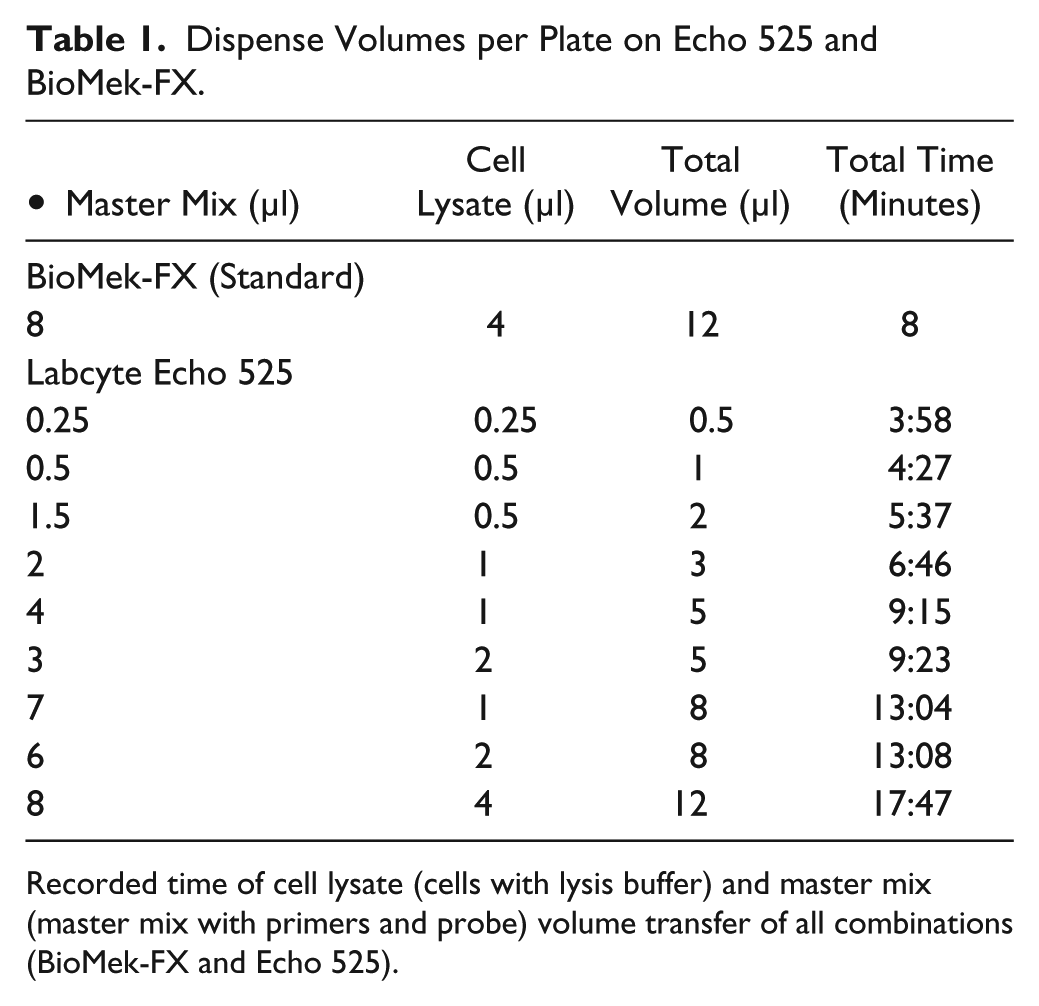
Recorded time of cell lysate (cells with lysis buffer) and master mix (master mix with primers and probe) volume transfer of all combinations (BioMek-FX and Echo 525).
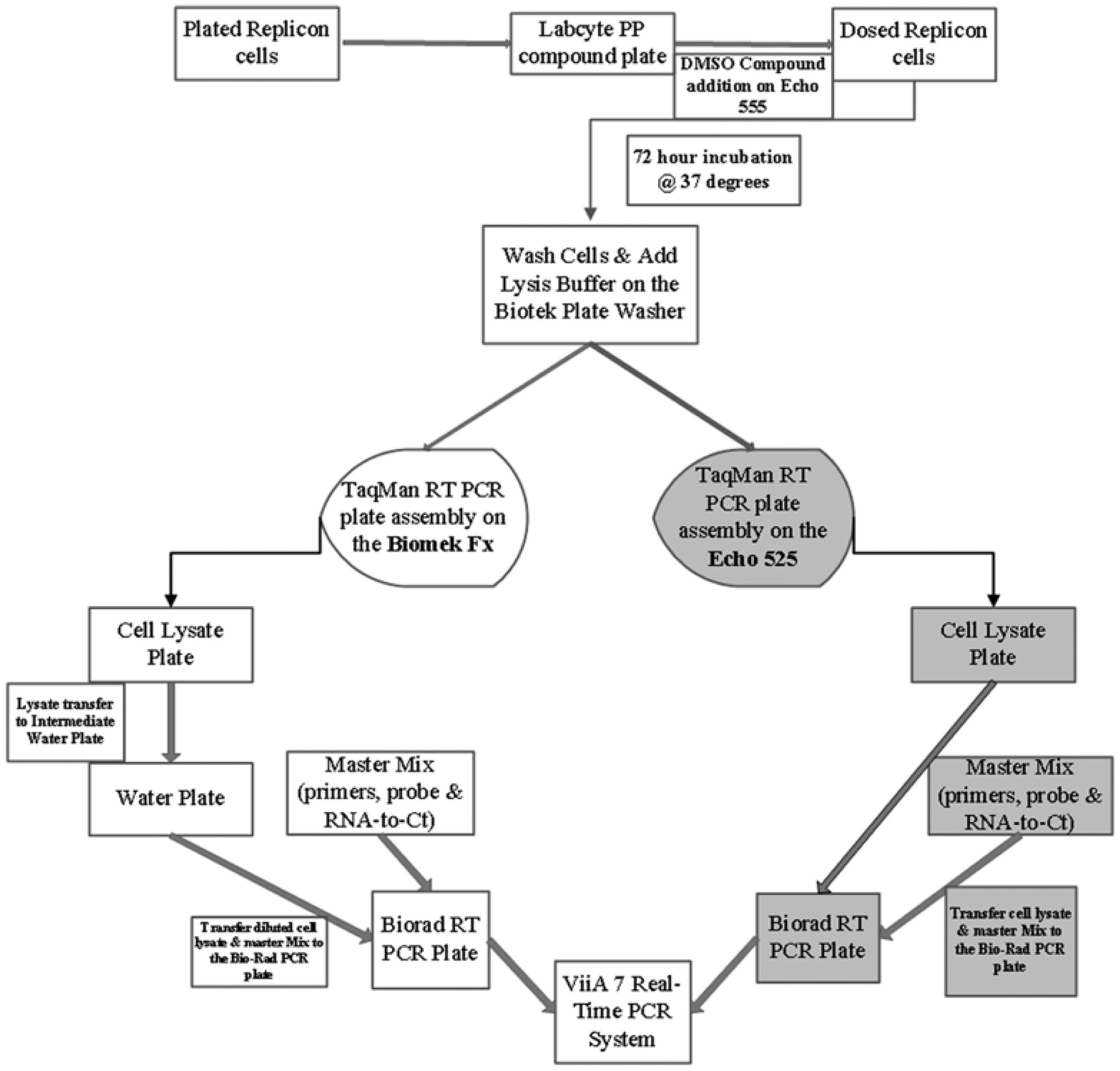
qRT-PCR TaqMan Assay flow chart of the BioMek FX and the Echo 525 method.
The qRT-PCR results and Ct (threshold cycle) values were determined for all wells and plotted against inhibitor concentration ( Fig. 2 ). Ct is the intersection between an amplification curve and a threshold line. This is a relative measure of the concentration of target in the PCR reaction. The average Ct and coefficient of variation (CV) were also calculated for the DMSO control wells, and ΔCt was calculated for each experiment. 10 EC50 and EC90 were then calculated for each inhibitor at each reaction volume. In qPCR assays, the 50% effective concentration (EC50) is defined as the drug concentration necessary to achieve an increase in the cycle threshold (Ct) of 1 greater than the DMSO control (baseline) Ct; EC90 is the drug concentration necessary to achieve an increase in Ct of 3.3 greater than the baseline Ct. EC50 and EC90 drug concentrations yield a twofold (1 Ct greater than baseline) or a 10-fold (3.3 Ct greater than baseline) reduction in HCV replicon RNA, respectively. These EC90 values were then analyzed in Bland–Altman minimum significant ratio (MSR) plots to compare both methods.2,4,7 All TaqMan reagents were from Applied Biosystems.
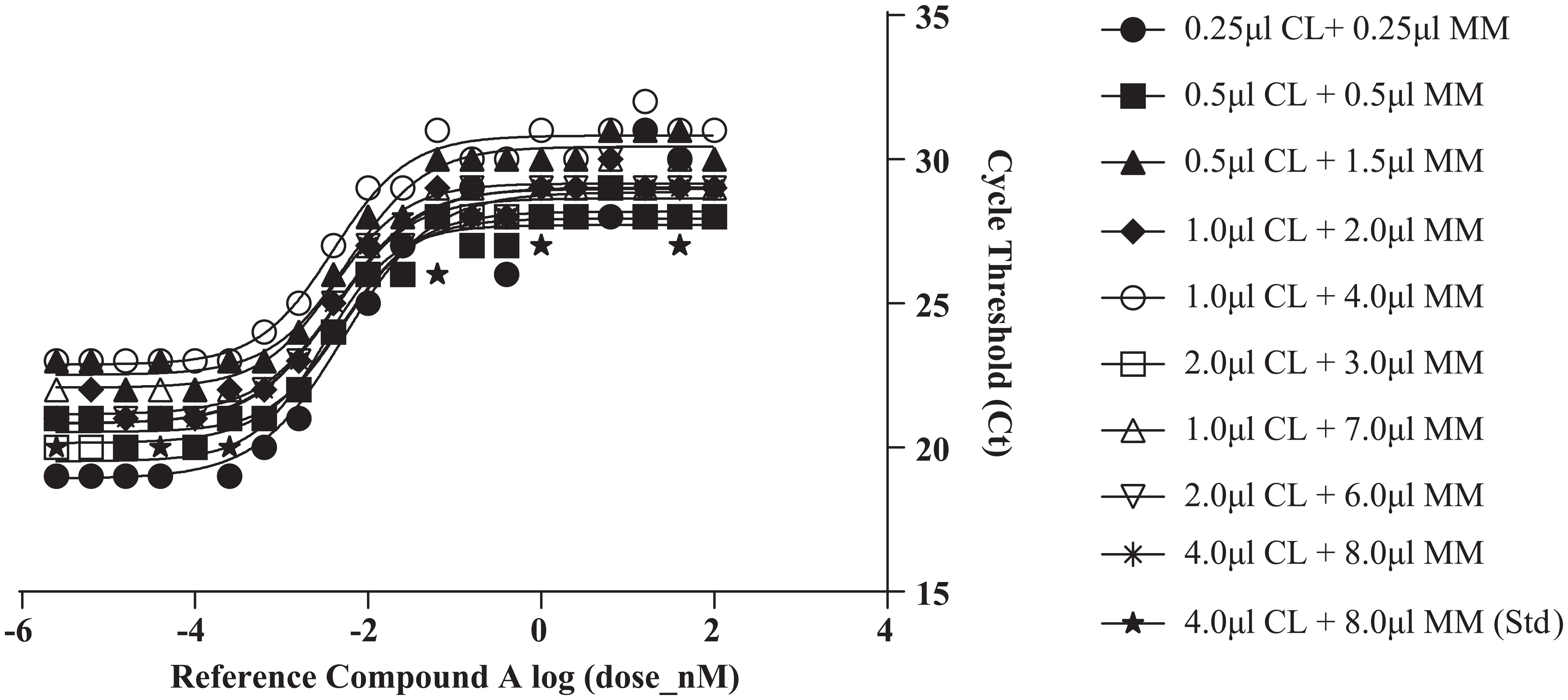
Dose–response curves of reference compound A show a uniform response at all reaction volumes. Effect of reference compound A on hepatitis C virus (HCV) replicon RNA synthesis in human hepatoma (Huh7) cells. (
Results
To estimate antiviral potency, replicon-bearing cell monolayers were cultured for 72 h with compounds in 20-point dose–response curves. HCV replicon RNA levels were then measured as a function of inhibitor concentration. As replication is inhibited, measured RNA levels will be lower, yielding an increased Ct. Compared to a DMSO-only control, a ΔCt value of +1 corresponds to a reduction by 50% of RNA levels (EC50), and a ΔCt value of +3.3 corresponds to a reduction by 90% of RNA levels (EC90).2,4,7
As shown in Figure 2 , dose–response curves (Ct vs. inhibitor concentration) for Reference compound A show uniform responses at all reaction volumes, from 12 µL down to 500 nL. Similarly, consistent results were observed for all inhibitors (results not shown). From these dose curves, EC50 and EC90 for each reaction volume were determined. For reference compound A, the EC50 ranged from 0.002 nM to 0.005 nM (σ = 0.0008 nM), and the EC90 ranged from 0.010 nM to 0.020 nM (σ = 0.003 nM) ( Table 2 ). The ranges of both EC50 and EC90 were within a twofold difference, which is within the limit of the assay. Therefore, reducing the total qRT-PCR reaction volume did not result in a decrease in accuracy or precision.
Reference Compound A’s EC50 and EC90 Values Are Consistent at All Reaction Volumes.
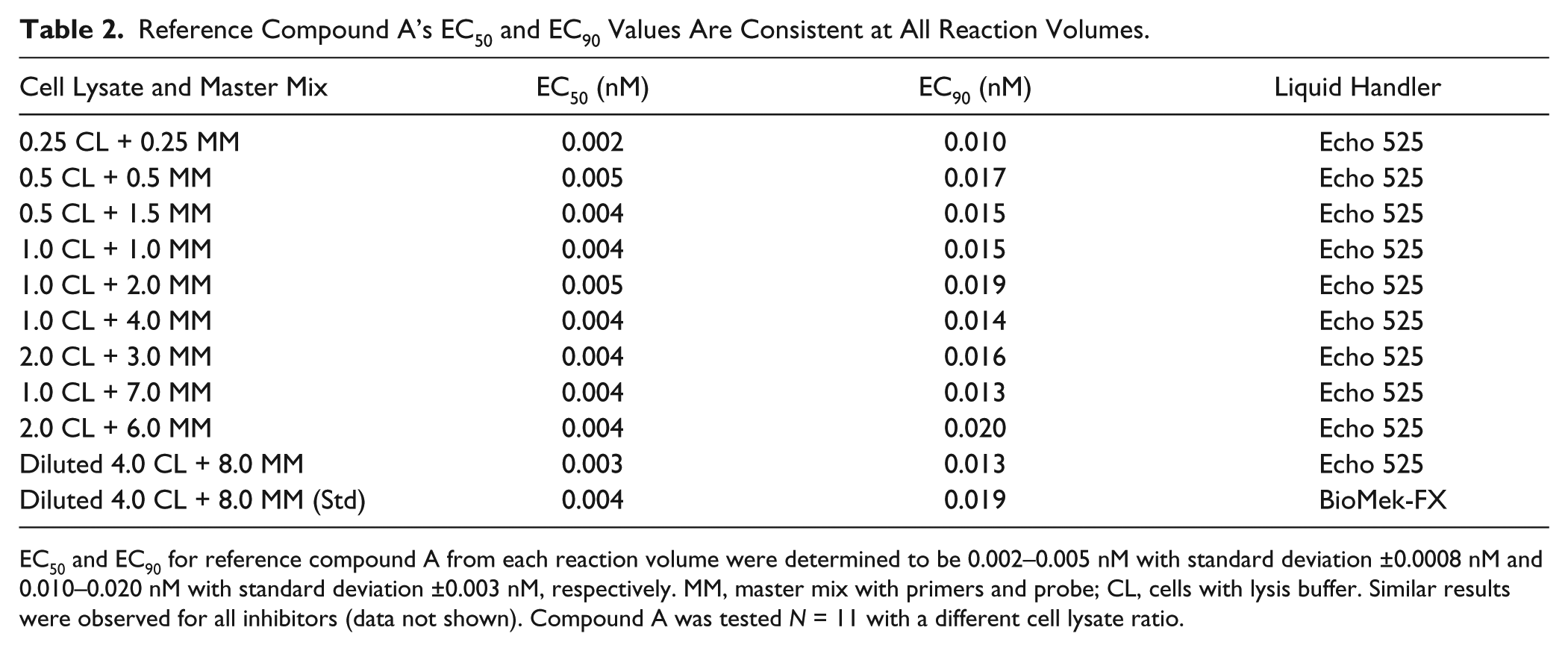
EC50 and EC90 for reference compound A from each reaction volume were determined to be 0.002–0.005 nM with standard deviation ±0.0008 nM and 0.010–0.020 nM with standard deviation ±0.003 nM, respectively. MM, master mix with primers and probe; CL, cells with lysis buffer. Similar results were observed for all inhibitors (data not shown). Compound A was tested N = 11 with a different cell lysate ratio.
To compare the results between each Echo-based experiment and the standard 12 µL reference data, Bland–Altman MSR plots
8
were created for EC90 values for all 15 HCV inhibitors (
Fig. 3A

Statistical analysis of Bland–Altman plots: MSR plots of inhibitors (EC90) of BioMek-FX (standard) 12 µl volume, with Echo 525 low-reaction-volume data from 0.500 µL to 12 µL. Comparison of two methods in (
Comparison of ΔCt and MSR Shows Reproducible Results at All Reaction Volumes.
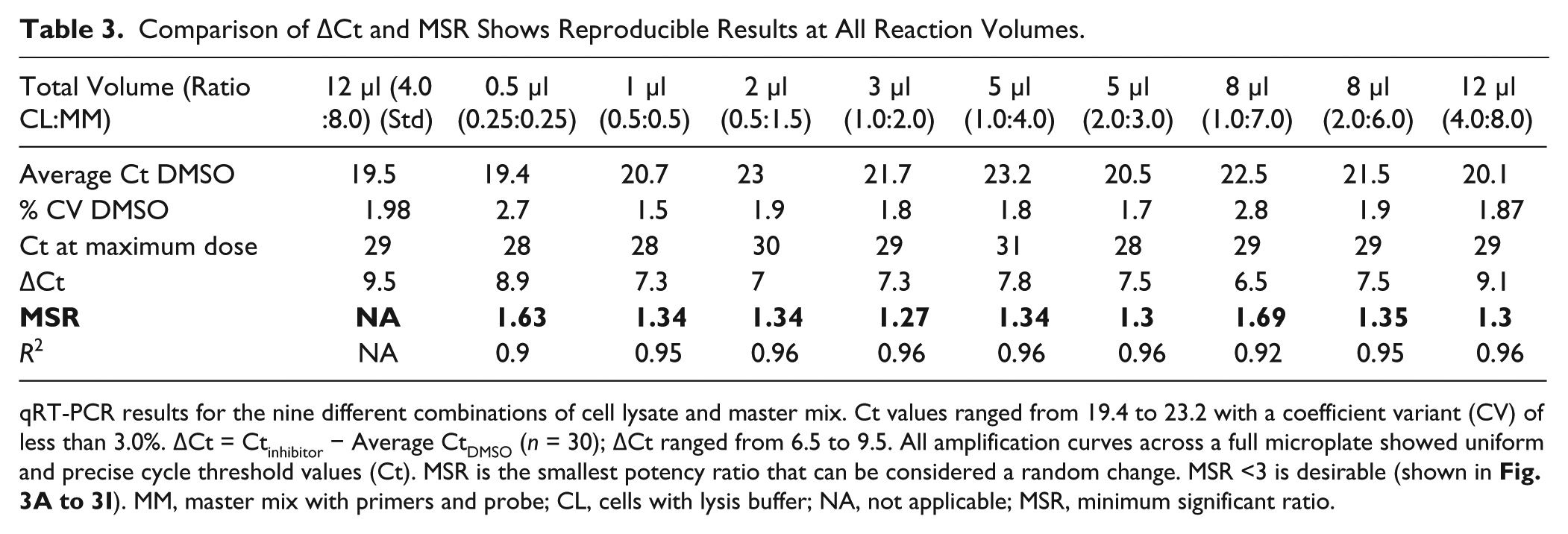
qRT-PCR results for the nine different combinations of cell lysate and master mix. Ct values ranged from 19.4 to 23.2 with a coefficient variant (CV) of less than 3.0%. ΔCt = Ctinhibitor − Average CtDMSO (n = 30); ΔCt ranged from 6.5 to 9.5. All amplification curves across a full microplate showed uniform and precise cycle threshold values (Ct). MSR is the smallest potency ratio that can be considered a random change. MSR <3 is desirable (shown in
Fig. 3A
To evaluate efficiency beyond the reproducibility and precision of liquid transfer methods, the cost and process time were also analyzed. With the ability to run these assays at lower volumes without a loss in data integrity, it is possible to reduce reagent consumption. The resulting aggregate cost savings throughout an entire high-throughput screening (HTS) campaign can be significant. With regard to time savings, Table 1 lists the setup time per plate for both the Echo 525 and BioMek FX. Because the Echo 525 transfers 25 nL droplets at a constant rate, the dispense time is primarily a function of the total transfer volume, meaning that larger volumes will take longer to dispense. Compared to an 8-min liquid transfer time for the BioMek FX, the Echo 525 was able to transfer cell lysate and MM in less time for reaction volumes smaller than 5 µL ( Table 1 ). Compared to the standard Biomek-FX method, the Echo 525 method reduced total cost from $0.52 to $ 0.12 per well. Therefore, reduced assay volumes will save both time and costs.
Discussion
The objective of this study was to reduce the cost of the HCV drug discovery qRT-PCR HTS assay for evaluating HCV inhibitors. Our initial cost-cutting screening campaign worked as anticipated. The Labcyte Echo 525 liquid-handling platform presents new capabilities for total assembly and miniaturization of qRT-PCR in 384-well formats. The Echo 525 enables the transfer of many cell lysates without a need for predilution. Volumetric precision and accuracy ensure excellent Ct precision even in the setting of very little target DNA concentration in low reaction volumes. Therefore, the Echo 525 may be a more suitable instrument for scientists designing experiments for low-volume qRT-PCR.
To significantly reduce qRT-PCR volumes and maintain data quality, the liquid-handling methods used must be precise and accurate. Tipless and touchless acoustic droplet ejection with the Echo liquid handler eliminates the cost of disposable tips and plates, and it simplifies assay setup by eliminating several dilution steps.
Precision for the resulting quantification curves among 384-well plates was excellent, with standard deviations less than 0.5 and CVs less than 3%. The results confirmed the advantages of using the Echo 525 liquid handler to miniaturize the reaction volumes for high-throughput qRT-PCR and illustrate the excellent accuracy and precision that the Echo 525 liquid handler provides when compared with the current process, which uses multiple dispensers.
This result provided additional financial and effective confirmation of the advantages of using the Echo 525 liquid handler for assay miniaturization for high-throughput qPCR in 384-well formats. The change in reaction volumes from 12 µL to 500 nL with the RNA-to-Ct 1-Step Kit enables gene expression directly from cell lysates. The qRT-PCR assay setup coupled with the Echo 525 Labcyte liquid handler can greatly simplify high-throughput qRT-PCR processes.
Concordant data using assay volumes ranging from 500 nL to 12 µL demonstrated significant cost savings. The data indicate that 1 µl of total reaction volume and significant cost reduction per plate could be implemented in the future. It is important to note, as shown in Table 1 , that a reaction volume higher than 5 µL results in the same assay duration as the standard method. Although the higher volume reaction increased the assembly time and cost of experiments, data quality was not compromised. The Echo 525 liquid handler enables assay setup and reaction volume reduction, which results in reagent and consumables savings of approximately 70 % with a higher throughput. These were the primary factors driving the need for fast, accurate, low-volume liquid handlers for qRT-PCR using the ViiA 7 Real-Time PCR System readout.
Clinical applications of these system improvements could also be adopted by diagnostic laboratories and healthcare institutions with the purposes of diagnosing infectious diseases and performing clinical trials, especially to reduce high testing costs for limited patient samples.
This technology enables scientists to rapidly explore the capabilities of miniaturized qRT-PCR and other genomics applications, while reducing reagent consumption and eliminating tip costs and labware costs, resulting in financially efficient operations in drug discovery.
Footnotes
Acknowledgements
The authors would like to thank Dr. Fred Lahser from Merck & Co. for useful input and comments during the course of writing this article. The authors also thank Michelle Steel from Applied Biosystems for useful discussions. The authors are thankful to Labcyte Inc for the Echo 525.
Abbreviations
Ct: Cycle threshold
Δt: Difference of target Ct – no drug control Ct
MR: Mean ratio
RLs: Ratio limits (statistical limits of the mean ratio)
MSR: Minimum significant ratio
LsA: Limits of agreement
MD: Mean difference
CV: Coefficient variant
MM: Master mix with primers and probe
CL: Cell with lysis buffer
NA: Not Applicable
FBS: Fetal bovine serum
Assay requirements for potency data (based on experience):
An MSR ≤3. An LsA between 0.33 and 3.0.
Declaration of Conflicting Interests
The authors declared no potential conflicts of interest with respect to the research, authorship, and/or publication of this article.
Funding
The authors received no financial support for the research, authorship, and/or publication of this article.