




Abstract
Paper-based electrochemical biosensors are a promising technology that enables rapid, quantitative measurements on an inexpensive platform. However, the control of liquids in paper networks is generally limited to a single sample delivery step. Here, we propose a simple method to automate the loading and delivery of liquid samples to sensing electrodes on paper networks by stacking multiple layers of paper. Using these stacked paper devices (SPDs), we demonstrate a unique strategy to fully immerse planar electrodes by aqueous liquids via capillary flow. Amperometric measurements of xanthine oxidase revealed that electrochemical sensors on four-layer SPDs generated detection signals up to 75% higher compared with those on single-layer paper devices. Furthermore, measurements could be performed with minimal user involvement and completed within 30 min. Due to its simplicity, enhanced automation, and capability for quantitative measurements, stacked paper electrochemical biosensors can be useful tools for point-of-care testing in resource-limited settings.
Introduction
In recent years, microfluidic paper-based analytical devices (µPADs) have shown great potential as point-of-care diagnostic devices due to their low cost, ease of use, and small footprint.1–4 These devices are based on lateral flow immunoassay technology that uses capillary flow for liquid transport and a colorimetric detection scheme. Although colorimetric assays are attractive for some applications requiring only qualitative results, electrical biosensors can provide important information for applications requiring quantitative measurements of chemical analytes and biomolecules. Previous works have demonstrated microfluidic paper-based electrochemical devices (µPEDs) for quantitative measurements of bioanalytes in biological samples5–7 and heavy metal ions in aqueous solutions. 8 The fabrication of these devices involves the formation of hydrophobic barriers in paper through various patterning techniques, including photolithography,9,10 inkjet printing, 11 and wax printing.12,13 Wax printing has gained much popularity due to its simplicity, affordability, speed, and convenience. Briefly, a wax printer is used to pattern wax on a paper surface that is subsequently infused into the paper by a heating step, forming complete hydrophilic barriers on resolidification. However, this process is limited to thin paper because printed wax cannot completely permeate through thicker paper, which results in incomplete hydrophobic barriers. Although it is possible to print multiple layers of wax, precise overlay of wax patterns is difficult. For paper-based electrochemical sensors, samples need to be manually dispensed on top of the sensing electrodes so that the biorecognition elements are fully immersed by the liquid, enhancing the electrochemical reactions.6,8 However, it is challenging for planar electrodes to be fully immersed by capillary flow because liquids are contained within the underlying substrate. To address these issues, we demonstrate a simple approach to improve the performance of paper-based electrochemical sensors using stacked paper devices (SPDs).
In this article, we demonstrate a unique strategy to fully immerse planar electrodes by liquids using SPDs. Proof of concept is carried out by performing amperometric measurements of xanthine oxidase, a biomarker associated with urinary tract infections,14,15 using SPDs and single-layer devices. These results reveal that electrochemical sensors on SPDs can generate higher detection signals than those on single-layer devices. In addition, sample loading and transport can be carried out solely by capillary flow, and each measurement can be completed within 30 min. Based on this approach, we expect other methods will be developed to improve liquid control in paper networks, thereby enhancing the functionality of paper-based electrochemical sensors.
Materials and Methods
Biochemicals and Reagents
Xanthine oxidase, hypoxanthine, and polypyrrole (PPy) were obtained from Sigma-Aldrich (St. Louis, MO). Blocker Casein in phosphate buffered saline (PBS) buffer and Blocker BSA (bovine serum albumin; 10%) in PBS and Dulbecco’s PBS (DPBS) buffer were purchased from Thermo Scientific (Tustin, CA). Deionized (DI) water was generated using a Barnstead Smart2Pure water purification system (Barnstead, Van Nuys, CA). Xanthine oxidase was resolved using 10% BSA in PBS and serially diluted in PBS buffer. All remaining biochemicals were used without further purification.
Fabrication of Paper Networks
Paper networks were designed using Autodesk AutoCAD software and fabricated by patterning wax onto Whatman chromatography paper (GE Healthcare Life Sciences, Pittsburgh, PA) using a Xerox ColorQube printer. The paper was heated for 1 min at 100 °C to allow the wax to permeate and form hydrophobic barriers on resolidification. Whatman 1 Chr paper was used to fabricate single-layer devices. SPDs for amperometric measurements were constructed by gluing (Elmer’s Glue-All Multi-Purpose Glue) three layers of 1 Chr paper having identical wax patterns on top of a single layer of 3MM Chr paper. On the 3MM Chr paper, wax patterns were printed on the top side, and a uniform layer of wax was printed on the bottom side. During heating, the wax from both sides merged together to form an enclosed channel. All of the devices were stored at room temperature prior to experiments.
Characterization of Paper Networks
Cross-sectional images of printed wax on chromatography paper were captured to characterize wax permeation at different heating conditions. Paper devices were cut using a guillotine paper cutter and imaged using a Nikon ECLIPSE TS100 microscope equipped with a DS-Fi1 camera (Nikon, Tokyo, Japan). The wax permeation depths were measured using Nikon’s NIS Elements software.
Fabrication of Electrochemical Sensors
Three-electrode sensors were fabricated by screen printing Ag/AgCl and carbon inks (Conductive Compounds, Hudson, NH) onto paper devices through custom stencils (Stencils Unlimited, Portland, OR). The electrode geometry was designed using Autodesk AutoCAD software (Autodesk, San Rafael, CA). Ag/AgCl ink was used to print the reference electrode, which was heated for 4 min at 100 °C. The working and counter electrodes were printed using carbon ink containing hypoxanthine (1:20) and dried overnight at room temperature. For four-layer SPDs, electrodes were printed on the top side of 3MM Chr paper, a 1/4-inch hole was cut directly above the electrodes in two (middle) pieces of 1 Chr paper, and a 1/16-inch observation hole was made in a third (top) piece of 1 Chr (top) paper.
Amperometric Measurements
Amperometric measurements were performed using a multichannel electrochemical workstation (GeneFluidics, Irwindale/Duarte, CA). A bias potential of −200 mV was used for all measurements. Sample loading was carried out by dipping the edge of the devices into solutions of xanthine oxidase and allowing the liquid to fill the networks by capillary flow. Measurements were performed after the channels were fully wetted for single-layer devices and after electrodes were fully immersed for SPDs. All measurements were performed at room temperature under ambient conditions.
Results and Discussions
Fabrication of Wax Channels in Paper
Wax printing is a simple approach for fabricating microchannels in paper. However, this approach suffers from two major limitations. First, the thickness of the printed wax limits how deep it can permeate into the paper, limiting its use to thin paper. We experimented with two different types of paper (Whatman 1 Chr, 0.18 mm thick; and Whatman 3MM Chr, 0.34 mm thick) and found that patterned wax could fully permeate the 1 Chr paper after 1 min of heating at 100 °C (
Fig. 1b
). However, wax could permeate only ~0.15 mm into the 3MM Chr paper after several minutes of heating at 100 °C (
Fig. 1d
). To determine if higher temperatures could improve the diffusion of wax, heating was performed at 150 °C and 200 °C for 10 min. Even at these elevated temperatures, the wax could only permeate ~0.19 mm into the paper, as shown in
Figure 1e
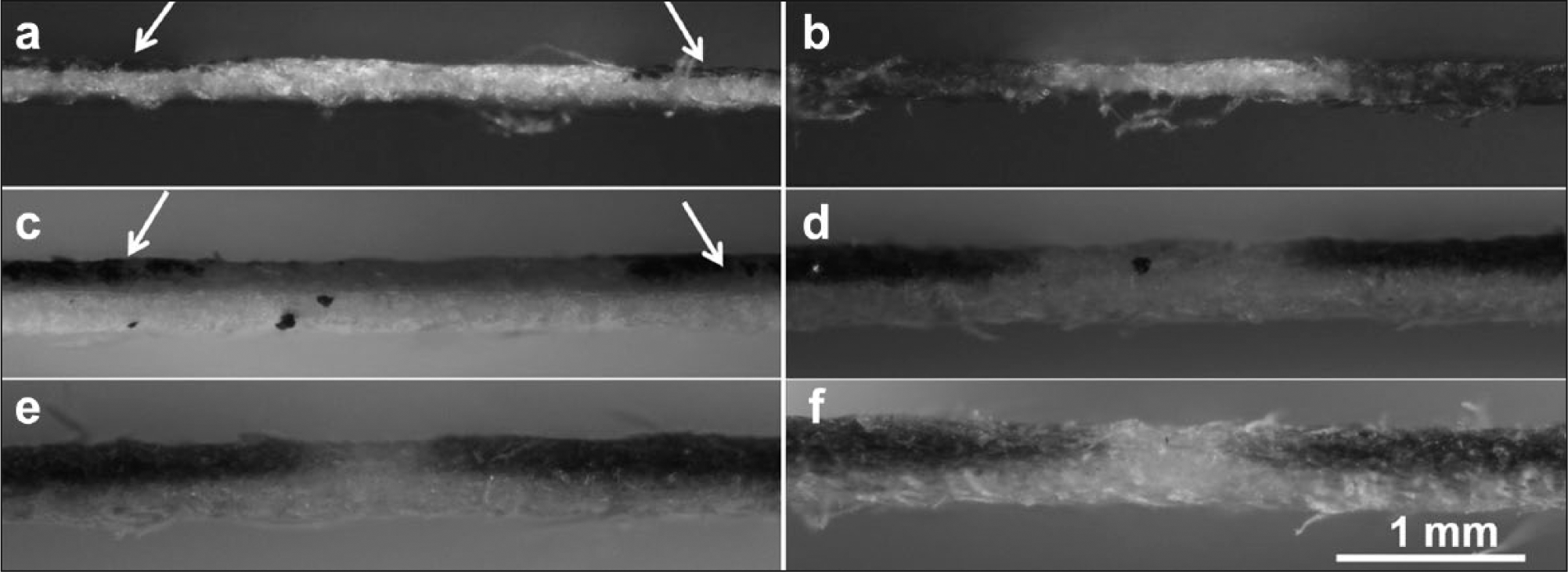
Cross-sectional images of printed wax on Whatman 1 Chr paper before heating (a), and after heating (b). Cross-sectional images of printed wax on 3MM Chr paper before heating (c), and after heating for 1 min at 100 °C (d), 10 min at 150 °C (e), and 10 min at 200 °C (f). Arrows indicate the regions patterned with wax.
Integration of SPDs with Electrochemical Sensors
Paper-based electrochemical sensors require the sample to be dispensed directly on top of the electrodes because it is challenging to fully immerse planar electrodes solely by capillary flow. However, it would be simpler if liquids could autonomously be wicked and transported to the electrodes, which would make testing more user-friendly. We introduce a unique technique to fully immerse electrodes by capillary flow using a four-layer SPD ( Fig. 2a ). The hydrophilic network consists of a 9-mm-diameter sensing region, where the electrodes are situated, connected to a 3-mm-wide channel that extends to the edge of the device. This channel allows the samples to be wicked and transported to the sensing region simply by dipping the edge of the device in an aqueous solution. A 1/4-inch hole is punched through the sensing region in the middle two layers which effectively forms a paper cavity. As the sample is wicked by the walls of the cavity, the electrodes become fully immersed when the cavity is filled. The height of the cavity was optimized by performing measurements of XO at 16,000 U/L using multi-layered SPDs. As shown in Figure 2b , larger amperometric signals were generated as the number of layers increased, which allowed more liquid to fill the cavity and immerse the electrodes. There is no noticeable increase in signal between four- and five-layer SPDs because the electrodes are fully submerged at this point and little improvement can be gained by adding additional layers. We also observed that SPDs generated faster flow velocities compared with single-layer paper networks that have similar dimensions. However, this is most likely due to artifactual gaps between the stacked layers which effectively act as fast-wicking open capillaries.
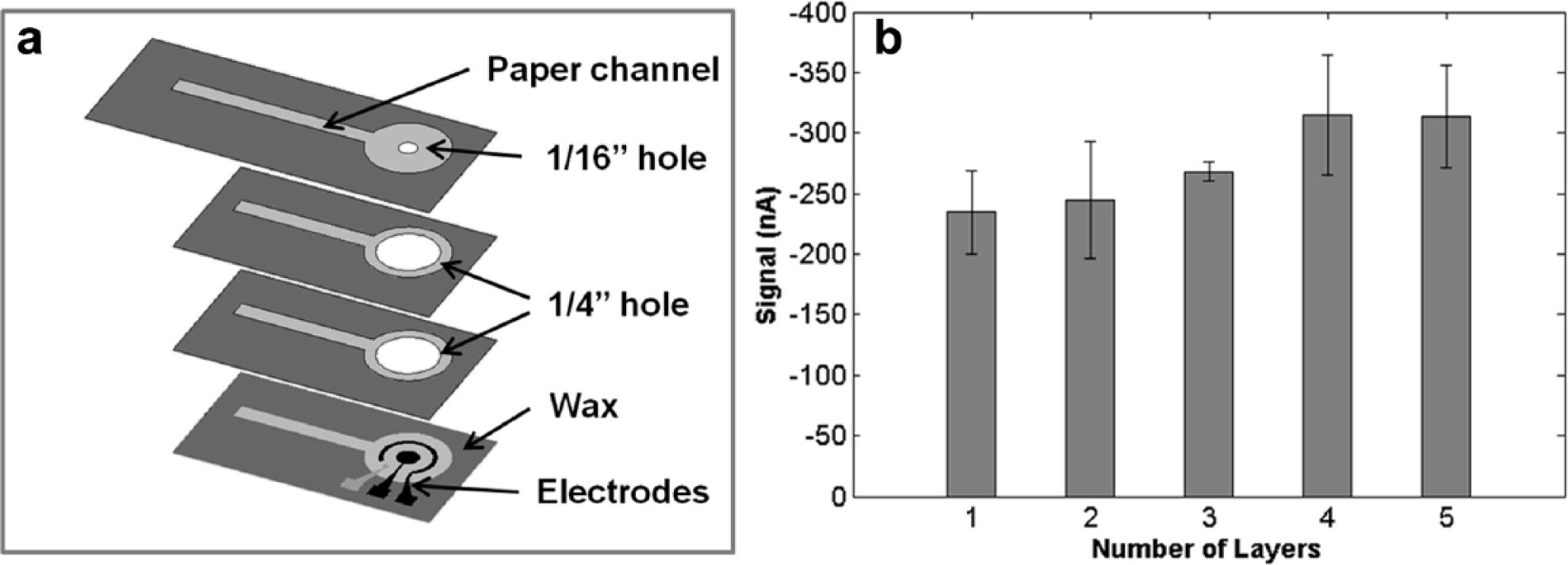
(a) An exploded-view schematic of a four-layer stacked paper device (SPD). (b) Amperometric measurements of xanthine oxidase at 16,000 U/L using multi-layered SPDs. Each bar represents the mean ± SD of two individual measurements.
Amperometric Measurements of Xanthine Oxidase
We demonstrated the utility of our SPDs by using them to perform amperometric measurements of xanthine oxidase. This detection scheme is based on the redox reaction that occurs when xanthine oxidase catalyzes the oxidation of hypoxanthine to xanthine and H2O2, as represented by the following equation: 17

Because the electrodes are precoated with hypoxanthine, the presence of xanthine oxidase in the sample will generate a measurable electrochemical signal. Studies by Ciragil et al. revealed that urine samples from patients suffering from urinary tract infections contained xanthine oxidase at much higher concentrations (2000–16,000 U/L) compared with sterile urine samples (17–271 U/L). 15 Therefore, measurements were performed using solutions of xanthine oxidase diluted in PBS from 0 U/L to 16,000 U/L. Amperometric measurements of xanthine oxidase were also performed using single-layer devices ( Fig. 3a ) to compare their performance. As shown in Figure 3d , the signal-to-noise ratios (SNRs) generated from the SPDs are 16–75% higher than those from single-layer devices. In addition, both sets of measurements exhibit a linear response for the entire range of tested concentrations. The higher SNRs generated by the SPDs are due to the electrodes being fully submerged by the samples, generating enhanced electrochemical reactions at the electrode surfaces. The noise in the detection signals for the two highest tested concentrations (12,000 and 16,000 U/L) is slightly higher compared with the lower concentrations. We attributed this to non-uniformities in the electrode surfaces (due to the screen printing process), resulting in inconsistent electrochemical reactions. Although further studies are needed to characterize the system, these preliminary results demonstrate that SPDs can significantly enhance the detection performance of paper-based electrochemical sensors.
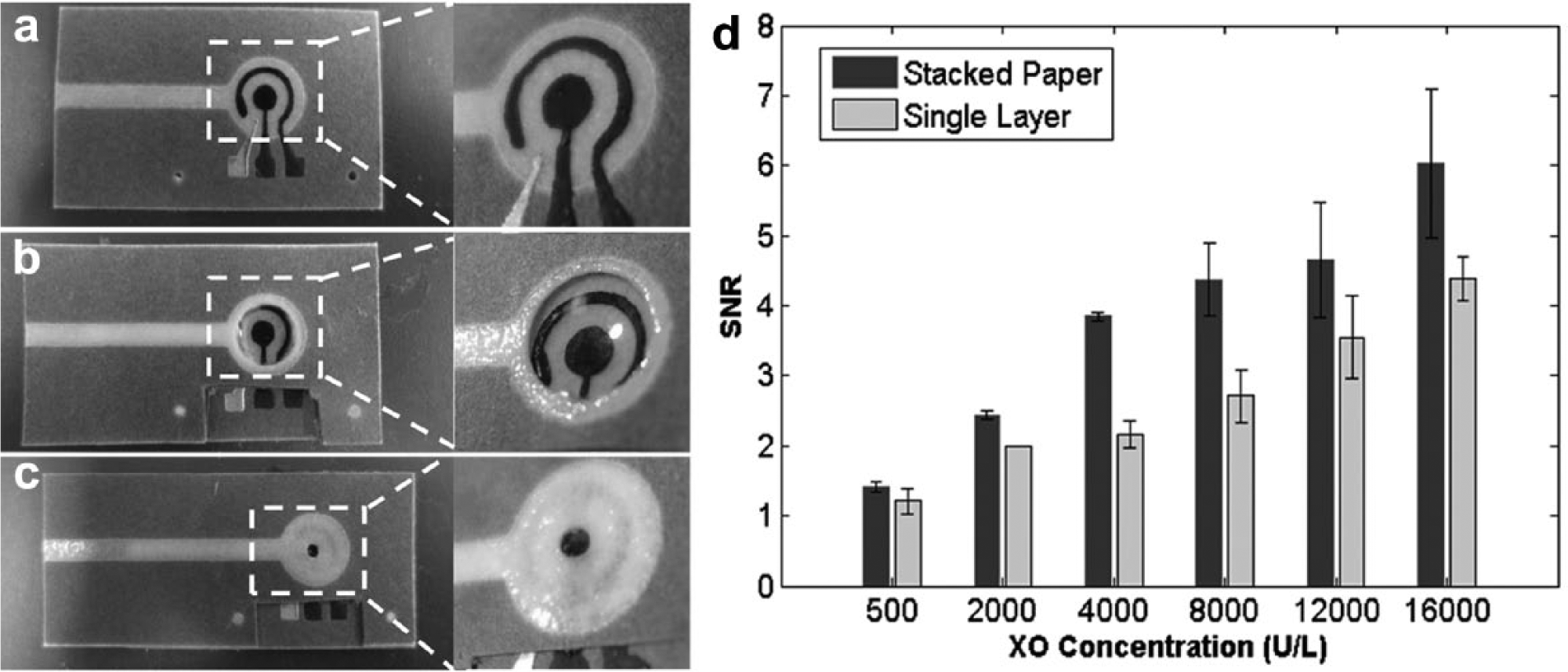
Electrochemical sensors on a single-layer device (a), a four-layer SPD with a 1/4-inch opening (b), and a four-layer SPD with a 1/16-inch opening (c). The insets show close-up views of the sensing regions. (d) Comparative measurements of xanthine oxidase using a single-layer device and a four-layer SPD. Each bar represents the mean ± SD of two individual measurements.
Conclusions
Paper offers a useful platform for creating functional analytical devices. In particular, paper-based electrochemical sensors enable rapid quantitative measurements, which is useful for many biosensing and diagnostic applications. For example, the diagnosis of many diseases and illnesses requires the quantification of biomarkers in a sample of body fluid. In addition, assessing the severity of contamination events can be carried out by measuring the concentration of toxins and compounds in water samples. Improving liquid control in paper networks will likely expand the versatility and capabilities of this technology. We demonstrated the utility of SPDs for immersing electrodes by liquid samples using capillary flow. Amperometric measurements of xanthine oxidase showed that SPDs resulted in improved detection performance compared with single-layer devices due to the electrodes being completely submerged by the sample. The simplicity of this approach makes it well suited for many other biosensing and diagnostic applications that require minimal equipment and user involvement such as point-of-care testing in resource-limited settings.
Footnotes
Acknowledgements
We thank Ying-Hung (Michelle) Lou for her assistance in fabricating and characterizing the paper networks.
Declaration of Conflicting Interests
The authors declared no potential conflicts of interest with respect to the research, authorship, and/or publication of this article.
Funding
The authors disclosed receipt of the following financial support for the research, authorship, and/or publication of this article: This work was support by the National Science Foundation CAREER award (ECCS-135056).