




Abstract
Coagulopathies in horses are common and potentially life-threatening. In equine field medicine, a portable point-of-care (POC) prothrombin time (PT) testing device could be useful to identify early changes in extrinsic clotting. The CoaguChek-XS (Roche Diagnostics) is a small, portable POC PT analyzer used in human medicine. Our preliminary study assessed the suitability of CoaguChek-XS for testing PT in horses and established the PT reference interval (PT RI) in healthy horses using this instrument. Blood samples collected from 102 healthy and ill horses were analyzed with the CoaguChek-XS and compared to a semi-automated coagulometric analyzer (SACA) as the gold standard. There was a significant positive correlation between the 2 measurement methods (r = 0.765, p < 0.01), and very good agreement, with 97% of the samples falling within limits of agreement. The mean CoaguChek-XS PT coefficient of variation was 0.8%, indicating high precision. With high precision and good agreement with the coagulometric PT, the CoaguChek-XS should be further validated for PT measurement in horses.
In horses, gastrointestinal (GI) disorders are the main cause of disseminated intravascular coagulation (DIC), a potentially life-threatening condition. Large colon volvulus, colitis, and strangulating small intestinal lesions are the most common GI conditions that cause DIC in horses,4,12 but DIC is also reported in septicemia, snakebites, rhabdomyolysis, and diffuse clostridial myonecrosis.11,13,16,19,21,22 Significantly prolonged PT was reported in 58% of horses with acute GI crisis–associated DIC, 12 and was significantly associated with strangulating GI lesions.3,4 Early diagnosis of subclinical DIC is crucial, and depends on laboratory testing of hemostasis. 3 Prothrombin time (PT) is commonly measured in horses to assess the status of hemostasis, specifically the extrinsic and common pathways. 21 Monitoring changes in PT over time is of diagnostic and prognostic value, as well as a clinical tool to help guide treatment.3,4
Equine medicine is often practiced at a distance from reference laboratories. Delays in receiving hemostasis test results may be detrimental in treating critically ill horses. A reliable, cost-effective, point-of-care (POC) test to assess hemostasis, such as PT measurement, would be useful under field conditions.
The CoaguChek-XS (Roche Diagnostics, Mannheim, Germany) is a small, portable POC PT analyzer, commonly used in human medicine for home monitoring of warfarin therapy, that is suitable for both venous and capillary blood samples, providing results within minutes.17,20 Studies have assessed the reliability, precision, and suitability of the CoaguChek-XS in humans1,9,17,18 and dogs.10,15 We assessed the performance and suitability of the CoaguChek-XS for PT measurement in horses compared to a reference method, and established the PT reference interval (PT RI) in healthy horses using this instrument.
We divided the horses in our study into 3 groups: healthy animals (control), ill animals diagnosed with conditions known to predispose to hemostatic abnormalities (i.e., GI conditions involving strangulation or endotoxemia; septicemia, Vipera palaestinae snakebite, rhabdomyolysis, and necrotic vaginitis and placentitis; group 1), and ill horses diagnosed with other conditions, deemed unlikely to predispose to hemostatic abnormalities (i.e., urogenital disorders, orthopedic injuries, and mild colic of various causes; group 2). Healthy horses were presented to the hospital for elective procedures, mostly fertility-related, or healthy mares accompanying their foals. The horses were considered healthy based on absence of any systemic illness in their medical history, and unremarkable physical examination findings, excluding mild non-inflammatory lameness or shoeing issues. The horses were consecutively recruited, given the availability of the authors (G Kelmer and N Berlin) for sampling, and the Hebrew University Veterinary Teaching Hospital (HUVTH) Diagnostic Laboratory (Hebrew University of Jerusalem, Rehovot, Israel) services for routine testing, between October 2013 and August 2014. Data collected from medical records included signalment, history, physical examination findings, and final diagnosis. The horses were recruited with their owners’ consent, and with approval of the HUVTH Committee of Animal Handling and Experimentation (KSVM-VTH/8_2013).
Whole blood (5 mL) was obtained by jugular venipuncture, using a 21-gauge needle and a 5-mL syringe. Immediately following the blood draw, 1.8 mL of whole blood was placed into a 3.2% 2-mL tri-sodium citrate tube, and then 1.5 mL was placed into an EDTA tube for packed cell volume (PCV) measurement, while 0.1 mL of whole blood was directly and immediately applied onto the CoaguChek-XS test strip already placed in the analyzer. To measure PCV, EDTA whole blood was placed into heparinized glass capillary tubes within 30 min of collection. The capillary tubes were then centrifuged (14,489 × g, 3 min), and the PCV was measured manually.
To ensure appropriate quality control, 5 both the analyzer and the test strips have integrated quality control functions that are automatically performed when the test strip is introduced into the analyzer before each test is run. To minimize pre-analytical and analytical variance, the CoaguChek-XS was operated exclusively by 2 of the authors (N Berlin or G Kelmer). Citrated whole blood was centrifuged at 1,006 × g for 7 min within 30 min of collection. Harvested plasma PT was immediately analyzed by the HUVTH Diagnostic Laboratory, using a semi-automated coagulometric analyzer (SACA; Thrombostat, Behnk Elektronik, Norderstedt, Germany; reagent: TEClot PT-S, ISI value 1.03, TECO, Neufahrm, NB, Italy). This instrument was previously validated in our laboratory consistent with American Society for Veterinary Clinical Pathology guidelines,7,14 using triplicate values of successive measurements from 10 healthy horses, and found to have a coefficient of variation (CV) of 2.0%.
CoaguChek-XS precision was calculated based on 3 successive measurements of 10 of the healthy control horses. Blood samples were separately collected and analyzed 3 times within 15 min using the CoaguChek-XS. The mean and standard deviation (SD) of the 3 measurements of each horse were calculated to determine the individual horse CV, dividing the SD by the mean.7,14 Overall CV was calculated by averaging the individual CVs.
The Pearson correlation test was used to examine the correlation between the SACA and CoaguChek-XS PTs. A Bland–Altman plot 2 was used to further assess the agreement between the 2 PT measurement methods. The PT RI for each measurement method was determined by calculating the 2.5–97.5 inter-percentile range of the results6,8 obtained from 48 control horses that served as the reference population (2 healthy horses with PCV <0.25 L/L were excluded from this analysis). The results were normally distributed, as determined by the Shapiro–Wilk test. 6 Each PT, determined by each of the 2 measurement methods, was then classified as within RI (WRI), shortened, or prolonged. These categories were used to evaluate the specificity and sensitivity of the CoaguChek-XS PT by comparing the normal and prolonged PT groups relative to the gold standard SACA PT; their agreement was examined by McNemar tests.
Statistical analyses were performed using SPSS v.17.0 (SPSS, Chicago, IL). All tests were 2-tailed, and in all, p ≤ 0.05 was considered significant.
We enrolled 102 horses (68 mares, 15 stallions, and 19 geldings) of various breeds, including Arabian (48 horses), Quarter Horse (16), mixed-breed (15), and other purebred horses (21), aged >2 y (median age 7.8 y, range: 2–28 y). There were 50 healthy horses (controls), 26 horses diagnosed with conditions potentially affecting hemostasis (group 1) and 26 horses with various diseases, deemed unlikely to affect hemostasis (group 2). The majority (23 of 26) of group 1 horses had sustained GI disorders, mostly surgical colic cases (20 of 23 horses) with intestinal incarceration or strangulation. Other conditions in group 1 included colitis and endotoxemia (2 of 26 horses), and one each with uterine torsion, pneumonia, and necrotic vaginitis.
In 5 horses (2 controls, 2 group-1 horses, and 1 group-2 horse), the PCV was <25 L/L (21–24 L/L). None of these anemic horses had clinical signs attributable to anemia. PT was measurable with both methods in all horses.
The overall CV of the CoaguChek-XS PT was 0.08% in repeated sampling of 10 healthy horses.7,14
The calculated PT RIs in 48 healthy horses were 11.5–14.9 s for the CoaguChek-XS, and 10.0–20.5 s for the SACA. The SACA range was 3.15-fold wider than the CoaguChek-XS range. Overall, 28 of 102 horses had prolonged PT when measured by the CoaguChek-XS compared to the CoaguChek-XS–based PT RI, including 2 of 50 healthy horses, 21 of 26 horses from group 1, and 5 of 26 horses from group 2. The SACA PT was prolonged compared to the instrument RI in 10 of 102 horses, including 2 of 50 healthy horses, 6 of 26 horses from group 1, and 2 of 26 horses from group 2.
The Pearson correlation coefficient comparing paired CoaguChek-XS and coagulometric PTs was 0.765 (p < 0.01; Fig. 1). The mean difference between the CoaguChek-XS and coagulometric PTs was 1.9 s (SD 3.2). The Bland–Altman plot illustrates that the majority of samples (99 of 102) fell within limits of agreement (Fig. 2). There was a marked outlier, with extremely prolonged PT, representing a horse that had sustained a ruptured bowel and died within minutes after the blood was drawn for the PT test; autopsy findings were consistent with DIC.
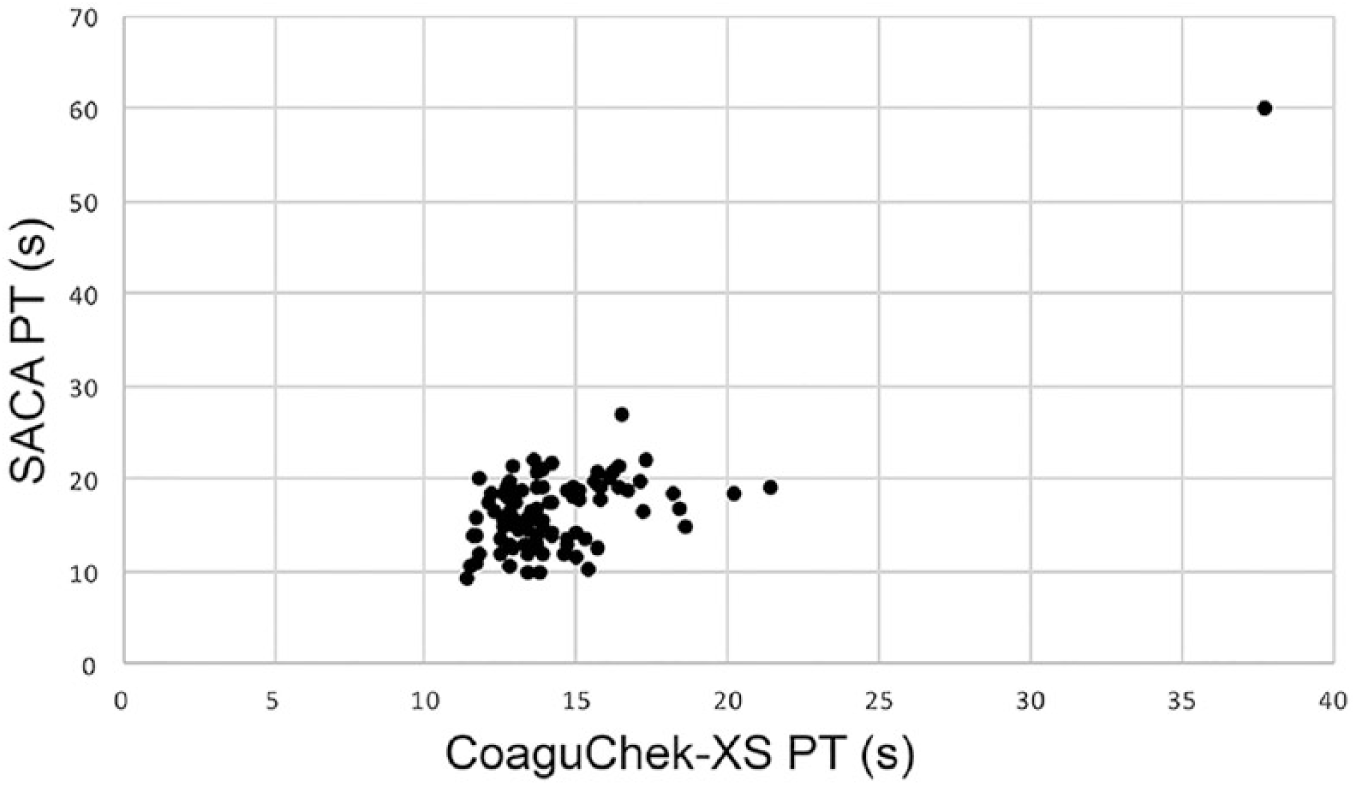
Correlation between 102 paired prothrombin times (PTs) in horses measured with the CoaguChek-XS (Roche Diagnostics) and a standard reference coagulometric analyzer (SACA). Each dot represents a single blood sample, obtained from a single horse (Pearson correlation coefficient r = 0.765; p < 0.01).
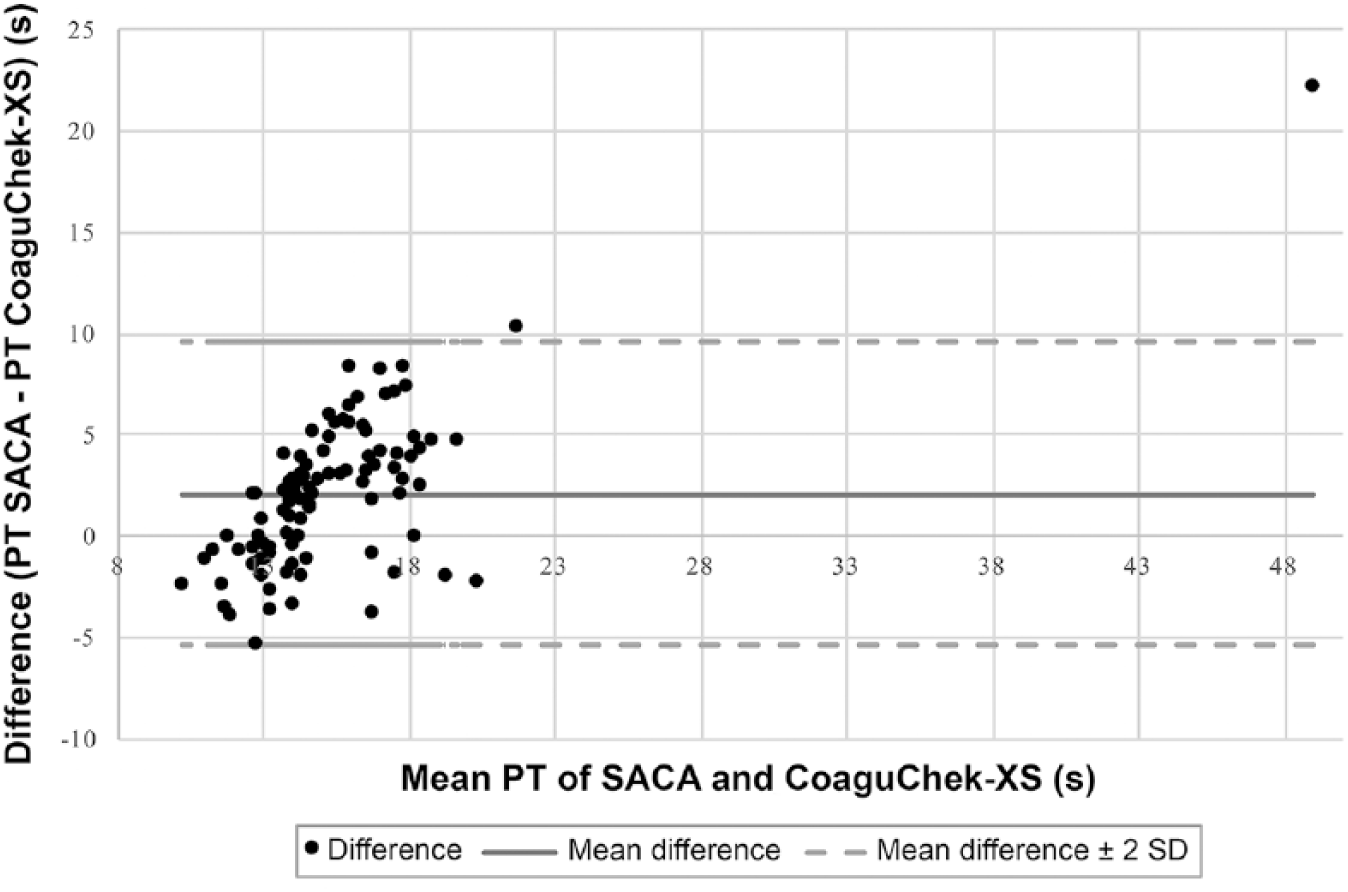
Bland–Altman plot for agreement between the CoaguChek-XS (Roche Diagnostics) prothrombin time (PT) and the standard reference coagulometric analyzer (SACA) measured in 102 horses. Each dot represents the difference between the 2 measurement methods in a single horse; 97.1% of the results fell within the limits of agreement.
To further assess the agreement between the 2 analyzers, the PTs were classified as WRI, shortened, or prolonged, based on their respective RIs (Table 1). Using a McNemar test, in 23 of 31 cases in which there was disagreement between this classification using the 2 measurement methods, the PT was classified as WRI based on the SACA, and prolonged based on the CoaguChek-XS (p = 0.004). This coincides with the wider PT RI of the SACA, compared to the CoaguChek-XS.
Horses with shortened, normal, or prolonged prothrombin time (PT) relative to their PT reference interval (PT RI), evaluated on the CoaguChek-XS and a semi-automated coagulometric analyzer (SACA).
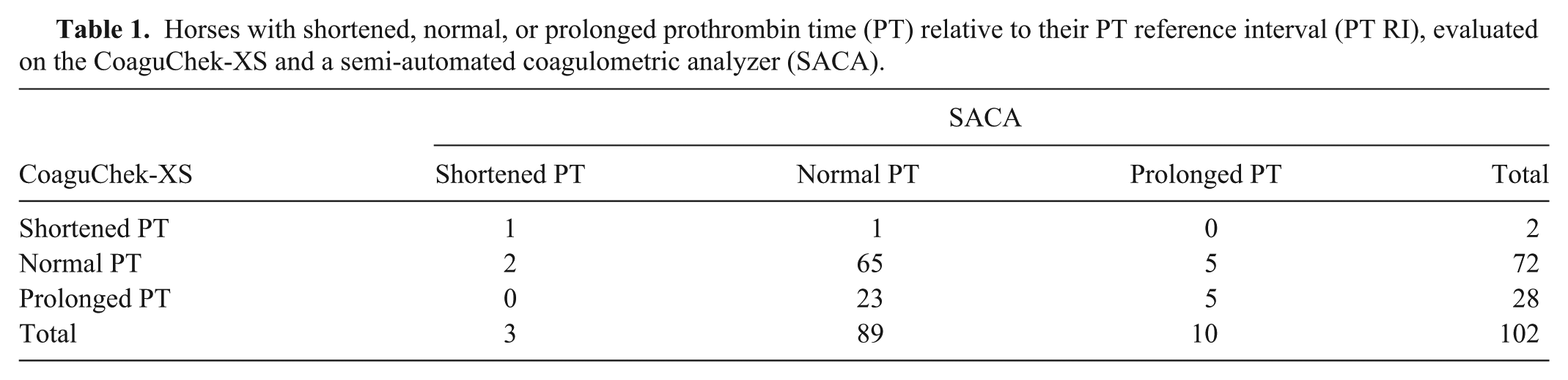
The overall sensitivity and specificity of the CoaguChek-XS to identify prolonged PT were 50% and 74%, respectively, when using SACA as the gold standard. Using the clinical classification of the horses, the CoaguChek-XS identified a prolonged PT in 21 of 26 ill horses, which were suspected to have a coagulopathy (group 1), with a calculated sensitivity of 80.8% (21 of 26 horses) and a specificity of 90.5% for identifying horses with a potential coagulopathy compared to normal horses.
The SACA required 5 min of blood centrifugation and an additional 5–10 min for PT analysis. The CoaguChek-XS was simple to use at the patient’s side; it is compact, battery-operated, and lightweight, requiring a minute (<0.01 mL) amount of whole blood, yielding the result within 30 s from applying a sample to the strip. Errors occurred when samples or strips were improperly placed, which occurred during the first few measurements until the operators became proficient in its use.
The Bland–Altman plot had very good agreement (97.1%) between the CoaguChek-XS and the SACA PT. Although the correlation between the 2 methods was low, correlation is only one aspect of the evaluation of a new method and does not necessarily suggest poor agreement between methods. A tested method may show high correlation with the reference method, but concurrently show a consistent, large error compared to the reference method. 2
The McNemar test results revealed a distinct, statistically significant trend within the disagreement, indicating that the results of both PT methods were significantly associated. Most cases of disagreement resulted from the major difference in the ranges of the PT RIs, which was 3.15-fold more narrow for the CoaguChek-XS compared to the SACA. This difference is not surprising; PT results are known to differ between laboratories as a result of differences in equipment, methods, reagents, and even in laboratory technicians.4,21 Using the same PT RI to classify the PTs as WRI or prolonged, the CoaguChek-XS results had moderate specificity (73.9%) and low sensitivity (46.2%) for detecting prolonged PTs compared with the standard reference method results. The specificity of the CoaguChek-XS in our study was low because a large portion of the results were categorized as false positive; they were classified as abnormal using the CoaguChek-XS PT RI, but classified as WRI using the SACA. This too can be attributed to the wider RI of the SACA, compared to the CoaguChek-XS RI, possibly suggesting that the true specificity rate of the CoaguChek-XS might be higher than the calculated one.
To further assess the sensitivity and specificity of the CoaguChek-XS for correctly identifying horses with potential coagulopathy, the clinical classification of the horses was used to calculate an overall sensitivity and specificity of 80.8% and 90.5% respectively. This suggests that the CoaguChek-XS is potentially very specific and quite sensitive for detecting abnormal hemostasis in horses, as reflected by an abnormal PT. However, further studies are recommended in order to support these conclusions, given that subclinical coagulopathy was not confirmed in any horse in our study and other coagulation parameters were not evaluated.
The CoaguChek-XS is considered inaccurate in human patients when the PCV is <0.25 L/L or >0.55 L/L. We included 5 horses with PCV <0.25 LL, for which no significant PT differences were noted in comparison to the rest of the study group. A wider spectrum of PCV may be suitable for use for the CoaguChek-XS PT measurement in horses and should be further investigated in studies including anemic horses. Until then, CoaguChek-XS–generated PT should be interpreted cautiously in horses, when the PCV is <0.25 L/L.
Footnotes
Acknowledgements
We thank Ms. Maria Griber and Dr. Tamara Shapiro from the HUVTH Diagnostic Laboratory for their technical assistance.
Declaration of conflicting interests
The authors declared no potential conflicts of interest with respect to the research, authorship, and/or publication of this article.
Funding
Dyn Diagnostics Ltd. (Caesarea, Israel) provided the CoaguChek-XS analyzer and the test strips used in our study.