



Abstract
Study Design
Observational Study.
Objectives
This study aimed to investigate the most searched types of questions and online resources implicated in the operative and nonoperative management of scoliosis.
Methods
Six terms related to operative and nonoperative scoliosis treatment were searched on Google’s People Also Ask section on October 12, 2023. The Rothwell classification was used to sort questions into fact, policy, or value categories, and associated websites were classified by type. Fischer’s exact tests compared question type and websites encountered between operative and nonoperative questions. Statistical significance was set at the .05 level.
Results
The most common questions concerning operative and nonoperative management were fact (53.4%) and value (35.5%) questions, respectively. The most common subcategory pertaining to operative and nonoperative questions were specific activities/restrictions (21.7%) and evaluation of treatment (33.3%), respectively. Questions on indications/management (13.2% vs 31.2%, P < .001) and evaluation of treatment (10.1% vs 33.3%, P < .001) were associated with nonoperative scoliosis management. Medical practice websites were the most common website to which questions concerning operative (31.9%) and nonoperative (51.4%) management were directed to. Operative questions were more likely to be directed to academic websites (21.7% vs 10.0%, P = .037) and less likely to be directed to medical practice websites (31.9% vs 51.4%, P = .007) than nonoperative questions.
Conclusions
During scoliosis consultations, spine surgeons should emphasize the postoperative recovery process and efficacy of conservative treatment modalities for the operative and nonoperative management of scoliosis, respectively. Future research should assess the impact of website encounters on patients’ decision-making.
Keywords
Introduction
Adolescent idiopathic scoliosis (AIS) is the most prevalent spinal deformity in adolescents, estimated to have a global prevalence as high as 5.2%.1,2 Management options range from conservative measures like bracing to surgical interventions, with the treatment course determined by factors like poor brace compliance, skeletal maturity, Cobb angle, and others.3,4 Between 1997 and 2012, rates of pediatric surgery increased by nearly 37% driven by advances in technology and outcomes for posterior spinal fusion. 5 The diversity in treatment methods, ranging from surgical to conservative approaches, coupled with increased rates of correction surgery due to advances in technologies, may lead patients to seek information online to understand their options for managing scoliosis.
Internet search engines are growing as popular tools for patient education, enabling individuals to find answers to questions that may not have been discussed in clinical settings. Given that untreated scoliosis can impact the health-related quality of life and psychosocial outcomes for adolescents, patients and caregivers may search the internet to gather more information about options for managing scoliosis. 6 A study by Wellburn et al 7 revealed that dissatisfied patients seek information online about spinal conditions like AIS when their questions remain unanswered during assessments. Analyzing frequently asked questions (FAQs) on major search engines, such as Google, could provide valuable insights for physicians into patient concerns and the resources patients encounter online. A study by Kasthuri et al 8 explored common spine surgery FAQs using Google’s People Also Ask (PAA) section, revealing that patients often inquire about technical procedure details and postoperative activities and restrictions.
Google’s PAA section is a web search feature that provides an expandable list of FAQs related to the original search query with corresponding website links that attempt to answer each question. 9 In order to retrieve FAQs related to the original search query, Google assesses the intent of a search query and sorts through billions of websites using machine learning and natural language processing systems that accurately detect search patterns.10,11 Google’s PAA section has also been used to identify FAQs associated with a wide variety of other fields in previous studies.8,12-19 Google was chosen as the search engine for this analysis due to its dominant position globally, commanding about 91.55% of internet search traffic, as opposed to less commonly used search engines like Bing and Yahoo, which make up only 3.11% and 1.21% of search traffic, respectively. 20 Furthermore, Google processes over 6 million health-related searches in the United States each day. 21 This indicates that the public has recognized the ability of the search engine to readily dispense health information, making it a reliable indicator of patient queries. Google has also proven to be more likely than other search engines to guide users to trustworthy resources, such as hospital ads and peer-reviewed journal sites, especially in the context of various spinal pathologies. 22
While previous studies have explored the types of questions likely to arise in spine consultations, this is the first study, to our knowledge, to investigate the types of questions patients ask regarding the operative and nonoperative management of scoliosis. Therefore, the objectives of this study are to assess the most searched types of questions implicated in the (1) operative and (2) nonoperative management of scoliosis as well as (3) the most readily available online resources associated with these treatment modalities. We hypothesize that most questions asked by patients seeking both operative and nonoperative management of scoliosis will be similar.
Methods
Search Terms and Extraction
A total of six terms were searched through the Google Search engine for operative (“Growing Rods Surgery,” “Scoliosis Spinal Fusion, “Scoliosis Surgery”) and nonoperative (“Scoliosis Bracing,” “Scoliosis Conservative Treatment,” “Scoliosis Nonoperative Management”) scoliosis treatment on October 12, 2023. To minimize the effects of personalized search results, all search terms were searched on a newly installed Google Chrome browser, consistent with methods employed in previous studies.8,12-19 For each of the search terms, the list of questions in the PAA section of the Google web search was expanded until 100 questions were generated. A downloadable program called Web Scraper was used to collect each question along with its associated website (https://webscraper.io/). 23 The software was programmed by supplying it with specific initial inputs that defined our data of interest. This setup enabled the software to identify and follow the established patterns across the web pages corresponding to each search term, thereby extrapolating these trends to aggregate a larger dataset of questions and websites.
Classification
Description of Classification Systems for Questions and Websites.
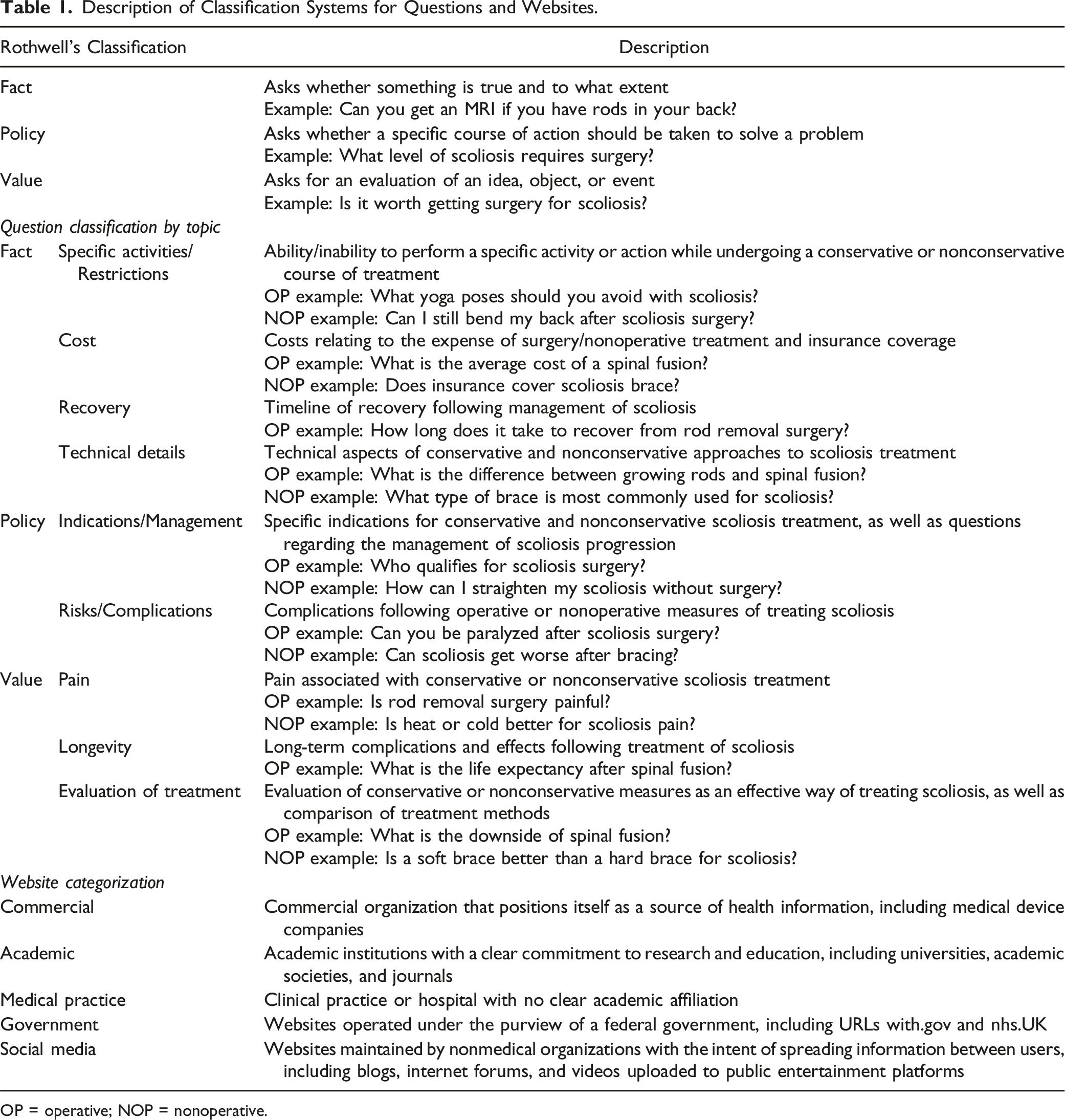
OP = operative; NOP = nonoperative.
Statistical Analysis
Cohen’s kappa coefficient was utilized to assess interobserver reliability using R statistical software (version 4.3.1; R Project for Statistical Computing, Vienna, Austria). Discrepancies in the classification of question topics, subcategories, and website types between the reviewers were resolved through conflict resolution procedures, wherein both reviewers discussed the differences in their categorizations until a unanimous decision on the designated classification was reached. Fischer’s exact tests were used to assess differences in the subcategories and websites encountered between the operative and nonoperative groups. Statistical significance was set at the .05 level.
Results
Data Collection and Classification Overview
A total of 600 questions were extracted upon search. However, 426 questions were identified to be unique. Of the unique questions gathered, 144 questions were categorized as unrelated to the study as these questions did not fit within a category under the operative or nonoperative management of scoliosis. Therefore, a total of 282 unique questions and 208 unique websites were classified according to the Rothwell classification system. Interobserver reliability was .900 for subcategory classification, .916 for website classification, and .967 for operative vs nonoperative classifications, suggesting significant agreement in classification between observers.
Categorized Question Types
Questions classified as fact accounted for 53.4% and 32.3% of operative and nonoperative management questions, respectively. Policy questions accounted for 23.3% and 32.3% of operative and nonoperative management questions, respectively. Value questions accounted for 23.3% and 35.5% of operative and nonoperative management questions, respectively (Figure 1). Rothwell’s classification stratified by treatment type.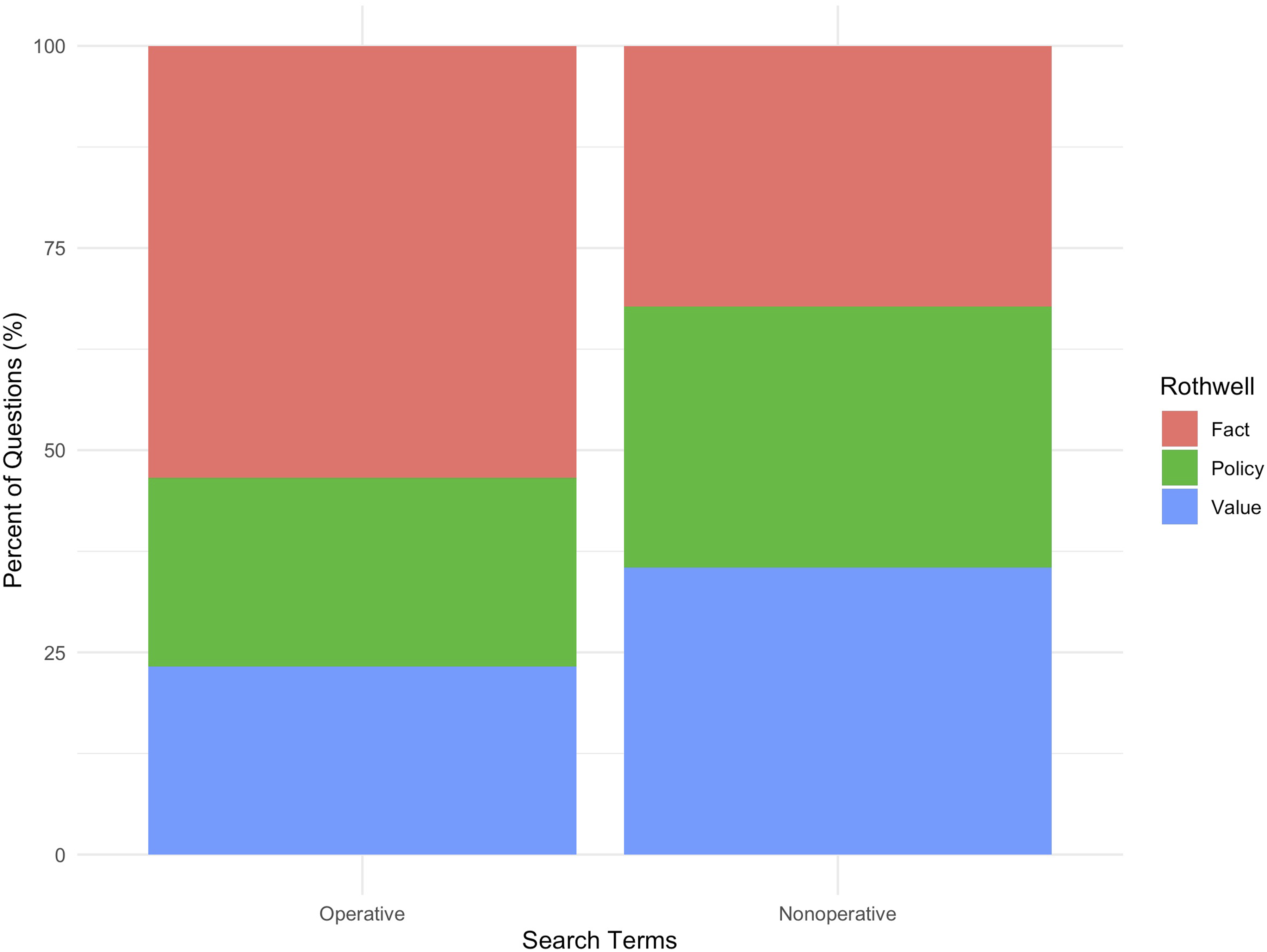
Categorized Question Subcategories
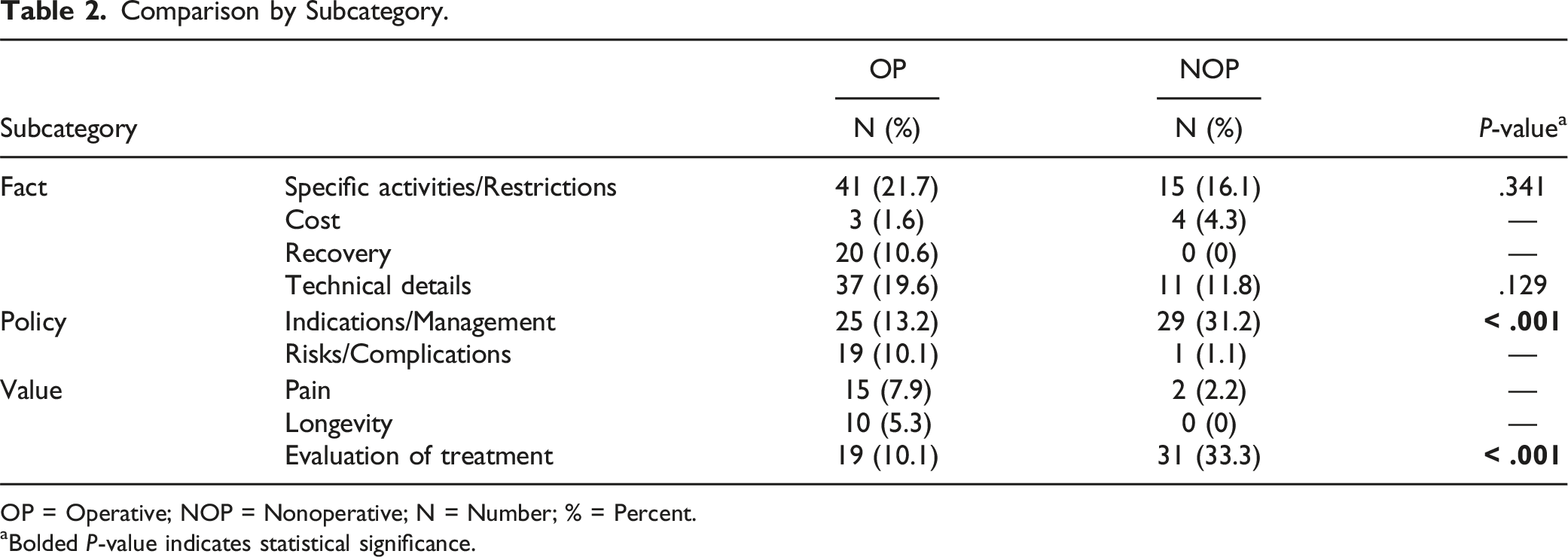
The operative question subcategory with the highest prevalence was specific activities/restrictions (21.7%), followed by technical details (19.6%) and indications/management (13.2%; Figure 2). The nonoperative question subcategory with the highest prevalence was evaluation of treatment (33.3%), followed by indications/management (31.2%) and specific activities/restrictions (16.1%; Figure 2). When comparing questions concerning operative and nonoperative management, questions relating to indications/management (13.2% vs 31.2%, P < .001) and evaluation of treatment (10.1% vs 33.3%, P < .001) were less likely to be considered operative than nonoperative (Table 2). All questions pertaining to recovery and longevity subcategories were concerned with the operative management of scoliosis. Subcategory classification stratified by treatment type. Comparison by Subcategory. OP = Operative; NOP = Nonoperative; N = Number; % = Percent. aBolded P-value indicates statistical significance.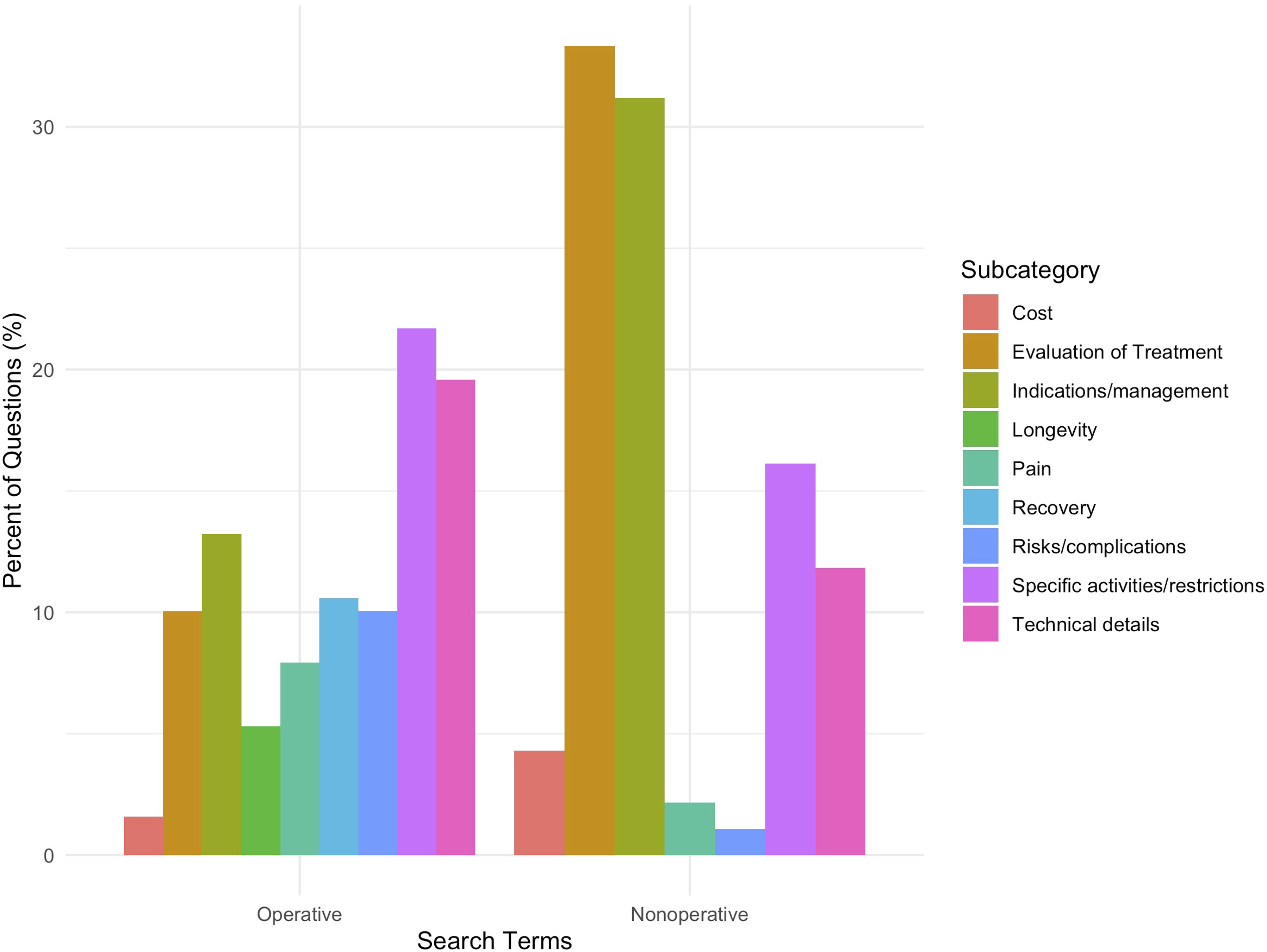
Categorized Website Types
Comparison by Website Category.
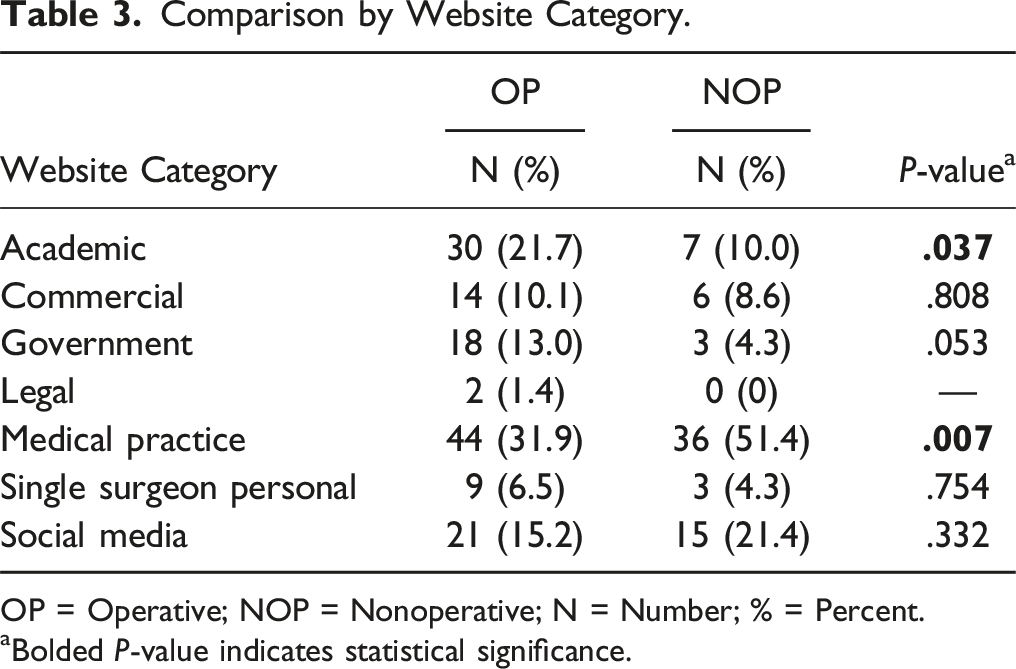
OP = Operative; NOP = Nonoperative; N = Number; % = Percent.
aBolded P-value indicates statistical significance.
Discussion
Google’s PAA section, which uses machine learning and natural language processing systems to sort through billions of inquiries on a search engine that commands 91.55% of internet search traffic globally, provides a unique perspective for analyzing patient concerns related to scoliosis treatment.10,11,20 This study investigates the types of questions patients ask about scoliosis treatment and highlights differences in search characteristics for operative and nonoperative modalities. The analysis of Google’s PAA section reveals distinct differences in the types of questions patients ask about scoliosis management. Fact and value-based questions were the most FAQs among those seeking information on operative and nonoperative management, respectively. Additionally, fact and policy questions each constituted 32.3% of nonoperative inquiries. Nonoperative questions were more likely to be related to indications/management and evaluation of treatment than were operative questions. In terms of website classification, operative questions were more likely to be associated with academic sites but less likely to be linked to medical practice when compared to nonoperative questions.
The most prevalent question type concerning the operative management of scoliosis was fact, which asks whether something is true and to what extent, accounting for 53.4% of all operative questions asked. This finding aligns with previous studies investigating FAQs associated with spinal surgery procedures, such as discectomy and lumbar fusion, where fact was identified as a primary question topic. 8 Additionally, prior studies examining various surgical treatments, both related and unrelated to spine surgery, determined that fact-based questions constituted the majority of those asked by internet users.13,16,17,19,24 This pattern signals a clear preference for objective information among individuals considering operative treatment. In addition, operative questions were primarily concerned with specific activities/restrictions, followed by technical details and indications/management. In this study, terms related to scoliosis surgery resulted in a higher proportion of questions related to specific activities/restrictions than other studies investigating search terms relating to discectomy and lumbar fusion, whereby these procedures had a higher proportion of questions concerning technical details. 8 A study by Pepke et al, 25 examining the return to sport after AIS correction surgery, highlighted a shift from preoperative chronic pain to postoperative occasional discomfort, facilitating early recovery of body confidence and resumption of sporting activities. These elements are critical aspects of the postoperative course, underscoring patients’ eagerness to gather information about their anticipated quality of life following correction surgery. Considering these insights, spine surgeons advising scoliosis surgery candidates should tailor consultations to focus on both short-term recovery and long-term limitations. This personalized approach can enhance patient satisfaction by presenting a transparent timeline for the postoperative recovery journey.
The most prevalent question type concerning the nonoperative management of scoliosis was value, which asks for an evaluation of an idea, object, or event, accounting for 35.5% of all questions asked. This was closely followed by fact and policy question types at 32.3%, whereby policy questions were considered as those that ask whether a specific course of action should be taken to solve a problem. Among patients asking nonoperative questions, the highest proportion of questions concerned evaluation of treatment, followed by indications/management and specific activities/restrictions. Nonoperative questions were more likely to be classified within indications/management and evaluation of treatment subcategories than operative questions. This indicates that patients seeking nonoperative treatment of scoliosis are concerned with the efficacy of conservative approaches. This is supported by Poder et al.’s study investigating attributes of non-surgical treatment choice for patients with low back pain, which reported that treatment modality effectiveness was the most important factor underlying patients’ choice for treatment. 26 Furthermore, age plays a crucial role in spine surgeons’ development of tailored treatment protocols for scoliosis patients. A study by Sud et al. highlighted a comprehensive approach for adolescent idiopathic scoliosis care, advocating for conservative treatment in patients expected to experience substantial growth. 27 Additionally, a systematic review by Lenz et al 28 indicates that factors such as diagnosis age under 13 years, a height velocity of 7-8 cm/year, and specific radiological criteria (Risser <1 or Sanders Maturity Scale <5) serve as indicators for curve progression. This complexity in assessing patient risk factors demonstrates the challenge of devising optimal treatment plans that ensure adequate medical care, highlighting the nuanced decisions physicians must make and the uncertainty faced by patients and their families. Therefore, considering the diverse needs of patients with varying growth expectations, those recommended for conservative treatment are more inclined to question the effectiveness and suitability of such approaches. Consequently, spine surgeons should prioritize advising patients on the potential benefits of nonoperative treatments, such as scoliosis braces or physical therapy, in mitigating curve progression and alleviating pain. Emphasizing the significance of patient-specific factors, including age and growth potential, is crucial in crafting an appropriate treatment protocol.
Websites linked to operative questions were more likely than those associated with nonoperative questions to be classified as academic. However, websites connected with operative questions were less likely to be linked to a medical practice compared to those linked to nonoperative questions, revealing distinctive patterns in online information-seeking behaviors within the context of scoliosis management. This stands in contrast to a previous study by Lubelski et al 29 investigating the most common answer choices of spine surgeons in the treatment of low back pain. In Lubelski et al.’s 29 study, individuals in private practice demonstrated higher odds of selecting surgical options such as PLIF/TLIF, ALIF, or others, in contrast to those in academic practice who exhibited greater odds of choosing no surgery. Despite spine surgeons in private practice being more inclined than their academic counterparts to recommend surgery, patients are utilizing the information provided on their websites regarding nonoperative treatment to address related questions. This discrepancy between the preferences of private practice surgeons and the online search habits of patients seeking information on nonoperative management emphasizes the crucial role of patient autonomy and informed decision-making in scoliosis treatment. It is also noteworthy that concerning nonoperative FAQs, social media websites had a higher prevalence (21.4%) compared to academic sites (10.0%). Given the recognized unreliability of information on social media platforms, it is concerning that the percentage of patients relying on these websites surpasses the usage of official government sources.24,30,31 In order to elevate the quality of health source information on social media, spine surgeons should look to occupy spaces on these platforms, dispensing credible and accurate information regarding scoliosis pathology and course of treatment. As social media has become a predominant source of information for internet users, these practices help create online banks of information that direct patients to content consistent with the most current treatment guidelines.
While Google’s PAA section offers valuable insights into the types of questions that patient’s value, this study is not without limitations. The data extraction was performed on the FAQs generated by Google after searching for an operative or nonoperative term, leaving any unique questions that might appear exclusively on other search engines out of the study. Even though a newly installed Google Chrome browser was used before each search term was searched, there could have been ways in which Google was still able to personalize the search results. This was also a descriptive study, which prevents any claims about causal relationships from being formed. In addition, it is not possible to know whether the individuals who were searching Google for nonoperative and operative treatment options, as indicated through Google’s PAA section, had scoliosis, were considering treatment options, or were indicated for surgery. Since Google’s PAA section changes over time to reflect the most frequently searched inquiries for a given topic, it is likely that the types of questions that patients ask and the websites that they receive information from may change over time. Furthermore, the accuracy of information from the sources to which Google directed patients was not verified; instead, the website type was used as an indication for the reliability of its contents. Finally, the classification of questions and websites by raters is inherently subject to bias. Despite clearly outlining a schematic for classification, the process remains subjective.
Conclusions
Our study reveals a notable difference in questions asked by patients regarding scoliosis treatment. Those seeking answers to questions concerning the operative management of scoliosis predominantly seek objective information. However, nonoperative inquiries are significantly associated with indications/management and evaluation of treatment, indicating curiosity about the efficacy of conservative approaches. Operative questions are linked to academic websites, whereas nonoperative questions are tied to medical practices, emphasizing that patients are being directed to reputable resources. This study provides unique insights into patient questions about scoliosis treatment, offering spine surgeons valuable information for clinic encounters. Due to factors including age of the patient and their expected potential for growth, there exists a complex and nuanced nature of providing an appropriate treatment plan for adolescent patients with scoliosis. Considering these clinical indications, patients and their families are often left to wonder why they have been assigned a particular treatment protocol, taking to internet sources as a means of finding out more about their specific treatment plan and how it compares to others. Incorporating this trend into the dialogue between spine surgeons and patients presents a valuable instrument for medical professionals to understand and prioritize the concerns most pertinent to individuals prescribed a particular regimen for managing their scoliosis— a condition characterized by its highly individualized treatment approaches. Future research should assess the impact of website encounters on patients’ decision-making, investigating the degree to which online resources affect the courses of treatment carried out by patients.
Footnotes
Declaration of Conflicting Interests
The author(s) declared no potential conflicts of interest with respect to the research, authorship, and/or publication of this article.
Funding
The author(s) received no financial support for the research, authorship, and/or publication of this article.
