




Abstract
Occupational health nurses can advance their professional practices through virtual platforms (e.g., social media and mobile applications). Virtual platforms allow occupational health nurses to disseminate occupational safety and health information efficiently to employees, families, and other stakeholders. Occupational health nurses exchange information with employees, enhancing communication and disseminating appropriate and accurate safety and health information to workers and their families. This article assists occupational health nurses in understanding how to use social media and other mobile applications to enhance their practices.
Shooter in the building! Take cover!” In less than 140 characters and 5 seconds of time, an occupational health nurse can send a Tweet to alert employees of a safety concern within a manufacturing facility. Virtual platforms, such as social media and mobile phone applications, are ways occupational health nurses can disseminate occupational safety and health information efficiently to employees, their families, and other stakeholders. Keller, Labrique, Jain, Pekosz, and Levine (2014) reported that the traditional vertical system of sharing information from scientists to the public is obsolete with the emerging technologies such as social networking. Social media platforms (e.g., Facebook, Twitter, and LinkedIn) are emerging as rapid horizontal information sharing mechanisms.
In a recent study by Wolf, Anton, and Wenskovitch (2014), a total of 665 occupational health nurses from the American Association of Occupational Health Nurses (AAOHN) were surveyed regarding personal and professional use of social media. The study concluded that 60% of occupational health nurse respondents used smartphones and were comfortable with smartphone applications (apps); 69% suggested websites to their patients or clients; and 23% used guidelines to assess the quality of health information on website applications. In addition, 86% of respondents indicated that policies exist within their organizations regarding employee Internet use. George (2011) stated that although much has been written about unprofessional use of social media by health care professionals, little information about the positive potentials for social media use has been publicized by professional associations, such as AAOHN, which actively subscribes to and participates in social media communication with their members. AAOHN uses websites (e.g., Facebook, Twitter, YouTube, and LinkedIn) to disseminate member- and industry-specific information. Occupational health nurses are key players in the information exchange process with their employees by enhancing communication and disseminating appropriate and accurate safety and health information to workers and their families. This article assists occupational health nurses in understanding how to use social media and other mobile applications in their practices.
Professional Development
AAOHN has identified nine competencies for occupational and environmental health nurses with three levels of competence for each: competent, proficient, and expert. The code of ethics, standards of practice, core curriculum, and competencies provide the basis for occupational and environmental health nurses’ scope of practice, knowledge, skills, and legal and ethical framework (AAOHN, 2007). In reviewing the nine competencies (i.e., Clinical Practice; Case Management; Workforce, Workplace, and the Environment; Regulatory/Legislative; Management, Business, and Leadership; Health Promotion and Disease Prevention; Health and Safety Education and Training; Research; and Professionalism), social media could be used in all areas by occupational health nurses. AAOHN (2007) defined an expert in occupational and environmental health nursing as a leader in the development of occupational safety and health policy within the organization; functions in an upper executive or management role; serves as a consultant to business and government; and designs and conducts significant research. One way occupational health nurses can move from competent to expert is through the use of innovative technology with the workforce.
Occupational health nurses have the ability to advance their professional practices using social media and mobile applications. Barry and Hardiker (2012) reported that nurses are part of an innovative profession and should embrace social media. Nurses should use social media to enhance practice and improve worker health. With any benefit comes risk, so occupational health nurses must review policy and guidance documents, such as the American Nurses Association (ANA) Principles for Social Networking and the Nurse (Randolph, 2012), prior to using social media and mobile applications within their organizations. ANA (2011) proposed the following principles when implementing a social media campaign: refraining from transmitting information that is individually identifiable; observing ethically prescribed professional client–nurse boundaries; refraining from posting disparaging remarks about clients, institutions, or other employees; using privacy settings; reporting any information to the appropriate authorities that could bring harm to clients’ privacy, rights, and welfare; and actively developing organizational online conduct policies.
Using Virtual Mobile Resources in Practice
Beyond the traditional social media platforms, Facebook, Twitter, and LinkedIn, additional mobile applications on smartphones can be used to quickly access or distribute critical information. The Pew Research Internet Project (2013) reported that 91% of adults polled (n = 2,076) owned a cellphone, 50% of these adults used their cellphones to download applications, and 60% accessed the Internet. In addition to cellphones, iPads can also be used to download mobile applications. Keller et al. (2014) reported that social media has been used by public health professionals to survey populations, gauge public opinion, disseminate health information, and promote mutually beneficial interactions between public health officials and the public. Occupational health nurses can expand upon these findings and use mobile applications in the workplace to improve dissemination of information to the workforce through the use of e-Safety, e-Environmental, and e-Health initiatives.
e-Safety
Mobile phone applications are available for both personal and occupational health and safety use (Table 1). A personal safety app is a mobile application that protects workers. These applications can be beneficial on and off the job. For the traveling employee, these applications may offer added protection in unfamiliar territory. The application “Citizen Cop,” released in 2014, is an example of a mobile phone app that can locate a smart position, inform police with global positioning system (GPS) location, provide traffic updates, alert police of an incident, and send a “Help Me!” text to local authorities. Typically, these applications can be activated by holding a button on a smartphone, shaking it vigorously or via loud screaming.
Safety, Environmental, and Health-Related Mobile Applications
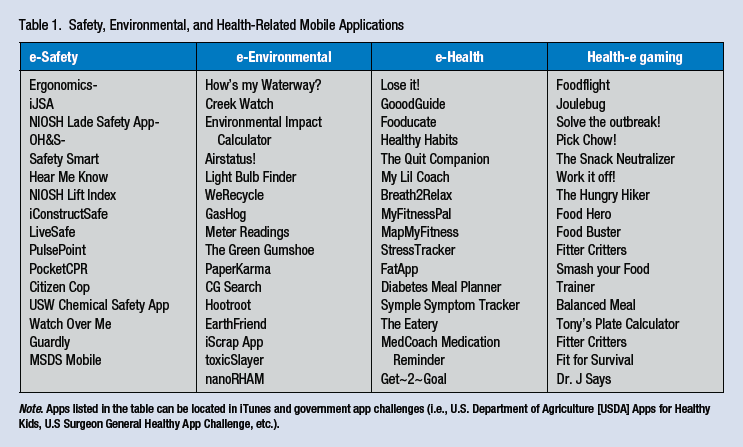
Note. Apps listed in the table can be located in iTunes and government app challenges (i.e., U.S. Department of Agriculture [USDA] Apps for Healthy Kids, U.S Surgeon General Healthy App Challenge, etc.).
Occupational safety and health professionals are turning to mobile applications to better accomplish job responsibilities as well as train employees. A host of safety applications (Table 1) can provide weather alerts and dosimeter readings, improving chemical safety. These apps assist the safety and health professional who may be working at a remote location. For example, the safety and health professional on a natural gas drilling site may need to quickly access a chemical safety handbook. The National Institute of Occupational Safety and Health (NIOSH) Pocket Chemical guide is now available for download through a third-party distributor via iTunes (ThatsMyStapler.com, 2010). This guide is an often-used resource for industrial hygiene information (e.g., first aid, personal protective equipment) for hundreds of chemicals.
At times of disaster (i.e., hurricanes, volcano eruptions, and tornados), communities and businesses turn to social media to quickly disseminate information to their residents and employees. The National Disaster and Preparedness Consortium (NDPC) is a resource that delivers training and educational programs specific to homeland security and disaster management. The National Disaster Preparedness Training Center (NDPTC; 2013) developed a course, Social Media for Natural Disaster Response and Recovery, which focuses on training leaders in the use of social media to communicate with the public about events as they unfold. The training provides tools, methods, and models to properly use social media during disasters to assist users in developing plans. Occupational health nurses could use this tool as a guide in introducing social media in their organization’s disaster management plan.
e-Environment
According to AAOHN, the scope of practice for occupational health nurses requires collaboration with workers, employers, members of the occupational health and safety team, and other professionals to identify health and safety needs, prioritize interventions, develop and implement interventions and programs, and evaluate care and service delivery (AAOHN, 2012). Occupational health nurses coordinate a holistic and multidisciplinary approach to delivering occupational and environmental health programs. For environmental issues, occupational health nurses can partner with organizations, such as the U.S. Environmental Protection Agency (EPA), to protect worker populations from environment hazards (EPA, 2014a). The EPA’s mission is to protect human health and the environment. This federal agency enforces environmental laws for all parts of society: communities, individuals, businesses and state, local and tribal governments to assure access to accurate information sufficient to effectively protect human health and manage environmental risks. The EPA has developed a program called “My Green App,” which guides users in finding apps suitable for understanding and protecting the environment. Currently, 290 apps are available in the categories of home, education, gaming, energy, and transportation. Individuals can also use this website to suggest ideas for apps, and developers can work on these suggestions. Examples of some of the apps available are Joulebug, a mobile app that rewards players for reducing energy waste and GasHog, which allows drivers to enter the odometer reading when fuel is added, so that the app can automatically calculate the fuel economy of the last tank of gas (EPA, 2014b). Additional environmental resources are available through several environmental agencies (Table 1).
e-Health
The Pew Research Internet Project (2013) estimated that 72% of Internet users access health information online. An estimated 77% of these users access search engines such as Bing or Google to find this information, and 35% of U.S. adults stated that they specifically went online to determine diagnoses. Wolf et al. (2014) reported that occupational health nurses should empower their employees to improve their health by embracing technology and encouraging the use of tools to access quality information online. Tools such as SPAT and DISCERN are resources for assessing online health information.
According to the U.S. Food and Drug Administration (2014), by 2015, 500 million smartphones worldwide will have a health care app, and by 2018, 50% of the estimated 3.4 billion smartphone users globally will have downloaded a health-related app. Health apps range from medication tracking to fitness accountability to food label guides to smoking cessation (see Table 1). The Office of the U.S. Surgeon General initiated a healthy app challenge in 2012 to develop an app to meet the mission of “The Surgeon General’s Vision for a Healthy and Fit Nation.” Developers were challenged to create apps that would empower users (the general public) to regularly engage in and enjoy health-promoting behaviors (e.g., fitness and physical activity, nutrition and healthy eating, and physical, mental, and emotional well-being; United States Surgeon General, 2014). The app “LoseIt!” won the Physical Fitness award. This app assists users in making health choices by setting a clear calorie budget and fitness agenda and providing a nutritional guide. Progress can be shared on social media sites for friendly competition between friends and coworkers. The Food and Nutrition award went to the GuideGuide app. This app can be used while shopping, and the barcodes for foods typically bought can be scanned for nutritional values. Healthier alternatives to usual food choices are provided to users, so that they can make small changes in their eating habits.
In this age of technology, children enjoy playing video games on computers and smartphones. To maximize children’s time in front of a screen, health-e gaming (Table 1) is suggested. As part of First Lady Michele Obama’s Let’s Move! initiative to fight childhood obesity, an app challenge, Apps for Healthy Kids, was introduced (U.S. Department of Agriculture, 2014). Developers were challenged to create apps aimed at tweens (ages 9-12), either directly or through their parents, to encourage healthy eating habits and physical activity. One of the winners was Food Hero, which encourages participant to make healthy food choices and complete a set of running, biking, and swimming challenges.
Empowerment From Social Media
In an era when information and communication technology is constantly changing, occupational health nurses are challenged with staying abreast of the technologies available, being able to appraise available information, and efficiently disseminating information to workers and their families. Social media and mobile application platforms can be effective in accomplishing this goal. Occupational health nurses must remain on the forefront of developing, introducing, and implementing these ideas in their workplaces, with the goal of these programs to maximize employee health and safety. The Centers for Disease Control and Prevention (CDC; 2011) developed “The Health Communicator’s Social Media Toolkit.” This toolkit is a starting point for occupational health nurses to improve the reach of health messages, increase access to health content and worker participation, and improve health communication efforts.
According to the World Health Organization (WHO), timely, accessible and credible health information is critical for improving health outcomes whether during an outbreak or to prevent illness (McNab, 2009). The potential for mobile phone apps and social media to address population health needs is significant. Occupational health nurses must embrace this technology, and find creative ways to use the technology within the practice setting. Challenges to be considered are as follows: (a) What information is appropriate to disseminate? (b) Do all employees have smartphones/iPads? and (c) Do all employees speak the same language? Conducting a needs assessment and setting priorities for employees and their families is a starting point to determine the information they are interested in receiving. Next, occupational health nurses can create a social media committee of stakeholders (e.g., management, safety, and employees) within the organization. Although a variety of social media opportunities are available, social-networking sites attract the largest portion of Internet users (Chou, Hunt, Beckjord, Moser, & Hesse, 2009). The connection between these technologies and narrowing the health disparities gap are promising when targeted communication messages via social media are sent to individuals with a variety of population demographics. This approach could positively affect diverse worker populations as well. Workers who are not interested in participating in face-to-face health-related programs may be more willing to participate in a virtual setting. Occupational health nurses must identify strategies to engage workers virtually.
Conclusion
Social media has grown rapidly to influence how individuals communicate today. Through the use of networking sites such as LinkedIn (Follow me), Facebook (Like me), or Twitter (Tweet me), individuals can share information to meet personal and professional needs. By further engaging in the use of mobile applications, occupational health nurses can improve information dissemination to the workforce through the use of e-Safety, e-Environmental, and e-Health initiatives. Occupational health nurses can challenge employees to “Follow Me, Like Me, or Tweet Me.”
Footnotes
Conflict of Interest
The author(s) declared no potential conflicts of interest with respect to the research, authorship, and/or publication of this article.
Funding
The author(s) received no financial support for the research, authorship, and/or publication of this article.
Author Biographies
Kimberly Olszewski is the director of Nurse Practitioner Programs and an assistant professor at the Bloomsburg University, and vice president of Mid State Occupational Health Services Inc. in Lewisburg, Pennsylvania.
Debra M. Wolf is the assistant director of Nursing Programs and an associate professor of nursing at the Chatham University, Pittsburgh, Pennsylvania.