




Abstract
Mind wandering (MW) is an internally generated form of distraction that may affect driver attention, yet its subjective experience and self-regulation during everyday driving remain poorly understood. This exploratory survey, on 154 licensed drivers, examined the prevalence of MW while driving, its perceived effects, levels of concern, and self-reported mitigation strategies. MW was reported more frequently in driving contexts as in general context, particularly during highway driving and emotionally demanding or multitasking situations. MW showed moderate associations with perceived effects and concern, but no significant association with mitigation strategy use. These findings indicate a gap between awareness of MW and the adoption of self-regulation strategies. Although based on self-reported data, the study provides insight into drivers’ subjective experiences of internal distraction and highlights the need for future research using objective and longitudinal approaches.
Introduction
Driving requires constant attention, vigilance, and decision-making to ensure safety. Despite these necessities, drivers often experience periods of mental disengagement or mind wandering (MW), defined as “the occurrence of stimulus-independent and task-unrelated thoughts” (Stawarczyk et al., 2011). Within the broader framework of driver distraction, mind wandering (MW) can be conceptualized as a form of internal distraction. Unlike external distractions or secondary-task distractions, such as mobile phone use, eating, or interacting with passengers, MW is internally generated, stimulus-independent, and does not necessarily involve observable behavior. While all forms of distraction divert attention away from the driving task, MW differs in that it reflects a decoupling of attention from the external driving environment rather than competition for attentional resources from an external task.
From a theoretical perspective, mind wandering during driving can be understood through Perceptual Decoupling Theory (PDT), which posits that mind wandering occurs when attention disengages from external sensory input and task-related processing and becomes oriented toward internally generated thoughts (Smallwood, 2013; Smallwood & Schooler, 2006). Within this framework, mind wandering represents a form of internal distraction, distinct from external or secondary-task distractions, as it involves an attentional decoupling from the driving environment without an observable competing task. PDT predicts that such decoupling is more likely in contexts characterized by low perceptual demand and sustained vigilance, such as monotonous or familiar driving situations. This perspective aligns with attentional resource and vigilance theories, which suggest that prolonged tasks with limited stimulation increase susceptibility to attentional lapses. Together, these theoretical approaches provide a conceptual basis for examining individual differences in general mind-wandering tendency, its manifestation in specific driving contexts, drivers’ perceived effects and concern, and the limited use of self-regulation strategies. Framing mind wandering within this theoretical context clarifies the mechanisms through which internally driven distraction may influence driver behavior and safety.
MW phenomenon occurs when focus shifts away from the primary task, which in the context of driving, potentially compromising attention to driving-related stimuli and impair crucial decision-making processes (Walker & Trick, 2018). Drivers often report limited recollection of their recent driving experience, indicating they may have traveled some distance with minimal conscious awareness (Dua & Charlton, 2019). Consequently, MW has emerged as a critical research area, with significant implications for road safety and growing relevance in modern driving environments.
Research indicates that MW is remarkably prevalent in daily life, occupying 30% to 50% of people’s waking thoughts (D'Mello & Mills, 2021; Gonçalves & da Silva, 2023; Stawarczyk et al., 2011). In the context of driving, this high prevalence raises particular concerns, as driver distraction remains a major contributor to road accidents and safety incidents (Qu et al., 2015; Tice et al., 2024). Research indicates that drivers are particularly prone to MW, as a form of distraction on familiar routes, which leads to reduced cognitive control and diminished awareness of their immediate environment – a state often described as “driving on autopilot” (Harms et al., 2021). Moreover, maintaining high levels of sustained attention during repetitive and monotonous tasks, such as driving, is inherently challenging (Kerruish et al., 2022).
The content of the thoughts that arise independent of people’s sensory input and/or their current tasks has been a topic of research over the last two decades. MW research has focused on the following categories: self-related thoughts (Baird et al., 2011; Kanske et al., 2017), future-oriented thinking (Coughlin et al., 2022; Pawlak & Moustafa, 2023; Stawarczyk et al., 2013), and planning and preparing for upcoming events (Kvavilashvili & Rummel, 2020; Stawarczyk et al., 2011). While some researchers hypothesize that MW serves a purpose in cognitive processes (Seli et al., 2018), its impact on driving performance requires careful examination.
Studies have shown that MW while driving can negatively affect performance by reducing visual attention and involvement in the driving task (He et al., 2011; Held et al., 2024; Pepin et al., 2021). Unlike regular secondary tasks, MW presents unique challenges because it cannot be adequately simulated by traditional models of multitasking (van Vugt et al., 2015; Walker & Trick, 2018; Yanko & Spalek, 2014).
Held et al. summarizes the negative effects of mind-wandering while driving as follows: MW impairs driving performance by reducing attentional focus, though its effects may be mitigated by minor tasks or demanding situations, differs fundamentally from typical multitasking, and induces periods of inattention where the primary task is neglected (Held et al., 2024).
The increasing complexity of driving conditions, coupled with the gradual integration of advanced automation technologies (SAE levels 0–5), highlights the need for a deeper understanding of how cognitive states like MW influence driver behavior. While higher levels of automation may reduce the need for active vehicle control, driver involvement remains essential, especially at lower levels of automation or in transitional scenarios. This underscores a pressing need to examine the dangers of MW and develop effective frameworks to detect and mitigate its impact (Held et al., 2024; Salvini et al., 2024; Yoshida et al., 2023).
Recent research has focused on elucidating the prevalence and consequences of MW, yet significant gaps remain. For instance, the nuanced relationship between MW, driver behavior, and safety outcomes is not fully understood, and effective countermeasures to address this phenomenon are still underexplored (Janssen et al., 2024). Moreover, as automation technologies evolve, the interplay between MW and different levels of driver engagement demands further investigation.
This article aims to address the gaps in understanding MW in the context of driving through a survey designed to answer several research questions:
What is the level of mind wandering (MW) experiences among drivers, level of mind wandering in driver context (MW_SDS) and the relation between them?
How do these experiences of MW vary across different driving contexts (e.g., highway, urban, night)?
What are the perceived effects of mind wondering (IMW) on driver behavior and safety and what are the strategies to reduce mind-wandering (SRMW)?
What is the relation between the level of MW and the respondents’ concern about its the frequency and impact (I39), level of effects of mind wondering (IMW) on driver behavior and safety or the level of strategies to reduce mind-wandering (SRMW)?
While experimental and simulator-based studies have provided important evidence that mind wandering can impair driving performance, less is known about how drivers subjectively experience MW in everyday driving, how they perceive its impact, and whether awareness translates into self-regulation. Survey-based approaches offer complementary insight by capturing drivers’ awareness, concern, and reported coping strategies in naturalistic contexts that are difficult to observe experimentally. By focusing on self-reported experiences rather than objective performance, the present study aims to clarify the relationship between MW, perceived effects, and mitigation efforts, thereby informing the development of education, intervention, and driver-assistance frameworks that account for internally generated distraction.
Materials and Methods
Participants
The study population was selected in a non-probabilistic way and consisted of 154 people from universities in Romania and other EU countries. After checking for incomplete questionnaires or data from countries other than the UE, 154 valid cases remained. Data analyzed revealed no significant differences between data from Romania and other countries from the EU, related to the main variables of the study, MW and MW_SDS (t(152) = −0.316, p = .753; t(152) = −0.553, p = .581). These results justify the analysis of this sample; it is sufficiently homogeneous for this study.
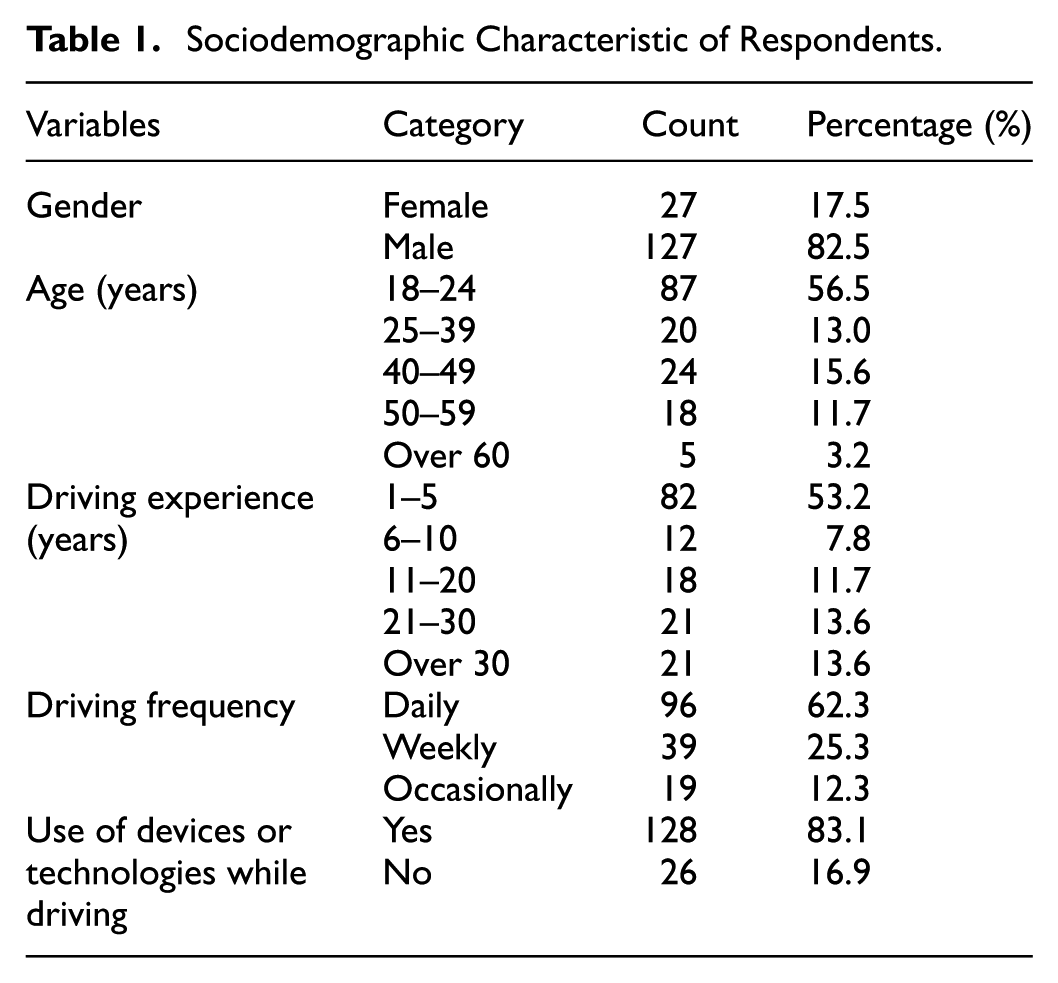
Participants were recruited through academic networks and online dissemination within university communities. Participation was entirely voluntary, and no incentives were offered for taking part in the study. The majority of respondents are male (82.5%), with the largest age especially in 18 to 24 years (56.5%), have less than 5 years of driving experience (53.2%), and they drive daily (62.3%). The majority of them use various devices or technologies while driving (83.1%; Table 1).
Sociodemographic Characteristic of Respondents.
Data Collection Method
The data was collected online. We used a questionnaire (Appendix A) that was available freely on Google Forms, during the second semester of the 2023 to 2024 academic year. This is one of the most used procedures for obtaining responses, particularly among students and professors (Coman et al., 2020, 2021; Dima et al., 2021). The respondents were informed about the purpose of the survey. After being informed, the participants were able to clearly state their agreement to participate to our exploratory study. We did not collect their e-mail addresses. Informed consent was obtained implicitly, as participants proceeded with the survey only after reviewing this information. The average time required to answer all the items from our questionnaire was 20 min. To ensure readability, we developed abbreviated names for each item that effectively communicate its meaning (Appendix B).
The Research Instrument
The first part of the questionnaire includes items pertaining to sociodemographic data. In the following three parts we used items that were derived from the following scales: (1) Mindful Attention Awareness Scale (MAAS) in part 2 (Brown & Ryan, 2003); (2) Future Self Thoughts Questionnaire (FST) in part 3 (Stawarczyk et al., 2012); (3) Manchester Driver Behavior Questionnaire (DBQ) in part 4 (Reason et al., 1990). Thus, for the second part, we used the following items from the MAAS scale: (Present Focus) difficulty to focus on what is happening at the present moment; (Distraction) distraction by thoughts about other things when trying to focus; (Sustained Attention) ability to maintain attention on a task for extended periods of time; (Thought Immersion) involvement in thoughts that lead to forgetting one’s present activities; (Sensory Awareness) ability to pay attention and notice all the sensory input when the driver is focused. Abbreviated versions of the MAAS, FST, and DBQ were used in this study to reduce participant burden and questionnaire length, given the exploratory nature of the research and the online data collection context. Item selection was theory-driven and based on prior empirical use. Internal consistency was evaluated for the final item sets, and reliability indices are reported in the Results section.
We used a Likert scale with five points, where 1 = total disagreement and 5 = total agreement. The MAAS was meant to measure the general tendency to be mindful and aware of “present-moment experiences and concerns” (Brown & Ryan, 2003). We chose MAAS because it emphasizes the attention/awareness dimension of mindfulness, which makes it relevant for MW. This scale has been previously used with some success (K. L. Young et al., 2019) and in present study it used for testing convergent validity of FST.
For the third part, we used the following items from the FST questionnaire: (Daydreaming) daydreaming about non-driving related topics; (Past Rumination) contemplating past experiences or events; (Future Planning) planning the respondents’ day or thinking about future events; (Self-Evaluation) evaluating respondents’ performance or abilities; (Worrying) worrying about thing’s or events; (Regret Focus) dwelling on regrets; (Present Disengagement) not focusing on what’s happening in the present moment; (Driving Distraction) distraction by other things when the respondents are trying to focus on driving. In a similar manner to the second part, we used a 5-point Likert scale, where 1 represented total disagreement and 5 equaled total agreement. The FST was initially designed to include 11 items that were intended to measure two dimensions of thoughts about the respondents’ future selves: (a) Frequency – the degree to which respondents spontaneously think about themselves in the future; (b) Clarity – the vibrancy with which respondents envision themselves in the future (McElwee & Haugh, 2010; Stawarczyk et al., 2012). In present study, we used only the dimension of frequency as a measure of level of mind wondering (MW).
For the fourth part, we used items from the DBQ questionnaire which entailed asking respondents to indicate whether they were experiencing mind-wandering in the following specific driving scenarios (MW_SDS): (Highway Driving) driving on highways; (Urban Driving) driving in urban areas; (Night Driving) driving at night; (Bad Weather) driving in bad weather conditions; (Traffic Jam) driving during congested traffic; (Fatigue Driving) driving while feeling tired; (Emotional Driving) driving while feeling stressed or angry; (Eating/ Drinking) driving while eating or drinking; (Multitasking Driving) driving while engaged in other activities (i.e., talking to passengers). We have used here a 5-point Likert scale, which ranges from total disagreement to total agreement. This scale was created in order to assess the subjective experience of driving error. It was used to differentiate between mistakes, violations, aggressive violations, and lapses (B. R. Burdett et al., 2016; Reason et al., 1990).
We added two batteries of items that were meant to approach the impact of mind-wandering (IMW) for the drivers (in part 5) and strategies to reduce mind-wandering (SRMW; in part 6). In the case of the fifth battery, the respondents were asked to assess if mind-wandering had a series of effects on driving: (a) missing traffic signs; (b) forgetting where the respondent is going; (c) taking bad decisions; (d) overlooking other vehicles or pedestrians; (e) generating anxiety or stress. In the case of the last battery added, the respondents were asked to indicate whether they used the following mind-wandering strategies, while driving: (i) turning off the radio and other audio devices; (ii) avoiding distractions like eating or using the phone; (iii) making eye contact with other drivers and pedestrians in order to stay alert; (iv) taking regular breaks from driving; (v) practicing mindfulness or meditation skills. In these two batteries we have also used a 5-point Likert scale, where 1 signified total disagreement and 5 total agreement.
The last item (I39) from the questionnaire addressed the respondents’ general concern about the frequency and impact of mind-wandering. For this item we have included 5-point scale in which the values where designated differently from the rest of the survey: 1 = not worried at all, 2 = a bit worried, 3 = moderately worried, 4 = very worried, and 5 = extremely worried.
Data Analysis
We analyzed the obtained quantitative data using IBM SPSS (version 26) and JASP. In our data analysis we summarized our data set using descriptive statistics, which entailed percentages, means, and standard deviation. For the variables that were measured through several indicators, we developed indexes to measure the information from those indicators, based on the results of Confirmatory factory analysis. The level of mind wandering was measured using an index variable (MW) computed as the mean of the FSTQ scale indicators. The results of CFA support a one factor structure (excluding items I13 and I14) with acceptable fit and adequate internal reliability (χ2(7) = 20.552, p = .004, CFI = 0.944, TLI = 0.880, IFI = 0.946, RMSEA = 0.112, and SRMR = 0.050; α = .769). We created also an index as the mean of the MASS scale indicators. This was another measure of level of MW to test validity of the scale FSTQ (frequency dimension). For the concept, MASS, results support a one factor structure (excluding item I11) with good fit and adequate internal reliability (χ2(2) = 3.505, p = .173, CFI = 0.987, TLI = 0.960, IFI = 0.987, RMSEA = 0.07, and SRMR = 0.035; α = .67). Evidence for convergent validity was obtained through moderate correlations between MAAS index and MW (rs = 0.503; p = .000). For both concepts, the values of index range from 1 to 5, where 1 means they have not experienced any at all, and 5 means they have experienced a high degree of mind waring.
For measuring mind wandering in specific driving context, we created an index variable ((MW_SDS),) as a mean of the I20 to I28 indicators. The values range from 1 to 5, where 1 means “They have not experienced any at all,” and 5 means “They have experienced a high degree of mind wandering.” The results of CFA support a one factor structure with acceptable fit and adequate internal reliability (χ2(25) = 64.78, p < .001, CFI = 0.933, TLI = 0.904, IFI = 0.934, RMSEA = 0.102, and SRMR = 0.059; α = .868).
In order to measure the impact of mind wandering, we created an index variable (IMW) as a mean of the I29 to I33 indicators. The values range from 1 to 5, where 1 means “They don’t experience any effects impact,” and 5 “They have experienced a high degree of effects.” The results of CFA support a one factor structure with acceptable fit and adequate internal reliability (χ2(5) = 11.549, p = .042, CFI = 0.975, TLI = 0.950, IFI = 0.976, RMSEA = 0.092, and SRMR = 0.038; α = .820).
For measuring strategies to reduce mind-wandering (SRMW), we created an index variable (strategies to reduce mind-wandering (SRMW)) as a mean of the indicators I34_I38, where 1 means that “They don’t have any strategy,” and 5 represents “They have a high level of strategies.” The results of CFA support a one factor structure with acceptable fit and adequate internal reliability (χ2(4) = 6.629, p = .157, CFI = 0.960, TLI = 0.899, IFI = 0.963, RMSEA = 0.065, and SRMR = 0.043; α = .582).
Results
What is the Level of Mind Wandering (MW) Experiences Among Drivers, Level of Mind Wandering in Driver Context (MW_SDS) and the Relation Between Them?
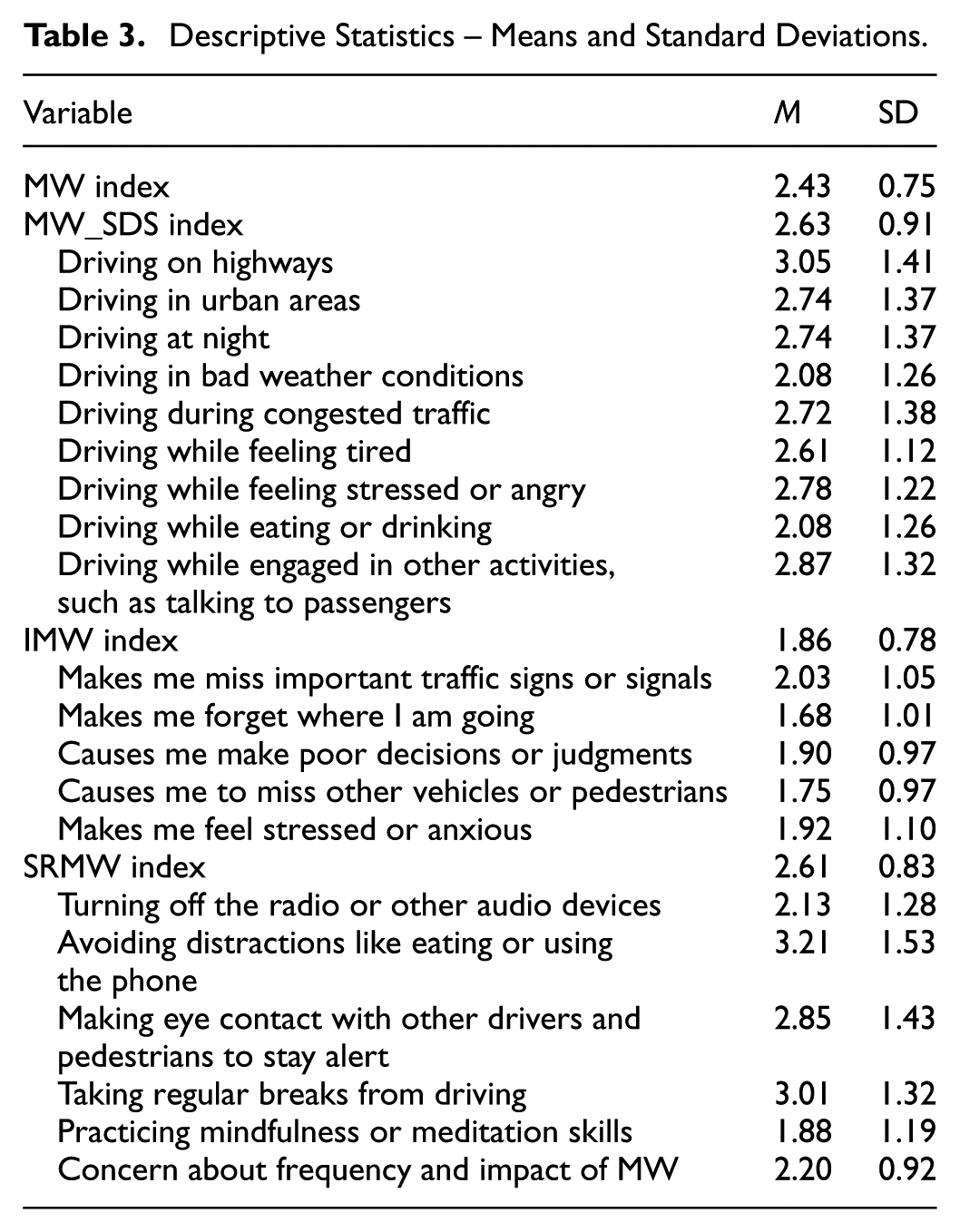
The respondents experienced a low level of mind wandering in general context (MW; M = 2.43; SD = 0.75). A small segment of them reported high level of MW (9.1%), 31.2% reported medium level and 59.7% reported low level of MW. (Table 2). They reported a higher level of degree of mind warring in driver context (MW_SDS, M = 2.63; SD = 0.91; t(153) = −2,585, p = .011; Table 3).
Descriptive Statistics-Percentages of Index Variables.

Descriptive Statistics – Means and Standard Deviations.
About 15.2% reported a high level of MW in driver contexts, 38.4% a medium level and 46.4% a low level (Table 2). There is a positive relation between these two variables (R2 = .110, b = 0.411, p = .000). For a 1-unit increase in the MW variable, the MW_SDS variable increases by 0.411 units, which means that people with a mind-wandering level in general have a much higher chance of manifesting mind-wandering in different driver contexts.
Overall, respondents reported relatively low levels of mind wandering in general, with the majority falling into the low category. However, mind wandering was more pronounced in driving contexts, as reflected by a higher mean score and a larger proportion of respondents reporting medium to high levels. The positive and significant association between general mind wandering and driving-related mind wandering indicates that individuals who tend to mind-wander in everyday situations are more likely to experience mind wandering while driving. This finding suggests that mind wandering represents a stable cognitive tendency that extends across contexts, potentially increasing vulnerability to attentional lapses during driving.
How do These Experiences of MW Vary Across Different Driving Contexts (e.g., Highway, Urban, Night)?
The respondents declared that they experienced mind-wandering predominantly while driving on highways (M = 3.05; SD = 1.41), while driving feeling stressed or angry (M = 2.78; SD = 1.22) and when they are engaged in other activities, such as talking with passengers (M = 2.87; SD = 1.32; Table 2).
The findings indicate that mind wandering occurs more frequently in demanding or emotionally charged driving situations, particularly while driving on highways, when feeling stressed or angry, and when simultaneously engaging in secondary activities such as talking to passengers. These contexts appear to increase cognitive load and distraction, making drivers more susceptible to attentional lapses.
What are the Perceived Effects of Mind Wandering (IMW) on Driver Behavior and Safety and the Strategies Used to Reduce Mind Wandering (SRMW)?
Furthermore, the descriptive statistics obtained for the items detailing the impact of mind-wandering indicated that the respondents don’t perceive that are some effects on auto vehicle driving (Table 2). Only 4.5% have a high level of recognize the effects and 16.9% a medium level of recognizing. They recognize in a higher level the fact that MW in traffic made them to miss important signs or signals (M = 2.03; SD = 1.05), made them feel stressed or anxious (M = 1.92; SD = 1.10), or made them poor decisions or judgments (M = 1.90; SD = 0.97). To reduce mind-wandering respondents declare that they try to avoid distraction while eating (M = 3.21; SD = 1.53), take regular breaks from driving (M = 3.01; SD = 1.32) and to make eye contact with other drivers and pedestrian to stay alert (M = 2.85; SD = 1.43). 13.6% of them have a high level of strategies used for make face to MW and 46.8% a medium level of strategies.
Descriptive statistics regarding the perceived impact of mind wandering suggest that most respondents do not strongly recognize its negative effects on driving performance. Only a small proportion reported medium to high awareness of these effects. Among the perceived consequences, respondents most frequently acknowledged missing important traffic signs or signals, experiencing stress or anxiety, and making poor decisions or judgments while driving. In terms of coping strategies, respondents reported primarily relying on behavioral adjustments, such as avoiding distractions like eating while driving, taking regular breaks, and maintaining eye contact with other drivers and pedestrians to remain alert. Although the majority reported using these strategies at low to moderate levels, a notable proportion indicated moderate to high engagement in efforts to manage mind wandering while driving.
What is the Relation Between the Level of MW and the Respondents’ Concern About Its the Frequency and Impact (I39), Level of Effects of Mind Wondering (IMW) on Driver Behavior and Safety or the Level of Strategies to Reduce Mind-Wandering (SRMW)?
When asked about how concerned are they about the frequency and impact of mind-wandering in their driving, the respondents stated a moderate level of concern for item I39 (M = 2.20, SD = 0.92). (Table 2) In terms of percentages, this means that 10.3% there are not worried and 67.5% are.
We identified a moderate positive correlation between the index and MW and I39, with rs = .350, p < .001. This indicates that the respondents who declared that they experience higher MW have the tendency to be more concerned about the frequency and impact of mind-wandering in their driving. In other words, they are aware of these situations.
In order to ascertain whether there is a correlation between the MW index and the effects of mind-wandering (IMW), we performed the Spearman’s Rho correlation analysis. We obtained a moderate positive correlation between them, with rs = .440, p < .001. This signifies that the respondents who stated that they experience higher mind-wandering had a moderate tendency to have higher scores at the items detailing mind-wandering effects on driving the auto vehicles. In other words, these people recognize that there is a much higher a number of possible effects for them.
The relationship between MW index and the level of the strategies to reduce mind-wandering index (SRMW) was revealed to entail a rs = 0.110, p = .176. This indicates that there is no significant correlation between these two variables. Is seems that people with high level of MW do not have a high number of strategies.
Respondents reported a moderate level of concern regarding the frequency and impact of mind wandering on their driving, suggesting a general awareness of the issue. The observed moderate positive correlation between general mind wandering and concern about its driving-related consequences indicates that individuals who experience higher levels of mind wandering tend to be more worried about its effects, reflecting greater subjective awareness of the problem. Similarly, the moderate positive association between mind wandering and perceived driving-related effects suggests that individuals with higher levels of mind wandering are more likely to recognize its negative consequences on driving performance. In contrast, the absence of a significant relationship between mind wandering and the use of strategies to reduce it indicates that higher levels of mind wandering do not necessarily translate into greater engagement in coping or self-regulation strategies, pointing to a potential gap between awareness and behavioral response.
Discussion
The findings from our survey provide valuable insights into the nature and impact of MW during driving. Several key patterns emerged from our analysis, which are discussed below in relation to existing literature and the study’s research questions.
The present findings should be interpreted as reflecting drivers’ subjective awareness and self-perceived experiences of MW during driving. While such perceptions are relevant for understanding risk awareness and self-regulatory processes, they do not provide a direct measure of actual driving behavior or performance.
Given the cross-sectional and single-session nature of the study, the findings reflect participants’ retrospective evaluations of their typical experiences rather than real-time fluctuations in MW during driving.
Occurrence of Mind Wandering Across Driving Contexts
The results indicate that MW is generally reported at low levels in everyday contexts but becomes more pronounced during driving, particularly in specific situations. MW was most frequently reported while driving on highways, which is consistent with previous research suggesting that less cognitively demanding and more monotonous driving conditions facilitate task-unrelated thoughts (B. R. D. Burdett et al., 2018, 2019). From the perspective of attentional resource theories, highway driving may require sustained vigilance with limited stimulation, thereby increasing susceptibility to attentional disengagement (Körber et al., 2015).
In addition, relatively higher levels of MW were reported when drivers felt stressed or angry and when they were engaged in secondary activities, such as talking to passengers. These findings highlight the complex interaction between internal states, external demands, and cognitive load. Even in driving contexts that require greater attentional control, internal distractions and emotional states appear to increase vulnerability to MW. This aligns with previous studies indicating that social interaction and emotional engagement can negatively influence attentional focus during driving (Stawarczyk et al., 2011).
Effects and Safety Implications
Despite experimental evidence demonstrating that MW negatively affects attention and driving performance (Martens & Brouwer, 2013; Pepin et al., 2021), the majority of respondents in this study reported low levels of perceived impact on their driving behavior. Only a small proportion of drivers acknowledged medium to high levels of MW-related effects, suggesting that many drivers may underestimate or fail to recognize the consequences of MW. This discrepancy between subjective self-reports and experimental findings may reflect limited awareness of subtle performance impairments or the use of compensatory behaviors that mask the effects of brief MW episodes.
Nevertheless, the moderate positive correlation between MW and perceived driving-related effects indicates that individuals who experience higher levels of MW are more likely to recognize its negative consequences, such as missing traffic signs, increased stress or anxiety, and impaired decision-making. This suggests that personal experience with frequent MW may enhance awareness of its risks, which could be a critical factor in promoting safer driving behaviors.
Experimental and simulator-based studies in cognitive psychology and traffic safety consistently show that MW is associated with reduced visual attention, slower reaction times, and impaired hazard detection (e.g., He et al., 2011; Martens & Brouwer, 2013; Pepin et al., 2021). In contrast, the present survey data indicate that many drivers report limited perceived impact of mind wandering on their driving. This divergence likely reflects differences between subjective awareness and objectively measured performance.
When interpreted in relation to the broader distraction literature, the present findings suggest that MW shares important functional similarities with other forms of driver distraction, particularly in its association with reduced attentional engagement and potential safety risks. However, unlike external distractions, MW does not involve an identifiable competing task and may therefore be less salient to drivers. This lack of salience may contribute to the relatively low levels of perceived impact reported by respondents, despite evidence from experimental studies indicating performance impairments during MW episodes.
Mitigation Strategies
The analysis revealed no significant association between MW frequency and the use of strategies to reduce MW while driving. Although many respondents reported employing behavioral strategies such as avoiding distractions, taking regular breaks, and maintaining eye contact with other road users, these strategies were generally used at low to moderate levels and did not increase with higher MW levels. This finding suggests a gap between awareness of MW and effective self-regulation.
Several explanations may account for this pattern. Drivers may lack knowledge of effective strategies to manage MW, may underestimate its impact on safety, or may rely on habitual behaviors that do not adequately address attentional disengagement. These results point to the need for the development of targeted interventions, including driver education programs and in-vehicle support systems, aimed at improving attentional control and reducing MW episodes. Although mitigation strategies were not the primary focus of the present study, they represent an important area for future research, potentially informed by frameworks such as the Perceptual Decoupling Theory (PDT).
Awareness and Concern
Respondents reported a moderate level of concern regarding the frequency and impact of MW on their driving, indicating a general awareness of its potential risks. The moderate positive correlation between MW levels and concern suggests that drivers who experience more frequent MW are more likely to perceive it as problematic. This relationship further supports the notion that direct experience with MW increases risk perception and awareness.
However, the absence of a strong link between concern and the adoption of mitigation strategies underscores a disconnect between recognizing the problem and taking effective action. These findings highlight the importance of educational and preventive initiatives that not only raise awareness about MW but also equip drivers with practical, evidence-based strategies to manage attentional lapses and enhance driving safety.
Overall, the findings support the view that MW can be considered a distinct subtype of driver distraction (namely, internal distraction) characterized by unique mechanisms and challenges for detection and mitigation. Recognizing these differences is essential for developing effective interventions that address not only external distractions but also internally driven attentional disengagement.
While experimental studies provide critical insights into the causal mechanisms and performance consequences of mind wandering, survey-based approaches such as the present study contribute complementary information by capturing drivers’ subjective experiences, awareness, and self-regulatory responses in naturalistic contexts. Together, these approaches offer a more comprehensive understanding of mind wandering in driving.
Conclusions
This study provides empirical insight into mind wandering (MW) during driving by examining its prevalence, contextual variation, perceived effects, levels of concern, and self-reported mitigation strategies. The findings indicate that MW is a common experience while driving, occurring more frequently in certain contexts, particularly during highway driving, emotionally demanding situations, and when drivers are engaged in additional activities. These contexts appear to facilitate attentional disengagement from the driving task, consistent with theoretical accounts of mind wandering under conditions of sustained or altered cognitive demand.
The results further show a positive relationship between general tendencies to mind wander and the occurrence of MW in driving contexts, suggesting that MW represents a relatively stable cognitive disposition that extends into everyday driving. Drivers who reported higher levels of MW were more likely to recognize its potential effects on driving behavior and to express concern about its frequency and impact. This indicates that subjective awareness of MW increases with experience of the phenomenon.
Despite this awareness, the use of strategies to reduce MW while driving was not associated with the level of MW reported. Although many respondents indicated employing behavioral strategies such as avoiding distractions, taking breaks, or maintaining alertness, these strategies were generally used at low to moderate levels and did not increase among drivers who experienced higher MW. This finding highlights a disconnect between recognizing MW as a potential risk and adopting effective self-regulation strategies to address it.
Taken together, these findings support the characterization of MW as a form of internal driver distraction that differs from external or secondary-task distractions. Because MW is internally generated and may occur without overt behavioral signs, it may be less salient to drivers and therefore more difficult to detect and manage. This lack of salience may contribute to the underestimation of its effects, despite evidence from experimental studies showing that MW can impair attention and driving performance.
The present study has several limitations. The reliance on self-reported, retrospective data limits conclusions about actual driving behavior and objective safety outcomes, as MW may occur without full conscious awareness and may be subject to recall bias. In addition, driving experience was assessed only through self-reported years and frequency of driving, without accounting for annual or total kilometers driven, which represents a more precise indicator of driving exposure and experience. Although established instruments were employed, the use of partial scales limits measurement validity, and future studies should rely on full, fully validated versions and additional validation procedures. The cross-sectional design precludes causal inference, and the use of a convenience sample restricts the generalizability of the findings. Future research should integrate subjective reports with objective measures, such as driving simulator data, physiological indicators, eye-tracking metrics (e.g., gaze variability and fixation patterns), and vehicle-based signals (e.g., steering or lane-keeping variability), and should also adopt repeated-measurement approaches, including daily diaries or experience-sampling methods, to capture MW more accurately and closer to its occurrence, thereby informing the development of feasible, data-driven ADAS-based interventions.
Despite these limitations, this study contributes to a broader understanding of internally generated distraction in driving. By focusing on drivers’ subjective experiences, perceived effects, and self-regulation efforts, the findings highlight the need for further research into mechanisms of MW detection and mitigation. Such work is particularly relevant in the context of evolving vehicle technologies and increasing levels of automation, where maintaining appropriate driver engagement remains critical for road safety.
Footnotes
Appendix A
Appendix B

Ethical Considerations
Ethical permission was not sought as this research did not involve any interaction with human participants/subjects, nor did it utilize identifiable private information.
Consent to Participate
Prior to participation, all respondents provided informed consent electronically. Participants were presented with clear information regarding the study’s purpose, procedures, confidentiality, and their right to withdraw at any time without penalty, before proceeding to complete the online questionnaire.
Funding
The authors disclosed receipt of the following financial support for the research, authorship, and/or publication of this article: This work was supported by a grant of the Ministry of Research, Innovation and Digitization, CNCS-UEFISCDI, project number PN-IV-P2-2.1-TE-2023-1434, within PNCDI IV.
Declaration of Conflicting Interests
The authors declared no potential conflicts of interest with respect to the research, authorship, and/or publication of this article.
Data Availability Statement
Data will be made available on request.