




Abstract
Digital innovation has become a strategic choice to reshape the tourism industry ecosystem and promote its high-quality development. In the new environment of the digital economy, it is important to clarify the driving factors of digital innovation in the tourism industry and their relationship mechanism. On the basis of literature research, we construct an analytical framework or the driving factors of digital innovation in the tourism industry from seven aspects. Based on the collection of relevant research data from 31 provinces in China, and using 31 provinces in China (excluding Hong Kong, Macau, and Taiwan) as the subject of empirical research, the level of digital innovation development dynamics in each province was empirically investigated. The results show that the level of digital innovation development dynamics of the tourism industry in the 31 provinces of China shows great regional differences, and overall it can be divided into four echelons. Intra-industry upgrading, inter-industry competition, policy support, the technology innovation environment, economic level and the digital technology environment are the most important driving factors for digital innovation in China’s tourism industry. Market demand scale, e-commerce platforms, and internet facilities are more important driving factors for digital innovation in the industry. The degree of influence of market consumption structure, digital industry level and cultural industry level on digital innovation of the tourism industry is relatively small. The findings of the study make an important theoretical contribution to the understanding of the factors influencing innovation in the tourism industry in the new era. The article highlights the simultaneous approach of optimizing both endogenous and exogenous dynamics to enhance the innovative development of the global tourism industry.
Introduction
Industrial innovation systems theory is a meso-level innovation systems theory between national innovation system and firm innovation system proposed by Malerba et al. (1997), after which Malerba (2002) innovated the industrial systems theory of innovation, where innovation is viewed as a systemic interaction process aimed at the creation and exchange of innovation-related knowledge and its commercialization. China has entered the era of the digital economy, and digital technology with the new generation of information technology, such as big data, cloud computing, artificial intelligence, blockchain, metaverse, and 5G, as the core has triggered the development trend of digital innovation in the tourism industry. The information technology revolution has caused a disruptive impact on the tourism industry’s ecosystem, development paradigm, business model, value creation, and organizational forms. Digital innovation has become a strategic choice to reshape the tourism industry ecosystem and promote the high-quality development of the industry. The macro and industrial environments of digital innovation in the tourism industry in the digital economy have changed significantly, as have the driving factors. Digital technology has profoundly changed the relationship mechanism among the driving factors of the tourism industry’s innovation and development, which in turn has triggered the deconstruction and reconstruction of their driving mechanism, and has posed new major challenges to the sustainable development of the industry. Therefore, it is of great theoretical value and practical significance to study the driving factors and their relationship mechanisms of digital innovation in the industry from a system perspective in the new environment of the digital economy, which is conducive to the precise identification of key driving factors affecting tourism industry innovation in the complex system environment, and to accurately grasp the development rules and trends of the tourism industry in the new era, so as to promote its high-quality development of tourism industry. Exploring the level of digital innovation development dynamics in China’s tourism industry in 31 provinces provides lessons and references for the rest of the country, and helps to guide digital innovation in the global tourism industry.
Literature Review
Digital innovation is digital product, process, and business model innovation driven by digital technologies such as cloud computing, big data, artificial intelligence, and blockchain (Vega & Chiasson, 2019). Digital innovation fundamentally changes the logic of value creation by digitally disrupting unbundling, recombining, and creating new connections between resources (Zhang et al., 2021). Entering the era of the digital economy, the factors driving digital innovation in the tourism industry have become a hot topic of academic research. The innovation and development of the tourism industry are the results of comprehensive effects of various macro-environmental, industrial and market factors (Divisekera & Nguyen, 2018; Rakhimov, 2022), including digital infrastructure, information technology innovation, human environment, industrial competition and cooperation, policy and legal systems, market demand changes, and many other driving factors. Digital infrastructure is the foundation of digital innovation (Paresishvili et al., 2017). Infrastructure such as digital platforms established by mobile internet, big data, cloud computing, blockchain, artificial intelligence, and other new-generation information technologies have reshaped the relationship between tourism producers and consumers, thus promoting the efficient allocation of the tourism industry’s resources, improving the efficiency of tourism market transactions, and promoting tourism innovation (Marino & Pariso, 2021; Sinha & Fukey, 2022). Information technology innovation is one of the primary driving forces of innovation in the tourism industry. It promotes innovation by facilitating the change of basic elements within the industry, the integration of elements between different industries, and the change of participating subjects, thus promoting the development of the industry’s innovation in terms of operation methods, product innovation, business processes, organizational relationships, and marketing channels (Marušić et al., 2019; Sari et al., 2021). Innovation in the tourism industry depends on human environment factors such as education, human resources, and culture (Hojeghan & Esfangareh, 2011). Tourism is a labor-intensive industry. Adventurous and innovative entrepreneurs with well-educated and experienced staff and organizations with innovative cultures are conducive to promoting the innovative activities of tourism enterprises, greatly improving the efficiency of the tourism industry and promoting its development (Omerzel, 2015; Rega & Inversini, 2016). Under the digital economy, industrial competition and cooperation is the main driving force to promote industrial innovation. Fierce market competition is conducive to promoting tourism enterprises to increase innovative activities to develop new tourism products and reduce costs (Divisekera & Nguyen, 2018). Innovation is conducive to improving the operating efficiency of tourism enterprises and creating greater flexibility in responding to demands, thus promoting enterprises to gain competitive advantages (Pirnar et al., 2012). Cooperation within the tourism industry and the division of labor and cooperation systems between the tourism industry, supporting industries and related industries are conducive to the promotion of industrial innovation and development. Suppliers, distributors, retailers, agents, and competitors in the tourism industry chain can efficiently establish various types of cooperative and interdependent relationships and contact networks with the help of digital network platforms (Qashou & Saleh, 2018), which is conducive to the formation of economies of scale by accessing innovation resources and promoting industrial innovation. The integration and development of the tourism and digital industries are conducive to promoting the formation and improvement of digital infrastructure, which enables the transfer, diffusion, and overflow of knowledge across industries. The flow of knowledge innovation resources promotes cross-border collaborative innovation in the tourism industry (Sun et al., 2021). National and local policies, laws, and other institutional factors are important elements affecting the innovation of the tourism industry. The improvement of public service and policy system will bring about the transformation of the development mode of tourism industry and the development of new business forms (X. Li et al., 2022). Through investment, taxes, loans, and other policy tools, the government attracts social capital investment, gathers outstanding talents, and promotes infrastructure construction, which is conducive to providing resource elements needed for innovation, including that of the tourism industry (Carlisle et al., 2013; Randall et al., 2020). The changes in tourism market demand are important driving forces affecting the digital innovation of the tourism industry. These changes drive tourism enterprises to develop new products and expand new businesses, thus enhancing their innovation impetus and contributing to sustainable tourism development (Tang, 2023). Under the new environment, tourists’ experience mode and consumption concept have undergone great changes. The growth of tourism market demand for virtual consumption scenarios, customized consumption products, online tourism, and other formats has driven product and business innovation, and new tourism formats such as tourism e-commerce, tourism virtual communities, and artificial intelligence services are conducive to improving the experience, convenience, and comfort of tourism consumption (Preko et al., 2023), and reshaping tourism producer consumer relationships.
In summary, the research from recent year on the driving factors of digital innovation in the tourism industry has shown a sharp increase in the number of studies, continuous extension of categories, and gradual deepening of content, which is highly consistent with the rapid development of digital innovation in the tourism industry. However, existing studies still have the following deficiencies: first, the research perspective is scattered and lacks a unified analysis framework from the perspective of systematic theory. Most of the existing studies look at one or several driving factors, but lack general rules to grasp the driving factors of digital innovation in the tourism industry from the perspective of environmental and industrial system integration. Second, most of the existing results lack practical tests of the theoretical research results. In particular, the empirical research results on the digital innovation of China’s tourism industry are few. China is one of the world’s tourism powers, and China is also the world’s largest developing country. Empirical research results about China will have significant reference value and promotion significance to guide the digital innovation of the global tourism industry. Therefore, this paper takes 31 provinces of China as the objects of empirical research, builds the driving factors analysis framework of digital innovation in the tourism industry on the basis of literature research, and conducts empirical research to explore the general rules of the tourism industry’s digital innovation to provide a reference for the digital transformation and development of the industry around the world.
Drivers of Digital Innovation in the Tourism Industry
Innovation in the tourism industry in the digital economy environment is gradually moving towards the digital innovation stage. The driving factors of innovation in the tourism industry and its structural system under the digital technology drive have changed significantly, presenting new elements, forms and effect characteristics.
Digital Technology Environment Drivers
Tourism is an information-intensive and information-dependent industry, and digital technology is the main driver of innovation in the tourism industry (Y. F. Yang, 2012). The disruptive innovations in the field of digital technology represented by cloud, big, things, intelligence, and migration in the digital economy era are constantly emerging and rapidly penetrating and spreading to the tourism industry, which can develop new products, markets, improve resource allocation efficiency, and optimize organization systems, thus promoting the spiral rise of digital innovation in the tourism industry. Ultimately, the industry will be iterated and upgraded. At the same time, digital technology promotes the integration and innovation of the digital and tourism industries. Cloud, large, material, intelligence, migration and other technologies comprehensively promote the digital and network transformation development of traditional tourism, and promote the high correlation between the digital and tourism industries (Y. Z. Li & Ren, 2020). Cloud broadcasting, performing arts, entertainment, exhibition, are embedded in the tourism industry, cultivating a new mode of “network experience + consumption” and expanding the new mode of intelligent tourism. The application of modern information technologies such as the internet, cloud computing, and big data in the construction of tourism network platforms has spawned the rise of a number of online Travel agencies in the Chinese market, such as Tongcheng Travel, Long, Ctrip, Feizhu, Qunar, and Hornet’s Nest. Driven by digital technology, China’s online travel platforms have developed rapidly, promoting the leap of the tourism industry value chain and the paradigm change of industry development, realizing the deep integration of the digital economy and the tourism industry and upgrading the industry’s structure.
Digital Institutional Environment Drivers
Policies and regulations mainly include laws, regulations, policies and other explicit institutions. Under a socialist market economy system with Chinese characteristics, the state actively intervenes in the economic activities of the tourism industry through policies and regulations in order to play the leading and guiding functions of government macro-regulation (Ren & Huang, 2020) and guide the healthy development of the industry under the framework of national economic strategic planning. Entering the era of the digital economy, the state puts forward the strategy of industrial digitization and digital industrialization, and the integration and development of the digital economy and the tourism industry become the focus of national policies. The central and provincial governments of China have issued a series of stimulating policies, such as the Tourism Development Plan for the 14th Five-Year Plan (The State Council of China, 2021), the Opinions of the General Office of the State Council on Further Releasing Consumption Potential and Promoting Sustainable Recovery of Consumption (The State Council of China, 2022), the “14th Five-Year Plan for the Development of Digital Economy” (The State Council of China, 2022), and Opinions of the Ministry of Culture and Tourism on Promoting the High-Quality Development of Digital Culture Industry (Ministry of Culture and Tourism, 2020). The national policy mainly provides preferential policies to support the development of the digital tourism industry in terms of investment and financial support, project approval, tax and fee concessions, infrastructure construction, and talent training, thus strongly promoting the development of digital innovation in the tourism industry nationwide. However, the digital economy is an emerging economic format, and government departments should reform the existing laws and regulations based on the principle of “accommodating innovation, prudent supervision, and strengthening protection” to create a good environment for intellectual property protection, information security, and market operation through the institutional supply of laws and regulations (Parida et al., 2019), This would effectively restrain the illegal speculation of enterprises, and form a good business environment and market order to stimulate market vitality, thus becoming an important driving force for promoting digital innovation in the tourism industry.
Digital Humanistic Environment Drivers
The human environment involves the cultural heritage, social values, customs, and habits of the region, which will potentially affect the innovative consciousness and spirit of entrepreneurs and research and development (R&D) personnel of regional tourism enterprises and the innovative business activities of tourism enterprises. The exchange between digital technology culture and traditional culture is more convenient and frequent in the digital economy, and the cultural environment presents a high degree of diversity, openness, and inclusiveness, which makes it easy to cultivate the innovation consciousness and spirit of tourism enterprise business managers and R&D personnel. Increasing digitization is part of the future of human resources, driving leaders and employees to change the way they think about innovation in the travel industry. Leading tourism entrepreneurs with an entrepreneurial and innovative consciousness are able to keenly identify business opportunities in digital technology and achieve innovation in business production and operation (Wang, 2017) thus gaining a competitive advantage. The demonstration effect of individual leading entrepreneurs will drive many others to follow and imitate, thus enhancing the general promotion of digital innovation in regional tourism enterprises and realizing the full spread of digital innovation in the tourism industry from point to point. Digital marketing has the potential to boost tourism spending by international tourists to address low tourist arrivals and lower tourism revenues. Therefore, the human environment is one of the important driving forces of digital innovation in the tourism industry.
Digital Economic Environment Drivers
The regional economic environment provides the economic infrastructure conditions of digital innovation in the tourism industry. This innovation relies on local production factor resources. Recently, China’s economy entered a new normal, and the digital economy has become an important pillar of industry—leading socio-economic development. The state has formulated a series of economic policies to promote the digital transformation of industrial structure and create a favorable environment for the development of the digital economy. The larger the total economic volume, the higher the economic growth rate, and the more reasonable the economic structure of the region, the better the economic environment of the region. Regions with a favorable economic environment can provide more sufficient funds, materials, human resources, and a broad consumer market for the digital innovation of the tourism industry, which is conducive to its promotion. At the same time, this innovation will radiate out and drive the development of the information industry and other related industries, such as agriculture, forestry, animal husbandry and fishery, manufacturing, commerce and retail, and service industries, thereby promoting the virtuous cycle development of the entire local economy.
Digital Infrastructure Drivers
Digital facilities are the basic material conditions for the orderly operation of digital innovation activities in the tourism industry, and it is the guarantee driving force to realize this innovation. Entering the era of the digital economy, the Chinese government is focused on supporting the construction of new infrastructure such as 5G, big data centers, artificial intelligence and industrial internet. The new infrastructure constructs the new structural power of the digital economy, which provides digital transformation, intelligent upgrading, and integration innovation for the digital innovation of the tourism industry (L. Sheng, 2020). The benefits of tourism enterprises relying on new infrastructure to carry out production and business activities will significantly increase, thus strengthening their behavior regarding digital innovation. At the same time, the demonstration effect will stimulate other tourism enterprises to carry out digital innovation on a larger scale, thus realizing the collective behavior of digital innovation within the industry. Furthermore, some tourism enterprises with sufficient capital and technical resources will invest in the construction of platform-layer infrastructure such as tourism network platforms and sharing economy platforms, and provide intelligent products such as information and data, technology and consulting, and intermediary services. In addition, digital technology improvements can help reduce the impact of factors such as tourism seasonality on tourism. Therefore, the infrastructure will empower the tourism industry to improve operational efficiency, develop new products, and explore new markets, thus promoting its digital innovation.
Market Demand Evolution Drivers
The digital economy era relies on mobile internet technology, big data, cloud computing, intelligent terminals, and other technical means to innovate the tourism consumption pattern, expand the tourism consumption channels, and change the tourism consumption structure. In terms of tourism consumption patterns, the trend of online and offline synergistic development and evolution is seen. Digital technology has given birth to the transformation of tourists’ consumption patterns to personalized, diversified, and customized demand patterns, thereby promoting the rapid development of digital economy platforms and promoting the deep integration and development of the tourism and digital economy industries. In terms of tourism consumption channels, demand has driven the development of O2O operation platforms, third-party payment platforms, social platforms, and other online consumption channels, gradually evolving into a combination of online and offline omni-channel models, breaking through the time and space constraints of tourism transactions (Figure 1). In terms of tourism consumption structure, the market shows the trend of upgrading from tourism-based consumption to experience-based and from material-based to service-based consumption (L. Li & Chen, 2021). The upgrade of the tourism market consumption structure directly promotes tourism product form and function innovation, and digital technology becomes the core element of innovative tourism products. Therefore, the evolution of market demand becomes one of the important driving forces for digital innovation in the tourism industry.

O2O tourism digital consumption pattern.
Industry Evolution Development Drivers
The essence of industrial innovation and development is the transformation and evolution of the industry itself. In the process of the evolution and development of the tourism industry, its internal transformation and upgrading, as well as the external industry competition and cooperation, drive its digital innovation. Within the tourism industry, the digital economy has innovated production factors, production methods, and organizational forms. Information has become the core production factor of the tourism industry, and big data is widely used in all aspects of tourism production and operation to improve production efficiency. Intelligent manufacturing has overturned the human-intensive industrial attributes of the tourism industry, and the wide application of artificial intelligence, such as robots, has optimized the production process. New forms of industrial organization, such as virtual industry clusters and digital economy platform networks, have innovated the development paradigm of the tourism industry and greatly promoted its digital innovation. The competitive pressure from alternative competitors outside the industry drives its digital innovation to respond more efficiently to market demand and improve industrial production efficiency, gaining a comparative competitive advantage. Moreover, the cooperation and integration of the digital economy and tourism industries are conducive to the formation of horizontal integration, vertical integration, and diversified extension of the tourism industry, which increases the relevance of both industries (Y. Z. Li & Ren, 2020) and obtains economies of scale and scope effects to promote the development of digital innovation in tourism.
System Structure and Relationship Mechanism of Digital Innovation Driving Factors of the Tourism Industry
Based on the system theory, the driving factors of digital innovation in the tourism industry are divided into endogenous and exogenous power system according to the nature of their roles, and they construct the system structure (Figure 2). The endogenous power system is composed of the direct basic driving factors inside the tourism industry to promote industrial digital innovation, including market demand evolution and industrial evolution development. The evolution of market demand brought about by digital technology, such as tourists’ consumption mode, consumption channels and consumption structure, and the evolution of the industry brought about by the internal transformation and upgrading of the tourism industry and external competition are the source of driving force for the reform of the industry’s supply, both of which influence and coordinate with each other to form the endogenous structural variables to promote tourism industry digital innovation. The exogenous power system consists of indirect supporting driving factors external to the tourism industry that promote industrial digital innovation, including the digital institutional environment, digital economic environment, digital technology environment, and new infrastructure. The digital science and technology environment drivers include digital technology innovation and industrial integration development, the digital institutional environment is divided into policy guidance and legal constraints, the digital humanities environment consists of the digital innovation environment and innovative entrepreneurs, and digital information technology and digital network platforms together constitute the new digital infrastructure drivers. These factors form the external environmental conditions that promote digital innovation in the tourism industry in four aspects: political, economic, technological, and facilities. Through favorable environmental factors, they influence the changes in demand and supply in the tourism industry, and then indirectly promote the tourism industry digital innovation. Therefore, the exogenous power system is the exogenous structural variable that promotes the digital innovation of tourism industry.

System structure of digital innovation drivers in the tourism industry.
The power system evolution of the tourism industry’s digital innovation comes from the competition and synergy between each driving factor of endogenous and exogenous power systems (Yu & Li, 2021) The competition between driving factors breaks the balance of the power system, thus promoting the self-organized evolution of the tourism industry and achieving a higher level of innovation development. The synergy between the driving factors promotes the evolution of the tourism industry to an orderly structure and maintains relative stability. The dynamic factors form a complex, nonlinear, and influential relationship under the interaction of competition and cooperation in the industrial ecosystem, thus constituting the dynamic mechanism of digital innovation development in the tourism industry. Under the action of the synergistic mechanism, a nonlinear coupling effect is generated among the driving factors within the power system, and the causal feedback relationship among the driving factors is formed (Figure 3).

Causal mechanism of the factors driving digital innovation in the tourism industry.
In the digital innovation power system of the tourism industry, seven driving factors are interrelated and interact with each other to form an organically linked power system, forming feedback loops of different levels and types of causality mechanisms. The change of each driving factor will make others change accordingly, and cause changes in the whole dynamic system, so it will achieve the spiraling process of breaking the balance, restoring the balance, and breaking the balance again, forming a continuous momentum to promote the digital innovation of tourism industry. With the dynamic evolution of the power system, the influence of each driving factor in the system is also in alternating changes, and the leading and auxiliary power to promote the development of digital innovation in the tourism industry is also dynamically adjusted, forming different leading power types of tourism industry digital innovation development power mode, such as market demand power, industrial evolution power, infrastructure power, institutional environment power, etc.
Empirical Research
Variable Selection and Data Source
According to the characteristics of the tourism industry and the principle of typicality, seven dimensions and 15 indicators were selected to construct the index system of driving factors for the innovation and development of the tourism industry under the digital economy (Table 1). The dependent variable Y is the tourism industry income, which is measured by the sum of the business income of star-rated hotels, travel agencies, and A-class scenic sites; the independent variable X’s indicators and their measurement methods are shown in Table 1.
Indicator System of Driving Factors of Digital Innovation Development of Tourism Industry.
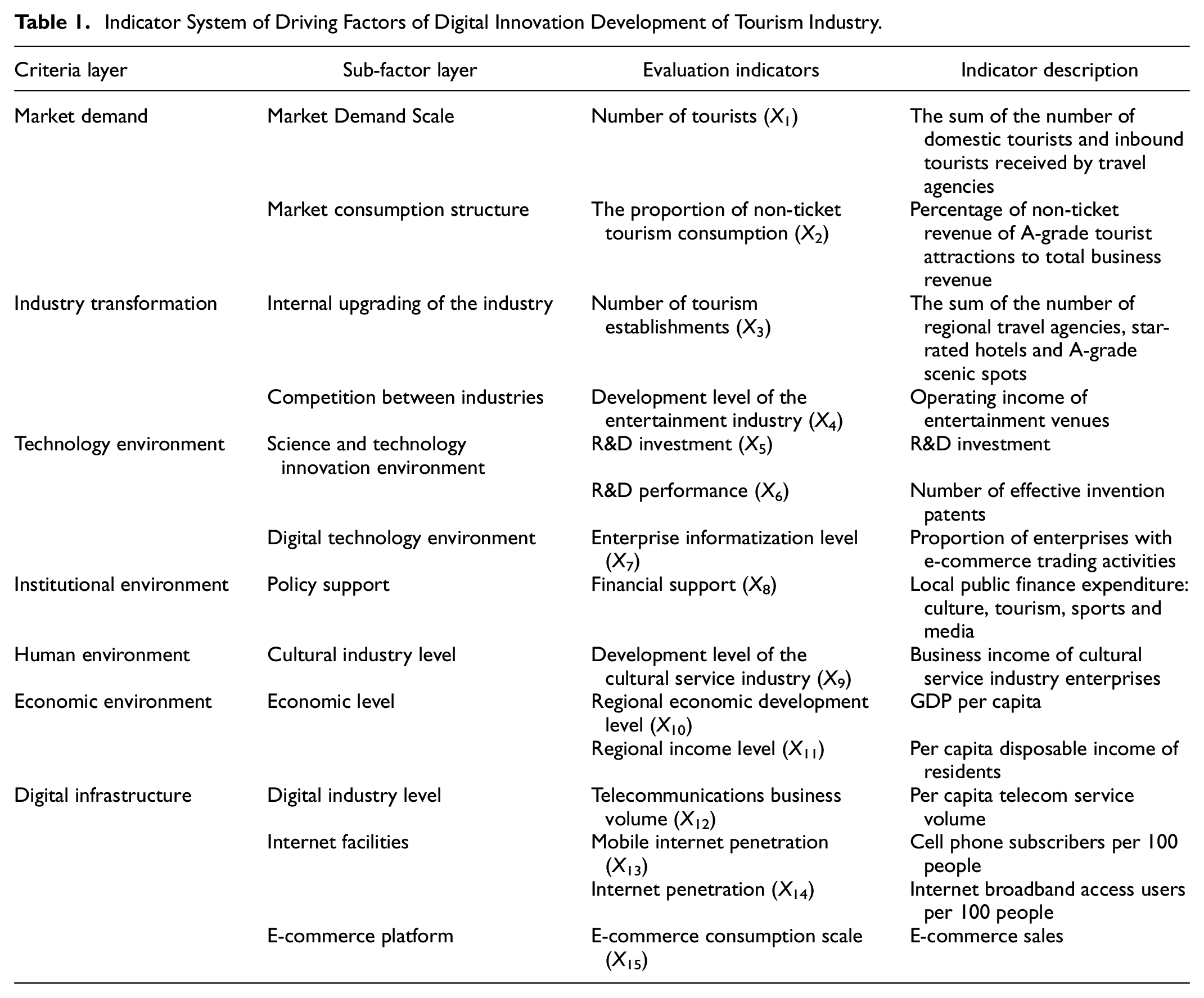
In the selection of evaluation indexes for the driving factors of digital innovation in tourism industry, the results of scholars in the construction of the index system of digital economy, tourism industry innovation and so on have been fully drawn upon (L. Li & Chen, 2021; Liu & An, 2022; Y. C. Sheng et al., 2023). From the system structure of the driving factors of digital innovation in the tourism industry, the evaluation index system of digital innovation in the tourism industry should contain seven dimensions: market demand, industrial transformation, scientific and technological environment, institutional environment, humanistic environment, economic environment, and digital infrastructure. Firstly, market demand is the inexhaustible driving force to promote the innovation of tourism industry, including both market demand scale and market consumption structure. Secondly, industrial transformation is the source of power for digital transformation of tourism industry, which mainly reflects intra-industry upgrading and inter-industry competition, and is measured by the number of tourism institutions and the level of development of entertainment industry. Thirdly, science and technology environment is the booster of digital innovation in tourism industry, reflecting the environmental condition of digital technology development in tourism industry, including science and technology innovation environment and digital technology environment; R&D investment and R&D performance are used to measure science and technology innovation environment, and enterprise informatization level is used to characterize digital technology environment. Fourthly, the institutional environment is the long-term guarantee for the innovative development of the tourism industry, which determines whether tourism can continue to carry out innovative activities, and reflects the degree of support of national policies for the innovation of the tourism industry, which is characterized by financial funds. Fifthly, the humanistic environment is a strong guarantee for the innovative development of tourism industry, which mainly refers to the level of development of cultural industry and is characterized by the level of development of cultural service industry. Sixth, the economic environment is a prerequisite for the innovative development of tourism industry, which mainly includes the level of regional economic development and residents’ income, characterized by GDP per capita and residents’ disposable income. Seventh, digital infrastructure is the root of promoting digital innovation in the tourism industry, mainly responding to the construction of digital infrastructure and the digital level of the industry, including the level of digital industry, Internet facilities and e-commerce platforms.
Due to the availability of data, the research sample could not cover all provinces in China, and the empirical results have errors with the actual situation in China. As the world’s second largest economy, China is one of the world’s major tourism countries, and the study of digital innovation in China’s tourism industry is typical and can provide a reference experience for the innovation of the world’s tourism industry. Based on the research of existing scholars on the systematic study of innovation in the culture and tourism industry (C. Y. Yang et al., 2016) and the measurement of the level of digital development (Zhang et al., 2021), the article uses the China Statistical Yearbook 2021 and the China Cultural Relics and Tourism Statistical Yearbook 2021 as the research database. Thirty-one provinces (municipalities directly under the Central Government and autonomous regions) in mainland China in 2020 areas were used as the research objects, and the relevant index data of the provinces are shown in Table 2.
Statistical Values of the Factors That Drive the Development of Innovation in the Tourism Industry in 31 Provinces (Municipalities and Autonomous Regions) in China.

Source. Data from China Statistical Yearbook 2021, China Cultural Heritage and Tourism Statistical Yearbook 2021, etc.
Determination of Index Weights
As an objective assignment method, the entropy method has more obvious advantages in the case of a larger number of evaluation objects and a more complex index system (Yan et al., 2012), and is more objective and scientific. Therefore, calculations were made according to the steps of dimensionless processing of evaluation indexes and objective assignment of the entropy method (Zheng et al., 2019).
(1) Data standardization processing: the data should be processed before using the entropy value method to avoid result bias. Here, data normalization processing is used, which is calculated as follows:

Note:
(2) The share of the jth indicator in the indicator in i provinces and cities:

(3) Calculate the information entropy value of item j:

(4) Calculate the weight of evaluation indicators:

(5) Calculate the comprehensive value of the sample:

The finalized results of the weighting of each indicator (Table 3) and the weighted calculation of the level of digital innovation development in the tourism industry in each province of China (Table 4) show that the level of digital innovation development momentum of the tourism industry shows great regional differences, which can be roughly divided into four echelons. The first echelon has the five provinces of Guangdong, Zhejiang, Jiangsu, Beijing, and Shanghai, which have the leading level of digital innovation in the tourism industry in China. The second echelon has five provinces, namely Shandong, Fujian, Hunan, Hubei, and Sichuan, which has a high level of digital innovation development momentum in the tourism industry. The third echelon includes eight provinces, which are Chongqing, Anhui, Henan, Jiangxi, Shaanxi, Hebei, Yunnan, and Liaoning, with a medium level of digital innovation development momentum in the tourism industry. The fourth echelon includes Guizhou, Gansu, Xinjiang, Qinghai, Ningxia, and Tibet, and their digital innovation development momentum level is at a relatively backward level.
Calculation Results of Index Weights.

Calculated Values of Correlation Coefficients.

Gray Correlation Analysis
From the above analysis, it is clear that the level of digital innovation development in the tourism industry is influenced by numerous driving factors, but the degree of influence of these factors is still unknown and needs further analysis. Based on the gray system theory (Deng, 1987), the gray correlation analysis method is used to analyze the degree of influence of different driving factors on digital innovation in the tourism industry. Considering the development of digital innovation in the tourism industry as a gray system, the tourism industry revenue of 31 provinces in China was used as the reference sequence, and the 15 evaluation indicators mentioned above were the comparison sequence (Table 3).
The gray correlation coefficient, gray correlation degree, and correlation order of each driving factor of digital innovation in the tourism industry are derived according to the calculation of gray correlation analysis, and they are shown respectively in Tables 4 and 5. If the gray correlation degree of a driving factor is larger, the higher the correlation between the factor and the tourism industry revenue and the greater the impact on the industry’s digital innovation. If the gray correlation degree is smaller, the lower the correlation degree of the factor with the tourism industry income and the smaller the degree of influence on the industry’s digital innovation.
Evaluation Results of Gray Correlation Degree and Correlation Order.

In the digital economy environment, the gray correlation degree between the tourism industry income of each province and the driving force of the industry’s innovation and development is as follows in descending order: number of tourism establishments, development level of the entertainment industry, financial support, R&D performance, regional economic development level, regional income level, enterprise informatization level, R&D investment, number of tourists, e-commerce consumption scale, mobile internet penetration, internet penetration, the proportion of non-ticket tourism consumption, telecommunications business volume, and the development level of the cultural service industry (Table 5).
Conclusion and Outlook
Discussion
In the digital age, digital innovation in the tourism industry needs to be promoted by both the exogenous and endogenous power systems. There are several recommendations for ways this can be done.
By utilizing the exogenous power system, policy support can be optimized. Government departments should build an efficient and robust digital tourism industry policy support system and introduce special preferential policies to support the digital transformation of the industry in terms of financial capital investment, tax and fee reduction, talent introduction, infrastructure construction, etc. Increase financial investment and tax incentives for enterprises in digital transformation, provide more attractive talent introduction policies for high-end digital professionals, and increase financial investment in and supply of infrastructure. An environment for scientific and technological innovation can be created as well: the government can build tourism research institutions, science and technology talent training schools, etc., through increased financial investment, the BOT (build-operate-transfer) model, special funds, and policy support in order to train a number of digital talents in tourism. For example, the introduction of guidelines for tourism students to learn content related to digital orientation, to accelerate the promotion of the transformation of the tourism talent supply system. Furthermore, the digital economy can be improved by using policy tools to guide the integration and development of the digital and tourism industries; using tax exemptions, financial subsidies, and other aspects to stimulate tourism enterprises to increase the application and the research and development of digital technology, facilities, and equipment; supporting the development of leading technology-based enterprises in the field of tourism, with those enterprises as the core radiation points to drive the expansion of digital tourism industry clusters on a large scale; and using the concept of a sharing economy to optimize the allocation of digital resources within the tourism industry, to enrich the supply of digital tourism products and services and promote the high-quality development of the tourism digital economy. Moreover, the digital technology environment can be optimized. Government legislative departments should improve the laws and regulations, industry standards, and the industry policy system of the digital economy and tourism industry; regulatory departments should strengthen law enforcement to create a good digital economy environment and a good market supervision system and to promote the standardized development of the digital tourism economy.
Optimizing the endogenous power system will also bring improvements. In terms of market demand, the new generation of information technology is used to establish a tourism demand management system and build a digital management process based on technology that integrates information collection, data processing and analysis, and result application. Tourism enterprises should innovate digital management concepts and shape a new digital operation model by innovating information service hubs and developing tourism analysis networks (Ye et al., 2022). In terms of industry evolution, a nationally unified tourism digital economy platform need to be constructed to promote synergy within the tourism industry and between it and other related industries. The intermediary effect of the digital economy platform is vigorously exerted to promote the upgrade from a chain structure to a network structure for the tourism industry. In this structure, multiple participating subjects form different levels of “multilateral relationships” based on interest ties, and complete digital economy laws and regulations are established to create a good market order and promote benign cooperation between multiple subjects competition.
Conclusion
Based on the above analysis, the following conclusions are obtained: first, the driving factor framework of tourism industry digital innovation in the digital economy environment includes endogenous and exogenous power systems. The endogenous power system consists of direct basic driving factors that promote digital innovation inside the tourism industry, including market demand evolution and industry evolution development. The exogenous power system is composed of the indirect supporting driving factors external to the tourism industry that promote digital innovation, including the digital institutional environment, digital economic environment, digital technology environment, and new infrastructure. The seven driving factors form a complex, nonlinear, interactive, and influential relationship under the interaction of competition and cooperation in the tourism industry ecosystem, thus constituting a causal feedback relationship mechanism for the development of its digital innovation.
Second, the empirical results show that there are great regional differences in the driving force level of digital innovation development in the tourism industry across 31 provinces of China, which can be divided into four echelons. Under the current development scenario of China’s tourism industry, the indicators that have the greatest influence on its digital innovation are the number of tourism establishments, the development level of the entertainment industry, financial support, R&D performance, the regional economic development level, regional income level, and the enterprise informatization level. In other words, intra-industry upgrading, inter-industry competition, policy support, the scientific and technological innovation environment, the economic level, and the digital technology environment are the most important driving factors for digital innovation in China’s tourism industry. Market demand scale, e-commerce platforms, and internet facilities are important driving factors for digital innovation in the tourism industry. The influence of market consumption structure, the digital industry level, and the cultural industry level on the digital innovation of the tourism industry are relatively small.
Outlook
In the context of the increasingly wide and deep influence of the digital economy, considering the continuous development and change of the factors influencing the innovation of the tourism industry, in order to achieve the high-quality and sustainable development of the tourism industry, how to use digital technology means to empower the innovation of the tourism industry has become an important issue. However, the research around digital innovation in tourism industry still needs to be deeply excavated and explored. Therefore, by combing the existing literature, the following outlook is proposed for future research on digital innovation in the tourism industry.
Conduct systematic theoretical research on tourism industry innovation. With the booming development of tourism, the theoretical research in the field of tourism is more abundant. However, high-level theories on digital innovation in the tourism industry are rare, and as an emerging research topic in China, its definition and connotation have not yet received a widely recognized conclusion. With the wide application of digital technology and the further development of industrial innovation, the relevant theoretical system of digital innovation in tourism industry will become more and more systematic and mature to know the digital innovation and high-quality development of tourism industry.
Digital innovation practice of tourism industry in different regions and comparative study. Accompanied by the development and growth of the digital economy, digital innovation in tourism industry faces new challenges. We will continue to promote the research on digital innovation in tourism industry from the levels of development ideas, motivating factors, influencing mechanisms and countermeasure paths, and compare the regional differences in digital innovation in tourism industry in different countries so as to inspire each other, learn from each other, realize a better combination of theories and practices, and promote the high-quality, sustainable and innovative development of the global tourism industry.
Reduce and eliminate the impact of digital divide on digital innovation in tourism industry. Under the influence of multiple factors, there are differences in the degree of ownership, application and innovation capacity of data, information and ICT (information and communication technology) in different regions. The digital divide creates constraints on people’s participation in and experience of tourism, and becomes an important influencing factor that hinders digital innovation in the tourism industry in the future. Therefore, how to eliminate the impact of digital divide on digital innovation in tourism industry will become an important research topic in tourism industry later.
Footnotes
Acknowledgements
The authors would like to thank all participants in this study. Special thanks to Chongqing Office for Philosophy and Social Sciences.
Declaration of Conflicting Interests
The author(s) declared no potential conflicts of interest with respect to the research, authorship, and/or publication of this article.
Funding
The author(s) disclosed receipt of the following financial support for the research, authorship, and/or publication of this article: This study was funded by the National Social Science Foundation of China (grant number: 18XGL008), Chongqing Social Science Planning Project (grant number: 2021YC046), Sichuan Provincial Key Research Base of Philosophy and Social Sciences—Research Center for Sichuan Tourism Development Project (grant number: LY22-05), Science and Technology Research Program of Chongqing Municipal Education Commission (grant number: KJQN202101625), Technology Foresight and System Innovation Project of Chongqing (grant number: CSTB2022TFII-OIX0081).
Ethical Approval
The paper does not involve human study participants and animal study participants, so ethics consent was not needed.

Data Availability Statement
All relevant data are within the paper.