




Abstract
Interactions between pedestrians and drivers are an important traffic safety issue. Psycho-social factors such as thoughts, perceptions and attitudes toward other people can be reliable predictors of riskier or safer behaviors among road users. The aim of this study was to assess how frequently participants perceive that drivers perform safe and risky road behaviors through drivers’ self-reported behavior and pedestrians and other drivers’ external perceptions. The results show that pedestrians assess the road behaviors of drivers in a seriously negative way. Meanwhile, drivers perceive their own behaviors as more appropriate than those performed by the rest of drivers. Women attribute more favorable assessments to other users’ road behavior. Similarly, older drivers do the same, and consider themselves “safer” users. On the contrary, younger drivers report a higher frequency of self-rated unsafe behaviors. The study highlights the importance of working on the awareness of self-rated road behaviors. Road safety interventions and programs in Spain must consider the differences related to gender and age.
Introduction
The World Health Organization (WHO, 2019) tells us that casualties due to traffic crashes were around 1.35 million in 2018, and these numbers are still increasing. Pedestrians account for about 22% of these deaths (Balasubramanian & Bhardwaj, 2018; Cinnamon et al., 2011). In fact, they are considered a vulnerable group within road users (Jiménez-Mejías et al., 2016). One of the most important relationships within the road context is the one between pedestrians and drivers. This is due to the significant increase in crashes involving these two types of road actors and the nuances surrounding the phenomenon. For instance, the increase of crashes involving pedestrians during night hours (World Health Organization, 2019), the involvement of children in traffic crashes (Abele et al., 2018; Lightstone et al., 1997), the lack of knowledge about the law, the increase of death risk for pedestrians depending on the vehicle’s speed (World Health Organization, 2019), or the driver’s ability to react to the actions of pedestrians (Salamati et al., 2012), among other aspects.
Research on driver-pedestrian relationships has traditionally focused on pedestrians’ perception of vehicles and vice versa, particularly concentrating on visual and auditory perception (Balasubramanian & Bhardwaj, 2018; Reinhardt-Rutland, 1986). However, we should consider that the study of attitudes and behaviors in the field of road safety has been developed from different perspectives depending on the assessed object and the type of user performing the assessment. For what concerns driver-pedestrian behavior, some studies point out that both drivers and pedestrians commit traffic infractions, thus contributing to road crashes (Cinnamon et al., 2011; Jiménez-Mejías et al., 2016).
Nevertheless, there are few studies that evaluate the possible differences between drivers’ self-perception and other road users’ perception according to determinate inadequate behaviors. Therefore, this research investigates behaviors performed by drivers in which a certain attitude is shown implicitly. In this sense, drivers will answer questions about how frequently they perform these behaviors. However, these items will also be evaluated by pedestrians and drivers about other users to compare these road users’ perceptions.
Studying Self-Reported Driving Behaviors: How Biased Could It Be?
There are essential differences regarding key elements that correspond to each of the road users. In the case of drivers, there is a relevant amount of literature providing information on their perception, proving that it is included within the different models that explain the most relevant elements involved in driving and crash prevention (Reinhardt-Rutland, 1986). From a skills-model perspective, driving tasks are composed of different perceptual-motor skills (Naweed, 2014). Therefore, safe driving depends directly on the drivers’ adaptability to the possible scenarios they can face on the road, and the performance demands implied by these scenarios (Hisham et al., 2016). Therefore, the task mainly involves attention, coordination, and perception (Martin et al., 2013). Cognitive-motivational models such as expectations, beliefs, and anticipations of future events are the relevant aspects that can save us from a traffic crash (Moyano & Mladinic, 2011).
Recent studies have provided new vital insights on the association between greater users’ perceptions of their own driving skills and a lower crash risk perceived (Harré et al., 2005; McIlroy et al., 2022; Sümer et al., 2006). Moreover, drivers generally claim to be safer, more skilled, more considerate, reliable, responsible, and wiser than others (Horrey et al., 2015; Walton & Bathurst, 1998). Also, other studies point out that the excess of trust (and over-confidence) can impact accident rates. In this way, users who overvalue their own abilities when driving are more likely to perform risky behaviors and therefore be involved in a traffic accident. A cognitive bias called Dunning-Kruger effect can explain differences between subject-perceived abilities and the objective performance in a task. In this sense, the overestimation of capacities will modulate behaviors and attitudes of the driver, provoking people with low ability to manifest risky behaviors. Moreover, the opposite effect this bias can produce must also be mentioned, because due to it, people with high performance in a task may tend to underestimate their own abilities. This situation can also be problematic as driving with fear, or low self-confidence can contribute to inaccuracies and clumsiness while driving, which can trigger risky behaviors.
Consequently, it is absolutely necessary to understand how driving performance-related capabilities may be used by drivers to determine the extent to which they self-regulate their driving behavior, and whether they know their own driving abilities or not, since this may impact the potential road safety benefits of driving self-restriction (Horswill et al., 2011). In this sense, it was found that self-efficacy is a strong predictor of performance in several areas, among which driving is included (Panadero et al., 2017).
Furthermore, the accumulated evidence shows a high degree of bias potentially affecting the results of empirical studies performed in this research field. Primarily, it used to be assumed that male drivers perceive being a skillful driver as a characteristic of their identity as men, whereas female drivers do not see driving as part of their identity (Özkan & Lajunen, 2006). In fact, according to some empirical studies (Garrity & Demick, 2001), the main effects of gender on driving reveal that females experience higher tension-anxiety than males while driving. It can be speculated that tension-anxiety may be a more critical factor in females’ driving performance than it is for males (Hempel et al., 2017).
Regarding age, global evidence points out a great problematic issue, especially between novice and/or young drivers, since they seem to be more inclined to perform risky behaviors while driving such as exceeding the speed limit, not using the seatbelt, driving under the influence of alcohol, and/or drugs or using their phones or other devices that cause the driver to be distracted (Oviedo-Trespalacios et al., 2018; Tosi et al., 2020; Yang et al., 2019).
External Perception on Other Road Users
The vast majority of studies on behaviors and attitudes when driving evaluate the self-informed perception of the performance of users. Nevertheless, there is evidence this self-informed behavior is inaccurate and does not precisely predict real behavior since users tend to overestimate or underestimate their behaviors (Blanchard et al., 2010; Corbett, 2001). Therefore, getting to know other users’ perceptions can add a differential value. On the one hand, it provides an external point of view to the individual who performs the action. On the other hand, it allows becoming aware of the level of discomfort or incidence that certain inappropriate behaviors of drivers over other road users. In this way, the resulting information of this typology of studies could be useful to develop preventive measures according to the necessities of all road groups who interact in cities. Despite this, there is relatively few research in this particular study framework.
If we consider pedestrians, there is some available information on how they assess the possibility of walking along their cities (walkability; Villaveces et al., 2012). Therefore, elements related to the conditions of sidewalks, road infrastructures, and perceived security influence users’ way of traveling (Alonso et al., 2020). Moreover, on the occasions in which they share spaces with drivers, pedestrians feel more comfortable in places where they are clearly visible to all road users. Therefore, they show a preference for well-lit spaces, low vehicle transit, and high pedestrian transit (Kaparias et al., 2012).
Likewise, part of the study is focused on risk perception and concerns of pedestrians through emotions, highlighting the fact that this road group feels more vulnerable at night or if they have previously suffered a traffic accident (Kummeneje & Rundmo, 2019). Moreover, pedestrians feel more unsafe in shared spaces with e-scooters (James et al., 2019) and in interactions with motorized vehicles (Chaurand & Delhomme, 2013). Pedestrians feel safe during their commutes matters since their behavior can be unpredictable in determinate situations such as intersections or interaction of vehicles. This happens especially in the case of underage people (Abele et al., 2018).
Pedestrians frequently report that drivers perform high infraction rates not santioned in many cases. Moreover, it is considered that the source of most traffic accidents are drivers of motorized vehicles (Petit et al., 2011). Regarding drivers, they are usually annoyed by how other people drive, even though they minimize and justify risky maneuvers and their own inadequate behaviors (García-Ramírez, 2018). Similar investigations performed on the cyclist population reflect that external raters reported significantly riskier behaviors than those performed by cyclists themselves. Also, the perceived frequency of performance of determinate behaviors was very different according to driving mistakes, positive behaviors in traffic, and infractions (Useche, Gené-Morales, et al., 2021).
Bearing in mind the aforementioned considerations and empirical highlights, we believe that there is a need to explore the subjective perception of behaviors and attitudes of drivers held by both pedestrians and by drivers themselves. The risk perception of certain actions or behaviors as road drivers is key to anticipating dangers (Ngueutsa & Kouabenan, 2017). The fact that there are differences between groups in situations in which there is no correspondence with a real danger makes it clear that there is a need for raising awareness on the topic (Eboli et al., 2017). This should be done from a different approach depending on whether the targets are drivers or pedestrians because of their differential characteristics.
Study Objectives and Hypotheses
The core aim of this paper was to examine the road users’ (pedestrians and drivers) assessment of how frequently they perceive drivers performing both safe and risky road behaviors. On the other hand, the specific objectives were: (i) to assess potential differences in the perception of driving behaviors, depending on the type of user, specifically among pedestrians and drivers; (ii) to comparatively assess the self-reported perception of driving behaviors in the case of the drivers; and (iii) to determine potential sociodemographic differences in terms of driving behavioral assessments made by participants.
Taking into account the insights provided by previous research experiences, the study hypotheses were (i) pedestrians will perceive more infractions and inadequate behaviors than drivers; (ii) drivers (as external raters) will suggest that other drivers have riskier behaviors more frequently than those they perform themselves, meaning that the external perception of inadequate behaviors will be higher than the self-informed behavior; and (iii) men and young drivers will report less inadequate behaviors about themselves than those external raters will perceive.
Materials and Methods
Participants
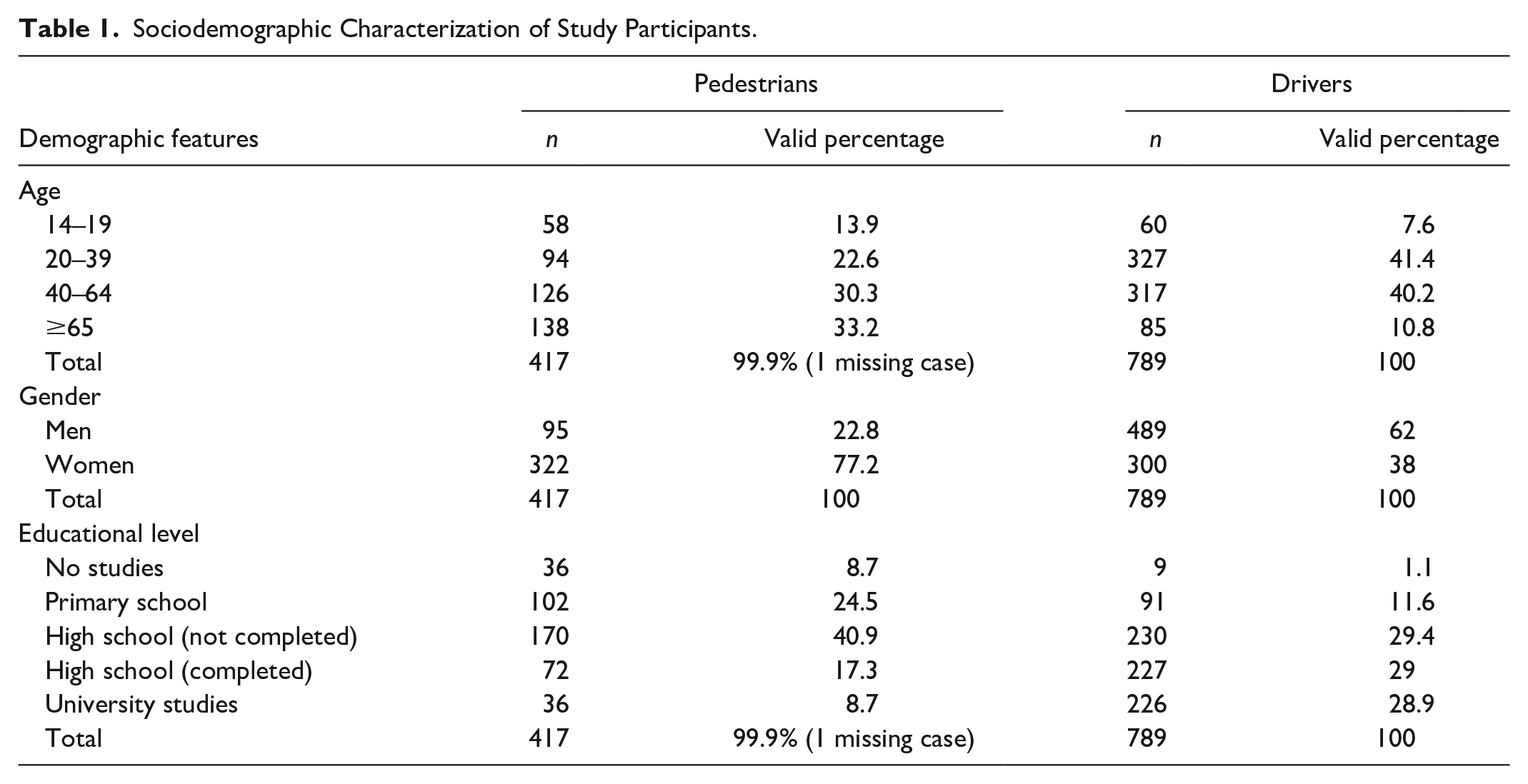
From a study setting established by means of a Simple Random Sampling proportional to age, gender, region, and habitat of the Spanish population, a total of 1,206 subjects took part in this study (further information of the sample is available in Table 1). Also, a key filter question used to select subjects who took part was age (no participants who were under 14 years old). We differentiated two types of road users: drivers (65.4%, regardless of the type of vehicle) and pedestrians (34.6%). The sample size represents an error margin for the general data of ±2.9 with a 95.5% confidence interval in the most unfavorable case of p = q = 50%.
Sociodemographic Characterization of Study Participants.
Procedure and Instruments
By means of a cross-sectional design, this study gathered the data using a survey conducted through computer-assisted telephone interviewing (CATI). A pilot version was applied to 50 cases (which were later not counted in the overall sample) in order to adjust the length and comprehensibility. Afterwards, the study questionnaire was reviewed by two experts in the research topic (Expert 1—on road safety, the core topic covered by the investigation; and Expert 2—in attitude measurement and social research) who approved the final form of the survey to be delivered to participants. It was decided to create an original questionnaire so the evaluated behaviors would adjust to the reality of the Spanish population and to make sure the items were easily adapted to the analyzed groups (pedestrians and drivers). The same scale was used for both of them.
The average duration of the survey was 27 minutes, with some variants due to the different respondent profiles. In order to achieve the objectives of the study, the following variables were considered: sociodemographic variables (gender and age); type of user (i.e., driver or pedestrian); and attitudes and behaviors. For this section, a set of seven driving behaviors associated with attitudes toward/against safety were included within a Likert scale, which assessed the frequency of performance ranging from 0 to 10, where 0 is “they (the drivers) never perform them,” and 10 means “they very frequently perform them.” Considering the study aim, drivers assessed both their own and other drivers’ behavior, while pedestrians only assessed the behavior of drivers.
We included the following behaviors to be considered by both types of road users: driving with little respect toward pedestrians, driving with little respect toward cyclists, driving in compliance with traffic signs, yielding at non-regulated crosswalks, and in short and usual routes, using the adequate restraint or protection systems for children, parking on a crosswalk, driving, or parking on the bike or bus lane. The Cronbach’s Alpha index (i.e., an internal consistency measure based on the correlations between different items on the same test) of the questionnaire was α = .791 for pedestrians and α = .760 for drivers, both above the usual α = .700 cut-off criterion used to determine its acceptability (Morera & Stokes, 2016; Ruiz-Hernandez et al., 2020).
Ethics
For this study, the Research Ethics Committee for Social Science in Health of the University Research Institute on Traffic and Road Safety (INTRAS) at the University of Valencia was consulted, granting its accordance with the principles stated in the Declaration of Helsinki for research with human subjects (IRB approval number HE0003021118).
All participants gave us their consent to participate in the study after a careful reading of the Informed Consent form, in which the study aim, and all the aforementioned considerations were explained by the research staff.
Data Processing
Statistical analyses were carried out using the Statistical Package for the Social Sciences version 23.0 (IBM SPSS Statistics for Windows, Version 23.0, Released 2015. IBM Corp, Armonk, NY, USA). Initially, and after a careful data curation, descriptive analyses were carried out to describe and characterize the responses provided by both groups of respondents. With the aim of comparing the mean values of pedestrians’ and drivers’ responses, non-parametric Kolmogorov-Smirnoff tests were used to assess the univariate normality of road behaviors (i.e., questionnaire items). Apart from being ordinal, these variables did not meet a normal distribution, so Student’s t-based Welch’s robust tests were performed. These analyses are useful for comparing means in cases of having small-to-medium sample sizes, discrete categories for comparison factors, and when assumptions such as univariate normality could not be met. They also depict the test results assuming both potential cases of variance equality and inequality (Levene’s test).
Post-hoc analyses were used to determine specific significant differences between pairs of specific groups composing the study sample (e.g., between young and elderly drivers). All statistical analyses were conducted with differential α = .05 and .001 significance levels.
Results
The group of pedestrians is mainly composed of women (77.2%), compared with 22.8% of men. Drivers were mainly men (62%) and 38% were women. As for age, the sample of the whole group of drivers comprised from 14 to 84 years old, and its average age was 40.95 (SD = 16.11). In the case of pedestrians, their age is distributed in the following way: the minimum age requirement was 14, and the maximum was 89 years old, and its average age was 48.40 (SD = 21.25). Regarding their educational level, the group that stands out the most among pedestrians is composed of people who did not complete high school (40.9%). A similar pattern is noticeable among drivers since most of them have not completed university studies (29.4%), while some of them (29%) have done so (see Table 1 for more details).
Perception of Traffic Behaviors and Attitudes
We analyzed the general level of perception of the participants, inquiring about the frequency in which other drivers are perceived to perform certain behaviors. In a frequency scale between 0 and 10, the assessments on other drivers are generally moderate, even though, as we will see in Table 2, the differences between assessments of different behaviors are statistically significant for six of the seven evaluated behaviors, depending on the road user (see Table 2 and Figure 1).
Perceived Frequency of Different Driving Behaviors.

Welch’s t-test for mean comparisons.
Cohen’s d coefficient.
The difference is significant at the level p < .05.
The difference is significant at the level p < .001.

Comparison of the perceived frequency of different driving behaviors, according to each type of road user.
It is remarkable that pedestrians assess drivers’ behavior in a slightly worse way than drivers themselves do. Overall, pedestrians tend to perceive that drivers perform unsafe behaviors with a greater frequency than those self-reported by them. Therefore, “Driving with little respect toward pedestrians” with M = 6.7 (pedestrians’ assessment) is the behavior showing the highest average value.
However, when the perception of the frequency with which the participants perform these behaviors themselves is analyzed, it can be noticed that means tend to become higher and quite different from each other, thus manifesting that—according to their perception—their behaviors are safer than other drivers’ (see Table 3 and Figure 1).
Perception of the Frequency of Performance of Different Road Behaviors, Both in Oneself and Among Other Drivers. .

Welch’s t-test for mean comparisons.
Cohen’s d coefficient.
The difference is significant at the level p < .001.
Therefore, for what concerns behaviors considered as less safe, or dangerous for road safety (such as, for instance, “driving with little respect” or “parking on crosswalks”), drivers claim that they perform them with less frequency than other drivers,. This applies to every behavior except for the case of non-regulated crosswalks (which is logical, since this is a positive behavior). The self-reported behaviors listed by drivers as the least frequent ones are “driving or parking on a bike/bus lane” (M = 1.21; SD = 2.12) and “parking on a crosswalk” (M = 1.25; SD = 2.12). However, the frequency of occurrence is quite higher in the case of positive/safe behaviors, such as “driving in compliance with traffic signs” (M = 7.88; SD = 2.19).
In Figure 1, the average frequency can be observed for every type of assessment (other drivers vs. oneself), and the degree to which every type of behavior is carried out (while the perception of other drivers’ behavior is more intermediate, participants do not have doubts when listing the frequency of their own behaviors, nor when stating that they are much more respectful and safer). Additionally, we see the different calculated average values for each behavior perceived by other drivers depending on the road user.
Perception of Pedestrians and Drivers: Sociodemographic Profile
In Table 4, differences in the analyzed variables are shown according to gender. Generally speaking, there are few significant differences (two behaviors for pedestrians, one for drivers when considering other drivers, and one for drivers when considering themselves). Also, in all cases, females were the ones assessing the performance of these behaviors as highly frequent compared with males.
Gender-Based Differences in the Assessment of Driving Behaviors.

Welch’s t-test for mean comparisons.
Cohen’s d coefficient.
The difference is significant at the level p < .05.
The difference is significant at the level p < .001.
On the other hand, and specifically in the case of pedestrians, females favor other people’s behavior concerning compliance with traffic signs (M = 6.37) and yielding at non-regulated crosswalks (M = 5.26). Even though this assessment is slightly higher than the one provided by males, it is still moderate within the scale. When women are drivers, they believe, to a wider extent, that other drivers park on crosswalks (M = 4.96). Finally, they also believe that other drivers comply with traffic signs with higher frequency (M = 8.31).
Regarding the assessment of pedestrians, no significant differences were found regarding age. However, results were found regarding three behaviors assessed by drivers when talking of other drivers. Also, specifically, there were differences in the 20 to 39 and 40 to 65 years old groups. The behaviors were “Driving in compliance with traffic signs” and “Yielding at non-regulated cross-walks” (Table 5). In both cases, older people assess other drivers better.
Age Group-Based Differences: Drivers Assessing Other Drivers.

The difference is significant at the level p < .05.
The difference is significant at the level p < .001.
Finally, and in relation to the use of passive safety measures statement “Using the adequate restraint and protection systems for children during short and usual routes,” young people between 14 and 19 years old give significantly lower mean assessments than drivers over 65 years.
Regarding self-assessments, drivers present significant differences in four behaviors (Table 6). Drivers who are 65 or older believe that they drive in compliance with traffic signs with more frequency than the rest of the participants; they also think that they yield to pedestrians at non-regulated crosswalks more than drivers between 14 and 39 years old; the same tendency is repeated in drivers who are between 40 and 64 years old.
Age Group-Based Differences: Self-Perceived Driving Behavior.

The difference is significant at the level p < .05.
The difference is significant at the level p < .001.
To conclude, drivers who are between 14 and 19 years old report that they perform unsafe behaviors to a higher extent, as well as parking on bike or bus lanes and using child protection systems way less than other participants.
Discussion
The findings of this study on pedestrians and drivers’ perceptions of common traffic behaviors point out that there are significant differences in regard to the way they perceive other road users’ behavior. Previous studies have also addressed certain discrepancies on the assessment of the risky roadand protective behaviors performed by third parties, showing that—overall—road users tend to perceive their road behaviors as “safer” than the ones assessed in other users (Useche et al., 2021). Concretely, the results of this research have depicted how pedestrians do not hold a considerably positive opinion of drivers’ behavior; as a matter of fact, significant differences are spotted in those behaviors that can be considered unsafe. However, we must highlight that their assessment is not extremely negative either.
Interestingly, pedestrians feel that the frequency of performance of such behaviors is higher than what is believed by drivers. In fact, this group considers that one of the most frequent behaviors of drivers is the lack of respect toward pedestrians (M = 6.70). This is concerning, and even more so if we observe the self-assessment scores assigned by drivers, who give themselves a much lower frequency of performance for the same behavior (M = 2.75). From what we notice here, the self-assessment of road users’ attitudes is quite high and positive when they refer to their own perception of themselves, which is also supported by other research (Laborda & Bordas, 2015; Lacherez et al., 2014).
However, despite the tendentially negative perceptions of pedestrians when they assess drivers, evidence remarks that crashes related to pedestrians have substantially diminished in Spain. We believe that this perception can be caused by not only the tendency to evaluate other people as “worse,” but also by what other studies have pointed out about pedestrians: “they are still largely ignored in the planning, design and operation of roads” (El Hamdani et al., 2020; Hisham et al., 2016). This highlights a key element for the work to be done in road safety plans, since even though they are included in such plans, pedestrians seem not to perceive it fully through the behavior of drivers.
On the other hand, it draws attention to how drivers assess other drivers in a more positive and “forgiving” way, compared with driving behavior reports when proxied by pedestrians. Theoretically, these differences may be partly explained by cognitive biases that are non-exclusive of transportation environment. Rather, we refer to highly addressed issues in social psychology, such as endo group bias, which makes an individual assess people who are perceived to be close or belong to their own group in a more positive way than others (Hisham et al., 2016; Tekeş et al., 2019).
In this particular case, cognitive biases may also cover the case of drivers when assessing their own driving behavior. Since people often consider themselves better drivers than they are, it is coherently expectable that self-perception of road misbehaviors would be lower among drivers, especially when self-reporting behavioral data related to socially desirable issues such as safety-related behaviors on the road (Sánchez-Vallejo et al., 1998; Tekeş et al., 2019).
Recent studies have regarded the possibility that biased perceptions of own driving behaviors, skills, and performance may give drivers excessive confidence and lower risk perception. Therefore, this may cause a higher probability of suffering a traffic crash as a result of greater risk assumption, especially among young and inexperienced drivers (Oviedo-Trespalacios & Scott-Parker, 2019; Teye-Kwadjo, 2019).
This assessment also follows tendencies already remarked by other studies, in which people consider themselves better than the rest, but there is also a clearly harmful element related to their perceptual skills. If we consider that the drivers’ self-perception of their skills is high and that they also believe that these skills have a high chance of preventing crashes, the combination of both factors contributes to increasing crash likelihood of such drivers (Ortuño & Llinares, 2015). Interestingly, some studies addressing possible interventions to risky road behaviors have highlighted the value of increasing risk perception of novice and offending drivers (Alonso et al., 2021; Lijarcio et al., 2022).
Gender, Age, and Behavioral Perceptions
For what concerns the relationships among personal features of participants and their response trends, we found very interesting patterns involving both gender and age. First of all, Spanish women tend to be “gentler” in the assessments of other people compared with the evaluation produced by men. In other words, women rely more on drivers’ behaviors. When they are pedestrians and drivers, they both produce more favorable assessments of the safety shown by others (Alonso et al., 2003).
Moving on to age, it seems like there is a tendency in the subjects’ self-assessment: the older the driver, the better the evaluation, while the younger the driver, the more infractions are accepted (Zheng et al., 2019). However, post-hoc analyses point out that this difference is not significant in the same way in every behavior, and neither in every group, and that it is not necessarily linear. On the one hand, one may think that more experienced drivers (normally older ones), will consider themselves as more skilled (Hempel et al., 2017; Sánchez-Vallejo et al., 1998); however, this does not necessarily mean that they perform safe behaviors more frequently. On the contrary, it may indicate a better knowledge of the law, or it may come from past road experiences.
We must, however, remark that other theories depict older people as being more reflexive and having higher moral reasoning on their own behavior. Additionally, it is interesting to see how young people recognize that they perform more risky road behaviors. This could be theoretically linked to personality factors such as sensation seeking and lower risk perception (Bachoo et al., 2013; Tosi et al., 2020; Useche, Hezaveh, et al., 2021).
Limitations of the Study and Further Research
It is important to consider the possibility of having made conclusions over potentially biased information as a first key limitation. Even though the anonymity of the study and its rigorously scientific character were emphasized, recent studies have sometimes shown huge discrepancies between the self-reported and the actual behavior of road users (Drupsteen et al., 2013; Useche et al., 2021).
Also, some studies have shown that stereotypes and cultural issues or may be interfering with road behavioral assessments of both drivers and pedestrians (Lim et al., 2013; Llinares & Ortuño, 2013; Özkan et al., 2006). Furthermore, and especially among young respondents, it is important to raise the question of whether self-assessments may also be linked to the individual’s needs for social approval and avoiding social rejection (Lajunen et al., 1998; Tosi et al., 2020; Warner et al., 2013).
Finally, a key potential benefit of this study is highlighting road role-based issues as a potential source of concern for researchers, especially if the relevance of human factors and relationships on the road is considered a potential way to prevent crashes (Taylor et al., 2007), mainly through the development of a greater awareness on the origin and consequences of risky driving behaviors. If road users are aware of all these risky behaviors, it will be easier to reduce them, even though other factors such as infrastructures, vehicles, and social issues remain complementary and relevant for understanding traffic crash dynamics holistically (Javadi et al., 2015). Therefore, even though further research is still necessary (Hatakka et al., 2002), the actions that raise awareness on safety behaviors are directly linked to the amount of information on subjective risk perception of different road users (Eboli et al., 2017).
Conclusions
We can list the following aspects as conclusions when comparing the findings obtained and the objectives of this work: (1) the perception of the performance of driving behaviors toward/against safety showed by pedestrians and drivers is different for each group, highlighting that pedestrians assess drivers less favorably; (2) pedestrians feel that drivers disrespect pedestrians with an average frequency; (3) drivers believe that they perform the assessed behaviors with a lower frequency, that, in turn, becomes higher when they are evaluating other drivers; and (4) there are gender and age-related differences in what concerns the perception that both groups have of drivers. Women assess other people’s behavior more favorably, both when they are pedestrians and when they are drivers. Moreover, older drivers consider that they perform safe behaviors with a higher frequency, while younger drivers admit to performing them with a comparatively lower one. Finally, there are no differences for what concerns age in the group of pedestrians.
This study also gives us an idea of the relevance of counting on various information sources (e.g., proxies, added to self-reports) to properly depict a very important relationship, which is often highlighted in literature because of road conflicts: pedestrians versus drivers. Apart from being closely related to crash prevention, further research could provide more insights in this direction, potentially helping to further understand the complex user-based road dynamics and struggles.
Footnotes
Acknowledgements
We would like to thank the Audi Corporate Social Responsibility program “Attitudes” for sponsoring the baseline research. Also, thanks to Arash Javadinejad (licensed translator) for the professional edition of the revised version of the manuscript.
Author Contributions
Conceptualization: F. Alonso, M. Faus, S.A. Useche. Methodology: M. Faus. Software: C. Esteban, S.A. Useche. Validation: F. Alonso, C. Esteban. Formal analysis: M. Faus, C. Esteban. Investigation: F. Alonso, C. Esteban, S.A. Useche. Visualization: M. Faus, S.A. Useche. Project administration: F. Alonso, C. Esteban. Supervision: F. Alonso, S.A. Useche. Writing—original draft preparation: M. Faus. Writing—review and editing: S.A. Useche.
Declaration of Conflicting Interests
The author(s) declared no potential conflicts of interest with respect to the research, authorship, and/or publication of this article.
Funding
The author(s) received no financial support for the research, authorship, and/or publication of this article.
