




Abstract
This study aimed to adapt and examine the psychometric properties of the autonomy support subscale of the Teacher as a Social Context Questionnaire (TASCQ; short version) in the Kenyan context. A total of 411 chemistry students from 10 secondary schools (175 males, 236 females; Mage = 16.62, SD = 0.75) participated in this study. The sample was randomly split for exploratory factor analysis (EFA; n = 100) and confirmatory factor analysis (CFA; n = 311). EFA findings revealed a four-factor structure supporting the conceptualization of autonomy support in the TASCQ. Additionally, CFA confirmed a good model, while further analyses on the items revealed adequate convergent and discriminant validity. Measurement invariance testing across gender indicated support up to the scalar level. Moreover, our McDonald’s omega coefficients indicated marginal, albeit acceptable internal consistency reliability. Hence, these findings support the use of the autonomy support subscale of the TASCQ (short version) as a valid and reliable measure of students’ perception of their chemistry teachers’ support for autonomy.
Plain Language Summary
This study aimed to assess how well the autonomy support subscale of the Teacher as a Social Context Questionnaire (TASCQ) measures the extent to which students perceive their teachers as autonomy supportive. We sought to determine whether the questionnaire could accurately identify four key ways—choice, control, respect, and relevance—through which teachers support student autonomy. The study findings revealed that participants could distinguish between the various ways teachers supported their autonomy. Consequently, the questionnaire was considered reliable and valid, implying that it consistently measured what it was intended to measure. Further findings revealed that the questionnaire worked well for both girls and boys. Hence, the questionnaire may help teachers, school administrators, educational policymakers, and researchers in Kenya understand how students perceive their teachers’ support for autonomy, particularly in chemistry education.
Introduction
The concept of autonomy support has gained traction in educational psychology due to its important role in fostering school success (Wong & Liem, 2022). The self-determination theory (SDT) buttresses autonomy support’s ability to recognize and nurture learners’ inner motivational resources (Reeve et al., 2004). Notably, the significance of autonomy support extends beyond learner motivation and learning outcomes, such as school success—autonomy support has also been linked to developmental benefits, including the fostering of critical thinking skills and enhancement of student engagement (Su & Reeve, 2011). Resolutely, the centrality of autonomy support provides a foundation for exploring various autonomy-affecting behaviors (Assor et al., 2002).
Particularly, the SDT refers to autonomy support as the teachers’ interpersonal behavior through which they facilitate the students’ sense of volition and self-regulated learning (Deci & Ryan, 1985; Ryan & Deci, 2000). However, the aggregate conceptualizations of autonomy support may hinder the intuitive comprehension of teachers’ actions that may support or suppress autonomy (Dancis, 2018). Hence, clarifying the components of autonomy support adds precision to the understanding of the unique contributions of the various autonomy-enhancing and autonomy-suppressing teacher behavior(s).
Autonomy-Enhancing and Autonomy-Suppressing Teacher Behavior
According to the SDT, students perceive a sense of autonomy from their teachers when they realize their personal values, goals, and interests (Ryan & Deci, 2000). In the classroom setting, teachers employ various interpersonal styles that not only facilitate teaching but also motivate their learners (Deci et al., 1981). Predominantly, a teacher’s motivational style can be either autonomy-enhancing or autonomy-suppressing (DeCharms, 1976; Deci et al., 1994). With many scholars viewing teachers’ support for learners’ autonomy as a hallmark of good humanistic teaching behavior (Assor et al., 2002), multiple empirical studies have sought to enunciate the various autonomy-enhancing or autonomy-suppressing teacher behaviors.
Interview data from students have aided in distinguishing the autonomy-enhancing or autonomy-suppressing teacher behavior. Particularly, Assor et al.’s (2002) seminal work outlines clearly the autonomy-affecting teacher behaviors as reported by students from previous studies. Among the autonomy-enhancing teacher behaviors prominently outlined are fostering of relevance, provision of choice, allowing criticism, and encouraging independent thinking among students (Assor et al., 2002). Further, Assor et al. (2002) delineated the autonomy-suppressing teacher behavior, including forcing meaningless and uninteresting activities, teacher intrusion in learner behavior, and suppressing criticism and independent opinions. Primarily, the autonomy-related behaviors outlined are in line with Ryan and Deci’s (2000) theoretical perspectives.
Undoubtedly, Assor et al.’s (2002) article might be the most revered empirical study in outlining the clear distinction between autonomy-suppressive and autonomy-enhancing behaviors. However, insights from Belmont et al.’s (1992) unpublished work ostensibly laid a foundation toward understanding the concept of autonomy support in a more nuanced way. Despite primarily examining the structure of teachers’ need-supportive practices—namely, involvement, structure, and autonomy support—Belmont et al. (1992) precisely highlighted the formative indicators of autonomy support, including choice, control, respect, and relevance. Corroboratively, Dancis (2018) examined 15 measures of autonomy support, identifying choice, control, respect, and relevance as the most prominent autonomy factors influencing teacher behaviors.
Remarkably, the provision of choice in the classroom setup is perceived when teachers offer options to students on how they conduct their learning (Jang et al., 2010). The ultimate goal of choice provision is to have students autonomously and deliberately select learning modalities that interest them. Moreover, lack of coercion (control) is manifested through a teacher’s diminished use of authority and force in managing the students during the teaching-learning process (Haerens et al., 2018). Predictably, controlling teacher behaviors suppress the students’ intrinsic motivation, which in turn impedes their participation. On the other hand, respect denotes the teachers’ validation of students’ opinions, ideas, and emotions, which is intended to empower them as free agents in their learning process (Rickert et al., 2024). Finally, fostering relevance refers to teachers’ provision of meaningful learning materials while overtly informing students of the aims and value of each academic task (Assor et al., 2002).
The current study was grounded in the SDT in line with the theory’s advocacy of the support of students’ autonomy as one of the rudimentary psychological needs. Conspicuously, the four formative indicators, as operationalized by Belmont et al. (1992) in the autonomy support subscale of their Teacher as a Social Context Questionnaire (TASCQ), reflect the teachers’ interpersonal behaviors which may foster autonomy as outlined in the SDT theory.
The Autonomy Support Subscale of the Teacher as a Social Context Questionnaire (TASCQ)
The TASCQ (Belmont et al., 1992) is one of the widely used instruments in assessing teacher behavior. Rooted in the SDT, the TASCQ operationalizes teacher behavior in terms of autonomy support, structure, and involvement, three key factors that influence the students’ motivation (Skinner & Belmont, 1993). Of concern is the autonomy support subscale, a dimension of the TASCQ that measures the degree to which students perceive their teachers as autonomy-supportive. Precisely, the autonomy support subscale assesses students’ perceptions of their teacher’s controlling behavior, respect, provision of choice, and efforts to foster relevance (Belmont et al., 1992).
There are two versions of the autonomy support subscale of the TASCQ—the 17-item extended version and the 8-item short version. Most of the previous empirical studies using Belmont et al.’s (1992) TASCQ instrument have adopted or adapted the short version scale (Ahn et al., 2019). Specifically, the subscale has been used to assess teacher autonomy support as perceived by chemistry students (González & Paoloni, 2015; Patall et al., 2018), students of religion (Ingersoll, 2020), and music students (Bonneville-Roussy et al., 2020). Further, the autonomy support subscale of the TASCQ has been used among various populations, including elementary students (Zee & Koomen, 2020), middle school students (Banerjee & Halder, 2021), high school students (Hölscher et al., 2024; Patall et al., 2018), and university students (Bonneville-Roussy & Evans, 2024; González & Paoloni, 2015).
Despite its prevalent use, studies identified through our systematic search have limited information regarding the psychometric properties of the autonomy support subscale of the TASCQ. The autonomy support subscale of the TASCQ has also not been validated in African educational contexts, particularly within the context of chemistry education. Furthermore, most studies have only assessed the reliability of the autonomy support subscale of the TASCQ. Empirical studies that have assessed other psychometric properties of the autonomy support subscale of the TASCQ focused on several indicators or items of autonomy support (González & Paoloni, 2015) or combined the autonomy support indicators with other variables (Patall et al., 2018). Further, none of the studies using the autonomy support subscale of the TASCQ have conducted measurement invariance of the instrument, which determines the extent to which a construct is measured similarly across multiple hierarchical nested levels (Van De Schoot et al., 2015). Therefore, this study addresses the above-stated gaps by adapting and validating the short version of the autonomy support subscale of the TASCQ for use among chemistry students in the Kenyan context. The following research questions were developed to provide a basis for the current study:
To what extent can students distinguish between the formative indicators of autonomy support?
Does the autonomy support subscale of the TASCQ (short version) demonstrate a valid factor structure?
Does the autonomy support subscale exhibit measurement invariance?
Do the items of the autonomy support subscale converge adequately onto their respective factors?
Do the formative indicators of autonomy support demonstrate discriminant validity?
Does the autonomy support subscale of the TASCQ (short version) exhibit acceptable internal consistency?
Methods
Participants
The study participants were enrolled in secondary schools from Murang’a County, Kenya. Notably, the 11 participant schools were selected using stratified random sampling to warrant representation across different school strata (including boarding schools and day schools) in the county. Within each participant’s school, simple random sampling was used to select students from chemistry classes, ensuring an equal chance of participation for eligible students. The inclusion criteria were form three (equivalent to grade 11 in the K-12 system) students who were enrolled in a chemistry class and volunteered to participate in the study. The exclusion criteria were students who failed to return or sign the informed consent and assent form. Eventually, a sample of 411 participants (175 males and 236 females), aged between 15 and 20 years (Mage = 16.61, SDage = 0.74) was involved in this study.
Measures
Autonomy Support Subscale of the TASCQ. The short version of the student-report autonomy support subscale of the TASCQ (Belmont et al., 1992) briefly measures the autonomy support practices by teachers as perceived by students. The 8-item subscale embraces the multidimensional conceptualization of autonomy support, assessing the four formative indicators of the construct as posited by the SDT. Each of autonomy support’s formative indicators contains two items, all of which were adapted for use in the chemistry education context. The adaptation of the autonomy support subscale of the TASCQ (short version) began with the examination of items by a panel of educational psychology experts to assess their cultural fairness and linguistic clarity. A minor modification—specifying the teacher in reference—was made to contextualize the items to chemistry education. Further, a pilot study involving 35 students from a non-participating school was conducted to inform any further refinements. With no ambiguities reported by the participants, the eight items were cleared for use in the main study. Specifically, the indicators include: (a) Choice (e.g., “My chemistry teacher gives me a lot of choices about how I do my schoolwork”), (b) Control (e.g., “It seems like my chemistry teacher is always telling me what to do”), (c) Respect (e.g., “My chemistry teacher listens to my ideas”), and (d) Relevance (e.g., “My chemistry teacher talks about how I can use the things we learn in school”). Items of the subscale are scored on a 4-point Likert scale, ranging from 1 (Not at all true) to 4 (Very true). Belmont et al. (1992) reported an acceptable composite reliability of the autonomy support subscale of 0.79.
Procedure
With all materials and procedures abiding by the core principles of the Declaration of Helsinki, the study was approved by the ethics committee of the University. The researchers provided relevant instructions to the study participants, after which informed consent and assent forms were issued. Furthermore, the researchers emphasized to the study participants the purely academic nature of the study and their freedom to withdraw from participation at any time without reprisal. The study participants were guaranteed strict confidentiality of their responses. Study participants who assented or consented to participate in the study were issued study questionnaires. Sufficient time was provided for completing the questionnaires.
Data Analysis
With no concrete evidence of the factor structure of the autonomy support subscale of the TASCQ from the past studies, a need arose to conduct an exploratory factor analysis (EFA), which was followed by the provision of factorial validity evidence through confirmatory factor analysis (CFA) results, a replication of the procedures by Ahn et al. (2019). Remarkably, the factor structure was evaluated to determine whether scale reflects the multidimensional nature of autonomy support, providing empirical support for the SDT framework and operationalization of the construct by Belmont et al. (1992) in the Kenyan context. Using the SPSS random sampling function, we randomly split the sample into two subsets (with nonsignificant differences) to obtain distinct datasets of 100 and 311 participants. A hundred participants were used for the EFA—the sample meets the minimum requirements of a sample size of a hundred observations and an observations-item ratio of 10:1 (Hair et al., 2019). The remaining 311 participants were used for CFA, convergent and discriminant validity analysis, reliability analysis, and invariance analysis. The rationale behind the minimum sample size (n ≥ 250) considered while conducting a CFA is outlined in Hu and Bentler (1999).
EFA
We conducted EFA, a multi-step procedure that allows the determination of the appropriate number of latent factors and the number of observed variables under each factor of a given construct (Costello & Osborne, 2005). Prior to the EFA, we did the Kaiser-Meyer-Olkin (KMO) test and Bartlett’s test of sphericity to assess the factorability of the data matrix (Hair et al., 2019). The KMO test measures sampling adequacy—a statistic of 0.50 represents the borderline minimum threshold for sampling adequacy (Kaiser, 1974). Conversely, Bartlett’s test of sphericity tests the null hypothesis that the correlation matrix is an identity matrix—rejection of the null hypothesis indicates the suitability of the dataset for factor analysis (Bartlett, 1950).
Upon confirming the factorability of the data matrix, we employed the Principal Axis Factoring (PAF) extraction method in EFA due to its optimal recovery of weak latent factors. The PAF extraction method is also tolerant to multivariate nonnormality (Briggs & MacCallum, 2003). The adequacy of the rotation method to be used was determined by the clarity of the number of reliable factors—correlations ≥ 0.32 on the factor correlation matrix warranted the use of oblique rotation methods (Tabachnick & Fidell, 2012). Particularly, promax rotation was applied to provide a more precise structure (Fabrigar et al., 1999), using the lowest probable power loadings and correlations between latent factors (Everitt & Hothorn, 2011).
To determine the number of latent factors to be extracted among the eight items of the short version autonomy support subscale of the TASCQ, we examined the following stopping rules: (a) the latent root criterion, (b) the percentage of variance criterion, and (c) parallel analysis results (Hair et al., 2019). Additionally, we examined the factor loadings to enhance the clarity and validity of the factor structure—rotated factor loadings matrix greater than 0.30 are arbitrarily considered salient (Cudeck & O’Dell, 1994; Watkins, 2021).
CFA
We proceeded to conduct a CFA for the provision of factorial validity evidence of the short version autonomy support subscale of the TASCQ. First, the second subset was subjected to the Doornik-Hansen test of multivariate normality, which is preferred for its power and size properties over other tests for moderate and large samples (Doornik & Hansen, 2008). Subsequently, the maximum likelihood method was employed to estimate the parameters of the CFA model (Kline, 2023). Selected absolute and incremental fit indices, including the normed chi-square (χ2/df), the comparative fit index (CFI), the Tucker–Lewis index (TLI), the root-mean-square error of approximation (RMSEA), and the standardized root-mean-square residual (SRMR), were used to evaluate the model fit. The adequacy of the model was determined by assessing whether the fit indices indicated a satisfactory model fit according to the accepted cut-off values: χ2/df ≤ 5, CFI ≥ 0.95, TLI ≥ 0.95, RMSEA ≤ 0.06, and SRMR ≤ 0.08 (Hu & Bentler, 1999).
Invariance Analysis
A multigroup factor analysis was conducted to test gender invariance. The analysis followed stepwise procedures to establish CFI, RMSEA, and SRMR differences for configural invariance, metric invariance, and scalar invariance (Putnick & Bornstein, 2016). Initially, a configural invariance model was used to assess whether the factor structure remained the same across the groups. This was followed by the metric invariance model, which assesses whether the factor loadings are equal across the groups. Moreover, the scalar invariance model was employed to determine whether item intercepts remain constant across the groups. The statistical differences in CFI and RMSEA values, below 0.010 and 0.015, respectively, between each pair of increasingly constrained models indicate measurement invariance across the respective groups (Chen, 2007). A score ≥ 0.010 in ΔSRMR was used as an indication of non-invariance regarding scalar invariance—the indication of non-invariance regarding metric invariance was a score of ≥0.030 (Putnick & Bornstein, 2016).
Convergent and Discriminant Validity
Standardized factor loadings offer valuable insights into the convergent validity among measure items—statistically significant standardized loading estimates above 0.50 were considered satisfactory (Hair et al., 2019). Further, examination of the average variance extracted (AVE) was conducted—AVE values equal to or exceeding 0.50 suggested adequate convergence (Fornell & Larcker, 1981). On the other hand, discriminant validity was established by examining the factor intercorrelations. Factor intercorrelations lower than 0.80 suggest acceptable discriminant validity (Brown, 2015). Additionally, the heterotrait–monotrait (HTMT) ratios of correlations between constructs and correlations within constructs were used to ascertain further discriminant validity. HTMT ratio values below 0.85 were indicative of the discriminant validity of the measure items (Henseler et al., 2015).
Internal Consistency Reliability
Complementarily, construct reliability (CR) is integral in ascertaining convergent validity of measure items—a CR value equal to or above 0.70 indicates acceptable internal consistency (Hair et al., 2019). Remarkably, the Omega coefficient (ω) was preferred to Cronbach’s alpha coefficient since it does not assume essential tau-equivalence (Hayes & Coutts, 2020).
Data were statistically analyzed using JASP (Version 0.19.3; JASP Team, 2025), the R packages lavaan (version 0.6–19; Rosseel, 2012) and mvn (version 5.9; Korkmaz et al., 2014).
Results
Prior to the EFA, we conducted some preliminary tests to assess the factorability of the data matrix. A significant Bartlett’s test of sphericity and a measure of sampling adequacy above the borderline minimum threshold (MSA = 0.564) was obtained. Moreover, the CFA data was assessed for multivariate normality. The violation of the assumption of multivariate normality—DH = 202.17, df = 16, p < .001—warranted the use of the maximum likelihood estimation method together with a bootstrapping procedure with 5,000 iterations to obtain robust standard errors and empirical confidence intervals (Efron, 1987; Nevitt & Hancock, 2001).
Exploratory Factor Analysis
Upon confirmation of the factorability adequacy, we proceeded with factor extraction using the first proportion of the sample (n = 100). First, we considered the eigenvalues and percentage variance accounted for by the extracted factors. Four factors were extracted, with each meeting the minimum threshold of the Kaiser rule of factor retention (see Figure 1). Factor 1 accounted for 17.1% of the variance with an eigenvalue of 2.35, while factor 2 accounted for 16.8% of the variance with an eigenvalue of 1.78. On the other hand, factor 3 accounted for 16.0% of the variance with an eigenvalue of 1.38, while factor 4 accounted for 14.3% of the variance with an eigenvalue of 1.04.

Scree plot of the exploratory factor analysis.
Parallel analysis results also indicated that the first four observed eigenvalues surpassed their corresponding randomly generated eigenvalues—the findings supported the retention of the four factors. Additionally, we considered the factor loading and correlation matrices of the four-factor model. The results indicated that each of the eight items predominantly loaded onto a single factor, supporting a clear factor structure. Remarkably, the rotated factor loadings matrix met the minimum threshold of saliency (0.69–0.86; see Table 1). Hence, EFA results suggested that a four-factor solution may best explain the dataset.
EFA Factor Loadings.

Note. Applied rotation method is promax.
Confirmatory Factor Analysis
The next step involved cross-validating the EFA results using confirmatory factor analyses using the second proportion of the sample (n = 311). A four-factor structure was specified, with the model fitting the data well: χ2(14) = 24.686, CFI = 0.984, TLI = 0.968, RMSEA = 0.050 (95% CI [0.012, 0.081]), SRMR = 0.025. Additionally, the standardized factor loadings of the eight items were above 0.40(0.676–0.888; see Table 2). Therefore, these CFA results support the factorial validity of the scale in the Kenyan context.
CFA Factor Loadings.
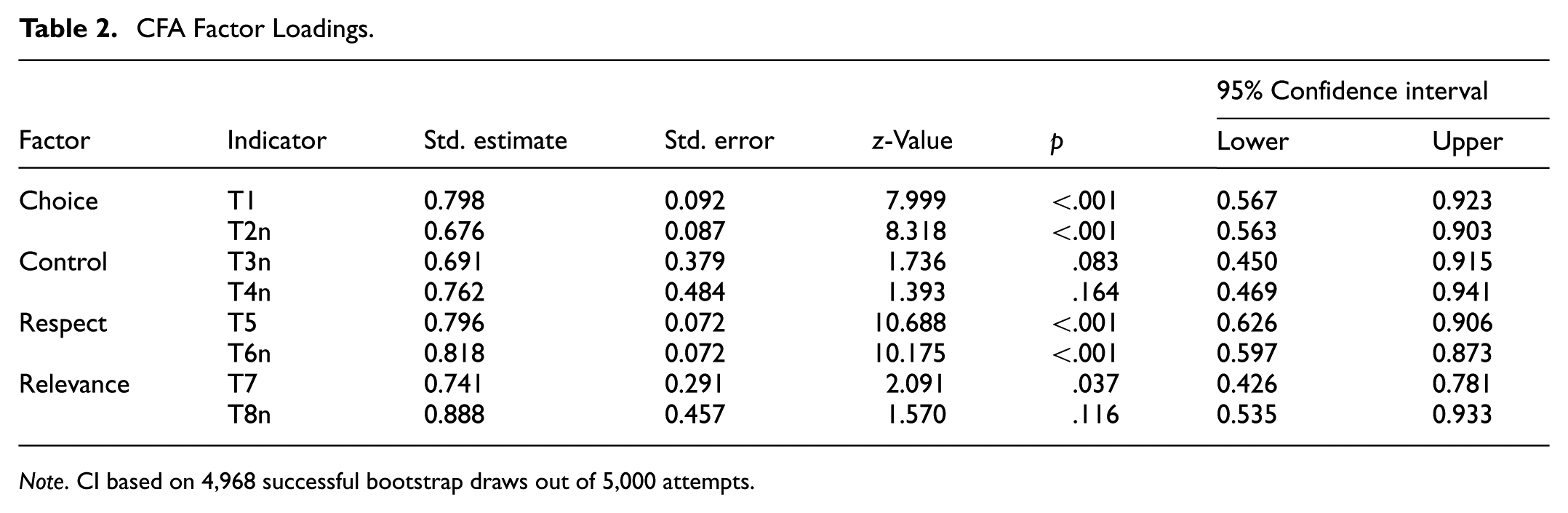
Note. CI based on 4,968 successful bootstrap draws out of 5,000 attempts.
Invariance Analysis
Measurement invariance analysis was conducted by comparing subgroups of the participants differentiated by gender (male = 139, female = 172). The results of the sequential testing of measurement invariance models and comparison of model fit deteriorations led to the conclusion that the four-factor structure of the autonomy support subscale of the TASCQ operates consistently across the gender subgroups. Particularly, the fit indices alluded to measurement invariance up to the scalar level (see Table 3).
Measurement Invariance Test of the Autonomy Support Subscale of the TASCQ Across Gender.

Note. M1 = Configural invariance model; M2 = Metric invariance model; M3 = Scalar invariance model.
Convergent and Discriminant Validity
Inferring from the standardized factor loadings, the eight items appear to have converged well onto their respective factors (see Table 2). Additionally, the AVE values exceeded the minimum threshold, suggesting adequate convergence. Specifically, the factors demonstrated AVE values of 0.65, 0.53, 0.53, and 0.67, respectively. Furthermore, the inter-factor correlations fell below ±0.80, ranging from −0.19 to 0.46, suggesting acceptable discriminant validity. Acceptable discriminant validity was also ascertained by the HTMT ratio of the factors, which fell below the threshold—the HTMT ratios ranged between 0.05 and 0.47.
Internal Consistency Reliability
The analysis of the subscales’ internal consistency indicated adequate values of the McDonald’s omega (ω), with only one of the factors’ω value falling slightly below the recommended threshold. Remarkably, the McDonald’s omega (ω) values ranged from .69 to .80—choice (ω = .79), control (ω = .69), respect (ω = .70), and relevance (ω = .80).
Discussion
The objective of this study was to adapt and examine the factor structure of the autonomy support subscale of the TASCQ (short version; Belmont et al., 1992) with Kenyan secondary school students who took chemistry. Despite gaining a reputation as a reliable measure of students’ perceptions of their teachers’ autonomy support and informing the development of new instruments (Hospel & Galand, 2016; Patall et al., 2018), few studies have examined the factor structure of the four-dimensional autonomy support subscale of the TASCQ. Further, none of the studies have examined the measurement invariance of the instrument.
Our results indicated that the students perceived the autonomy support subscale of the TASCQ (short version) as a four-factor scale. This implied that the students could differentiating the four formative indicators of autonomy support—choice, control, respect, and relevance. Notably, these results underscore the robustness of the factorial structure of the autonomy support subscale as conceptualized by the TASCQ. The confirmation of a four-factor structure supports the SDT’s theoretical previsions that autonomy support is a multifaceted construct (Belmont et al., 1992). The students’ ability to distinguish the various dimensions of autonomy suggests that they experience autonomy support from their teachers in nuanced ways, buttressing the theory’s advocacy for context-specific expressions of autonomy (Ryan & Deci, 2000).
Furthermore, these findings corroborate earlier findings by González and Paoloni (2015), as participants in this study were able to distinguish between the two dimensions of teacher autonomy support (choice and relevance). Comparably, González and Paoloni’s (2015) results in conjunction with the current findings suggest chemistry students’ ability to distinguish between the various formative indicators of teacher autonomy support.
Our findings regarding the measurement invariance of the autonomy support subscale of the TASCQ across gender indicated support for configural, metric, and scalar invariance. These findings suggest a uniform interpretation of the four-factor model for both male and female respondents in our study, up to the scalar level, enabling valid comparisons of latent means across groups. Hence, the autonomy support subscale of the TASCQ essentially maintains equivalence across gender subgroups.
Moreover, the standardized factor loadings and AVE values provided evidence for convergent validity, having exceeded the minimum thresholds (Fornell & Larcker, 1981; Hair et al., 2019). This implied that items within each formative indicator adequately captured the underlying construct, as evidenced by the inter-factor correlations and HTMT ratios, which fell within the acceptable limits (Brown, 2015; Henseler et al., 2015). Remarkably, our findings suggest the distinctiveness of the autonomy support subscale of the TASCQ’s four formative indicators—choice, control, respect, and relevance.
Finally, our results suggest satisfactory internal consistency reliability of the four factors of the autonomy support subscale of the TASCQ. Conspicuously, only one factor’s McDonald’s omega coefficient fell below the ideal threshold—ω = .69. Nevertheless, the coefficient still fell within the acceptable range. Our findings are in congruence with Belmont et al.’s (1992) study where the reliability coefficients of the factors ranged between 0.67 and 0.77. Despite having several borderline values of the scale’s reliability, our results lend further validity to the autonomy support subscale of the TASCQ as a robust measure of autonomy support among high school students who take chemistry.
Limitations and Future Research
Our study examined the factor structure of the short version autonomy support subscale of the TASCQ (8 items), which limits the generalizability of our findings. Hence, examining the long version autonomy support subscale of the TASCQ (17 items) is recommended. Furthermore, this study’s scope was limited to one subject, chemistry, which limits the generalizability of the findings to other educational domains. New studies might be required to analyze the psychometric properties of the autonomy support subscale of the TASCQ (short version) in other educational domains, thereby extending the instrument’s reliability and validity evidence. Our results supported measurement invariance of the autonomy support subscale of the TASCQ across gender up to the scalar level. New empirical studies may consider evaluating measurement invariance across other variables, such as year of study and age, at more stringent levels using a more demographically balanced sample. Moreover, our study established several borderline reliability scores which might be acceptable in exploratory research. Hence, caution should be practiced while using this scale to measure autonomy support. Our study adopted a cross-sectional design, which limits causal interpretations. Further studies may investigate the longitudinal validation of the autonomy support subscale of the TASCQ, which could provide insights into the predictive validity and stability of the instrument over time.
Practical Applications and Implications
The validation of the autonomy support subscale of the TASCQ (short version) provides education stakeholders and researchers with a reliable and valid tool for assessing students’ perceptions of autonomy-supportive practices in chemistry classrooms in the Kenyan context. In return, this may inform teacher professional development programs by identifying areas where teachers may require training or support, such as the provision of relevant content and the offering of choice to learners. Furthermore, school administrators may utilize the validated autonomy support subscale of the TASCQ (short version) to enhance teaching quality, particularly in the wake of competence-based education in Kenya, which advocates for the creation of student-centered learning environments. Regular assessment of autonomy support by the administrators can help implement and oversee targeted interventions aimed at improving students’ autonomy in the pursuit of increased student engagement and motivation. Moreover, policymakers in the education sector can use the validated autonomy support subscale of the TASCQ (short version) to evaluate the effectiveness of pedagogical strategies and curriculum reforms that emphasize autonomy support. Overall, the validated scale serves as an indispensable measure that can guide evidence-based decision-making in the formulation of educational policy reforms, school management, and teaching.
Conclusion
While many studies have used the autonomy support subscale of the TASCQ, no study has examined the factor structure of the instrument including its measurement invariance. Our study provides evidence of the validity and reliability of the autonomy support subscale of the TASCQ, ascertaining the instrument as a robust measure of autonomy support among high school students who take chemistry. However, the presence of borderline reliability scores in some of its factors raises questions over the consistency of the scale in measuring autonomy support among chemistry students in the Kenyan context. Nevertheless, the use of the autonomy support subscale of the TASCQ is expected to aid other scholars in understanding the significance of autonomy support on students’ performance, among other education-related outcomes.
Footnotes

Ethical Considerations
Ethical approval for this study was obtained from the Kenyatta University Ethics Review Committee (Approval Number: PKU/3003/I2027). The study was conducted in accordance with the core principles of the Declaration of Helsinki, ensuring limited risk of harm to the study participants through voluntary participation and confidentiality during the research process. The study findings contribute to the understanding of autonomy support, with implications for educational practice and policy which outweigh the possible risk of psychological harm to the study participants.
Consent to Participate
Written informed consent was obtained from study participants aged 18 years and above prior to data collection. Study participants below 18 years assented to participate in the study with the pertinent legal guardians (school heads) consenting to their individual participation. Participants were provided with clear information regarding the purpose of the study and the potential risks and benefits.
Author Contributions
Eric Kamau Wambui: Conceptualization; Methodology; Investigation; Formal Analysis; Data curation; Resources; Writing—Original Draft Preparation. Anthony Muriithi Ireri; James Ndege Oluoch; Peter Mucheru Mwaura: Methodology; Formal Analysis; Supervision; Validation; Writing—Review & Editing.
Funding
The authors received no financial support for the research, authorship, and/or publication of this article.
Declaration of Conflicting Interests
The authors declared no potential conflicts of interest with respect to the research, authorship, and/or publication of this article.
Data Availability Statement
The data supporting the findings of this study are available upon reasonable request from the corresponding author.*