




Abstract
This study aimed to investigate the role of teacher support and equity in the relationship between teacher’s autonomy-promoting behavior and students’ learning strategies. The approach examines the direct relationship between teacher’s autonomy-supportive behavior and students’ learning strategies and via perceived teacher support. It also discusses the effect of perceived equity for the relationship between autonomy-supportive behavior in teacher’s and teacher support. Data were obtained from 24 secondary schools in nine Lithuanian municipalities with poor socioeconomic level contexts (N = 632 pupils). The findings revealed that teacher’s autonomy-supportive behavior is directly associated to student’s greater use of learning strategies, as well as through a mediator—student’s perceptions of teacher support. The association between teacher’s autonomy-supportive behavior and teacher support is moderated by students’ perceived equity so that the positive relationship is stronger for students with a higher than with a lower perceived equity. This study adds to the understanding of the importance of teacher behavior for students’ learning by concentrating on equity, which is especially essential for students from low-income families. Teachers may foster equity by providing more possibilities for autonomy for all students, creating a supportive classroom environment and inviting students to be active participants in the learning process.
Keywords
Introduction
One of the important goals of education is to develop the autonomy-supportive learning so that students could manage their own learning process and take more and more responsibility for it and its results. Active, conscious, and meaningful learning by the student is a prerequisite for high achievement, so researchers are constantly looking for answers to the question of how to encourage such a process.
For more than 20 years, the theory of self-determination (Deci & Ryan, 2000; Ryan & Deci, 2020) has been used to explain what stimulates and supports students’ desire to learn. According to it, the experience of autonomy or self-determination in the learning process is related to the learner’s inner desire to learn and engage in the learning process. The student then actively pursues his or her interests and goals, has a choice in his or her actions, but is also open to the influence of others (Ryan & Deci, 2017). As Reeve (2016) observes, “the goal of autonomy support is clear and obvious—namely, to provide students with learning activities, a classroom environment, and a student-teacher relationship that will support their daily autonomy” (p. 133). This means that the purpose of the support provided by the teacher is to enable the needs of the student’s autonomy to be met. Specifically, teacher behavior manifests itself in minimizing instruction, conveying optimal expectations, helping to understand the meaning of tasks, and giving students choices (Brenner, 2022). This environment creates an atmosphere where students are encouraged to judge the value of a task, feel, and reveal their competencies, and collaborate with others. All these conditions create preconditions for greater students’ involvement in learning, promote intrinsic motivation, self-confidence, and well-being (Gagné & Deci, 2005; Reeve & Jang, 2006; Reeve et al., 2018; Ryan & Deci, 2017). In the interaction between teachers and students perceived equity is also an important variable—students who value the learning environment as equitable are being more engaged in the learning process (Molinari & Mameli, 2018). This aspect of equity is particularly important in schools with a high percentage of students from a low socioeconomic background.
Historically, a student’s social, economic, and cultural status (SES) has been conceptualized and measured in a variety of ways. According to scientists (Broer et al., 2019), a hundred years ago it was proposed to conceptualize this phenomenon as the occupational status of the father. Later, the criteria were expanded to include questions about household items, parents’ education, occupation, income, etc. In the eighties of the last century, one general agreement was reached that the SES indicator should be a composite variable, usually measuring parents’ education, income, and occupation, since these three indicators reflect different aspects of the family environment. However, it is necessary to note that the broad nature of the concept of SES leaves some freedom for researchers to decide which proxy variables to use as indicators of SES.
The analysis of international student achievement studies of various countries shows that in all the countries that participated in the research, the unfavorable social, economic, and cultural environment of students has clear connections with student achievement (Broer et al., 2019). Both in Europe, where individualistic culture is more prominent, and in Asia, where communal culture is more fostered, this regularity can be seen (Koza Çiftçi & Melis Cin, 2017). Research by separate groups of researchers also show a tendency for students from low SES backgrounds to get lower grades, perform worse in exams and acquire lower education than their peers from a higher SES (Albert et al., 2020; Broer et al., 2019; Caponera & Losito, 2016).
Recognizing that enabling effective students’ learning process is a very complex and multi-layered phenomenon, influenced by factors at all levels of education (national, school, and student’s), interacting directly and indirectly with each other and influencing students’ progress. In this article we focus on school (classroom) level and interaction between teacher and students. Teacher’s performance is quite unequivocally recognized as one of the most important factors influencing students’ learning process and learning achievement (Goldhaber & Liddle, 2012; Jensen, 2009; Wiliam, 2011), and this is particularly important for students from a low SES environment. The OECD (2012) report “Equity and Quality in Education,” published already a decade ago, makes it clear that effective teachers are vital for disadvantaged schools for two reasons: “First, highly competent teachers can have large positive effects on student performance, strong enough to close achievement gaps between disadvantaged and advantaged students. Second, they may help low performing students to catch up and improve” (OECD, 2012, p. 130).
It is noteworthy that social equity in education manifests itself in two ways: firstly, as accessibility and inclusion (basic minimum standards are accessible to every student), secondly—as fairness—personal and social factors must not create obstacles to a student’s learning success (Kyriakides et al., 2018). In our research, the second point is important—how conditions are created at the class level that can compensate for a certain lack of personal and social factors experienced by the student. The researchers (Rohatgi et al., 2022) highlight, that the importance of teacher fairness is a vital sign of a supportive climate. The following have also been observed, that teacher strongly influences student’s learning via “need supportive” or “need thwarting” teacher’s behavior (Ahmadi et al., 2022). Thus, a problematic question arises: what kind of teacher behavior can encourage students from disadvantaged SES to learn? This study identifies teacher’s autonomy-supportive behavior that may lead to a higher quality learning process for students, that is, more actively apply learning strategies in schools with low SES contexts.
Theoretical Background
Teacher’s Autonomy-Supportive Behavior
According to the theory of self-determination, children are by nature active and engaged, intrinsically motivated to learn (Deci & Ryan, 2016), but the role of the environment is also very significant here. The process of a child’s motivation is not self-contained or automatic (Ryan & Deci, 2017), therefore the satisfaction of the child’s three basic psychological needs—autonomy, competence, and relatedness—is a precondition for developing the student’s intrinsic motivation to learn. Such students will tend to achieve their learning goals and actively engage in learning activities, be able to motivate themselves to learn and strive for mastery, enjoy their activities (Deci & Ryan, 2000, 2016; Liu et al., 2016). Research shows that intrinsic motivation is related to learning success, well-being, and is one of the key factors for school good adjustment (Howard et al., 2021). The study shows “that teachers find it harder to teach at-risk students in autonomy-supportive ways” (Hornstra et al., 2015, p. 387), although this style of teaching is linked to the learning engagement of students from low SES contexts (Brandisauskiene et al., 2021a).
According to the creators of self-determination theory (Deci & Ryan, 2000), intrinsic motivation as the most autonomous form of motivation is directly related to personal satisfaction and independence, and this theory provides a basis for understanding the influence of the need for autonomy during learning. In order to encourage children to learn, teachers typically use a motivational style, which can be an autonomy-supportive style or a highly controlling style (Deci et al., 1981). If the teacher is characterized by the first (autonomy-supportive) behavior, it stimulates the student’s activity, enables the student to actively seek knowledge and feel good. “Autonomy support is the interpersonal sentiment and behavior the teacher provides during instruction, first to identify, then to vitalize and nurture, and eventually to develop, strengthen, and grow students’ inner motivational resources” (Reeve, 2016, p. 130). Teachers with different motivational (an autonomy-supportive or controlling) style use different teaching strategies (Reeve & Jang, 2006). Research data show that students who have autonomy supportive teachers are intrinsically motivated and have positive learning outcomes (Gunnell et al., 2013; Jang et al., 2016), and pupils who have controlling style teachers have lower motivation and lower achievement (Hein et al., 2015). Teacher’s behavior that promotes student autonomy, which can be seen as giving the student the independence to receive information in the desired way and be an active participant in learning, is thought to increase student’s interest in learning as well as increase student’s internal motivation. It should be noted that the provision of the three basic needs correlated positively with achievement across cultures, provides a broad support for the cross-cultural universality of Self-determination Theory (Nalipay et al., 2020). According to these researchers (Nalipay et al., 2020), in Western schools, teacher support for recognition of student competence was more important than in Eastern, but in both Western and Eastern cultures, meeting student autonomy and relatedness needs was critical to higher student achievement.
Teacher’s behavior that promotes autonomy is highly intertwined with other social processes that take place in the classroom and with interactions between the student and the teacher. In the interaction between teacher’s autonomy-supportive behavior and student’s learning peculiarities, a key role is played by teacher support for a student and student’s perception of how much equity is inherent in the learning environment.
Teacher Support
There are different definitions of teacher support concept. We rely on the social support model and narrow perspective which views teacher support in the form of help, trust, friendship, and interest of the student (Fraser, 1998; Lei et al., 2018). This perspective characterizes teacher support as a teacher’s sensitivity to students’ needs, warm, and positive emotional interaction with the student, support for students’ autonomy in promoting student efforts and helping to overcome affective and behavioral difficulties. Researchers (Praetorius et al., 2020; Schlesinger et al., 2018) suggest that supportive teacher-student relationships are one of the quality aspects of teacher’s work (along with classroom management and cognitive activation of students). Hargreaves (2021) states that in a healthy school environment, with a strong focus on social-emotional aspects, children learn best. Supportive teacher-student relationships are particularly important in adolescence and can act as a protective factor when faced with the risk of decline in motivation, engagement in learning, and academic achievements (LoCasale-Crouch et al., 2018). According to Brinkworth et al. (2018), teacher-student relationships are one of the most important aspects of students’ experiences and have a disproportionally high impact on their achievement. Every positive relationship with a teacher is associated with a greater student engagement in learning process in general (participation, enjoyment, and aspiration; Martin & Collie, 2019). However, relationships are not only important in terms of learning. Pianta et al. (2012) confidently state that “these relationships and their value emotionally, instrumentally, and psychologically are fundamental supports to the value of their experience in the classroom setting for furthering development” (p. 369). Teacher’s interaction with students hinders or promotes the development of the students to the extent that teachers engage, provide meaningful challenges, and provide social or relationship support (Pianta et al., 2012). It seems that taking into account students themselves, ensuring their social and emotional needs along with a supportive relationship are closely related with a learning-promoting climate and is a necessary way for a teacher to work. The researchers note that students whose teachers showed greater sensitivity, responsiveness, predictability, and emotional warmth in their interactions had greater motivation, engagement in learning, they had less conflict, and performed better (LoCasale-Crouch et al., 2018). Research shows that the more teacher supports the students perceive, the higher their achievement are (Brandisauskiene et al., 2021b). When working with students from low SES, building supportive relationships seems even more important because, as Xuan et al. (2019) emphasize, we can change relationships as a proximal factor, but we cannot change low SES as a distal factor. However, researchers note that the quality of interpersonal interactions between teachers and low SES students is poorer (Scales et al., 2020) and that teachers have less favorable attitudes toward these students (Savolainen et al., 2022).
Equity
Equity is an important element in interactions between teacher and students, especially in adolescence, when students become particularly sensitive to issues of equity. The classroom environment, in which equity is one of the main values, provides better learning opportunities and ensures the success for all students (Debnam et al., 2014), encourages student activity, intrinsic motivation, and engagement in learning (Molinari & Mameli, 2018). When interacting with pupils, equality in terms of respect for diversity and the degree to which they are treated is a core value for teachers. (Debnam et al., 2014; Sorkos & Hajisoteriou, 2021). Teacher’s autonomy-supportive behavior can be a helpful tool in creating equity in the classroom. Teachers create a level playing field for all students by giving them opportunities to actively participate in the learning process and collaborate (Sorkos & Hajisoteriou, 2021). (Sorkos & Hajisoteriou, 2021). According to Ülavere and Veisson (2015) it is important to encourage children to think critically and to express their views. Research results show that equity in the learning environment is a factor allowing students to express their opinions as well as dissent (Mameli et al., 2020). It is noted that effective teachers believe all children can learn, they encourage students to feel responsible for the learning process, respect their students, and value their diversity (Schmid, 2018), in other words, they emphasize equity as an important element of the learning process. In a qualitative study which analysed the beliefs and behavior of teachers working in an overall low-performing school, and preeminent in that their students excelled in high achievement, it was found that one of the characteristics of these teachers was the belief that all students can and will learn and that this learning is a reflection of the teacher (Schmid, 2018). Although equity is singled out as one of the most important conditions for quality education (OECD, 2012), there is still a lack of empirical research to answer the question of how equity affects the learning process of students.
Learning Strategies Applied by the Student
Finally, as a variable in students’ effective learning process, we chose to analyse the learning strategies applied by the student. In our view, they can testify the student’s efforts, active, meaningful engagement in the learning process, and can therefore be identified as an achievable outcome of the teaching and learning process.
According to Doyle and Zakrajsek (2019), learning is not something that happens to you, it is the one who does the work who does the learning. The learner needs to understand the learning material, relate the new knowledge to existing prior knowledge and make meaningful use of the knowledge or skills acquired (Doyle & Doyle, 2021) and learning must be understood as the result of brain activity. Based on the knowledge of the processes taking place in learners’ nervous systems, teachers can apply particular teaching strategies (Brandišauskienė et al., 2020):
(1) strategies for engaging the learner with educational material (e.g., to use different activities and games, to teach short funny stories or stories with different emotional “load” related to the former or future curriculum when teaching new materials);
(2) strategies for the perception of instructional materials (e.g., teaching students to ask questions in order to understand how much they have learned, to repeatedly explain more difficult topics, to encourage linking new learning material to what is already known from before, etc.);
(3) strategies for consolidating instructional materials (e.g., to test the learned material several times and in different ways and at different times, to encourage students to explain in their own words what they have understood, or to ask them to present the new material they have learned in their own different ways).
We present teaching strategies because teaching, according to Rodriguez (2013), is an interactive two-way system that connects the teacher, the student, and their interactions. The teacher, consciously understanding what he or she is doing, must responsibly promote such a learning process that enables the student to learn more actively and meaningfully. The three types of teaching strategies outlined above focus on the student’s conscious participation in the lesson and, if applied by the teacher, help the student to develop an arsenal of effective learning strategies. For example, if a teacher in a lesson teaches students linking new learning material to what is already known from before for the perception of instructional materials and explains why this is important, students are likely to apply this strategy on their own. Consequently, the use of student’s learning strategies primarily depends also on the ways the teacher works.
It must also be acknowledged in advance that defining the effectiveness of student learning strategies is very difficult. A synthesis of research by Hattie and Donoghue (2016) shows that more than 400 terms for optimal student learning strategies are used in scientific sources. According to these researchers, the effectiveness of most strategies is too different and depends on when they are used in the learning process. The hypothetical model the researchers propose, “describes three inputs and outcomes (skill, will, and thrill), success criteria, three phases of learning (surface, deep, and transfer) and an acquiring and consolidation phase within each of the surface and deep phases” (p.1) And while this categorization, as acknowledged by Hattie and Donoghue (2016), “is arbitrary (but not capricious), more experimental research is needed” (p. 9), a synthesis of 228 meta-analyses reveals some of the most effective strategies. Based on the work of these researchers and new discoveries in the neuroscience, a questionnaire on learning strategies applied by the student was developed and used in this study.
Interaction Between Teacher Behavior, Perceived Equity, and Learning Strategies Applied by the Student
The processes that take place during learning are complex, encompassing not only student’s cognitive but also the social emotional aspects of the interaction between the student and the teacher. The teacher has a significant role to play in these processes. By behaving in one way or another, responding in a certain way to the questions students have, the teacher develops interactions with students that can encourage and help meet or, on the contrary, suppress students’ needs for autonomy, competence, and relatedness. The results of the research suggest that the teacher has a greater impact on student achievement and the learning process than the socioeconomic background (Brandisauskiene et al., 2021b; Schmid, 2018). The importance of teacher-student interaction is particularly important in adolescence (Grazia et al., 2021; LoCasale-Crouch et al., 2018), where the adolescent forms his or her own identity and becomes particularly sensitive to the need for equity in class and school environment. Teacher’s autonomy-supportive behavior can serve to meet these needs as it promotes the student’s autonomy, self-presence, and reducing the pressure to behave in the only correct way indicated by the teacher (Núñez & León, 2015). In addition, teacher’s autonomy-supportive behavior creates the preconditions for equity, as such teacher behavior promotes respect to diversity, and understanding that each student is unique and valuable. It is the equity that is an important component of effective interactions between teacher and student. The student must feel the equity in order to respond to the teacher’s encouragement to behave autonomously and authentically, otherwise he or she may be afraid to show independence. Another important component that enhances the effectiveness of teacher’s autonomy-supportive behavior in the learning process is teacher support. The student may need encouragement to behave autonomously, emotional support, or teacher’s assistance in certain help-seeking situations. Teacher support can perform student’s effort regulation function and help overcome affective and behavioral difficulties. It is the teacher support in particular that can help to meet the student’s competence and relatedness needs. The researchers, with reference to the results of their research, recommend using teaching models based on the interaction between teacher’s autonomy-supportive behavior, equity, and teacher support as the effective ones in the learning process (Lubans et al., 2017).
We agree with Grazia et al. (2021) that teacher’s autonomy-supportive behavior is important in student’s individual assumption of responsibility for learning. We believe that teacher’s autonomy-supportive behavior encourages the student to engage in the learning process and actively apply learning strategies. Perceived equity and teacher support are the factors that reinforce this interaction.
Thus, we present a theoretical model (shown in Figure 1) and hypotheses for our research, which we support with two theoretical approaches. The first, the self-determination theory, emphasizes the importance of fulfilling the learner’s autonomy, competence, and relatedness needs, while the second, the Vygotskian socio-cultural theory, argues that the social environment and the social context are crucial for the child’s cognitive development and learning.
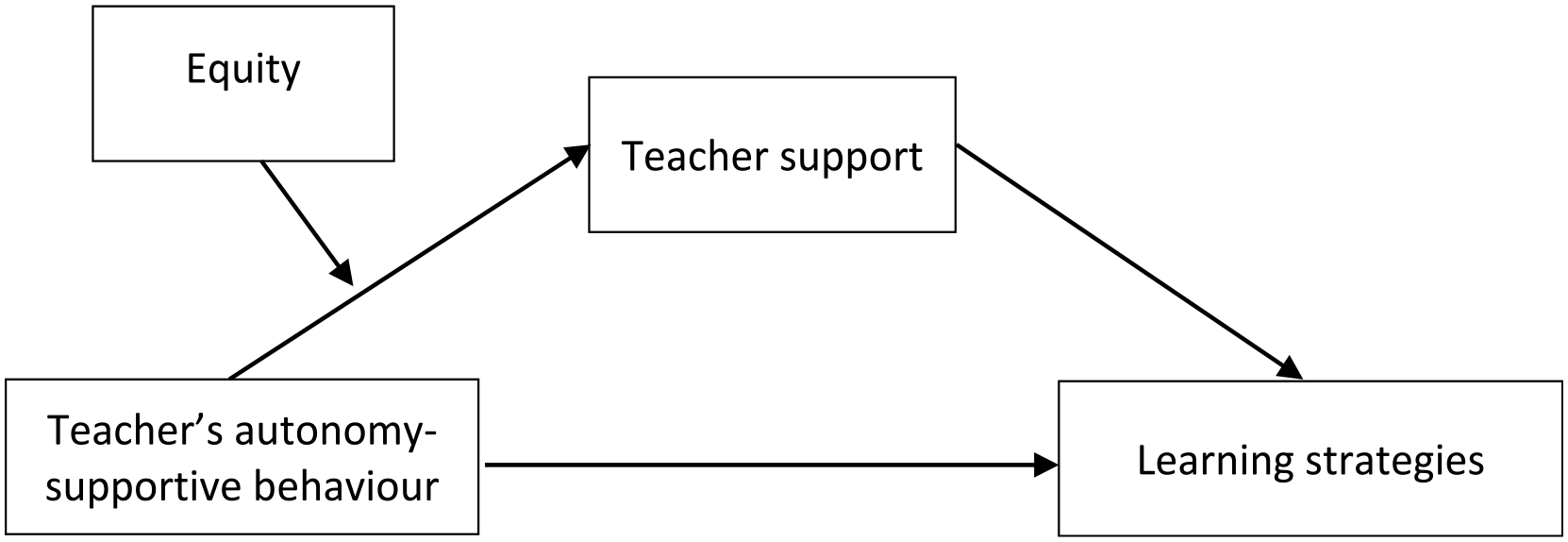
The conceptual model.
Method
Sample
Participants were chosen through convenience sampling. Based on an evaluation of the Lithuanian education system (ŠMSM, 2019), 24 general education schools were selected from nine Lithuanian municipalities with poor socioeconomic status contexts. In terms of number of students, these are schools of small towns or villages. The considerable number of students (ranging from 24.4% to 34.3%) come from low-income homes and study there. The socioeconomic status distribution of participation mirrors the overall distribution of students across the country’s regions.
The total number of students who participated in this study was 632. The sample included 52.2% female students and 47.8% male students in grades 7 to 10. Table 1 shows the participants’ detailed sociodemographic information.
Sociodemographic Characteristics of Participants.

Data Collection
The data was collected in May 2021. The survey was first sent to selected secondary school principals. With their permission, information regarding the study’s goal and requests for their children to participate in the study were sent to the students’ parents and guardians. Only students whose parents or guardians agreed to their children taking part in the study were included. All students participated in the study voluntarily. They were assured of the data’s confidentiality. The data was gathered using a web-based survey on the Internet platform (https://apklausa.lt/). Students filled in the questionnaire at their leisure ensuring that neither researchers nor teachers had any influence on the responses.
Research Instruments
The Learning Climate Questionnaire (LCQ; Black & Deci, 2000) was used to assess students’ perceptions of teachers’ autonomy-supportive behavior. This questionnaire consisted of six items answered on a 7-point Likert scale from 1 (strongly disagree) to 7 (strongly agree). The 6-item LCQ scores were derived by averaging all item scores. A higher score indicates that the teacher is seen to be more autonomy-supportive. “My teacher provides me with choices and options” is one example of an item. In the current study, the Learning Climate Questionnaire demonstrated reliability (McDonald’s ω = .905). The teacher support subscale of the What Is Happening in this Class? (WIHIC) questionnaire was used to assess perceived teacher support (Fraser et al., 1996; Fraser & Fisher, 1983). This subscale had eight items, each of which was assessed on a 5-point Likert Scale, ranging from 1 (almost never) to 5 (almost always). A higher score indicates that the teacher is seen to be more supportive. “The teacher assists me when I am having difficulty with my work,” for example. McDonald’s omega demonstrated that this subscale is highly reliable (McDonald’s ω = .914). To examine students’ perceptions of equity, the equity subscale from the What Is Happening in this Class? (WIHIC) questionnaire (Fraser et al., 1996; Fraser & Fisher, 1983) was used. This subscale contains eight items. Each response is scored on a 5-point Likert scale from 1 (almost never) to 5 (almost always). A higher score indicates a greater sense of equity. An example of an item is: “I get the same opportunity to answer questions as other students.” This scale showed evidence of reliability in this study (McDonald’s ω = .928).
Students’ learning strategies were assessed using the Learning strategies scale (Brandisauskiene et al., 2022). This scale consisted of nine items that were answered on a 5-point Likert scale from 1 (almost never) to 5 (almost always). A higher score reflects student’s increased use of learning strategies. An example of an item is: “While learning at home I link a new learning material with the one I already know from before.” The reliability of the Learning strategies scale, as assessed by McDonald’s omega, was .905.
Gender (boys and girls) and grade (7th, 8th, 9th, and 10th grade) are social demographic characteristics examined in this study.
Data Analysis
For assessing moderated mediation, the data was analysed using IBM’s Statistical Package for the Social Sciences (SPSS) version 23.0 and Hayes’ PROCESS macro (version 3.5; Hayes, 2018). The McDonalds omega (ω) coefficient which is interpreted similarly to Chronbach’s alpha, was used to measure the reliability of the subscales (McDonald, 1999). To ensure valid research results, the correspondence of the distributions of the variables to the normal distribution was checked.
For sample sizes greater than 300, data normality is determined by the absolute values of skewness and kurtosis (West et al., 1995). Skewness and kurtosis measurement standards should be between 1 and 1. Based on the assessment of skewness and kurtosis for large samples, normality tests revealed that data related to the main study variables (teacher autonomy-supportive behavior, teacher support, learning strategies, and equity) were close to a normal distribution (Ghasemi & Zahediasl, 2012; Gravetter & Wallnau, 2014; Islam, 2019; Kim, 2013). As a result, independent Pearson correlation was used to test the relationships between all study variables before analysing moderated mediation. Independent samples Student t-test was used to compare the differences of two groups. Before analysing moderated mediation, Pearson correlation was performed to examine the associations between all research variables. All independent variables were mean-centered when testing a proposed model to reduce multicollinearity and improve the interpretation of regression coefficients (Iacobucci et al., 2017). Gender and grade were included as covariates in a model since analysis revealed that they were connected to the primary study variables. To ensure that the results were not affected by outliers, Mahalanobis distance estimates were calculated based on the variables of moderated mediation model and excluded from the analysis.
For the analysis, 10,000 bootstrap samples with a 95% confidence interval were used. The statistical significance level used was .05. A model’s moderating effect and effect size were estimated using R2 change (explained extra variance). Simple slope tests were calculated to investigate the nature of the interactions, and significant interactions were plotted. Indices of the indirect effect of moderated mediation were considered statistically significant if the bootstrap 95% CI did not include zero.
Research Ethics
The study was carried out in accordance with the Helsinki Declaration criteria and was authorized by the Ethics Committee of Education Academy Vytautas Magnus University in Lithuania (protocol number: SA-EK-21-03).
Results
Descriptive Statistics
Table 2 shows the mean, standard deviation, median, mode, skewness, and kurtosis for all continuous variables used in the current study.
Descriptive Statistics for Study Variables.

Table 3 shows the relationship between the key study variables. As expected, students’ learning strategies positively correlated with teacher’s autonomy-supportive behavior, while teachers support positively correlated with both teacher’s autonomy-supportive behavior and student’s learning strategies. These findings suggest that the more students experience autonomy-supportive behavior and assistance from teachers, the more actively they utilize a range of learning strategies. Furthermore, perceived equity was positively associated with teacher’s autonomy-supportive behavior, learning strategies, and teacher support. This indicates that the more the teacher encourages and supports student autonomy, the more the students regard the classroom atmosphere as equitable, and the more actively they employ various learning techniques when studying. All bivariate associations (p < .001) were statistically significant.
Bivariate Correlations of All Variables.

p < .001.
Analysing the Student t-test results (Table 4), it can be seen that both boys and girls feel similarly the teacher’s autonomy-supportive behavior: the mean values obtained are similar, with no statistically significant difference. The results of the study also show that boys and girls equally perceive teacher support. Perceived equity was statistically significantly higher in the sample of girls (t(630) = −2.736, p < .01). However, given the magnitude of the effect (Cohen’s d = −0.22), the difference between the means is small. The mean of the learning strategies scale is also higher in the sample of girls (t(630) = −4.016, p < .001), but this difference is small (Cohen’s d = −0.32).
Student t-Test Findings for Differences of Variables in Terms of Gender.

Comparing the means of the variables between students in grades 7 to 8 and 9 to 10 (Table 5), it was found that the mean values of perceived teacher support, teacher’s autonomy-supportive behavior and learning strategies were similar, with no statistically significant difference. Although the magnitude of the effect is small (Cohen’s d = 0.20), students in grades 7 to 8 (M = 3.76) are more likely to experience equity than students in grades 9 to 10 (M = 3.58, t(630) = 2.458, p < .05).
Student t-Test Findings for Differences of Variables in Terms of Grades.

Moderated Mediation Effects
Figure 2 depicts the findings of the moderated mediation model. The findings revealed the significant direct positive effect of teacher’s autonomy-supportive behavior to students learning strategies (β = .132, SE = 0.023, CI [0.088, 0.177], p < .001). As the teacher’s autonomy-supportive behavior increases, so do the student’s learning strategies. Besides, teacher support mediated the relationship between teacher’s autonomy-supportive behavior and learning strategies. Teacher support increases when teachers’ autonomy-supportive behavior increases (β = .237, SE = 0.020, CI [0.197, 0.277], p < .001), as teacher support increases, so do learning strategies applied by the students (β = .377, SE = 0.038, CI [0.302, 0.452], p < .001; see Figure 2 and Table 6). In terms of outcomes, perceived equity had a direct positive relationship with teacher support. The greater the pupils’ perception of equity, the more frequently they felt supported by the teacher (β = .401, SE = 0.033, CI [0.336, 0.467], p < .001). Moreover, perceived equity moderated the relationship between teacher’s autonomy-supportive behavior and teacher support (β = .040, SE = 0.016, CI [0.008, 0.071], p < .001).

The importance of equity and teacher support for the relationship between teacher’s autonomy-supportive behavior and learning strategies.
The Effect of Perceived Equity on The Relationship Between Teacher’s Autonomy-Supportive Behavior and Learning Strategies Applied by the Students Via Teacher Support.
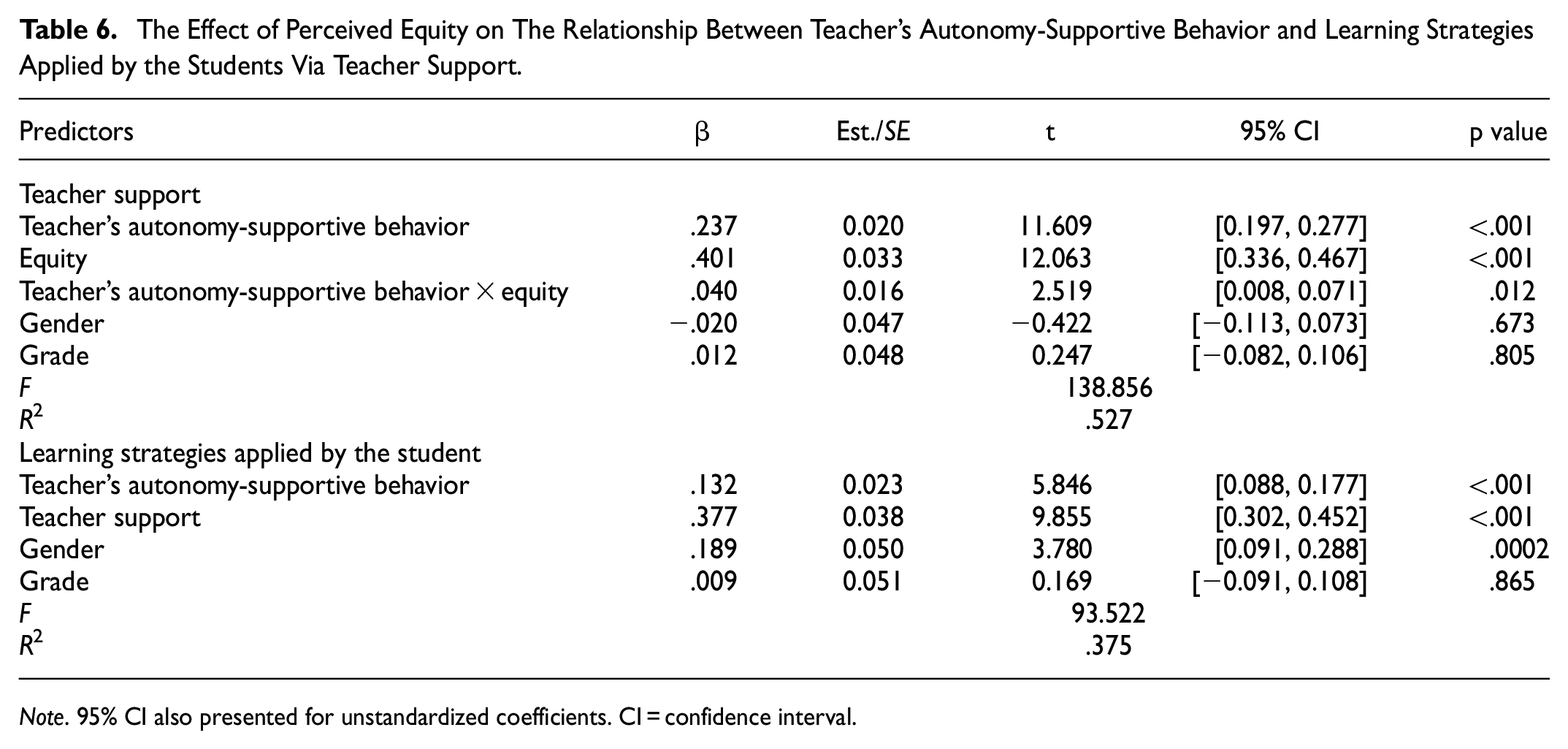
Note. 95% CI also presented for unstandardized coefficients. CI = confidence interval.
Simple slope tests revealed that the relationship between teachers’ autonomy-supportive behavior and teacher support was stronger for students who perceived equity as higher than for students who perceived equity as lower (see Figure 3). However, the effect size of interactions was small (ΔR2 = .0048), though significant (p = .0120).
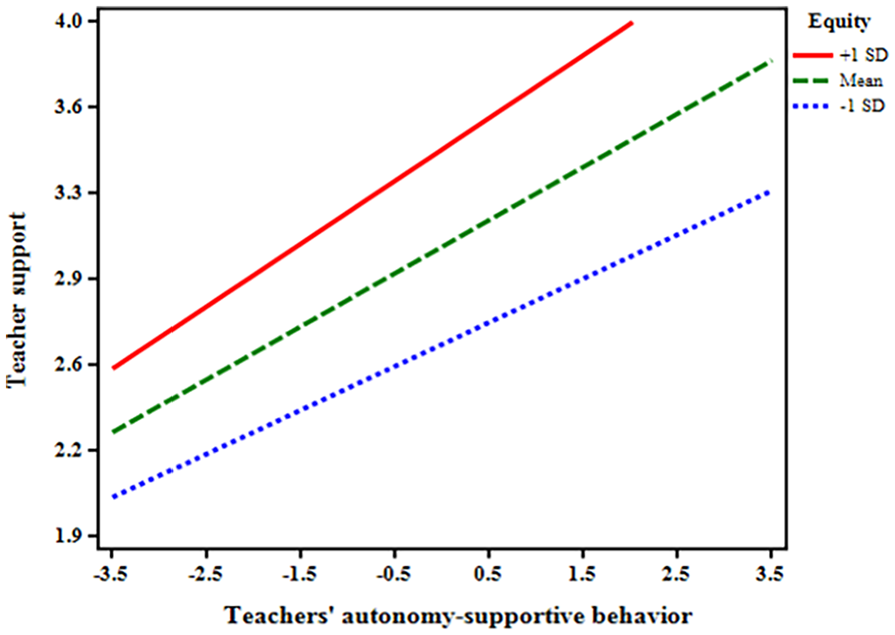
The effect of perceived equity for the relationship between teacher’s autonomy-supportive behavior and teacher support.
Table 7 shows the conditional indirect effects of teachers’ autonomy-supportive behavior on students’ learning strategies for various moderator values. As we can see from the table, the direct effect of teacher’s autonomy-supportive behavior on learning strategies applied by the students was stronger than indirect, through teacher support. Taking moderator values into consideration, the conditional indirect effect and total effect were stronger for students with higher than lower perceived equity. The moderated mediation index is 0.015.
The Total, Direct, and Conditional Indirect Effects of Teacher’s Autonomy-Supportive Behavior on Learning Strategies Applied by the Student for Different Moderator Values.

Note. SE and CI are bootstrapped when presenting indirect effects. CI = confidence interval.
Discussion
Our research findings confirm the presented hypothetical model as well as both research hypotheses raised at the beginning of the study. In a general sense, the results of our study relate to a presented Ahmadi et al. (2022) classification system for teachers’ motivational behaviors which emphasizes that teacher’s behavior being “need supportive” or “need thwarting” strongly influence student’s learning. Our study results are significant in several respects. First, our research results confirm the meaning of teacher’s autonomy-supportive behavior for active students’ participation in the learning process: when teachers are more conducive to students’ autonomy, students are more actively using learning strategies. This confirms the assumption of Grazia et al. (2021) that teacher’s autonomy-supportive behavior encourages students to be proactive and take responsibility for the learning process. Such students’ behavioral response can occur because teacher’s autonomy-supportive behavior according to Hinnersmann et al. (2020) increases students’ autonomous motivation, their higher engagement in learning activities and lower anxiety state. As Alrabai (2021) research results show, learner’s perceived choice (more freedom of choice) and intrinsic motivation are mediators between teacher autonomy-supportive teaching and learner autonomy. Moreover, high autonomy-supportive teaching style influences students’ affective valence and enjoyment (Leisterer & Paschold, 2022; Ou et al., 2021), encourages students’ need for satisfaction, increases a supportive class climate and possibility for students’ prosocial behavior (Cheon et al., 2023; Dietrich & Cohen, 2021). It can be assumed that all the above factors caused by the teacher’s autonomy-supportive behavior encourage students’ active participation in the learning process, in other words, more active use of learning strategies is applied. These findings reiterate the importance of teacher’s autonomy-supportive behavior and encourage careful listening to the concern expressed by Ryan and Deci (2020) that, despite strong research-based evidence that fulfillment of students’ psychological needs is very important in the learning process, there are still a lot of examples of educational practice when traditional motivational models fail to meet students’ needs.
Second, it emerges that teacher’s autonomy-supportive behavior is highly intertwined with other social processes taking place in the classroom and student-teacher interactions, more specifically with perceived equity in class and teacher support. Perceived teacher support mediates the relationship between teacher’s autonomy-supportive behavior and learning strategies applied by the students, which means that as teacher’s autonomy-supportive behavior increases, so does teacher support increases, and students are more actively using learning strategies. Based on these findings, we can assume that the student’s need for autonomy is one of the basic needs in the learning process. It is also important that the teacher helps the student to meet the needs for competence and relatedness because this can help the student cope with emotional, behavioral, or learning difficulties.
Third, our findings reaffirm results of many researches that the relationship between teachers and students lie at the heart of the learning environment (Brinkworth et al., 2018). Students are first and foremost personalities, so the relationship with the teacher is a very important factor in the learning process for them. “For many young people, relationships with teachers are core organizers of experience; they are fundamental to core developmental functions” (Pianta et al., 2012, p. 369). Learning is also a communication, social, and emotional practice (Hargreaves, 2021), therefore social contact is naturally stimulating (Kytle, 2012). Adolescents have more opportunities to be autonomous in their activities when there is an emotionally-supportive climate in classrooms (Ruzek et al., 2016). Relationships with the teacher also can be significant for involving the student in the process of curricula formation (Tavernaro-Haidarian, 2020). Supportive teacher-student relationships are crucial in adolescence because they encourage student engagement in learning (LoCasale-Crouch et al., 2018). Thus, teachers’ efforts to create effective interactions between them and students are a critical and crucial factor in improving student learning (LoCasale-Crouch et al., 2018). These findings are particularly important for low SES students, who, as research shows, are characterized by low learning motivation both in the pre-pandemic period and during the pandemic (Erentaitė et al., 2022). It is worth noting that the creation of a positive individual relationship with students is also very important for teachers themselves, as it is related to their job satisfaction and well-being (Claessens et al., 2017).
Fourth, perceived equity is especially relevant factor in the interaction between teacher and students. The study findings show that perceived equity has a positive direct relationship with teacher support. The higher the equity students perceive, the more they claim to receive more teacher support. Moreover, perceived equity moderated the relationship between teacher’s autonomy-supportive behavior and teacher support: the relationship between teacher’s autonomy-supportive behavior and teacher support was stronger for students with higher than with lower perceived equity. It is possible that students with a predominant equity environment in their classroom feel more courage and confidence to ask for teacher support. On the other hand, it may be that a teacher who relies on the principle of equity tends to be more proactive in providing support to his or her students, distributing it equally to all, without excluding any one.
In agreement with the presented concept of equity by Debnam et al. (2014): “In relation to education the school equity does not mean treating all students in exactly the same way, but rather treating students fairly by ensuring that each student receives what they need to be successful” (p. 447–448), we would like to note that in various scientific literature, equity is most often associated with the quality of education and it is emphasized that providing equal opportunities for all students from early childhood to high school is the most beneficial educational policy. This is very important, but in our view, equity must first be expressed through quality relationships between teacher and student and then in the overall classroom environment. Every child, no matter what gender, abilities, nationality, social status, age he or she is, should feel inherently valuable and equal to others. Accordingly, such learning conditions would lay the foundations for a student’s well-being: he or she would not be afraid to ask for help, would see caring and equitable teachers and would be more involved in the learning process. Thus, we see equity as one of the important elements in ensuring effective teacher-student interaction and an effective learning process. Research shows that, like teacher support, equity is important not only in terms of learning but also in the overall development of students (Debnam et al., 2014). Our research results indirectly reflect the importance of inclusive education and promote the practical implementation of the principles of inclusive education—strengthening social-emotional learning and celebrating difference and diversity (Shaeffer, 2019).
We would like to point out that our study results show differences between girls and boys in assessing teacher’s behavior. The research findings suggest that boys and girls similarly perceive teacher’s behavior as well as equally perceive teacher support. But the results of the equity show a small, statistically significant differences between girls and boys: girls’ perceived equity is higher than boys’. We also found that girls were more active in applying learning strategies compared to boys. These results may reflect two trends often found in previous studies: (1) girls have a more “compliant” profile than boys (Grazia et al., 2021), which means that they were less strict, critical of equity expression and (2) they tend to be more actively engaged in the learning process than boys (Kessels & Houtte, 2022; Korlat et al., 2021). Thus, teachers should pay more attention to communicating with boys and consciously rethink their behaviors. Creating positive relationships with students, according to Claessens et al. (2017), there must be a conscious teacher’s strategy because avoiding a negative pattern of communication with students is very important. The teacher-student relationship requires effort from the teacher, and the teacher’s awareness can help him or her behave professionally: not to react to students’ behavior, based on preconceptions but to try to build a connection with all the students.
Another interesting discovery was that students from grades 7 to 8 perceived teacher’s autonomy-supportive behavior and equity as more pronounced than students from grades 9 to 10. It is possible that older adolescents (grades 9–10) are more critical of teacher’s behavior than younger adolescents (grades 7–8). In addition, the older students are, the more autonomy they may want and the more sensitive they are to equity issues. These findings are important in considering the practical principles of teacher’s activity: it is important for an effective teacher to be aware of student’s psychosocial development aspects and to choose classroom behavior strategies that meet the student’s maturity and needs.
Research results (Brandisauskiene et al., 2021a) have shown that the variables of the learning environment (teacher support, student cohesiveness, peer cooperation, and equity) are positively associated with students’ engagement in learning, so the results of our current study reaffirm the assumptions that teacher support and equity are crucial factors for effective students learning. Also, we would like to point out that building a supportive relationship between students and teachers would also indirectly reduce the problems of student misbehavior (Wubbels, 2011). Thus, for purpose to facilitate an effective student learning process, it is important that teachers and the school community as a whole create a school environment where students feel teachers’ support and equity.
Limitation of the Present Study and Future Directions
We would like to discuss limitations of this study. First, this research is based on students’ self-report data. Because our study relied on teacher promoted autonomy, perceived equity, and teacher support perceived by the students, these are not objective data on how teachers actually behave in the classroom. Although the obtained research data confirmed the hypothetical moderated mediation model we developed, further research should be conducted to investigate the links between objective teacher behavior and students’ perceived autonomy, equity, interpersonal relationships, and how this affects the learning process. Understandably, such surveys would require significantly more time and human resources, as well as raising the question of the possibility of maintaining the anonymity of survey participants’ data. Second, since the study was conducted in small urban and rural schools in municipalities with low SES contexts, the small magnitude of the moderation effect raises questions how much results of the study reflect the specificity of the sample. Therefore, new researches should be conducted with larger populations in order to generalize our research results. Third, the design of a longitudinal study would reveal the dynamics of the interactions analyzed in our study and would be useful for a deeper understanding of these phenomena.
The conducted study also raises the question of the directions of further research in this field of the study. One direction could be the study in which three dimensions of the perceived autonomy-supportive teachers’ behavior and their relationship with students’ learning strategies would be analysed. Tilga et al. (2017) research shows that autonomy-supportive teachers’ behavior consists of three dimensions (organizational, procedural, and cognitive) but there is still a lack of research where autonomy-supportive teachers’ behavior would be analysed as multidimensional construct. Another direction could include additional variables that were not included in the model of this study. We believe that it would be relevant to analyze the links between teachers’ teaching and students’ learning strategies in further research. As already mentioned in the literature analysis of this study, the role of the teacher in students’ learning process is important due to the interactive mutual interaction between the student and the teacher. This can be particularly important for low SES students, as one of the effective ways to help them learn is to involve them into the teaching and learning process. Therefore, to explore the teaching strategies used by teachers and their implications for the learning strategies applied by students would, in our view, be a meaningful continuation of this study.
Conclusion
The research revealed the direct relationship between teacher’s autonomy-supportive behavior and students’ learning strategies and via perceived teacher support. Also, the effect of perceived equity for the relationship between teacher’s autonomy-supportive behavior and teacher support was analysed. The obtained research results in a sample of 632 students allowed to confirm the hypothetical research model. Analysis of the study data revealed the importance of teacher’s autonomy-supportive behavior for students’ participation in learning process: when teachers promote more autonomy, students are more actively using different learning strategies. The teacher support and perceived equity in class plays a significant role in this connection. Perceived teacher support mediates the relationship between teacher’s autonomy-supportive behavior, which means that as teacher’s autonomy-supportive behavior increases, so does teacher support, as teacher support increases, so do the learning strategies used by the students. Perceived equity is important in interaction between teacher and students. Our research results show that perceived equity is positively and directly related with teacher support. The higher the equity students perceive, the more they claim to receive more teacher support. Moreover, perceived equity moderated the relationship between teacher’s autonomy-supportive behavior and teacher support: the relationship between teacher’s autonomy-supportive behavior and teacher support was stronger for students with higher than with lower perceived equity.
In summary, an empirical study confirmed the importance of teacher’s behavior and meaning of equity for relationship between teacher and students. The results of the study are significant for both further research and practice. They encourage to look back at the relationship between teacher and student and once again reconsider the most suitable ways of teacher’s behavior in class taking into account students’ age and their psychological characteristics.
The results of this study also urge education policy makers, school principals, teachers, and all those involved in student education to keep in mind that equity is a significant factor for effectiveness of student learning and interaction processes between teacher and student. Therefore, equity in the classroom should become a basic and mandatory principle in the activities of every teacher.
Footnotes
Declaration of Conflicting Interests
The author(s) declared no potential conflicts of interest with respect to the research, authorship, and/or publication of this article.
Funding
The author(s) disclosed receipt of the following financial support for the research, authorship, and/or publication of this article: This research was funded by the Research Council of Lithuania (LMTLT) project “Creating a Supportive Learning Environment: in Search of Factors enabling the School Com-munity” (Agreement No. S-DNR-20-1), co-financed by the European Union under the measure “Implementation of Analysis and Diagnostics of Short-term (Necessary) Research (in Health, Social, and Other Fields) related to COVID-19.”
Institutional Review Board Statement
The study was conducted according to the guidelines of the Declaration of Helsinki and approved by the Ethics Committee of Education Academy Vytautas Magnus University, Lithuania (Protocol number: SA-EK-21-03).
