



Abstract
The United States’ imposition of high tariffs on Chinese products has not only reshaped global trade dynamics but also provoked significant consumer responses at the grassroots level in China. This study examines how Chinese consumers interpret and respond to these tariff measures, particularly in terms of attitudes toward domestic products, tariff awareness, media exposure, perceptions of fairness in trade, ethnocentrism, and brand-switching behavior. Using a structured survey of Chinese consumers and employing confirmatory factor analysis (CFA) alongside structural equation modeling (SEM), we assessed both the measurement and structural model fit. Reliability and validity tests confirmed the robustness of the constructs, while the Fornell-Larcker criterion established strong discriminant validity. Path analysis revealed that knowledge of tariffs significantly influenced ethnocentric consumers’ attitudes, but not their feelings toward Chinese goods. Exposure to media and ideas of fairness in trade are strong factors in both ethnocentrism and consumer attitudes. This shows how important information framing and perceptions of justice are in molding how people act as consumers. Furthermore, consumer ethnocentrism and positive attitudes toward Chinese products strongly predicted brand switching, suggesting a shift away from foreign products toward domestic alternatives in response to U.S. tariff pressures. This research contributes to understanding how macro-level trade policies translate into micro-level consumer reactions, particularly in a politically charged trade-war context. The results show that tariffs can make people more nationalistic, ethnocentric, and loyal to brands, helping politicians and businesses navigate the unpredictable world of international trade and consumer behavior.
Plain Language Summary
This study examines how Chinese consumers reacted to US-China trade tensions. Many Chinese consumers felt mistreated when the U.S. imposed taxes on Chinese products. We wanted to know how this mood affected thinking and buying. Our findings demonstrate that tariff awareness makes Chinese people more loyal to domestic products and less likely to buy U.S. goods. Media coverage also matters when the news emphasizes conflict or unfair treatment, national pride grows, and local companies are supported. If consumers believe China is unfairly treated in global trade, they become ethnocentric and dislike U.S. brands. Attitudes matter; people who are ethnocentric or dislike U.S. products are more inclined to move to Chinese companies. This illustrates that foreign political tensions affect daily shopping. The study shows how trade conflicts affect consumer behavior and why national identification strengthens when people feel mistreated.
Introduction
In today’s globalized world, understanding consumer behavior has become a significant challenge, particularly when national economic goals conflict with international trade. A prime example of this is the use of tariffs, which are often intended to shield local industries but can unintentionally shape how consumers view and buy products (Bian & Forsythe, 2012; Golgeci et al., 2025; Zhang & Chang, 2021). Awareness of tariffs can evoke national pride, particularly in markets that are particularly sensitive to issues of sovereignty and economic protectionism (Almazán-Gómez et al., 2025; Balabanis & Diamantopoulos, 2004) as governments promote the growth of local businesses through tariff measures, consumer ethnocentrism, the notion that purchasing domestic products is the right thing to do often increases (Shimp & Sharma, 1987). This growing sense of ethnocentrism, along with increased media coverage and concerns about fairness in global trade, can significantly impact how people perceive foreign products, especially those from economically powerful nations like the United States. In this context, brand-switching behavior, in which consumers switch from one brand to another, has become a crucial indicator of how trade policies influence global brand loyalty. While brand switching has typically been linked to price sensitivity and dissatisfaction (Sahay & Sharma, 2010; Warokka & Gallato, 2012; Wahyuningsih et al., 2023), new findings suggest that larger factors, such as tariffs and national interests, also have a significant impact (Volles et al., 2023). The trade tensions between China and the United States, particularly since the U.S. began imposing tariffs on a wide range of Chinese products in 2018, have significantly shaken global trade and consumer behavior. These protective measures were intended to reduce the U.S. trade deficit and boost local production. However, they have also disrupted multinational supply chains and altered how Chinese consumers perceive their purchases (Bown, 2020). As tariffs drove up the prices of American goods, Chinese shoppers began to reconsider their purchasing choices, weighing factors such as quality, cost, and national pride. Amid this geopolitical struggle, there has been a noticeable rise in consumer ethnocentrism, where buying foreign brands, especially American ones, is increasingly seen as unpatriotic or detrimental to the economy (Charinsarn & Speece, 2025; Ju et al., 2024; Rao et al., 2025; Spielmann et al., 2020; Zhou & Hui, 2003). At the same time, media coverage has fueled nationalistic sentiments, framing U.S. tariffs as unfair economic aggression, thereby swaying public opinion and influencing buying habits (Tan, 2011; Willnat, 2022). This shift has led to a growing preference for local brands and a wariness toward American products, potentially driving consumers who were once loyal to switch brands.
The recent rise in trade tensions between the United States and China, highlighted by the 2025 hike in tariffs on crucial Chinese exports such as electric vehicles, semiconductors, and green technologies, has had a significant impact on how consumers in China perceive the situation (Alessandria et al., 2025; Che et al., 2025). Many Chinese citizens view these tariffs as politically driven and economically aggressive (Liu et al., 2025; Ma & Ning, 2024), which has sparked a wave of national pride and increased consumer ethnocentrism (Jiang, 2024; Shan Ding, 2017). As the media focuses on stories about unfair trade practices and foreign containment, public conversations are increasingly linking buying choices to a sense of patriotic duty. Younger and urban Chinese consumers, in particular, are showing a noticeable shift in their preferences (Ye et al., 2025), choosing domestic brands not only for their quality but also as a means of resisting foreign economic pressure (Özturan et al., 2024; Walter et al., 2024).
Despite the growing importance of trade policies in shaping consumer behavior, surprisingly little research has examined how factors such as tariff awareness, media exposure, and perceptions of fairness in trade influence consumer ethnocentrism and attitudes toward U.S. products. Even more interesting is how these factors can lead to brand-switching behavior. Most previous studies have either examined consumer ethnocentrism broadly or focused solely on attitudes toward domestic products without thoroughly exploring how these attitudes translate into actual actions, such as switching brands, especially in politically charged climates (Akbarov, 2022; Baber et al., 2023; Baber et al., 2024; Balabanis & Siamagka, 2022; Srivastava & Narang, 2025; Trivedi et al., 2024; Yadav, 2024). Additionally, the impact of media exposure on consumer nationalism remains somewhat unclear (Liao & Xia, 2023; Y. Yang et al., 2022; Yu et al., 2022). This study addresses a pressing issue at the intersection of consumer behavior, political economy, and international marketing, examining how macroeconomic and socio-political factors influence consumer behavior, particularly in the context of the U.S.–China trade conflict. To kick things off, the following research question arises: RQ1: How does tariff awareness influence consumer ethnocentrism in the context of U.S.–China trade relations? RQ2: What role does media exposure play in shaping consumer ethnocentric attitudes? RQ3: To what extent does perceived fairness in trade influence consumer ethnocentrism and attitudes toward U.S. products? RQ4: How does consumer ethnocentrism affect attitudes toward U.S. products? RQ5: How do attitudes toward U.S. products impact brand-switching behavior among Chinese consumers?
This study’s primary theoretical tension involves comprehending how a macro-level economic policy shock, specifically tariffs, induces micro-level consumer identity responses that influence brand-switching behavior. Trade disputes among nations frequently evoke views of inequitable treatment, economic jeopardy, and intergroup rivalry. Social Identity Theory and Economic Patriotism suggest that such circumstances enhance loyalty to the national in-group and foster the rejection of foreign out-groups. Consequently, tariff awareness not only affects economic judgments but also acts as an identification signal that amplifies consumer ethnocentrism, thereby influencing sentiments toward domestic and international businesses and leading to brand switching. By incorporating socio-political elements such as tariff awareness and trade fairness, it sheds light on how broader economic factors influence individual consumer behavior. This understanding is vital for global brands navigating protectionist markets, as it enables them to position themselves more strategically in response to shifting consumer sentiment. What makes this research stand out is its unique framework, which links tariff-related concepts (such as awareness, media exposure, and fairness in trade) with psychographic factors (including consumer ethnocentrism and product attitudes) to forecast brand switching behavior. Unlike earlier models that separate consumer attitudes from market actions, this study illustrates the direct connection between policy-level influences and consumer-level decisions. This study expands the understanding of consumer ethnocentrism by linking it to external economic policies and the impact of media. It also highlights brand-switching behavior as a reaction to broader perceptions. Additionally, it provides policymakers and multinational companies with valuable insights on how to address and mitigate adverse consumer reactions to trade policies.
Literature Support and Hypothesis Formulation
Theoretical underpinning
Social Identity Theory (Tajfel, 1979; Tajfel et al., 2001) asserts that individuals identify with groups and display preferential behaviors toward their in-group when faced with external challenges. Trade conflicts and tariff impositions often heighten intergroup tensions, as consumers perceive tariffs as symbolic or economic challenges to their national identity (Carvalho et al., 2019; He & Wang, 2015). When external entities, such as foreign governments, implement discriminatory economic policies, members of the in-group react by strengthening national allegiance and distancing themselves from products associated with the out-group (Hossain, 2024). Previous research indicates that geopolitical conflicts and nationalist signals exacerbate consumer ethnocentrism, leading to reduced choice for international brands and heightened support for domestic options (Balabanis & Diamantopoulos, 2004; Chang et al., 2025; De Nisco et al., 2020). In the Chinese context, awareness of U.S. tariffs may evoke emotions related to national identity, reinforce ethnocentric inclinations, and affect customers’ perceptions of Chinese products. This offers a psychological rationale for how tariff knowledge and media exposure influence consumer ethnocentrism and the development of attitudes.
The notion of Economic Patriotism (Clift & Woll, 2012) explains why consumers can use their purchasing power to safeguard national economic interests during economic disruption. Economic patriotism posits that consumers are driven not solely by individual preferences but also by a sense of duty to support the national economy, particularly when external entities are viewed as acting unjustly (Reznikova et al., 2018; Spielmann et al., 2020). Tariffs indorsed by foreign governments may be perceived as unfair economic hostility, leading consumers to exhibit support for domestic industries (Contractor, 2025). This entails selecting domestic products, eschewing imports, and taking compensatory measures, such as brand switching (Chen et al., 2014; Tsai et al., 2005). Within this theoretical framework, the perception of fairness in trade is pivotal: the greater the consumers’ perception of foreign tariffs as unjust, the more inclined they are to make consumption choices driven by nationalism.
The integration of the aforementioned views offers a cohesive framework elucidating how macro-level trade policy shocks influence consumer-level behavioral consequences. Awareness of tariffs and media exposure serves as cognitive stimuli, enhancing feelings of external threats or economic inequity. These impressions thus amplify customer ethnocentrism and reinforce preferences for domestic products, ultimately influencing brand-switching behavior, particularly from U.S. brands to Chinese equivalents. Consequently, the theoretical framework regards tariffs not only as economic tools but also as identity-related and socio-psychological catalysts that might alter consumer choices. This multi-tiered theoretical integration improves the conceptual clarity and explanatory strength of the proposed framework (Figure 1).

Conceptual framework.
Figure 1 shows the hypothesized links between tariff policies, how consumers see things, and how often they switch brands. The model assumes that tariff knowledge, media exposure, and trade fairness impact consumers’ ethnocentric attitudes and product evaluations during international trade battles. Because each variable represents a different aspect of how consumers interpret geopolitical and economic events, these three factors operate as parallel routes. Tariff awareness shows consumers’ grasp of foreign economic challenges and national policies. Social Identity Theory and Economic Patriotism say perceived challenges to national economic welfare increase in-group loyalty and defensive consumption. Thus, tariffs increase ethnocentrism and boost domestic product sentiments at the macro level. Media exposure shapes perceptions, interpretations, and emotions surrounding trade events. According to media framing theory, repeated exposure to tales about unfair treatment, economic aggression, or national vulnerability can increase nationalism. Media is an autonomous information source, not dependent on tariff awareness. So, it emerges in a parallel pathway. Consumers judge trade fairness based on how their country is handled abroad. Justice theory and reciprocity rules suggest that people react strongly when they feel their nation is mistreated. Anger, in-group favoritism, and rejection of foreign products result from perceived unfairness. This mechanism is normative, not informational or policy-based, justifying its independent pathway.
Impact of Tariff Awareness on Consumer Ethnocentrism and Attitudes Toward Chinese Products
Tariff awareness is all about how well economic players like businesses, consumers, and policymakers understand tariffs, how they work, any potential changes, and the wider economic effects they can have. This concept is essential for navigating the world of international trade and making wise decisions (Amiti et al., 2019). When people are more aware of tariffs, they can make better choices about sourcing, pricing, planning for supply chain resilience, evaluating market access, and ensuring compliance, ultimately boosting competitiveness and profitability (Pierce & Schott, 2016). To create effective and predictable trade policies, it is essential to understand how current or proposed tariffs affect various sectors and overall economic welfare (Fajgelbaum et al., 2020). On the other hand, consumer ethnocentrism concerns the beliefs consumers hold about the morality and appropriateness of buying foreign-made products versus those made at home. Ethnocentric consumers often feel that purchasing imports is wrong because it harms the domestic economy, leads to job losses, and is felt to be unpatriotic.
In contrast, buying domestic products is viewed as the right thing to do to support the national economy and fellow citizens (Shimp & Sharma, 1987). Klein (2002) points out that perceived economic threats can lead to negative feelings toward foreign goods, a key aspect of ethnocentrism. He suggests that concerns about the domestic economy drive people to avoid imports. Increased awareness of tariffs feeds into these concerns. Similarly, Zeugner-Roth et al.’s (2015) research shows that the effects of ethnocentrism can vary across contexts and be triggered by pressing economic issues. Handley and Limão’s (2017) study has also demonstrated that when firms are aware of uncertainties in tariff policies, their behavior changes; likewise, when consumers are aware of actual tariff implementations, it can shift their attitudes and purchasing decisions through activated ethnocentrism. These findings indicate that awareness of tariffs is pertinent not only to the interests of firms and policymakers but also to consumers, particularly regarding their ethnocentric tendencies. Expanding upon these preceding investigations, the subsequent hypothesis is proposed.
H1a Tariff awareness positively influences the consumer ethnocentrism.
H1b Tariff awareness positively influences the attitudes toward Chinese products.
Impact of Media Exposure on Consumer Ethnocentrism and Attitudes Toward Chinese Products
Media exposure, which refers to how often, for how long, and in what ways we engage with mass communication channels such as news and social media, plays a significant role in shaping our perceptions through agenda-setting and framing (Valkenburg et al., 2016). Consumer ethnocentrism is the belief that buying foreign products can hurt our domestic economy and national identity, leading people to prefer local goods as a moral obligation (Zeugner-Roth et al., 2015). Significantly, media exposure boosts consumer ethnocentrism by: highlighting economic threats, such as job losses due to imports, which makes audiences more likely to see foreign products as harmful (Kersten & Greitemeyer, 2023) reinforcing nationalist messages that connect buying local with being patriotic (Cleveland et al., 2016) sensationalizing trade disputes and recessions to increase aversion to imports (Nijssen & Douglas, 2011) creating social media echo chambers driven by algorithms that promote uniform protectionist views (Lee et al., 2014). Therefore, the media serves as a crucial factor in triggering and reinforcing ethnocentric consumer biases. Drawing upon the findings of these investigations, the subsequent hypothesis is put forth.
H2a Media exposure positively influences the consumer ethnocentrism.
H2b Media exposure positively influences the attitudes toward Chinese products.
Impact of Fairness in Trade on Consumer Ethnocentrism and Attitudes Toward Chinese Products
Fairness in trade is all about how consumers perceive justice in international exchanges. It encompasses aspects such as ethical production, including fair wages and safe working conditions, as well as environmental sustainability and fair competition (Balabanis & Diamantopoulos, 2004; Verhofstadt et al., 2016). These perceptions play a significant role in shaping consumer ethnocentrism (ET), the idea that buying foreign products can harm local economies. When trade feels unfair, like in cases of dumping or labor exploitation, consumer ethnocentrism tends to spike, leading to negative attitudes toward imports (Balabanis & Diamantopoulos, 2004; Shimp & Sharma, 1987). Concerns about unfair practices in Chinese trade, such as intellectual property theft, government subsidies, and relaxed regulations, only heighten this consumer ethnocentrism-driven resistance to Chinese products, as consumers see these practices as threats to their industries (Hoon Ang et al., 2004; Nijssen & Douglas, 2004). It is important to note that consumer ethnocentrism, which reflects a general bias against foreign goods, and perceptions of fairness, which focus on specific ethical issues related to countries like China, function independently. While consumer ethnocentrism dismisses all imports, fairness concerns are more targeted, often aimed at countries like China based on their production ethics (De Ruyter, 1998; Klein et al., 1998). Considering the discourse, we propose the following hypothesis.
H3a Fairness in trade positively influences the consumer ethnocentrism.
H3b Fairness in trade positively influences the attitudes toward Chinese products.
Impact of Consumer Ethnocentrism on Brand Switching Behavior
Consumer ethnocentrism creates a negative association with loyalty to foreign brands, often leading to a greater tendency to switch to domestic options. Highly ethnocentric people tend to view foreign products as not just economically damaging but also morally inferior (Shimp & Sharma, 1987). As a result, they often choose to ditch imported brands in favor of local ones (Herz & Diamantopoulos, 2013). This tendency to switch brands becomes even stronger when good domestic alternatives are available (Javalgi et al., 2005). However, it can differ depending on the type of product and the perceived quality differences (Nijssen & Douglas, 2004). Research shows that CET directly influences the intention to switch brands, especially when national identity is a strong factor (Zeugner-Roth et al., 2015). Overall, this discussion highlights how consumer ethnocentrism negatively impacts brand switching behavior, leading us to suggest the following hypothesis.
H4 Consumer ethnocentrism has a positive and significant influence on brand switching behavior.
Impact of Attitude Toward Chine’s Product on Brand Switching Behavior
Consumer attitudes toward Chinese products are heavily influenced by factors like perceived quality, safety concerns, stereotypes about the country of origin, and sociopolitical tensions, all of which play a significant role in driving brand switching behavior (Shan Ding, 2017; R. Yang et al., 2018). When consumers hold negative views, such as believing Chinese products are of low quality, unethical, or a threat to the economy, they tend to shift away from Chinese brands toward domestic or alternative options (Hoon Ang et al., 2004; Klein et al., 1998). This tendency is powerful in high-involvement categories such as electronics and baby products, where perceived risk makes consumers even more likely to avoid these brands (Siamagka & Balabanis, 2015). On the flip side, positive attitudes, such as perceiving good value for money or technological innovation, can reduce the likelihood of switching brands. However, this loyalty can be pretty fragile and easily shaken by product failures or geopolitical issues (Furukawa & Terasaki, 2025; Herstein et al., 2014). Overall, these insights suggest that attitudes toward Chinese products have a significant impact, both positive and negative, on brand switching behavior. Based on these observations, we propose the following hypothesis.
H5 Attitudes toward Chinese products have a positive and significant influence on brand switching behavior.
Methodology of the Study
Research Design
The researchers employed a quantitative research method to investigate the relationships between the different variables. A structured questionnaire was used to get primary data from the target group. The study chose the survey method because it enables the gathering of a large number of responses quickly.
Sampling Technique and Sample Size
The study employed a convenience sampling method to collect responses, as it was easy to obtain and cost-effective, making it a suitable fit for our non-probability sampling approach. We chose this method because our study was exploratory and we had limited time and funding. We contacted individuals from universities, retail stores, and supermarkets and asked them to complete the questionnaire independently. After checking and cleaning the data, we were left with 300 valid responses.
A sample size should be at least five times the total number of questionnaire items (Hair et al., 2010). Kline (2023) analyzes the significance of sample size and underscores the need for a sample of more than 200 participants. The “10-times rule” posits that a model’s most complex construct should be supported by a minimum of ten indicators (Boomsma, 1982, 1985; Sekaran, 2003; Sekaran & Bougie, 2016), recommending a sample size of 100 to 200 respondents, while Wolf et al. (2013) advocate for a range of 30 to 460 respondents for structural equation modeling (SEM). The 10 times rule indicates that 300 responses are adequate are there are 30 items in total. Consequently, the sample size substantiates the validity and reliability of the findings. Additionally, we highlighted experience, pertinent information, and skills throughout the questionnaire survey.
Instrument Development
We ensured that the items in the questionnaire were based on well-known scales from the literature, thereby maintaining content validity (Table 1). On a five-point Likert scale, 1 means “Strongly Disagree” and 5 means “Strongly Agree.” This was true for all items unless otherwise noted, and the detailed items of the constructs are displayed in Appendix Table A1.
Constructs and Items Sourcing.

Data Collection
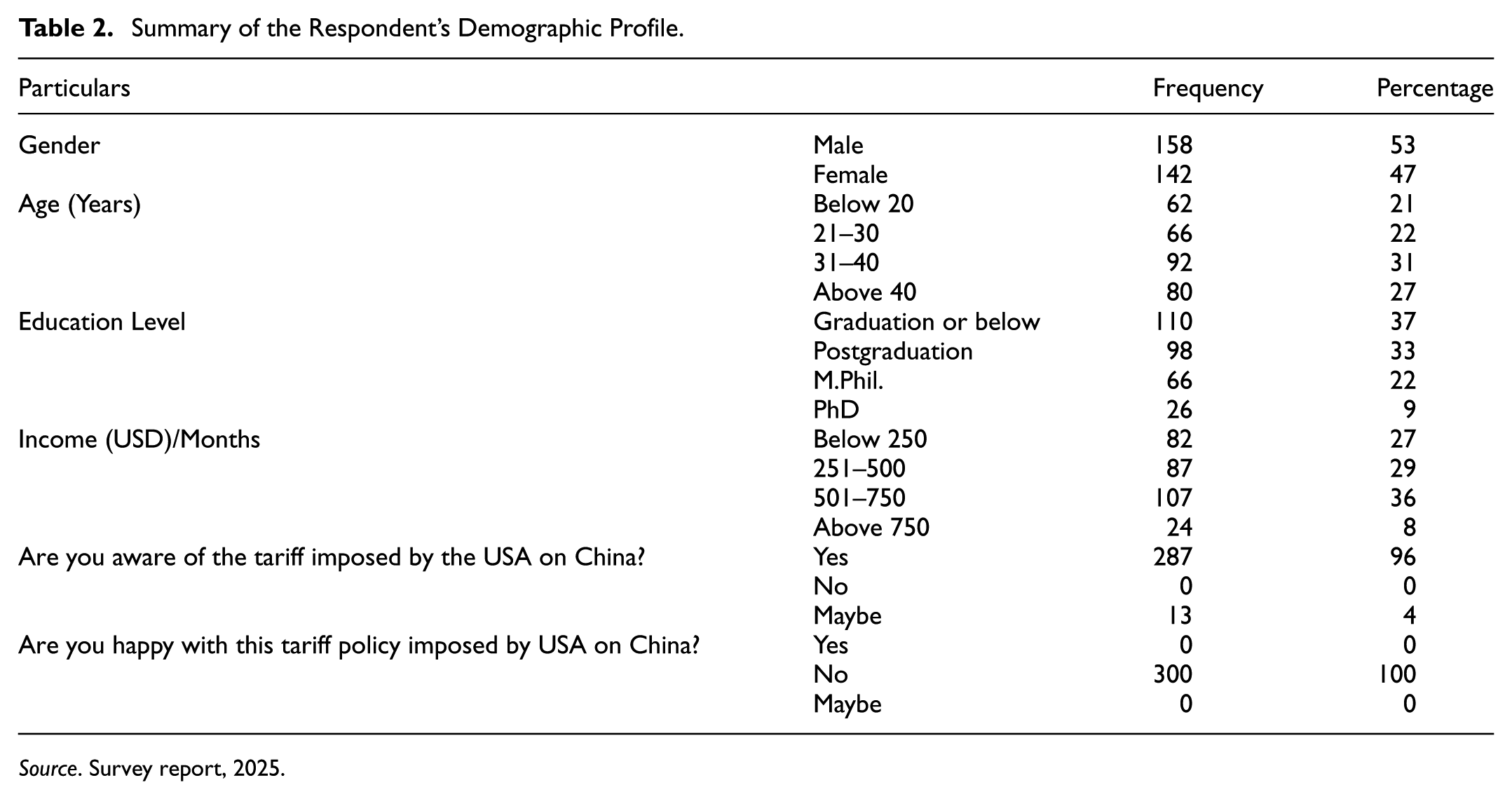
Data has been collected from Chinese people born in China. No data was collected from people from other countries currently staying in China. The data collection process took around 3 months from March to June 2025. During the dissemination of the questionnaire, we asked every individual about their volunteer participation and carefully read the respondents’ consent, marking the opinion accordingly. The respondent’s consent clearly stated that the data would be used only for research purposes and that there would be no invasion of privacy, even though there was no question about the personal identity of the respondents. The summary of the respondent’s demographic profile is shared in detail in Table 2.
Summary of the Respondent’s Demographic Profile.
Source. Survey report, 2025.
Table 2 represents a survey of 300 people, with a nearly equal split between men and women (53% men and 47% women), ensuring that all points of view were represented. The sample had a wide range of ages, but the biggest group (31%) was between 31 and 40 years old. After that, 27% were older than 40, 22% were between 21 and 30, and the smallest group, 21%, was younger than 20. There was also much variety in their educational backgrounds. More than a third (37%) had a high school diploma or lower, another third (33%) had finished college, 22% had an M.Phil., and a smaller 9% had a PhD. Monthly incomes were also different. 36% said they made between USD 501 and 750, 29% said they made between USD 251 and 500, 27% said they made less than USD 250, and only 8% said they made more than USD 750. It was clear that 96% of respondents knew about the U.S. tariff policy on China, and only 4% were unsure. Notably, none of the people who took part said they did not know about the policy. Even more surprising was the fact that everyone who answered was unhappy with the policy. This indicates a strong group disapproval of the U.S. tariff decision on China.
The demographic makeup of a group that is pretty educated, has a range of incomes, and is aware of policies suggests that both economic factors and involvement in discussions about international trade influence the opinions shared. The fact that everyone disagrees with the tariff policy suggests that there may be a consensus that cuts across demographic lines. This suggests that the negative views stem from shared economic or political concerns rather than from demographic differences alone.
Data analysis Tools and Technique
We first coded the data we collected and put it into SPSS version 25 for some fundamental analysis. This included checking and cleaning the data to identify missing values or outliers, using descriptive statistics, and using Cronbach’s alpha to test reliability. Before we started the primary analysis, we checked for normality, multicollinearity, and Exploratory Factor Analysis (EFA).
Next, we used SPSS Amos version 24 to do Confirmatory Factor Analysis (CFA) to check the validity of our measurement model. We looked at both convergent and discriminant validity. We also used Structural Equation Modeling (SEM) to examine the proposed links between the variables and to test the model’s fitness. Following the guidelines set by Hair et al. (2019), we examined several fit indices, including Chi-square/df, CFI, GFI, AGFI, TLI, NFI, RMSEA, and SRMR, to assess the model’s fit. Based on the model fitness test, we proceeded with the path analysis to measure the cause-and-effect relation among independent and dependent variables.
Results
Table 3 shows the results of the Kaiser-Meyer-Olkin (KMO) measure and Bartlett’s test of sphericity as well as the CMB test. Both of these test’s help determine if the dataset is suitable for factor analysis. The KMO value we found is .825, which is much higher than the minimum value of .60 that Kaiser (1974) recommends. This indicates that the sampling is perfect, meaning the correlations between the variables are close together and ready to be extracted. Furthermore, Bartlett’s test of sphericity indicates a Chi-square value of 5307.223 with 435 degrees of freedom, and a significance level of p < .001. This result is statistically significant, which means we can reject the null hypothesis that the correlation matrix is just an identity matrix. In simpler terms, it shows that the variables are related in a meaningful way, which supports the idea that our dataset is suitable for factor analysis (Bartlett, 1954). The KMO statistic and Bartlett’s test together give strong evidence that the data is suitable for more exploratory or confirmatory factor analysis.
KMO and Bartlett’s Test and CMB Test.

Source. SPSS output (v. 25).
To evaluate potential common-method bias (CMB), we performed Harman’s single-factor test by inputting all measurement items into an unrotated exploratory factor analysis utilizing principal component extraction. The findings reveal that the initial factor represented merely 15.56% of the overall variation, well below the widely recognized benchmark of 50% for denoting substantial common-method variance (Podsakoff et al., 2003). Given that no singular component appeared and the primary factor did not predominate the variance, common-method bias is improbable to be a significant issue in this study.
Table 4 shows the results of our exploratory factor analysis (EFA), which used principal component analysis with varimax rotation. This analysis identified six distinct components aligned with the proposed constructs: Attitude toward Chinese Products, Media Exposure, Brand Switching Behavior, Tariff Awareness, Consumer Ethnocentrism, and Fairness in Trade.
Exploratory Factor Analysis (EFA).

Extraction Method: Principal Component Analysis (PCA). Rotation Method: Varimax with Kaiser Normalization.
Source. SPSS output (v. 25).
Every item had strong loadings on its factor, with values that were much higher than the minimum acceptable level of .60 (Awang, 2012; Babu et al., 2024). This shows that our measurement model is valid. For example, the factor loadings for Attitude toward Chinese Products were between .879 and .907, indicating perfect internal consistency. The loadings for Media Exposure items were between .784 and .878, and the loadings for Brand Switching Behavior were between .804 and .849. These numbers all show that the items are very similar. Tariff Awareness had loadings between .784 and .866, and Consumer Ethnocentrism had loadings between .745 and .825. Both of these demonstrate their reliability. Lastly, the Fairness in Trade items had loadings between .696 and .801, which is also in line with the suggested cut-off values for factor analysis (Effendi, 2019; Jaman et al., 2023).
In conclusion, the EFA results provide strong evidence that the items are accurately organized into their intended constructs, which guarantees both construct reliability and discriminant validity. These results confirm that the measurement model is appropriate for subsequent confirmatory factor analysis (CFA) or structural equation modeling (SEM).
The results of the normality test for all the variables that were looked at are shown in Table 5. The items’ skewness values range from −0.145 to −0.831, and their kurtosis values range from −0.960 to 1.297. According to Kline (2023), structural equation modeling (SEM) is acceptable if the skewness values are between ±3 and the kurtosis values are between ±10. These findings indicate that the data remains relatively close to normality.
Assessment of Normality.

Source. SPSS AMOS output (v. 24).
The critical ratios (c.r.) for skewness and kurtosis, on the other hand, show some values that are higher than ±1.96, which suggests that the data is not perfectly normal in one way or another. That being said, these kinds of differences are prevalent in social science research, especially when using Likert-scale data (Byrne, 2016; Collier, 2020). The multivariate kurtosis value of 447.683 and the C.R. value of 88.481 are both important pieces of evidence that multivariate non-normality exists. Based on these findings, the presumption of stringent multivariate normality is not fully met. Nonetheless, the data is suitable for analysis employing CB-SEM or robust estimation techniques, which are specifically formulated to handle non-normal data distributions adeptly.
The CFA results in Table 6 show that all constructs have good reliability and convergent validity. The factor loadings for the Attitude toward Chinese Products (ACP) scale are very high (0.854–0.915), and it has excellent internal consistency (Cronbach’s α = .945; C.R. = 0.945) and a strong AVE of 0.775. Tariff Awareness (TA) and Media Exposure (ME) also show good reliability (α = .881 and 0.902; C.R. = 0.882 and 0.902, respectively) and good convergent validity (AVE = 0.599 and 0.650). Fairness in Trade (FT) and Consumer Ethnocentrism (CE) exhibit moderate to strong loadings (0.620–0.794), with satisfactory reliability (α = .829 and .846; C.R. = 0.830 and 0.847) and AVE values exceeding 0.50, indicating that their items effectively capture the constructs. Brand Switching Behavior (BSB) is accurately quantified (loadings 0.746–0.818; α = .884; C.R. = 0.885; AVE = 0.605). Moreover, the internal consistency of the measurement model is acceptable, as the Cronbach’s alpha scores are above the acceptable threshold of .70 (Hair et al., 2019), affirming the constructs’ validity composite reliability (C.R.) values remain above the threshold of 0.70 (Ab Hamid et al., 2017). All constructs’ average variance extracted (AVE) is above the 0.50 threshold, affirming adequate convergent validity (Hair et al., 2010). The findings indicate that the measurement model exhibits significant validity and reliability, ensuring robustness in capturing the intended constructs.
CFA and Assessment of Construct’s Reliability and Validity.

Source. SPSS AMOS output (v. 24).
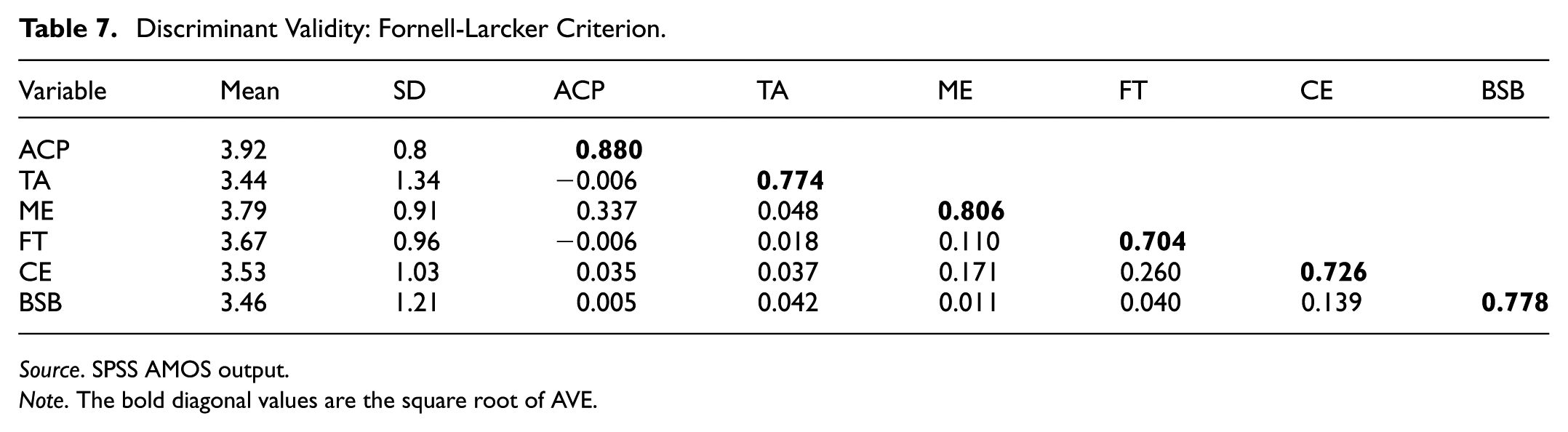
The Fornell-Larcker criterion is used in Table 7 to check the discriminant validity of the constructs. The square root of each construct’s AVE, shown on the diagonal, is higher than the correlations between that construct and all the others. This means that each construct captures its unique variance (Fornell & Larcker, 1981). For example, the square root of the AVE of Attitude toward Chinese Products (ACP) is 0.880, which is higher than its correlations with tariff awareness, media exposure, fairness in trade, consumer ethnocentrism, and brand switching behavior. Tariff Awareness (TA) (0.774), Media Exposure (ME) (0.806), Fairness in Trade (FT) (0.704), Consumer Ethnocentrism (CE) (0.726), and Brand Switching Behavior (BSB) (0.778) all have AVE-based values that are higher than their inter-construct correlations. The low correlations between constructs, such as CE and BSB (0.139) or ME and FT (0.110), indicate that the constructs differ from each other. All of these results show that the measurement model meets the criteria for discriminant validity, which means that each construct is separate from the others in both theory and practice.
Discriminant Validity: Fornell-Larcker Criterion.
Source. SPSS AMOS output.
Note. The bold diagonal values are the square root of AVE.
Table 8 shows a summary of the different indices that were used to check the overall model fit. The chi-square to degrees of freedom ratio (CMIN/df = 1.620) is well below the recommended threshold of 3, which means that the fit is good (Hair et al., 2010). The root mean square residual (RMR = 0.050) meets the recommended value of ≤0.05 (Diamantopoulos & Siguaw, 2000), which means that the observed and predicted covariances are very close to each other.
Model Fit Summary (Indices).

Source. SPSS AMOS output.
Goodness-of-fit measures, such as GFI (0.881) and AGFI (0.858), are higher than the 0.80 benchmark (Doll et al., 1994), which means that the model fits well. The incremental fit indices also show that the model is strong. NFI (0.910), RFI (0.902), IFI (0.953), TLI (0.947), and CFI (0.952) all exceed the 0.90 threshold set by Hair et al. (2010) and Hu & Bentler (1999). The RMSEA value of 0.046 is also below the 0.08 cutoff (Browen & Cudeck, 1993), which further supports the model’s good fit. All of these indices together show that the structural model fits the data well. This is a reasonable basis for testing hypotheses and doing structural analysis.
The structural model underwent testing to evaluate the proposed relationships among constructs in Table 9. The findings indicate that tariff awareness (TA) exerts a significant positive influence on consumer ethnocentrism (CE) (β = .085, p < .05), thereby confirming H1a; however, its impact on attitude toward Chinese products (ACP) is not significant (β = −.053, p = .276), resulting in the rejection of H1b. Media exposure (ME) has a significant positive effect on both CE (β = .342, p < .001) and ACP (β = .922, p < .001), which supports H2a and H2b. Fairness in trade (FT) has a significant effect on CE (β = .936, p < .001), which supports H3a. However, it does not have a significant effect on ACP (β = −.094, p = .497), which means that H3b is rejected. In terms of behavioral outcomes, consumer ethnocentrism (CE) has a positive effect on brand switching behavior (BSB) (β = .992, p < .001), which supports H4. Similarly, attitude toward Chinese products (ACP) exerts a significant positive influence on brand switching behavior (BSB) (β = .383, p < .001), thereby corroborating H5.
Path Analysis.

Source. SPSS AMOS output.
Note. ** = p < .05 and *** = p < .001.
In general, the results show that exposure to media and feelings of fairness in trade are two significant causes of consumer ethnocentrism. Ethnocentrism and feelings about Chinese products are also major causes of brand switching behavior. On the other hand, in this case, knowing about tariffs and fairness in trade does not directly affect how people feel about Chinese goods.
Discussion
This research enhances the comprehension of consumer behavior in cross-cultural trade environments by investigating the precursors of brand switching behavior, emphasizing tariff awareness, media exposure, fairness in trade, consumer ethnocentrism, and perceptions of Chinese products. The results offer detailed insights into the mechanisms by which cognitive, informational, and perceptual factors influence both attitudinal and behavioral outcomes.
In line with H1a, awareness of tariffs has a significant impact on consumer ethnocentrism, indicating that understanding trade policies bolsters nationalistic consumption behaviors. This corresponds with Shimp and Sharma’s (1987) theory of consumer ethnocentrism, which asserts that macroeconomic awareness can engender a moral imperative to endorse domestic products (Han & Guo 2018; Shan Ding, 2017; Souiden et al., 2018). Notably, tariff awareness did not significantly influence attitudes toward Chinese products (H1b not supported), indicating that cognitive awareness alone may not lead to evaluative judgments of foreign brands. This finding emphasizes the necessity of differentiating between knowledge-based ethnocentric inclinations and emotional product assessments (Carmona et al., 2024). Attitudes toward foreign products often stem from broader cultural, social, and experiential factors (Jiménez & San Martín, 2010; Oberecker & Diamantopoulos, 2011). Tariff information, however, is neutral, technical, and unemotional, making it less likely to shift attitudes, especially toward widely consumed products like Chinese goods. Several studies argue that tariff awareness affects consumer perception only when it directly increases personal expenditure (Fajgelbaum et al., 2020). If consumers do not feel clear, immediate price increases attributable to tariffs, their attitudes remain unchanged. Media exposure proved to be a strong predictor of both consumer ethnocentrism and attitudes toward Chinese products (H2a and H2b supported). These findings highlight the crucial influence of media on consumer perceptions and behaviors (Arman, 2022; Yuan et al., 2024). Exposure to media content - be it news, social media, or advertisements which seems to bolster ethnocentric tendencies and shape product-specific attitudes simultaneously. This dual influence substantiates earlier claims that the media serve as both a socialization agent and a cognitive framing tool in consumer decision-making (McLeod & Shah, 2009; Östman, 2014). Interestingly, perceptions of fairness in trade significantly influenced consumer ethnocentrism (H3a supported) but did not affect attitudes toward Chinese products (H3b not supported). This varying impact indicates that perceptions related to fairness stimulate moral and ethical considerations associated with ethnocentric behavior; however, these perceptions may not directly influence affective evaluations of foreign products. The outcome corresponds with previous research indicating that attitudinal responses to products are influenced by immediate affective or brand-related signals rather than abstract trade fairness factors (Devinney et al., 2010; Schamp et al., 2023). Numerous studies indicate that perceptions of Chinese items typically rely on practical and sensory features rather than ethical considerations regarding trade procedures (Khan & Ahmed, 2016). Consequently, even when consumers acknowledge global trade equity concerns, they predominantly assess Chinese items based on quality and value, thereby diminishing the influence of fairness evaluations. Research on ethical consumption (Carrington et al., 2014) indicates that moral or fairness concerns affect consumer attitudes solely when these values are profoundly ingrained. For numerous customers, the principle of global trade equity is not a significant personal value, hence exerting negligible influence on product-level perceptions. At the behavioral level, both consumer ethnocentrism and attitudes toward Chinese products were significant predictors of brand switching behavior (H4 and H5 supported). Ethnocentric consumers are more inclined to eschew foreign brands, thereby affirming the established correlation between nationalistic values and consumption behaviors (Ishii, 2009; Kinawy, 2025). At the same time, whether people have positive or negative feelings about Chinese products has a direct effect on whether they switch brands. This shows that both cognitive beliefs and emotional evaluations work together to shape buying decisions.
The results advance the literature by illustrating how macro-level trade policy shocks can induce micro-level behavioral changes driven by national identity and economic patriotism. The significant impact of tariff awareness on consumer ethnocentrism and perceptions of Chinese products reinforces the notion that trade policies serve as both economic tools and threats to identity. When consumers view foreign tariffs as unjust or antagonistic, they respond defensively by reinforcing national allegiance, a trend aligned with Social Identity Theory and contemporary studies on economic patriotism (Carvalho et al., 2019; Mainolfi, 2022). This outcome corresponds with previous research indicating that geopolitical crises frequently intensify domestic product preference (Auruškevičienė et al., 2025; Cevik, 2025). The notable connections between media exposure, ethnocentrism, and sentiments indicate that mass communication is crucial in framing trade disputes and influencing public opinion (Ha et al., 2022; Zhu, 2022). Media storylines highlighting unjust treatment or foreign antagonism seem to stimulate nationalist sentiments, hence bolstering support for home products (Wang, 2006). This discovery enhances the study of political consumerism by demonstrating how informational contexts affect patriotic consumption behavior. Consumer ethnocentrism and positive sentiments toward Chinese products significantly predicted brand-switching behavior, demonstrating a clear behavioral manifestation of national identity cues. This expands the literature on consumer nationalism by demonstrating that tariff-induced identity activation can lead to tangible marketplace behavior rather than merely attitudinal changes. The model demonstrates the intersection of trade policy, country identity, and consumer behavior, emphasizing the psychological mechanisms by which global trade disputes influence marketplace decisions.
Theoretical Contribution
This paper makes significant theoretical contributions to consumer behavior, trade policy, and nationalism-driven consumption. The research enhances understanding of how macroeconomic policy shocks, such as tariffs, affect micro-level consumer identity responses. The study shows that tariff awareness significantly increases consumer ethnocentrism, thereby extending Social Identity Theory and the notion of Economic Patriotism into the realm of trade disputes, suggesting that economic policies can trigger identity-protective purchasing behaviors.
The study offers a more detailed analysis of the multifaceted factors that influence consumer ethnocentrism. This model integrates policy-based cues (tariff awareness), information framing (media exposure), and moral assessments (fairness in trade), in contrast to previous research that predominantly emphasized national identification or subjective hatred. These variables function as concurrent routes, demonstrating that a confluence of cognitive, informational, and normative cues shapes consumer nationalism. This expands current theoretical frameworks and emphasizes the intricate context in which identity-driven consumer behavior arises.
The study enhances the brand-switching literature by demonstrating how consumer ethnocentrism and positive attitudes toward domestic products function as identity-driven behavioral mechanisms. This illustrates that ethnocentrism not only influences product assessments but can also lead to significant changes in consumer behavior during geopolitical conflicts. The study connects political consumerism and brand management research by elucidating how global conflicts influence daily consumption choices.
Managerial Implication
The results offer significant implications for managers, especially those overseeing global brands during political or trade-related tensions. The notable impact of tariff knowledge and views of justice suggests that consumers are attuned to indicators of international conflict. Global companies, particularly those linked to nations in conflict, should implement proactive communication strategies that prioritize transparency, equity, and mutual respect to mitigate ethnocentric reactions. Secondly, the influence of media exposure on attitude formation underscores the need to scrutinize public narratives and media sentiment. Companies must actively monitor social discourse and manage their reputation to identify emerging negative narratives and modify their messaging accordingly. Public relations methods that prioritize cultural respect, sustained engagement, and contributions to the local economy can foster trust and mitigate consumer antagonism. Third, domestic firms should strategically capitalize on heightened nationalistic sentiment by highlighting local craftsmanship, national value creation, and cultural identity in their branding. Campaigns rooted in national pride or "Made in China" value propositions may be more impactful during times of trade conflict. The findings indicate that brand switching is likely when consumers view foreign brands as inconsistent with national objectives. Global corporations may need to implement short-term tactical measures, such as price adjustments, enhanced after-sales support, or localized promotional initiatives, to sustain competitiveness during politically sensitive periods.
Policy Implication
The findings also present significant consequences for policymakers and public institutions. The robust correlation between tariff awareness and ethnocentrism demonstrates that trade policies have significant psychological and behavioral effects beyond financial metrics. Policymakers must acknowledge that tariffs may inadvertently exacerbate nationalistic consumer behavior, influencing market outcomes and competitive dynamics. Secondly, perceived equity in trade is a crucial determinant of consumer perceptions, suggesting that public confidence in international commerce relies not solely on economic outcomes but also on convictions about justice and equality. Governments should prioritize clear communication about trade negotiations and ensure that citizens comprehend the logic behind policy decisions. Third, due to the impact of media exposure, governments ought to implement measures that foster fair and balanced reporting on trade matters, thereby mitigating misinformation that could exacerbate nationalism or distort public attitudes. Public education initiatives may help citizens analyze trade disputes more impartially and reduce excessive reactions in consumer markets. Ultimately, in prolonged trade conflicts, policymakers may partner with industry associations to formulate measures that bolster domestic companies while preserving positive relations with foreign entities. By understanding consumer responses to trade conflicts, policymakers can better anticipate market disruptions and formulate policies that balance national interests with global economic stability.
Conclusion
This study offers novel insights into Chinese consumers’ responses to trade tensions with the United States by analyzing the psychological and behavioral mechanisms at play during economic conflict. The results indicate that awareness of tariffs on China increases consumer ethnocentrism, illustrating that trade policies serve as identity-relevant signals that elicit heightened national allegiance and distrust toward foreign goods. This underscores the notion that macro-level political activities can directly influence micro-level consumer psychology. Media exposure was identified as a significant framing influence. Frequent exposure to coverage of trade conflicts or to storylines emphasizing external concerns increases the likelihood that consumers will develop nationalistic consumption impulses. This underscores the significance of information environments in influencing public attitudes during times of global tension. Likewise, attitudes of equity in trade surfaced as a crucial ethical motivator. When consumers perceive their nation as being mistreated in global transactions, they react defensively by reinforcing their preference for domestic items and distancing themselves from U.S. goods. The findings indicate that consumer ethnocentrism directly correlates with negative opinions toward U.S. brands. This identity-based inclination affects both emotional assessments and behavioral results. Adverse perceptions of U.S. products ultimately increase the likelihood that consumers will opt for domestic alternatives, illustrating how geopolitical tensions can influence routine market choices.
The study delineates a distinct progression of psychological responses: policy awareness, media framing, and fairness evaluations collectively foster nationalistic sentiment, subsequently affecting product perceptions and behavioral intentions. These findings enhance understanding of the repercussions of trade conflicts on consumer markets and emphasize the importance of identity, equity, and information processing in shaping brand selection amid international strife.
Limitation and Future Work
This research used convenience sampling to collect data from 300 Chinese customers. This strategy is prevalent in exploratory behavioral research, particularly in examining context-specific responses to geopolitical events; however, it has notable limits. The sample exhibits a predominantly uniform trend, with the majority of respondents expressing dislike of U.S. tariffs on China, suggesting potential attitudinal clustering or response bias. This similarity diminishes the diversity required to encompass a broader range of perspectives on tariff awareness, ethnocentrism, and brand-switching behavior. Due to heightened national sensitivity regarding U.S.–China trade ties, participants may have been more inclined to express nationalistic or ethnocentric attitudes, thereby exaggerating effect sizes. We explicitly acknowledge that the sample may not fully represent the broader Chinese population across various locations, socioeconomic strata, or political affiliations. Subsequent research should use probability-based sampling, or at least stratified random sampling, across several Chinese provinces and demographic categories (e.g., age, income, education, urban versus rural). Integrating multi-city sampling, offline recruitment, and equitable regional representation would improve generalizability and mitigate the impact of nationalistic response biases. Furthermore, cross-national comparative analyses (e.g., China versus South Korea or India) could yield more profound insights into how political tensions shape consumer attitudes across diverse socio-political contexts.
This study investigates brand switching behavior broadly, without distinguishing among product categories. Different kinds of products, like necessities, luxury items, or tech products, may make consumers react differently when there are trade tensions. Future research could implement a category-specific methodology to investigate the heterogeneity in switching behavior among products. By addressing these limitations, future research can enhance comprehension of the mechanisms driving consumer responses to trade policies and yield more refined insights for both theoretical and practical applications in cross-cultural consumer behavior.
Footnotes
Appendix
Questionnaire Items.

| Variable | Item code | Statement (Items) |
|---|---|---|
| Tariff Awareness | TA1 | I am aware of the tariffs imposed by US on exported goods. |
| TA2 | I understand how tariffs affect the prices of our products in US market. | |
| TA3 | I regularly keep up with news about trade tariffs. | |
| TA4 | Tariffs influence my purchasing decisions about imported country’s goods. | |
| TA5 | I believe tariffs are used as a tool of trade war. | |
| Media Exposure | ME1 | I frequently encounter news about international trade in the media. |
| ME2 | I pay attention to media discussions about tariffs and exported products. | |
| ME3 | Media has shaped my perception of foreign goods. | |
| ME4 | I am exposed to nationalistic content that emphasizes buying local products. | |
| ME5 | My attitude toward foreign products is influenced by media messages. | |
| Fairness in Trade | FT | I believe that trade between countries should be fair and balanced. |
| FT2 | Some foreign countries take unfair advantage in trade agreements. | |
| FT3 | U.S. trade policies are generally unfair to other nations. | |
| FT4 | Unfair trade practices by US harm Chinese exporters. | |
| FT5 | Fairness in trade is an important issue that should be addressed by governments. | |
| Consumer Ethnocentrism | CE | Chines should always buy Chinese-made products. |
| CE2 | Purchasing foreign-made products is unpatriotic. | |
| CE3 | Only products made in the China should be sold here. | |
| CE4 | It is not right to purchase foreign products because it hurts the Chinese economy. | |
| CE5 | We should buy from U.S. only when there are no China alternatives. | |
| Attitude towards Chinese Products | ACP | China made products are of high quality. |
| ACP2 | I prefer buying products that are made in the China | |
| ACP3 | I trust the safety standards of China products. | |
| ACP4 | I feel good when I purchase China products. | |
| ACP5 | I believe Chinese products are competitively priced compared to foreign ones. | |
| Brand Switching Behaviour | BSB1 | I have switched from a foreign brand to a China brand recently. |
| BSB2 | I am likely to stop buying a brand if I find out it is foreign (U.S). | |
| BSB3 | I prefer to support domestic brands, even if I’ve used a foreign one before. | |
| BSB4 | I consider brand origin when deciding to switch brands. | |
| BSB5 | National origin is more important to me than brand loyalty. |

Ethical Considerations
The data collection revealed a certain message regarding the goal and application of the data. The questionnaire makes clear that each respondent’s answers will be used for research goals, guaranteeing no invasion of privacy. The respondents agreed and expressed their view based on the remark. All participants thus gave informed permission for inclusion before starting the research.
Author contributions
RJ: Conceptualization, Investigation, Methodology, Project administration, Supervision, Visualization, Writing–review & editing. MAB: Conceptualization, Data curation, Investigation, Methodology, Resources, Software, Validation, Visualization, Writing–original draft, and Writing–review & editing. MFR: Conceptualization, Project administration, Validation, Writing–original draft, and Writing–review & editing. MAH: Conceptualization, Data curation, and Writing–original draft. MIK: Conceptualization, Data curation, and Writing–original draft.
Funding
The authors received no financial support for the research, authorship, and/or publication of this article.
Declaration of Conflicting Interests
The authors declared no potential conflicts of interest with respect to the research, authorship, and/or publication of this article.
Data Availability Statement
Data will be available upon reasonable request.