




Abstract
This paper aims to develop and test a model that involves consumer ethnocentrism, world-mindedness, patriotism, and domestic product quality syndrome. This research used a quantitative approach. Data were collected through a survey of 222 respondents in Jakarta, Indonesia. The respondents are consumer electronic product users. Structural equation modeling (SEM) analysis was used to test the conceptual model and hypotheses. The results of this research show that the conceptual model has a good fit. We found that consumer ethnocentrism has a positive and significant impact on domestic product quality syndrome. We also found that patriotism significantly influences consumer ethnocentrism, while world-mindedness does not significantly influence consumer ethnocentrism. Data were collected only in Jakarta. Furthermore, a convenience sampling technique was applied. Thus, the findings of this research may not be generalized to other contexts. Therefore, future studies involving larger respondents coming from diverse areas are required to improve the generalization of the results and examine the stability of this research’s findings. Company should align its strategy and quality objectives with the level of consumer ethnocentrism and patriotism to overcome domestic product quality syndrome. There is a lack of research that develops and tests a model that can be used to explain the phenomenon of domestic product quality syndrome. This research fulfills the literature gaps.
Introduction
Background
In the globalization era, one of the concepts that attract the attention of many scholars is product (good or service) quality (Conti, 2013; Sierra, 1999). Many researchers acknowledged that product quality is one of the critical factors in a business competition (Cooper & Kleinschmidt, 2007). This is because the focus on product quality can provide a lot of positive benefits, such as consumer satisfaction (Bakti & Sumaedi, 2013; Tsiotsou, 2006), perceived value (Chinomona et al., 2013; Sumaedi et al., 2012), consumer loyalty (Devaraj et al., 2001; Yieh et al., 2007), word of mouth (Widianti et al., 2015), and so on. Furthermore, Shetty (1986) argued that focus on product quality could improve productivity, sales, and profitability. Thus, many companies try to pursue product quality focus strategy and develop an excellent quality management system.
One of the challenges that are faced by the companies with product quality focus strategy is a consumer’s perception of the quality of a product may be different from the actual condition/objective fact of quality of the product. Zeithaml (1988) had explained that perceived quality might be different from objective quality. For example, the objective quality of the product of “ABC” brand is higher than the objective quality of the similar product of brand “XYZ.” However, a consumer may perceive that the quality product of “ABC” brand is lower than that of “XYZ” brand. This phenomenon may be named “bias perceived quality.” Literature has documented the empirical evidence of the existence of bias perceived quality well (e.g., Aaker & Jacobson, 1994; Braeutiga & Pauly, 1986; Koh et al., 2010; Thelen et al., 2006).
One of bias perceived quality types is a consumer may perceive that quality of his or her country domestic product is higher than the quality of the foreign product even though the objective quality of the products shows different condition (Chryssochoidis et al., 2007; Hamin & Elliott, 2006; Thelen et al., 2006). This may happen because he or she thinks that his or her country is better than other countries (Ahmed et al., 2013; Deb & Chaudhuri, 2012; Qing et al., 2012). We called this bias perceived quality type as “domestics product quality syndrome.” In the free trade era, this bias type should be carefully managed by companies because it may disadvantage them. Thus, it is essential to study domestic product quality syndrome.
Research Gap
In management and consumer behavior literature, it is well known that we need to develop a theoretical model to understand a social phenomenon. Thus, it is essential to develop a theoretical model that can explain the phenomenon of domestic product quality syndrome. Unfortunately, there is a lack of research that develops and tests a model that can be used to understand the phenomenon of domestic product quality syndrome.
Domestics product quality syndrome may relate to customer ethnocentrism. This is because consumer ethnocentrism is a concept that represents the emotional attachment of a consumer to the domestic product (Baker & Michie, 1995; Cilingir & Basfirinci, 2014; Hamin et al., 2014).
In the existing literature, several researchers have studied the link between the perceived quality of foreign products and/or the perceived quality of domestic products with consumer ethnocentrism. Wong et al. (2008) investigated the relationship between consumer ethnocentrism with product quality assessments for young Chinese consumers. They revealed that the perception of low levels of ethnocentrism-young Chinese consumers on foreign product quality is better than the perception of domestic product quality. They found that the “difference is statistically significant” (Wong et al., 2008). The perception of high levels of ethnocentrism-young Chinese consumers on domestic product quality is better than the perception of foreign product quality (Wong et al., 2008). However, “the difference is not statistically significant” (Wong et al., 2008).
Although Wong et al. (2008) provided a significant contribution, two main issues should be addressed. First, the research was performed in the context of Chinese-young consumers. In China, joint ventures may be a norm so that “young Chinese consumers may see these actions as making products more local, other consumers may see joint ventures as making products as more foreign” (Wong et al., 2008). In Indonesia, consumers may see joint ventures as making products as more foreign. Second, Wong et al. (2008)’s study did not examine the effect of consumer ethnocentrism on domestic product quality syndrome directly. Thus, the findings of the research may not directly be used to explain the phenomenon of domestic product quality syndrome.
Quang et al. (2017) tested the effect of consumer ethnocentrism on foreign product quality judgment in the context of Chinese children’s Food in Vietnam. They found that consumer ethnocentrism influences foreign product quality judgment negatively and significantly. Similar to Wong et al. (2008), Quang et al. (2017) did not examine the effect of consumer ethnocentrism on domestic product quality syndrome directly. Thus, the findings of the research also may not directly be used to explain the phenomenon of domestic product quality syndrome.
Kashif et al. (2015) studied the effect of consumer ethnocentrism on perceived service quality of US-based fast-food restaurants in the city of Lahore, Pakistan. They revealed that consumer ethnocentrism affects perceived service quality of US-based fast-food restaurants in the city of Lahore, Pakistan, negatively and significantly. Even though Kashif et al. (2015) investigated the relationship between consumer ethnocentrism and perceived quality in a novel context, they did not examine the effect of consumer ethnocentrism on domestic product quality syndrome directly. Thus, the findings of the research also may not directly be used to explain the phenomenon of domestic product quality syndrome.
Shoham and Gavish (2016) evaluated the impact of consumer ethnocentrism on another country’s—Palestinian Authority—product quality judgment for Jewish-Israeli consumers. They found that consumer ethnocentrism has a significant and negative impact on another country’s product quality judgment. However, Shoham and Gavish (2016) did not examine the effect of consumer ethnocentrism on domestic product quality syndrome directly. Thus, similar to other researches that are previously discussed, the findings of the research also may not directly be used to explain the phenomenon of domestic product quality syndrome.
Based on the previous explanation, it can be stated that there is a lack of research that directly examines the effect of consumer ethnocentrism on domestic product quality syndrome. Furthermore, in existing literature, several studies of consumer ethnocentrism antecedent have been conducted (e.g., Chowdhury, 2015; Erdogan & Uzkurt, 2002; Feurer et al., 2016; Shimp & Sharma, 1987). More specifically, some researchers found that consumer ethnocentrism is significantly affected by world-mindedness (Al Ganideh et al., 2012; W. N. Lee et al., 2003) and patriotism (Deb & Chaudhuri, 2012; Rybina et al., 2010; Vida & Reardon, 2008). In other words, a theoretical model that involves consumer ethnocentrism, world-mindedness, and patriotism can be used to understand the phenomenon of domestic product quality syndrome. Unfortunately, there is a lack of research that develops and tests a model that involves consumer ethnocentrism, world-mindedness, patriotism, and domestic product quality syndrome.
Research Objectives
To fulfill the gap in the literature, this paper aims to develop and test a model that involves consumer ethnocentrism, world-mindedness, patriotism, and domestic product quality syndrome. More specifically, this paper tries to answer some questions:
Does consumer ethnocentrism affect domestic product quality syndrome?
Does patriotism affect consumer ethnocentrism?
Does world-mindedness affect consumer ethnocen-trism?
This research was performed in the context of consumer electronic products in Jakarta, Indonesia. We selected consumer electronic products because there are several foreign consumer electronic product brands in Jakarta, Indonesia, such as LG, Samsung, Panasonic, Philips, and Toshiba. We defined consumer electronic products as electronic equipment that is used in homes, such as television, telephone, washing machine, and desktop computers.
Literature Review and Hypotheses
Bias Perceived Quality and Domestic Product Quality Syndrome
This paper defines bias perceived quality as the difference between consumer perceptions of the quality of a product and objective quality of the product. This may happen in two ways. First, a consumer perceives that the quality of a product is low while the objective quality of the product is high or vice versa (Hamin & Elliott, 2006). Second, the consumer perceives that quality of a product of a brand, which is brand ABC, is lower than quality of a similar product of another brand, which is brand XYZ, while objective quality of the product of brand ABC is as high as or higher than objective quality of the product of brand XYZ or vice versa (Hamin & Elliott, 2006).
The empirical evidence of the existence of bias perceived quality has been well documented in existing literature (e.g., Aaker & Jacobson, 1994; Braeutiga & Pauly, 1986; Koh et al., 2010; Thelen et al., 2006). This paper focuses on bias perceived quality that relates to domestic and foreign products. We called it “domestic product quality syndrome.” More specifically, domestic product quality syndrome represents a condition in which a consumer perceives that quality of his or her country domestic product is higher than the quality of the foreign product even though the objective quality of the products shows different condition (Chryssochoidis et al., 2007; Pecotich & Rosental, 2001; Thelen et al., 2006). This happens because the consumer thinks that his or her country is better than other countries (Ahmed et al., 2013; Deb & Chaudhuri, 2012; Qing et al., 2012).
Domestic product quality syndrome has a close relationship with consumer ethnocentrism. However, domestic product quality syndrome is different from consumer ethnocentrism. Consumer ethnocentrism represents consumer preference on a product due to the domestic characteristics even though he may be aware that other foreign products have better value (Sharma et al., 1995; Shimp & Sharma, 1987). On the other hand, the domestic product quality syndrome represents consumer’s unconsciousness evaluation on the product quality. The consumer with high domestic product quality syndrome is not aware that the domestic quality may have a lower objective quality than the foreign product.
Consumer ethnocentrism is an emotional process (Baker & Michie, 1995; Cilingir & Basfirinci, 2014; Hamin et al., 2014), while domestic product quality syndrome is a cognitive process. A cognitive process may be happened using the top-down processing mode (Shimp, 2010). In this mode, the quality evaluation is not based on objective quality evaluation, but it was evaluated based on the information or schema that available in the human brain (Shimp, 2010; Solomon, 2012; Wilcox et al., 2011). A consumer with high domestic product quality syndrome has a schema in his or her brain that a domestic product always has better quality than a foreign product. Figure 1 shows the conceptual model of this research to explain domestic product quality syndrome.
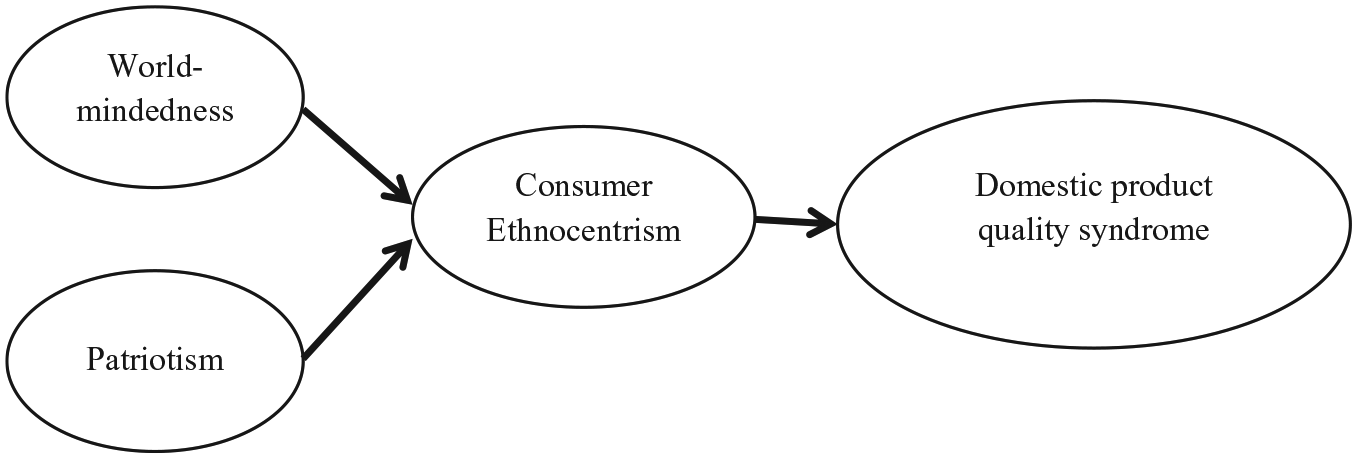
Research conceptual model.
Consumer Ethnocentrism
One of the popular concepts that attract the attention of many scholars is consumer ethnocentrism (Fernández-Ferrín et al., 2020; Feurer et al., 2016; Gammoh et al., 2020; H. M. Lee et al., 2020; Souiden et al., 2018; Yen, 2018). Consumer ethnocentrism was first introduced by Shimp and Sharma in 1987 (John & Brady, 2011). Nevertheless, the concept is not new in sociology because a sociologist, which is Sumner, had introduced ethnocentrism in 1906 (Caruna & Magri, 1996).
Sumner (1906 cited in Bizumic & Duckitt, 2012) defined ethnocentrism as “[a] view in which one’s own group is the center of everything, and all others are scaled and rated in reference to it.” Related to the definition of Sumner (1906), in an international marketing perspective, Shimp and Sharma (1987) defined consumer ethnocentrism as “the beliefs held by the consumers about the appropriateness, indeed morality, of purchasing foreign-made products.”
Consumer ethnocentrism represents the emotional attachment of a consumer to the domestic product (Baker & Michie, 1995; Cilingir & Basfirinci, 2014; Hamin et al., 2014). A consumer with high ethnocentrism will have a high degree of loyalty to the domestic product due to the emotional attachment (Makanyeza & du Toit, 2017). To avoid cognitive dissonance, a consumer with high loyalty to a brand’s product may perceive that the quality of the product is higher than the quality of the similar product of other brands (Solomon, 2012). Thus, consumers with high ethnocentrism may perceive that the quality of the domestic product is higher than the quality of the foreign product even though the objective quality of the products shows different conditions. In other words, consumer ethnocentrism may influence domestic product quality syndrome positively. Based on the explanation, the first hypothesis of this research is formulated as follows:
Patriotism
Patriotism is one of the important topics related to consumer behavior (Edmondson et al., 2020; Yoo & Lee, 2020). In the existing literature, some researchers have different perspectives on patriotism. Some researchers viewed that patriotism is the same concept as nationalism (Vida & Reardon, 2008). Meanwhile, other researchers stated that patriotism is different from nationalism (Balabanis et al., 2001). Some researchers defined patriotism as “love for or devotion to one’s country” (Sharma et al., 1995). The definition is similar to the definition of nationalism (Vida & Reardon, 2008). On the other side, Kosterman and Feshbach (1989) argued that patriotism points to “feelings of attachment to own county,” while nationalism refers to “the view that own country is superior and should be dominant.” The major difference between patriotism and nationalism is that nationalism is “a jingoistic cause of war,” while patriotism is “a healthy national self-concept” (Kosterman & Feshbach, 1989). This research adopted the definition of patriotism that is different from nationalism.
Previous studies had identified that patriotism is one of the critical factors that influence consumer ethnocentrism. Some researchers argued that patriotism is the antecedent variable of consumer ethnocentrism (Shankarmahesh, 2006; Sharma et al., 1995). Furthermore, some studies found that patriotism has a positive impact on consumer ethnocentrism (Balabanis et al., 2001; Deb & Chaudhuri, 2012; Rybina et al., 2010; Sharma et al., 1995; Vida & Reardon, 2008). Based on the explanation, the second hypothesis of this research is formulated as follows:
World-Mindedness
World-mindedness is defined as a person “who favors a world-view of the problems of humanity, whose primary reference group is mankind, rather than national identities” (Topçua & Kaplan, 2015). Based on the definition, world-mindedness is close to “cultural openness” (Shankarmahesh, 2006). Nevertheless, world-mindedness is different from cultural openness (Saffu et al., 2010; Topçua & Kaplan, 2015). World-mindedness refers to a “world-view of humanity’s problems,” while cultural openness represents someone’s openness to other cultures while (Gammoh et al., 2020; Rawwas et al., 1996; Sampson & Smith, 1957; Shankarmahesh, 2006; Skinner, 1988). More clearly, the fundamental concept of world-mindedness is the humanitarian aspect (Skinner, 1988). Therefore, Shankarmahesh (2006) stated that world-mindedness is similar to internationalism.
The causal relationship between world-mindedness and consumer ethnocentrism has been studied by many researchers. Many researchers revealed that world-mindedness is the antecedent of consumer ethnocentrism (Al Ganideh et al., 2012; Shankarmahesh, 2006; Siemieniako et al., 2011). The review study of Shankarmahesh (2006) concluded that world-mindedness has a negative effect on consumer ethnocentrism. Furthermore, some empirical studies found that consumer ethnocentrism is influenced by world-mindedness (Al Ganideh et al., 2012; W. N. Lee et al., 2003). A consumer with high world-mindedness may prefer a foreign product to a domestic product since she or her may feel that a foreign product has a higher standard than a domestic product (Pandey et al., 2019). Hence, the third hypothesis of this research is formulated as follows:
Methodology
Sample
This study used a quantitative research methodology. We conducted a survey to collect data by utilizing a self-administered questionnaire. The survey was conducted in Jakarta, Indonesia. We selected Jakarta due to the capital city of Indonesia. As the capital city of Indonesia, the resident of Jakarta has easy access to buy both Indonesian domestic and foreign products. Furthermore, we selected the participant of the survey who is a consumer electronic product user. The respondent is 18 years old or older. According to Indonesian law, someone who is 18 years old or older can be categorized as adults. The sample of this study is 222 respondents. The sample size is acceptable due to two main reasons. First, the sample size fulfilled the requirement of the analysis method that we used (Hair et al., 2006). Second, the sample size is larger than several previous researches on consumer ethnocentrism, world-mindedness, or patriotism (e.g., Karoui & Khemakhem, 2019; Nijssen & Douglas, 2008, 2011; S. Park & Avery, 2016; Supphellen & Rittenburg, 2001). The demographic profile of the respondents can be seen in Table 1.
The Respondents’ Demographic Profile.

We performed a convenience sampling technique due to several reasons. First, we did not have access to the characteristic information of the research population, which is the consumer electronics product user in Jakarta, Indonesia. Therefore, we could not employ a sampling technique that could truly represent the consumer electronics product user in Jakarta, Indonesia. Second, there are budget and operational limitations. Third, this research aims to test a conceptual model and hypotheses developed based on theory. According to Calder et al. (1981 cited in H. H. Park & Sullivan, 2009), “as long as the study is not intended to provide interval estimates of the mean scores on the scales, a conveniently selected sample is appropriate for theory testing purposes.”
Variables and Measures
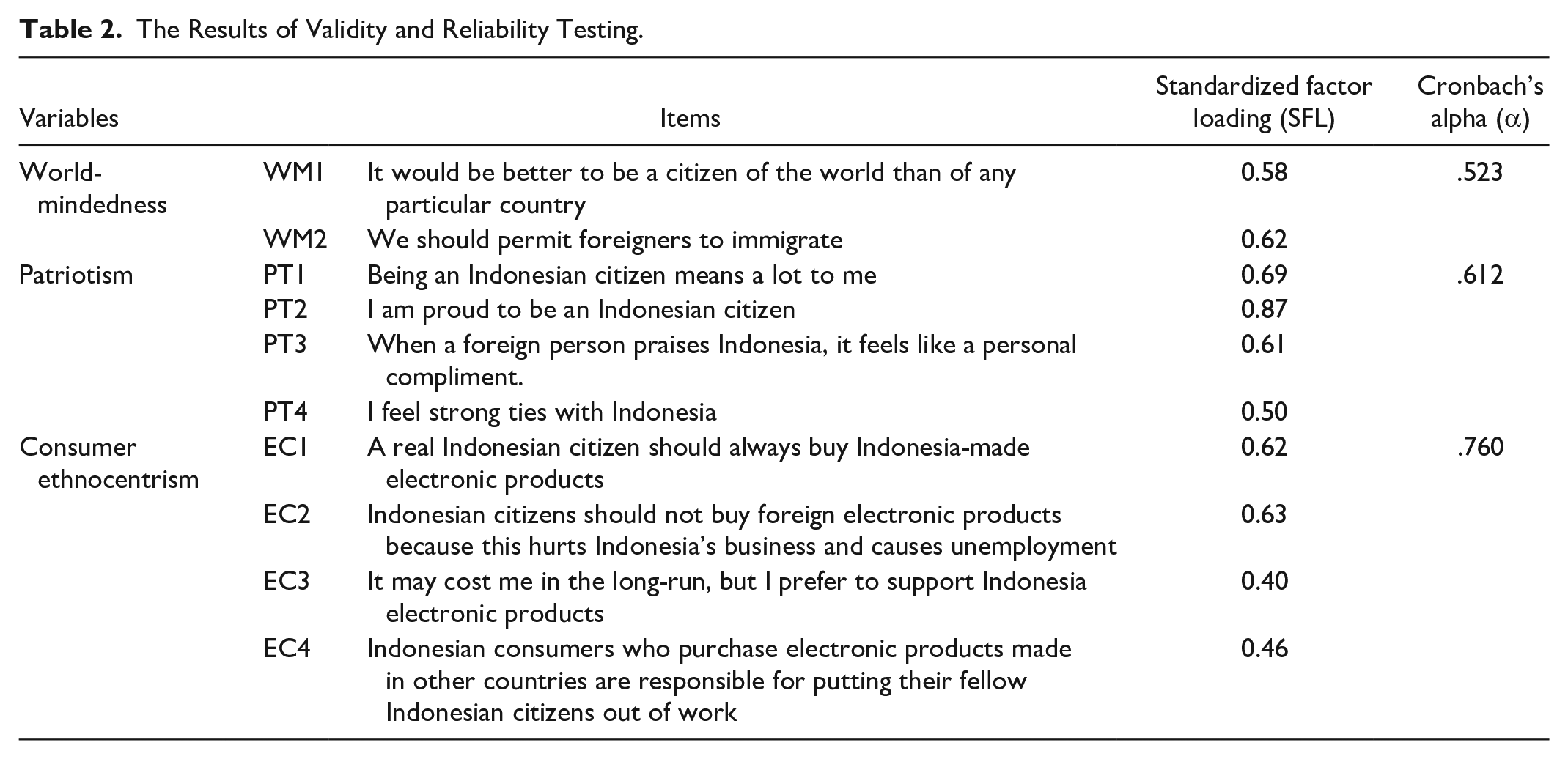
This research involved four variables, namely domestic product quality syndrome, world-mindedness, patriotism, and consumer ethnocentrism. Domestic product quality syndrome was measured using a single indicator, which is the superiority of Indonesian domestic products. World-mindedness was measured by two indicators that are adopted from Rawwas et al. (1996). Patriotism was measured using four indicators based on the study of Rybina et al. (2010). Finally, four indicators of consumer ethnocentrism were adopted from Klein et al. (2006). Table 2 shows the indicators of world-mindedness, patriotism, and consumer ethnocentrism.
The Results of Validity and Reliability Testing.
To tackle the strong brand effect of the foreign cult during the study, we performed two approaches. First, we selected the respondents from various electronic products brand. Second, the indicators of the research variables were designed for evaluating general electronic product rather than a specific electronic product. By using these approaches, we expected that in evaluating the indicators, the respondents will focus on the general product type (domestic versus foreign) rather than the specific brand that they used so that the strong brand effect of a foreign cult brand can be anticipated.
Data Analysis
We performed two stages of analysis. First, we analyzed the measurement model. In this analysis stage, we examined the goodness of fit, construct validity, and reliability of the measurement model. The goodness of fit and construct validity analysis was performed by using confirmatory factor analysis-structural equation modeling (CFA-SEM) technique, while the reliability analysis was conducted by examining the Cronbach’s alpha coefficient. We did not perform exploratory factor analysis (EFA) since our measurement model of the research variables was adopted from the previous research. Furthermore, the research variables are not multidimensional, so that we did not need to perform EFA for identifying the dimension of the variables.
The second stage analysis was aimed to examine the goodness of fit of our conceptual (structural) model and proposed hypotheses. We performed the SEM technique to achieve the analysis objectives.
We selected SEM due to two main reasons. First, the conceptual model of this research involved three types of variables, namely independent variable, intervening variable, and dependent variable. SEM is appropriate for the conceptual model type of this research. Second, we can efficiently test the measurement model goodness of fit and construct validity using SEM. All data analyses were supported by SPSS and Lisrel.
Result and Discussion
Measurement Model Analysis Result
The results of the measurement model’s goodness of fit analysis are presented in Figure 2 and Table 2. From Table 2, it can be concluded that the measurement model has a goodness of fit. The validity and reliability analysis results are presented in Table 3. Table 3 shows that all variables have good construct validity since their standardized factor loading (SFL) value is equal or higher than 0.5, except two indicators (Hair et al., 2006; Malhotra, 2007). We removed the two indicators from the subsequent analysis.

Measurement model analysis results.
The Result of Measurement Model’s Goodness of Fit Testing.

Note. NNFI = non-normed fit index; CFI = comparative fit index; IFI = incremental fit index; RMSEA = root mean square error of approximation.
All variables also fulfill reliability criteria since the Cronbach’s alpha value of all variables are higher than 0.5 (Bassioni et al., 2008; Fu & Juan, 2017; Mehta et al., 2000; Sumaedi et al., 2015; Tari et al., 2007). We used 0.5 as the cut off value of Cronbach’s alpha due to two reasons. First, the indicators we used are obtained from existing literature so that theoretically, the indicators can be used to measure the construct (Agung, 2011; Diamantopoulos et al., 2012). Second, we involved a variable with two indicators. Some researchers argued that the alpha value of 0.5 might be tolerated for a variable with two indicators (Bassioni et al., 2008; Fu & Juan, 2017; Mehta et al., 2000; Sumaedi et al., 2015; Tari et al., 2007).
Structural Model Analysis and Hypotheses Testing Result
Table 4 and Figure 3 show the structural model analysis and hypotheses testing results. From Table 4, it can be concluded that the structural model has a goodness of fit. Thus, we can use our proposed conceptual model to explain the phenomenon of domestic product quality syndrome.
The Result of Structural Model’s Goodness of Fit Testing.

Note. NNFI = non-normed fit index; CFI = comparative fit index; IFI = incremental fit index; RMSEA = root mean square error of approximation.

Structural model analysis results.
From Figure 3, it can be stated that consumer ethnocentrism (β value = 0.68, t value = 6.89) has a positive and significant impact on domestic product quality syndrome. Thus, H1 is supported.
Patriotism (β value = 0.51, t value = 5.23) has a positive and significant impact on consumer ethnocentrism. Therefore, H2 is supported. Figure 3 shows that world-mindedness (β value = -0.15, t value = -1.33) doesn’t have a significant impact on consumer ethnocentrism. Hence, H3 is not supported.
Theoretical Implications
Understanding consumer behavior is a key success factor of a business. Many researchers have investigated consumer behavior related to product evaluation (e.g., Balinsky et al., 1951; Dong & Yun-Tang, 2012; Kumar, 2015; Pandey et al., 2019). Generally, they agreed that consumer’s product evaluation is a complex process.
Related to product evaluation, the phenomenon of domestic product quality syndrome is an important phenomenon that is needed to be studied. However, up to date, there is a lack of researchers that develop and test a conceptual model that can be used to explain the phenomenon. Our research provided the first theoretical contribution by developing and testing a conceptual model related to the phenomenon. Our research result shows that the proposed conceptual model has a good fit. Thus, the model can be used to explain the phenomenon of domestic product quality syndrome.
Our research found that consumer ethnocentrism has a positive and significant impact on domestic product quality syndrome for consumer electronic products. This means consumer with high ethnocentrism will be more likely to have domestic product quality syndrome than a consumer with low ethnocentrism. This research result supported our hypothesis. Furthermore, this finding supports previous researches that found the significant relationship between consumer ethnocentrism and product quality (e.g., Chryssochoidis et al., 2007; Hamin & Elliott, 2006; Huddleston et al., 2001; Pecotich & Rosental, 2001).
Our research also revealed that patriotism influences consumer ethnocentrism positively and significantly. This means that patriotism can increase the level of consumer ethnocentrism. A consumer with high patriotism tends to have high ethnocentrism. This finding is consistent with the finding of previous studies, such as Sharma et al. (1995), Vida and Reardon (2008), Deb and Chaudhuri (2012), and Rybina et al. (2010).
The next finding of this research is the non-significant effect of world-mindedness on consumer ethnocentrism. In the existing literature, there are contrary findings regarding the relationship between world-mindedness and consumer ethnocentrism. While some researchers found a significant impact of world-mindedness on consumer ethnocentrism (e.g., Al Ganideh et al., 2012; W. N. Lee et al., 2003), other researchers failed to find a similar result. Thus, this research supports the previous researches, such as Topçua and Kaplan (2015) and Balabanis et al. (2001), which revealed the non-significant effect of world-mindedness on consumer ethnocentrism.
According to Balabanis et al. (2001), the non-significant effect of world-mindedness on consumer ethnocentrism does not disregard the critical role of world-mindedness. Instead, this finding provides a different perspective that world-minded consumers do not always tend to purchase foreign product and disregard domestic ones. This finding also corresponds to Skinner (1988), which views that the fundamental aspect of world-mindedness is humanitarian. The participant of this research may separate the humanitarian aspect from the economics aspect so that there is no significant impact of world-mindedness on consumer ethnocentrism.
Managerial Implications
This research also provided several practical implications. First, this research found that consumers with high ethnocentrism will likely to have domestic product quality syndrome. Therefore, a company that operates within a country with high consumer ethnocentrism should pursue a strategy that can communicate that the company is a part of the country. Balabanis et al. (2001) suggested that in a high consumer ethnocentrism environment, a company needs to change the symbols of foreign products into the national symbols. Another approach that can be used by a company is involving as much as possible the domestic human resource and another local resource in producing its product. In the context of quality management, a company should establish a quality objective relates to the perceived nationality index of the company and/or the percentage of local content and resource the company has.
Second, this research found that the significant predictor of consumer ethnocentrism is patriotism. This finding can be utilized by a company in two ways. First, the company can use the information on the patriotism level of a country’s citizen as a proxy for the condition of consumer ethnocentrism. Second, the company should align its strategy with the patriotism level of a country’s citizens.
Third, this research found that world-mindedness does not influence consumer ethnocentrism. This finding can be utilized by a company when developing its marketing strategy. The company should be aware that a high world-mindedness consumer may not have a higher preference for foreign products. Given this, a company that operates in a market with high world-mindedness consumers should not overexpose the fact that its product is foreign.
Conclusion and Limitation
This paper aims to develop and test a model that involves consumer ethnocentrism, world-mindedness, patriotism, and domestic product quality syndrome. Our research results show that our model has a good fit. We also found that consumer ethnocentrism has a positive and significant impact on domestic product quality syndrome. Furthermore, we also found that patriotism significantly influences consumer ethnocentrism, while world-mindedness does not significantly affect consumer ethnocentrism.
Nevertheless, this study has generated interesting findings; we admitted that this study has some limitations. First, this research was employed by the cross-sectional study. The convenience sampling technique was applied in selecting the respondent. Second, we conducted this research only in Jakarta. Thus, the findings may be different if the research was performed in another area. Third, the sample size is limited for performing a comparative study, which may be very interesting for managerial implications for making strategy in different market segments. Given this, we recommend replicating this study in another area to test the stability of the research. We also recommend improving the sampling technique in future research. Furthermore, we also recommend improving the sample size and performing demographic variables based comparative study and formulating strategy in different market segments based on the comparative study.
Footnotes
Acknowledgements
Authors would like to thank all the respondents involved in this study. All authors are the main contributor of this paper.
Declaration of Conflicting Interests
The author(s) declared no potential conflicts of interest with respect to the research, authorship, and/or publication of this article.
Funding
The author(s) disclosed receipt of the following financial support for the research, authorship, and/or publication of this article: This study was funded by the annual research project budget (DIPA) of Indonesian Institute of Sciences.
