




Abstract
The paper analyses the scientific research on consumer ethnocentrism using bibliometric analysis from 1958 to 2023 from the Scopus database. The research investigates the evolution of the consumer ethnocentrism studies published to date; prolific authors, journals, research articles, institutions and countries; predominant themes and their evolution; emerging areas through systematic literature review, bibliographic coupling and keyword co-occurrence technique. The results highlight that the year 2022 witnessed the maximum publications; Journal of International Marketing is at the leading position; USA has dominance in publications; the article titled “Domestic Country Bias, Country-of-Origin Effects, and Consumer Ethnocentrism: A Multidimensional Unfolding Approach” by Balabanis and Diamantopoulos has maximum citations; theoretical foundation and measurement, antecedents, moderators, possible outcomes, and emerging areas are the central themes based on keywords. The study reveals the scope of future research on tourism, education, and health sector in cross-cultural settings.
Introduction
Globalization has eased the flow of goods across boundaries, accelerating international trade. Tariff barriers have been reduced, but non-tariff barriers still threaten the smooth flow of global trade (Shankarmahesh, 2006). The nation imposes tariff barriers, while people of the nation construct non-tariff barriers. Consumer Ethnocentrism (CE hereafter) is one such non-tariff barrier. CE is “the beliefs held about the appropriateness, indeed morality, of purchasing foreign-made products” (Shimp & Sharma, 1987, p. 280). It is an extension of the Ethnocentrism construct, defined as “a view of things in which one’s group (referred to as in-group) is the centre of everything, and all others (referred to as out-group) are scaled and rated with reference to it” (Sumner, 1906, p. 13). Looking closely at the concept, ethnocentric consumers have a favourable bias toward the in-group over the out-group. The In-group is its own group of producers from the native country of origin, and the out-group is an outside group of other nations. It is a perception of superiority of one’s group over inferiority of other groups (Sharma et al., 1995; Wall et al., 1972).
In international trade, a fundamental movement is taking place in every continent, wherein the local producers/companies are facing a severe challenge from global competitors. In this case, the high ethnocentric tendencies of consumers will surely help locals to thrive. In both economic and political spheres, ethnocentrism is at its peak, whether it is, former American President Donald Trump’s campaign “Buy American, Hire American” (Phillip, 2021) or incumbent President Biden’s order “Ensuring the Future is Made in All of America by All of America’s Workers” (House, 2021), aimed at supporting local producers/companies. Similarly, in India, the recent announcement on the ban on imports of laptops and computers (ET, 2023) aimed to promote a domestic manufacturing base under the production-linked incentive scheme for IT hardware.
CE has always been a topic of great interest for researchers and practitioners (Watson & Wright, 2000). Since its inception, several studies have analyzed the concept measurement, antecedents, significant themes, theories, consequences, mediators, and moderators (Balabanis & Diamantopoulos, 2004; Bawa, 2004; Camacho et al., 2021; Dimofte et al., 2008; Haque & Maheshwari, 2015; Jia et al., 2023; Mwantu & Tanko, 2016; Nguyen et al., 2022; Shoham & Brenčič, 2003; Vuong & Khanh Giao, 2020; Yousaf et al., 2022).
Therefore, given the diversity of publications over the last—years, it is essential to understand the evolution of the concept to systematize its gaps, major themes, and linkages between authors, countries, and institutions. In order to comprehend the full scope of existing literature, the present study performs bibliometric analysis based on a systematic literature review. To the best of our knowledge, only one study on bibliometric analysis of CE (Baber et al., 2023) that too covered the time frame between 1989 and 2020 only. Thus, the present study will be a pioneer in post-COVID time, performing bibliometric analysis on this topic from its inception in 1955 till 2023 to offer a scholarly view of the scientific contribution related to the topic. The present study will answer the following research questions:
RQ1: What is the trajectory of the evolution of the CE studies published to date?
RQ2: Who are the prolific authors, journals, research articles, institutions, and countries in the field of study?
RQ3: What are the predominant themes and how have they evolved?
RQ4: What are the emerging areas to examine in future?
The study makes two notable contributions to the literature revolving around ethnocentrism. First, it captures all the literature (1958–2023) generated on ethnocentrism, providing the most comprehensive and exhaustive study to date on ethnocentrism, explaining the conceptual structure, and identifying the primary keywords used throughout the journey of ethnocentrism in academic research. Second, it provides a snapshot of the evolution of ethnocentrism research since its start, enabling us to identify the predominant themes of each time and how they have evolved from their fledgling nature to their current solid form. Hence, the present study analysis will provide marketers, academicians, and professionals with a better insight into the state of the art and point out the potential trajectories for the future, taking a deep dive into the predominant and current themes.
Review of Literature
Consumer Ethnocentrism
Sumner (1906) found the first traces of ethnocentrism. According to him, Ethnocentrism is “vision of things in which one’s own group is the centre of everything, and all others are scaled up and evaluated accordingly” (Sumner, 1906, p. 13). Later, (Shimp & Sharma, 1987) appended consumers to ethnocentrism, making it Consumer Ethnocentrism (CE). They are the precursors of this concept who even built a scale for its measurement called CETSCALE. CE indicates “a general proclivity of buyers to shun all imported products, irrespective of their price or quality considerations, due to nationalistic reasons” (Shankarmahesh, 2006, p. 147).
Ethnocentric consumers perceive the purchase of foreign products as unpatriotic and immoral as it hampers the growth of their local economy. They take the import of foreign products not just as an economic threat but also as a cultural threat (Cleveland et al., 2009). However, the results are not similar everywhere; ethnocentric tendencies differ from place to place. For example, Balabanis and Diamantopoulos (2004) point out a low level of ethnocentrism in developing countries, who prefer foreign over national products. Consumption habits of consumers are shifting, and today, marketers are confronted with challenges in the acceptance of their products in abroad.
In the literature, CE was studied with many variables like purchase intention, willingness to buy, attitude toward the foreign brand, and brand image, to mention a few. CE is a complex structure having a multidimensional nature. It has cognitive, affective, and normative domains. The cognitive domain supported the notion that domestic products are superior and foreign products are inferior, while the affective domain stressed the importance of emotions in purchasing the product. Moreover, the normative domain highlights the appropriateness and morality of purchasing domestic products and considers the adverse effects of foreign purchases on national employment and the well-being of people (Vida et al., 2008). However, beyond its multiple dimensions, another debate revolves around its antecedents and outcomes. Furthermore, it has been noticed that consumers differ in their ethnocentric tendencies due to various underlying reasons like the development level of an economy, the economic-political environment, psychological and demographic characteristics.
However, despite the rich literature, the whole theoretical structure is divergent in its results. Therefore, Bibliometric analysis is applied to systematize and contribute a better understanding of the relationships between the studies.
Methodology
The application of statistical techniques helps a researcher to expand his vision of the concept by applying different bibliometric tools (Waltman et al., 2010). The usage of statistical techniques enables a researcher to structure the produced content, generate clusters and maps, identify main keywords and themes between them, prolific authors and institutions, top journals and articles, and to find relationships which cannot be simply seen from content analysis, bridging research gaps. This way, the data can be visualized better to facilitate interpretation (Börner et al., 2003; Waltman et al., 2010).
Systematic Literature Review
Systematic Literature Review (SLR) is a way of synthesizing scientific data to address research problems in a transparent manner. The primary goal is to decrease the possibility of biases and promote transparency at every level by relying on a systematic approach, assessing the quality of the research, and encapsulating it objectively (Liberati et al., 2009).
SLR was performed to generate a database for bibliometric analysis. SLR represents a scientific inquiry, a procedure by which existing literature is collected and summarized to improve understanding and outlying the agendas for future research (Snyder, 2019). SLR produces high transparency, objectivity, rigour, and reproducibility in the data (Tranfield et al., 2003). Scopus, one of the largest databases and also a consistent one for bibliometric analysis was selected (Anees-ur-Rehman et al., 2016; Donthu et al., 2021; Kumar et al., 2021; Wang & Waltman, 2016). All indexed journals in Scopus undergo rigorous evaluation criteria to maintain their quality (Elsevier, 2019). The search strings were: “Consumer ethnocentrism” OR Ethnocentrism OR Ethnocentric. The search was applied in “Article title” and “Keywords.” Next, to filter the articles, the search was limited to the Subject area—Business, Management & Accounting, Social Sciences, Psychology and Arts & Humanities; Document type—Article; Language—English; Source type—Journal; Publication stage—Final. The search was limited to journal articles as in the academic community, such publications are considered the most up-to-date source of knowledge (Rodríguez-López et al., 2020). The search was conducted in August 2023. At last, in exclusion criteria those articles were put whose technical information like author, year or journal name was missing or who had not used Consumer Ethnocentrism or Ethnocentrism as a primary variable in their study. The analysis was carried out using article title, abstract, and introduction. If still, any doubt remains, the entire article was read. Thus, in total 397 articles met both the inclusion and exclusion criteria.
Bibliometric Analysis
Bibliometric analysis is a statistical and mathematical analysis of the published empirical data to examine the themes/patterns in the field of study (De Bellis, 2009). To perform bibliometric analysis, VOSviewer software, version-, Scopus analyze tool, and MS-Excel were used (Van Eck & Waltman, 2010). VOSviewer provides high-quality visualization of many items (Sinkovics, 2016). In VOSviewer, Bibliographic coupling, and Keyword co-occurrence techniques were applied (Callon et al., 1983; Kessler, 1963). Combining these two techniques gives a better interpretation of the results (Åström, 2002; Chang et al., 2015; Leung et al., 2017). In bibliographic coupling, the more references articles share, the more remarkable is their similarity (Donthu et al., 2021; Egghe & Rousseau, 2002). In it, articles form thematic clusters sharing similar references, identifying prominent themes and structure (Jarneving, 2005). The technique uncovers the current topics of positive growth that scholars may take up in future (Donthu et al., 2021). In the keyword co-occurrence technique, the frequency with which the two distinct keywords appear together in the sample is analyzed (Cobo et al., 2011; Nova-Reyes et al., 2020; Rodríguez-López et al., 2020). The analysis of both techniques is shown in network maps, each calculated by measuring the interactions between links and terms (Sepulcri et al., 2020; Waltman et al., 2010). The terms (in our case, articles, keywords, journals, and countries) are represented by the nodes and coloured clusters, where larger nodes represent more relevant terms than smaller ones. The lines indicate the linkages and distance between the nodes, where closer lines indicate stronger relations than distant lines (Sinkovics, 2016; Van Eck & Waltman, 2019).
Results
Figure 1 shows all 397 articles published in the context of Consumer Ethnocentrism/Ethnocentrism from 1958 to August 2023. The data was obtained from the Scopus Analyze Result tool and MS Excel. It is interesting to note that although the concept began early, with the article by Plant (1958), but it was the year 1997 when regular publications started on the topic, probably after the study by Sharma et al. (1995) on the antecedents and the moderators of CE providing a slight push to the body of knowledge. Overall, not much research was seen till 2000. This fact is consistent with our knowledge that before the 1990s, the world was not very open for the international trade and whatever little was done was restricted by tariff barriers. At the advent of the 21st century, ethnocentrism (as a non-tariff barrier) started gaining attention. In the first decade (2001–2010), the concept was slowly evolving, the consistent research gained a pace in 2006 after the publication by Shankarmahesh (2006) on an integrated view of CE.

Publications from 1958 to 2023.Source. The Author.
In 2011, the proliferation of research was seen with more or less 20 publications per year, despite the 2008 economic crisis. The last 5 years have seen a significant upsurge in number of articles published. The reasons could be the explosion of international trade with the ease of protectionist measures around the globe. The highest peak of publications was in 2020, with 47 articles, more than double that of previous years. As world trade increased, research on CE also grew phenomenally. The years following 2020 saw a dip in publications, possibly due to the COVID-19 pandemic and the repercussions afterwards.
Bibliographic Coupling Technique
Table 1 provides the data of the top 10 leading journals publishing articles on CE/Ethnocentrism along with publisher name, ABDC rating, total documents published, and total citations received. The Bibliographic Coupling technique was applied by sources with fractional counting, which gives equal weightage to each publication (Perianes-Rodriguez et al., 2016).The minimum number of source documents is kept at one, and the minimum number of citations is kept at 30. Out of 241 sources, 58 meet the threshold.
Top 10 Leading Journals.

Source. The Author.
The Journal of International Marketing stands out in the list having the most citations (762) with just three publications. The cite score of the journal for the year 2023 (till July) is 7.2 and for 2022 is 9.1. The higher the score, the better it is. Usually, a number greater than one is considered a good citescore. It is the “average number of citations received in the present year and in previous 3 years to all the documents published in the journal, divided by the number of publications in the journal during the same time frame” (Wiki, 2023). Cite score provides a transparent, comprehensive, current insight view of a journal (Elsevier, 2019). In this journal, the maximum citations (381) were received by the article “Cosmopolitanism, Consumer Ethnocentrism, and Materialism: An eight-country study of Antecedents and Outcomes” by Cleveland et al. (2009). This article also holds second place in terms of maximum citations received.
The next on the list is the Journal of the Academy of Marketing Science, having 598 citations for two publications. The cite score for 2023 (July) is 23.2 and for 2022 is 23, the highest in the list. The journal includes the article “Domestic Country Bias, Country-of-Origin Effects, and Consumer Ethnocentrism: A Multidimensional Unfolding Approach” by Balabanis and Diamantopoulos (2004) having the highest number of citations (514) among all published articles on CE/Ethnocentrism ever in the Scopus. The article has an A* rating, the highest in the ABDC quality journal list, making it the most premium journal.
However, it is noticeable that some journals have published fewer articles and nevertheless have received higher citations (e.g., Journal of International Marketing, Journal of the Academy of Marketing Science, and European Journal of Marketing). Interestingly, five articles out of the top 10 are from leading journals, highlighting the relevance and importance of the topic (Figure 2).

Network Visualization of Top Journals.Source. The Author.
Table 2 shows the top 10 countries publishing articles on the CE/Ethnocentrism according to the total citations received. The data was generated using Bibliocoupling for countries along with fractional counting. The minimum number of documents of in a country is kept at five, and the minimum number of citations is kept at 30. Out of 83 countries, 27 meet the threshold.
Top 10 Publishing Countries.

Source. The Author.
The data set reveals that the documents of the USA have been positioned as a knowledge hub with maximum citations (3,797), followed by the UK (1,555), Australia (1,376), and so on. The top cited (514) article was from the UK. Furthermore, six out of the top 10 cited articles are from the USA. seven countries (USA, UK, Canada, Australia, Spain, France, and Slovenia) out of 10 are from the Western part of the world, indicating their major hold on publications. Asian continent spread is limited to China, Turkey, and India. It is worth noting that the research on this field is gaining attention in other parts of the world as well, but to a lesser extent.
India, a developing country, stands in 10th position, leaving a scope for improvement. Through the MAKE IN INDIA initiative, the government must emphasize the quality and standardization of products and marketers, through packaging and labelling of products, must convey that the product is domestically produced and its consumption will surely do add value to addition for the country and its citizens (Shimp & Sharma, 1987). Marketers must try to increase the ethnocentrism level of consumers by advertising the product in such a way that it highlights its consumption benefits for the nation as a whole. As Ethnocentrism is going beyond nationalism, wherein people of similar cultures consider themselves as in-group and the rest as out-group. This in-group mentality could be used to highlight that customers are loyal to their country if they boycott foreign products and if they use them, they betray their own people (Narang, 2016; Supphellen & Grønhaug, 2003)
This way, if Indians recognize the importance of ethnocentrism, it will surely interest researchers to study the phenomenon and publish more on it (Figure 3).
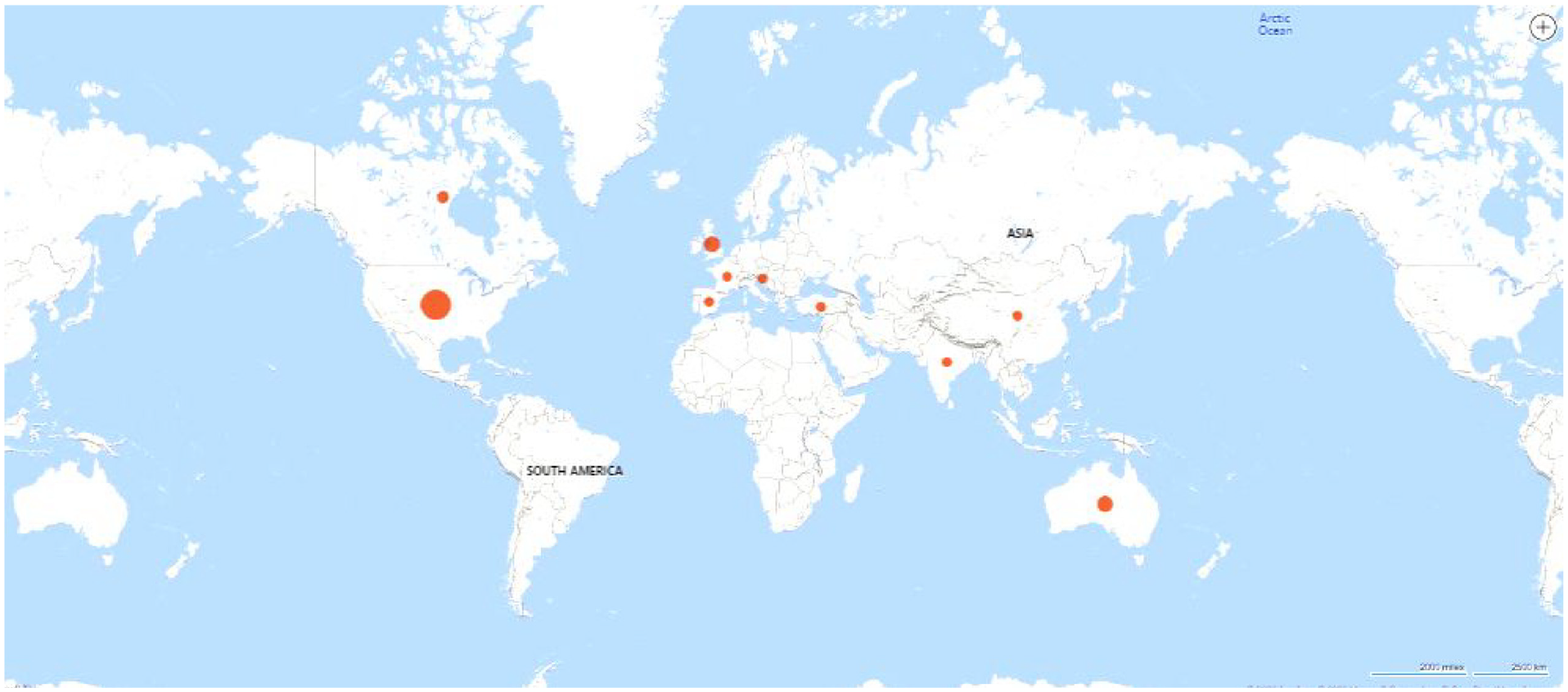
World Map of top 10 Publications.
Table 3 depicts the top 10 published articles in terms of citations along with their author, source and country. The Biblio coupling technique was applied to documents with fractional counting. A minimum number of citations of a documents is kept at 70; out of 397 documents, 28 meet the benchmark. The largest set of connected items consists of 24 items.
Top 10 Published Articles.

Source. The Author.
The top most cited (514) article was “Domestic Country Bias, Country-of-Origin Effects, and Consumer Ethnocentrism: A Multidimensional Unfolding Approach” by Balabanis and Diamantopoulos (2004). The article has maximum citations and is published in one of the premium journals (Journal of the Academy of Marketing Science) with A* rating, also comes from a country (UK) which holds second position in the list of top publishing countries. The article examines the preferences of U.K. people for domestic products and foreign products for eight products. Results indicate that the consumer-biased preference for domestic products is dependent on a particular country of origin and specific product category. A relatively recent article, “Consumer Ethnocentrism, National Identity, and Consumer Cosmopolitanism as Drivers of Consumer Behaviour: A Social Identity Theory Perspective” by Zeugner-Roth et al. (2015), also finds a place in the list with 234 citations.
Among the top authors, the ones who stand out in the knowledge are Balabanis and Diamantopoulos (2004), Cleveland et al. (2009), Hammond and Axelrod (2006), Wang and Chen (2004), and Zeugner-Roth et al. (2015). This is perhaps because they published articles on Domestic Country Bias, Country-of-Origin, Cosmopolitanism, materialism, antecedents, and outcomes and evolution, focusing basics of the concept which has been cited by other researchers in their field of investigation. City University, London and the Department of Marketing, Loughborough University, UK, are the top most active institutions.
In the list, five articles out of 10 find their place in the top 10 leading journals. In addition, six out of 10 are from the USA (the top most publishing country) (Figure 4).

Network Visualization of authors of the top-cited articles.Source. The Author.
Table 4 shows the three most cited studies within each cluster along with its theme. Cluster 1 titled overall conceptualization of CE/Ethnocentrism is formed by six studies. The central authors of the cluster are Zeugner-Roth et al. (2015) and Siamagka and Balabanis (2015). The cluster examined the current structure of CE and an extension of its structural periphery and details its measurement. It proposes that the CE is a multidimensional structure encompassing many dimensions like cognitive, affective and behavioural. It also says that an effectively designed measuring instrument (CETSCALE in most cases) better predicts the results. Though, CETSCALE is considered reliable and valid but in cross-cultural studies, it should be revised accordingly to produce more reliable results. The studies also add that the CE effect doesn’t operate in isolation. Rather, national identity, consumer cosmopolitanism, and sociopsychological traits also add to its influence.
Main Themes of the Clusters.
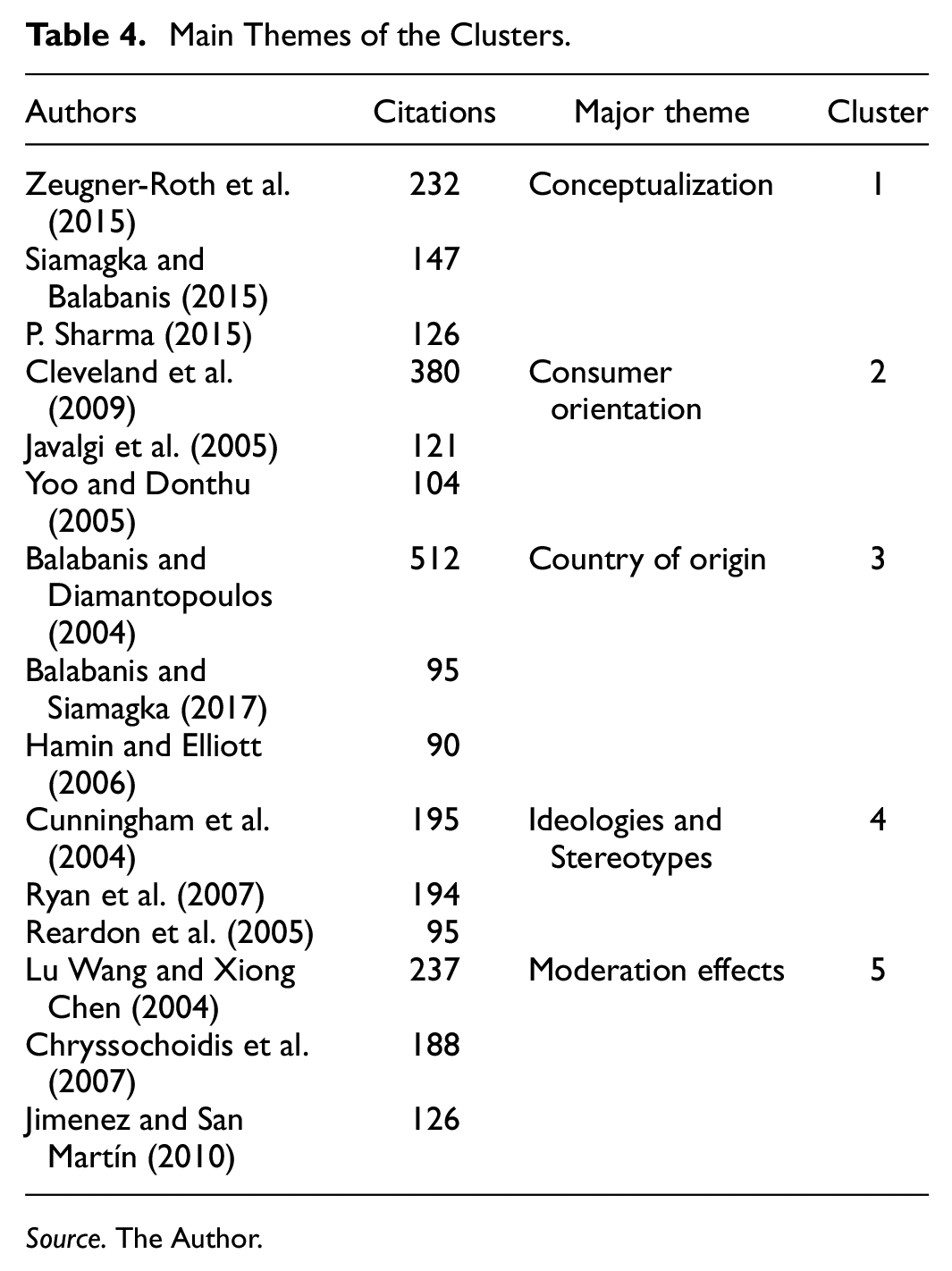
Source. The Author.
Cluster 2 is related to the consumer types and their attitudes toward imports. Cleveland et al. (2009) and Javalgi et al. (2005) are the top most cited authors. The cluster details the consumers’ reluctance to buy foreign goods and the reasons behind it. The reluctance can be attributed to consumer type, consumers’ cultural orientation, etc. The possible traits are collectivism/individualism, masculinity/femineity, uncertainty avoidance, and long-term/short-term orientation. Also, the studies show that a consumer’s willingness to purchase foreign products is affected by the reputation these foreign products have acquired over time. Additionally, the consumer’s attitude toward the purchase of foreign products will be more positive if the product is deemed necessary.
Cluster 3 deals with the studies revolving around the country of origin (COO). Balabanis and Diamantopoulos (2004) and Balabanis and Siamagka (2017) are the top most cited authors. The studies say that consumer business for domestic products depends on the specific COO. In addition, the studies also reveal that the product features/type other than COO may be more effective in neutralizing the negative effects of COO on CE. At last, the COO effect was more studied and more prevalent in more developed countries than in less developed countries.
Cluster 4 deals with the studies revolving around ideologies and stereotypes. Cunningham et al. (2004) and Ryan et al. (2007) are the top most cited authors. The studies portray right-wing ideologies, explicit and implicit prejudice and rigidity in thinking by highlighting that implicit ethnocentrism is distinct from explicit ethnocentrism. Blacks believe in the ideology of endorsing multiculturalism over colourblindness, while the opposite is the case for Whites. Cluster 5 deals with the studies revolving around moderators of CE. Wang and Chen (2004) and Chryssochoidis et al. (2007) are the top most cited authors. The studies reveal the moderating role of quality judgment and conspicuous consumption on the association between CE and willingness to buy local products. The association becomes weaker when a consumer perceives domestic product as of low quality or when a consumer has high conspicuous consumption values. The studies also say that the COO effect also acts as a moderator in several cases but its effect is activated at different levels of CE. Among ethnocentric consumers, the COO effect is activated either at the country-specific level or product-specific level, while among non-ethnocentric consumers, this effect is activated at the attribute-specific level.
Keyword Analysis
To investigate the predominant themes, the Co-occurrence technique was applied to all keywords with Fractional counting (Van Eck & Waltman, 2014). The first analysis was done by dividing the whole data set into three parts: 1958 to 2012, 2013 to 2018, and 2019 to 2023, to facilitate the longitudinal analysis of the evolution. Before 2008 the publications were very less that’s why there are merged and taken together till 2012. Minimum occurrences are kept 3. In the initial phase (1958–2012), out of 448 keywords, 30 meet the threshold. In the mid phase (2013–2018), out of 494 keywords, 36 meet the threshold. In the current phase (2019–2023), out of 565 keywords, 46 meet the threshold. The subsequent analysis was done by taking the whole data together (1958–2023). Out of 4,152 keywords, only those that had occurred at least five times were selected, generating 61 words.
To avoid the distorting of the results and to identify trends and themes more clearly, the main search strings of the study, “Ethnocentrism” and “consumer ethnocentrism”, were removed from the keywords lists. In addition, the refinement is done through a normalization process to homogenize words in singular and plural (human/humans, purchase intention/purchase intentions), words in American versus British English (consumer behaviour/consumer behaviour), and also the words like country of origin/country-of-origin.
In the initial phase, the most discussed areas were COO, consumer behaviour, CETSCALE, ethnicity, and prejudice. Whereas, the emerging fields were animosity, culture, globalization, international marketing and social behaviour. This was the phase when the concept started developing and reached its developed stage by cementing its foothold in the field of research. In the second phase, keywords such as COO, CETSCALE, and Animosity remained same in their foothold, at the same time, purchase intention, racism, nationalism, animosity, and patriotism, culture, cosmopolitanism, diversity, national identity, religion, and social identification came out as emerging areas. In the current phase, the presence of CETSCALE and COO decreased, and more work is done on purchase intention, animosity, perception, consumer behaviour, racism, culture, materialism, nationalism, product judgement, religiosity, and consumer attitude (Figure 5; Tables 5 and 6).

Keyword Cluster.Source. The Author.
Major Keywords of the Three Phases.

Source. The Author.
Major Keywords.

Source. The Author.
Cluster 1 is related to the theoretical foundation and its measurement. The theoretical foundation details how the concept has evolved with its associated variables like Country of origin (COO), CETSCALE, consumer behaviour and consumption behaviour. It includes the definitions of CE /Ethnocentrism and the emergence of the concept. COO, a construct highly intertwined with the CE is the most noticeable (38), indicating its relative significance. The cluster revolves around measuring the influence of ethnocentrism on consumer behaviour and consumption behaviour through the measurement instrument CETSCALE (Shimp & Sharma, 1987). Cluster 2 is related to the antecedents of the CE/Ethnocentrism. Nationalism was examined in 12 studies, perhaps one of the most significant antecedents of the construct. Nationalism is related to outgroup rejection and hostility toward others (Ariely, 2012; Figueiredo & Elkins, 2003) and demonstrates the aggressive side of favourable in-group appraisal (Kosterman & Feshbach, 1989). Also, it symbolizes superiority and domination of one’s nation over others. Next on the list are racism, prejudice and patriotism. Patriotism was also a leading factor in making of ethnocentric tendencies. Patriotism is a strong feeling of love and attachment to our own nation without having any hostility with others (Figueiredo & Elkins, 2003; Mummendey et al., 2001). Patriotic people tend to favour their own nation’s products out of love and commitment to their country (Carvalho et al., 2019). In the literature also, patriotism and nationalism are considered the two antecedents of CE (Balabanis et al., 2001).
Cluster 3 discusses the role of moderators in influencing CE/Ethnocentrism. Gender (male/female) and subjective norms (social identification/social behaviour) were found to be the most contributing moderators in the study. Cluster 4 details the possible outcomes. Influence on purchase intention was measured in 16 studies, making it a major dependent variable. The structural equation modelling (SEM) technique is used in seven studies to test the hypothesis and relationships. Ethnocentric tendencies are used to form the judgement about the product in six studies. Cluster 5 highlights the emerging areas to work on. When the world is speedily moving toward globalization, leading to cosmopolitanism and change in perception, the psychographic traits of a consumer (lifestyles, social groups, etc.) are analyzed deeply. Cultural aspects are given immense importance nowadays in understanding the ethnocentrism phenomenon.
Discussion and Conclusion
The present study uses bibliometric techniques (Biblio coupling, co-occurrence and co-citation) to underpin the conceptual structure and themes. Analysis revealed that CE/ethnocentrism research has been growing consistently, but the most influential research was conducted in the last decade. The year 2020 experienced the greatest number of articles. Journal of International Marketing (762) and Journal of the Academy of Marketing Science (598) were the most cited journals having A and A* ratings. The USA (3,797) and the UK (1,555) were the major contributing countries in the literature, indicating the sizable hold of the West in the publications. Balabanis and Diamantopoulos (2004) and Cleveland et al. (2009) are prolific authors from the UK and Canada. Country Of Origin (38), Cetscale (31), and Consumer Behaviour (21) are the most used keywords in the study. In terms of theories, CE is mostly used with social identity theory (Huang et al., 2008; Negy et al., 2003) and the theory of planned behaviour (Maksan et al., 2019; Miftari et al., 2021; Xin & Seo, 2020). SEM technique has been used for analysis in many studies.
Based on leading documents, Bibliocoupling technique formed four clusters: Conceptualization, Consumer Orientation, Country of origin, Ideologies and Stereotypes, and Moderation effects. These clusters laid down the foundation for future research. The study also examined thematic developments of the concept, based on it, and grouped the keywords into four major themes: Theoretical foundation and Measurement, Antecedents, Moderators, Possible Outcomes, and Emerging areas. Evidently, the initial focus was on theory building and later shifted to emerging areas in the context of globalization.
The study is unique in it that divided the entire time frame into three parts and analyzed the major keywords of each and the evident developments over time. In the initial phase, the most discussed areas were COO, consumer behaviour and CETSCALE; this was when the concept started evolving and creating its solid foundation. The study found that although the concept started early, there remains a scarcity of studies published in its initial years. CE was initially examined on consumer behaviour, later the focus shifted to purchase intention. Transition can be seen in measurement methodology from first-generation tools (Regression, factor analysis) to second-generation tools (CB-SEM and PLS-SEM). As time progressed, methods of examining the relationship between variables also evolved.
In the second phase, surprisingly, the foundation remains unchanged (COO, consumer behaviour and CETSCALE), while keywords such as purchase intention, racism, nationalism, animosity, and patriotism came out as emerging areas. In the current phase, the presence of CETSCALE and COO decreased, and more work was done on purchase intention, animosity, and perception. In a nutshell, Perception, materialism, acculturation, social identity theory, sustainability and xenocentrism are the newly studied areas of the last 4 to 5 years. Racism, nationalism, religiosity, cosmopolitanism, and national identity are the areas of mid-phase on which research continued in the current phase, too, explaining their seminal importance in the field of study.
It is evident that studies on China remained persistent in all three stages, highlighting the role of ethnocentrism in Chinese consumer behaviour. With the rise of China as a superpower, it is perceived as a threat by various global entities (Peerenboom, 2008). Many studies on developing countries (India, Indonesia, Malaysia, Bangladesh, Taiwan, or Turkey) were done around the mid-phase, indicating that ethnocentrism is not just restricted to developed countries; instead, developing countries also started focusing on ethnocentrism before a purchase of a foreign product. The important to notice is the consistent studies on culture in all three periods, explaining that the advent of foreign products in the domestic market leads to cultural dilution, forcing local products to protect their national identity.
In the early phase, the major focus was on analyzing consumer behaviour, with time it gets equally divided on purchase intention and consumer behaviour. Demographic characteristics of consumers have always played a moderating role in influencing the ethnocentric tendencies of a consumer. The impact of ethnocentrism on international trade and marketing is evident from its presence in the initial phase.
The outcomes of the present research in a post-pandemic world disclose the great potential of the topic to be explored more in cross-cultural areas, as most of the existing studies have focused on a single country. In future, the focus from conspicuous consumption (electronics, automobiles) can be diverted to tourism, food, service, education, and health sectors, where little or no focus has been done so far. The impact of ethnocentrism could be checked on the immigration statistics of the area. The impact of ethnocentric tendencies on the CSR (Corporate Social Responsibility) attitude of a firm/individual could be a promising avenue of research. As, marketers usually use the ethnocentrism concept to build their brand image and sometimes take advantage of market segmentation, too. In this regard, the Netnography method could be used to excel in the market.
Overall, it is noticed that the studies primarily focused on theory building, which also seems logical as the field is still in its exploratory stage. Clusters explain how the macro-level factors (political factors, socio-economic factors, historical background, development level) serve as antecedents of the concept, how purchase intention, product judgement, brand image, and perceived quality serve as its outcomes, how demographic profiles (gender, age, income level) of consumers influences their ethnocentrism beliefs, how they moderate the relationship between determinants and outcomes of the CE and finally how the social identity theory explains the phenomenon.
Limitations and Future Scope
There are a few limitations of the study. The search string used in the study was “Consumer ethnocentrism” or Ethnocentrism or Ethnocentric. In future, other related terms, such as CET or its synonyms along with other subject domains, could be used to widen the vistas of research. The present study has taken Scopus database for analysis, in the future other databases (e.g., WoS or Scopus and WoS together) may be used to navigate the topic in a better way. Though the present study scope is limited to academics, the government may institutionalize the concept through a “Buy local, Support local” type strategy for its ground reality check.
Footnotes
Declaration of Conflicting Interests
The author declared no potential conflicts of interest with respect to the research, authorship, and/or publication of this article.
Funding
The author received no financial support for the research, authorship, and/or publication of this article.

Data Availability Statement
Data sharing is not applicable to this article as no datasets were generated or analyzed during the current study.