




Abstract
While academic procrastination has been widely studied, little attention has been given to its occurrence in specific domains such as English listening, which requires sustained cognitive focus and emotional regulation. Moreover, despite growing recognition of the benefits of mindfulness for learners’ emotional and motivational functioning, limited research has explored how mindfulness may mitigate listening procrastination through affective and motivational pathways. This study aimed to examine how mindfulness relates to listening procrastination among Chinese EFL college learners, with English listening anxiety and intrinsic motivation considered as potential mediating factors. A total of 394 EFL students from several universities in China were conveniently selected and administered self-report questionnaires. These participants were undergraduate English majors receiving systematic training in core language skills. Structural equation modeling and mediation analyses were employed to evaluate the proposed relationships. The results indicated that higher degrees of mindfulness and intrinsic motivation were tied to lower levels of listening procrastination and listening anxiety. Conversely, English listening anxiety was positively correlated with listening procrastination. Furthermore, mindfulness positively predicted intrinsic motivation while inversely predicting listening anxiety. The findings demonstrated that both English listening anxiety and intrinsic motivation significantly mediated the relationship between mindfulness and listening procrastination. The implications of these findings are discussed, along with recommendations for future research in this area.
Plain Language Summary
This study explores how mindfulness impacts listening habits among college students in China who are learning English. Specifically, it looks at how mindfulness relates to listening procrastination—putting off listening tasks—and how factors like listening anxiety and motivation play a role in this relationship. Researchers surveyed 394 college students who learn English as a foreign language. They used questionnaires to gather information about students’ mindfulness, listening anxiety, motivation, and their tendency to procrastinate when it comes to listening activities. The findings revealed that students who practiced mindfulness tended to procrastinate less on listening tasks. They also experienced lower levels of anxiety when listening in English. Moreover, those who felt more motivated to learn English were also less likely to procrastinate. On the other hand, higher listening anxiety led to more procrastination. Importantly, the study found that mindfulness helped increase students’ intrinsic motivation, meaning their motivation to learn came from personal interest rather than external pressures. This connection was crucial because it showed that people with higher mindfulness were likely to feel less anxiety about listening, which in turn reduced their tendency to procrastinate. These insights suggest that fostering mindfulness and motivation could benefit college students in their language learning journeys. The researchers encourage further studies to explore these relationships and develop strategies to help students become more engaged and less anxious when learning English
Keywords
Introduction
Academic procrastination—defined as the intentional delay of academic tasks despite awareness of negative consequences (Steel, 2007)—is a pervasive phenomenon in higher education worldwide. Research consistently suggests that approximately 70% of university students regularly engage in procrastination behaviors (Cheng & Xie, 2021; Steel, 2007). Such behavior has been shown to undermine academic performance, disrupt learning continuity, and impair psychological well-being (Gareau et al., 2019; Kim & Seo, 2015). Beyond academic costs, procrastination is closely associated with emotional distress, including anxiety, depression, fear of failure, low self-esteem, and feelings of helplessness (Gadosey et al., 2021; F. Sirois & Pychyl, 2013). These findings highlight procrastination as not merely a time-management issue but a complex self-regulatory failure involving cognitive, emotional, and motivational processes.
Despite extensive research on academic procrastination, its domain-specific manifestations remain underexplored. Most existing studies conceptualize procrastination as a generalized academic behavior, paying limited attention to how it operates within specific learning domains such as foreign language education. This omission is notable because language learning, particularly in foreign language contexts, entails distinctive cognitive and emotional demands, including sustained attention, rapid information processing, repeated practice, and heightened affective involvement (Fallah, 2017; Khabar et al., 2025). Among language skills, English listening is especially demanding due to real-time processing requirements, unfamiliar vocabulary, varied accents, and fast speech rates. These characteristics may increase cognitive load and emotional strain, rendering learners more vulnerable to avoidance and delay. Accordingly, listening procrastination warrants focused investigation as a domain-specific form of academic procrastination shaped by unique linguistic and affective pressures.
In Chinese EFL context, institutional and cultural characteristics may further amplify these challenges. Chinese higher education is often characterized by exam-oriented instruction, strong emphasis on accuracy, and teacher-centered pedagogy (Lin, 2020). Such conditions may prioritize performance outcomes over intrinsic interest, fostering extrinsically regulated learning and heightened evaluation anxiety. Cultural norms emphasizing respect for authority and fear of losing face may also discourage risk-taking in listening and oral tasks, reinforcing avoidance behaviors (Rao, 2002; Wang, 2006). Consequently, Chinese EFL learners may be particularly susceptible to listening anxiety and disengagement, making the examination of listening procrastination in this context both timely and necessary.
Identifying individual difference variables that may alleviate procrastination under these conditions is therefore critical. One such variable is mindfulness, defined as purposeful, present-moment awareness of one’s internal experiences without judgment (Bishop et al., 2004; Kabat-Zinn, 1994). Mindfulness has gained prominence in educational psychology due to its role in enhancing attention regulation, emotional balance, and self-awareness (Brown et al., 2007; Flett et al., 2016). Empirical evidence links mindfulness to improved psychological well-being and adaptive self-regulation, suggesting its potential to counter maladaptive academic behaviors. Emerging research has demonstrated a negative association between mindfulness and procrastination, indicating that mindful individuals are less likely to avoid tasks in response to discomfort or negative emotions (Chambers et al., 2008; F. M. Sirois & Tosti, 2012). However, despite increasing interest in mindfulness within educational settings, its role in foreign language learning—and particularly in listening-related procrastination—remains insufficiently explored. More importantly, prior studies have rarely examined the psychological mechanisms through which mindfulness influences procrastination in affectively demanding language tasks.
In this connection, two variables are especially relevant: English listening anxiety and intrinsic motivation. Listening anxiety has been identified as a salient affective barrier in EFL learning, often interfering with task initiation, persistence, and performance (Balkis & Duru, 2007; Owens & Newbegin, 1997). Learners who experience elevated anxiety may delay or avoid listening tasks as a coping strategy, thereby reinforcing procrastination (Milgram et al., 1995). In contrast, intrinsic motivation—defined as engagement driven by inherent interest and enjoyment—serves as a protective factor that promotes persistence, deep learning, and self-regulation (Deci & Ryan, 2000; Ryan & Deci, 2000). Intrinsically motivated learners are more likely to approach tasks proactively and resist procrastinatory impulses (Steel, 2007). Further, by fostering nonjudgmental awareness, mindfulness can attenuate anxious reactions to listening difficulties while simultaneously supporting autonomous and dynamic engagement with learning tasks (see Fallah et al., 2023; Luberto et al., 2013). However, empirical evidence testing these mediational pathways in EFL listening contexts is currently lacking.
Addressing this gap, the present study examines the relationship between mindfulness and listening procrastination among Chinese EFL university students, with English listening anxiety and intrinsic motivation proposed as mediating variables. By situating procrastination within the specific domain of English listening and integrating emotional and motivational mechanisms, this study advances a more nuanced understanding of self-regulation in foreign language learning. The findings are expected to offer both theoretical insights into domain-specific procrastination and practical implications for pedagogical interventions aimed at fostering mindfulness, reducing listening anxiety, and promoting sustained engagement in EFL listening instruction. To achieve these objectives, the following research questions were formulated:
Are there statistically significant relationships among mindfulness, listening procrastination, listening anxiety, and intrinsic motivation among Chinese EFL learners?
Do listening anxiety and intrinsic motivation mediate the relationship between mindfulness and listening procrastination among Chinese EFL learners?
Review of Literature
Listening Procrastination
Procrastination is a multifaceted cognitive-behavioral pattern marked by the voluntary delay of intended actions despite expecting detrimental consequences (Steel, 2007). As a pervasive phenomenon, it affects approximately one in four adults and influences various domains of life, particularly in educational settings (Ferrari, 1994). Within academia, academic procrastination refers to the irrational delay in initiating or completing essential academic tasks—such as writing papers, preparing for exams, delivering presentations, completing reading assignments, and fulfilling administrative obligations (Ozer et al., 2009). This delay often extends to the last possible moment or beyond the set deadline, sometimes resulting in incomplete or entirely neglected tasks (Dryden, 2000). It is widely regarded as a maladaptive behavior that contributes to diminished academic performance (Kim & Seo, 2015) and heightened experiences of negative emotions, including anxiety, guilt, and shame (Marquina-Luján et al., 2016; Ozer et al., 2009; Taghavi-Nejad et al., 2024).
In the era of language learning, procrastination may manifest in the avoidance or delay of tasks that are cognitively demanding or emotionally uncomfortable, such as speaking, reading, or listening in a second language. These tasks often require sustained attention, effort, and resilience in the face of difficulty or unfamiliarity. Thus, L2 learners may procrastinate on activities such as listening to audio recordings, practicing comprehension exercises, or engaging with authentic spoken materials.
Listening procrastination, in particular, refers to the deliberate postponement or avoidance of listening-related tasks, such as completing assigned listening exercises, practicing listening skills regularly, or preparing for listening assessments. Such procrastination may be driven by feelings of low self-efficacy, fear of failure, or difficulty processing auditory input in real time—factors that are exacerbated when learners perceive their listening ability as weak or feel overwhelmed by fast-paced or accented speech.
Despite extensive research on general academic procrastination, listening procrastination remains markedly underexplored, particularly within foreign language learning contexts. Given the cumulative and skill-dependent nature of listening development, delays in listening practice may be especially detrimental; however, little empirical research has systematically examined the psychological antecedents of listening-specific procrastination. This gap underscores the need for focused investigation into the factors that contribute to listening procrastination among EFL learners.
Foreign Language Listening Anxiety
Foreign language anxiety (FLA) has long been recognized as a key affective variable shaping both the processes and outcomes of second language (L2) learning. As a context-specific form of anxiety, it has attracted sustained scholarly attention since the seminal work of Horwitz et al. (1986), who conceptualized FLA as a distinct psychological construct arising from the unique demands of language learning. Drawing on Control-Value Theory (CVT; Pekrun, 2006), anxiety is viewed as an activating negative achievement emotion that emerges when learners attach high value to a task but perceive limited control over successful performance. In L2 contexts, learners who strongly value English proficiency yet question their own competence are particularly susceptible to FLA. Such anxiety can disrupt attentional focus, hinder memory retrieval, and foster avoidance behaviors, especially during cognitively demanding skills such as listening. Moreover, elevated FLA may raise learners’ affective filter (Krashen, 1982), reducing receptivity to linguistic input and ultimately constraining language acquisition.
However, it is important to recognize that foreign language anxiety may relate to a particular kind of language skill like listening or reading (MacIntyre & Gardner, 1994; Muhammadpour et al., 2025; Thorpe et al., 2025). Recent research has increasingly emphasized the importance of studying skill-specific language anxiety, such as foreign language listening anxiety (FLLA), as a construct distinct from general FLA (Bárkányi & Brash, 2025; Elkhafaifi, 2005; Muhammadpour et al., 2025; Thorpe et al., 2025). FLLA refers particularly to the anxiety learners endure in response to listening comprehension tasks in a foreign language. As Krashen (1985) noted, listening to an FL can be particularly anxiety-provoking due to the ephemeral nature of spoken input and the difficulty of catching every word in real time. Despite this, empirical research on FLLA remains relatively limited. Employing both qualitative and quantitative methods, Kim (2000) uncovered an inverse association between FL listening anxiety and FL listening performance, suggesting that anxiety directly interferes with learners’ ability to process auditory input. In a more recent investigation in Arabic language classrooms, Elkhafaifi (2005) created the Foreign Language Listening Anxiety Scale, adapting it from Saito et al.’s (1999) FL reading anxiety scale. He found that FLLA significantly predicted students’ listening comprehension outcomes, confirming its impact on receptive skill development.
Empirical studies have also shown that FLLA is especially prevalent among Chinese EFL learners, likely due to the high-stakes nature of listening assessments in exam-oriented systems and learners’ limited exposure to authentic spoken English. Liu and Huang (2011), for instance, found that many Chinese university students experienced significant anxiety not only when speaking English but also when trying to comprehend spoken English in academic and test settings. Yan and Horwitz (2008) similarly noted that fear of misunderstanding or missing key information during listening tasks intensified learners’ stress and reduced their confidence. More recently, X. Zhang (2019) reported that language-specific anxieties such as listening anxiety negatively predicted English enjoyment and confidence, while Wang et al. (2021) showed that FLLA contributed to academic disengagement and procrastination among Chinese students.
Although research on foreign language listening anxiety has expanded in recent years, its role in shaping listening-related academic behaviors such as listening procrastination remains insufficiently examined. Moreover, few studies have investigated listening anxiety alongside other key psychological factors, including mindfulness and intrinsic motivation, within an integrated explanatory framework. To address this gap, the present study examines English listening anxiety in conjunction with mindfulness and intrinsic motivation as predictors of listening procrastination among EFL learners.
Intrinsic Motivation in L2 Learning
Intrinsic motivation, rooted in self-determination theory, emphasizes the importance of fostering our natural tendencies to engage in positive and effective behaviors (Deci & Ryan, 1985). This concept reflects an internal drive to engage in activities or pursue goals for their own inherent satisfaction and enjoyment (Deci & Ryan, 1985). As articulated by Ehrman et al. (2003), learners who perceive learning as an end in itself and find tasks both challenging and engaging, tend to experience heightened intrinsic motivation. Research has evidenced that intrinsic motivation is vital for sustaining and promoting academic performance (Dong, 2025; Xu et al., 2021; Zhao et al., 2025).
In context of L2 learning, intrinsic motivation is characterized as the pleasure derived from learning a language just for the sake of it, without any external pressure (Dong, 2025; Jiang et al., 2024; Wu, 2003). Numerous studies, including those by Brown (1994) and Dörnyei (1994, 2001), have examined L2 intrinsic motivation, revealing its predictive capability for factors such as perceived autonomy, competence, persistence, and positive emotional responses toward language learning, while simultaneously correlating with lower levels of anxiety (Ehrman, 1996; Noels et al., 2001).
Recent studies have further illuminated the intricate links between intrinsic motivation and language anxiety, highlighting that intrinsic motivation negatively correlates with anxiety levels (Liu & Huang, 2011; F. Zhang & Wu, 2024). Language learners lacking intrinsic motivation or driven solely by external factors tend to experience substantially higher anxiety levels compared to their intrinsically motivated counterparts (Noels et al., 2001). Similarly, Khodadady and Khajavy (2013) determined that EFL learners with high levels of intrinsic motivation generally express positive attitudes toward their language classes, exhibit satisfaction with their English education, and experience reduced fear in foreign language communication contexts.
Related to the present study, research has documented that intrinsic motivation fulfills a pivotal role in mitigating academic procrastination (Fernández Da Lama & Brenlla, 2023; Howard et al., 2021; Işıkgöz, 2024; Risni & Vitasmoro, 2023; Tisocco & Liporace, 2023). This relationship can be attributed to the fact that those who enjoy high rates of motivation tend to view their coursework as engaging and worthwhile. As a result, they are less inclined to engage in persistent and irrational procrastination regarding their academic responsibilities (Fallah, 2017; Taghavi-Nejad et al., 2024). Işıkgöz (2024) reported that students with a strong intrinsic motivation had not only higher levels of engagement and commitment to learning but also exhibited lower levels of anxiety and procrastination. Similarly, Risni and Vitasmoro (2023) found that intrinsic motivation was a predictor of academic achievement and self-directed learning among learners, establishing a clear link between intrinsic motivation, effective learning strategies, and positive academic outcomes.
However, despite clear evidence linking intrinsic motivation to reduced anxiety and lower levels of general academic procrastination, its specific role in explaining listening-related procrastination in EFL contexts has received limited empirical attention.
Mindfulness
Mindfulness can be defined as a state of enhanced awareness characterized by an individual’s conscious concentration on the present moment, coupled with an impartial and non-reactive stance toward one’s emotions, thoughts, and experiences (Kabat-Zinn, 1994). Mindfulness serves as a psychological attribute that facilitates an individual’s capacity to maintain a mindful state over extended periods. Individuals exhibiting higher levels of dispositional mindfulness often find themselves experiencing states of mindfulness more frequently, with greater intensity and duration. Such individuals demonstrate an enhanced ability to remain anchored in the present moment while observing the dynamism of their thoughts and emotions without resorting to judgment. This practice fosters an accepting and open attitude toward one’s experiences, enabling a deeper understanding of self (Keng et al., 2011).
Research has robustly linked elevated mindfulness skills to an array of positive life outcomes. For example, individuals endowed with superior mindfulness capacities typically report higher degrees of life satisfaction (Henriksson et al., 2016), enhanced overall well-being (Brown et al., 2007; Shapiro et al., 2006), and significantly lower instances of anxiety and depression (Babanoğlu & Atalmış, 2025; Bajaj et al., 2016; Fallah, 2017; Fallah et al., 2023). Furthermore, higher levels of mindfulness correlate positively with more effective self-regulatory behaviors, particularly in achievement-related contexts (Amani et al., 2022; Babanoğlu & Atalmış, 2025; Rui et al., 2025). By embracing mindfulness, learners can engage in self-reflection regarding their educational processes. This self-awareness regarding personal strengths and weaknesses helps students to set more achievable goals, consistently monitor their progress, and modify their strategies as necessary, thus enhancing their overall self-regulation (Brown et al., 2007; Shapiro et al., 2011).
Of particular pertinence to the present investigation is the interplay between mindfulness and procrastination. Research shows that higher ranks of mindfulness correspond with a reduced tendency to procrastinate (Flett et al., 2016). The non-judgmental awareness integral to mindfulness can mitigate the motivational conflicts and feelings of task aversion that often characterize procrastination (Shapiro et al., 2006). Further, individuals who cultivate higher mindfulness levels tend to exhibit greater self-control and are less easily distracted—traits that are frequently associated with the propensity to procrastinate (Schutte & de Bolger, 2020; Taghavi-Nejad et al., 2024). Moreover, research has consistently revealed that self-reported mindfulness levels show an inverse association with various forms of psychological distress and mood disorders (Babanoğlu & Atalmış, 2025; Baer, 2003; Broderick & Metz, 2009; Brown & Ryan, 2003; Fallah, 2017; Fallah et al., 2023; Gilbert & Christopher, 2010; Hofmann et al., 2010; Rui et al., 2025).
Despite the well-documented benefits of mindfulness for emotional regulation and self-regulation, empirical research examining mindfulness within EFL learning—particularly in relation to listening-specific academic behaviors—remains scarce. Little is known about how mindfulness interacts with affective and motivational factors to influence listening procrastination, highlighting the need for targeted investigation in language learning contexts.
The Hypothesized Model
Figure 1 depicts the proposed model based on the aforementioned literature. The diagram indicates anticipated positive relationships between mindfulness and intrinsic motivation, suggesting that as mindfulness increases, so does intrinsic motivation. Additionally, mindfulness is predicted to have an inverse correlation with both listening anxiety and listening procrastination. Furthermore, a positive connection is expected between listening anxiety and listening procrastination, indicating that higher levels of one may lead to increases in the other.
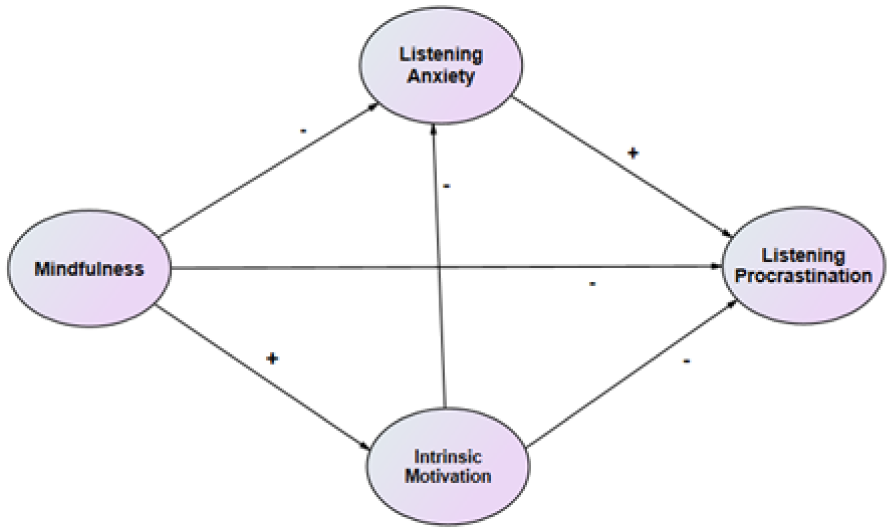
The expected model.
Method
Participants and Procedure
For data collection, a total of 394 university EFL learners were recruited through convenience sampling. Participants’ ages ranged from 18 to 40 years (M = 21.03), comprising 288 females (73.09%) and 106 males (26.90%) (see Table 1). All participants were native speakers of Chinese and majored in English. They were enrolled in undergraduate English programs at several comprehensive universities across China, where English is taught as a major subject within 4-year degree programs. The participants represented typical college EFL learners who receive extensive instruction in language skills, including listening, speaking, reading, and writing, as part of their academic curriculum.
Demographic Characteristics of the Participants.

Note. **p < .01.
In this study, convenience sampling was adopted owing to the accessibility of participants within university English programs and the practicality of obtaining a sufficiently large and diverse sample from multiple intact classes. This approach is widely recognized as appropriate for exploratory structural modeling research in applied linguistics, where random sampling is often infeasible (Fallah, Fatollahi, et al., 2025). Furthermore, deliberate efforts were made to include students from different academic years and proficiency levels to enhance the representativeness and generalizability of the findings.
First, consent was obtained from the English departments and the respective professors. Prior to the administration of the scales, the research objective was communicated to the participants, and they were guaranteed that their involvement would be optional, and their data would be kept confidential and anonymous. Then, the participants completed self-report scales that measured their listening procrastination, mindfulness, intrinsic motivation, and English listening anxiety. The scales were administered in in-person classes, with instructions provided to ensure that participants understood how to complete the scales. The participants also provided demographic information, such as age and gender, on a separate data sheet.
Instrumentation
To collect the necessary data, we utilized modified self-report instruments. While the original questionnaires were in English, this study employed translated versions to enhance response rates among student participants, ensuring greater accessibility and engagement. Using translated and adapted instruments was crucial to ensure semantic and cultural appropriateness for Chinese EFL learners, given that direct English administration could have posed comprehension barriers or cultural bias (Sun et al., 2018).
Chinese editions of the questionnaires were devised by translation and back-translation. Beyond back-translation, additional steps were taken to ensure translation validity: two bilingual experts in applied linguistics independently reviewed the translations for conceptual and linguistic equivalence; a pilot study with 26 students was conducted to check clarity and item relevance; and necessary revisions were made based on participant feedback and expert consensus. These refinements ensured that the items reflected contextually meaningful expressions and experiences related to English listening learning in Chinese classrooms. Reliability and validity of the scales were also examined.
Listening Procrastination
Listening procrastination was assessed using a revised version of Yockey’s (2016) academic procrastination scale. This modified scale is designed to evaluate students’ tendencies to postpone English listening tasks and comprises 6 items (e.g., “Although I am aware that I should engage with audio materials, I frequently delay doing so”), which are scored on a Likert type scale from 1 (strongly disagree) to 6 (strongly agree). The scale proved excellent reliability, with a Cronbach’s alpha value of α = .91.
Mindfulness
The mindfulness of EFL learners was evaluated through a revised form of the Freiburg Mindfulness Inventory (Walach et al., 2006). This inventory embraces 14 statements (e.g., “I am receptive to the experiences of the present moment”) rated on a Likert scale ranging from 1 (strongly disagree) to 6 (strongly agree). The instrument exhibited high reliability, indicated by a Cronbach’s alpha of α = .92.
Intrinsic Motivation
EFL learners’ intrinsic motivation was tested using a modified edition of the Intrinsic Motivation Inventory (Deci & Ryan, 1985), adapted by Chang (2005) specifically for EFL contexts. This scale features 6 items, with responses recorded on a 6-point Likert scale from “strongly disagree” (1) to “strongly agree” (6). The reliability of the scale was satisfactory, with a Cronbach’s alpha of α = .82. An example of an item was, “Learning English is a challenge that I enjoy.”
English Listening Anxiety
For the evaluation of English listening anxiety, the study employed eight items from X. Zhang’s (2013) Foreign Language Listening Anxiety Scale, with a representative example being, “I feel anxious when I’m unsure if I comprehend what I’m hearing in English.” Responses are scored on a Likert scale spanning from strongly disagree (1) to strongly agree (6). The reliability of this scale was confirmed with a Cronbach’s alpha index of α = .86.
Statistical Analysis
To analyze the data, various analyses were conducted. Descriptive analyses were used to obtain initial data characteristics, such as means, minimums, maximums, standard deviations, skewness, and kurtosis measures. Internal consistency reliability estimates were determined using Cronbach’s alpha coefficient to appraise the interconnections between the whole items in the scales. Structural Equation Modeling (SEM) was employed to test the connections between the outcome measure (listening procrastination) and predictor variables (mindfulness, English listening anxiety, and intrinsic motivation). Goodness of fit indices, including chi-square divided by degrees of freedom (χ2/df), Tucker-Lewis Index (TLI), Comparative Fit Index (CFI), Normed Fit Index (NFI), and Root Mean Square Error of Approximation (RMSEA), and Standardized Root Mean Square Residual (SRMR) were considered to appraise the fit of the model.
Results and Discussion
Results
Descriptive Analyses and Validation Metrics
Before initiating the core analysis, the gathered dataset underwent a thorough evaluation to check for essential statistical assumptions, including linearity, normality, outliers, the presence of multicollinearity, and the homogeneity of variance-covariance. All necessary criteria were satisfied. The assessed skewness values ranged from −0.61 to 0.71, while kurtosis values varied between −0.12 and 0.81, indicating that the distributions of the items were within acceptable limits (refer to Tables 2 and 3).
Descriptive Statistics for Listening Procrastination, Listening Anxiety, Mindfulness, and Intrinsic Motivation (n = 394).

Reliability and Validity Measures.

Note. CR = composite reliability; AVE = Average Variance Extracted.
Additionally, the measurement models were scrutinized for composite reliability (CR) and average variance extracted (AVE) to verify convergent validity. Building on the criteria set by Fornell and Larcker (1981), both AVE and CR were confirmed to exceed the thresholds of 0.5 and 0.7, respectively. Furthermore, discriminant validity was established, as demonstrated by the square root of AVE surpassing the intercorrelations among the variables (Hair et al., 2009). The findings provided substantial support for both discriminant and convergent validity, as shown in Table 4, and also highlighted significant interrelations among the variables, as detailed in Table 3. This comprehensive analysis underscores the robustness of the measurement framework applied in this research.
Correlation Measures Among the Variables (n = 394).

Note. **p < .01.
SEM Analysis
To achieve the primary objectives outlined, SEM using maximum likelihood estimation was utilized via AMOS 22. This analytical approach allows for the examination of the interaction of multiple variables simultaneously, enabling a comprehensive understanding of the relationships among them. In this analysis, we aimed to explore how mindfulness, intrinsic motivation, and listening anxiety collectively influence listening procrastination. Additionally, SEM provides robust goodness-of-fit measures that help validate the proposed model, thereby ensuring the reliability of findings.
The hypothetical model was examined and the given measures of goodness-of-fit were satisfactory, with TLI = 0.94, CFI = 0.96, NFI = 0.95, RMSEA = 0.05, SRMR = 0.02, and χ2/df = 1.98 (Table 5). The output of the modified model illustrated that mindfulness positively accounted for intrinsic motivation (β = .61, p < .01), while inversely predicted listening anxiety (β = −.18, p < .01) and listening procrastination (β = −.14, p < .01). Furthermore, listening anxiety significantly predicted listening procrastination (β = .54, p < .01). Intrinsic motivation inversely predicted listening anxiety (β = −.21, p < .01) and listening procrastination (β = −.16, p < .01) The schematic representation of the model including the path coefficients is given in Figure 2.
Modification Measures in the SM Model.


The final model.
Mediation Analyses
To test the mediating influences of intrinsic motivation and listening anxiety on the mindfulness—listening procrastination link, PROCESS macro was run (Hayes, 2013). This method is advantageous for identifying the mechanisms through which a predictor variable, such as mindfulness, potentially relates to an outcome variable, which in this case is listening procrastination. The mediation analysis allows us to determine if intrinsic motivation and anxiety serve as significant mediators in this relationship, thus enriching our understanding of the underlying processes involved. Such insights are valuable for developing targeted interventions and enhancing our theoretical frameworks.
The analysis output showed that listening anxiety (a = −0.23, SE = 0.03, 95% CI [−0.29, −0.16]) and intrinsic motivation (a = −0.07, SE = 0.02, CI [−0.08, −0.01]) could significantly mediate the influence of mindfulness on listening procrastination as no zero value was found in the related confidence intervals (Table 6).
Estimates of the Mediating Effects.
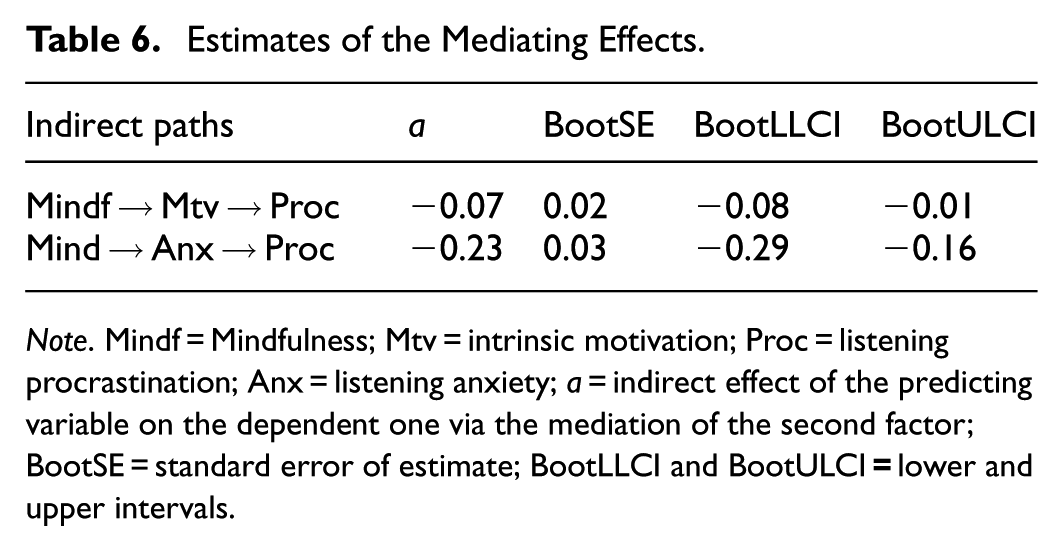
Note. Mindf = Mindfulness; Mtv = intrinsic motivation; Proc = listening procrastination; Anx = listening anxiety; a = indirect effect of the predicting variable on the dependent one via the mediation of the second factor; BootSE = standard error of estimate; BootLLCI and BootULCI
Discussion
As mentioned before, this study focused on testing the connections among mindfulness, English listening anxiety, intrinsic motivation, and listening procrastination in college English learners. Additionally, the research assessed the indirect link between mindfulness and listening procrastination. The reported fit indications showed that the model was a good match for the data from college-level EFL learners in China. Although the hypothesized model assumes a directional path from mindfulness to listening procrastination through motivational and affective mechanisms, it is also plausible that these variables influence one another reciprocally. For instance, repeated procrastinatory behaviors might gradually weaken learners’ mindfulness by fostering habitual avoidance and self-doubt, while reduced mindfulness could in turn increase the tendency to procrastinate. Such bidirectional dynamics cannot be fully captured through the cross-sectional SEM design employed in the present study, and the findings should therefore be interpreted as correlational rather than strictly causal. Nevertheless, these outcomes resonate with previous conceptual and empirical findings in educational psychology that emphasize the interdependence of attention, emotion, and motivation in shaping learning behavior (e.g., Pekrun, 2006; Zimmerman, 2008).
The output of SEM analysis indicated that mindfulness positively accounted for intrinsic motivation. Mindfulness and intrinsic motivation were also significantly and negatively associated with English listening anxiety and listening procrastination; that is, higher rates of mindfulness and intrinsic motivation were associated with lower levels of listening-related anxiety and procrastination. English listening anxiety could positively predict listening procrastination. Additional findings revealed that mindfulness had an indirect connection to listening procrastination, mediated by English listening anxiety and intrinsic motivation. This suggests that both listening anxiety and intrinsic motivation partially influenced the relationship between mindfulness and listening procrastination. These results align with past empirical and theoretical research, although such investigations are limited in the field of education and represent a novel approach within the context of foreign/second language listening.
Mindfulness and English Listening Anxiety
The results regarding the link between mindfulness and English listening anxiety corroborate previous studies that identified negative correlations between mindfulness and distress in both general education and foreign language contexts (e.g., Brannon, 2010; Brown & Ryan, 2003; Burton et al., 2013; Fallah, 2017; Fallah et al., 2023; Taghavi-Nejad et al., 2024). Mindfulness is the conscious awareness of thoughts, emotions, and experiences in the present moment with no judgment (e.g., Brown & Ryan, 2003; Kabat-Zinn, 1994). In contrast, elevated anxiety mainly leads to increasing self-consciousness, judgment, and preoccupation with oneself (Burton et al., 2013). Besides, greater mindfulness may enhance emotional regulation skills (Brown et al., 2007), potentially alleviating the negative feelings that EFL learners experience during listening tasks. This can also be understood in the context of mindfulness reducing rumination (Coffey et al., 2010), which is linked to anxiety and depression, characterized by persistent negative thoughts over the past or future (Nolen-Hoeksema, 2000). EFL learners facing anxiety during listening activities—like tests, comprehension exercises, or class instructions—might ruminate on fears of failure or misunderstanding, which disrupts their listening ability. However, by practicing mindfulness, learners may focus more effectively on their listening performance and be less distracted by their comprehension errors (see Brannon, 2010; Kabat-Zinn et al., 1992), leading to reduced anxiety. Thus, when fully present in the moment, college English learners can maintain better concentration on listening tasks and let go of troubling thoughts, resulting in a calmer mental state. In the Chinese context, where evaluative pressure and fear of losing face are prevalent, mindfulness may provide students with an alternative emotional framework—encouraging acceptance and balance instead of self-criticism and comparison—thereby mitigating anxiety more effectively.
Mindfulness and Listening Procrastination
The finding that mindfulness inversely predicts listening procrastination among college English learners in China is consistent with those of earlier research investigating the interplay between these constructs across various educational contexts. For instance, Cheung and Ng (2019) reported that higher mindfulness was significantly related to lower tendencies toward academic procrastination among college students in Hong Kong. Similarly, Soleimani-Rad et al. (2023) found that mindfulness could effectively reduce procrastinatory behaviors among language learners, thereby enhancing their self-regulation and academic functioning. In addition, research (e.g., F. M. Sirois & Tosti, 2012) has accentuated the salubrious role of mindfulness in decreasing procrastination by promoting adaptive emotional and cognitive processes.
As plausible explanations, first, mindfulness, characterized by purposeful attention to the present moment and non-judgmental awareness of internal experiences (Kabat-Zinn, 2003), enhances metacognitive awareness and emotional regulation. Learners who are more mindful are better equipped to notice task-avoidant tendencies or anxiety-provoking thoughts (e.g., fear of failure in understanding spoken English, test-related listening stress), and instead of reacting impulsively or escaping into listening procrastination (e.g., putting off listening practice, skipping comprehension homework), they are more likely to accept these thoughts without judgment and redirect their focus toward constructive action. Second, in the context of EFL listening, where performance expectations and test-driven curricula may heighten stress and disengagement (see Krashen, 1982), mindfulness may serve as a crucial internal buffer. It helps learners develop a more compassionate and less reactive relationship with listening-related challenges. This shift in mindset can significantly reduce the avoidance cycles that characterize listening procrastination and increase learners’ willingness to persist through difficulty. Such an effect might be particularly salient in China, where academic competition and institutional emphasis on achievement can amplify avoidance tendencies; mindfulness thus offers a culturally adaptive way to manage performance-related strain.
Mindfulness and Intrinsic Motivation
The finding that mindfulness positively predicts intrinsic motivation among EFL learners in China aligns with a growing body of empirical literature emphasizing the beneficial impact of mindfulness on motivational processes in educational contexts. Specifically, this result is in compliance with the findings of Ruffault et al. (2016), who demonstrated that higher levels of mindfulness are connected to more self-determined kinds of motivation in athletes, a pattern that extends to academic settings. Similarly, Ryan et al. (2021), building upon self-determination theory, argued that mindfulness enhances individuals’ capacity to participate in activities for their genuine pleasure, a defining feature of intrinsic motivation. In the context of Chinese learners, Li et al. (2023) provided more evidence by demonstrating that mindfulness interventions significantly enhanced students’ intrinsic learning motivation, academic engagement, and emotional resilience.
Theoretically, this connection can be explained through several interrelated mechanisms. First, mindfulness fosters non-judgmental acceptance and present-moment awareness, which allows learners to disengage from performance-related anxiety and external evaluative pressures (see Brown & Ryan, 2003). This shift enables them to reconnect with the inherent joy and satisfaction derived from the learning process itself, rather than focusing on extrinsic rewards or fears of failure. Second, mindfulness enhances self-regulation and attentional control, both of which are critical for sustaining engagement in activities that are intrinsically motivating. When learners are more attuned to their internal experiences and values, they are more likely to pursue learning goals that resonate with their own interests and personal growth, aligning with the core tenets of SDT. In a collectivist educational culture such as China’s, where conformity and external evaluation are often emphasized (see Lin, 2020), mindfulness may help learners internalize motivation by promoting autonomy and personal meaning within an otherwise externally driven learning environment.
Intrinsic Motivation and Listening Procrastination
The results showed that intrinsic motivation was negatively associated with listening procrastination. This result aligns with research suggesting that those who are intrinsically motivated are less likely to delay language learning tasks, including those related to listening (Kim & Seo, 2015). Intrinsic motivation, represented by a genuine interest in and enjoyment of the learning process, fosters sustained engagement and a sense of personal relevance in academic activities (Deci & Ryan, 2000). When students learn out of inherent curiosity or personal satisfaction—rather than external pressures—they tend to adopt more proactive and self-regulated learning behaviors, which reduces the likelihood of postponing listening practice or comprehension tasks (Steel, 2007). Therefore, it is plausible that Chinese college EFL learners who found English listening intrinsically rewarding were more engaged, better able to manage their time, and less inclined to delay their listening skill development. This relationship might be moderated by the broader educational context, as intrinsic motivation can be harder to cultivate in systems emphasizing competition and standardized assessment, highlighting the importance of fostering autonomy-supportive classroom practices.
Intrinsic Motivation and English Listening Anxiety
The present study showed that intrinsic motivation significantly and inversely predicted listening anxiety among Chinese university EFL students. This result is in line with prior research indicating inverse relationships between intrinsic motivation and anxiety in educational contexts (Dewaele & MacIntyre, 2014).
This finding suggests that students who engage in English listening practice out of inherent interest, enjoyment, and internal satisfaction are less probable to endure anxiety in listening comprehension tasks. This result is in keeping with SDT (Deci & Ryan, 1985, 2000), which postulate that intrinsic motivation—derived from autonomy, competence, and relatedness—enhances well-being and reduces psychological distress. When learners are intrinsically motivated, they are more probable to perceive listening in English as a personally meaningful and enjoyable experience, which can buffer them against negative emotional states such as anxiety. Furthermore, intrinsic motivation fosters a growth mindset and mastery-oriented goals, which encourage students to view listening mistakes and challenges as part of the learning process rather than as threats to self-worth—thereby alleviating listening anxiety (Dörnyei, 2009). Given the collectivist orientation of Chinese classrooms and the prominence of social comparison, intrinsic motivation may protect students from evaluative fears and help them view errors as opportunities rather than sources of shame.
English Listening Anxiety and Listening Procrastination
The present investigation revealed a significant positive relationship between English listening anxiety and listening procrastination among Chinese university EFL learners. This finding is in accordance with research emphasizing the detrimental role of anxiety in academic self-regulation and time management (e.g., Onwuegbuzie, 2004; F. Sirois & Pychyl, 2013). Listening in a foreign language is inherently stressful for many students, and heightened listening anxiety can lead learners to delay engagement with listening-focused tasks as a maladaptive coping mechanism (Zhang et al., 2022). This finding is also consistent with CVT (Pekrun, 2006), which posits that negative activating emotions such as anxiety can undermine task engagement when learners perceive low control over learning outcomes. In the case of English listening tasks, linguistic insecurity and fear of miscomprehension may erode perceived control and prompt listening procrastination. This tendency may be amplified in Chinese classrooms, where the strong emphasis on correctness and exam performance increases sensitivity to errors and fuels avoidance behaviors.
Mediating Effects of Intrinsic Motivation and English Listening Anxiety
The results demonstrated that mindfulness was indirectly linked with listening procrastination via the mediation of English listening anxiety and intrinsic motivation. Specifically, higher amount of mindfulness was related to lower listening anxiety and higher intrinsic motivation, which in turn predicted lower levels of listening procrastination. These findings underscore the significance of affective and motivational pathways in understanding how mindfulness influences self-regulation and academic behavior in language learners, especially within the domain of English listening.
The partial mediation suggests that while mindfulness may exert a direct influence on reducing listening procrastination, its effects are significantly channeled through its capacity to reduce emotional barriers (i.e., English listening anxiety) and enhance internal motivational resources. This supports a control-value theory perspective (Pekrun, 2006), which posits that emotions and motivation co-function to influence learners’ self-regulation strategies and performance in specific language skills such as listening.
These findings have practical implications for language education. Interventions that foster mindfulness—such as brief in-class mindfulness exercises or self-reflective practices—may contribute to reducing listening procrastination not merely by addressing behavior directly, but by modulating students’ emotional and motivational orientations. This is particularly relevant in high-stakes EFL listening contexts such as China, where learners often experience significant academic pressure.
Conclusion
This study has contributed to a deeper understanding of the complex interplay between mindfulness, English listening anxiety, intrinsic motivation, and listening procrastination among college English learners in China. The findings underscore the significance of mindfulness in fostering intrinsic motivation while simultaneously mitigating English listening anxiety and listening procrastination. The positive connection between mindfulness and intrinsic motivation, coupled with the negative associations of mindfulness and intrinsic motivation with both listening anxiety and listening procrastination, highlights the potential for mindfulness-based interventions in L2 listening classrooms. At the same time, these relationships should be interpreted within clearly defined contextual boundaries, as they are embedded in China’s distinctive academic culture, where institutional and societal pressures may amplify anxiety and dampen intrinsic motivation, thus shaping how mindfulness exerts its regulatory effects.
The implications of these findings are multifaceted. Theoretically, this research aligns with SDT (Deci & Ryan, 2000), which postulates that intrinsic motivation is crucial for optimal learning and engagement. By demonstrating how mindfulness enhances intrinsic motivation and reduces skill-specific anxiety related to listening tasks, this study extends the understanding of motivational dynamics within L2 listening development. Moreover, by situating these relationships within the Chinese cultural and institutional framework, it underscores the context-sensitive nature of mindfulness effects rather than their universal applicability, suggesting that variations may emerge across educational systems characterized by different motivational climates and assessment practices. Additionally, it contributes to the emerging body of research on the role of mindfulness in educational psychology (Dunning et al., 2019), particularly within language skill-specific domains that have received comparatively less empirical attention.
Practically, educators and curriculum developers can benefit from integrating mindfulness practices into language learning settings. For example, implementing brief mindfulness exercises, such as guided meditations or mindfulness breathing techniques at the start of each class, can help establish a conducive learning environment that enhances students’ focus and emotional regulation (Keng et al., 2011). These practices may be particularly beneficial in reducing anticipatory anxiety before listening tasks, which is a common barrier to effective comprehension. Teachers could, for instance, begin listening sessions with a 2-min breathing exercise encouraging students to notice sounds and bodily sensations, thereby grounding their attention before the listening activity begins. Mindful listening tasks—where students consciously focus on tone, rhythm, and pauses without judging their comprehension—could also help develop both attentional control and self-compassion during difficult exercises.
Beyond mindfulness interventions, motivational strategies are equally important. Teachers can strengthen intrinsic motivation by creating autonomy-supportive environments—for example, offering choices in listening materials (e.g., podcasts, interviews, or dialogues relevant to students’ interests), integrating reflective listening journals where learners express personal reactions to content, and providing competence-building feedback that emphasizes effort and progress rather than comparison. Pairing mindfulness with such motivational techniques can cultivate sustained engagement and reduce avoidance behaviors such as procrastination. Furthermore, promoting intrinsic motivation through autonomy-supportive teaching—such as allowing students to select listening topics, engage in interactive listening activities, or work on projects aligned with personal interests—can foster a stronger sense of ownership over learning processes (Reeve, 2016). In exam-oriented EFL contexts such as China, these combined approaches may help buffer the effects of evaluative pressure by supporting emotional regulation and self-determined engagement.
Despite these contributions, the study has several limitations that warrant cautious interpretation of the findings. First, the cross-sectional research design precludes causal inferences and limits conclusions about the directionality of relationships among mindfulness, intrinsic motivation, listening anxiety, and listening procrastination. Second, the reliance on convenience sampling from a single national context may constrain the representativeness of the sample and reduce external validity. Third, the exclusive use of self-report instruments raises the possibility of common method variance and social desirability bias, potentially inflating associations among key constructs. Taken together, these methodological constraints suggest that the results should be viewed as associative rather than causal and context-specific rather than universally generalizable.
Future research could address these limitations by employing more diverse methodologies, including qualitative approaches, behavioral measures of procrastination, or teacher-reported indicators of engagement. Longitudinal or experimental designs are also recommended to examine temporal and reciprocal pathways among mindfulness, motivation, and anxiety, thereby clarifying how these constructs dynamically influence one another over time. Further studies might explore additional mediating mechanisms—such as listening self-efficacy or goal orientations—to deepen understanding of the processes linking mindfulness to listening outcomes. Comparative investigations across cultural and institutional contexts are particularly encouraged, as they would help delineate the boundaries of generalizability and identify contextual moderators such as assessment intensity, instructional style, and sociocultural learning norms.
In conclusion, this research highlights the pivotal role of mindfulness in shaping motivational and emotional processes underlying English listening development. By demonstrating how mindfulness, intrinsic motivation, and listening anxiety jointly relate to listening procrastination, the study reinforces the value of holistic pedagogical approaches that address both cognitive and affective dimensions of language learning. While the findings are most directly applicable to Chinese college EFL settings, they offer theoretically informative insights that may inspire contextually adapted interventions in other EFL environments. Continued cross-cultural and longitudinal research will be essential for strengthening the theoretical robustness and practical transferability of mindfulness-based approaches in language education.
Footnotes
Acknowledgements
We would like to thank all EFL learners, teachers, and heads of academic departments for their warm cooperation during the data collection phase.

Ethical Considerations
The study procedures were approved by the review board of Xuchang Vocational Technical College (approval number: 2024-4324).
Consent to Participate
Informed consent was obtained from the participating EFL learners.
Funding
The author received no financial support for the research, authorship, and/or publication of this article.
Declaration of Conflicting Interests
The author declared no potential conflicts of interest with respect to the research, authorship, and/or publication of this article.
Data Availability Statement
The dataset of the current study is available from the corresponding author* on reasonable request.