



Abstract
The current study aimed to investigate the underlying effects of short-term traveling abroad on relieving social anxiety disorder (SAD) and improving English listening skills based on students’ perspectives. The study examined the effects of two independent variables: (1) the duration of traveling abroad and (2) the type of listening sources. Mixed-method approaches with a purposive sample were used consisting of 112 students with (SAD) majoring in English at Qassim University, Saudi Arabia. All participants enrolled in the fall 2018 semester and had traveled abroad to an English-speaking country for a period ranging from 1 to 8 weeks. Surveys were distributed, and five participants were semi-structurally interviewed. The study found that: (1) with alpha set at (α ≤ .05), traveling abroad was a significant factor in relieving the (SAD), and statistically significant differences were observed for the duration of travel abroad for those who stayed abroad longer; (2) there were three effective listening sources on relieving the (SAD) during traveling abroad: (a) living with a host family or a roommate, (b) solo listening to TV channels or movies, and (c) social gatherings and events; and (3) formal listening situations such as the ones occurred at banks, airports and police stations, were the most confusing and least effective. In addition, for the variation of the effective listening sources, one-way ANOVA was used, and the results showed no statistically significant differences. More traveling or study abroad opportunities should be encouraged as the study opens doors for further academic investigations.
Introduction
Social anxiety disorder (SAD), also known as social phobia, is a mental disorder that is rapidly increasing. It is characterized by fear and isolation from social situations and events (Lancu et al., 2015). According to the World Health Organization (2021), there are more than 264 million people worldwide who suffer from a type of anxiety disorder. In addition, it has been found that males and females are equally affected by anxiety disorder with females’ number being slightly higher. Although SAD is not yet considered a disability, it causes severe impairments in different aspects of life, learning, and achievements. It has been called “the illness of lost opportunity” (Stein & Gorman, 2001).
At the main time and in the last decade, traveling abroad and visiting other countries during schools’ breaks and summer vacations for varying periods and reasons has become a common habit for many people and students around the world. The Saudi Tourism Information and Research Centre (MAS), for instance, reported that tourists traveling abroad in the summer of 2018 reached more than 16 million and that the number of tourist flights departing outside the kingdom during the summer of 2018 was 9.4 million (MAS, 2019). However, during travel abroad, English has been the major global language of communication as it has become one of the few enduring facts of modern life with more than 450 million people who speak English as a first language and varying between 500 million to over a billion of non-native English speakers (Abramova et al., 2013).
During traveling abroad, EFL students often have a wide range of opportunities for direct contact with native speakers, which makes the need for meaningful communication a necessity. Moreover, this opportunity to communicate and exchange allows them to immerse and enjoy practicing English freely, and listen to different accents from diversified sources used in many different places and situations without the fear of teachers’ eyes or the pressure of a watcher (Al-Faisal & Jamal, 2004; LaTorre, 2011; Stone & Petrick, 2013).
However, although students often tend to listen more than speak to various sources while traveling abroad, some of those students have a sort of social anxiety disorder which makes the situation more complicated. Social anxiety disorder usually leads to avoidance of people and social events which would for sure affect daily routines, relationships, and other activities. The current study aimed to investigate the impact of short-term traveling abroad for students with a social anxiety disorder (SAD) on improving their English listening skills.
Theoretical Framework
To frame the impact of traveling abroad on listening skills, the social constructivist theory by Vygotsky (1978), a pioneer of sociocultural theory, and Kolb’s (Model of Experiential Learning) was implemented. The theory focuses on the important and interplaying roles between an individual and the social environment in developing humans’ linguistic and intellectual aspects. In the constructive model, Vygotsky explained how individuals are greatly influenced by interactions with their surroundings and social life. Listening and speaking skills, for example, are among the most critical and influential skills. In his theory, Vygotsky (1978) outlined three main concepts which are related to the current study: (1) learning and progress happen only with the interaction in real-life situations with others, or what he termed “more knowledgeable others”; (2) individuals learn and develop their skills based on their roles and situations in the community; and (3) language is the root of culture and environment.
Furthermore, the current study adopted Kolb’s (1984) model, known as the Experiential Learning Cycle, as a framework for the study. Kolb’s model is extensively used in current educational studies (Kim, 2013; Sitthiworachart et al., 2021), and holds that learning progress is essentially created by the transformation of real-life situations and experiences (Li & Armstrong, 2015). In the current study, Kolb’s model provides an understanding of the learning stages, activities, and reflections that EFL students experience during traveling abroad. Figure 1 illustrates the successive stages of Kolb’s model.

Kolb’s framework for learning.
Kolb’s model which began in 1970, is based on the assumption that individuals learn and develop their skills by doing, acting, or interactions with the surroundings in direct experience. During traveling abroad, individuals inevitably interact with others in multiple real-life situations, and as a result, go through the learning stages and cycles as explained in Kolb’s model. The model represents a continuous process of learning and development stages. During traveling abroad, learning first occurs through personal encounters with others and expressive symptoms of a problem and becomes the basic concept of observation and internal review of strengths and weaknesses. This reflective stage allows the learners to focus more on their weaknesses, abilities, and strengths because during traveling abroad, learners try to communicate effectively and understand rules, situations, and ideas. The learners could then determine the most prominent aspects of these forces. Then, the learners at the last stage could learn in meaningful ways, which happens to the listening skills as well when students are directly exposed to the English language, demanding that they carefully hear and focus more on what is being prompted. They gain experience and then realize and explore the most critical aspects of power and vulnerability in them, enabling them to learn from experience the most important strengths and weaknesses and attempt to develop themselves even more. Thus, Kolb’s learning circle is a continuous process that will begin again as soon as one circle is completed.
Literature Review
Social Anxiety Disorder (SAD)
Anxiety has been defined as “a feeling of worry, confusion, reluctance or apprehension” as a response toward unpredictable. Social Anxiety Disorder (SAD), also known as social phobia, is a mental health condition that usually occurs as a result of fear of social situations and events for being watched and judged by others. It is a psychological reaction to protect oneself from ridicule, bullying, or harm (Bystritsky et al., 2013).
Social anxiety is a form of psychological discomfort or reluctance as a result of fear of being wrong, rejected, or negatively evaluated. Social anxiety disorder (SAD) has been considered to be the third most prevalent psychiatric disorder (Moutier & Stein, 1999). Those with social anxiety tend usually not only to avoid social life and events, but also have some difficulties in immersion with others. However, individuals who suffer from social anxiety may still feel comfortable around a few familiar people such as friends and family (Rudaz et al., 2017).
Furthermore, language anxiety can be separated into two main subcategories: (a) trait anxiety and (b) situation-specific anxiety. Trait anxiety has been described as “a relatively stable tendency to exhibit anxiety in a large variety of circumstances” (Phillips, 1992, p. 14). Those with a nervous disposition typically fall into this category. By contrast, situation-specific anxiety occurs only as the result of a specific situation or event such as giving a presentation, taking a test, or public speaking (Hodapp et al., 1995).
Listening Definition and Sources
Listening is a basic and powerful way to connect with others. Listening is a direct or indirect interaction between two humans or sides. The literature has provided several different definitions of English listening skills. Listening has been defined as “the process of receiving, attending to, and assigning meaning to aural stimuli” (Wolvin & Coakley, 1985, p. 74). Moreover, according to Rubin (1995), listening is “an active process in which listeners select and interpret information which comes from auditory and visual clues to define what is going on and what the speakers are trying to express” (p. 7). Listening skills enable learners to receive and interpret complete messages accurately to communicate effectively with others.
During traveling abroad, some listening situations and incidents require a complete understanding of spoken English that would help gradually improve listening skills. Ching and Chang (2008) study investigated students’ listening anxiety associated with learning English in which more than 160 students whose ages were 18 to 19 years were surveyed. The study found that a high level of listener anxiety was consistently associated with three situations: (1) taking formal English courses, (2) low self-confidence or worrying about teachers’ eyes, and (3) worrying about tests and grading. Moreover, the study interestingly found that the more relaxing atmospheres outside classrooms such as the ones that occur during travel abroad, the less anxiety EFL students would feel.
Moreover, in their study about listening comprehension anxiety among Saudi EFL learners, Otair and Noor (2017) found that classroom atmosphere is a significant cause of listening comprehension anxiety. Participants in their study clearly expressed their stress and fear of failure in the competition with other students which had highly provoked their listening anxiety. Moreover, Dewaele and Al-Saraj (2013) in their study of Arab women studying English in a preparatory program in Saudi Arabia found that teachers’ behaviors and interactions with students in the listening classroom significantly contributed to listening anxiety.
As a result and to find more relaxing venues for listening, Rheault (2007) found that, after conducting interviews with more than 1,006 adults in Saudi Arabia, 82% of subjects still preferred watching TV, English news and movies, international events, money, and the economy to improve their listening skills. Moreover, 93% of these people appear to be attached to Arab news channels that broadcast documentaries. Approximately 41% of them said that internet channels are important as the source for follow-up and listening.
Traveling Abroad and Language Learning
Over time, views of learning have evolved, and many now believe that learning is indeed a product of action and labor, not leisure (Werry, 2008). Most recent studies show that traveling abroad has not only a positive impact on students’ psychological and linguistic development, but can also relieve some psychological illnesses and increase the level of their self-esteem and the recognition of their abilities (Black & Duhon, 2006; Hadis, 2005; Rowan-Kenyon & Niehaus, 2011). Moreover, traveling abroad, even for a short period, has been found a great venue for developing English communication skills and socialization with the host culture in multiple ways (Paris et al., 2014; Streitwieser & Light, 2018).
However, studies on the educational outcomes of traveling abroad are scattered across many fields, and thus how young students look at the impact of travel on their English learning development is profoundly limited (Coles & Swam, 2014; Rowan-Kenyon & Niehaus, 2011). Only a few, if any at all, studies investigated the impact of traveling abroad on students’ learning English as a foreign language at different levels (Falk et al., 2012; Freestone & Geldens, 2008).
For instance, Mori and Gobel (2021) explored the possible effects of studying abroad on English listening and reading skills for (69) Japanese students using pre-and post-tests. Participants took a pre-test in listening and reading before their departure and then took it again after finishing a semester-long in a study abroad program. They found that studying abroad had statistically significant effects on improving listening and reading comprehension.
Moreover, it has been found that traveling abroad provides experiential learning (Stone & Petrick, 2013). The experiential learning is defined as “the meaningful discovery of self” (Boydell, 1976, p. 19). During traveling abroad, students uncover knowledge on their own and experience independent learning. Dewey (1938), a pioneer in the idea of learning by doing and experiencing, proposed that a skill that a student develops in one situation can gradually improve and become better in subsequent experiences.
Stone and Petrick (2013) discussed the positive effects of traveling abroad and concluded that personal development and increased life skills were among the most beneficial effects. They found that out-of-class direct experiences were the most impactful part of traveling abroad, such as personal growth and independence, newly constructed knowledge, and direct contact with the natives.
Travel Purpose and Duration
Traveling abroad for either educational purposes, pleasure or personal development for a short period has been the common and preferred method of traveling for undergraduate students because of their age, budget, and cost (American Institute for International Education, 2019). In a study done by the US Institute of International Studies, undergraduate students who traveled abroad for educational purposes for 8 weeks or less were 58% of all students. In contrast, only 2% preferred to spend an entire year abroad, and only 7% wanted to extend their stay for a semester (American Institute for International Education, 2019).
Furthermore, short-term travel for educational purposes started a long time ago. Ritchie (2003) traced the beginning of the travel abroad for educational purposes and found that it started in the early 18th century during which young children from southern Europe used to make regular visits to central Europe for educational purposes.
Most of the current studies have agreed on the impact of traveling abroad on individual development and the achievement of some educational goals. Moreover, it seems that traveling abroad, even short or objectiveless ones, has positive effects. Laubscher (1994) noticed that out-of-class learning experiences often occur during travel abroad, and found that travel greatly affected students’ learning while abroad. More interestingly, he found that traveling, whether it was with or even without a learning objective, enhanced educational benefits, adopting new perspectives and skills, and gaining some skills through traveling such as independence, and self-confidence (Laubscher, 1994).
Moreover, current statistics and studies have shown the increasing number of students traveling to Western countries and stated the effect of short-term foreign traveling on improving English-language learners’ skills. Falk et al. (2012) stated that travellers’ real-life situations or first-hand language experience with trial and errors have made traveling abroad not only an alternative to formal schooling for EFL students, but also learning and acquiring English by first-hand experience, which outweighs what they learn inside classrooms in many different aspects. As a result, traveling abroad for language practice and development has become the foundation of transformative learning (Llanes & Muñoz, 2013; Morgan, 2010).
Studying the impact of traveling abroad on over 400 dietetic undergraduate and graduate students, Merklen et al. (2022) found that the length of traveling abroad was a statistically significant factor in improving students’ cultural intelligence. The study also found that traveling abroad with improving skills in mind had higher cultural intelligence scores than those who traveled for tourism or pleasure only. Likewise, after surveying more than 6,000 randomly selected students at the University of Mississippi, Edwards et al. (2018) found a positive correlation between the time spent abroad and cultural competence. Students who spent more time abroad felt more comfortable interacting with people, had more foreign friends, and participated more in cultural activities.
However, the current literature evidently lacks the focus on the impact of traveling abroad on relieving some psychological illnesses and improving specific aspects of English skills. Ross and Rivers (2018) noticed that the primary focus of current research is heavily on the emotional and social interactions within the classrooms and ESL environments rather than the daily lives of learners within various social contexts. Moreover, conducting semi-structured interviews with eight-university level ESL learners asking them about their social experiences beyond the classrooms, they found the emotional experiences beyond classrooms to be more intense in comparison to the classroom environment.
With the research gap mentioned above regarding the underlying effect of traveling abroad on improving listening skills for EFL students with social anxiety disorder, the current study tried to fill out the gap and answer the following two questions:
RQ1: What is the most relieving and effective listening source for students with SAD during their short-term traveling abroad from their perspectives?
RQ2: Are there statistically significant differences between the study samples according to the length of travel abroad and the type of listening sources?
Methods
The current study employs mix-method approaches, namely surveys and semi-structured interviews to validate the findings of data from 112 EFL male students with SAD who had traveled abroad to one of the English-speaking countries. Students with SAD were first identified confidentially by using the Foreign Language Classroom Anxiety Scale (FLCAS) by Horwitz et al. (1986) and after consultations with the sample’s instructors which mainly address classrooms’ anxiety related to specific English skills such as listening and speaking. FLCAS was used to measure the dependent variable because SAD has been recognized as a situation-specific anxiety that often occurs with the social usage of a foreign language environment outside classrooms. SAD is a type or a degree of FLACS described as feelings of discomfort, apprehension, and/or worry associated with foreign language situations out of the fear of inefficient communication, the eye of the watcher, and/or negative evaluation.
Participants
A purposive sample was used to target English major students with SAD in the 2018 fall semester who had traveled abroad for a short period ranging from a week to 8 weeks in one or more English-speaking countries. Purposive sampling is a nonprobability sampling technique to suit the study’s “nature, assumption, and purpose” (Morse & Niehaus, 2009) as participants in the study were selected because they have some elements needed in the study. As a result, participants in the study had three characteristics: (1) a sort of SAD, (2) had traveled abroad to an English-speaking country for some time, and (3) successfully finished the “advance listening course.” All participants were males, moreover. English teachers and instructors were first consulted, and students with a sort of SAD were identified using FLCAS. The sample’s listening proficiency was recorded in the advanced listening/speaking class they had taken before traveling abroad. Moreover, the number of received surveys was 112 after the exclusion of empty surveys or surveys with missing data. Table 1 shows some of the demographic characteristics of the sample.
Duration and Purposes of Participants’ Traveling Abroad.
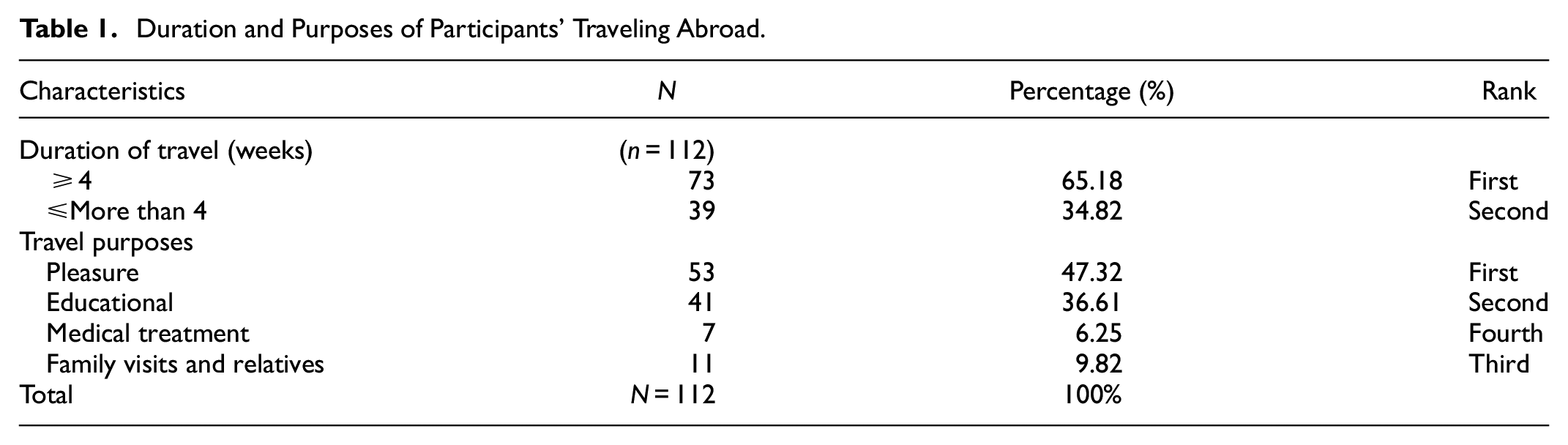
As for the qualitative approach, five of the respondents were semi-structurally interviewed to clarify the impact of short-term traveling abroad on listening skills. The interviewees were selected based on their duration of travel, and thus three of the interviewees were selected from the study sample group whose travel duration was less than 4 weeks because they were larger, around 65% of the study’s sample. The constructive interviews allowed respondents to express their opinions, feelings, and ideas with clarity and ease (Hatch, 2002). Although the interview questions were prepared, the respondents had the freedom to express their opinions freely. Before each interview began, consent forms, which indicate the right of each respondent to participate, refuse, or withdraw at any time, were presented and signed by each respondent. The respondents were also reassured that the data were collected and used for research purposes only. Each interview lasted between 25 and 35 minutes and was recorded and transcribed.
Study Instrument
Students with SAD were first identified using Foreign Language Classroom Anxiety Scale (FLCAS). Then, a questionnaire was developed by the researcher, and data were afterward gathered to collect some demographic information about participants and responses to refereed statements. The demographic information requested some information regarding participants’ education level and travel habits, purposes, duration, and destinations. The time they spent abroad, going abroad, and their views on the most critical listening and the most powerful influence of travel in improving their English listening skills were the focus of the questionnaire.
The questionnaire had two sections: (1) the first part aimed at obtaining some demographic and travel information; (2) the second part contained (20) statements to measure the most influential listening source that developed participants’ listening skills such as “I think living with the host family was the most effective source to improve my listening skills,” and “watching TV was indeed the most significant source that improved my listening.” Likert 5-point scale was used for each statement, ranging from “strongly agree” to “strongly disagree.” The third part of the questionnaire was a test to measure listening competence and abilities with multiple-choice questions. Two listening segments were played for participants with varying lengths and difficulties, and each was followed by four multiple-choice questions.
Validity and Reliability
Validity refers to the degree to which the instrument actually and accurately measures the phenomenon being measured (Obeidat et al., 2005). Furthermore, Light et al. (1990) stated that the way to measure the validity is by having experts and specialists examine the tool and agree that the instrument “looks right, reads right, and feels right” (p. 152). Seven faculty members and specialists and four students reviewed and refereed the instrument. The Index of Item-Objective was also used to see the alignment of the statements with the instrument’s objective and structure.
As for instrument reliability, before the beginning of the study, a pilot study was carried out in which 28 participants from the English department at a Saudi university were administered to make sure that the instrument’s items were clear and appropriate for the participants. After obtaining the data, SPSS (version 23.0) was used to measure the Cronbach’s alpha reliability coefficient and the results are shown in Table 2.
Cronbach’s Alpha Reliability Coefficient.

According to Nunnally (1978) and Crocker and Algina (1986), the reliability coefficients for the two scales are considered high values for both instruments. This means that both of the instruments are reliable.
Findings
The Most Relieving and Effective Listening Source
The first RQ was about the most relieving and effective listening sources from the perspectives of students with SAD during traveling abroad. Respondents indicated that because of the fact that the listening activities and sources varied, the listening sources were not the same or had the same effects on improving listening. In other words, different listening sources had different degrees of effects. One part of the questionnaire was developed to obtain statements on the most influential listening source usually encountered during travel abroad according to the 5-point Likert scales ranging from “strongly agree” to “strongly disagree.” Statements such as “most or maybe all my social meetings and encounters are with non-native English speakers” and “in official listening situations like banks and rental offices, I try to depend on myself and concentrate during conversation and listening.” The higher the score gets, the more influential the source would be.
After analyzing the 112 participants’ responses through SPSS, the Statistical Product and Service Solutions, the results showed that “living with a host family or a foreign roommate” was the most relieving and effective source of listening. More specifically, the EFL students with SAD had ranked the most relieving and influential listening sources during traveling abroad in the following order: (1) living with a host family or a foreign roommate, (2) solo watching TV and listening to some channels or movies, and (3) social gatherings, celebrations, and events. Formal listening situations that occur in official places which may have some legal consequences such as the ones at airports, rental offices, banks, and police stations were the most confusing situations and least effective (see Figure 2).

Most influential listening sources during travel abroad.
In addition, to explore the topic further, semi-structured interviews were conducted by the researcher with five of the study’s participants from each of the listening source groups with varying duration. All the interviews were conducted in English. Analyzing the qualitative data, two main themes emerged:
Reasons Behind Their Actual Experiences
During the interviews, interviewees reflected on their actual experiences and explained in more detail the reasons behind their perspectives. The data showed that the reduction of fear, rejection, or even bullying were the reasons behind selecting their most influential listening source. Living with a host family, usually, an old lady or a small family with kids, helped them develop listening skills and relieve SAD. Moreover, being around a limited number of foreigners gradually improved their English listening skills due to the reduction of fear and bullying that might occur in a larger group. One of the interviewees pointed out that:
Living with a host family or a roommate was more relaxing for me. I felt more comfortable because I speak to someone familiar to me. Chatting with a large group of people or in front of people usually makes my hands sweat or my mouth dry, it just makes me feel confused.
What the respondent talked about during the interview was logical. Conversations and listening to stories, jokes, or information with a host family or roommate during traveling abroad indeed occur in a more relaxing and friendly atmosphere. Moreover, this might be because of the nature and structure of the host families, who would usually be small, old, and/or retired, which makes them usually less busy and have more spare time to chat and share.
Participants stated that watching TV and movies is the most influential source because they can move from one channel to another at their convenient time, place, and situation without fear of a watcher. In addition, they can repeat listening to the news, segments, and passages as many times as they wish. One participant clearly expressed this by saying,
Watching TV, news or a movie has improved my listening skills. I often watch TV while I am in complete relaxation physically, mentally and psychologically, which helped me develop my listening skills with time. I can also choose what I listen to when I want to and repeat listening several times.
Thus, the ability to repeat and slowly listen to words, sentences, and phrases over and over again was the main reason for preferring this type of listening source.
Expectations of the Receivers
During the interviews, it was clear that the familiarity of the receivers with the linguistic proficiency of the participants was a significant factor in selecting the listening source. For instance, one of the participants who indicated that the social gatherings and meetings that usually occur with friends or in worship places were the most effective source for listening clarified that small social gatherings such as classmates or conversations partners who know their linguistic abilities were the direct factors that eased their SAD and made them more relaxed. For example, one of the participants explained:
I like social gatherings and the exchange of talks, jokes, and preaches in places of worship. People don’t usually speak quickly with me because they are usually considerate of my abilities as a non-native and a stranger.
In short, it seems that living with a host family was the most effective listening source for students with SAD whereas the formal situations, where they feel usually less comfortable and under more pressure, were the most confusing listening source for them.
Length of Travel Abroad and the Sources of Listening
The study’s second question was about the impact of the length or duration of the travel abroad on improving the listening skills of students with SAD. To do that, two pieces of listening segments were played and followed by four multiple-choice questions after each segment. Participants were divided into two groups: (1) the first group consisted of the participants whose travel abroad lasted less than 4 weeks; and (2) the second group consisted of the participants whose travel duration lasted and ranged from 4 to 8 weeks. The results were then statistically analyzed using a t-test through SPSS. Table 3 shows the t-test results.
t-Test Summary Investigating the Effect of the Travel Abroad Duration on Listening.

Note. n = 112.
The results of the t-test for the independent samples were statistically significant. A statistically significant difference was observed between the averages of the two groups’ means according to the travel duration as an independent variable favoring those whose length and duration of the travel abroad was more than 4 weeks. In other words, the longer the participants stayed abroad, the more and greater the impact on their listening skills t (112) = 4.51.
The difference between the two common averages is 0.8, which means that, on average, students who had traveled for less than 4 weeks showed less progress in listening by approximately 0.8 than those who spent more time abroad and stayed for more than 4 weeks. Therefore, given that p is less than .0001, we can refuse the null hypothesis and conclude that the average group μ1 ≠ μ2. Furthermore, the statistical analysis results using SPSS showed the d effect of 0.73, which according to Cohen’s (1969) guidelines, represents a relatively large effect size.
RQ2 of this study also measures the effect of the listening sources on improving listening skills and competencies. As mentioned earlier, the participants were divided into four groups regarding the most relieving and influential listening sources: (1) living with a host family or roommate (47 students; 42%); (2) watching TV and movies (33 students; 29%), and (3) social gatherings and events (23 students; 21%).
All listening sources affect English learners as a second language, but the depth and breadth of their effects vary. Each learner progresses differently, however. After dividing the subjects into groups according to the most relieving and effective listening source, the impact of the source on improving listening and understanding hearing was then measured. Data were statistically analyzed using SPSS to look at the effect of listening sources on listening comprehension. Table 4 shows the results of the one-way ANOVA tests.
Summary of ANOVA to Reveal the Impact of Listening Sources on Listening Improvement.

Note. n = 112.
As shown in Table 4, the ANOVA results are not statistically significant for the listening source’s effect on listening improvement, where F (3, 108) = 2.33, the mean of the squares = 0.211, and the alpha level (α = .056). Thus, the value of “F” is not statistically significant with respect to the degree and understanding of listening. As a result, we cannot reject the null hypothesis, H0, in the population, no statistically significant difference is found between students’ listening comprehension based on their listening sources.
Table 5 shows the means and standard deviations for each group on their listening comprehension test scores.
Means and Standard Deviations of Groups on Their Listening Comprehension.

As evident from Table 5, the participants have a relatively high ability to understand what they hear. The averages of the groups were close to each other and ranged between 3.72 and 4.01, but there were no statistically significant differences found between the groups’ means.
Furthermore, to investigate the matter further, given the difference in the listening means between the participants with SAD whose primary source of listening was living with a host family or roommate, M = 4.01, and the mean of the other groups which ranged between 3.72 and 3.74, data were divided into two groups: (1) the first group included the data for respondents whom living with a host family was the most influential source of listening and (2) the second group consisted of the data for the rest of the subjects whose primary listening source was other than living with a host family or roommate, namely social situations, TV and channels, or even the official situations. In other words, 47 respondents who considered living with a host family or roommate as the most relieving and effective source were grouped into one group, and 65 respondents whose primary listening source was either social gatherings, watching TV and movies, or official situations were grouped into another group. A t-test was performed to reveal whether statistically significant differences were found between the group means. Table 6 shows the results.
t-Test Results Between a Group of Official Situations and Other Groups.

Note. N = 112. d = 0.62.
The results of the t-test reveal a statistically significant difference between the means of the group that considered living with a host as the most important and influential source and the group who indicated otherwise; t (112) = 3.23, p ≤ .001. Therefore, a statistically significant difference is found between the means of the two groups.
Furthermore, the value of the effect size (d) was computed as 0.62, indicating that the difference between the means of the two groups was 0.62 SDs and thus reflecting a medium to large effect of treatment according to Cohen’s (1969) guidelines.
Several t-tests were performed using SPSS (version 23.0) among the means of the groups. However, all of the tests were not statistically significant. For example, when the t-test was done between the mean of the social meetings group calculation and the rest of the respondents, the result was not statistically significant and showed no statistically significant difference. The value was (t = −1.48), and the significance level was p = .14, indicating a small effect size.
Therefore, living with a host family or foreign roommate as a main source of listening was the most influential and powerful source of listening skills. Moreover, no statistically significant differences were found between the mean of the respondents except in comparison between the mean of the group of official positions and the other group. This statistical result is meaningful. Respondents in official situations, unlike other situations, have the highest levels of attention, ability, and capability in listening and understanding what was heard. They heard in formal situations that required careful and accurate understanding and the consequences of not understanding legal issues.
Discussion
As found in the current study, traveling abroad seems to have a positive impact on the personal growth and linguistic development of students with SAD which coincides with several recent studies (Black & Duhon, 2006; Hadis, 2005; Rowan-Kenyon & Niehaus, 2011). Furthermore, the findings of the current study aligned with Vygotsky’s sociocultural theory and Kolb’s framework in which participants directly experienced the cycle of the “experiential learning model,” and had a concrete experience interacting with native speakers in multiple settings, purposes, and situations. This “experiential learning” helped participants to reflect on themselves systematically in order to learn something new about themselves, improve their existing skills, and realize their listening strengths and weaknesses. This finding coincides with the findings of current studies (Mori & Gobel, 2021; Stone & Petrick, 2013) in which learning from experiences was defined as the discovery of the self.
In addition, the current study showed that traveling abroad even for a short period allowed for some relief for SAD which enabled the participants to meaningfully interact directly with the natives (Rowan-Kenyon & Niehaus, 2011; Streitwieser & Light, 2018). It also seems that traveling abroad helped relieve the anxiety often associated with the classroom atmosphere which coincides with some recent studies (Dewaele & Al-Saraj, 2013; Otair & Noor, 2017). The traveling abroad allows them to be exposed to different sources of listening with various accents, each of which influences the development of listening skills. A person by nature often listens more than speaks (Al-Faisal & Jamal, 2004), and this nature becomes more evident during exposure to different situations in a foreign country which requires listening with comprehension in multiple ways (Rheault, 2007).
Although different types of listening sources affect listening skills and comprehension, the findings of the current study showed that living with a host family or a roommate which often allows for direct contact with others has an extended effect (Stone & Petrick, 2013). One possible explanation would be that a sense of relaxation, comfort, and fearlessness of the consequences are experienced during living with a host family and roommate which coincides with the findings of recent studies (Dewaele & Al-Saraj, 2013; Rudaz et al., 2017). Therefore, intense concentration and more relaxing attempts to understand what is being said are needed because of the consequences or questions that may result from the lack of understanding.
The length of traveling abroad and staying in foreign countries seems to be as well significant, which means that the longer the travel period and exposure to listening situations, the better the listening skills become and the more relieving symptoms of SAD (Edwards et al., 2018; Merklen et al., 2022; Rowan-Kenyon and Niehaus, 2011). For example, the study showed that respondents who spent more than 4 weeks abroad developed their listening skills more than those who spent less than that.
Although the current study fills a gap in the literature, it has some limitations. The data were collected in 2018 from male subjects majoring in English who were studying at the same institution and had a sort of SAD. Furthermore, while the study opens up a wide range for future academic studies, some other variables should also be studied and taken into consideration in any future academic endeavors. For instance, subjects’ gender, types of personality, and social skills in connection to listening skills are some influential variables that need to be further studied.
Moreover, as found in Werry’s (2008) study, the current study finds that learning is no longer happening merely in the classrooms. Since the expansions of the internet and studying abroad programs, it is important to open the doors to students to go out, travel, and interact with the natives which would certainly have great and everlasting impact not only on their linguistic abilities, but also on their communication skills. More travel opportunities and expansions of study abroad programs should be provided. Students will overcome some of the emotional, personal, or even social obstacles and difficulties.
Conclusion
Even for a short period, the study shows that traveling abroad is an effective method that has many positive effects on developing personal linguistic skills, given that educational institutions worldwide are striving to enable their affiliates to benefit and learn from new experiences and knowledge in their lives and enhance their cognitive, emotional, and psychomotor competencies. Improving listening comprehension in the English language is an important skill, mainly because a person by nature hears more than speaks. Accordingly, higher educational institutions are supposed to strive to create greater travel opportunities for all students and encourage them to engage in experience and friction, even for a short period.
In learning a foreign language, the importance of traveling abroad as the findings of the current study indicated cannot be understated. Learning now has changed, and more traveling abroad opportunities should be provided. University administrators should accentuate the learning value of traveling abroad, and reduce any barriers. Benefits will be tangible for students, instructors, and society.
Footnotes
Acknowledgements

Declaration of Conflicting Interests
The author declared no potential conflicts of interest with respect to the research, authorship, and/or publication of this article.
Funding
The author(s) disclosed receipt of the following financial support for the research, authorship, and/or publication of this article: Researcher would like to thank the Deanship of Scientific Research, Qassim University for funding publication of this project.
Ethical Approval
The study was reviewed and approved by the Committee of Research Ethics and Institutional Review Board at Qassim University. Written informed consent to participate in this study was provided by the participants.
Submission Declaration and Verification
This work is approved by the author and has not been published previously. It is also not under consideration for publication elsewhere.
Data Availability Statement
Data sharing not applicable to this article as no datasets were generated or analyzed during the current study.