




Abstract
The introduction of modal verbs in English textbooks across levels in China was surveyed and compared with Chinese learners’ use in writing to explore the potential impact of textbook introduction on learners’ real use. The results have revealed (1) divergences between the sequence of modal verb presentation in textbooks and their frequency order in native speakers’ use, the unusual lower coverage of WOULD and early introduction of SHALL in particular; (2) the imbalanced coverage of different forms and senses of modal verbs in textbooks, notwithstanding that learners deploy some senses or forms in writing even if these usages have not been introduced; and (3) the constrained way of introduction—English to Chinese translation in vocabulary, simple explanation and exemplification in sentence context. Core senses and fundamental forms introduced early in textbooks are used most frequently in learners’ writing. Modal verbs with the perfect aspect structure and their associated senses introduced in textbooks at university levels rarely occur in learners’ writing even at advanced levels. Limited agreement between textbook introduction and learners’ use has been detected.
Introduction
Teaching materials play an essential role in EFL classrooms around the world deciding the content of and how teachers conduct their classes (Cunningsworth, 1995; Tomlinson & Masuhara, 2018). As learners’ main source of language input in the EFL context, textbooks provide shortcuts to what are perceived to be reliable primings (Hoey, 2005; Kırkgöz, 2011) though digital materials in recent years have allowed learners for more substantial L2 contact. Their evaluation, the appropriateness and pertinence for students, is therefore of high significance. This observation forms the basis of the research project, a retrospective evaluation in which we look at EFL textbooks that are in use on a large scale in China, by millions of Chinese learners at different proficiency levels, to learn about the type and quality of the language input contained in them. Part of its findings, the introduction of modal verbs in EFL textbooks, are reported in this paper.
The introduction of modal verbs was chosen as the target of the present paper mainly because of their pervasiveness in everyday language behavior and importance as a grammatical category to EFL learners. Modal verbs constitute about 8% of all the verb tokens in English written texts (Kennedy, 2002). Successful social interaction seems unrealistic without the proper use of modal verbs for the conveyance of speakers’ or writers’ attitude, stance toward or judgment of the possibility or necessity of a proposition or situation. The use of modal verbs is nevertheless particularly challenging for language learners (e.g., Fujimoto, 2019; Hyland & Milton, 1997; Pemberton, 2020; Römer, 2004). Their polysemy, multi-functionality and uniqueness in structural-semantic distribution pose a considerable learning problem to language learners. Learners’ L1 and native culture (Aijmer, 2002; Gao, 2020), L2 proficiency (Elturki & Salsbury, 2016; Gao, 2023), essay topics (Hinkel, 2009; Pemberton, 2020), and teaching materials (McEnery & Kifle, 2002; Pemberton, 2020) are reported to be factors impacting their use. What is encoded in Chinese EFL textbooks about what should be learned and how it should be learned about modal verbs is of particular interest to us. Whether and how textbook introduction to modal verbs impacts learners’ real use warrants investigation. The present study intends to contribute to this line of research by surveying the introduction to different forms and senses of modal verbs and the way of introduction in EFL textbooks across levels in China. Comparisons were then made with learners’ use in writing to explore potential association between the two.
Modal Verbs in EFL Textbooks
Textbooks tend to “dominate and dictate what happens in the classroom” as most teachers teach from textbooks and learners resort to textbooks as their main language input source in the EFL context (Tomlinson, 2020, p. 13). Theoretically, EFL textbooks should be a representation of real language use to prime learners to use English in a meaningful and engaging way. Recent corpus-based studies, however, have revealed significant inconsistencies between the use of lexical items and grammatical structures by native speakers, and those introduced in EFL textbooks (Russell, 2017). Textbook writers usually “base their materials on intuition/inspiration, teaching experience/repertoire, and typical topics and activities in existing materials, rather than on principled frameworks” or real language use (Graves, 2019, p. 341). Whether the comparatively newly developed EFL textbooks in China are predominantly intuitive or a reflection of authentic language use is worthy of investigation.
Modal verbs constitute a focal concern in EFL textbooks due to their pervasiveness and expressive force as no area of English grammar is both more important and difficult than the system of modals for EFL learners (Palmer, 1979). Their presentation in textbooks in different areas and countries has been compared with native speakers’ use to evaluate the appropriateness of textbook presentation and coverage. Holmes (1988) calculates the range and frequency of epistemic devices in two EFL textbooks and two reference grammar books in comparison to that in BROWN, LOB, and LUND corpora and reports a surprisingly low percentage (27% or 40%) of the total range of epistemic modal verbs covered in the two textbooks. In a study of 22 textbooks, Hyland (1994, p. 247) summarizes and comments in a disappointing tone that “modal expressions are simply introduced without system or comment and are summarily dealt with in a single exercise which fails to emphasize either their function or importance. Generally, the range of modal verbs addressed and the information provided on their use is inadequate.”Römer (2004) furthers this line of research and conducts a comparative analysis of modal verbs, their distribution and patterns, in spoken British English corpus and selected texts from a series of EFL textbooks used in Germany. Huge discrepancies have been discovered and it is suggested to change the introduction order of modal verbs and present different meanings of modal verbs in textbooks in accordance with their proportion in real use. Following Römer (2004), the presentation of modal verbs in EFL textbooks in other countries such as Malaysia (Khojasteh & Reinders, 2013), Finland (Nordberg, 2010), Spain (Durán et al., 2007), Korea (Lee & Kang, 2016), and India (Bose, 2005) was compared with native speakers’ use. Consistent findings have been reported that great discrepancies exist between the representation of modal verbs in EFL textbooks and the real use by native speakers. Researchers, therefore, relate students’ difficulty with modal verbs with the way they are introduced in coursebooks. EFL textbooks are accused of failing to present the full range of modal expressions in a balanced way and misleading learners with inaccurate explanations (Holmes, 1988; Hyland, 1994; McEnery & Kifle, 2002).
There is nonetheless “no guarantee that learners will understand and use language because of the materials” (Graves, 2019, p. 338). Whether and to what extent the introduction to modal verbs in textbooks influences learners’ real use calls for investigation. Existing research concentrates on the comparison between modal verb introduction and native speakers’ use (Durán et al., 2007; Khojasteh & Reinders, 2013; Lee & Kang, 2016; Römer, 2004). Few studies investigate the impact of textbook introduction on learners’ real use. Moreover, existing research counts and compares modal verb frequencies in terms of lemma without distinguishing their different forms and senses though polysemy and multi-functionality are widely acknowledged features of modal verbs. The present study, based on a textbook corpus, takes a fine-grained descriptive approach to documenting the presentation of modal verbs in two widely used series of English textbooks in China targeting learners at different levels of China’s Standards of English Language Ability (CSE). The introduction to different forms and senses of core modal verbs was discerned and coded and then compared with their use in Chinese learners’ writing at different CSE levels which has been investigated and reported in Gao (2023). Comparisons were conducted to explore whether textbook introduction to modal verbs accords with native speakers’ use or impacts learners’ real use. Specifically, the study was guided by the following research questions:
(1) What forms or senses of modal verbs are introduced in which English textbooks and how? Does the order of introduction conform to native speakers’ use?
(2) How does the treatment of modal verbs in contemporary textbooks compare to empirical evidence on their use in writing by learners at different CSE levels?
It is hypothesized that different forms and senses of modal verbs are introduced in Chinese English textbooks in a balanced way and in a sequence conforming to native speakers’ use as the textbook series selected are updated and reported to be compiled by selecting authentic reading and listening materials and adopting the latest task-based or text-driven approach (Liu & Zheng, 2019; Yang, 2014). As an almost indispensable and also influential element in the EFL teaching-learning situation, textbooks are expected to exert an impact on learners’ use. The CSE, issued by the Ministry of Education and National Language Standard Committee of the People’s Republic of China in 2018, is a national English language proficiency scale. It defines the English ability of Chinese learners and users by nine levels (CSE 1, 2 … to 9) and three stages—elementary, intermediate and advanced stage in ascending order from lower proficiency levels to higher ones with every three levels corresponding to one stage. The CSE takes a use-oriented approach to the description of language ability based on the communicative language ability model and the educational needs of Chinese learners. With around 2,400 descriptors, the CSE has both an overall description of the language ability of Chinese learners and users and specific descriptions matching their different levels, which offers a useful structure for investigating Chinese learners’ English proficiency.
Data and Methodology
Textbooks employed in primary and middle schools in different cities and provinces of China were surveyed and the series of English textbooks published by People’s Education Press (Liu & Zheng, 2019)—textbooks used at CSE 1 to 4 levels were selected for analysis as they have the widest coverage of 48.03% to 54.7% in primary, junior and senior middle schools throughout China. Contemporary College English Books 1 to 6 (Yang, 2014) were chosen for they target English major undergraduates years 1 to 4, which correspond to CSE 5 to 7 levels, and have been in use widely for two decades in Chinese universities.
Under the guidance of activity theory, the textbook series by Liu and Zheng (2019) is said to be topic-centered and text-based which integrates listening, speaking, reading, watching and writing activities in each unit and emphasizes the learning process and strategy to develop learners’ ability to use English to do things as featured in the editors’ words. Contemporary College English Books 1 to 6 are also reported to be text-based, that is, all the activities and tasks in each unit revolve around the text, intending to foster students’ ability to understand, appreciate and use English. Neither states explicitly how grammar is introduced or taught. Language forms seem not to be the focus of either textbook series.
Each page of the textbooks mentioned above was photocopied and scanned and then saved in a TIF format, which were then converted and saved into text files (.txt). Manual checking was conducted for errors on each page and text headers were added to each file based on the respective sections of textbook units. The total pedagogic corpus size is around 5,496,000 running words and the detailed information of the corpus is presented in Table 1. Nine core modal verbs—CAN, COULD, SHALL, SHOULD, WILL, WOULD, MAY, MIGHT, and MUST were used as node words for the lexical search carried out with WordSmith Tools (Scott, 2008). After all concordance lines containing these words were extracted from the corpus, each line was examined manually to delete the non-modal-verb uses such as CAN and WILL used as nouns in rubbish can or strong will. The rest of the lines were saved for later analyses. The researcher read through the concordance lines and identified and coded the forms and senses of each modal verb. It was noted down in which book and how what form or sense was introduced, the results of which were then compared with native speakers’ use in Römer (2004) and the empirical evidence on the use of modal verbs in writing by Chinese learners at the corresponding CSE levels (Gao, 2023).
Corpus of Chinese English Textbooks: Sub-Corpus Breakdown (10,000s).

Results and Discussion
The Introduction of Modal Verbs in English Textbooks in China
A close examination of the introduction to modal verbs in the series of English textbooks in China demonstrates that ever since grade 1 primary school modal verbs are introduced to Chinese EFL learners. At the primary school stage CAN, COULD, WILL, WOULD, MUST, SHALL, and SHOULD have been introduced, either in a one-to-one English to Chinese translation such as CAN-keyi, MUST-bixu, and WILL-jiangyao in vocabulary or as a whole chunk or a conversation formula as in What would you like to eat? in textbooks. In terms of grading and progression, it is discerned that only the ABILITY, POSSIBILITY, and PERMISSION senses of CAN and its affirmative and negative forms are introduced at CSE 1 level—grades 1 to 3 primary school. Then at CSE 2 (from grade 4 primary school) the introduction of modal verbs extends to cover the OFFER sense of CAN, the WOULD LIKE pattern and its PREFERENCES sense, the PLANS and INTENTIONS sense of WILL, and the ADVICE sense of SHOULD. The ABILITY sense of COULD, the OBLIGATION and NECESSITY and RULES senses of MUST, the SUGGESTIONS sense of SHALL and the REGRETS sense of SHOULD are added in grade 6 primary school. The modal verb pattern WOULD LIKE is introduced at an early stage as a set phrase or formula for it is used frequently in everyday conversations.
At the junior middle school stage (CSE 3), the ABILITY, POSSIBILITY, and PERMISSION senses of CAN, the OBLIGATION and NECESSITY and RULES senses of MUST, and the SUGGESTIONS sense of SHALL and SHOULD are repeated to provide learners with a recycled exposure. Some other senses are introduced at this level such as the REQUESTS and GUESSES and PREDICTIONS senses of CAN, the REQUESTS and SUGGESTIONS senses of COULD, the OBLIGATION and NECESSITY sense of SHOULD, and the DEDUCTIONS and CONCLUSIONS senses of MUST. Two new modal verbs—MAY and MIGHT are introduced at this level to express PERMISSION and POSSIBILITY. All the nine core modal verbs, until CSE level 3, have been introduced in textbooks to Chinese learners with WOULD in only one pattern WOULD LIKE and its associated senses. The introduction is restrained to their fundamental forms–affirmative, negative and question forms and basic senses such as the ABILITY, PERMISSION, and POSSIBILITY senses of CAN. Very few explanations are given about their pragmatic functions and the way of introduction again is simple–either listing their Chinese correspondents or being included in a conversation. The presentation of modal verbs is cyclical in textbooks. That is, their basic senses are introduced in textbooks at lower levels and then repeated at higher levels so that learners come across the uses again to ensure enough exposure for acquisition.
At CSE level 4 (grade 11 senior middle school) the use of all the nine modal verbs is introduced again summarily in a separate grammar section of the textbook. The majority of these are repetitions. Some new senses are added such as the GUESSES and DEDUCTIONS senses of COULD, the WILLINGNESS and OFFER sense of WILL, using WOULD to talk about the future in the past, and SHOULD to talk about the ideal or desired situations.
Ever since CSE level 5 the way of introducing modal verbs differs greatly. Writers of Contemporary College English have a separate grammar section as part of the exercises in each unit. The use of modal verbs in the main text of a unit is listed as an example, along with brief explanations, and then some sentences are provided for the learners to transform in accordance with the example. Below is an instance quoted from Exercise 6 Contemporary College English Book 1 Unit 2.
Study the sentence pattern and rewrite each of the sentences.
Example Pattern: if subject+verb (past perfect), subject+would/should /could/might + main verb (have done)
If that kind of thing had happened when I was young, the whole village would have condemned such an ungrateful son … (para. 6)
(used when you are talking about something that might have happened in the past but did not happen)
The patient wasn’t sent to the hospital soon enough, and he died on the way
Textbook writers may expect learners to derive the use by themselves during the process, the efficiency of which is worthy of investigation. The past affirmative and negative forms of SHOULD to talk about regrets or undesirable situations in the past, the use of WOULD, SHOULD, and MIGHT after IF clauses and the affirmative and negative forms of WOULD to talk about imagined situations in the past and the future in the past are introduced in Contemporary College English Book 1 at CSE level 5. Then in Book 4 (CSE 6) the past affirmative form of WOULD is brought up to talk about imagined situations in the past.
Various forms and senses of modal verbs are introduced and repeated in English textbooks from CSE levels 1 to 6 in China, which implies that textbook writers agree on the various difficulty of different modal verb patterns—affirmative, negative and question forms are taught at primary and middle school stages (the basic levels), followed by the more complex forms—after IF clauses, past affirmative and negative forms at university stage (the intermediate levels). Senses introduced at CSE levels 1 and 2 are restrained to the fundamental core ones such as the ABILITY, POSSIBILITY, and PERMISSION senses of CAN and the PLANS and INTENTIONS senses of WILL. From CSE level 3 senses to convey epistemic modality are taught such as the GUESSES and PREDICTIONS senses of CAN and the DEDUCTIONS and CONCLUSIONS senses of MUST. Only at higher CSE levels 5 and 6 are senses of talking about regrets or undesirable situations and imagined situations in the past and the future in the past taught. The grading and progression of the introduction reflect the perceived difficulty of the structures and senses. The way of introduction varies from simple English to Chinese translation or explicit explanation at CSE levels 1 to 4 to example sentences to follow at CSE levels 5 and 6. Many forms of modal verbs are left out without mentioning even in textbooks at CSE level 7 such as ellipsis, inversion, and use with adverbs. Textbook writers might be interviewed later for their choices and arrangements.
The findings here differ from that reported in previous research (Khojasteh & Reinders, 2013; Lee & Kang, 2016; Römer, 2004). The sequence of modal verb presentation, for example, in German textbooks is can → must → may → could → would/’d → should → will/’ll → shall → might; in Malaysian textbooks can → will → should → may → would/’d → must → could →might → shall; and in Korean textbooks can → will → should → would → must → could → may →might → shall.
In Chinese textbooks the order of introduction is can → would like → will → should → could → must → shall →may → might → would. One obvious divergence is the presentation of WOULD. In textbooks in other countries, WOULD receives medium attention and always ranks the fourth or fifth to be introduced (Khojasteh & Reinders, 2013; Lee & Kang, 2016; Römer, 2004). In Chinese textbooks WOULD, except for its WOULD LIKE pattern and PREFERENCES sense, is the last modal verb to be introduced at CSE 4 level, which explains its less use in both Chinese learners’ (Chen, 2012; Hu & Li, 2015; Liang, 2008; Ma & Lv, 2007) and scholars’ (Gao, 2020) writing to some extent as Chinese learners feel safe to use modal verbs that are taught early in textbooks (Ma & Lv, 2007). While the diminishing use of SHALL is reflected in textbooks in other countries clearly—the last or penultimate modal verb introduced, SHALL is prioritized to be the sixth introduced in grade 6 primary school textbook (CSE 2) in China. The presentation order of modal verbs in none of the EFL textbooks conforms to that found in native speaker corpus: will/’ll → would/’d → can → could → should → might → must → may→ shall (Römer, 2004, p. 195). Textbook writers’ intuition about or conceived importance of modal verbs seems to vary from the real use. Textbook writers in China may be interviewed or surveyed to find out why WOULD is reckoned to be the least important and introduced last. The importance of item frequency in the compilation of teaching materials, that is, other things being equal the more frequent item should be introduced at an earlier stage in the learning process (Römer, 2004), has not received its due focus.
The way of introduction to modal verbs in primary and middle school textbooks in China is in line with that in textbooks in other countries (Durán et al., 2007; Khojasteh & Reinders, 2013; Lee & Kang, 2016). That is, they favor “the indiscriminate combination of the form-function criterion in the traditional presentation of modal verbs” and “the criteria used to classify and introduce them are not based on their grammatical behavior but on their semantic capacity to express notions such as possibility, certainty, obligation, permission and so on” (Durán et al., 2007, p. 29). The direct English to Chinese translation as CAN—neng, nenggou and WILL—jiangyao conveys their semantic meanings to learners. The summary explanation of modal verbs in the grammar section is also presented in their various semantic values such as Can (1) ABILITY We can speak a little English. (2) PERMISSION You can play basketball at weekends. (3) REQUEST Can you help me with my Chinese? in grade 7 textbook. The way of introduction in Contemporary College English differs greatly from that in textbooks at lower levels and in other countries. Decontextualized example sentences of modal verbs are provided with a simple one-sentence explanation and some exercise sentences to modify accordingly. The textbook writers seem to adopt an implicit approach expecting learners to derive the use and form of modal verbs by themselves. An obvious change in textbook writers’ adopted approaches has been detected that textbooks at lower levels rely on explicit presentation and use listening and reading to focus on specific forms whereas coursebooks at higher levels provide learners with examples in sentence context and encourage them to notice and discover the usage and then communicate in planned discourse by deriving the rules and transforming the sentences accordingly. More examples in the discoursal context might be helpful for Chinese learners to derive the pragmatic functions of modal verbs.
A similar imbalanced introduction to different senses and forms of modal verbs has been discovered here. The ABILITY and REQUESTS senses of COULD, for instance, are introduced in textbooks at CSE 2 level whereas the POSSIBILITY sense has never been mentioned. The two senses of SHALL introduced at CSE 3 level—SUGGESTIONS and PLANS and INTENTIONS both appear in question form with first-person pronouns as their subjects as in Shall we start the meeting now? and Where shall I wait for you?. Though SHALL tops the list of modal verbs in interrogative context (Mindt, 1995; Römer, 2004), it co-occurs with nouns and other pronouns to state RULES in statement forms such as The president shall hold office for 5 years. Its usage in statement never appears in any textbooks studied here. “To achieve a higher degree of authenticity,” textbook writers should keep “similar proportions of the different senses of” modal verbs as these “found in the English used in real-life situations” (Römer, 2004, p. 196). It is worth discussing what principled framework textbook writers should adopt in selecting and presenting linguistic items and grammatical structures in textbook compilation and whether the introduction to language items in accordance with their use by native speakers facilitates learning.
Comparison Between Textbook Introduction and Learners’ Use
The use of modal verbs in Chinese learners’ writing in some way follows the introduction sequence in textbooks. Learners at CSE 1 and 2 levels are able to use the affirmative, negative and question forms of modal verbs in their essays (see forms and senses distribution of CAN across levels in Table 2 as an example). This matches the levels at which coursebooks typically teach these patterns. When learners move up to CSE 3 and 4 levels, more complex structures like inversion, passive, after IF clauses, ellipsis and use with adverbs appear in their writing. Chinese learners can use modal verb patterns that are taught in textbooks at higher levels (passive and after IF clauses) or that never have been mentioned (inversion, ellipsis and use with adverbs) in their writing at CSE 3 and 4 levels. Surveys or interviews with learners may help us understand where and how they acquire and deploy these forms at intermediate levels. The simplicity of structure, that is, the Modal verb + Verb pattern is the most frequent modal verb form in learners’ writing with no need for tense or aspect change, might be a reason for their unconscious acquisition and usage. Despite the introduction to the past affirmative and negative forms of modal verbs in textbooks at CSE 5 and 6 levels, such usage seems distinct in learners’ writing. Learners tend to avoid the modal verbs with the perfect aspect structure consciously or unconsciously in writing either to ensure the grammaticality of writing or due to the lack of proficiency. No direct relationship could be established between the textbook introduction to modal verb forms and their use in learners’ writing. What is taught in textbooks is not necessarily what is learned and used by learners in communication.
Forms and Senses Distribution of CAN Across Levels (Gao, 2023, p. 49).
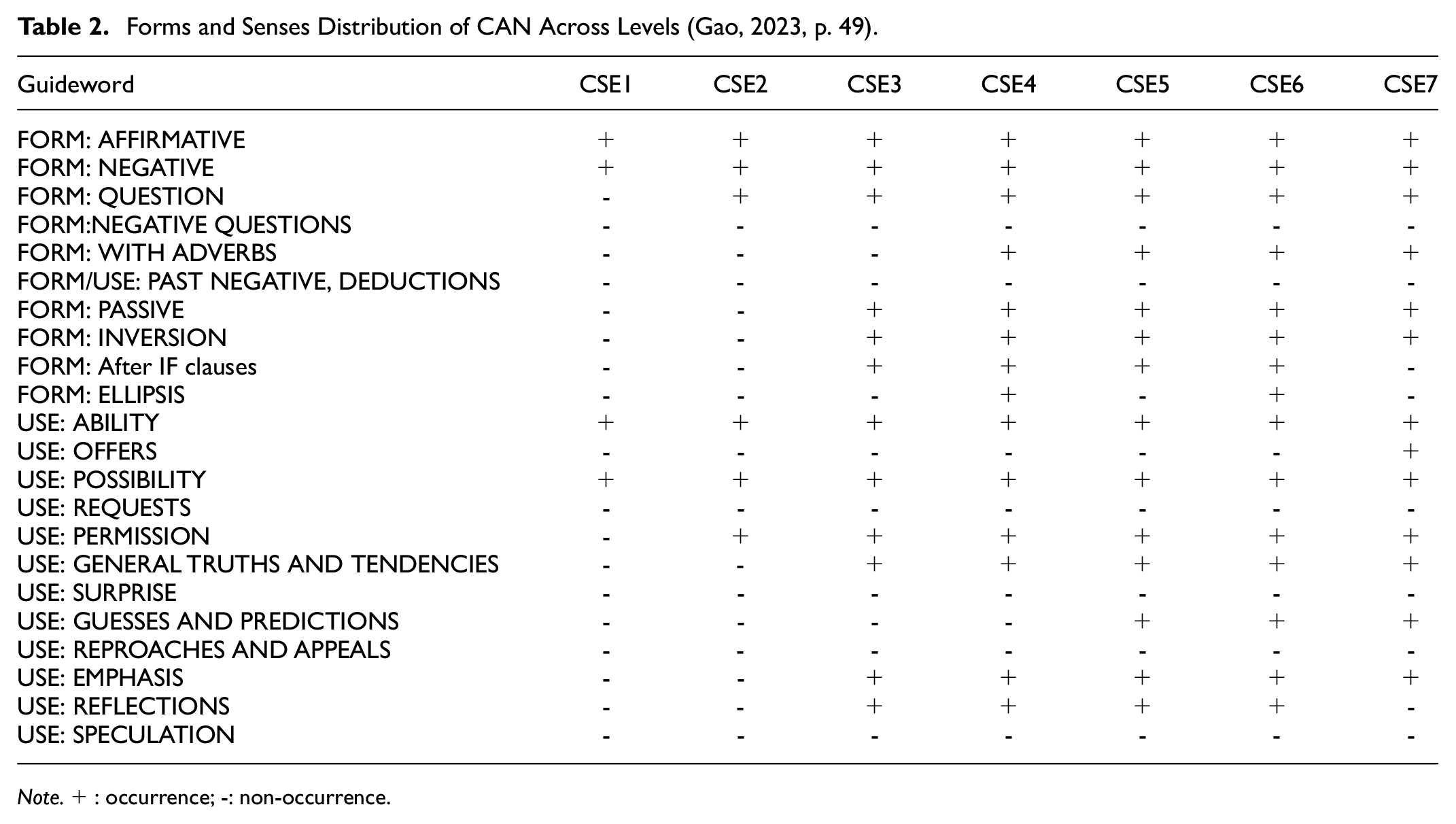
Note.+: occurrence; -: non-occurrence.
A more divergent picture arises when we zoom in on the senses introduced in textbooks and used in learners’ writing. Again conformity between these two is found in the majority of modal verbs at lower levels (CSE 1 and 2). That is, the fundamental senses of CAN, WILL, MUST, SHALL, and SHOULD are introduced in textbooks and used in writing by Chinese learners at CSE 1 and 2 levels. Variation exists in the use of COULD. The ABILITY sense of COULD is introduced in textbooks at CSE 2 level but employed in learners’ writing since CSE 1. Learners might acquire COULD as the past tense form of CAN and use it in writing in neglect of the subtle shades of politeness associated. Few cases of COULD exist in writing at CSE 2 and 3 levels. Its use increases to more than that in native speakers’ writing from CSE 4 level. What causes the drop in use at CSE 2 and 3 levels warrants further investigation despite that COULD is introduced explicitly in textbooks at CSE 2 level.
There are, however, a number of areas of disagreement between the introduction of modal verbs in textbooks and their use in learners’ writing at higher levels. It takes some time for learners to acquire the core senses of MAY (PERMISSION, POSSIBILITY) and the SUGGESTIONS sense of COULD as they are taught in textbooks at CSE 3 level but used in learners’ writing from CSE 4 level. The POSSIBILITY sense of MIGHT is also taught in textbooks at CSE 3 level whereas rarely used in learners’ writing across levels. Chinese learners at CSE 1 and 2 levels employ SHOULD in its OBLIGATION and NECESSITY, ADVICE and SUGGESTIONS senses in writing though such usages are introduced in textbooks at CSE 3 level. Textbooks at intermediate levels (CSE 4–6 levels) elaborate on the past affirmative and negative forms to talk about regrets or undesirable situations or imagined situations in the past. Learners’ writing at these levels or even higher levels includes rare occurrences of these forms or senses. There is limited agreement on the textbook introduction to and learners’ use of grammatical items at advanced levels compared to lower levels (McCarthy, 2015). Genre variation might explain the absence of some senses in learners’ writing. For instance, the REQUESTS sense of COULD is introduced in textbooks at CSE 3 level but never appears in learners’ writing studied here as this usage is frequent in spoken language whereas seldom used in written texts.
Conclusions
This study, based on a pedagogic corpus of English textbooks used in primary and middle schools and universities in China, has investigated the introduction to different forms and senses of modal verbs in textbooks and the potential association between their textbook introduction and learners’ real use. Textbook writers in China seem to have a consensus on when and where the core modal verbs are introduced—CAN, WILL and SHOULD first, followed by MUST, MAY, SHALL, and COULD with MIGHT and WOULD at a later stage. The sequence of introduction diverges from the frequency order in native speakers’ use. It is, to some extent, reflected in Chinese learners’ use. That is, these introduced early in textbooks are used most frequently in learners’ writing. It is worth further investigation to see whether it is a learning impact or just because the senses of CAN, WILL, and SHOULD are the most noteworthy in Chinese learners’ writing. WOULD seems to be a much-neglected item in both textbooks—the last modal verb introduced and Chinese learners’ writing—consistently underused in learners’ writing across levels. Further investigation will be conducted to find out for what reason Chinese textbook writers made this choice and whether it is the main reason for learners’ underuse.
The way of modal verb introduction in English textbooks in China is rather constrained in either English-to-Chinese translation, simple explanation or exemplification. The mere one-to-one translation blurs the subtlety of modal verb senses and constitutes a problem for learners. The summary explanation in the appended grammar section serves as a reference and the example sentences in the exercise section for learners to deduce the usages have high demands on learners. Moreover, the forms and senses taught in textbooks are imbalanced while learners’ use extends beyond this scope. The impact of the textbook introduction to modal verbs on Chinese learners’ use in writing seems to be limited. How learners use textbooks to acquire language use and to what extent textbooks exert influence on their learning call for further investigation.
Footnotes
Declaration of Conflicting Interests
The author declared no potential conflicts of interest with respect to the research, authorship, and/or publication of this article.
Funding
The author disclosed receipt of the following financial support for the research, authorship, and/or publication of this article: I acknowledge support from Social Sciences Foundation of Ministry of Education China Project “Criterial features in Chinese EFL learners’ writing at different levels of the China’s Standards of English Language Ability ” (20YJA740011) and the Fundamental Research Funds for the Central Universities.

Data Availability Statement
Data supporting the findings of this study are available from the corresponding author Xia Gao on request.