




Abstract
Despite the rekindled interest in emotions and individual differences in second language acquisition (SLA) under the influence of positive psychology, the interrelationships among regulatory focus, L2 grit and achievement emotions remain under-researched. Drawing on structural equation modeling (SEM) approach, this study aimed to examine the predictive effects of regulatory focus on L2 grit through the mediation of achievement emotions. A total of 1043 non-English major undergraduates from a comprehensive university in central China participated in the study. Data were collected with a questionnaire adapted from three published scales and analyzed using multiple regression and multiple mediation analysis with a 1000-bootstrap method. Results showed that all three psychological constructs under investigation were correlated with each other and regulatory focus had an indirect predictive effect on L2 grit, which was mediated by achievement emotions. As with the mediating effect of achievement emotions, enjoyment and boredom had a partial mediating effect on the relationship between promotion focus and L2 grit, whereas hope and anxiety had a full mediating effect on the relationship between prevention focus and L2 grit. The findings are discussed in relation to the identified mediating mechanism for regulatory focus and L2 grit in boosting L2 learning motivation among Chinese English-as-a-foreign-language (EFL) learners.
Introduction
With the rekindled interest in emotions and individual differences in applied linguistics, the past decade has witnessed a growing body of research on the relationships among personalities, emotions, motivation, and second/foreign language (L2) learning achievements. Research has shown that personality trait (e.g. grit), emotions (e.g. enjoyment), and motivational factors (e.g. regulatory focus) have significant impacts on L2 learning performance (Eom & Papi, 2022; Jiang & Papi, 2022; Papi & Khajavy, 2021; Sudina & Plonsky, 2021; H. Wei et al., 2019; R. Wei et al., 2020).
Grit, as a higher-order positive personality trait, refers to the passion and perseverance that individuals possess in the pursuit of long-term goals (Duckworth et al., 2007; Duckworth & Quinn, 2009). Originally conceptualized as a domain-general construct, grit is also embraced by second language researchers to mean consistency of interest and perseverance of effort in the process of L2 learning and teaching (e.g., Sudina et al., 2021; Teimouri et al., 2022). Achievement emotions refer to a wide range of emotions that students experience in relation to the academic learning and achievement in academic settings (Pekrun et al., 2002). Closely interrelated with assorted achievement emotions, regulatory focus, a bi-dimensional construct comprised of promotion focus and prevention focus, is defined as a self-regulatory motivational principle for “reducing discrepancies between current states and desired end-states” (p.1281) by either approaching positive outcomes or avoiding negative ones (Higgins, 1997).
While recent studies have indicated that L2 grit, a relatively stable trait variable, has significant predicative or mediating effects on L2 learning motivation, emotion and outcomes (Li & Dewaele 2021; Pawlak et al., 2022; Sudina & Plonsky, 2021), few studies have investigated to what the extent L2 grit itself can be predicted by other individual difference variables (S. Yang et al., 2022). Yet, understanding the interplay of emotions, motivation factors and L2 grit, particularly how the socio-affective variables may contribute to language learners’ grit level, is practically significant for enhancing motivation, cultivating positive emotions and fostering self-regulated learning (SRL) in an input-poor learning environment (Teng & Zhang, 2020) given the high emotional and physical demands language learning process may impose on the Chinese English-as-a-foreign-language (EFL) learners. To fill this research lacuna, we conducted a questionnaire-based survey among a large sample of Chinese university students, aiming to explore the interrelationships of L2 grit, regulatory focus and achievement emotions by testing a hypothesized model of the three constructs.
Literature Review
Regulatory Focus
Regulatory focus theory was initially proposed by Higgins (1997) to account for the principles underlying motivational human behaviors beyond the hedonic or pleasure principle. This theory distinguishes two different types of regulatory foci, that is, promotion focus and prevention focus, which determine self-regulation along the process of goal pursuit. Individuals with a promotion focus are motivated to approach the desired end-states by “attaining accomplishments and fulfilling hopes and aspirations,” whereas those with prevention focus avoid the undesired end-states through “insuring safety, being responsible and meeting obligations” (Higgins, 1997, p. 1282). Moreover, both of them adopt different self-regulatory strategies when facing difficult tasks, life failures, or decision-making. Specifically, promotion-motivated people tend to have strategic inclinations to approach positive outcomes or matches to desired end-states. Prevention-motivated people, in contrast, are risk-aversive and inclined to avoid negative outcomes or mismatches to the desired end-states (Crowe & Higgins, 1997; Liberman et al., 2001; Molden & Higgins, 2005; Scholer et al., 2019). Taken together, regulatory focus theory presents the motivational function that involves both promotion and prevention foci, differing from each other not only in goals that individuals pursue but also in strategies they prefer to utilize for achieving the ultimate goals.
In applied linguistics, Dörnyei (2009) first applied regulatory focus theory to illustrate future L2 self-guides (see also Papi et al., 2019; Teimouri, 2017). According to the theoretical framework proposed by Dörnyei (2009) for L2 motivational self-system (L2MSS), promotion focus and prevention focus are respectively concerned with ideal L2 self and ought-to L2 self. This framework offers some ground-breaking insights into L2MSS and motivates the indirect research on regulatory focus in the field. As a result, a number of promotion-related constructs (e.g. L2 enjoyment; willingness to communicate) and prevention-related constructs (e.g. L2 anxiety; low classroom participation) have been investigated indirectly in the ensuing studies on future L2 selves (see Papi & Khajavy, 2021, for more details).
Motivational factors have become an increasingly popular topic of L2 research (Y. Wang & Liu, 2022). In particular, the regulatory focus theory has gradually gained traction in second language acquisition (SLA) and researchers have begun to directly study the associations between regulatory focus and L2-related variables (e.g. Jiang & Papi, 2022; Papi & Khajavy, 2021). For example, in a study investigating 161 EFL learners in China, Jiang and Papi (2022) discovered that promotion focus has a significantly negative predictive power for L2 anxiety, whereas prevention focus is not significantly associated with L2 anxiety. In another study adopting SEM technique, Papi and Khajavy (2021) built a model to explain the relationships among regulatory focus, L2 self-guides, L2 emotion, L2 use inclination, and L2 achievement. The model showed that promotion focus positively predicted ideal L2 selves, which in turn exerted positive influence on L2 enjoyment, eager L2 use, and L2 achievement. On the contrary, prevention focus was a negative predictor of ought-to L2 selves, with positive impacts on L2 anxiety and vigilant L2 use but negative ones on L2 achievement. To the best of our knowledge, the relationship between regulatory focus and grit still remains underresearched in SLA research. Although previous studies have shown that L2 grit is significantly correlated with L2 motivation, these studies only produced mixed results regarding the link (e.g. Alamer, 2021; Teimouri et al., 2022). Thus, there might be a need to examine how the motivational factor of regulatory focus may predict L2 grit to gain new perspectives on self-regulation learning in L2 research.
L2 Grit
Although whether grit is a unidimensional, bidimensional, or four-dimensional construct still remains a contentious issue (Duckworth & Quinn, 2009; Ebadi et al., 2018; Giordano, 2019; see also Khajavy et al., 2021), it is generally considered to encompass two factors: consistency of interest (CI) and perseverance of effort (PE). CI represents a person’s consistent passion for long-term goals despite challenges and difficulties, while PE reflects an individual’s tendency to invest sustained effort over a prolonged period.
To measure the two dimensions of grit, Duckworth et al. (2007) and Duckworth and Quinn (2009) developed and validated a 12-item grit scale and an 8-item short grit scale, which have been extensively utilized to measure the domain-general grit level of participants from various disciplinary backgrounds. A plethora of studies have employed these two scales to investigate the relationship between grit and academic/non-academic achievements (e.g. Akos & Kretchmar, 2017; Datu et al., 2016; Eskreis-Winkler et al., 2014; Von Culin et al., 2014). Student grit level is found to be a positive predictor of academic motivation (Piña-Watson et al., 2015), achievement goals (Chen et al., 2018), self-efficacy (Usher et al., 2019), and learning engagement (Fosnacht et al., 2018; Hodge et al., 2018; H. Wei et al., 2019).
Informed by the prior studies on grit and its links to academic achievements in neighboring disciplines, second language researchers have attempted to integrate grit into L2 research and investigate its effects on L2 learning outcomes. The pioneering work on grit in language learning is a study conducted among Japanese university students by Lake (2013), which found strong positive relationships between grit and L2-self factors such as ideal L2 self, interested L2 self, and a bunch of motivational and language-specific variables (see also R. Wei et al., 2020). In a similar vein, H. Wei et al. (2019) found that grit has strong positive effects on Chinese middle school students’ foreign language performance through the mediation of foreign language enjoyment and classroom environment. However, both studies adopted the domain-general grit scales (i.e. Duckworth et al., 2007; Duckworth & Quinn, 2009) to measure students’ grit, and this might affect the generalizability of research findings for L2 research due to the limited psychometrical properties and predictive validity of the research instruments
In line with the call for language-specific scale with more robust psychometrical properties, a number of researchers have developed and validated L2-grit scale across different learners and contexts (Alamer, 2021; Sudina et al., 2021; Teimouri et al., 2022; M. M. Wang et al., 2023). Drawing on Duckworth et al.’s (2007) two-factor structure of domain-general grit, Teimouri et al. (2020) first developed a domain-specific measure of L2 learners’ grit, resulting in a 9-item scale along the dual dimensions of Persistence of Efforts and Consistency of Interest. The reliability and construct validity of this language-specific measure was later attested to in Sudina et al.’s (2021) study on a sample of 454 ESL and EFL learners, yielding additional empirical evidence for the two-dimension structure of L2 grit. Such bi-factor model was also confirmed in R. Wei et al.’s (2020) partial replication study of Teimouri et al. (2022) in the Chinese context, which revealed significant associations between L2 grit and learner factors such as age and language proficiency. More recently, Alamer (2021) adopted EFA and CFA approaches to validate another language domain-specific grit scale that consists of 12 items adapted from Clark and Malecki’s (2019) academic grit scale and Duckworth et al.’s (2007) domain-general grit scale. The scale was evidenced to boast of relatively sound psychometric properties specific to the L2 research domain. It is also worth noting that, by integrating metacognition with grit exquisitely, M. Wang et al. (2023) developed an instrument for measuring L2 grit in other psychological contexts, heralding a new line of research on this topic.
Previous studies have shown the significant relationship of L2 grit with both personal and contextual factors for L2 learning (e.g. Derakhshan & Fathi, 2023; Li & Dewaele, 2021; Pan, 2022; Shirvan & Alamer, 2022; Shirvan et al., 2021). Among the language learner variables potentially relating to L2 grit, the non-cognitive factors such as emotions have evoked immense research interest in the teaching and learning of L2. A number of researchers have explored the mediating effects of negative emotions (e.g. anxiety) and positive emotions (e.g. enjoyment) on the relationship between L2 grit and L2 achievements (Li & Dewaele, 2021; E. Liu & Wang, 2021; Shirvan et al., 2021; Teimouri et al., 2022). For example, E. Liu and Wang (2021) drew on data from 697 Chinese high school students to explore the interrelationships among L2 grit, foreign language enjoyment (FLE), foreign language anxiety (FLA) and foreign language performance, which revealed significant mediating effects of FLE and FLA on the relationship between L2 grit and foreign language performance. A more recent study conducted by Li and Dewaele (2021) directly examined the predictive effects of general grit on Chinese secondary students’ foreign language classroom anxiety (FLCA). According to the study, those reporting higher level of general grit tended to experience less negative emotion of FLCA, thus perceiving English classes in more positive light. The study echoed the research findings of Teimouri et al. (2022), which also suggested that grittier L2 learners would experience more positive emotion of FLE and less negative emotion of FLA, thus being more willing to communicate in the target language and investing greater efforts into L2 learning. Nonetheless, most studies mentioned above literally adopted cross-sectional research design, which has limitations in reflecting the complex and dynamic nature of emotions and personality. Against this backdrop, Shirvan et al. (2021) conducted a longitudinal study on 437 Iranian EFL learners, employing bivariate latent growth curve model to examine the covariance between the initial and growth levels of L2 grit as well as their relationships with FLE. This study lent further support to the positive relationship between L2 grit and achievement emotions.
In sum, findings of the studies reviewed above have provided empirical evidence for the link of domain-general or domain specific grit with achievement emotions in L2 classroom. Both positive and negative emotions such as FLE and FLA that students experience in academic contexts would be the results of their L2 grit level and in turn determine the extent to which they can achieve L2 proficiency.
Achievement Emotions
Achievement emotions refer to a broad range of emotional experiences “directly linked to academic learning, classroom instruction and achievement” (Pekrun et al., 2002, p. 92). Drawing on the control-value theory and the cognitive motivational model, Pekrun et al. (2002) used the dimension of valence and the dimension of activation to categorize achievement emotions into positive activating achievement emotions (e.g. enjoyment, pride), positive deactivating achievement emotions (e.g. relief, relaxation, satisfaction), negative activating achievement emotions (e.g. anger, anxiety, shame), and negative deactivating achievement emotions (e.g. boredom, hopelessness). Studies of achievement emotions have shown that negative emotions may have debilitating or even detrimental effects on students’ learning performance (e.g. Guo et al., 2018), while positive emotions can help sustain learning interest, enhance learning engagement, and promote academic achievements (e.g. Münchow & Bannert, 2019; Shangguan et al., 2020).
Apart from their direct effects on academic achievements, achievement emotions are oftentimes researched as a mediator or moderator of target relationship in the fields of education, psychology and applied linguistics. Recently, there has been cumulative evidence to demonstrate the mediating role of achievement emotions in the relationship between relatedness satisfaction (Zhen et al., 2017), interaction (Y. Wang et al., 2022), regulatory focus (Deng et al., 2022) and learning engagement in the instructional settings. As Pekrun et al. (2002) proposed, moreover, achievement emotions might be significantly related to both motivation (e.g. regulatory focus) and personality trait (e.g. grit), their mediating effects for these two psychological constructs have also drawn researchers’ attention. For example, Tang et al. (2016) attempted to explore the mediating role of achievement emotions in the relationship between regulatory focus and grit through a survey of 644 Chinese senior high school students. According to the study, positive activating emotions (i.e. cheerfulness) and negative deactivating emotions (i.e. dejection) have a mediating effect on the relationship between promotion focus and grit, while negative activating emotions (i.e. agitation) instead of positive deactivating emotions (i.e. satisfaction) have a full mediating effect on the relationship between prevention focus and grit. In addition, hope, as a trait positive emotion, is found to be strongly correlated with grit (Davidson, 2014), triggered by the tendency to avoid unfavorable outcomes (Poels & Dewitte, 2008) in alignment with the avoidance feature of prevention focus. Thus, it is justifiable to hypothesize that this kind of feeling could be a possible mediator of the relationship between prevention focus and grit.
In SLA research, the role of achievement emotions in language learning has long been a topic of enormous interest for quite a time (Dong, 2022), particularly during the emotional turn (H. Liu et al., 2022; H. Liu & Song, 2021). Considering the subject-specificity of achievement emotions (Pekrun & Perry, 2014), it is a worthwhile endeavor to explore achievement emotions in SLA. Considerable research attention has been paid to the effects of anxiety on L2 learning and performance since Horwitz et al. (1986) published their seminal study of this negative activating emotion. Prior studies in this research strand have yielded mixed findings about the relationship between anxiety and L2 achievement (cf. Y. Yang et al., 2021), though, two recent meta-analytic reviews (Teimouri et al., 2019; Zhang, 2019), albeit on different independent samples, both revealed an overall small-to-medium sized negative correlation between the two variables. In the same way, other achievement emotions such as enjoyment and boredom have also gained increasing research attention in the field (Derakhshan et al., 2021; Dewaele & Li, 2021; Jin & Zhang, 2021; Y. Wang, 2023) because of the burgeoning research on positive psychology in SLA (Derakhshan, 2022; Y. Wang et al., 2021). For example, Jin and Zhang (2021) conducted a study on 320 senior high school students, which found the dimensional variables of enjoyment to be significant impacting factors for foreign language learning. In a subsequent large-scale study involving 2,002 Chinese EFL learners from secondary schools, Dewaele and Li (2021) examined the two emotional constructs of enjoyment and boredom in unison, finding that both emotions exert a parallel mediating effect on the relationship between teacher enthusiasm and learning engagement. As regards the negative emotion of boredom, which has apparently aversive effects on L2 learning, there has been a rapidly growing body of research in the past few years, well-documenting the sources, influences and trajectories of boredom in foreign language classroom (e.g. Li, 2021; Li & Han, 2022; Pawlak et al., 2021), as well as the mediating role of this debilitating emotion (e.g. Derakhshan et al., 2022; Dewaele & Li, 2021). However, whether the aforementioned achievement emotions play mediating roles in the relationship between regulatory focus and L2 grit has received scant attention in SLA research. Since the regulatory focus theory posits that promotion-motivated individuals focus on the presence of positive outcomes (Brockner & Higgins, 2001), they tend to experience enjoyment (when positive outcomes appear) and boredom (when positive outcomes disappear). However, prevention-motivated individuals focus on the absence of negative outcomes (Brockner & Higgins, 2001) and consequently orient towards emotions of hope (when negative outcomes disappear) and anxiety (when negative outcomes appear). Based on the broaden-and-built theory (Fredrickson, 2001), positive emotions help broaden individuals’ thought-action repertoires and build their resources (e.g., increasing grit level); contrarily, negative emotions may have an opposite effect (e.g., decreasing grit level). Thus, hope and enjoyment may encourage individuals to invest more enthusiasm and effort into language learning, while anxiety and boredom may diminish their language learning interest and effort. To better understand the complex interplay of these individual difference variables in foreign language learning, it is of necessity to incorporate both positive and negative emotions as mediators into examining the relationship between regulatory focus and L2 grit. Thus, this study set out to test a hypothesized model of the above constructs. According to the model, regulatory focus is expected to exercise influence on L2 grit through the mediating role of achievement emotions (see Figure 1). Specifically, enjoyment and boredom are hypothesized to modulate the impact of promotion focus on L2 grit whereas prevention focus exerts impact on L2 grit through the mediation of hope and boredom.

The hypothesized model of regulatory focus, achievement emotions, and L2 grit.
The Present Study
Reviewing the theoretical and empirical studies related to regulatory focus, L2 grit and achievement emotions has led to two research gaps that are worthwhile to be addressed. First, although grit has often been examined as a predictor of L2 achievements (e.g. Li & Dewaele, 2021), few studies have ever examined the predictor variables of this personality trait, especially in terms of the predictive effects of motivational factors on L2 learners’ domain-specific grit. Second, despite the copious research on achievement emotions and their mediating effects on the relationship between grit and L2 achievement, there is still a paucity of research investigating how achievement emotions mediate the relationship between regulatory focus and L2 grit. To bridge the gaps, we designed the current study to explore the relationships between regulatory focus and L2 grit and the mediating role of achievement emotions in an attempt to answer the following research questions:
RQ1: What are the interrelationships among regulatory focus, achievement emotions and L2 grit?
RQ2: Do promotion focus and prevention focus have significant predictive effects on the Chinese EFL Learners’ L2 grit?
RQ3 How do achievement emotions mediate the relationship between regulatory focus and L2 grit?
Participants
A total of 1,043 undergraduate students from a comprehensive university in central China voluntarily participated in the current study. The sample comprised participants from various disciplines of natural sciences, social sciences, and humanities, including Education, Philosophy, Chinese Language and Literature, English, Journalism and Communication, Mathematics, Chemistry, Statistics, Computer Engineering, Physics. All the participants attended EFL classes, a compulsory element of the university curriculum, twice per week with a duration of 1.5 hours for each class. Sixty-three questionnaire responses collected from our sample were finally excluded from data analysis due to apparently random or incomplete responses, leaving a dataset of 982 responses (94.15%) to be valid for data analysis. The sample was roughly balanced across gender with 425(43.28%) males and 557(56.72%) females and the mean age of participants was 18.66 (SD = 0.85). At the time of data collection, none of the participants had any experience of living or studying abroad.
Instruments
To measure the variables under investigation in our study, we adapted three questionnaires from the previous studies (Alamer, 2021; Lockwood et al., 2002; Xu & Yang, 2017). Since Lockwood et al. (2002) and Alamer (2021)’s questionnaires were developed in English, the first and second authors, who are proficient in both English and Chinese, translated the questionnaire items into Chinese, using back-translation method. Consensus was reached on the Chinese version of both questionnaires after resolving all the disagreements through discussion. The final bilingual research instruments can be found in the Appendix.
The Regulatory Focus Scale
The General Regulatory Focus Scale developed and validated by Lockwood et al. (2002) was adopted to measure students’ level of regulatory focus. The scale was comprised of two dimensions of promotion focus and prevention focus with 18 question items. Each question item was on a 7-point scale, with 1 representing “strongly disagree” and 7 “strongly agree.” In the present study, the Cronbach’s Alphas for this scale and its subscales were .83, .74, and .80 respectively.
The L2 Grit scale
Students’ L2 grit level was gauged by using the 12-item version of Alamer’s (2021)L2 Grit Scale, with two subscales of Perseverance of Efforts (PE) and Consistency of Interest (CI). The subscale of PE contained 6 items (e.g. I complete my language learning tasks irrespective of how difficult they are), and the subscale of CI had 6 items in reverse wording (e.g. My interest in learning the second language changes every month). A 5-point Likert-type scale (1 = “not at all true of me”; 5 = “very true of me”) was applied to measure the extent to which students would continue to work hard and keep consistent interest even when they encounter difficulties or failures in L2 learning. The higher score the participants had, the grittier they would be in learning a second/foreign language. In the current research, the measure had ideal internal consistency with Cronbach alphas of .80 for overall scale, and .88 and .75 for two subscales respectively.
The English Achievement Emotions Scale
Xu and Yang’s (2017) 12-item Adolescent English Achievement Emotion Questionnaire was employed to assess students’ achievement emotions involving boredom (item 1, 5, 9), enjoyment (item 2, 6, 10), hope (item 3, 7, 11) and anxiety (item 4, 8, 12). Participants were invited to complete the question items (e.g. I feel learning English is boring) on 5-point scale (1 = “not at all true of me”; 5 = “very true of me”). In the current study, the internal consistency coefficient of the four components were .79, .69, .71, and .64 respectively, indicating acceptable reliability.
Research Procedure
The current study received approval from the Research Ethics Committee of the first and second authors’ affiliation. First, a pilot study was conducted among 60 students and minor changes were made to the questionnaires after piloting based on the comments from the students. In the main study, participants were then invited to complete the revised questionnaires in paper-based format from October to November in 2021. The questionnaire administration was implemented in captive groups by the first and second authors collaboratively. Prior to the administration, a written consent was obtained from each participant to assure them of anonymity, confidentiality and rights of withdrawal. Finally, the collected data were entered into computer using IBM SPSS (26.0) for data cleaning, coding, and analysis.
Data Analysis
The IBM SPSS (26.0) and AMOS (24.0) software was employed to analyze the collected data and perform multiple mediation analysis. First, descriptive statistics including means, standard deviations, skewness and kurtosis of all the examined variables were calculated to describe the dataset. Second, Pearson correlation analyses were run to reveal the associations among the two types of regulatory focus, various achievement emotions, and participants’ L2 grit. Third, multiple regression analysis was conducted to examine the predictive effects of regulatory focus on L2 grit before inserting the positive and negative achievement emotions as mediators. Finally, a structural equation modeling (SEM) model was established to assess the interrelationships among regulatory focus, L2 grit and achievement emotions. We built a direct effect model with paths from regulatory focus to L2 grit and an indirect effect model by adding paths from achievement emotions to L2 grit. The goodness-of-fit (GFI), the adjusted goodness-of-fit (AGFI), the comparative fit index (CFI), and the root mean square error of approximation (RMSEA) were used to evaluate the model fit. As bootstrap method is considered an ideal choice for conducting mediation analysis (Hayes, 2009), we adopted a 1000-bootstrap method with 95% bias-corrected confidence interval (Taylor et al., 2008) to test the mediating effects of achievement emotions on the relationship between regulatory focus and L2 grit.
Results
Relationships Between Regulatory Focus, L2 Grit, and Achievement Emotions
The descriptive statistics of all the variables of this study are shown in Table 1. According to the criteria proposed by Kline (2005), the skewness (range: −0.38 to 0.46) of all the variables was within ±2, and kurtosis (range: −0.27 to 0.37) of them was within ±7, suggesting that our research data were normally distributed.
Descriptive Statistics of All the Investigated Variables (n = 982).

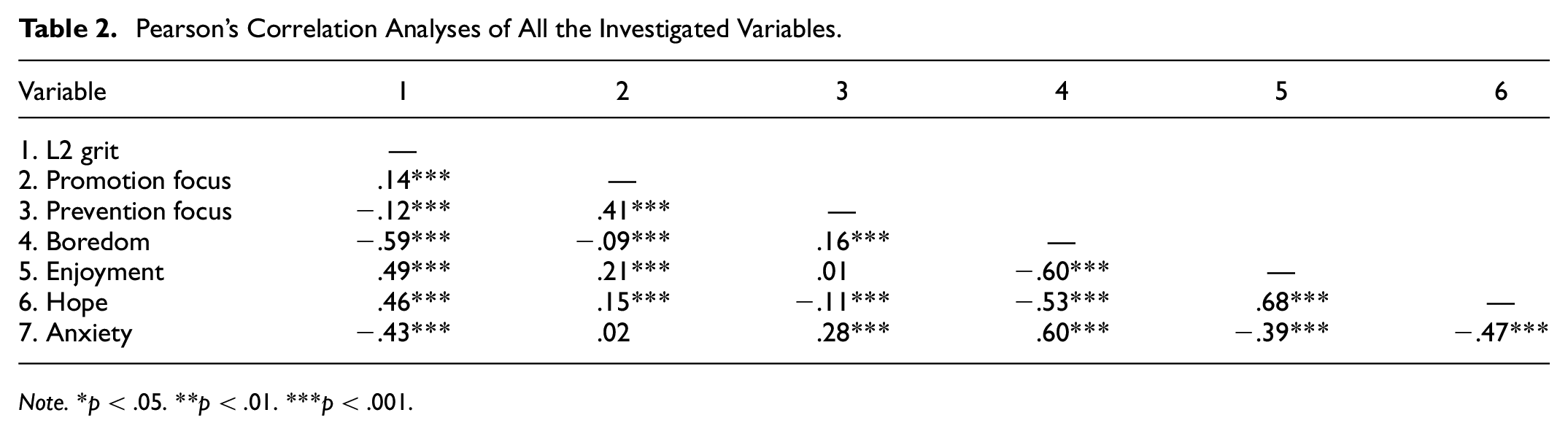
Table 2 presents the results of correlation analyses on the investigated variables. There was a significantly positive but weak relationship between L2 grit and promotion focus (r = 0.14, p < .001, r2 = 0.02), and a significantly negative but weak relationship between L2 grit and prevention focus (r = −0.12, p < .001, r2 = 0.01). The results indicated that students with higher levels of L2 grit were more likely to have a tendency for promotion focus and those with lower levels of L2 grit may have an inclination toward prevention focus.
Pearson’s Correlation Analyses of All the Investigated Variables.
Note.*p < .05. **p < .01. ***p < .001.
For the correlation between achievement emotions and L2 grit, our statistical analyses demonstrated that L2 grit was positively correlated with enjoyment (r = 0.49, p < .001, r2 = 0.24) and hope (r = 0.46, p < .001, r2 = 0.21) with a medium effect size. By contrast, it has significantly negative correlations with boredom (r = −0.59, p < .001, r2 = 0.35) with large effect size and anxiety (r = −0.43, p < .001, r2 = 0.18) with medium effect sizes. These results indicated that grittier students tend to perform more positive achievement emotions (e.g. enjoyment, hope) and less negative emotions (e.g. boredom, anxiety) in the academic context.
There also existed complicated linkages between achievement emotions and regulatory focus. On the one hand, promotion focus was positively linked to enjoyment (r = 0.21, p < .001, r2 = 0.04) as well as hope (r = 0.15, p < .001, r2 = 0.02) with both small effect sizes, yet it was negatively linked to boredom (r = −0.09, p < .01, r2 = 0.01) with a small effect size, and had no significant relationship to anxiety (r = 0.02, p > .05, r2 = 0.00). These findings suggested that students having inclinations toward promotion focus are more likely to perform positive achievement emotions such as hope and enjoyment, but less likely to feel bored. On the other hand, prevention focus was only negatively associated with the positive academic emotion of hope (r = −0.11, p < .01, r2 = 0.01), but no significant relationship was found between prevention focus and enjoyment (r = 0.01, p > .05, r2 = 0.00). Whereas, there appeared positive correlations between prevention focus and negative achievement emotions such as boredom (r = 0.16, p < .001, r2 = 0.03) and anxiety (r = 0.28, p < .001, r2 = 0.08), but the effect sizes were relatively small. These results showed that students with higher levels of prevention focus tended to become bored, anxious, and less hopeful in the language learning process.
The Mediating Effects of Achievement Emotions on the Relationship between Regulatory Focus and L2 Grit
The Mediating Effects of Enjoyment and Boredom on the Relationship Between Promotion Focus and L2 Grit
To examine whether the two types of regulatory focus (i.e. promotion focus, prevention focus) have predictive power for the participants’ L2 grit score, we entered the collected data into regression model and the results showed that both predictor variables as a whole significantly predicted the participants’ L2 grit score, F (2, 979) = 29.63, p < .001, R2 = 0.057 (Table 3). While promotion focus had a positively predictive effect on L2 grit (β = 0.23, p < .001), prevention focus significantly predicted L2 grit in a negative way (β = −0.21, p < .001).
The Results of Regression Analysis on Regulatory Focus and L2 Grit.

To further explore the mechanism and cause of promotion focus in predicting L2 grit, we then introduced two mediating variables (i.e. enjoyment, boredom) between promotion focus and L2 grit and built a mediation model (Figure 2). This model is considered reasonably fit with data: χ2 = 769.121, df = 112, GFI = 0.927 > 0.900 (Bagozzi & Yi, 1988), AGFI = 0.901 > 0.900 (Scott, 1995), CFI = 0.890 ≈ 0.900 (Bagozzi & Yi, 1988), RMSEA = 0.077 < 0.080 (Hair et al., 2017).

The first model of multiple mediation analysis.
Figure 2 shows that promotion focus influenced L2 grit in a complex way. Specifically, promotion focus was found to significantly predict the positive academic emotion of enjoyment (β = .24, p < .001) the negative academic emotion of boredom (β = −.12, p < .01), and L2 grit (β = .24, p < .001). The paths from enjoyment to L2 grit (β = .69, p < .001) and from boredom to L2 grit (β = −.73, p < .001) were both statistically significant.
To test the validity of the mediating role of achievement emotions in the relationship between promotion focus and L2 grit, we utilized the bootstrap method to sample 1000 times and built a bias-corrected 95% confidence interval. As Table 4 shows, the 95% bias-corrected confidence interval of the total indirect effect of two mediators, enjoyment and boredom [0.043, 0.175], which did not include zero, illustrated that enjoyment and boredom significantly mediated the relationship between promotion focus and L2 grit while tested simultaneously. Furthermore, the 95% bias-corrected confidence intervals of the indirect effect of enjoyment and boredom were [0.033, 0.116] and [0.004, 0.072], respectively, and both of them were without being across zero. This indicated that enjoyment and boredom played a significant mediating role in the effect of promotion focus on L2 grit while tested separately. Contrasting the mediating effect of enjoyment with that of boredom, we found that the 95% bias-corrected confidence interval [0.005, 0.07] did not include zero, and it suggested that enjoyment was a stronger mediator in the relationship between promotion focus and L2 grit than boredom.
Measurement of Mediating Effects for Model 1.

Note. BC = bias corrected; CI = confidence interval.
The Mediating Effects of Hope and Anxiety on the Relationship Between Prevention Focus and L2 Grit
The results showed that prevention focus had a statistically significant predictive effect on the L2 Grit (β = −.21, p < .001). To investigate how prevention focus predicted L2 grit levels, this study added enjoyment and boredom as two mediators to the relationship between prevention focus and L2 grit and created a multiple mediation model (Figure 3), which was perfectly fit with the data: χ2 = 543.231, df = 112, GFI = 0.942 > 0.900 (Bagozzi & Yi, 1988), AGFI = 0.921 > 0.900 (Scott, 1995), CFI = 0.919 > 0.900 (Bagozzi & Yi, 1988), RMSEA = 0.063 < 0.080 (Hair et al., 2017).
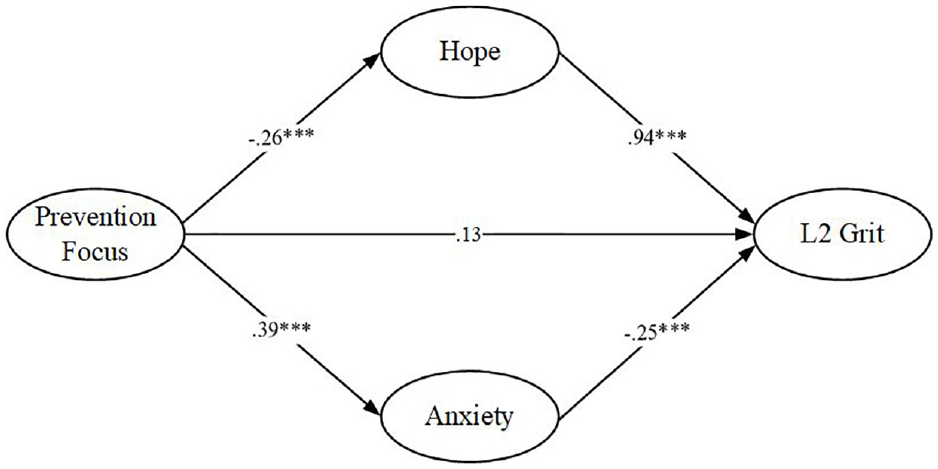
The second model of multiple mediation analysis.
As Figure 3 displays, prevention focus significantly predicted anxiety (β = .39, p < .001) and hope (β = −.26, p < .001), rather than L2 grit (β = .13, p > .05). In addition, there were both statistically significant paths from hope to L2 grit (β = .94, p < .001) and from anxiety to L2 grit (β = −.25, p < .001).
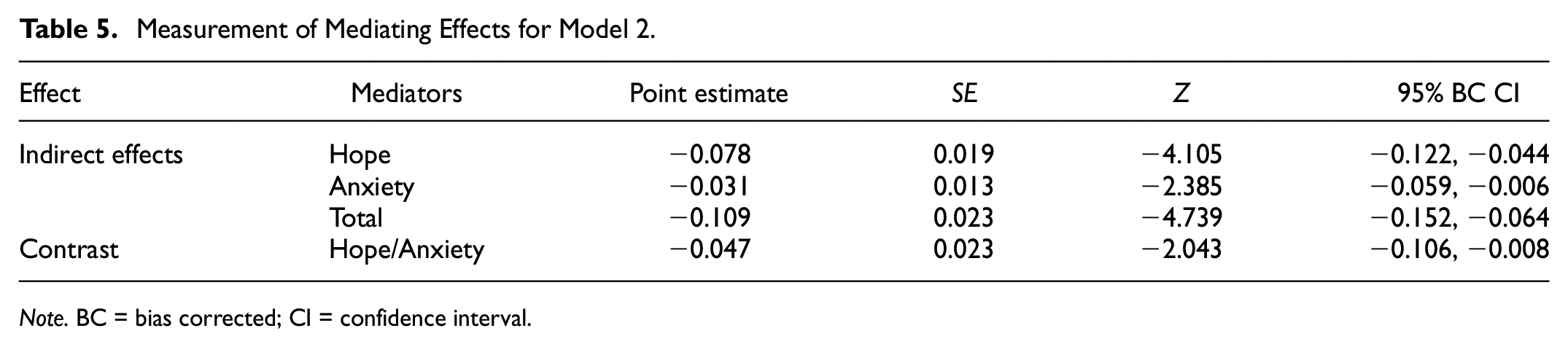
We applied the bootstrap method to sample 1000 times and built a bias-corrected 95% confidence interval to test the mediating effect of achievement emotions between prevention focus and L2 grit. Table 5 indicates the 95% bias-corrected confidence interval of total indirect effect for hope and anxiety as mediators [−0.152, −0.064], which did not include zero. This illustrated that hope and anxiety significantly mediated the relationship between prevention focus and L2 grit while tested simultaneously. Moreover, the 95% bias-corrected confidence intervals of the indirect effect of hope and anxiety were [−0.122, −0.044] and [−0.059, −0.006], respectively, and both of them did not include zero. This showed that enjoyment and boredom significantly mediated the effect of prevention focus on L2 grit while tested separately. After comparing the mediating effect of hope with that of anxiety, we found that the 95% confidence interval [−0.106, −0.008] did not include zero, which suggested that hope was a stronger mediator in the relationship between prevention focus and L2 grit than anxiety.
Measurement of Mediating Effects for Model 2.
Note. BC = bias corrected; CI = confidence interval.
Discussion
The Relationships Between Regulatory Focus, Achievement Emotions, and L2 Grit
The present study examined how the regulator focus dichotomy (i.e. promotion focus, prevention focus) relates to Chinese university EFL learners’ L2 grit through the mediation of their self-reported achievement emotions. In response to the RQ 1 and RQ2 of our study, we found empirical evidence to support the significant linkages existing between some investigated variables and confirm the predictive effects of promotion focus and prevention focus on our participants’ L2 grit level.
First, with respect to the link of regulatory focus with L2 grit, promotion focus was positively correlated with L2 grit, while prevention focus was negatively correlated with L2 grit. These findings are consistent with those of some previous studies indicating that regulatory focus, as a motivational variable, was significantly associated with general grit (e.g. Higgins, 2008; Lake, 2013; Rusu et al., 2013). Moreover, promotion focus positively and prevention focus negatively exert a predictive effect on students’ L2 grit. The present study further suggests that students with predominant focus on the presence and absence of positive outcomes show more consistent interest in the L2 and willingness to learn it persistently. In contrast, students with prevention concerns, who tend to avoid the undesired learning outcomes, exhibit relatively low level of L2 grit. However, it is worth mentioning that the effect sizes of both correlations are found to be small, indicating that the relationship between regulatory focus and L2 grit might be mediated or moderated by some other learner variables. Second, L2 grit was found to have moderately positive associations with positive achievement emotions such as enjoyment and hope, but moderately negative correlations with negative achievement emotions such as boredom and anxiety, which to some extent corroborates the findings of prior studies about the relationship between achievement emotions and L2 grit (Lee, 2020; E. Liu & Wang, 2021; Pawlak et al., 2022; H. Wei et al., 2019). To put it another way, individuals who experience more positive and fewer negative achievement emotions in the language learning process are more likely to persevere in achieving their goals of learning, which confirms the influence and significance of positive emotions for L2 learning (MacIntyre et al., 2019).
Furthermore, the promotion and prevention regulatory foci were also found to be significantly related to a portion of achievement emotions. Specifically, the significant positive correlation between promotion focus and enjoyment as well as the significant negative correlation between promotion focus and boredom dovetailed with the regulatory focus theory, indicating that students with a higher level of promotion focus experience more positive activating emotion whereas a lower level of promotion focus means more negative deactivating emotion. On the other hand, prevention focus was found to be significantly associated with anxiety in a positive way. These results seem to be inconsistent with the regulatory focus theory, which suggests that a lower level of prevention focus indicates more negative activating emotion (Scholer et al., 2019), while the negative link between prevention focus and hope was not concerned in this theory. Such discrepancy and inconsistency existing between the current study and the previous ones may be attributable to the different research participants and contexts. First, compared with other relevant studies, the participants in this study are mainly constituted by university students. Consequently, the obtained findings are only pertinent to the relationship between achievement emotion and regulatory focus within this group of L2 learners. Second, since the types of emotions that our study focused on are mainly academic ones, it is understandable that there would be discrepancy in our findings when the theory was applied to the specific field of L2 learning. These point to the necessity of adapting the regulatory focus theory in future studies to align with the actual participants and contexts. In addition, because emotions are generally believed to play a vital role in language learning (MacIntyre et al., 2019), it is equally important to cultivate students’ motivating behaviors towards the promotion focus, given its links with the positive emotions that are proxies for successful L2 learning.
The Mediation of Achievement Emotions in the Relationship Between Regulatory Focus and L2 Grit
According to the results related to RQ3, achievement emotions had a mediating effect on regulatory focus and L2 grit, but the scenarios seemed to be divergent between the two types of regulatory focus. Hence, it is necessary to discuss both scenarios separately based on the results from two multiple mediation models.
It can be seen from model 1 that after introducing enjoyment and boredom into the model, the predictive effect of promotion focus on L2 grit is still significant. This indicates that promotion focus can not only predict L2 grit directly, but also affect the level of L2 grit indirectly through the mediating role of achievement emotions, that is, enjoyment and boredom have partial mediating effects on their relationships. In this scenario, the inconsistent findings with the previous studies that reported the predictive effect of regulatory focus on grit (e.g. Higgins, 2008; Rusu et al., 2013) can be explained by the indirect mediation effect of achievement emotions. Furthermore, the mediation mechanism that promotion focus boosts students’ L2 grit via enjoyment and reduces their L2 grit via boredom, also gives plausible explanation to such inconsistency. In other words, the claim that there exists a positive relationship between promotion focus and L2 grit should be made with caution due to the fact that the indirect effects of positive and negative achievement emotions need also be taken into consideration. In light of the regulatory focus theory (Scholer et al., 2019) and the broaden-and-built theory (Fredrickson, 2001), individuals with promotion focus pay more attention to the emergence of positive outcomes and the achievement of ideal goals, and positive emotions contribute to the building of individual resources in the long term but negative emotions play a counterproductive role. When they approach or obtain positive results, they are more likely to arouse positive emotions such as enjoyment, which will contribute to their consistence of interest and persistence of effort in second language learning (H. Wei et al., 2019; E. Liu & Wang, 2021; Shirvan et al., 2021). On the contrary, the inaccessibility or disappearance of positive results might cause negative emotions such as boredom to individuals, which will hinder the building of long-term resources and decrease their grit level in L2 learning (E. Liu & Wang, 2021). Furthermore, when comparing the indirect effect of enjoyment and boredom in the model, we found that the former was significantly stronger than the latter. This suggests that the positive predictive effect of promotion focus on L2 grit is induced by the discrepant effects of two achievement emotions (i.e. the positive effect of enjoyment is stronger than the negative effect of boredom), attesting to the hypothesis proposed by Tang et al. (2016) in L2 context, that is, the mutual offset of emotions’ mediations contributes to the positive predictive effect of promotion focus on L2 grit. Therefore, when fostering grit among the students with promoting focus in L2 learning, it is imperative to create a positive L2 environment and promote the generation of enjoyment to offset the adverse impact caused by the negative emotions such as boredom.
From Model 2, it can be seen that after the introduction of hope and anxiety, the predictive effect of prevention focus on L2 grit is no longer significant. This suggests that the effect of prevention focus on L2 grit is mediated by achievement emotions and that prevention focus exerts no direct effect on L2 grit, that is, hope and anxiety have a full mediating effect on their relationship. These findings are consistent with the those reported by Rusu et al. (2013) in their research but are different from the findings that regulatory focus promotes grit directly (Higgins, 2008). In other words, university students with inclinations toward prevention focus may pay more attention to the avoidance of negative outcomes in L2 learning. Therefore, when negative results occur, they would experience negative achievement emotions like anxiety due to the shame caused by the failure avoidance, which leads to lower levels of L2 grit (E. Liu & Wang, 2021); on the other hand, if negative results are successfully avoided by them, positive emotions like hope will be evoked and have a positive effect on their L2 grit (E. Liu & Wang, 2021; Shirvan et al., 2021; H. Wei et al., 2019). The different mediating mechanisms of hope and anxiety found in this study are also aligned with Fredrickson’ (2001) theory, which posits that positive emotions will build individual resources and promote personal development, while negative emotions hinder the construction of resources, and thus inhibit individual development. In addition, from the comparison of the indirect effects of the two achievement emotions, we found that hope, as a mediating variable, have a stronger indirect effect as compared to anxiety. In light of this, we believe that it is more efficient to construct a hopeful second language learning atmosphere than to suppress the generation of anxiety when cultivating the grit of L2 learners with prevention focus.
Conclusion
In this study, we have examined the interrelationships among regulatory focus, achievement emotions, and L2 grit, and the mediating effects of achievement emotions on the relationship between regulatory focus and L2 grit. Drawing on correlational analysis, regression analysis and multiple mediation analysis on our collected data, we have obtained the following research findings. First, most dimensions of examined constructs, that is, regulatory focus, achievement emotions, and L2 grit, are significantly correlated with each other, except for the relationship between promotion focus and anxiety and the one between prevention focus and enjoyment. Second, promotion focus and prevention focus exert significant but opposite predicting effects on students’ L2 grit. Third, in terms of mediation analyses, the study has evidenced that enjoyment and boredom have a partial mediating effect on the relationship between promotion focus and L2 grit while hope and anxiety have a full mediating effect on the relationship between prevention focus and L2 grit. Additionally, the positive achievement emotions of enjoyment and hope are found to exert more powerful mediating effects on the relationships than the negative emotions of boredom and anxiety.
The findings of the current study may have both theoretical and practical implications for the research on language learner psychology and language teaching practice. Theoretically, they may add further empirical evidence to the L2 motivational self-system (L2MSS), the specific application of regulatory focus theory in the SLA context, and generate deeper insights into the mechanism underlying the influence of motivation and emotion on L2 grit. In practical sense, our findings suggest that teachers ought to encourage and help their students to become learners with promotion-focus, characterized by the desire for positive outcomes, growth mindset, and orientation towards ideal selves. Influenced by these motivational behaviors, students will keep consistent interest in learning the L2 and make persistent efforts to acquire it once they set a goal to achieve their ideal selves through continuous progress. The situations of students’ achievement emotions should also be considered in L2 teaching and teachers need to be aware of students’ emotional states and changes in class so that their emotions can be dealt with appropriately. Our findings have also shown the indirect but predominant influence of students’ achievement emotions on L2 grit. As such, it is necessary for L2 instructors to promote positive achievement emotions and minimize negative achievement emotions during their instructions. For instance, teachers can set a positive example for learners to foster positive emotions among them (E. Liu & Wang, 2021), or teach mindfulness meditation techniques to students with extreme emotions such as anxiety to mitigate their negative emotions (Morgan & Katz, 2021). Given that the indirect effect of positive achievement emotion is greater than that of negative achievement emotion, it is more effective to promote the generation of learners’ enjoyment and hope than to lessen their boredom and anxiety in the process of cultivating learners’ L2 grit.
The aforementioned theoretical and practical significance notwithstanding, our findings need to be interpreted cautiously considering the following three limitations. To begin, the study was conducted with only undergraduate students in tertiary educational context and thus the findings may not be extrapolated to other learner populations. Second, the study adopted a one-shot survey design to investigate the relationships between regulatory focus, achievement emotions, and L2 grit, which is liable to ignore the dynamic and malleable features of psychological and emotional constructs. Third, this study may be limited in providing a nuanced and in-depth analysis of the relationships between target variables due to the constraints caused by the lack of qualitative data. To redress above limitations, future research can involve a wider range of participants, including primary, middle, or high school students and graduate students as well, in order to improve the external validity of research. In addition, further studies may adopt longitudinal research design and utilize some state-of-the-art methods such as Q-method, cross-lagged panel analysis or latent profile analysis, and so on, to unravel the complex and dynamic relationships among given variables (Derakhshan et al., 2023). Last but not least, researchers of similar interest may incorporate interview as a data collection method into their future research along this line of inquiry.
Footnotes
Appendix
The English Academic Emotions Scale.Please rate how much you agree or disagree with the following statements based on your previous experience.

| Question items | Not at all true of me | Slightly not true of me | Neutral | Slightly true of me | Very true of me |
|---|---|---|---|---|---|
| 1我觉得学习英语枯燥无味
(I find learning English boring) |
1 | 2 | 3 | 4 | 5 |
| 2学习英语时,我感觉很棒
(When I learn English, I feel great) |
1 | 2 | 3 | 4 | 5 |
| 3我坚信英语考试会一切顺利
(I am confident that everything will go well in the English test) |
1 | 2 | 3 | 4 | 5 |
| 4当被迫学习英语时,我变得焦虑
(When I am pushed to learn English, I become anxious) |
1 | 2 | 3 | 4 | 5 |
| 5我常对学习英语有一种倦怠感
(I often feel burned out when learning English) |
1 | 2 | 3 | 4 | 5 |
| 6做英语题时,我感到愉悦
(I feel enjoyable when I do English exercises) |
1 | 2 | 3 | 4 | 5 |
| 7做英语题时,我非常自信
(I feel very confident when doing English exercises) |
1 | 2 | 3 | 4 | 5 |
| 8英语考试时,我紧张的喘不过气
(When taking the English test, I am nervous and out of breath) |
1 | 2 | 3 | 4 | 5 |
| 9我讨厌学习英语
(I hate learning English) |
1 | 2 | 3 | 4 | 5 |
| 10做完英语题时,我感到开心
(I feel joyful when I finish English exercises) |
1 | 2 | 3 | 4 | 5 |
| 11想到英语考试时,我感到愉快
(I feel happy when I think about the English test) |
1 | 2 | 3 | 4 | 5 |
| 12做英语题时,我感到不安
(I feel uneasy when I do English exercises) |
1 | 2 | 3 | 4 | 5 |
Declaration of Conflicting Interests
The author(s) declared no potential conflicts of interest with respect to the research, authorship, and/or publication of this article.
Funding
The author(s) disclosed receipt of the following financial support for the research, authorship, and/or publication of this article: This work is funded by a teaching reform grant from the Graduate School of Hubei University (JGYJS202321), a research grant of Philosophy and Social Science from Hubei Province (22Y002), a teaching reform grant from the Graduate School of Jilin University (2022GJY060) and a research grant of Philosophy and Social Science from Jilin Province (SKZ2023091).

Data Availability Statement
The research data used in this study are available from the corresponding author upon request.